Downey’s offbeat reports of the 1994 FIFA World Cup for The Irish News are subsequently compiled for his first book, Just One Big Party. He spends six years as a BBC news producer in Derry and Belfast, before joining the Derry News as editor in 2001. During his period as editor (2001–2004), the Derry News wins two Newspaper Society awards for Fastest Circulation Growth in the United Kingdom.
Since 2004, Downey has published six comic novels set in the criminal underbelly of post-ceasefire Ireland. His books have been described as “a superb blend of comedy, political dirty tricks, grisly murder and bizarre twists.”
A former deputy-president of the Union of Students in Ireland, Downey is one of the organisers of a student occupation of government offices in Dublin on Budget Day 1988 in protest against education cutbacks.
In 2006, Downey helps establish the new Northern Ireland literary review Verbal and edits the publication for its first six issues.
A lifelong political anorak, in 2007, Downey works as an election pundit for TV3 (Ireland), alongside the Irish comedian Brendan O’Carroll. In 2010, he wins a contest to predict the winners of Northern Ireland’s 18 Westminster constituencies, missing out on just one, Naomi Long, who surprisingly beat First MinisterPeter Robinson in Belfast East. He donates his prize, a framed Ian Knox cartoon, to Long by way of apology.
Downey’s 2010 comedy-thriller The American Envoy is the first novel issued by an Irish publishing house as a Kindlee-book, simultaneously with its paperback release.
In June 2011, Downey is appointed Director of Media for Culture Company 2013, the body tasked with delivering Derry’s UK City of Culture year.
Downey is married to Una McNally, and they have two children.
Hutchinson’s father, Harry Hutchinson, a Scottish printer whose own father had left Dublin to find work in Scotland, is Sinn Féin treasurer in Glasgow and is interned in Frongoch internment camp in 1919–21. His mother, Cathleen Sara, is born in Cowcaddens, Glasgow, of emigrant parents from County Donegal. She is a friend of Constance Markievicz. In response to a letter from Cathleen, Éamon de Valera finds work in Dublin for Harry as a clerk in the Labour Exchange, and later he holds a post in Stationery Office.
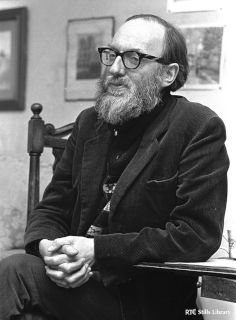
Hutchinson is five years old when the family moves to Dublin and is the last to be enrolled in St. Enda’s School before it closes. He then goes to school at Synge Street CBS where he learns Irish and Latin. One of his close friends there is the poet and literary critic John Jordan. In 1948 he attends University College Dublin (UCD) where he spends a year and a half, learning Spanish and Italian.
Having published some poems in The Bell in 1945, Hutchinson’s poetic development is greatly influenced by a 1950 holiday in Spain and Portugal. A short stop en route at Vigo brings him into contact for the first time with the culture of Galicia. Later, in Andalusia, he is entranced by the landscape and by the works of the Spanish poets Federico García Lorca, Emilio Prados and Luis Cernuda.
In 1951 Hutchinson leaves Ireland again, determined to live in Spain. Unable to get work in Madrid, as he had hoped, he travels instead to Geneva, where he gets a job as a translator with the International Labour Organization, which brings him into contact with Catalan exiles, speaking a language then largely suppressed in Spain. An invitation by a Dutch friend leads to a visit to the Netherlands, in preparation for which he teaches himself the Dutch language.
Hutchinson returns to Ireland in 1953 and becomes interested in the Irish language poetry of writers such as Piaras Feiritéar and Aonghus Fionn Ó Dálaigh and publishes a number of poems in Irish in the magazine Comhar in 1954. The same year he travels again to Spain, this time to Barcelona, where he learns the Catalan and Galician languages, and gets to know Catalan poets such as Salvador Espriu and Carles Riba. With the British poet P. J. Kavanagh, he organises a reading of Catalan poetry in the British Institute.
Hutchinson goes home to Ireland in 1957 but returns to Barcelona in 1961 and continues to support Catalan poets. An invitation by the publisher Joan Gili to translate some poems by Josep Carner leads to the publication of his first book, a collection of thirty of Carner’s poems in Catalan and English, in 1962. A project to publish his translation of Espriu’s La Pell de brau (The Bull-skin), falls through some years later. Some of the poems from this project are included in the collection Done into English.
In 1963, Hutchinson’s first collection of original poems in English, Tongue Without Hands, is published by Dolmen Press in Ireland. In 1967, having spent nearly ten years altogether in Spain, he returns to Ireland, making a living as a poet and journalist writing in both Irish and English. In 1968, a collection of poems in Irish, Faoistin Bhacach (A Lame Confession), is published. Expansions, a collection in English, follows in 1969. Friend Songs (1970) is a new collection of translations, this time of medieval poems originally written in Galician-Portuguese. In 1972 Watching the Morning Grow, a new collection of original poems in English, comes out, followed in 1975 by another, The Frost Is All Over.
In October 1971, Hutchinson takes up the Gregory Fellowship in Poetry at the University of Leeds, on the recommendation of Professor A. Norman Jeffares. There is some controversy around the appointment following accusations, later retracted, that Jeffares had been guilty of bias in the selection because of their joint Irish heritage. He holds tenure at the University for three years, and during that time contributes to the University’s influential poetry magazine Poetry & Audience.
From 1977 to 1978 Hutchinsonn compiles and presents Oró Domhnaigh, a weekly radio programme of Irish poetry, music and folklore for Ireland’s national network, RTÉ. He also contributes a weekly column on the Irish language to the station’s magazine RTÉ Guide for over ten years. A collaboration with Melita Cataldi of Old Irish lyrics into Italian is published in 1981. Another collection in English, Climbing the Light (1985), which also includes translations from Irish, Italian and Galician, is followed in 1989 by his last Irish collection, Le Cead na Gréine (By Leave of the Sun). The Soul that Kissed the Body (1990) is a selection of his Irish poems translated into English. His most recent English collection is Barnsley Main Seam (1995). His Collected Poems is published in 2002 to mark his 75th birthday. This is followed in 2003 by Done into English, a selection of many of the translated works he produced over the years.
A co-editor and founder of the literary journal Cyphers, Hutchinson receives the Butler Award for Irish writing in 1969. He is a member of Aosdána, the state-supported association of artists, from which he receives a cnuas (stipend) to allow him to continue writing. He describes this as “a miracle and a godsend” as he is fifty-four when invited to become a member and is at the end of his tether. A two-day symposium of events is held at Trinity College Dublin, to celebrate his 80th birthday in 2007, with readings from his works by writers including Macdara Woods, Eiléan Ní Chuilleanáin, Paul Durcan and Sujata Bhatt. His most recent collection, At Least for a While (2008), is shortlisted for the Poetry Now Award.
Hutchinson lives in Rathgar, Dublin, and dies of pneumonia in Dublin on January 14, 2012.
Gallagher is commissioned to write essays for The Irish Times, the Irish Medical Times and various journals. She takes up writing screenplays and stage plays. The result is a prolific list of productions which have been staged around the world as well as broadcast by RTÉ and the BBC.
Gallagher varies work from plays to speech therapy, as well as working with prisoners, and this leads her to be a visiting lecturer at universities across the globe. She is deeply involved in the organisations of her craft, leading her to being a member of Irish PEN, both on its committee and as vice president, on the Irish Writers’ Union committee as well as a council member of the Society of Irish Playwrights. Over the years she wins a number of awards including the Arts Council and European Script Fund Awards, the MHA TV Script Award, and the EU Theatre Award.
Gallagher’s husband is Gerhardt Gallagher. They live in Dublin and have three children, Mia, Donnacha, and Etain. In 2012 she is diagnosed with cancer and kidney disease. She dies on January 15, 2018.
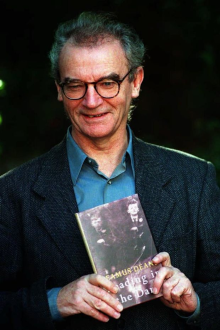
Deane is the fourth child of Frank Deane and Winifred (Doherty) and is brought up as part of a Catholicnationalist family. He attends St. Columb’s College in his hometown, where he befriends fellow student Seamus Heaney. He then attends Queen’s University Belfast (BA and MA) and Pembroke College, Cambridge (PhD). Although he too becomes noted for his poetry, he chooses to go into academia instead. He workws as a teacher in Derry, with Martin McGuinness being one of his students. McGuinness later recalls how Deane was “gentle, kind and never raised his voice at all, an ideal teacher who was very highly thought of.”
Deane is the co-editor of Field Day Review, an annual journal of Irish studies. He also serves as general editor of the Penguin Classic James Joyce series and of Critical Conditions, a series in Irish Studies which is jointly published by the University of Notre Dame Press and Cork University Press. He co-founds the book series Field Day Files, which contains key works by David Lloyd, Joe Cleary, Marjorie Howes, and Kerby A. Miller.
The first collection of Deane’s poetry, Gradual Wars, is published in 1972 and receives the AE Memorial Award for Literature. His first novel, Reading in the Dark, is published in 1996 and is partly autobiographical. It wins the 1996 Guardian Fiction Prize and the 1996 South Bank Show Award for Literature, is a New York Times Notable Book, wins The Irish Times International Fiction Prize and the Irish Literature Prize in 1997, besides being shortlisted for the Booker Prize in 1996. The novel is translated into more than twenty languages. He is also the general editor of the monumental Field Day Anthology of Irish Writing, which is 4,000 pages long and whose first volumes are released in 1990. It is later criticised for excluding the voices and experiences of Irish women. He responds to this by stating, “To my astonishment and dismay, I have found that I myself have been subject to the same kind of critique to which I have subjected colonialism … I find that I exemplify some of the faults and erasures which I analyse and characterize in the earlier period.”
Deane’s first marriage is to Marion Treacy. Together, they have four children. He is in a civil partnership with Emer Nolan until his death. They have one child together.
Following a short illness, Deane dies at the age of 81 on May 12, 2021 at Beaumont Hospital in Dublin.
Murdoch is born on July 15, 1919, in Phibsborough, Dublin, the daughter of Irene Alice (née Richardson) and Wills John Hughes Murdoch. Her father, a civil servant, comes from a mainly Presbyterian sheep farming family from Hillhall, County Down. In 1915, he enlists as a soldier in King Edward’s Horse and serves in France during World War I before being commissioned as a second lieutenant. Her mother trains as a singer before Iris is born and is from a middle-class Church of Ireland family in Dublin. Her parents first meet in Dublin when her father is on leave and are married in 1918. Iris is the couple’s only child. When she is a few weeks old the family moves to London, where her father had joined the Ministry of Health as a second-class clerk. She is a second cousin of the Irish mathematician Brian Murdoch.
From 1947 to 1948 Murdoch studies philosophy as a postgraduate at Newnham College, Cambridge. She meets Ludwig Wittgenstein at Cambridge but does not hear him lecture, as he had left his Trinity College professorship before she arrives. In 1948 she becomes a fellow of St. Anne’s College, Oxford, where she teaches philosophy until 1963. From 1963 to 1967 she teaches one day a week in the General Studies department at the Royal College of Art.
In 1956 Murdoch marries John Bayley, a literary critic, novelist, and from 1974 to 1992 Warton Professor of English at Oxford University, whom she had met in Oxford in 1954. The unusual romantic partnership lasts more than forty years until Murdoch’s death. Bayley thinks that sex is “inescapably ridiculous.” She in contrast has “multiple affairs with both men and women which, on discomposing occasions, Bayley witnesses for himself.”
Murdoch’s first novel, Under the Net, is published in 1954 and is selected in 1998 as one of Modern Library’s 100 best English-language novels of the 20th century. She had previously published essays on philosophy, and the first monograph about Jean-Paul Sartre published in English. She goes on to produce 25 more novels and additional works of philosophy, as well as poetry and drama.
Murdoch’s last novel, Jackson’s Dilemma, is published in 1995. She is diagnosed with Alzheimer’s disease in 1997 and dies on February 8, 1999, in Oxford. There is a bench dedicated to her in the grounds of Lady Margaret Hall, Oxford, where she enjoyed walking.
Weldon is born on September 6, 1890, in Hiskinstown, Delvin, County Westmeath, the eldest son of James Weldon, a schoolteacher, originally of Ballinea, Mullingar, and Fanny Weldon (née Duncan). He attends his father’s school at Delvin until he is eighteen, and the relationship between father and son is to remain rather formal and strict.
Stimulated by the visiting fit-up theatrical companies and of news from Dublin of the Abbey Theatre, in September 1908 he takes the lead in a local staging of a political melodrama, Robert Emmet by Henry C. Mangan. The following summer he leaves for Dublin, ostensibly to become a civil servant but in fact to audition as an actor at the Abbey Theatre. His acting career with the Abbey Theatre begins in September 1910 with a role in R. J. Ryan’s The Casting-out of Martin Whelan.
MacNamara is the author of several novels, the most well-known of which is his first, The Valley of the Squinting Windows (1918), its title a byword for small-town hypocrisy and begrudgery. The work itself is an uneasy fusion of a satiric portrait of gossipy, prying women and dipsomaniacally drinking men with a naturalist tragedy in which the sins of the past repeat themselves in the lives of the younger characters. The novel’s frank treatment of sexual matters is eclipsed as a cause of offence by the unflattering portrayal of almost all the inhabitants of the fictional village called Garradrimna, a place that local people feel would be automatically identified as Delvin. In the ensuing controversy the novelist’s father, James Weldon (widely suspected of being the author), and his school are subject to boycott. His attempts to seek legal redress in 1923 are unsuccessful.
MacNamara continues to write for many years after this controversial first work, and locates most of his later fiction in Garradrimna, in the Irish Midlands. Among his plays are The Glorious Uncertainty (1923) and Look at the Heffernans! (1926). His work is part of the literature event in the art competition at the 1924 Summer Olympics in Paris.
In 1925 McNamara is appointed registrar to the National Gallery of Ireland in Dublin, a position he holds until his retirement in 1960. In 1932 he becomes one of the first members of the Irish Academy of Letters, and in 1935 joins the board of directors of the Abbey Theatre.
MacNamara marries Helena Degidon, a schoolteacher, in 1920. His later years are dogged by increasing ill health and he dies at Sir Patrick Dun’s Hospital, Dublin, on February 4, 1963.
Lynch is born in Dublin on March 25, 1859. Her father, who is a committed, non-violent Fenian, dies when she is young. Her mother, Anna Theresa Calderwood, is married twice. She grows up in a very female house with her mother and ten sisters and half-sisters. Her stepfather is James Cantwell, also a Fenian, who runs the Star and Garter Hotel. After finishing school, she works as a sub-editor for a provincial paper and as a governess in Europe.
A nationalist like her father and stepfather, Lynch is an executive member of the Ladies’ Land League and as a result closely associates with Fanny Parnell. She writes extensively, producing short stories and satirical sketches, as well as Land War fiction, travel writing, translations and literary criticism. Her satirical pieces include “A Dublin Literary Coterie Sketched by a Non-Pretentious Observer” (1888) and “My Friend Arcanieva” (1895). She publishes William O’Brien‘s paper United Ireland from France, after it is suppressed in Ireland. She disagrees with William Butler Yeats on the literary merit of Emily Lawless, calling her work “highly polished literary stories.”
Lynch also writes fiction on the subject of political and cultural affairs in Ireland, sometimes meeting controversy. Her first novel, Through Troubled Waters (1885), is a fictionalised version of a real-life incident in Galway in which the daughters of a prosperous landowning family are murdered to make way for the sons to inherit the land. The novel also depicts the rural clergy as complicit, by denouncing the victims from the pulpit. The newspaper United Ireland strongly criticises the novel, claiming it peddles in anti-Irish stereotypes for a British audience. She responds by stating that she had intended the book for an Irish publisher and audience, and that she should not be asked “to prove my patriotism at the expense of truth.”
Lynch publishes across Ireland, the United Kingdom and from Paris. By 1896, she has settled in Paris, having also lived in both Spain and Greece. She speaks Greek and French. She then returns to lecture in Ireland and is a part of the salons of Paris in the Belle Époque as well as the Irish Literary Revival in Dublin. She is friends with the historian, biographer and literary critic Arvède Barine (pseudonym of Louise-Cécile Vincens), the writers Mabel and Mary Robinson, and the medievalist Gaston Paris. Her work however does not bring significant income, and she is forced to apply to the Royal Literary Fund for help on multiple occasions. Eventually it takes a toll on her health. She spends time in hospital in Margate, England in 1903.
Higgins is born on April 24, 1896, on the west coast of Ireland in Foxford, County Mayo. He is the eldest son of Joseph, a policeman stationed in Foxford at the time of his son’s birth, and Annie Higgins. His poem “Father and Son” is a loving tribute to his father. He grows up in Ballivor, County Meath, where his family has farmed for several generations. He spends the largest part of his adult life in Dublin, in a house he has built beside the River Dodder in Rathfarnham. His health is poor, and though his friends are inclined to regard him as a hypochondriac, his frequent predictions that he would die young prove to be accurate.
Higgins marries Beatrice May Moore in 1921. The marriage is a happy one. Even Frank O’Connor, who dislikes him, praises him as a kind and considerate husband. He is however reputed to have had a number of affairs, notably with the actress Ria Mooney.
Higgins is a student of William Butler Yeats and serves on the board of the Abbey Theatre from 1935 until his death. His best-known book of poetry is The Gap of Brightness (1940). He is also well known for his poem “Father and Son.” He writes a moving elegy for his fellow poet Pádraic Ó Conaire. He is generally acknowledged to be a fine poet but is less successful in his Abbey Theatre work. Frank O’Connor says unkindly that Higgins could not direct a children’s poetry recitation.
In 1937 Higgins is tour manager of the Abbey Theatre production of Teresa Deevy‘s Katie Roche, which tours to the Ambassador Theatre in New York City. There are five performances from October 2-6. His Abbey career can be seen in the Abbey Theatre archives.
Higgins is a popular and convivial man. Even O’Connor, who comes to regard him with deep suspicion, admits that he is a delightful person to know. His circle of friends includes many of the leading Irish literary figures of his time, including Yeats, Padraic O Conaire, George William Russell, Lennox Robinson, and for a time O’Connor. O’Connor, however, comes to regard him as untrustworthy and a troublemaker, and describes him unflatteringly in his memoir My Father’s Son. For Yeats, Higgins seems to feel a genuine affection, once remarking that he never left Yeats’ house without “feeling like a thousand dollars.” He is also capable of great kindness and generosity to younger writers like Patrick Kavanagh.
(Pictured: “F. R. Higgins,” Oil on Canvas by Sean O’Sullivan, courtesy of the Abbey Theatre, Dublin)
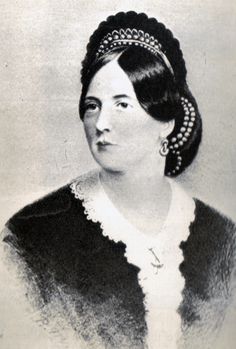
Jane is the last of the four children of Charles Elgee, the son of Archdeacon John Elgee, a Wexford solicitor, and his wife Sarah (née Kingsbury). Her great-grandfather is an Italian who had come to Wexford in the 18th century. She has a special interest in Irish folktales, which she helps to gather. She marries Sir William Wilde on November 12, 1851, and they have three children, William Charles Kingsbury Wilde (1852–1899), Oscar Fingal O’Flahertie Wills Wilde (1854–1900), and Isola Francesca Emily Wilde (1857–1867).
Wilde, who is the niece of Charles Maturin, writes for the Young Ireland movement of the 1840s, publishing poems in The Nation under the pseudonym of “Speranza.” Her works include pro-Irish independence and anti-British writing. She is sometimes known as “Speranza of the Nation.” Charles Gavan Duffy is the editor when “Speranza” writes commentary calling for armed revolution in Ireland. The authorities at Dublin Castle shut down the paper and bring the editor to court. Duffy refuses to name who has written the offending article. “Speranza” reputedly stands up in court and claims responsibility for the article. The confession is ignored by the authorities. But in any event the newspaper is permanently shut down by the authorities.
Wilde is an early advocate of women’s rights, and campaigns for better education for women. She invites the suffragistMillicent Fawcett to her home to speak on female liberty. She praises the passing of the Married Women’s Property Act 1882, preventing women from having to enter marriage “as a bond slave, disenfranchised of all rights over her fortune.”
William Wilde is knighted in January 1864, but the family celebrations are short-lived, for in the same year Sir William and Lady Wilde are at the centre of a sensational Dublin court case regarding a young woman called Mary Travers, the daughter of a colleague of Sir William’s, who claims that he had seduced her and who then brings an action against Lady Wilde for libel. Mary Travers wins the case and costs of £2,000 are awarded against Lady Wilde. Then, in 1867, their daughter Isola dies of fever at the age of nine. In 1871 the two illegitimate daughters of Sir William are burned to death and in 1876 Sir William himself dies. The family discovers that he is virtually bankrupt.
Lady Wilde leaves Dublin for London in 1879, where she joins her two sons, Willie, a journalist, and Oscar, who is making a name for himself in literary circles. She lives with her older son in poverty, supplementing their meagre income by writing for fashionable magazines and producing books based on the researches of her late husband into Irish folklore.
Lady Wilde contracts bronchitis in January 1896 and, dying, asks for permission to see Oscar, who is in prison. Her request is refused. It is claimed that her “fetch” appears in Oscar’s prison cell as she dies at her home, 146 Oakley Street, Chelsea, on February 3, 1896. Willie Wilde, her older son, is penniless, so Oscar pays for her funeral, which is held on February 5, at Kensal Green Cemetery in London. A headstone proves too expensive and she is buried anonymously in common ground. A monument to her, in the form of a Celtic cross, is erected at Kensal Green Cemetery by the Oscar Wilde Society in 1999.
Cahir Healy, Irish nationalist politician, is born in Mountcharles, County Donegal, on December 2, 1877. He is a leader of northern Nationalists and is a self educated man who makes major contributions to Ireland’s cultural and literary heritage.
Healy is re-elected in 1923, but remains in custody until the following year, in which he does not defend his seat. Instead, he is elected to represent the seat in the House of Commons of Northern Ireland in the 1925 Northern Ireland general election, but does not take his seat until 1927 due to the Nationalist abstentionist policy. In 1928 he becomes a founder of the National League of the North. In 1929, with the break-up of the large Fermanagh and Tyrone constituency, he switches to sit for the new seat of South Fermanagh. In a 1931 Fermanagh and Tyrone by-election he is again elected for Fermanagh and Tyrone to the British Parliament, but stands down again in 1935.
Healy becomes an insurance official but continues to write, his output including journalism, poetry and short stories. He is interned by the United Kingdom government for a year during World War II under Defence Regulation 18B. In 1950 he is elected to the British House of Commons for a third time, on this occasion representing Fermanagh and South Tyrone. He finally sits in the British Parliament in 1952, and holds the seat until he stands down in 1955. He leaves the Northern Ireland House of Commons in 1965, by which point he is the Father of the House.
Healy dies on February 8, 1970, at the age of 92 at Enniskillen, County Fermanagh.
(Pictured: Portrait of Cahir Healy by Lafayette, half-plate nitrate negative, July 7, 1932, given by Pinewood Studios via Victoria and Albert Museum, 1989, National Portrait Gallery, London)






 seamus dubhghaill