seamus dubhghaill

Promoting Irish Culture and History from Little Rock, Arkansas, USA


Leave a comment

Death of George William Russell, Writer, Critic & Poet

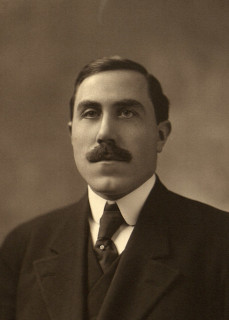
George William Russell, Irish writer, editor, critic, poet, painter and Irish nationalist, dies of cancer in Bournemouth, England, on July 17, 1935.

Russell is born on April 10, 1867, in Lurgan, County Armagh, in what is now Northern Ireland. He writes with the pseudonym Æ (often written AE or A.E.). He is also a writer on mysticism, and a central figure in the group of devotees of theosophy which meets in Dublin for many years. He takes his pseudonym from a proofreader’s query about his earlier pseudonym, “AEon.”

Russell is the second son of Thomas Russell and Mary Armstrong. His father, the son of a small farmer, becomes an employee of Thomas Bell and Co., a prosperous firm of linen drapers. The family relocates to Dublin, where his father has a new offer of employment, when he is eleven years old.

Russell is educated at Rathmines School and the Metropolitan School of Art, where he begins a lifelong, if sometimes contentious, friendship with W. B. Yeats. In the 1880s, he lives at the Theosophical Society lodge at 3 Upper Ely Place, sharing rooms with Hamilton Malcolm Magee, the brother of William Kirkpatrick Magee.

Following his time at the Metropolitan School of Art, Russell becomes an accounts clerk in a drapery store but leaves in 1897 to organize agricultural cooperatives. Eventually he becomes editor of the periodicals Irish Homestead (1905–23) and The Irish Statesman (1923–30). In 1894 he publishes the first of many books of verse, Homeward: Songs by the Way, which establishes him in what is known as the Irish Literary Revival. His first volume of Collected Poems appears in 1913 and a second in 1926. He maintains a lifelong interest in theosophy, the origins of religion, and mystical experience. Candle of Vision: Autobiography of a Mystic (1918) is the best guide to his religious beliefs.

At the turn of the 20th century, Russell is considered by many to be the equal of Yeats, but he does not continue to grow and develop as Yeats does. He is prolific and versatile, but many critics find his poetry facile, vague, and monotonous, with “rather too much of the Celtic Twilight” in it.

Russell designs the famous Starry Plough flag for the Irish Citizen Army, which is unveiled on April 5, 1914, and flown during the Easter Rising in April 1916.

Russell, who had become increasingly unhappy in the Irish Free State which, according to Yeats, he called “a country given over to the Devil,” moves to England soon after his wife’s death in 1932. Despite his failing health he goes on a final lecture tour in the United States but returns home utterly exhausted. He dies of cancer in Bournemouth, England, on July 17, 1935. His body is brought back to Ireland, and he is interred in Mount Jerome Cemetery, Dublin.


Leave a comment

Death of Patrick Mayhew, British Barrister, Politician & Northern Ireland Secretary

Patrick Barnabas Burke Mayhew, Baron Mayhew of Twysden, PC, QC, DL, British barrister, politician and Secretary of State for Northern Ireland, who serves during a critical period in the Northern Ireland peace process, dies at his home in Kent, England, on June 25, 2016. He is a key figure in the December 1993 Downing Street Declaration which leads to the Provisional Irish Republican Army (IRA) ceasefire on August 31, 1994

Mayhew is born on September 11, 1929. His father, George Mayhew, is a decorated army officer turned oil executive. His mother, Sheila Roche, descendant of members of the Anglo-Irish Protestant ascendancy, is a relative of James Roche, 3rd Baron Fermoy, an Irish National Federation MP for East Kerry. Through his father, Mayhew is descended from the Victorian social commentator Henry Mayhew. He is educated at Tonbridge School, an all boys public school in Tonbridge, Kent.

Mayhew then serves as an officer in the 4th/7th Royal Dragoon Guards, studies law at Balliol College, Oxford, and is president of the Oxford University Conservative Association (OUCA) and of the Oxford Union. He is called to the Bar by the Middle Temple in 1955.

In 1963, Mayhew marries The Rev. Jean Gurney, and they have four sons.

Mayhew contests Dulwich at the 1970 United Kingdom general election, but the incumbent Labour Party member, Samuel Silkin, beats him by 895 votes. He is Member of Parliament (MP) for Tunbridge Wells from its creation at the February 1974 United Kingdom general election, standing down at the 1997 United Kingdom general election.

Mayhew is Under Secretary of Employment from 1979 to 1981, then Minister of State at the Home Office from 1981 to 1983. After this, he serves as Solicitor General for England and Wales from 1983 to 1987, and then Attorney General for England and Wales and simultaneously Attorney General for Northern Ireland from 1987 to 1992.

Mayhew is Secretary of State for Northern Ireland from 1992 to 1997, the longest anyone has served in this office.

Mayhew is one of only five Ministers (Tony Newton, Kenneth Clarke, Malcolm Rifkind and Lynda Chalker are the others) to serve throughout the whole 18 years of the premiership of Margaret Thatcher and John Major. This represents the longest uninterrupted Ministerial service in Britain since Henry John Temple, 3rd Viscount Palmerston, in the early 19th century.

Mayhew is knighted in 1983. On June 1997, he is given a life peerage as Baron Mayhew of Twysden, of Kilndown in the County of Kent. He retires from the House of Lords on June 1, 2015.

Mayhew suffers from cancer and Parkinson’s disease in his later years. He dies at the age of 86 on June 25, 2016, in his home in Kent.

Mayhew’s son, The Honourable Henry Mayhew, appears in the fourth episode of the series The Secret History Of Our Streets, discussing life in the Portland Road, Notting Hill, London. Another son, Tristram, co-founds the outdoor adventure company Go Ape. His son Jerome is the Conservative Party MP for the constituency of Broadland in Norfolk since December 2019.


1 Comment

Birth of Fra McCann, IRA Volunteer & Sinn Féin Politician

Fra McCann, Irish politician, is born in Belfast, Northern Ireland, on June 19, 1953. He becomes active in the Irish republican movement and is imprisoned in the 1970s for membership of the Provisional Irish Republican Army. He also takes part in the blanket protest while in prison. In 1987, he is elected to Belfast City Council in a by-election, representing Sinn Féin.

McCann grows up in the Falls Road area of West Belfast. He is educated at St. Comgalls Primary School on Divis Street and later at St. Peters Secondary School off the Whiterock Road.

McCann is interned on the prison ship HMS Maidstone from February 14 until March 14, 1972, when he is moved to Long Kesh Detention Centre.

McCann is released from Long Kesh on May 9, 1972, then rearrested in November 1972 and re-interned until December 1975. During this period of internment, he is sentenced to nine months for escaping from Long Kesh through a tunnel. During this escape, IRA volunteer Hugh Coney is murdered by British soldiers.

McCann is arrested again in November 1976 and imprisoned in Crumlin Road Gaol where he spends six months on remand before being sentenced to three years. He joins the blanket protest in Crumlin Road Gaol where he and his comrades are held in solitary confinement until August 1978 when they are moved to the H-Blocks in Long Kesh, joining hundreds more on the blanket protest. He is released on November 22, 1979.

Upon his release, McCann travels throughout Ireland with other ex-prisoner’s highlighting the inhumanity in the H-Blocks. He travels throughout the United States in 1980 during which time he is arrested and spends 17 days in prison in New York. In 1981, he travels to Canada where he helps form H-Block committees and raises awareness about the hunger strike.

On his return to Ireland McCann is elected to sit on the National H-Block Committee and speaks at many events in support of the hunger strike. In the aftermath of the hunger strike he helps reorganise Sinn Féin in the Falls area.

McCann is elected to Belfast City Council in 1987 and sits on the Strategic Policy and Resources Committee and the Parks and Leisure committee. He is elected to the Northern Ireland Assembly representing Belfast West in 2003 and again in 2007, 2012 and 2018. While there he sits on the Finance and Personnel Committee and the Committee for Social Development.

In June 2006, McCann is charged with assault and disorderly behaviour following an incident in west Belfast. The incident occurs as the Police Service of Northern Ireland (PSNI) are attempting to arrest a teenager for attempted robbery. However, he claims heavy-handedness by the police and states, “I tried to put myself between one of the officers and the girl when the police officer radioed for assistance.” He is released on bail.

In October 2021, McCann announces that he would be stepping down as Member of the Legislative Assembly (MLA) for Belfast West and would not be contesting the next election.


Leave a comment

Birth of Colin Bateman, Novelist, Screenwriter & Journalist

Colin Bateman, novelist, screenwriter and former journalist known mononymously as Bateman, is born on June 13, 1962, in Newtownards, County Down, Northern Ireland.

Bateman attends Bangor Grammar School leaving at the age of 16 when he is hired by Annie Roycroft to join the County Down Spectator as a “cub” reporter, then columnist and deputy editor. A collection of his columns is published as Bar Stool Boy in 1989.

Bateman has been writing novels since his debut, Divorcing Jack, in 1994. Divorcing Jack wins a Betty Trask Award in the same year and is adapted into a 1998 film starring David Thewlis. Several of his novels feature the semi-autobiographical Belfast journalist, Dan Starkey.

Bateman’s book Murphy’s Law is adapted from the BBC television series Murphy’s Law (2001–2007), featuring James Nesbitt. He explains on his website that “Murphy’s Law was written specifically for James Nesbitt, a local actor who became a big TV star through Cold Feet. The ninety-minute pilot for Murphy’s Law on BBC One was seen by more than seven million people, and led to three TV series, on which I was the chief writer.”

Bateman’s eight-part series Scúp is written in English and translated into Irish. It is produced by Stirling Productions and BBC Northern Ireland. A second series has since been commissioned.

Bateman’s children’s book Titanic 2020 is shortlisted for the 2008 Bisto Book of the Year Award and the Bolton Children’s Book Award

Much of Bateman’s work is produced under the name “Bateman” rather than his full name. His 2007 novel I Predict a Riot bears (among others) the dedication: “For my Christian name, gone but not forgotten.” Since 2016, he has moved increasingly into film, writing the screenplays for The Journey, starring Timothy Spall and Colm Meaney, and Driven starring Jason Sudeikis and Lee Pace. Both films are premiered at the Venice Film Festival and selected for the Toronto International Film Festival. He is currently writing films about Fidel Castro in New York, ‘The Hotel Theresa’ and the British double agent George Blake.


Leave a comment

Protestant March Ends in Bloody Battle on the Craigavon Bridge

A Protestant march against the creation of “no-go” areas in Londonderry on June 3, 1972, ends in a bloody battle on the Craigavon Bridge. Soldiers use rubber bullets and water cannon to control the crowd when the so-called “Tartan gangs” at the tail end of the march begin to throw bottles and stones at the British Army.

The “no-go” areas, known as Free Derry, are areas where both the Irish Republican Army and Provisional Irish Republican Army can openly patrol, train and open offices with widespread support and without involvement of security services. Bogside, Creggan and Brandywell make up the area Free Derry, and it is still known by that name despite the barricades no longer being present.

The 10,000 strong march sets off from Irish Street at 1500 GMT to call for an end to the “no-go” areas on the east bank side of the River Foyle.

The biggest security operation since the start of the Troubles is set up for the march with soldiers on every corner. The bridge is the centre of the trouble as it joins the Protestant side of the town to the “no-go” Roman Catholic areas of Bogside and Creggan.

Despite pleas from march organisers for the violence to stop it does not end until the Ulster Defence Association (UDA) steps in. They form a human barrier between the protesters and the Army. The confrontation lasts an hour and results in one man being injured but no arrests.

A spokesman for the Army says, “Naturally it is regretted that we have to fire rubber bullets but there we are. The only alternative is the Bogside would be invaded by the Protestant marchers.”

Despite the violence, William Craig, the leader of the Ulster Vanguard movement, who organised the march, says the marches will go on. “We are no longer protesting – we are demanding action,” he says.

On July 31, 1972, the then Secretary of State for Northern Ireland William Whitelaw orders 20,000 soldiers to dismantle IRA barricades in the “no-go” areas of Derry and Belfast.

1972 becomes the bloodiest year of the Troubles. Some 470 people are killed that year, the overwhelming majority of them civilians.

(From: “1972: Protestant march ends in battle,” BBC On This Day, http://news.bbc.co.uk/onthisday)


Leave a comment

The Glenanne Barracks Bombing

The Glenanne barracks bombing is a large truck bomb attack carried out by the Provisional Irish Republican Army (IRA) against a British Army (Ulster Defence Regiment) base at Glenanne, near Mountnorris, County Armagh, on May 31, 1991. The bombing leaves three soldiers dead and 14 people wounded, four of them civilians.

The bombing takes place at a time when the Northern Ireland Office arranges multi-party talks, known as the Brooke/Mayhew talks, on the future of Northern Ireland. Sinn Féin members are not invited to attend because of their links with the IRA, which prevents them from being recognised as a “constitutional” party. The talks end in failure soon after.

Built in 1972, the barracks house two companies of the 2nd Battalion, Ulster Defence Regiment (UDR). Seen as an outpost, it sits on the dividing line between a Protestant area and a Catholic area. Although the military barracks itself had not been attacked by the IRA previously, seven UDR soldiers from the base had already been killed during the Troubles.

At 11:30 PM, a driverless truck loaded with 2,500 lb (1,100 kg) of a new type of homemade explosive is rolled down a hill at the rear of the barracks and crashes through the perimeter fence. According to a witness, a UDR lance corporal who alerts the base, the truck is a Mercedes, and a Toyota HiAce van carrying at least two men acts as a support vehicle. The men are seen outside the parked van, masked and armed, one with a handgun and the other with a submachine gun. This same witness alerts the base believing the IRA team are about to carry out a mortar attack, and debris thrown up on the roof by the lorry as it plunges down the hill is misinterpreted by some inside the base as a mortar projectile. Automatic fire is heard by other witnesses just before the main blast. A Reuters report claims that IRA members trigger the bomb by firing upon the driverless vehicle. It is later determined that the lorry had been stolen the day before in Kingscourt, County Cavan, in the Republic of Ireland.

The blast leaves a crater 200 ft. (61 m) deep and throws debris and shrapnel as far as 300 yards (270 m). The explosion can be heard over 30 miles (48 km) away, as far as Dundalk. This is the biggest bomb detonated by the IRA up to this point. Most of the UDR base is destroyed by the blast and the fire that follows. At first, a massive mortar attack is suspected. Some livestock are killed and windows broken around the nearby Mossfield housing as a result of the explosion. The cars parked outside the base are obliterated. Ceilings are brought down and the local primary school is also damaged.

The barracks is usually manned by eight soldiers, but at the time there are 40 people in the complex, attending a social event. Three UDR soldiers – Lance Corporal Robert Crozier (46), Private Sydney Hamilton (44) and Private Paul Blakely (30) – are killed and ten are wounded. Two of them are caught by the explosion when they come out to investigate after a sentry gives the alarm. A third dies inside the base. Four civilians are also wounded. The Provisional IRA claims responsibility two days later.

Author Kevin Toolis lists the destruction of Glenanne UDR barracks in County Armagh as part of the cycle of violence and tit-for-tat killings in neighbouring County Tyrone. The IRA later claims that the death of three of its men in the town of Coagh is a Special Air Service (SAS) retaliation for the Glenanne bombing.

The base is never rebuilt. It had outlived its operational usefulness and a decision had already been taken to close it down. The decision not to rebuild the compound raises some controversy among unionists. A memorial stone is erected by the main entrance road with the names of the UDR soldiers killed over the years while serving in Glenanne.


Leave a comment

Birth of Betty Williams, Peace Activist and Nobel Peace Prize Recipient

Elizabeth “Betty” Williams (née Smyth), peace activist and co-recipient of the Nobel Peace Prize in 1976, is born in Belfast, Northern Ireland, on May 22, 1943.

Williams’s father works as a butcher and her mother is a housewife. She receives her primary education from St. Teresa Primary School in Belfast and attends St. Dominic’s Grammar School for Girls for her secondary school studies. Upon completing her formal education, she takes up a job of office receptionist.

Rare for the time in Northern Ireland, Williams’s father is Protestant and her mother is Catholic, a family background from which she later says she derived religious tolerance and a breadth of vision that motivated her to work for peace. Early in the 1970s she joins an anti-violence campaign headed by a Protestant priest. She credits this experience for preparing her to eventually found her own peace movement, which focuses on creating peace groups composed of former opponents, practicing confidence-building measures, and the development of a grassroots peace process.

Williams is drawn into the public arena after witnessing the death of three children on August 10, 1976, when they are hit by a car whose driver, an Irish Republican Army (IRA) paramilitary named Danny Lennon, had been fatally shot in return fire by a soldier of the King’s Own Royal Border Regiment. As she turns the corner to her home, she sees the three Maguire children crushed by the swerving car and rushes to help. Their mother, Anne Maguire, who is with the children, dies by suicide in January 1980.

Williams is so moved by the incident that within two days of the tragic event, she obtains 6,000 signatures on a petition for peace and gains wide media attention. With Mairead Corrigan, she co-founds the Women for Peace which, with Ciaran McKeown, later becomes the Community of Peace People.

Williams soon organises a peace march to the graves of the slain children, which is attended by 10,000 Protestant and Catholic women. However, the peaceful march is violently disrupted by members of the IRA, who accuse them of being “dupes of the British.” The following week, she leads another march in Ormeau Park that concludes successfully without incident – this time with 20,000 participants.

In recognition of her efforts for peace, Williams, together with Corrigan, become joint recipients of the Nobel Peace Prize for 1976.

The Peace Prize money is divided equally between Williams and Corrigan. Williams keeeps her share of the money, stating that her intention is to use it to promote peace beyond Ireland, but faces criticism for her decision. She and Corrigan have no contact after 1976. In 1978, Williams breaks off links with the Peace People movement and becomes instead an activist for peace in other areas around the world.

Williams receives the People’s Peace Prize of Norway in 1976, the Golden Plate Award of the American Academy of Achievement in 1977, the Schweitzer Medallion for Courage, the Martin Luther King, Jr. Award, the Eleanor Roosevelt Award in 1984, and the Frank Foundation Child Care International Oliver Award. In 1995, she is awarded the Rotary International “Paul Harris Fellowship” and the Together for Peace Building Award.

At the 2006 Earth Dialogues forum in Brisbane, Williams tells an audience of schoolchildren during a speech on Iraq War casualties that “Right now, I would like to kill George W. Bush.” From September 17 to 20, 2007, she gives a series of lectures in Southern California. On September 18, she presents a lecture to the academic community of Orange County entitled “Peace in the World Is Everybody’s Business” and on September 20 she gives a lecture to 2,232 members of the general public, including 1,100 high school sophomores, at Soka University of America. In 2010, she gives a lecture at WE Day Toronto, a WE Charity event that empowers students to be active within their communities, and worldwide.

Speaking at the University of Bradford before an audience of 200 in March 2011, Williams warns that young Muslim women on campus are vulnerable to attacks from angry family members, while the university does little to help protect them. “If you had someone on this campus these young women could go to say, ‘I am frightened’ – if you are not doing that here, you are dehumanising them by not helping these young women, don’t you think?”

At the time she receives the Nobel Prize, Williams works as a receptionist and is raising her two children with her first husband Ralph Williams. This marriage is dissolved in 1981. She marries businessman James Perkins in December 1982 and they live in Florida in the United States.

In 2004, Williams returns to live in Northern Ireland. She dies on March 17, 2020, at the age of 76 in Belfast.


Leave a comment

Charles, the Prince of Wales, Visits Omagh

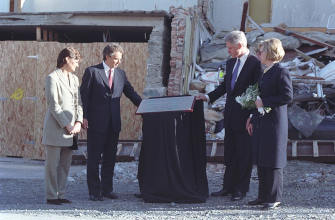
Charles, the Prince of Wales, visits Omagh, County Tyrone, Northern Ireland, on May 5, 1999, and meets with relatives of those killed in the August 15, 1998 car bombing and some of the young people who were injured.

The prince has a private meeting with a group of those injured and bereaved in the August attack on the Northern Ireland market town, which left 29 dead. It fulfills a promise he made to the people of the town when he visited it three days after the bombing by the Real Irish Republican Army (IRA).

After his meeting with residents at the offices of Omagh District Council, the prince says, “I was determined to come back today to see how all of you were faring after all the terrible things you have had to go through.”

Referring to the IRA assassination of his uncle, Lord Mountbatten, he says, “Having experienced myself a relative who was blown to smithereens, I can well understand how these poor people must feel.” He adds that there is enormous concern and care across the world, and many who have given generously to the Omagh Fund, which organisers say has topped £4.5m.

Before visiting the site of the bombing and the regeneration scheme, the prince says the rebuilding plans are bringing “new life, new meaning and new hope back to this really remarkable community.”

“It always was a remarkable community, it still is. You set a wonderful example to many other communities, not only in Northern Ireland but in other parts of the world who also have suffered so traumatically,” the prince says.

Speaking about his visit to Soho following the Admiral Duncan pub bombing by neo-Nazi David Copeland the previous Friday (April 30, 1999), he adds, “I am sure your experiences will be of enormous help to those people in London who have shared with you yet another tragedy in another horrible bombing.”

Marion Radford, who was injured in the Omagh bombing and whose 16-year-old son Alan died, says, “Visits like this help, just to know people care. I found this helpful, I found him a very nice person, he does care and was a sympathetic listener.”

(From: “UK Prince returns to Omagh,” BBC News, http://www.bbc.news.com, May 5, 1999)


Leave a comment

Birth of John Watson, Formula One Driver & Commentator

John Marshall Watson, MBE, British former racing driver and current commentator, is born in Belfast, Northern Ireland, on May 4, 1946.

Watson is educated at Rockport School, in Holywood, County Down. His Formula One career begins in 1972, driving a customer MarchCosworth 721 for Goldie Hexagon Racing in the World Championship Victory Race, a non-Championship event at Brands Hatch. His first World Championship events come in the 1973 season, in which he races in the British Grand Prix in a custom BrabhamFord BT37, and the U.S. Grand Prix, where he drives the third works Brabham BT42. Neither is particularly successful, as in the British race he runs out of fuel on the 36th lap and his engine fails after only seven laps in the United States event.

Watson scores his first World Championship point in the 1974 Monaco Grand Prix, while driving for Goldie Hexagon Racing. He goes on to score a total of six points that season, driving a customer Brabham BT42-Ford modified by the team. He fails to score Championship points the following year, driving for Surtees Racing Organisation, Team Lotus and Team Penske. At the 1975 Spanish Grand Prix he has the chance to score his first win. He is in second position, behind Mario Andretti, until he has to stop in the pits for checks after his car starts to suffer vibrations. Andretti retires later, and after rejoining the race Watson finishes in eighth, his best Championship result in 1975. In non-Championship races he fares somewhat better, taking second place in the Race of Champions at Brands Hatch, and fourth at the BRDC International Trophy race at Silverstone.

Watson secures his first World Championship podium with third place at the 1976 French Grand Prix. Later that season comes his first victory, driving for Penske in the Austrian Grand Prix having qualified second on the grid. After the race he shaves off his beard, the result of a bet with team owner Roger Penske.

In the third race of the 1977 Formula One season, the South African Grand Prix, he manages to complete the race distance, scores a point, and takes his first ever fastest lap. His achievements are overshadowed, however, by the deaths of driver Tom Pryce and a track marshal, Jansen Van Vuuren. His Brabham-Alfa Romeo lets him down throughout the season but, despite this, he gains his first pole position in the Monaco Grand Prix and qualifies in the top ten no fewer than 14 times, often in the first two rows. Problems with the car, accidents, and a disqualification leads him to race the full distance in only five of the 17 races. The closest he comes to victory is during the French Grand Prix, where he dominates the race from the start only to be let down by a fuel metering problem on the last lap which relegates him to second place behind eventual winner Mario Andretti.

In 1978, Watson manages a more successful season in terms of race finishes, even out-qualifying and out-racing his illustrious teammate Niki Lauda on occasion. He manages three podiums and a pole, and notches up 25 points to earn the highest championship placing of his career to that point.

For 1979, Watson moves to McLaren where he gives them their first victory in over three years by winning the 1981 British Grand Prix and also securing the first victory for a carbon fibre composite monocoque F1 car, the McLaren MP4/1. Later in the 1981 season, the strength of the McLaren’s carbon fibre monocoque is demonstrated when he has a fiery crash at Monza during the Italian Grand Prix. He loses the car coming out of the high speed Lesmo bends and crashes backwards into the barriers. Similar accidents have previously proven fatal, but Watson is uninjured in an accident he later recalls as looking far worse than it actually was. After James Hunt‘s abrupt retirement after the Monaco Grand Prix in 1979, he is the only full-time competitive British F1 driver up until the end of his career.

Watson’s most successful year is 1982, when he finishes third in the Drivers’ Championship, winning two Grands Prix. In several races he achieves high placings despite qualifying towards the back of the grid. At the first ever Detroit Grand Prix in 1982, he overtakes three cars in one lap deep into the race on a tight, twisty track that is difficult to pass on. Working his way from 17th starting position on the grid, he charges through the field and scores a victory in the process. He goes into the final race of the season at Caesars Palace with an outside chance of the title, but he finishes five points adrift of Keke Rosberg and level on points with Didier Pironi.

A year later in 1983, Watson repeats the feat of winning from the back of the grid at the final Formula One race in Long Beach, another street circuit, starting from 22nd on the grid, the farthest back from which a modern Grand Prix driver had ever come to win a race. His final victory also includes a fight for position with teammate Niki Lauda, who had started the race 23rd, though Watson ultimately finishes 27 seconds ahead of his dual World Championship winning teammate.

At the end of the 1983 season, however, Watson is dropped by McLaren and subsequently retires from Formula One. Negotiations with team boss Ron Dennis reportedly break down when he asks for more money than dual World Champion Lauda is earning, citing having won a Grand Prix in 1983 where Lauda did not. Dennis instead signs Renault refugee Alain Prost for comparatively little. Watson does return for one further race two years later, driving for McLaren in place of an injured Lauda at the 1985 European Grand Prix at Brands Hatch, in which he qualifies 21st and places seventh in the race.

In 1984 Watson turns to sports car racing, notably partnering Stefan Bellof to victory at the Fuji 1000 km during Bellof’s 1984 Championship year. He is also part of the driver lineup for Bob Tullius‘ Group 44 Jaguar team at the 1984 24 Hours of Le Mans driving an IMSA spec Jaguar XJR-5 powered by a 6.0 litre V12 in the IMSA / GTP class. In what is Jaguar’s first appearance at Le Mans since 1959, he briefly takes the lead toward the end of the first hour when the faster Porsche 956s and Lancia LC2s pit. Driving with American Tony Adamowicz and Frenchman Claude Ballot-Léna, they fail to finish the race due to engine trouble though they are classified in 28th place.

Watson also finishes second in the 1987 World Sportscar Championship season alongside Jan Lammers in the TWR Silk Cut Jaguar XJR-8 when they win a total of three championship races (Jarama, Monza and Fuji). He competes in the 24 Hours of Le Mans seven times over the course of his career between 1973 and 1990, finishing 11th, a career best, in his last start in 1990 driving a Porsche 962C for Richard Lloyd Racing alongside fellow Grand Prix drivers Bruno Giacomelli and Allen Berg.

After retiring from active racing, Watson works as a television commentator for Eurosport, the BBC, Sky Sports’ Pay Per View, BSkyb, runs a race school at Silverstone and manages a racetrack. He also becomes the first man to ever test a Jordan Formula One car in 1990. He currently provides expert commentary on the GT World Challenge Europe alongside regular Blancpain television commentator David Addison.

(Pictured: John Watson at the 1982 Dutch Grand Prix)


Leave a comment

The Funeral of Joe B. O’Hagan, Founding Member of the Provisional IRA

Leading Sinn Féin members are among the 5,000 people who attend the funeral of Joe B. O’Hagan, a founding member of the Provisional Irish Republican Army (PIRA), on April 26, 2001. Party president Gerry Adams gives the oration at the graveside when the leading republican figure is buried in Lurgan, County Armagh, Northern Ireland.

O’Hagan, known to all and sundry simply as JB, dies on Monday, April 23, 2001, in the town in which he was born almost 79 years previously and from which he and his wife Bernadette had been exiled for 25 years during the current phase of the conflict. As befitted a soldier of Óglaigh na hÉireann, a uniformed IRA Guard of Honour attends O’Hagan’s body in the wake house and it is six of his comrades who carry the coffin, bedecked in the Irish Tricolour and beret and gloves, from the family home on the first section of its journey to St. Paul’s Chapel for the Funeral Mass.

Up to 2,000 people attend the funeral and businesses in the bustling North Armagh town close along the route as a mark of respect. At St. Colman’s Cemetery just outside the town, Sinn Féin President Gerry Adams pays fulsome tribute to a republican who had been active from the 1940s into the 1990s and right up to his sudden death. Adams notes O’Hagan’s strong faith and welcomes the tribute paid during the Funeral Mass to JB’s republican beliefs and exploits. He adds, however, that it is high time the Catholic hierarchy reverses its directive banning the Tricolour from republican funerals in church premises. “Our National Flag should be allowed to stay on the coffin for the entire ceremony,” he says.

“I have always associated JB with Bernadette,” he tells those gathered at the graveside, “even though they were apart for so many years. They were married for 52 years, and Bernadette told me yesterday that she wouldn’t change a day of it, that she was proud of him and of his life.”

“In many ways he died the way he had lived, very quietly, modestly, not complaining, unassuming to the end. He was one of the most respected republicans of our time. There is no greater tribute that can be paid to any man or woman than to be known as a decent human being and Joe B. was that and more.”

Adams goes on to briefly record the extraordinary history of O’Hagan’s involvement in the republican struggle, as soldier and political activist, since he first joined the IRA in 1940, including that famous 1973 escape from Mountjoy Jail by helicopter, accompanied by Kevin Mallon and the late Seamus Twomey.

“JB grew up in the 1920s in a state abandoned by the Irish Government, where nationalists were subjected to the B-Specials and the Special Powers Act. He stood up at a time when standing up was a very very dangerous thing to do,” says Adams. “It is a wonder to me that he was active in every decade from the 1940s on. There is a mighty man!”

“He also personifies why Irish republicanism has never been defeated. He was an example of a physical force republican who was prepared to support and exhaust other means of struggle. He saw armed struggle as a means rather than as an end, but he never ceased to be an unrepentant republican and to work always for the establishment of an Irish Republic based on national rights for the people of this island. He supported the Good Friday Agreement not as an end but as an effort to build a new accord with our opponents and enemies. Political unionism has found it very difficult to deal with this strategy.”

“Joe B was very philosophical and very wise. He is representative of that republican element who never broke a promise in their lives.”

“Those who seek to defeat the republican struggle by blaming the IRA for everything need to know that none of this will work. That is because of the work that JB and people like him put into this struggle. We won’t be worn down or accept anything less than our full rights. The message for David Trimble and Tony Blair is that it is impossible for us to accept inequality, injustice and second-class citizenship. That is the past. We are looking to the future.”

“Joe B’s passing has left a huge gap, but we should celebrate his life. He touched so many of us. Joe B kept us right. The flame he kept flickering in the lean times is burning brightly now because of his contribution.”

Adams extends his solidarity and sympathy and that of all those present to Bernadette, to O’Hagan’s children, Barry, Kevin, Fintan, Siobhán, Felim and Dara, to his eleven grandchildren and four great-grandchildren, his sisters and entire family circle.

At the end of the Funeral Mass for O’Hagan, the O’Hagan family lead by Joe’s son Fintan place the Irish Tricolour on the coffin before the remains are taken from the chapel. This act is borne out of anger and frustration.

O’Hagan was a republican, an honourable man and a religious man who went to Mass every day. So, his family feels that the Catholic Church, that was as much an influence on O’Hagan’s life as was his republicanism, should respect his wish and allow his coffin to be draped in the Tricolour. The family appeals to the Catholic Church authorities and Adams intercedes on their behalf, but they are refused the right to grant O’Hagan his wish that the Flag not be removed from his coffin.

Dara O’Hagan, the Sinn Féin Northern Ireland Assembly member for Upper Bann, tells the bishop that by sticking to their old policy the Catholic Church is criminalising republicanism and indeed criminalising her father.

Also, the Catholic hierarchy misses a great opportunity to heal a hurt that has existed for over 20 years, when the remains of IRA Volunteer Kevin `Dee’ Delaney were refused entry into Corpus Christi Church in Springhill while bearing the Irish Tricolour. The rancour and hurt felt by republicans over this slight, coming as it does, in conjunction with the British Government’s attempts to criminalise republicanism, has long been an insult that republicans have resented. After all, churches are the people’s property as it is their money and effort that build them. The people of Springhill and the Greater Ballymurphy area paid £5 a brick for the Corpus Christi building and the Delaney family no doubt contributed to that fund.

By taking matters into their own hands, the O’Hagan family claims back some ground for republicans and sends a message to the bishops that they have a part to play in this new political era and that they need to look at their attitude to republicanism.

O’Hagan’s wife Bernadette says that as Fintan draped the Irish Trocolour on Joe’s coffin and the church burst into spontaneous applause, her heart was lifted. “I was so glad, and I walked down the aisle with a smile on my face,” said Bernadette.

(From: “Unassuming and mighty man laid to rest” by Martin Spain, An Phoblacht Republican News, May 3, 2001)