Gilmartin is the son of Michael Gilmartin, Rinshiona, Castlebar.[1] He is educated at the Franciscan monastery boys school in Errew and at O’Dea’s Academy in Castlebar. He attends St Jarlath’s College in Tuam, and then St Patrick’s College, Maynooth. Following his ordination to the priesthood in 1883, he becomes a professor of mathematics and natural science at St Jarlath’s.
In 1891, Gilmartin serves as Dean of Formation and Vice-President of St Patrick’s College, Maynooth. He is awarded a Doctor of Divinity by Rome in 1905.
During the Irish War of Independence, Archbishop Gilmartin speaks out strongly against violence. In January 1920, he criticizes the “undisguised ruffianism” in the rebel ranks. He counsels his priests that whatever their personal political beliefs, they should not take an aggressive part on behalf of either side. However, many younger clerics support Sinn Féin and the IRA.
T.H. White describes meeting the Archbishop on the top of Croagh Patrick on an annual Reek Sunday pilgrimage during the 1930s in his book The Godstone and the Blackymor and having a cup of tea with him on the top after overenthusiastically kissing his ring.
Gilmartin dies at the age of 78 in office in Tuam on October 14, 1939.
Gilmartin writes the memoir of Primate Joseph Dixon in Healy’s Centenary History of Maynooth in 1895. He is also a contributor to the Irish Ecclesiastical Record, the Irish Theological Quarterly, and the Catholic Encyclopedia.
MacHale is born in Tubbernavine, near Lahardane, County Mayo on March 6, 1791, to Patrick and Mary Mulkieran MacHale. He is so feeble at birth that he is baptised at home by Father Andrew Conroy. By the time he is five years of age, he begins attending a hedge school. Three important events happen during his childhood: the Irish Rebellion of 1798, the landing at Killala of French troops, whom the boy, hidden in a stacked sheaf of flax, watches marching through a mountain pass to Castlebar, and a few months later the brutal hanging of Father Conroy on a false charge of high treason.
With his friend and ally, Daniel O’Connell, MacHale takes a prominent part in the important question of Catholic emancipation, impeaching in unmeasured terms the severities of the former penal code, which had branded Catholics with the stamp of inferiority. During 1826 his zeal is omnipresent. He calls on the Government to remember how the Act of Union in 1800 was carried by William Pitt the Younger on the distinct assurance and implied promise that Catholic emancipation, which had been denied by the Irish Parliament, should be granted by the Parliament of the Empire.
Oliver Kelly, Archbishop of Tuam, dies in 1834, and the clergy selects MacHale as one of three candidates, to the annoyance of the Government who despatches agents to induce Pope Gregory XVI not to nominate him to the vacant see. Disregarding their request, the pope appoints MacHale Archbishop of Tuam. He is the first prelate since the Reformation who has received his entire education in Ireland. The corrupt practices of general parliamentary elections and the Tithe War cause frequent rioting and bloodshed and are the subjects of denunciation by the new archbishop, until the passing of a Tithes bill in 1838. He also leads the opposition to the ProtestantSecond Reformation, which is being pursued by evangelical clergy in the Church of Ireland, including the Bishop of Tuam, Killala and Achonry, Thomas Plunket.
The repeal of the Acts of Union 1800, advocated by O’Connell, enlists MacHale’s ardent sympathy and he assists the Liberator in many ways, and remits subscriptions from his priests for this purpose. In his zeal for the cause of the Catholic religion and of Ireland, so long downtrodden, but not in the 1830s, he frequently incurs from his opponents the charge of intemperate language, something not altogether undeserved. In his anxiety to reform abuses and to secure the welfare of Ireland, by an uncompromising and impetuous zeal, he makes many bitter and unrelenting enemies, particularly British ministers and their supporters.
The Great Famine of 1846–47 affects his diocese more than any. In the first year he announces in a sermon that the famine is a divine punishment on his flock for their sins. Then by 1846 he warns the Government as to the state of Ireland, reproaches them for their dilatoriness, and holds up the uselessness of relief works. From England as well as other parts of the world, cargoes of food are sent to the starving Irish. Bread and soup are distributed from the archbishop’s kitchen. Donations sent to him are acknowledged, accounted for, and disbursed by his clergy among the victims.
The death of O’Connell in 1847 is a setback to MacHale as are the subsequent disagreements within the Repeal Association. He strongly advises against the violence of Young Ireland. Over the next 30 years he becomes involved in political matters, particularly those involving the church. Toward the end of his life, he becomes less active in politics.
MacHale attends the First Vatican Council in 1869. He believes that the favourable moment has not arrived for an immediate definition of the dogma of papal infallibility. Better to leave it a matter of faith, not written down, and consequently he speaks and votes in the council against its promulgation. Once the dogma had been defined, he declares the dogma of infallibility “to be true Catholic doctrine, which he believed as he believed the Apostles’ Creed“. In 1877, to the disappointment of the archbishop who desires that his nephew should be his co-adjutor, Dr. John McEvilly, Bishop of Galway, is elected by the clergy of the archdiocese, and is commanded by Pope Leo XIII after some delay, to assume his post. He had opposed this election as far as possible but submits to the papal order.
Every Sunday MacHale preaches a sermon in Irish at the cathedral, and during his diocesan visitations he always addresses the people in their native tongue, which is still largely used in his diocese. On journeys he usually converses in Irish with his attendant chaplain and has to use it to address people of Tuam or the beggars who greet him whenever he goes out. He preaches his last Irish sermon after his Sunday Mass, April 1881. He dies in Tuam seven months later, on November 7, 1881, and is buried in the cathedral at Tuam on November 15.
O’Byrne is the son of James Burns, a farmer, and his wife Isabella (née Arnett). His biographer states that his parents came from County Wicklow, which would imply that their name had been anglicised from the form “O’Byrne,” which their son readopts. He never marries and spends most of his life living with his unmarried sister Teresa. He has other siblings, as he is survived by four nieces and two nephews.
O’Byrne’s childhood is spent in the Balmoral district of south Belfast in a comfortable but slightly precarious middle-class Catholic environment. Although sparse in direct autobiographical references, his writings contain references to excursions around the Malone and Stranmillis areas, with particular reference to the Botanic Gardens. He is educated at St. Malachy’s College. After leaving school, he manages a spirit grocery on the Beersbridge Road in east Belfast and is active in the Sexton Debating Society, named after Thomas Sexton, then home rule MP for Belfast West, and led by Joseph Devlin, who remains a lifelong friend despite their later political differences. He also studiess music with Carl Hardebeck, acquiring an extensive knowledge of Irish folk music and becoming an accomplished singer of Irish tunes in Hardebeck’s arrangements.
O’Byrne subsequently joins the Belfast Gaelic League, becoming a leading member, though he never masters the Irish language. He moves in the literary and antiquarian circles around Francis Joseph Bigger, whose friendship becomes central to his career and self-definition. He is a regular participant in Bigger’s soirées and establishes friendships with many prominent political and cultural figures, among them Roger Casement and Alice Milligan. Although he is usually seen as a specifically northern writer, he draws extensively on a wider Irish tradition of defensively self-glorifying Catholic-nationalist antiquarianism, including the works of W. H. Grattan Flood and Archbishop of Tuam, John Healy, a major source for his later pamphlet on Saint Patrick and for the descriptions of Ulster monasteries in As I Roved Out: A Book of the North (1946).
In 1900, O’Byrne publishes a collection of verses, A Jug of Punch, of which no copies are known to survive, and in 1905 collaborates with Cahir Healy on another collection, The Lane of the Thrushes, which applies Celtic revival imagery to rural Ulster. He publishes another collection, The Grey Feet of the Wind, in 1917. The manuscript of his unpublished Collected Poems (1951) is in the Public Record Office of Northern Ireland.
In 1902, O’Byrne gives up the spirit grocery to work full time as a journalist, singer, and storyteller. He appears at a wide variety of concerts, where he cuts a striking figure in Gaelic dress with saffron kilt. He provides musical interludes at productions by the Ulster Literary Theatre, and his recitation of Eleanor Alexander’s humorous piece on the battle of Scarva inspires Harry Morrow’s celebrated satirical play Thompson in Tir-na-nOg (1912). In 1913, he founds and manages the Celtic Players, a theatre company which stages some plays of his own composition, including The Dream of Bredyeen Dara, possibly a nativity story incorporating Saint Brigid of Kildare.
During World War I O’Byrne achieves immense cross-community success with a weekly dialect column in the Unionist paper Ireland’s Saturday Night, describing the domestic activities of “Mrs. Twigglety” and her working-class friends. At the same time, he has abandoned his earlier support for Devlin’s home rule politics to embrace physical-force republicanism under the influence of Denis McCullough. During Casement’s imprisonment and trial, he carries on an intense correspondence with him, comforting him, urging him to convert to Catholicism, and sending him religious icons. Some commentators have detected homoerotic undertones in their exchanges, though this is a matter of opinion.
After the Easter Rising of 1916, O’Byrne is active in the reconstituted Irish Republican Army (IRA), and in 1919–20 he smuggles arms from Belfast to Dublin. In August 1920, he emigrates to the United States, where he goes on a six-month lecture tour to raise funds for victims of the Belfast pogroms. He allegedly raises $100,000 and funds the construction of Amcomri Street in west Belfast. He spends the next eight years in the United States as a speaker and entertainer, contributing to American Catholic publications. He develops an abiding fondness for Chicago and considers applying for American citizenship. At one point he corresponds with the film star Rudolph Valentino, who admires his verses on Italian themes.
O’Byrne returns to Belfast in September 1928 with the intention of opening a bookshop in Dublin, but this has to be abandoned after the loss of his savings in the Wall Street crash of October 1929. He settles into respectable semi-poverty in Cavendish Street, off the Falls Road, and remains a presence on the fringes of Belfast literary life. In 1930, he founds the Cathal O’Byrne Comedy Company, which performs plays of his own composition, notably the slight comedies The Returned Swank and The Burden, drawing on The Drone, by Samuel Waddell. In 1932, he sings at a concert in the Dublin Mansion House held to mark the Eucharistic Congress. He writes extensively for Catholic publications in Ireland and elsewhere, in particular the Capuchin Annual, Irish Monthly, and Irish Rosary, and publishes several pamphlets with the Catholic Truth Society (CTS). The sensibility displayed in these writings has much in common with that of Brian O’Higgins, Aodh de Blácam, Daniel Corkery and Gearoid Ó Cuinneagáin.
O’Byrne also publishes The Gaelic Source of the Brontë Genius (1932), Pilgrim in Italy (1930), and the story collection From Far Green Hills (1935), which retells gospel episodes in the style of an Irish storyteller with elements of Wildean orientalist exoticism. Pilgrim in Italy is published by the Three Candles Press of Colm Ó Lochlainn, an old friend through the Bigger circle, as is his last story collection, Ashes on the Hearth (1948), a series of slight reveries in which the narrator, wandering the back streets of Dublin, relives such resonant moments as the last days of James Clarence Mangan.
O’Byrne is best remembered, however, for As I Roved Out (1946), a collection of 128 articles on Belfast history originally published from the late 1930s in the Belfast Irish News. It displays considerable knowledge of Belfast history, drawn from lifelong reading and from conversations with Bigger, and can be seen as at once the summation of and a lament for the northern branch of the Irish revival associated with such figures as Bigger and Alice Milligan. The pieces, moving out from central Belfast to surrounding rural districts are held together by the storyteller surveying the landscape. Surveys of Belfast by journalistic flâneurs are not unprecedented, O’Byrne dismisses the mercantile and unionist establishment of Belfast as hopelessly materialistic and oppressive, casting himself and, by implication, his Catholic/nationalist readers as internal exiles forced into the side streets of history, treasuring a martyred religious faith and gazing back wistfully to the bright and fleeting hope represented by the Society of United Irishmen and the cultural revival. The book is punctuated by expressions of anger against the whole heritage of the Ulster plantation. The economic success of the planters is attributed solely to their plunder of the natives. The textile industry is discussed solely in terms of exploitation and starvation wages. Shipbuilding is dismissed with a remark that ships were built in Ulster long before the planters arrived. Finally, the history of Belfast is summed up in the confrontation between the Belfast merchant, ancestor of the unionist “establishment,” and would-be slave-trader Waddell Cunningham and the United Irishman and self-declared “Irish slave” William Putnam McCabe.
There are numerous contemptuous references to the Sabbatarianism and respectable dullness of late Victorian Belfast, contrasted with the lively artistic activities of the volunteer period. The book is reprinted three times in O’Byrne’s lifetime and is seen by nationalists as an underground classic. Its image of Belfast layered with fragmentary and hidden memories has been drawn on by authors as diverse as Ciaran Carson and Gerry Adams, and in the early twenty-first century O’Byrne is commemorated as one of the city’s significant writers. A plaque is placed on his Cavendish Street house in 2004. It is ironic that his reputation should rest on his memorialisation of Belfast, for he denounced it as “interminable miles of mean streets . . . one of the ugliest cities in the world.”
O’Byrne is believed by some, though not all, of his acquaintances to be homosexual. This view is supported by references to the descriptions of male beauty (based on Gaelic saga models) which recur in his writings and by the expressions of longing which permeate his work (which might also reflect a wider sense of loneliness or cultural displacement). His last years, 1954–57, are spent in the Nazareth Nursing Home in Ormeau Road, Belfast, where he dies on August 1, 1957, a month after suffering a stroke. His funeral is crowded, and his gravestone describes him as “singer, poet and writer who brought joy into the lives of others.”
(From: “O’Byrne, Cathal” by Patrick Maume, Dictionary of Irish Biography, http://www.dib.ie, October 2009)
Ó Maolchonaire is born in the townland of Figh, civil parish of Tibohine, barony of Frenchpark, County Roscommon. His father and mother are Fíthil and Onóra Ó Maolchonaire. Two other sons survive to adulthood, Maoilechlainn and Firbisigh. They belong to a well-known family of historians and poets. He is brought up in the family profession.
Ó Maolchonaire studies for the priesthood at Salamanca, entering the Irish college founded in 1592. He first studies the liberal arts and philosophy. In 1593 he translates into Irish a short Castilian catechism by Jerónimo de Ripalda SJ. The original is a simple catechetical work written in Aristotelian master-pupil dialogue. According to Mícheál Mac Craith, Ó Maolchonaire’s translation pointedly refers to the Irish as Eirinnach rather than Gaedheal.
After five years at the Salamanca Irish college, Ó Maolchonaire leaves to join the Franciscan province of Santiago. Aodh Mac Cathmhaoil is among his classmates in the Salamanca Franciscan friary. They and nine of their peers in the Santiago province are later raised to the episcopacy, an unprecedented development in the history of the order.
At the height of the Nine Years’ War, Ó Maolchonaire sails to Ireland where he serves as a confessor and preacher to troops under the command of Hugh O’Neill and Hugh Roe O’Donnell. In 1601, they request a bishopric for Ó Maolchonaire “in recognition of his diligence, commending his sound judgment on Irish affairs.” After the disaster of Kinsale in 1601, he accompanies O’Donnell to Spain as his confessor and adviser, hoping to see a renewal of Spanish military intervention in Ireland.
In 1602, Ó Maolchonaire attempts to get approval for O’Donnell to meet Philip III in person, but they are kept at arm’s length by the Spanish court. During this time, they also drafted an official complaint against the Jesuit superiors of the Irish college at Salamanca over presumed discrimination in favour of Old English students at the expense of students from Connacht and Ulster.
While waiting for a response to his repeated calls for military support in Ireland, O’Donnell becomes seriously ill and dies at Simancas, being assisted on his deathbed by Ó Maolconaire. In keeping with his patronage of the order of friars minor in Donegal, O’Donnell is buried in the Franciscan habit. Ó Maolchonaire accompanies the remains to their last resting place in the Franciscan church at Valladolid. He continues to press for military support after O’Donnell’s death. He participates in an abandoned maritime expedition which reaches Achill Sound in 1603 but never lands in Ireland. He subsequently assists the Spanish councils of state and war to stem the flow of Irish military migrants and their dependents in Spain.
As adviser to Puñonrostro, the king’s appointee as protector of Irish exiles in Spain, Ó Maolchonaire helps to secure funds for widows, orphans and clerics. Trained as a chronicler and genealogist, he sponsors the entry of Irish soldiers into Spanish military orders and successfully calls for the promotion of Henry O’Neill, second eldest son of the earl of Tyrone, as colonel of Irish infantry units in Flanders, the O’Neill tercio in 1604.
In 1606, the Franciscan general chapter is held in Toledo where Ó Maolchonaire is selected as minister-provincial of the Irish friars minor. The most notable act of his tenure as provincial is the founding of a new Irish Franciscan college at Leuven in the Habsburg Netherlands. A year before his appointment, he begins his efforts in earnest with an appeal to the Spanish king. The loss of five Franciscan houses during the Nine Years’ War makes a new foundation essential. In response, Philip III instructs Albert VII, Archduke of Austria, to provide a perpetual grant for a new college in the university town of Leuven. Ó Maolchonaire’s part in founding the college clearly influences the Catholic pastoral mission to Ireland during the seventeenth century. The first and most active Irish printing press on the continent is long in operation at Leuven.
After Hugh O’Neill and Rory O’Donnell leave Ireland in 1607, Ó Maolconaire accompanies them from Douai to Rome as interpreter and advisor. Christopher St. Laurence, baron of Howth, implicates him in a plot to seize Dublin Castle and raises a new rebellion just before the Flight of the Earls. In recognition of his losses, Philip III and Paul V offer O’Neill the concession of Ó Maolchonaire’s promotion to the archbishopric of Tuam. On Sunday, May 3, 1609, he is consecrated archbishop by CardinalMaffeo Barberini in the centre of Rome at the Chiesa Santo Spirito in Sassia. He remains in Rome until his appointment as archbishop of Tuam before returning to Madrid on behalf of Hugh O’Neill.
In response to the 1613–15 Parliament of Ireland, Ó Maolchonaire writes from Valladolid a remonstrance to the Catholic members of the parliament, rebuking them for assenting to the bill of attainder that confiscated the estates of O’Neill, O’Donnell and their adherents. As Archbishop of Tuam, he never takes possession of his episcopal see, governing through vicars general. He continues to live in Madrid and Leuven, as is the case with many Irish clergy at the time. Like his fellow-Franciscan, Luke Wadding, and Peter Lombard, Archbishop of Armagh, he serves as a key intermediary and his influence in Irish matters is considerable. In 1626, a year after Charles I declared war on Spain, he makes the case for an invasion of Ireland under the joint leadership of the earls of Tyrone and Tyrconnell.
Ó Maolconaire dies at the Franciscan friary of San Francisco el Grande in Madrid on November 18, 1629. In 1654, two Irish friars bring his remains back to St. Anthony’s College in Leuven where he is buried near the high altar in the collegiate chapel.
Hugh Roe O’Donnell (Aodh Rua ÓDomhnaill), sixteenth century Irish nobleman also known as Red Hugh O’Donnell, dies at Simancas Castle in Valladolid, Spain, on September 10, 1602. Evidence suggests he might have been poisoned by an English spy.
O’Donnell is born on October 30, 1572, in Lifford (which is in present-day County Donegal) and is the son of Hugh McManus O’Donnell, the Gaelic Lord of Tyrconnell, a territory which takes in most of the present-day county of Donegal except for the Inishowen peninsula. His mother, Aodh MacManus’ second wife, is the formidable and extremely well-connected Scottish lady, Fionnuala Nic Dhomhnaill, known to history as the Iníon Dubh or The Dark Daughter. A daughter of James Mac Donald she had been raised at the Scottish court.
In 1587, at the age of fifteen, O’Donnell marries Rose O’Neill, the daughter of Hugh O’Neill, Earl of Tyrone, a nephew of Turlough Lynagh O’Neill who is recognised by the Irish as The O’Neill. He is, therefore, a bridge between two traditional enemies, the O’Donnell’s and the O’Neills.
The English Lord Deputy of Ireland, Sir John Perrot, recognises the importance of the young O’Donnell prince and decides to secure him as a hostage thus giving him power over the O’Donnell clan and preventing them from forming a treaty with the O’Neills. In 1587, when he is sixteen, O’Donnell and two friends, a MacSweeney and an O’Gallagher, are persuaded to board a ship at Rathmullan which has been disguised as a Spanish wine barque. Once onboard they are carried off to Dublin Castle as prisoners. The O’Donnell’s offer to pay a large ransom and the Iníon Dubh also gives up 25 Spaniards rescued from the Armada. The English agree to this but as soon as the Spaniards are handed over, they are beheaded. The agreement is not kept.
Perrot has his hostage but a most reluctant one. The young man continuously seeks ways to escape. His first opportunity comes at Christmas in 1590 when a rope is smuggled in to the prince. He escapes and flees into the Wicklow Mountains. He seeks shelter with Phelim O’Toole who has him returned to the English as he fears the anger of the infamous Perrot.
A year later, at Christmas in 1591, O’Donnell makes his second attempt at escape, this time by crawling through the Dublin Castle sewers. With him are Henry and Art O’Neill, two sons of Shane O’Neill (Shane the Proud). This time the escapees make their way to the Glenmalure stronghold of Fiach McHugh O’Byrne. Unfortunately, the winter is very severe and Art O’ Neill dies from exposure just as the O’Byrne rescue party finds them. Both Red Hugh and Henry O’Neill suffer severe frostbite but are safely returned to Ulster.
While O’Donnell is held prisoner by the English, his father becomes senile. In 1592, when O’Donnell is sufficiently recovered, he is inaugurated as the O’Donnell and England, for her treachery, has an avowed and implacable enemy.
In 1595 O’Donnell ambushes an English force in the Curlew Mountains, killing 500 of them including their commander. However, the tide is turning against the Irish now. England is flooding the country with armies and many of the leading Gaelic families are beginning to make deals with them.
In 1601 the Spanish land in Kinsale and the English besiege them. O’Neill and O’Donnell march south from Ulster and Ballymote Castle in Sligo in an attempt to break the siege. This turns into a debacle causing the Irish to scatter and the Spanish to surrender. O’Neill marches back north and O’Donnell is sent to Spain to ask for more troops from Phillip III. In Spain, he is treated like a royal. He petitions aid from the King who gives him a promise of another Spanish force.
It is, however, unlikely that O’Donnell is poisoned. A more probable cause of death is the tapeworm that Simancas documents of the time state to be the cause of his demise. His Last Will and Testament, written in his dying moments with his loyal retinue, is an extremely evocative and moving document. One original is preserved in Simancas and the other in the Chancellery archive in Valladolid.
O’Donnell is buried in the chapter of the Franciscanmonastery in Valladolid. Though the building is demolished in 1837, the exact location of the tomb may have been discovered following a Spanish archaeological dig in May 2020.
O’Donnell is succeeded as chieftain of his clan and prince of Tyrconnell by his brother Rory.
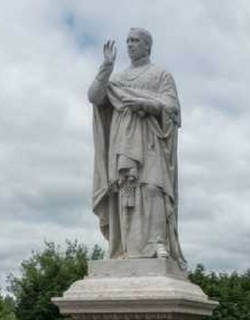
(Pictured: Statue of Gaelic Chieftain Red Hugh O’Donnell in County Donegal)
Saint Gelasius of Armagh B (AC), also known as Giolla Iosa and Gioua-Mac-Liag, dies on March 27, 1174. The son of the Irish poet Diarmaid, Saint Gelasius (meaning `servant of Jesus’) is the learned abbot of Derry for sixteen years. He is consecrated Archbishop of Armagh c. 1137, when Saint Malachy resigns and serves as Primate of Ireland until 1174.
During his long episcopacy, Gelasius has to deal with the events before and after the Norman invasion, including the alleged Donation of Ireland by Pope Adrian IV to Henry II of England, Henry’s arrival in Ireland in 1171, and Pope Alexander III’s confirmation of everything granted by Adrian IV.
Gelasius reconstructs the Cathedral of Armagh and, in 1162, consecrates Saint Laurence O’Toole as Archbishop of Dublin, although the invasion and settlement of Dublin by Norsemen means that the Christians of that see are looking more to Canterbury than Armagh. That same year, during the Synod of Clane in County Kildare, a uniform liturgy is ensured throughout Ireland by requiring that only Armagh-trained or Armagh-accredited teachers of divinity may teach in any school attached to the Irish Church.
Gelasius is an indefatigable prelate. He makes constant visitations throughout Ireland, reorganizes old monasteries, and convenes synods. He is said to be the first Irish bishop to whom the pallium is sent. Pope Eugene III’s papal legate, Cardinal Giovanni Paparoni, brings four pallia with him to the Synod of Kells in 1152 for the archbishops of Armagh, Cashel, Dublin, and Tuam. The records of this synod include the first mention of tithes in Irish annals, which Cardinal Paparoni proposes but none of the participants support. The matter of tithes and the Peter’s Pence is an important consideration in subsequent negotiations between Pope Adrian IV and Henry II of England.
Gelasius convenes another synod at Armagh in 1170 in the hope of finding some means to expel the Anglo-Normans, who had invaded the country the previous year, before they become too entrenched. In 1171, Henry II of England arrives, lavishly entertains the civic and ecclesiastic Irish leaders, and requests the convening of the Synod of Cashel, during which he presents a plan for improving the Church of Ireland. At this time there is no mention of any claim of Canterbury or the Donation. However, the eighth canon of the synod decrees that the Irish Church will celebrate the Divine Office according to the usage of the Church of England, which is still Catholic at the time.
The bishop of Armagh does not attend the Synod of Cashel. At the time he is occupied in a visitation of Connacht and Ulster in an attempt (in concert with the high king) to organize a defense of Ireland. He realizes that Henry II has duped many Irish princes by masking his true intentions.
The following year Henry II falls under interdict for his murder of Saint Thomas Becket. When news of HenryII’s penitential, bare-foot walk to the shrine of Saint Thomas and his plans for the `uplift’ of the Irish Church reaches Rome, Pope Alexander III confirms the Donation of Ireland made by Pope Adrian IV. Shortly thereafter the Church of Ireland became English, the School of Armagh is closed (c. 1188) and the last native bishop of Armagh until the Reformation dies in 1313.
(From: “Saints of the Day – Gelasius of Armagh” by Katherine I Rabenstein, CatholicSaints.Info (www.catholicsaints.info) | Pictured: Arms of the Archbishop of Armagh, in the Church of Ireland)
MacHale’s parents are Patrick and Mary Mulkieran MacHale. He is so feeble at birth that he is baptised at home by Father Andrew Conroy. By the time he is five years of age, he begins attending a hedge school. Three important events happen during his childhood: the Irish Rebellion of 1798, the landing at Killala of French troops, whom the boy, hidden in a stacked sheaf of flax, watches marching through a mountain pass to Castlebar, and a few months later the brutal hanging of Father Conroy on a false charge of high treason.
With his friend and ally, Daniel O’Connell, MacHale takes a prominent part in the important question of Catholic emancipation, impeaching in unmeasured terms the severities of the former penal code, which had branded Catholics with the stamp of inferiority. During 1826 his zeal is omnipresent. He calls on the Government to remember how the Act of Union in 1800 was carried by William Pitt the Younger on the distinct assurance and implied promise that Catholic emancipation, which had been denied by the Irish Parliament, should be granted by the Parliament of the Empire.
Oliver Kelly, Archbishop of Tuam, dies in 1834, and the clergy selects MacHale as one of three candidates, to the annoyance of the Government who despatches agents to induce Pope Gregory XVI not to nominate him to the vacant see. Disregarding their request, the pope appoints MacHale Archbishop of Tuam. He is the first prelate since the Reformation who has received his entire education in Ireland. The corrupt practices of general parliamentary elections and the Tithe War cause frequent rioting and bloodshed and are the subjects of denunciation by the new archbishop, until the passing of a Tithes bill in 1838. He also leads the opposition to the ProtestantSecond Reformation, which is being pursued by evangelical clergy in the Church of Ireland, including the Bishop of Tuam, Killala and Achonry, Thomas Plunket.
The repeal of the Acts of Union 1800, advocated by O’Connell, enlists MacHale’s ardent sympathy and he assists the Liberator in many ways, and remits subscriptions from his priests for this purpose. In his zeal for the cause of the Catholic religion and of Ireland, so long downtrodden, but not in the 1830s, he frequently incurs from his opponents the charge of intemperate language, something not altogether undeserved. In his anxiety to reform abuses and to secure the welfare of Ireland, by an uncompromising and impetuous zeal, he makes many bitter and unrelenting enemies, particularly British ministers and their supporters.
The Great Famine of 1846–47 affects his diocese more than any. In the first year he announces in a sermon that the famine is a divine punishment on his flock for their sins. Then by 1846 he warns the Government as to the state of Ireland, reproaches them for their dilatoriness, and holds up the uselessness of relief works. From England as well as other parts of the world, cargoes of food are sent to the starving Irish. Bread and soup are distributed from the archbishop’s kitchen. Donations sent to him are acknowledged, accounted for, and disbursed by his clergy among the victims.
The death of O’Connell in 1847 is a setback to MacHale as are the subsequent disagreements within the Repeal Association. He strongly advises against the violence of Young Ireland. Over the next 30 years he becomes involved in political matters, particularly those involving the church. Toward the end of his life he becomes less active in politics.
MacHale attends the First Vatican Council in 1869. He believes that the favourable moment has not arrived for an immediate definition of the dogma of papal infallibility. Better to leave it a matter of faith, not written down, and consequently he speaks and votes in the council against its promulgation. Once the dogma had been defined, he declares the dogma of infallibility “to be true Catholic doctrine, which he believed as he believed the Apostles’ Creed“. In 1877, to the disappointment of the archbishop who desires that his nephew should be his co-adjutor, Dr. John McEvilly, Bishop of Galway, is elected by the clergy of the archdiocese, and is commanded by Pope Leo XIII after some delay, to assume his post. He had opposed this election as far as possible but submits to the papal order.
Every Sunday MacHale preaches a sermon in Irish at the cathedral, and during his diocesan visitations he always addresses the people in their native tongue, which is still largely used in his diocese. On journeys he usually converses in Irish with his attendant chaplain and has to use it to address people of Tuam or the beggars who greet him whenever he goes out. He preaches his last Irish sermon after his Sunday Mass, April 1881. He dies in Tuam seven months later, on November 7, 1881.
Unlike similar organisations of the time, which are antiquarian in nature, the SPIL aims at protecting the status of the Irish language, which is threatened with extinction at the time. Its mission statement says that it is “possible and desirable to preserve the Irish Language in those parts of the Country where it is spoken, with a view to its further extension and cultivation.” Hyde writes that the formation of the society can truly be said to be the first attempt made to recruit the common people to the cause of the Irish language. The society succeeds in having Irish included on the curriculum of primary and secondary schools and third-level colleges in 1878.
Nolan becomes involved in the nascent home rule campaign of the Home Rule League. On February 8, 1872, he is elected MP for Galway County in a by-election, defeating by a large majority the Conservative William Le Poer Trench. Of the 4,686 available electors, who are chiefly Catholic, 2,823 vote for Nolan and 658 for Trench.
Trench appeals the result, claiming on petition that there is widespread intimidation during the election campaign. The local Catholic bishops and clergy had strongly supported Nolan, chiefly because the family of his opponent, a Captain Trench, was active in proselytism. The trial of the Galway County Election Petition begins, before Judge William Keogh, on April 1 and ends on May 21, 1872.
Judge Keogh finds that Nolan had been elected by the undue influence and intimidation and in his report states that he found 36 persons guilty of undue influence and intimidation, including John MacHale, the Archbishop of Tuam, the Bishop of Clonfert, Patrick Duggan, and the Bishop of Galway, John McEvilly, and twenty-nine named priests, such intimidation being in some cases exercised in the very churches. As a result, Nolan is unseated on June 13, with the seat going to Trench. The judgement causes an uproar. The judge is threatened with removal from the bench and his reputation never recovers.
Nolan retakes the seat at the 1874 election. He remains MP after the 1885 constituency reforms as MP for Galway North until 1895.
When the Irish Parliamentary Party splits over Charles Stewart Parnell‘s long-term family relationship with Katharine O’Shea, the separated wife of a fellow MP, Nolan sides with his deposed leader and seconds the motion to retain Parnell as chairman at the ill-fated party meeting in Committee Room 15 of the House of Commons. He goes on to become whip of the pro-Parnellite rump of the split party, the Irish National League. He loses the Galway North seat to an Anti-Parnellite, Denis Kilbride, in 1895 and stands unsuccessfully as a Parnellite for South Louth in 1896. He is re-elected unopposed at Galway North after the reunification of the Parliamentary Party in 1900 but loses the seat again for the final time in 1906 when he stands as an Independent Nationalist.
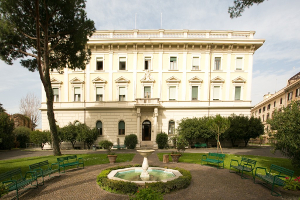
The Pontifical Irish College, a Roman Catholic seminary for the training and education of priests, is founded in Rome, Italy, on November 6, 1628.
Towards the close of the sixteenth century, Pope Gregory XIII sanctions the foundation of an Irish college in Rome and assigns a large sum of money as the nucleus of an endowment. However, the pressing needs of the Irish chieftains make him think that, under the circumstances, the money might as well be used for religion by supplying the Irish Catholics with the sinews of war in Ireland as by founding a college for them at Rome.
The project is revived in 1625 by the Irish bishops, in an address to Pope Urban VIII. Cardinal Ludovico Ludovisi, who is Cardinal Protector of Ireland, resolves to realize at his own expense the desire expressed to the pope by the Irish bishops. A house is rented opposite Sant’Isodoro a Capo le Case, and six students go into residence January 1, 1628. Eugene Callanan, Archdeacon of Cashel, is the first rector, Father Luke Wadding, OFM being a sort of supervisor. Cardinal Ludovisi dies in 1632 and as he is of a princely family with a large patrimony, he makes provision in his will for the college. It is to have an income of one thousand crowns a year, a house is to be purchased for it, and he leaves a vineyard as Castel Gandolfo where the students might pass their villeggiatura. The cardinal’s will directs that the college should be placed under the charge of the Jesuits. Both the heirs and Wadding suspect that provision and disputed it. A protracted lawsuit is finally decided in 1635 in favour of the Jesuits.
On February 8, 1635, the Jesuits take charge of the college and govern it until financial difficulties force them to give up control in September 1772. An Italian priest, Abbate Luigi Cuccagni, is made rector. The rectorate of Cuccagni comes to an end in 1798, when the college is closed by order of Napoleon.
Dr. Michael Blake, Bishop of Dromore, who is the last student to leave the college at its dissolution in 1798, returns a quarter of a century later to arrange for its revival, which is affected by a brief of Pope Leo XII, dated February 18, 1826. He becomes the first rector of the restored college, and among the first students who seek admission is Francis Sylvester Mahony of Cork, known to the literary world as Father Prout. Having set the college well to work, Blake returns to Ireland and is succeeded by Dr. Boylan, of Maynooth, who soon resigns and dies in 1830. He is succeeded by a young priest, later CardinalPaul Cullen.
Dr. Cullen is succeeded by Dr. Tobias Kirby, known for his holiness of life. He governs the college for more than forty years. His successor is Michael Kelly, later coadjutor to the Archbishop of Sydney.
In 2011, under orders from Pope Benedict XVI, Cardinal Timothy Dolan, Archbishop of New York, leads a root and branch review of all structures and processes at the college. He is assisted in the visitation report by then Archbishop of Baltimore and now Cardinal Edwin O’Brien and Msgr. Francis Kelly of the Northern American College in Rome. The report is highly critical of the college and, as a result of which, three Irish members of the staff are sent home and a fourth resigns.
Today the Pontifical Irish College serves as a residence for clerical students from all over the world. Every year over 250 Irish couples choose the college chapel as a means to marry in Rome. It organises events for the Irish and wider international community who are currently residing in Rome and has over the years become an unofficial centre for Irish visitors to Rome seeking advice and information.






 seamus dubhghaill