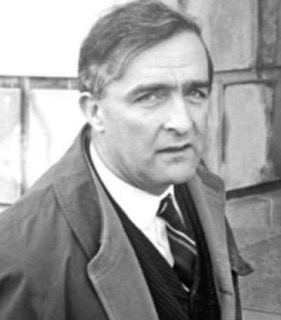
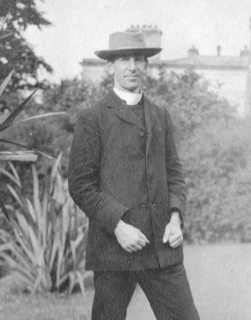
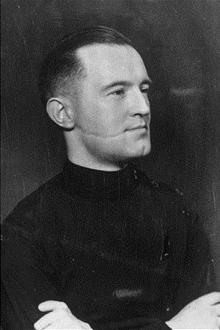
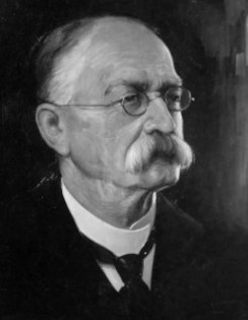
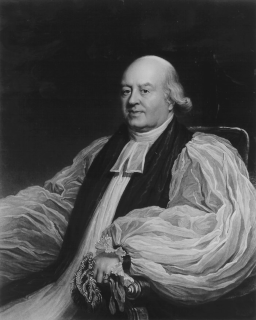
Discontented with James Chichester-Clark and Brian Faulkner who come to government after O’Neill’s 1969 fall from power, Boal resigns from the UUP in 1971 and joins Ian Paisley in establishing the Democratic Unionist Party (DUP) in order to provide dissident unionist opinion with a viable political alternative. He works as the first chairman and one of the first public representatives of the DUP and continues to sit in Stormont during the years of 1971–1972. He later resumes his practice as a barrister.
While Boal’s interest in federalism diminishes after the 1970s, the federalist Boal scheme of January 1974 is again put forward by liberal protestants such as John Robb as late as 2007. His friendship with Paisley finally breaks when the DUP agrees to enter government with Sinn Féin in 2007. He tells Paisley, who takes the breach very hard, that he had betrayed everything he ever advocated.
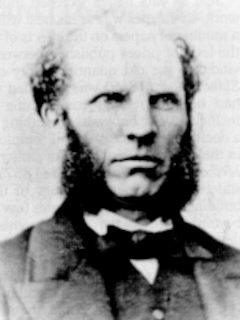
Cairnes is born on December 26, 1823, at Castlebellingham, County Louth, the son of William Elliott Cairnes (1787–1863) of Stameen, near Drogheda, and Marianne Woolsey, whose mother is the sister of Sir William Bellingham, 1st Baronet of Castlebellingham. William decides upon a business career, against the wishes of his mother, Catherine Moore of Moore Hall, Killinchy, and becomes a partner in the Woolsey Brewery at Castlebellingham. In 1825, he starts on his own account in Drogheda, making the Drogheda Brewery an unqualified success. He is remembered for his great business capacity and for the deep interest he takes in charity.
After leaving school, Cairnes spends some years in the counting house of his father at Drogheda. His tastes, however, lay altogether in the direction of study, and he is permitted to enter Trinity College Dublin, where he takes the degree of BA in 1848, and six years later that of MA. After passing through the curriculum of Arts, he engages in the study of Law and is called to the Irish bar. But he lacks a desire to pursue the legal profession, and over some ensuing years, he devotes himself to writing in various publications about social and economic questions and treatises that relate to Ireland. He focuses mostly on political economy, which he studies thoroughly.
While residing in Dublin, Cairnes makes the acquaintance of the Archbishop of DublinRichard Whately, who conceives a very high respect for Cairnes’ character and abilities. In 1856, a vacancy occurs in the chair of political economy at Dublin, founded by Whately, and Cairnes receives the appointment. In accordance with the regulations of the foundation, the lectures of his first year’s course are published. The book appears in 1857 with the title Character and Logical Method of Political Economy. It follows up on and expands John Stuart Mill‘s treatment in the Essays on some Unsettled Questions in Political Economy and forms an admirable introduction to the study of economics as a science. In it the author’s peculiar powers of thought and expression are displayed to the best advantage. Logical exactness, precision of language, and firm grasp of the true nature of economic facts, are the qualities characteristic of this as of all his other works. If the book had done nothing more, it would still have conferred inestimable benefit on political economists by its clear exposition of the true nature and meaning of the ambiguous term law. To the view of the province and method of political economy expounded in this early work the author always remains true, and several of his later essays, such as those on Political Economy and Land, Political Economy and Laissez-Faire, are but reiterations of the same doctrine. His next contribution to economical science is a series of articles on the gold question, published partly in Fraser’s Magazine, in which the probable consequences of the increased supply of gold attendant on the Australian and Californian gold discoveries are analysed with great skill and ability. And a critical article on Michel Chevalier‘s work, On the Probable Fall in the Value of Gold, appears in the Edinburgh Review for July 1860.
In 1861, Cairnes is appointed to the professorship of jurisprudence and political economy in Queens College Galway, and in the following year he publishes his admirable work The Slave Power, one of the finest specimens of applied economic philosophy. The inherent disadvantages of the employment of slave labour are exposed with great fullness and ability, and the conclusions arrived at have taken their place among the recognised doctrines of political economy. The opinions expressed by Cairnes as to the probable issue of American Civil War are largely verified by the actual course of events, and the appearance of the book has a marked influence on the attitude taken by serious political thinkers in England towards the Confederate States of America.
During the remainder of his residence at Galway, Cairnes publishes nothing beyond some fragments and pamphlets, mainly upon Irish questions. The most valuable of these papers are the series devoted to the consideration of university education. His health, at no time very good, is still further weakened in 1865 by a fall from his horse. He is ever afterwards incapacitated from active exertion and is constantly liable to have his work interfered with by attacks of illness.
In 1866, Cairnes is appointed professor of political economy in University College, London. He is compelled to spend the session 1868–1869 in Italy, but on his return continues to lecture until 1872. During his last session he conducts a mixed class, ladies being admitted to his lectures. His health soon renders it impossible for him to discharge his public duties. He resigns his post in 1872 and retires with the honorary title of professor emeritus of political economy. In 1873 his own university confers on him the degree of LL.D.
Cairnes dies at the age of 51 at Blackheath, London, England, on July 8, 1875.
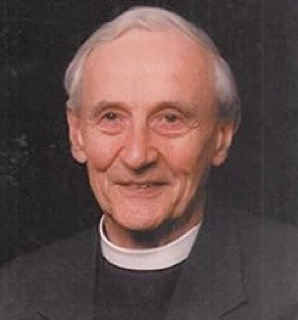
He is appointed Dean of Cork in 1952. Consecrated a bishop, he serves as Bishop of Cork, Cloyne and Ross, between 1952 and 1956. At forty-two, he is the youngest Church of Ireland clergyman appointed to a bishopric since John Gregg in 1915. He serves as Archbishop of Dublin from 1956 to 1969. During this time, he maintains a courteous relationship with John Charles McQuaid, his Roman Catholic counterpart as Archbishop of Dublin. From 1969 to 1980, he serves as Archbishop of Armagh.
Alongside CardinalWilliam Conway, Simms chairs the first official ecumenical meeting between the leaders of Ireland’s Protestant Churches and the Catholic Church in Ballymascanlon Hotel, Dundalk, County Louth, on September 26, 1973, an important meeting amidst the increasing violence in Northern Ireland. The meeting is protested by Ian Paisley.
Simms is a scholar, and publishes research on topics including the history of the Church of Ireland, and theological reflections on key texts including the Book of Kells, Saint Patrick’s Breastplate, and the Sarum Primer. He is also a fluent speaker of the Irish language.
Simms is also an accomplished journalist, and the author of many newspaper obituaries. His weekly Thinking Aloud column in The Irish Times is a popular reflection, and runs continuously for thirty-eight years. He also works on the research, preparation, and even performs the presentation, of a number of television programmes.
In 1978, Simms is made an honorary fellow of Trinity College Dublin.
Simms is the uncle of mathematician David J. Simms. In 1941, he marries Mercy Felicia Gwynn. They have five children. He dies in Dublin on November 15, 1991. He is interred with his wife in the cemetery attached to St. Maelruain’s Church, Tallaght, County Dublin.
The son of a local school teacher, Noonan is raised in Loughill, County Limerick. He is educated at the local National School and St. Patrick’s Secondary School in Glin, before studying to be a primary school teacher at St. Patrick’s College, Drumcondra, Dublin. He subsequently completes a BA and H.Dip. in English and Economics at University College Dublin (UCD). He begins to work as a secondary school teacher in Dublin. He develops an interest in politics from his mother, whose family had been heavily involved in Fine Gael at the local level in Limerick, and joins the Dublin branch of the party after graduating from university.
Having been involved in the local Fine Gael organisation in Limerick since the late 1960s, Noonan first holds political office in 1974, when he is elected as a member of Limerick County Council. Having built up a local profile he contests the 1981 Irish general election for the party and secures a seat in Limerick East. Upon taking his Dáil seat, he becomes a full-time politician, giving up his teaching post and resigning his seat on Limerick County Council. Though Fine Gael forms a coalition government with the Labour Party, as a first time Teachta Dála (TD), he remains on the backbenches. He serves as a TD from 1981 to 2020.
Noonan marries Florence Knightley, a native of Castlemaine, County Kerry and a primary school teacher, in 1969. They have three sons (Tim, John and Michael) and two daughters (Orla and Deirdre). In May 2010, Noonan appears on RTÉ‘s The Frontline to talk about his wife’s battle with Alzheimer’s disease. Florence Noonan dies on February 23, 2012 of pneumonia.
Goddard Henry Orpen, lawyer and historian, is born in Dublin on May 8, 1852, the fourth son of the five sons and three daughters of John Herbert Orpen, barrister, of Dublin, and Ellen Susanna Gertrude Richards, youngest daughter of Rev. John Richards of Grange, County Wexford.
On August 18, 1880, in St. Peter’s Church, Aungier Street, Dublin, Orpen marries Adela Elizabeth Richards, the daughter and heiress of Edward Moore Richards, engineer and the landlord of Grange, County Wexford. Adela is his first cousin once removed, her great-grandfather and his grandfather being the Rev. John Richards. They live for two decades after their marriage at Bedford Park, Chiswick, London, with their daughter Lilian Iris (b. 1883) and son Edward Richards (b. 1884). Soon after their marriage, he begins taking lessons in the Irish language in line with his passionate interest in Irish historical and antiquarian research, which gradually supplants his languishing legal career. He translates and edits a French rhymed chronicle about the Anglo-Norman conquest of Ireland, entitled The Song of Dermot and the Earl (1892), the title which he gives it and by which it has since generally been known in English. He also translates Émile de Laveleye‘s Le Socialisme Contemporain (The Socialism of Today, 1884), to which he adds a chapter on English socialism.
After Adela’s father transfers ownership of his estate to her in 1900, now renamed Monksgrange, the Orpens reluctantly leave London to live there, enabling Orpen to devote his time fully to research and writing. His major work is Ireland Under the Normans (Vols. 1–2, 1911; Vols. 3–4, 1920), which argue that the Norman invasion benefited the Irish, leading to advances in agriculture and trade.
Both before and after his death Orpen’s work is the subject of hostile criticism from those with more nationalist inclinations, starting with Eoin MacNeill in a series of lectures delivered in 1917. Despite his own eminence as a scholar of medieval Ireland, MacNeill resorts to unfair polemic in his attack on Orpen, caricaturing his account of pre-Norman Irish society and disregarding the more subtle nuances in his views of the English Irish relationship. In this he has been followed by generations of other scholars and readers, overlooking the depth of Orpen’s research, the perceptiveness of his interpretations, and the extent of his fieldwork on the archaeological evidence from the medieval period. Orpen takes the study of Anglo-Norman Ireland out of the realm of vague antiquarianism and professionalises it. His standards are not those of “the gentleman-amateur” as might be expected from his background, but of the twentieth century “scientific” historian, and he is therefore now widely regarded as the founder of the professional study of Anglo-Norman Ireland. Perhaps the most striking evidence of the continued validity and relevance of his work is that his four-volume Ireland Under the Normans has been twice republished in more recent years, in 1968 by Oxford University Press and in 2002 in a one-volume version by Four Courts Press.
Orpen is elected a member of the Royal Society of Antiquaries of Ireland (RSAI), serving as president in 1930–32), and the Royal Irish Academy (RIA) (1911), and contributes historical articles to their journals as well as to periodicals such as The American Historical Review (1913–14) and The Cambridge Medieval History (1932, 1936). A lecture to the New Ross Literary Society is later published as New Ross in the Thirteenth Century (1911). He also contributes a major chapter on the medieval church to the second volume of Walter Alison Phillips‘s History of the Church of Ireland (1934). Though his literary work is recognised by an honorary doctorate from TCD in 1921, he feels increasingly isolated as Monksgrange is targeted during the Irish Civil War and raided on several occasions. On religion he lists himself as an agnostic in the 1911 census.
Orpen’s final work is The Orpen Family, a personal family history printed for private circulation in 1930. A portrait of Orpen (above) by Seán O’Sullivan hangs in Monksgrange.
Orpen dies on May 15, 1932, at Monksgrange, and is buried alongside his wife Adela in St. Anne’s Churchyard, Killanne, County Wexford. His very extensive papers, including correspondence, manuscripts and drawings, as well as records and papers of the Orpen family, are held at Monksgrange. Included there is a very large collection of his photographs, a skill in which he notably distinguishes himself. A small collection of his correspondence is also held in the National Library of Ireland (NLI).
(From: “Orpen, Goddard Henry” by Philip Bull, Dictionary of Irish Biography, http://www.dib.ie, October 2009, revised March 2021 | Pictured: Portrait of Goddard Henry Orpen by Seán O’Sullivan)
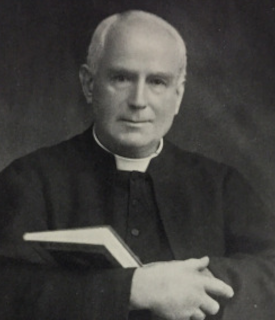
Maturin is born on February 15, 1847, at All Saints’ vicarage, Grangegorman, Dublin, the third of the ten children of the Rev. William Basil Maturin and his wife, Jane Cooke (née Beatty). The Maturins, a prominent Anglo-Irish family of Huguenot ancestry, have produced many influential Church of Ireland clergymen over the generations, the most notable being Maturin’s grandfather, the writer Charles Robert Maturin. His own father, whose tractarian convictions are considered too “high church” for many in Dublin, is a somewhat controversial figure in the church. Religion plays a huge part in the Maturin children’s lives. Two of his brothers enter the church and two sisters become nuns. As a young man, he assists in training the choir and playing the organ at his father’s church. Educated at home and at a Dublin day school, he goes on to attend Trinity College Dublin (TCD), from where he graduates BA in 1870.
Though he initially intends to make a career in the army as an engineer, a severe attack of scarlet fever around 1868, and the death of his brother Arthur, changes his outlook on life, and he decides to become a clergyman. He is ordained a deacon in 1870 and later that year goes as a curate to Peterstow, Herefordshire, England, where his father’s friend Dr. John Jebb is rector. He subsequently joins the Society of St. John the Evangelist, entering the novitiate at Cowley, Oxford, in February 1873. As a Cowley father he is sent in 1876 to establish a mission in Philadelphia, Pennsylvania, where he works as an assistant priest and, from 1881, as rector of Saint Clement’s Church. Though he proves to be an effective clergyman and popular preacher, his growing religious doubts and increasing interest in Catholicism results in his returning to Oxford in 1888. Then follows a six-month visit in 1889–90 to a society house in Cape Town, South Africa. He returns to Britain, where he preaches, and conducts retreats around the country and occasionally on the continent. In 1896 he produces the first in a series of religious publications, Some Principles and Practices of Spiritual Life.
Maturin’s continuing religious anxieties eventually lead to his conversion to Catholicism on March 5, 1897, at the JesuitBeaumont College outside London. He then studies theology at the Canadian College, Rome, and is ordained there in 1898. Following his return to England he lives initially at Archbishop’s House, Westminster, and undertakes missionary work. He then serves at St. Mary’s, Cadogan Street, in 1901. He becomes parish priest of Pimlico and, in 1905, having joined the newly established Society of Westminster Diocesan Missionaries, organises the opening of St. Margaret’s chapel on St. Leonard’s Street, where huge crowds come to hear his sermons. As a Catholic priest, he returns to Ireland on several occasions, and frequently preaches at the Carmelite church, Clarendon Street, Dublin. His attempt, at the age of sixty-three, to enter into monastic life at the Benedictinemonastery at Downside, in 1910, proves unsuccessful. He returns to London and begins working in St. James’s, Spanish Place, while maintaining his preaching commitments. He continues to write, publishing Self-Knowledge and Self-Discipline (1905), Laws of the Spiritual Life (1907) and his autobiographical The Price of Unity (1912), in which he traces his gradual move toward Catholicism. His sermons, like his approach when hearing confessions, are said to have much appeal for their integrity. Despite his influence as a preacher, he seems often feel that his life and vocation lack real purpose and at times he suffers from depression.
After a brief visit to the United States in 1913, Maturin accepts the post of Catholic chaplain at the University of Oxford in 1914. He travels to New York in 1915 and, after preaching there throughout the spring, boards the RMS Lusitania in May to return to England. The liner is torpedoed and sinks on May 7, 1915, off the southern coast of Ireland. He assists his fellow passengers in the last minutes, and it is presumed that he refuses a life jacket, as they are in short supply. His body washes ashore. A service is held for him at Westminster Cathedral.
Maturin’s friend Wilfrid Philip Ward edits a collection of his spiritual writings, Sermons and Sermon Notes, in 1916.
(From: “Maturin, Basil William” by Frances Clarke, Dictionary of Irish Biography, http://www.dib.ie, October 2009)
Gwynn is educated at St. Columba’s College, Dublin, and Trinity College Dublin. In 1896 he heads the list of Foundation Scholars in Classics at TCD. In 1898 he graduates Bachelor of Arts, gaining a “first of firsts” with gold medals in Classics and Modern Literature.
In 1900, along with his brother Edward Gwynn and others, Gwynn founds the Social Services (Tenements) Company to provide housing for poor families in Dublin. He subsequently spends many periods working with the poor in Dublin’s slums. He is instrumental in founding the Trinity Mission, which serves slum dwellers in Belfast, and is for many years actively involved in the Dublin University Fukien Mission (later the Dublin University Far Eastern Mission), eventually becoming its chairman and president.
He is ordained deacon in 1906, achieving full priesthood two years later. He is the only one of Rev. John Gwynn’s sons to be ordained, and he never serves in a parish. That same year, he proceeds to MA and is elected a Fellow of Trinity College Dublin.
In 1907 Gwynn is appointed Lecturer in Divinity and Tutor. He remains Lecturer in Divinity until 1919 and continues as Tutor until 1937. He is appointed Chaplain of TCD in 1911, retaining that post until 1919.
In January 1909 he is appointed Acting Warden of his old school, St. Columba’s College, which is facing a major financial crisis. He keeps the institution afloat until a new warden is appointed.
Horrified by the brutality of the Dublin Metropolitan Police (DMP) toward strikers during the lockout in 1913, Gwynn becomes a prominent advocate of the workers’ cause and joins the Industrial Peace Committee. On November 12, 1913, when the committee is barred from holding its meeting at the Mansion House, he invites the members to his college rooms at No. 40, New Square. It is this meeting that leads to the foundation of the Irish Citizen Army (ICA). In their history of Trinity College McDowell and Webb observe, “Gwynn’s support for the ‘army’ concept was based simply on the idea that military-style discipline would keep unemployed men fit and give them self-respect. ‘Sancta simplicitas!'”
In 1914 Gwynn marries Dr. Eileen Gertrude Glenn, a rector’s daughter from Pomeroy, County Tyrone. They have six children.
In 1916 Gwynn is appointed Professor of Biblical Greek, a post he holds for forty years (1916-56). During those four decades, he holds a number of other, often overlapping, academic appointments at the university, including Professor of Hebrew (1920-37), Registrar (1941), Vice-Provost (1941-43), Senior Lecturer (1944-50), and Senior Tutor (1950-56). In 1937 he is co-opted to Senior Fellowship. He is made an honorary fellow in 1958.
When the Dublin University Fabian Society is formed. Gwynn becomes one of its vice-presidents.
Like several of his brothers, Gwynn is a fine cricket player, in his youth captaining both his school XI and the Dublin University XI. A right-handed batsman and right-arm slow bowler, he plays once for the Ireland cricket team in 1901. He also plays four first-class matches for Dublin University in 1895. He retains a lifelong interest in the sport, and John V. Luce portrays him as President of the Dublin University Cricket Club, with his “tall rangy figure … a familiar sight at matches in College Park.”
Gwynn is tall and athletic, but in later life suffers from deafness. To aid his hearing he carries a large ear trumpet with him and this, together with his height and glowing white hair, makes him an impressive and instantly recognizable figure around Trinity College. In character, he is patient, kind and wise, but at the same time resolute and tough. His nephew-in-law, the late Archbishop of Armagh, George Simms, remarks that his “gentle humility inspired trust and drew confidences, his stubborn integrity brought surprises for those who mistook charity for easy-going indifference,” and spoke of his “Athanasian courage.”
Gwynn dies in Dublin at the age of 85 on June 25, 1962. He is buried in Whitechurch churchyard.
Joyce is the eldest of three sons of Michael Joyce, an Irish Catholic from a family of tenant farmers in Ballinrobe, County Mayo, and his wife, Gertrude (née Brooke), who although born in Shaw and Crompton, Lancashire, is from a well-off AnglicanAnglo-Irish family of physicians associated with County Roscommon. The Joyces return to Ireland in 1909. William, a precocious child, attends Coláiste Iognáid SJ, a Jesuit school in County Galway, from 1915 to 1921. At the age of fourteen, he abandons Catholicism for Anglicanism, apparently after being told that all non-Catholics, including his mother, would be damned. In adult life he is nominally anglican, though his adherence to Christianity is tenuous.
The Joyces are unionists and teach their children fervent imperialism. During the Irish War of Independence, Joyce openly associates with the Black and Tans and acts as a scout for them. An acquaintance claims that his views are so extreme even loyalists dislike him. On December 9, 1921, he flees to England to join the Worcestershire Regiment and is followed to England in 1923 by the rest of the family. When he enlists, he claims to be eighteen, but after he contracts rheumatic fever, his age is discovered, and he is discharged in March 1922. For a time, he studies mathematics and chemistry at Battersea Polytechnic Institute as a pre-medical student (1922–23), but he leaves of his own accord, with a reputation for laziness and violent political views. His studies in English and history at Birkbeck College are more successful. He is a brilliant linguist and mathematician and graduates BA with first-class honours in 1927. He publishes an academic article on philology and considers progressing to an MA. He later falsely claims that his research had been plagiarised by a Jewish academic. In 1932, he enrolls at King’s College, London, for a Ph.D. in educational psychology.
Joyce is disturbed by the difference between depressed post-war Britain and the imperial ideal that he had imbibed in Galway and is mocked for his outspoken patriotism and obvious Irishness. He identifies strongly with Thomas Carlyle, an earlier angry anti-liberal from the provinces. His life is marked by repeated episodes of hero worship, followed by disillusion and bitter denunciation. In 1923, he joins the British Fascists, an organisation that has a significant Irish loyalist membership, and in 1924 he allies himself with a militant splinter group, the National Fascists. Most British fascists see themselves as Tory auxiliaries, and they often provide a security presence at conservative meetings. On October 22, 1924, while stewarding a meeting addressed by a Jewish conservative candidate, he has his face slashed and is left with a prominent scar across his right cheek. He joins the Conservative Party in 1928 and is active in the Chelsea constituency until 1930, when he is forced out because of his eccentricities and sexual misbehaviour. On April 30, 1927, he marries Hazel Kathleen Barr. They have two daughters but separate in 1935, largely because of his infidelities, heavy drinking, and temper. The marriage is dissolved in 1937.
In November 1933, Joyce abandons his Ph.D. studies to work for Sir Oswald Mosley‘s British Union of Fascists (BUF). By early 1934 he has become its paid publicity director, traveling throughout Britain to organise meetings. He is a powerful, rabble-rousing speaker, driven by an instinctive awareness that vitriolic verbal abuse gives speaker and audience a sense of power and solidarity. MI5 sees him as a compelling, though deranged, personality. On February 8, 1937, he marries Margaret Cairns White, a BUF activist from Lancashire, with whom he had cohabited since 1936.
Joyce leads a BUF faction that favours a recruitment strategy based on uncompromising ideological assertion. This is challenged by populists who prioritise marches and displays and hold that indoctrination should follow membership. In February 1937, he is BUF candidate for the London County Council in Shoreditch. The party wins 14 percent of the vote. In March 1937, he, along with many full-time BUF staff, are sacked when the BUF cuts expenses. But his dismissal also reflects Mosley’s awareness that his obsessive rhetoric repels “respectable” recruits and that he is no longer a biddable, slavish admirer of “the Leader.” He later falsely claims near-exclusive credit for the BUF’s escalating antisemitism, a view that Mosley eventually finds it convenient to adopt in order to evade his own responsibility.
In April 1937, Joyce founds the National Socialist League, helped by a wealthy patron. He supports himself as a private tutor, refusing to take Jewish pupils. He is active in various antisemitic and pro-Nazi groups such as the Right Club and engages in “peace” campaigns based on the view that British interests lay with Germany against Russia. Political marginalisation intensifies his admiration for Nazi Germany and hero worship of Adolf Hitler. By the time of the Munich crisis in 1938, he has decided that if war comes, he will go to Germany, though he also considers moving to Ireland. He renews his British passport for one-year terms in August 1938 and August 1939.
On August 26, 1939, Joyce and his wife leave London for Berlin. He is allegedly tipped off about his impending arrest and internment by an MI5 officer, to whom he had supplied information on communists. His siblings, whom he recruited into his fascist organisations, are variously penalised for his activities. At a loose end in Berlin, he is persuaded by a British associate to become a radio announcer with the English-language service of the Reichs-Rundfunk-Gesellschaft (RRG). He makes his first broadcast on September 6, 1939, and receives a contract in October. He finds in radio an outlet for his forceful style and delight in saying the unsayable, and in the early years of the war takes an exultant pride in recounting Nazi victories. His performances are admired by Joseph Goebbels, whom Joyce, to his regret, never meets. On September 26, 1940, he acquires German citizenship.
The novel experience of hearing the enemy in one’s own living room attracts wide audiences in Britain. Joyce’s practice of naming newly captured prisoners of war in his broadcasts is also a compelling motive for listening. In fact, he tries to recruit British prisoners of war as collaborators. The name “Lord Haw-Haw,” invented by the Daily Express radio critic in September 1939, initially applies to several English-language broadcasters but in time becomes associated with Joyce. He is initially a figure of fun, imitated by comedians, but there are sinister undercurrents of terrifying omnipotence, intensified by his sneering, gloating delivery and his delighted deployment of the “big lie” technique. It is widely believed that British-based fifth columnists supply him with information, that he predicts air raids, and shows minute local knowledge. In time, fear and his growing notoriety feed popular hatred of him in Britain, though his anti-British taunts allegedly win appreciative Irish audiences. He exults that he is daily committing treason and rendering himself liable to the death penalty.
In 1940, Joyce publishes a commissioned self-justifying propaganda work, Twilight over England. His representation of himself echoes that of Hitler in Mein Kampf – the provincial patriot, whose martial sacrifices are betrayed by corrupt elites, learning through poverty the hollowness of bourgeois patriotism and the need to synthesise socialism with nationalism. He shares with his hero a paranoid belief in his own ability to create an alternative reality through language and obstinacy. He dreams of becoming the English Führer.
In Berlin, the Joyces’ marriage comes under increasing strain, marked by drunken rows, domestic violence, and infidelity on both sides, though they retain a fierce mutual fascination. They divorce on August 12, 1941, but remarry on February 11, 1942, while continuing their previous behaviour. As the Axis powers begin to fail, his broadcasts become more defensive, focusing on the Soviet threat. On October 14, 1944, he is awarded the German War Merit Cross, first class. On October 22, he is sworn into the Volkssturm (territorial army) and begins drilling. The Joyces are evacuated from Berlin in March 1945, initially to Apen near the Dutch border and then to Hamburg, where he makes a last, drunken, defiant broadcast on April 30, 1945, the day of Hitler’s death. After an unsuccessful attempt to escape to Sweden, the Joyces hide at Flensburg near the Danish border. On May 28, 1945, he is shot and captured while gathering firewood.
Joyce is brought back to Britain on June 16 after Parliament passed legislation simplifying treason trial procedures. At his September 17-20 trial, he proves his American citizenship, but the court holds that his illegally acquired British passport incurred duties of allegiance. His appeals are rejected by the Court of Appeal and the House of Lords. His fate is influenced by British public opinion, and possibly by a desire to avoid antagonising the Soviet Union. In his death cell he blames the defeat of national socialism on German limitations. He also fantasises that he could have saved Hitler from his incompetent subordinates.
Joyce is hanged by Albert Pierrepoint at Wandsworth Prison on January 3, 1946. Unlike most of his fellow Nazis, he proclaims to the end his allegiance to national socialism and hatred of Jews. He corresponds cheerfully with Margaret, joking evasively about the death camps and expressing a belief that his spirit will survive, watch over her, and continue his work. To neo-Nazis he becomes a martyr. Even among those to whom his activities had been repellent, a significant body of opinion holds he should not have been condemned on a questionable and innovative technicality. The historian A. J. P. Taylor maintains that Joyce was executed for making a false declaration to obtain a passport, a misdemeanour that normally incurs a £2 fine.
In 1976, Joyce is reinterred in Galway as it is feared that a grave in England might become a fascist shrine. Thomas Kilroy‘s play Double Cross (1986) juxtaposes Joyce and Brendan Bracken as Irishmen who reinvented themselves through fantasies of Britishness. The BBC Sound Archive has recordings of some of Joyce’s broadcasts and transcripts of others, collected during the war as evidence for a future treason trial.
(From: “Joyce, William Brooke (‘Lord Haw-Haw’)” by Patrick Maume, Dictionary of Irish Biography, http://www.dib.ie, October 2009)
MacFarland is the elder son of John MacFarland, draper, and his second wife Margaret Jane, daughter of Rev. William Henry, a famous Covenanting Church minister. Both parents are devout Presbyterians, well educated, with strong intellectual interests.
MacFarland teaches at Repton School in Derbyshire from 1876 to 1880. A decade later, his younger brother Robert, also a Queen’s Belfast and Cambridge mathematics graduate, also teaches at Repton.
The emissaries of the provisional council of Ormond College in the University of Melbourne are impressed with MacFarland. He negotiates a salary of £600 plus the profit from “farming” the college. On March 18, 1881, he becomes the first master of Ormond College, passing the opening-day ordeal in the presence of 440 Presbyterian grandees, clergy and their ladies.
On Sir John Madden‘s death in 1918, MacFarland becomes chancellor of the university and is knighted in 1919. He presides over a period of considerable expansion, working closely with Sir John Monash, vice-chancellor from 1923, and Sir James Barrett.
MacFarland is immensely and properly proud of his careful financial management, but the erstwhile reformers are hardly tender enough in balancing economy with humanity. The professors become increasingly restive about the limited responsibility for academic matters and allocation of resources council allows them. When the issues come to a head in 1928, MacFarland’s prestige is too much for the professoriate who have great respect for his administrative capacity, humanity and reasonableness. Even in his eighties he does not retire as chancellor, probably wisely concluding that his likely successor, Barrett, will prove to be too divisive.
MacFarland’s reputation as a business manager leads to his directorship from about 1905 of the National Mutual Life Association, serving as chairman from 1928, and of the Trustees Executors and Agency Company. From 1913 he represents the Trustees Executors on the Felton Bequests Committee. He is also the popular chairman from its foundation in 1908 of the Alexandra Club Co. as the members of the leading female social club prefer men to control their finances.
In his younger days MacFarland is a vigorous cyclist and walker in the Australian Alps, Tasmania and New Zealand. By the age of 40 he is spending a month each summer trout-fishing in the South Island of New Zealand. He is also a regular golfer at Royal Melbourne and belongs to the Melbourne Club.
“Few men in any community, and almost no man in this community, can have won such universal esteem. No evil was ever spoken of him or could be thought of in connection with him; before him evil quailed. The greatest disciple of the greatest of the Greeks called his dead master ‘our friend whom we may truly call the wisest, and the justest, and the best of all men we have ever known’. And many of us can sincerely say that of John Henry MacFarland.”
(From: “Sir John Henry MacFarland (1851-1935)” by Geoffrey Serle, Australian Dictionary of Biography, http://www.adb.anu.edu.au, 1986)
His birth into the politically influential Beresford family affords him a degree of opportunity, and he is made a vice-regal chaplain in 1766. Brother of George de la Poer Beresford, 1st Marquess of Waterford, he marries Elizabeth Fitzgibbon, sister of John FitzGibbon, 1st Earl of Clare, on June 16, 1763. They had three sons and five daughters. These connections, however, do not automatically result in his being promoted to bishop, despite reaching episcopal age in 1773, and he spends several years as a well-beneficed rector of Urney in the Diocese of Derry. The Beresford family complains that he has been overlooked for several episcopal vacancies in the 1770s and it is not until 1780 that he is created Doctor of Divinity and consecrated Bishop of Dromore on April 8, 1780. At Dromore he erects a handsome new episcopal residence. On May 21, 1782, he is transferred to the diocese of Ossory and, as bishop there, takes his seat in the Irish parliament and exercises influence over the ecclesiastical borough of St. Canice.
The death of Primate Richard Robinson in 1794 is the stimulus for a reorganisation within the Church of Ireland hierarchy, and Beresford is one of the candidates rumoured to succeed him. However, his familial ties disadvantage him, because the government does not want to favour one Irish “party” over another. He is instead appointed to the vacant archbishopric of Tuam on October 10, 1794. An influential and senior position within the church, it is worth £5,000 per annum, which is more than Archbishop Charles Agar receives for the archbishopric of Cashel and provides him with extensive patronage.
In the late 1790s Beresford regularly attends parliament, particularly in the crucial session of 1799 as the Acts of Union is debated and shares his brother John’s view that a union is the best means of securing the Protestant interest in Ireland.
In the years following the union Beresford gains a temporal peerage, becoming 1st Baron Decies on December 22, 1812. He is an amiable, kind and loquacious individual, and is patron to artists, including Gilbert Stuart, who produces a portrait of him as Bishop of Ossory. His long years of service within the established church also makes him very wealthy, worth £250,000 at the time of his death.
Beresford dies on September 6, 1819, at Tuam, County Galway, and is succeeded in the barony by his eldest surviving son John on September 8, 1819. His eldest son Marcus had died in 1803. His youngest daughter Louisa, widow of Thomas Hope, marries, by special license, her cousin William Carr Beresford on November 29, 1832. Through Louisa he is a grandfather of British MP and patron of the arts, Henry Thomas Hope.
(From: “Beresford, William” by Martin McElroy, Dictionary of Irish Biography, http://www.dib.ie, October 2009, revised June 2024)