seamus dubhghaill

Promoting Irish Culture and History from Little Rock, Arkansas, USA


2 Comments

Birth of Georgie Hyde-Lees Yeats, Wife of Poet W. B. Yeats

Georgie Hyde-Lees Yeats, the wife of the poet William Butler Yeats, is born Bertha Hyde-Lees in Fleet, Hart District, Hampshire, England, on October 16, 1892.

Hyde-Lees is the daughter of militia captain (William) Gilbert Hyde-Lees (1865–1909), of the Manchester Regiment, and Edith “Nelly” Ellen (1868–1942), daughter of barrister and manufacturer Montagu Woodmass, JP. Her father is regarded by her mother’s family as “a most undesirable character, but ‘rolling in money,'” having taken up the life of a “gentleman alcoholic” on resigning his commission after receiving an inheritance from his wealthy uncle Harold Lees, of Pickhill Hall, near Wrexham, then part of Denbighshire. He is “attractive, reckless, witty, and… musical,” and fond of pranks. She has an elder brother, Harold (1890–1963), who becomes a clergyman, with “rigid moral standards” and “a less than joyous existence,” his only indulgence being “a fine collection of drawings and etchings.” When she is only a few years old, her parents’ marriage fails due to her father’s alcoholism. Her father has enough income to support his family, allowing Georgie and her mother to spend “a good deal of their time” travelling in Europe, but his wife is in the awkward social position of being a “married woman without a husband.” The family lives a vaguely bohemian and nomadic lifestyle, travelling frequently to country homes and spending long periods visiting relatives.

Hyde-Lees attends a number of schools in Knightsbridge, London art schools, studies languages and classics, and piano. She becomes a close friend of Dorothy Shakespear, who is fond of Georgie and shares many of her interests despite being six years her senior. After the death of her father in 1909 at the age of 44, her mother marries Dorothy’s uncle, Henry Tucker, Olivia Shakespear‘s brother, and they move to Kensington.

Hyde-Lee’s mother often brings young musicians and artists she has recently met to Olivia Shakespear’s salon, many of whom become well-known modernists, including Ezra Pound, Walter Rummel, and Frederic Manning. She continues to make the rounds of country estates with her mother and Olivia and Dorothy Shakespear. It is in their company in 1910 or 1911, as a seventeen-year-old, that one morning she meets W. B. Yeats at the British Museum and again that afternoon during tea at the Shakespears.

Seven years later, when Hyde-Lees is 25 and Yeats is 52, he asks her to marry him. Only a few weeks earlier, Iseult Gonne, the daughter of Maud Gonne whom Yeats had loved for many years, had rejected his marriage proposal. She and Yeats marry just three weeks later, on October 20, 1917, in a public register office, witnessed by her mother and Ezra Pound. During the honeymoon, while Yeats is still brooding about Iseult’s rejection, she begins the automatic writing which fascinates him. Yeats writes about her psychography days later in what is to be A Vision (1925), and it holds the marriage together for many years. Within a year of marriage, Yeats declares her name of Georgie to be insufferable, and henceforth calls her George.

The couple has two children, Anne and Michael. Hyde-Lees Yeats dies on August 23, 1968, in Rathmines, County Dublin. She is buried at Drumcliff Churchyard, Drumcliff, County Sligo.


Leave a comment

Death of Louise Gavan Duffy, Educator & Irish Language Enthusiast

Louise Gavan Duffy, educator, Irish language enthusiast and a Gaelic revivalist, dies in Dublin on October 12, 1969. She sets up the first Gaelscoil in Ireland. She is also a suffragist and Irish nationalist who is present in the General Post Office, the main headquarters during the 1916 Easter Rising.

Duffy is born in Nice, France, on July 17, 1884, the daughter of the Irish nationalist Sir Charles Gavan Duffy, one of the founders of The Nation and his third wife, Louise (née Hall) from Cheshire, England. Her mother dies when she is four. She is then raised in Nice by her Australian half-sisters from her father’s second marriage. It is a well-to-do and culturally vibrant home where she is exposed to political figures and ideas.

Duffy’s brother George Gavan Duffy, one of the signatories to the Anglo-Irish Treaty in 1921, is an Irish politician, barrister and judge. Her half-brother Sir Frank Gavan Duffy is the fourth Chief Justice of the High Court of Australia, sitting on the bench from 1913 to 1935. Another brother works most of his life as a missionary in the French colony of Pondicherry.

Duffy’s first visit to Ireland is in 1903, at the age of 18, when her father dies and is buried in Glasnevin Cemetery. This is when she first hears Irish spoken. She finds a grammar book in a bookshop and becomes curious. Her father was not an Irish speaker, though her grandmother in the early 1800s was likely fluent.

Duffy spends the years between 1903 and 1907 between France and England. She takes courses through Cusack’s College in London so that she can matriculate.

Duffy decides to continue her studies in Dublin but cannot afford to move until she receives a small inheritance from her grandmother on the Hall side of the family. Once in Ireland in 1907, at the age of 23, she begins her university studies, taking arts. She lives in the Women’s College, Dominican Convent, as women are not allowed to attend lectures in the Royal University of Ireland. She goes occasionally to the Gaeltacht to learn Irish. Graduating in 1911 with a Bachelor of Arts from University College Dublin (UCD), she is one of the first women to do so.

Given the lack of teachers, even without a full qualification, Duffy then teaches in Patrick Pearse‘s St. Ita’s school for girls in Ranelagh. She studies with the Dominicans again in Eccles Street, gaining a Teaching Diploma from Cambridge University.

A supporter of women’s suffrage, Duffy speaks at a mass meeting in Dublin in 1912 in favour of having the Home Rule bill include a section to grant women the vote. She also joins the Irish republican women’s paramilitary organisation Cumann na mBan, as a founding member in April 1914, serving on the provisional committee with Mary Colum, as a co-secretary.

Duffy is aware that being a suffragist and a nationalist are not necessarily the same thing, realising her involvement in Cumann na mBan is in support of nationalism. When St. Ita’s closes due to funding problems in 1912, she takes the opportunity to complete her qualifications. After receiving her Cambridge teacher’s diploma in 1913, she returns to UCD to study for a Master of Arts degree.

Duffy is in fact working on her master’s thesis during the Easter break in 1916 when the rumour comes to her that the Rising has begun in Dublin city centre. She walks to the Rebel headquarters in the GPO where she tells Pearse, one of the leaders, that she does not agree with the violent uprising.

Duffy spends all of Easter week working in the GPO kitchens with other volunteers like Desmond FitzGerald and a couple of captured British soldiers, ensuring the volunteers are cared for. The women in the GPO are given the opportunity to leave under the protection of the Red Cross on the Thursday as the shelling of the building has caused fires, but almost all of them refuse. In the end, she is among the second group of the people to leave the GPO on the Friday, tunnelling through the walls of the buildings to avoid coming under fire.

Duffy’s group makes it to Jervis Street Hospital where they spend the night. The next day, Saturday, Pearse formally surrenders. She heads for Jacob’s Biscuit Factory, another volunteer position, on the morning after the surrender, to see what is happening. There she finds a holdout of volunteers who are unaware of the surrender or that the fighting is over.

After 1916 Duffy is elected to the Cumann na mBan’s executive and in 1918 is one of the signatories to a petition for self-determination for Ireland which is presented to President Woodrow Wilson by Hanna Sheehy-Skeffington. During her time in the GPO, she had collected names of the volunteers and promised to take messages to their families. This possibly influences her in being involved in the National Aid Association and Volunteers Dependants Fund. In the aftermath of the rebellion there are 64 known dead among the volunteers, while 3,430 men and 79 women are arrested. Families need support. These organisations are able to arrange funding from the United States.

In 1917, Duffy co-founds and runs Scoil Bhríde, as a secondary school for girls in Dublin through the medium of Gaelic. It is still in operation as a primary school. Her co-founder is Annie McHugh, who later marries Ernest Blythe. The end of the Rising leads to the Irish War of Independence (1919-21). During this time, she is mostly focused on the school. However, it is raided by the military and Duffy later admits it is in fact used for rebel meetings and to safeguard documents. In October 1920, the Irish leader Michael Collins meets Archbishop Patrick Clune there in secret. In an effort to support the nationwide boycott of the police, the Royal Irish Constabulary (RIC), in 1920, she has a leaflet sent to all branches of Cumann na mBan which states in part that the RIC are the “eyes and ears of the enemy. Let those eyes and ears know no friendship.”

The war ends with the Anglo-Irish Treaty in 1921. The result is the Irish Civil War which lasts until 1923. Duffy is a supporter of the Treaty, which her brother had signed, and as such she leaves Cumann na mBan and joins Cumann na Saoirse, in which she is instrumental in founding as an Irish republican women’s organisation which supports the Pro-Treaty side.

Once the civil war is over, Duffy leaves the political arena and returns to education. She especially needs to focus on funding in the early years of the school. She works with UCD’s Department of Education from 1926, once Scoil Bhríde is recognised as a teacher training school. She publishes educational documents like School Studies in The Appreciation of Art with Elizabeth Aughney and published by UCD in 1932.

Until her retirement, Duffy also lectures on the teaching of French. She retires as principal in 1944.

Once retired, Duffy gives much of her time to the Legion of Mary and to an association which works with French au pairs in Dublin. In 1948 she is awarded an honorary Doctor of Laws by the National University of Ireland.

Recognising the importance of her first-hand experience and with a good political understanding, Duffy records her memories of the events in which she has taken part. In 1949, she gives an account of her life in relation to nationalist activities to the Bureau of Military History. She is involved in a Radio Éireann broadcast in 1956 about the women in the Rising. In 1962, she takes part in the RTÉ TV program Self Portrait broadcast on March 20, 1962. In March 1966 she gives a lecture in UCD to mark the 50th anniversary of the Rising which is published in The Easter rising, 1916, and University College Dublin (1966).

Duffy dies, unmarried, on October 12, 1969, aged 85, and is interred in the family plot in Glasnevin Cemetery.

In 2014, An Post issues a stamp to commemorate the centenary of the founding of Cumann na mBan. In 2016, for the centenary, a documentary is produced, discussing seven of the women, including Duffy, who were involved in the Easter Rising.


Leave a comment

Birth of Thomas Finlay, Judge, Politician & Barrister

Thomas Aloysius Finlay, Irish judge, politician and barrister, is born on September 17, 1922, in Blackrock, Dublin. He serves as a Teachta Dála (TD) for the Dublin South-Central constituency from 1954 to 1957, a Judge of the High Court from 1971 to 1985, President of the High Court from 1974 to 1985 and Chief Justice of Ireland and a Judge of the Supreme Court from 1985 to 1994.

Finlay is the second son of Thomas Finlay, a politician and senior counsel whose career is cut short by his early death in 1932. He is educated at Clongowes Wood College, University College Dublin (UCD) and King’s Inns. While attending UCD, he is elected Auditor of the University College Dublin Law Society. His older brother, William Finlay, serves as a governor of the Bank of Ireland.

Finlay is called to the Bar in 1944, practicing on the Midlands circuit and becomes a senior counsel in 1961.

Finlay is elected to Dáil Éireann as a Fine Gael TD for the Dublin South-Central constituency at the 1954 Irish general election. He loses his seat at the 1957 Irish general election.

Following his exit from politics in 1957, having lost his Dáil seat, Finlay resumes practicing as a barrister. He successfully defends Captain James Kelly in the infamous 1970 arms trial.

In 1971, Finlay is tasked by the Fianna Fáil government with representing Ireland before the European Commission of Human Rights, when, in response to the ill treatment of detainees by security forces in Northern Ireland, they charge the British government with torture. Despite the notional recourse such prisoners would have within the British legal system, the Commission rules the complaint admissible.

Finlay is subsequently appointed a High Court judge and President of the High Court in January 1974. In 1985, Taoiseach Garret FitzGerald and his government nominates him to the Supreme Court and to the office of Chief Justice of Ireland. On October 10, 1985, he is appointed by President Patrick Hillery to both roles.

During this period Finlay presides over a number of landmark cases, including Attorney General v X in 1992, when he overturns a High Court injunction preventing a pregnant teenage rape victim travelling to the UK for an abortion.

When, in the same year, Judge Liam Hamilton of the High Court, chair of the Beef Tribunal, seeks disclosure of the cabinet’s minutes for a particular meeting, Chief Justice Finlay along with the majority of the Supreme Court deny the request ruling that the concept of collective government responsibility in the Constitution takes precedence.

Finlay announces his resignation as Chief Justice of Ireland and retirement as a judge in 1994.

After his retirement, Finlay presides over a number of public inquiries.

In 1996, Finlay oversees the inquiry into the violence by English fans at the aborted 1995 friendly soccer match versus the Republic of Ireland at Lansdowne Road. His report to Bernard Allen, Minister for Sport, is critical of security arrangements on the night and recommends improvements to ticketing, seat-allocation, fan-vetting and policing arrangements. The Irish Government shares his report with the British Home Office.

After the collapse of The Irish Press group in 1995, the Minister for Enterprise and Employment, John Bruton, receives a damming report from the Competition Authority that Independent Newspapers has abused its dominant position and acted in an anti-competitive manner by purchasing a shareholding in The Irish Press. In September 1995, Bruton announces the Commission on the Newspaper Industry with an extremely wide remit to examine diversity and ownership, competitiveness, editorial freedom and standards of coverage in Irish newspapers as well as the impact of the sales of the British press in Ireland. Minister Bruton appoints 21 people to the commission and appoints Finlay chair. Due to the wide remit and huge number of submissions, the commission’s report is delayed but is eventually published at the end of July recommending widespread reforms.

Following the discovery of the BTSB anti-D scandal, in 1996, Finlay is appointed the chair and singular member of the Tribunal of Inquiry into the Blood Transfusion Service Board. The speed and efficiency with which his BTSB Tribunal conducts its business, restores confidence in the Tribunal as a mechanism of resolving great controversies in the public interest.

Finlay also sits on an Irish Rugby Football Union (IRFU) panel to adjudicate on the cases of Rugby players accused of using banned performance-enhancing substances.

Finlay is married to Alice Blayney, who predeceases him in 2012. They have five children, two of whom follow in his family’s legal tradition: his son John being a Senior Counsel and his daughter Mary Finlay Geoghegan a former judge of the High Court, Court of Appeal and Supreme Court. Whenever his work schedule allows, he escapes to County Mayo where he indulges his passion for fishing.

Thomas Finlay dies at the age of 95 in Irishtown, Dublin, on December 3, 2017.


4 Comments

Death of Edward Pennefather, Barrister & Lord Chief Justice of Ireland

Edward Pennefather, PC, KC, Irish barrister, Law Officer and judge of the Victorian era, who holds office as Lord Chief Justice of Ireland, dies on September 6, 1847, in Dunlavin, County Wicklow.

Pennefather is born at Darling Hill, Knockevan, County Tipperary, on October 22, 1773, the second son of William Pennefather of Knockevan, member of the Irish House of Commons for Cashel, and his wife Ellen Moore, daughter of Edward Moore, Archdeacon of Emly. He goes to school in Clonmel and graduates from Trinity College Dublin. He is called to the Irish Bar in 1795. He lives at Rathsallagh House, near Dunlavin, County Wicklow.

His brother, Richard Pennefather, has a longer and more successful career as a judge. Appointed a Baron of the Court of Exchequer in 1821, he serves for nearly 40 years and is held in universal regard. With the general support of the profession, he remains on the Bench until shortly before his death at eighty-six, by which time he is blind. Edward and Richard, “the two Pennefathers,” are leading practitioners in the Court of Chancery (Ireland).

Pennefather is generally regarded as more gifted, a master of the law of equity and also a skilled libel lawyer. In 1816, he is one of the lead counsels in the celebrated libel case of Bruce v. Grady, which arises from the publication of a scurrilous poem called “The Nosegay,” written by a barrister, Thomas Grady, about his former friend, the notably eccentric banker George Evans Brady of Hermitage House, Castleconnell, County Limerick. The quarrel is said to arise from a dispute over money which Bruce had loaned to Grady. The plaintiff claims £20000 but the jury awards £500.

Pennefather is made a King’s Counsel by 1816. He is very briefly Attorney-General for Ireland in 1830 and is made Third Serjeant-at-law (Ireland) in the same year. He becomes Second Serjeant and First Serjeant in the two following years. He is Solicitor-General for Ireland in the first Peel ministry in 1835 and again in the second Peel ministry in 1841. In the latter year, he is appointed Lord Chief Justice of the Queen’s Bench for Ireland and holds the position until he resigns on health grounds in 1846.

According to Elrington Ball, Pennefather is considered to be one of the greatest Irish advocates of his time, and one with few rivals in any age, but he does not live up to expectations as a judge, due largely to his age and increasing ill-health. As a judge he is remembered mainly for presiding at the trial of Daniel O’Connell in 1843 for sedition, where his alleged bias against the accused damages his reputation: he is accused of acting as prosecutor rather than judge, and his summing-up is described as simply an extra speech for the prosecution. Further damage to his reputation is done by the majority decision of the House of Lords quashing the verdict in the O’Connell case: while many of the errors were the fault of the prosecution, the Law Lords do not spare Pennefather for his conduct of the proceedings, and in particular for his summing-up. The Law Lords comment severely that the course of the trial, if condoned, will make a mockery of trial by jury in Ireland.

The related trial of Sir John Gray descends into farce when the Attorney-General, Sir Thomas Cusack-Smith, who is noted for his hot temper, challenges one of the defence counsel, Gerald Fitzgibbon, to a duel, for having allegedly accused him of improper motives. Pennefather tells the Attorney-General severely that a man in his position has no excuse for such conduct, whereupon the Attorney-General agrees to let the matter drop. The public notes with interest that Fitzgibbon’s wife and daughter are present in Court during the contretemps.

Following a long illness, Pennefather dies in Dunlavin, County Wicklow, on September 6, 1847. He is buried in Christ Church Cemetery, Delgany, County Wicklow.

In January 1806, Pennefather marries Susannah Darby, eldest daughter of John Darby of Leap Castle, County Offaly, and his wife Anne Vaughan, and sister of John Nelson Darby, one of the most influential of the early Plymouth Brethren. They have ten children, including Edward, the eldest son and heir; Richard, Auditor General of Ceylon; Ellen, who marries James Thomas O’Brien, Bishop of Ossory, Ferns and Leighlin, and Dorothea, who marries in 1850, as his second wife, James Stopford, 4th Earl of Courtown, and has three sons. Two of Dora’s sons, General Sir Frederick Stopford, commander at the Landing at Suvla Bay, and Admiral Walter Stopford, become famous.


Leave a comment

Birth of John Redmond, Irish Nationalist Politician

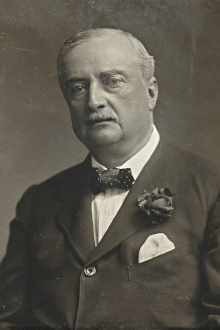
John Edward Redmond, Irish nationalist politician, barrister, and Member of Parliament (MP) in the House of Commons of the United Kingdom, is born to an old prominent Catholic family in Kilrane, County Wexford on September 1, 1856. He is best known as leader of the moderate Irish Parliamentary Party (IPP) from 1900 until his death. He is also leader of the paramilitary organisation the National Volunteers.

Several of Redmond’s relatives are politicians. He takes over control of the minority IPP faction loyal to Charles Stewart Parnell after Parnell dies in 1891. He is a conciliatory politician who achieves the two main objectives of his political life: party unity and, in September 1914, the passing of the Irish Home Rule Act.

The Irish Home Rule Act grants limited self-government to Ireland, within the United Kingdom. However, implementation of Home Rule is suspended by the outbreak of the World War I. Redmond calls on the National Volunteers to join Irish regiments of the New British Army and support the British and Allied war effort to restore the “freedom of small nations” on the European continent, thereby to also ensure the implementation of Home Rule after a war that is expected to be of short duration. However, after the Easter Rising of 1916, Irish public opinion shifts in favour of militant republicanism and full Irish independence, resulting in his party losing its dominance in Irish politics.

In sharp contrast to Parnell, Redmond lacks charisma. He works well in small committees but has little success in arousing large audiences. Parnell had always chosen the nominees to Parliament. Now they are selected by the local party organisations, giving Redmond numerous weak MPs over whom he has little control. He is an excellent representative of the old Ireland but grows increasingly old-fashioned because he pays little attention to the new forces attracting younger Irishmen, such as Sinn Féin in politics, the Gaelic Athletic Association in sports, and the Gaelic League in cultural affairs.

Redmond never tries to understand the unionist forces emerging in Ulster. He is further weakened in 1914 by the formation of the Irish Volunteers by Sinn Féin members. His enthusiastic support for the British war effort alienates many Irish nationalists. His party has been increasingly hollowed out, and a major crisis, notably the Easter Rising, is enough to destroy it.

Redmond is increasingly eclipsed by ill-health after 1916. An operation in March 1918 to remove an intestinal obstruction appears to progress well initially, but he then suffers heart failure. He dies a few hours later at a London nursing home on March 6, 1918.

Condolences and expressions of sympathy are widely expressed. After a funeral service in Westminster Cathedral his remains are interred, as requested in a manner characteristic of the man, in the family vault at the old Knights Templars‘ chapel yard of Saint John’s Cemetery, Wexford, amongst his own people rather than in the traditional burial place for Irish statesmen and heroes in Glasnevin Cemetery. The small, neglected cemetery near the town centre is kept locked to the public. His vault, which has been in a dilapidated state, has been only partially restored by Wexford County Council.


Leave a comment

Birth of Gerard Hogan, Judge, Lawyer & Academic

Gerard William Augustine Hogan, MRIA, Irish judge, lawyer and academic who has served as a Judge of the Supreme Court of Ireland since October 2021, is born on August 13, 1958, in Carrick-on-Suir, County Tipperary. He previously serves as Advocate General of the European Court of Justice from 2018 to 2021, a Judge of the Court of Appeal from 2014 to 2018 and a Judge of the High Court from 2010 to 2014. He first works as a barrister and lecturer in law specialising in constitutional and administrative law.

Hogan is born to Mai and Liam Hogan. His father is the deputy principal of the Christian Brothers secondary school in the town. He is educated at University College Dublin (UCD), from where he receives BCL and LLM degrees in 1979 and 1981. He co-authors his first book Prisoners’ Rights: A Study in Irish Prison Law in 1981 with Paul McDermott and Raymond Byrne. He obtains a John F. Kennedy memorial scholarship to study for an LLM at the University of Pennsylvania Law School. He subsequently attends the King’s Inns. He holds two doctorates – an LLD from UCD and a PhD in law from Trinity College Dublin in 2001.

In 1986, early in his legal career, he supports the Anti-Apartheid Movement with other legal scholars, including Mary McAleese, Mary Robinson and Bryan MacMahon. He is involved with the Progressive Democrats and in 1988 writes the party’s proposed new Constitution of Ireland with Michael McDowell. In May 2021, he is made a member of the Royal Irish Academy.

Hogan is called to the Bar in July 1984 and becomes a Senior Counsel in 1997. He appears domestically in cases in the High Court and the Supreme Court and internationally at the European Court of Human Rights and the European Court of Justice.

Hogan is noted in particular for his experience in constitutional law. He acts for the Attorney General of Ireland in references made by President Mary Robinson under Article 26 of the Constitution of Ireland to the Supreme Court regarding the Information (Termination of Pregnancies) Bill 1995 and the Employment Equality Bill of 1997. He appears again for the Attorney General (with Dermot Gleeson and Paul Gallagher) in another reference made by President Mary McAleese regarding the Health (Amendment) (No. 2) Bill 2004.

Hogan is a law lecturer and fellow at Trinity College Dublin from 1982 to 2007. He lectures on constitutional law, competition law and the law of tort. He is regarded as “one of the foremost constitutional and administrative lawyers in Ireland.” He is the co-author of Administrative Law in Ireland and JM Kelly: The Irish Constitution, the core Irish legal texts in Irish administrative and constitutional law respectively. He also writes a text on political violence and a book chronicling the origins of the Constitution of Ireland.

During his career as a barrister, Hogan is involved in cases involving employment law, habeas corpus, immigration law, judicial review, company law and commercial law.

Hogan appears for Katherine Zappone and Ann Louise Gilligan in Zappone v. Revenue Commissioners in the High Court and Miss D in her case related to the rights to travel abroad for an abortion. He represents the State in the High Court and the Supreme Court in litigation that emerges following a court finding that an offence of unlawful carnal knowledge is unconstitutional. In 2008, he acts for Colm Murphy and Seamus Daly in the Supreme Court who are contesting an action taken by families of victims of the Omagh bombing when they are refused access to books of evidence.

Hogan is involved in several tribunals and Oireachtas committee investigations, appearing either in the actual proceedings or in related court proceedings. He represents Desmond O’Malley at the Beef Tribunal in 1992, Dermot Desmond at the Moriarty Tribunal in 2004, and Jim Higgins and Brendan Howlin in actions related to the Morris Tribunal. He acts for the Committee on Members’ Interests of Seanad Éireann in action taken by Ivor Callely.

Hogan is the first barrister to appear in an Irish court without a wig, following the enactment of the Courts and Court Officers Act 1995.

Throughout his career, Hogan has been a member of committees and boards in areas requiring legal expertise. He chairs the Department of Justice‘s Balance in Criminal Law Review Group and is a member of three other review groups: the Constitution Review Group, the Competition and Mergers Review Group and the Offences Against the State Acts Review Group. He is also a member of the Competition Authority‘s Advisory Panel and the Committee on Court Practice and Procedure.

Hogan is appointed a Judge of the High Court in 2010. Soon after his appointment, he holds an emergency hearing in his home regarding a blood transfusion for a sick baby. He is one of three judges who hears a case taken by Marie Fleming, seeking a right to die in 2012. His reference to the European Court of Justice in 2014 regarding the International Safe Harbor Privacy Principles, results in a declaration by the Grand Chamber that the Safe Harbour Decision is invalid. He subsequently becomes a Judge of the Court of Appeal upon its establishment in October 2014.

In May 2018, Hogan is nominated by the Government of Ireland for appointment as the Advocate General to the European Court of Justice. His term begins in October 2018 and was scheduled to expire in October 2024. Anthony Collins is appointed in 2021 to complete his term following his appointment to the Supreme Court. He concludes his term on October 7, 2021.

In one of his first opinions, on a reference from the French Conseil d’État, Hogan finds that Regulation (EU) No 1169/2011 of the European Parliament and of the Council of October 25, 2011, requires that products originating from Israeli-occupied territories should indicate if these products come from such a territory. His opinion is followed by the Court of Justice.

In April 2021, the Irish government nominates Hogan to the Supreme Court of Ireland. He is appointed in October 2021.


Leave a comment

Olympic Champion Michelle de Bruin Banned from Swimming

On August 6, 1998, Irish Olympic swimming champion Michelle de Bruin is banned from swimming for four years after being found guilty of tampering with a drug test. The International Swimming Federation says she used alcohol to tamper with urine samples taken the previous January at her home as part of the out-of-competition doping control programme run by FINA, the world governing body of swimming.

De Bruin is the golden girl of Irish swimming, winning three medals at the 1996 Summer Olympics in Atlanta. Her performances in Atlanta give rise to much muted comment about a dramatic improvement in her times. U.S. swimmer and then world record holder Janet Evans is more vocal, stating at one press conference that the Irish swimmer’s performance is “questionable and suspicious.” Supporters decry the comments as jealousy. At the same time, the Irish media does not cover itself in glory with the national broadcaster RTÉ apparently decreeing that comment about possible drug taking should not be referenced by commentators.

FINA says her urine sample shows “unequivocal signs of adulteration” and has an alcohol content (to mask drug taking) that is “compatible with physical manipulation.”

De Bruin confirms a challenge to the ban at a news conference on Friday, August 7. It continues her emphatic and repeated claims that she has never breached drug rules. Her sister, Aisling Smith, speaking from the family home in Rathcoole, on the outskirts of Dublin, says, “Michelle is determined to fight it through.”

De Bruin competes under her maiden name of Smith at the 1996 Atlanta Olympics and wins gold medals in the 400m individual medley, 400m freestyle, and the 200m individual medley. She wins a bronze medal in the 200m butterfly event.

Reacting to news of the ban, Irish Minister for Tourism, Sport and Recreation Dr. Jim McDaid says it is a personal tragedy for the swimmer and her family. Taking time out from government business in Reykjavik, Iceland, he says, that like the rest of the Irish people, he is “saddened and disappointed” at the ban and hopes that the Olympic champion can establish her innocence.

A four-year ban from any national or international swimming contest at De Bruin’s age of 28 effectively ends her swimming career. She could also be stripped of the four medals – two gold, two silver – she won at the 1997 European Aquatics Championships in Seville, Spain.

At a later conference, Evans highlights that the accusations of de Bruin’s doping had been heard by her poolside. De Bruin later receives an apology from Evans.

De Bruin never returns to competitive swimming and later works as a barrister, practising under her married name. Despite the ban for manipulating samples, none of Smith’s swimming achievements have been annulled, and she remains Ireland’s most successful Olympian.

Her coach and husband, Erik de Bruin, previously serves a four-year ban for using illegal drugs during his career as a discus thrower.


Leave a comment

Death of Edith Anne Stoney, First Woman Medical Physicist

Edith Anne Stoney, considered to be the first woman medical physicist, dies in Bournemouth, England, on June 25, 1938.

Stoney is born into an old-established Anglo-Irish scientific family at 40 Wellington Road, Ballsbridge, Dublin, on January 6, 1869. The daughter of George Johnstone Stoney, FRS, an eminent physicist who coins the term “electron” in 1891 as the “fundamental unit quantity of electricity,” and his wife and cousin, Margaret Sophia Stoney. One of her two brothers, George Gerald, is an engineer and a Fellow of the Royal Society (FRS). One of her two sisters, Florence Stoney, is a radiologist and receives an OBE. Her cousin is the Dublin-based physicist George Francis FitzGerald FRS (1851–1901), and her uncle Bindon Blood Stoney FRS is Engineer of Dublin Port, renowned for building a number of the main Dublin bridges and developing the Quayside.

Stoney demonstrates considerable mathematical talent and gains a scholarship at Newnham College, Cambridge, where she achieves a First in the Part I Tripos examination in 1893. However, she is not awarded a University of Cambridge degree as women are excluded from graduation until 1948. During her time at Newnham, she is in charge of the College telescope. She is later awarded a BA and an MA from Trinity College Dublin, after they accept women in 1904.

After briefly working on gas turbine calculations and searchlight design for Sir Charles Algernon Parsons, she takes a mathematics teaching post at the Cheltenham Ladies’ College.

Following the 1876 Medical Act, it is illegal for academic institutions to prevent access to medical education based on gender. The first medical school for women in Britain is established in 1874 by Dr. Sophia Jex-Blake in anticipation of this law. The London School of Medicine for Women quickly becomes part of the University of London, with clinical teaching at the Royal Free Hospital. Stoney’s sister Florence is a student at the school, graduates in medicine with honours in 1895 (MB BS) and obtains her MD in 1898. Meanwhile, Stoney gains an appointment as a physics lecturer at the school in 1899. Her first tasks are to set up a physics laboratory and design the physics course. The laboratory is planned for 20 students, and the course content is pure physics, as required by university regulations. It includes mechanics, magnetism, electricity, optics, sound, heat and energy. In her obituary in The Lancet, an ex-student of hers notes: “Her lectures on physics mostly developed into informal talks, during which Miss Stoney, usually in a blue pinafore, scratched on a blackboard with coloured chalks, turning anxiously at intervals to ask ‘Have you taken my point?’. She was perhaps too good a mathematician … to understand the difficulties of the average medical student, but experience had taught her how distressing these could be”.

In 1901, the Royal Free Hospital appoints Florence into a new part-time position of medical electrician. The following April, the two sisters open a new x-ray service in the electrical department. During their time at the Royal Free Hospital, the two sisters actively support the women’s suffrage movement, though oppose the direct violent action with which it is later associated.

During her time at the school, Stoney also plays a central role in the British Federation of University Women (BFUW). She is elected treasurer, in her absence, at the first executive meeting on October 9, 1909, a position she holds until the end of May 1915. She becomes increasingly engaged with the political lobbying of the Federation. At the executive meeting on October 19, 1912, she proposes the names of two members for a subcommittee to secure the passing into law of a bill to enable women to become barristers, solicitors or parliamentary agents. The legislation is eventually enacted after the war within the Sex Disqualification (Removal) Act 1919.

Stoney resigns her post at the school in March 1915 and it is recorded that “with due regret and most unwillingly a change is desirable in the physics lectureship.” She is offered £300 on tendering her resignation.

Both Stoney and Florence offer their services to the British Red Cross at the War Office in London, to provide a radiological service to support the troops in Europe, on the day Britain declares war. Their offer is refused, because they are women. Florence sets up her own unit with the Women’s Imperial Service League and spends the next 6 months in Europe. Stoney organises supplies from London where she also serves on the League’s committee. Florence returns to London at the time Stoney resigns from the London School of Medicine for Women. She contacts the Scottish Women’s Hospitals (SWH), an organisation formed in 1914 to give medical support in the field of battle and financed by the women’s suffrage movement. The organisation has gained agreement to set up a new 250-bed tented hospital at Domaine de Chanteloup, Sainte-Savine, near Troyes (France), funded by the Cambridge women’s colleges of Girton and Newnham and it becomes her role to plan and operate the x-ray facilities. She establishes stereoscopy to localise bullets and shrapnel and introduces the use of x-rays in the diagnosis of gas gangrene, interstitial gas being a mandate for immediate amputation to give any chance of survival.

The hospital is near the front line and, in her own words, by September 1915, “the town had been evacuated, the station had been mined, and we heard the heavy guns ever going at nighttime.” The unit is entirely female, except for two part-time male drivers, and her technical assistant, Mr. Mallett.

They are assigned to the Corps Expéditionnaire d’Orient and ordered to move to Serbia. After boarding the steamship Mossoul in Marseille, they reach Salonika (known as Thessaloniki in modern Greece) on November 3, where they take the night train north to Ghevgheli (now Gevgelija in modern North Macedonia), on the Serbian side of the Greek border. They set up a hospital in an unused silk factory where they treat 100 patients with injuries ranging from frostbite to severe lung and head wounds. Following defeats at the hands of Bulgarian forces, Stoney and her staff retreat to Salonika by December 6, 1916. Eleven days later, they have re-established the hospital on a drained low swamp by the sea, and by New Year’s Day 1917 she has the lights on and the x-rays working. Despite the lack of equipment and resources, she establishes an electrotherapy department and various equipments for the muscular rehabilitation of the soldiers in their care. She also assists with problems on two British hospital ships, on which the x-ray systems have been damaged during a storm and gives support to the SWH unit in Ostrovo (now Arnissa on Lake Vegoritida formerly lake Ostrovo in Northern Greece), which arrives during September 1916. She has a break for sick leave in December 1917 and returns the following summer. She applies for an appointment as an army camp radiologist in Salonika, but her demand is blocked by the War Office.

In October 1917, Stoney returns to France to lead the x-ray departments at the SWH hospitals of Royaumont and Villers-Cotterêts. In March 1918, she has to supervise a camp closure and retreat for the third time, when Villers-Cotterêts is overrun by the German troops. During the final months of the war the fighting intensifies and there is a steep increase in workload. In the month of June alone the x-ray workload peaks at over 1,300, partly because of an increased use of fluoroscopy.

Stoney’s war service is recognised by several countries, and she is awarded the Médaille des épidémies du ministère de la Guerre and the Croix de Guerre from France, the Order of St. Sava from Serbia, and the Victory Medal and British War Medal from Britain.

On returning to England, Stoney takes a post as lecturer in physics in the Household and Social Science department at King’s College for Women which she holds until retirement in 1925. After leaving King’s she moves to Bournemouth, where she lives with her sister Florence, who is suffering from spinal cancer, dying in 1932.

During her retirement, Stoney resumes her work with the BFUW for which she had acted as the first treasurer before the war. She becomes one of the earliest (and oldest) members of the Women’s Engineering Society and plays an active part in the organisation until shortly before her death. She travels widely and, in 1934, she speaks to the Australian Federation of University Women on the subject of women in engineering, highlighting the contribution made by women workers during the war. In 1936, she establishes the Johnstone and Florence Stoney Studentship in the BFUW, for “research in biological, geological, meteorological or radiological science undertaken preferably in Australia, New Zealand or South Africa.” The studentship is now administered by Newnham College, Cambridge, and supports clinical medical students going abroad for their elective period. The declaration of Trust is dated February 11, 1942 and the Johnstone And Florence Stoney Studentship Fund Charity is registered on March 25, 1976.

Stoney dies on June 25, 1938, at age 69, and obituaries are printed in both the scientific and medical press – Nature, The Lancet, The Woman Engineer and national newspapers in England, The Times and Australia.

Stoney is remembered for her considerable bravery and resourcefulness in the face of extreme danger, and her imagination in contributing to clinical care under the most difficult conditions of war. As a strong advocate of education for women, she enables young graduate women to spend time on research overseas and another to enable physicists to enter medical school thanks to the fund she created. Through her work and engagements, she is remembered as a pioneer of medical physics.

(Pictured: Edith Anne Stoney during her time in Cambridge in the early 1890s)


Leave a comment

Birth of Michael Doheny, Writer, Lawyer & Co-founder of the IRB

Michael Doheny, Irish writer, lawyer, member of the Young Ireland movement, and co-founder of the Irish Republican Brotherhood (IRB), is born on May 22, 1805, at Brookhill, parish of Fethard, County Tipperary, the second son of Michael Doheny of Brookhill, a small farmer, and Ellen Doheny (née Keley).

Doheny receives a rudimentary education from an itinerant scholar while labouring on his father’s holding, and in 1826 attends Maher’s classical academy near Emly for nine months. Educating himself in the late 1820s and early 1830s while teaching the children of local farmers, he determines on a career in law to help secure political redress for the disenfranchised poor. He is admitted to Gray’s Inn in November 1834, enters the King’s Inns, Dublin, in 1835 and is called to the Irish bar in 1838. Settling later that year in Cashel, County Tipperary, he first practises in the local courts and then on the southern circuit. Appointed legal assessor to the borough of Cashel under the Municipal Corporations (Ireland) Act 1840, he successfully prosecutes former borough officers for misappropriation of funds and fraudulent transfer of property, winning wider attention. He had supported the campaign for repeal in the early 1830s, and in 1841 joins Daniel O’Connell‘s Repeal Association, becoming active in forming temperance bands and setting up town meetings. By May 1841 he is on the association’s general committee. O’Connell finds him less tractable than most and is ruffled by his queries into the association’s financial management.

During 1842 Doheny begins to associate with the more militant members of the repeal movement such as Thomas Davis. There is a marked gap in age and class between Doheny and most of this group and some look down on his lack of refinement. Others, however, admire his zeal and sincerity, and an anonymous colleague describes him as “rough, generous, bold, a son of the soil, slovenly in dress, red-haired and red-featured, but a true personification of the hopes, passions, and traditions of the people.” Assisting in the launch of The Nation in October 1842, he is chagrined to find most of his articles rejected as unfit for publication, although fifteen are published between January 1843 and September 1844. He also publishes a competent History of the American Revolution (1846) for The Nation‘s “Library of Ireland” series. More impressive as a speaker than a writer, he contributes regularly to repeal meetings at Conciliation Hall, Burgh Quay, Dublin. He enthuses at the apparent martial potential of the immense, ordered crowds attending the “monster” repeal meetings of 1843, and is one of the main organisers of the Cashel meeting of May 31, 1843, at which he is loudly cheered. However, his later claim to have deliberately set up these meetings, with Davis and John Blake Dillon, on quasi-military lines in order to prepare the peasantry for a future war with Britain, is far-fetched. His opposition to O’Connell’s decision to submit to proclamation of the proposed meeting of October 8, 1843, at Clontarf again greatly irritates O’Connell.

An active member of the Repeal Association parliamentary committee from February 1844, in February and March 1845 Doheny chairs a sub-committee of five senior barristers investigating the legality of withdrawal from the House of Commons by the body of repeal MPs, coming “reluctantly” to the verdict that such an action is open to criminal prosecution. O’Connell’s gruff dismissal of his report testifies to their awkward relationship. He further vexes O’Connell by his advocacy of non-denominational university education during debates over the Maynooth College Act 1845. Irrevocable divisions between the Young Irelanders and O’Connell open up between April and July 1846 when Doheny leads calls for endorsement of the conduct of William Smith O’Brien – imprisoned for a month for refusal to serve on a parliamentary committee – and voices Young Ireland’s martial convictions in a speech at Liverpool. After the secession of the Young Irelanders from the Repeal Association in July 1846, he opposes attempts at reconciliation and is one of the founders of the Irish Confederation on January 13, 1847.

During the summer of 1847, Doheny begins setting up “Confederate Clubs” in east Tipperary and aids James Fintan Lalor in organising a failed tenant league meeting at Holycross, County Tipperary, on September 19. He is one of the few Young Irelanders attracted to Lalor’s revolutionary agrarian philosophy, but supports Smith O’Brien against John Mitchel in January 1848, deploring irresponsible demands for insurrection. However, after Mitchel’s conviction for treason felony in May, he supports armed action. Arrested for seditious speechmaking at Cashel on July 12, he is bailed on July 20. During the confused period of “rebellion” in late July, he attempts to organise the peasantry in Tipperary but is frustrated by O’Brien’s vacillation.

After the collapse of the armed adventure at Ballingarry on July 31, Doheny takes refuge near Slievenamon and, with James Stephens, eludes pursuit for nearly two months, until he finally escapes, disguised as a clergyman, on a cattle-ship from Cork to Bristol. Some days later he reaches Paris, where he stays for two months with Stephens and John O’Mahony before leaving for New York City. Practising law in New York, he dedicates himself to the development of an Irish American republican movement. Tensions between conservative and radical Young Ireland exiles, perhaps aggravated by social snobbery, surface by late 1849, when he is arrested for attempting to push Thomas D’Arcy McGee into an open cellar on a New York street, angered by accusations of boasting, drunkenness, and incompetence. Similar criticisms are made by John Blake Dillon and appear to have some foundation.

Doheny finds time to write The Felon’s Track (1849), a polemical account of the repeal agitation and the 1848 insurrection that is highly critical of O’Connell. Despite a rambling narrative, it becomes a popular work and is reprinted several times. He also gives several lectures on historical and literary subjects to Irish American societies and contributes a memoir on Geoffrey Keating to O’Mahony’s translation (1857) of Foras Feasa ar Éirinn.

Involved with the New York Irish militia from his arrival, he is elected lieutenant colonel of the 69th Infantry Regiment in November 1851, and in September 1852 becomes colonel of a new regiment, the Irish Republican Rifles. These formations are often wracked by dissension over strategy and leadership, and in February 1856 he and O’Mahony found the Emmet Monument Association, planning to mobilise an Irish American force to invade Ireland. Efforts to acquire Russian backing fails on the close of the Crimean War in March 1857.

In autumn 1857, Doheny and O’Mahony make overtures to James Stephens to reorganise the republican movement in Ireland, and in March 1858 they accept Stephens’s demands for undisputed authority there, though by the winter of 1858–59 Doheny shows increasing distrust of Stephens’s ambitions. Adopting the organisational structure set out by Stephens in establishing the IRB in 1858, he and O’Mahony found the American equivalent, the Fenian Brotherhood, in early 1859, although he plays a subordinate part. In July 1859, he founds and edits a short-lived newspaper in New York, The Phoenix, to promote Fenian ideals. Active in opposing the national petition for self-government of 1860–61, he argues that Britain will only yield to force. He assists in making preparations for the funeral of Terence Bellew MacManus in Ireland and acts as one of the pallbearers in New York. Travelling to Ireland in October 1861, he appears to argue for using the excitement engendered by the funeral to spark an insurrection in Dublin but is thwarted by Stephens.

Doheny dies suddenly on April 1, 1862, in New York and is buried in Calvary Cemetery in the city’s borough of Queens.

(From: “Doheny, Michael” by James Quinn and Desmond McCabe, Dictionary of Irish Biography, http://www.dib.ie, October 2009)


Leave a comment

Birth of John Bruton, Fine Gael Politician & 10th Taoiseach of Ireland

John Gerard Bruton, Irish Fine Gael politician who serves as Taoiseach from 1994 to 1997 and Leader of Fine Gael from 1990 to 2001, is born to a wealthy, Catholic farming family in Dunboyne, County Meath, on May 18, 1947. He plays a crucial role in advancing the process that leads to the Good Friday Agreement in 1998.

Bruton is educated at Clongowes Wood College and then goes on to study economics at University College Dublin (UCD), where he receives an honours Bachelor of Arts degree and qualifies as a barrister from King’s Inns, but never goes on to practice law. He joins the Fine Gael party in 1965 and is narrowly elected to Dáil Éireann in the 1969 Irish general election, as a Fine Gael TD for Meath. At the age of 22, he is one of the youngest ever members of the Dáil at the time. He serves as a parliamentary secretary in the government of Liam Cosgrave (1973–77).

Following Fine Gael’s defeat at the 1977 Irish general election, the new leader, Garret FitzGerald, appoints Bruton to the front bench as Spokesperson on Agriculture. He is later promoted as Spokesperson for Finance. He plays a prominent role in Fine Gael’s campaign in the 1981 Irish general election, which results in another coalition with the Labour Party, with FitzGerald as Taoiseach. He receives a personal vote in Meath of nearly 23%, and at the age of only 34 is appointed Minister for Finance, the most senior position in the cabinet. In light of overwhelming economic realities, the government abandons its election promises to cut taxes. The government collapses unexpectedly on the night of January 27, 1982, when Bruton’s budget, that was to impose an unpopular value-added tax (VAT) on children’s shoes, is defeated in the Dáil.

The minority Fianna Fáil government which follows only lasts until November 1982, when Fine Gael once again returns to power in a coalition government with the Labour Party. However, when the new government is formed, Bruton is moved from Finance to become Minister for Industry and Energy. After a reconfiguration of government departments in 1983, he becomes Minister for Industry, Trade, Commerce and Tourism. In a cabinet reshuffle in February 1986, he is appointed again as Minister for Finance. Although he is Minister for Finance, he never presents his budget. The Labour Party withdraws from the government due to a disagreement over his budget proposals leading to the collapse of the government and another election.

Following the 1987 Irish general election, Fine Gael suffers a heavy defeat. Garret FitzGerald resigns as leader immediately, and a leadership contest ensues between Alan Dukes, Peter Barry and Bruton himself, with Dukes being the ultimate victor. Dukes’s term as leader is lackluster and unpopular. The party’s disastrous performance in the 1990 Irish presidential election, in which the party finishes in a humiliating and then unprecedented third in a national election, proves to be the final straw for the party and Dukes is forced to resign as leader shortly thereafter. Bruton, who is the deputy leader of Fine Gael at the time, is unopposed in the ensuing leadership election.

Bruton’s election is seen as offering Fine Gael a chance to rebuild under a far more politically experienced leader. However, his perceived right-wing persona and his rural background are used against him by critics and particularly by the media. However, to the surprise of critics and of conservatives, in his first policy initiative he calls for a referendum on a Constitutional amendment permitting the enactment of legislation allowing for divorce in Ireland.

By the 1992 Irish general election, the anti-Fianna Fáil mood in the country produces a major swing to the opposition, but that support goes to the Labour Party, not Bruton’s Fine Gael, which actually loses a further 10 seats. Even then, it initially appears that Fine Gael is in a position to form a government. However, negotiations stall in part from Labour’s refusal to be part of a coalition which would include the libertarian Progressive Democrats, as well as Bruton’s unwillingness to take Democratic Left into a prospective coalition. The Labour Party breaks off talks with Fine Gael and opts to enter a new coalition with Fianna Fáil.

In late 1994, the government of Fianna Fáil’s Albert Reynolds collapses. Bruton is able to persuade Labour to end its coalition with Fianna Fáil and enter a new coalition government with Fine Gael and Democratic Left. He faces charges of hypocrisy for agreeing to enter government with Democratic Left, as Fine Gael campaigned in the 1992 Irish general election on a promise not to enter government with the party. Nevertheless, on December 15, 1994, aged 47, he becomes the then youngest ever Taoiseach. This is the first time in the history of the state that a new government is installed without a general election being held.

Bruton’s politics are markedly different from most Irish leaders. Whereas most leaders had come from or identified with the independence movement Sinn Féin (in its 1917–22 phase), Bruton identifies more with the more moderate Irish Parliamentary Party (IPP) tradition that Sinn Féin had eclipsed at the 1918 Irish general election.

Continued developments in the Northern Ireland peace process and Bruton’s attitude to Anglo-Irish relations come to define his tenure as Taoiseach. In February 1995, he launches the Anglo-Irish “Framework Document” with the British prime minister John Major. It foreshadows the 1998 Good Friday Agreement, which, among other things, establishes an elected, power-sharing executive authority to be run by these onetime adversaries, ending 30 years of bloodletting that had claimed more than 3,000 lives. However, he takes a strongly critical position on the British Government‘s reluctance to engage with Sinn Féin during the Irish Republican Army‘s 1994–1997 ceasefire. He also establishes a working relationship with Gerry Adams of Sinn Féin; however, both are mutually distrustful of each other.

Bruton presides over a successful Irish Presidency of the European Union in 1996, and helps finalise the Stability and Growth Pact, which establishes macroeconomic parameters for countries participating in the single European currency, the euro. He is the fifth Irish leader to address a joint session of the United States Congress on September 11, 1996. He presides over the first official visit by a member of the British royal family since 1912, by Charles, Prince of Wales.

The coalition remains in force to contest the 1997 Irish general elections, which are indecisive, and Bruton serves as acting taoiseach until the Dáil convenes in late June and elects a Fianna Fáil–Progressive Democrats government. He retires from Irish politics in 2004 and serves as the European Union Ambassador to the United States (2004–09).

Bruton dies at the age of 76 on February 6, 2024, at the Mater Private Hospital in Dublin, following a long bout with cancer. A state funeral is held on February 10 at St. Peter’s and St. Paul’s Church in Dunboyne.