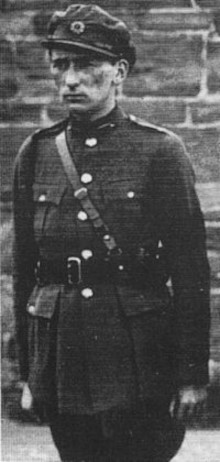
Adams is born in 1926. He marries Anne Hannaway, also a Republican from an established republican family, by whom he has thirteen children, three of whom die in infancy. His children include Gerry Adams, a former abstentionistMP for Belfast West and former TD who becomes a leading figure in Sinn Féin and serves as its president until 2018, as well as Liam Adams, who dies serving a prison sentence in Northern Ireland for raping his daughter.
Adams is captured after being shot and wounded during an IRA operation in 1942 after he shot a Royal Ulster Constabulary (RUC) police officer in the foot. He is sentenced to eight years in prison and serves five. He is interned in 1971 along with his son, Gerry Adams.
Adams dies “a lonely old man” on November 17, 2003. He is buried with the Irish tricolour, despite the private reservations of family members over alleged abuse that would only be made public some years later. His son, Gerry, says that he felt his father had “besmirched” the flag.
In December 2009, six years after Adams’s death, his family claims that he had subjected some members of his family to emotional, physical and sexual abuse over many years. The family says that this abuse “had a devastating impact” on the family, with which they are still then coming to terms. The family decides to go public about the abuse in order to help other families in similar circumstances.
(Pictured: Gerry Adams, Sr. (L) pictured with his son, Sinn Fein’s Gerry Adams)
Tobin is the eldest son of Mary Agnes (nee Butler) and David Tobin, a hardware clerk. He has two younger siblings, Katherine and Nicholas Augustine Tobin, also born in Cork. His family moves to John Street in Kilkenny and then to Dublin. He goes to school in Kilkenny and is an apprentice in a hardware shop at the time of the 1916 Easter Rising. As a participant in the Rising, he fights in the Four Courts garrison under Edward Daly. He is arrested, court martialed, and sentenced to death but his sentence is commuted to life imprisonment. He is a prisoner in Kilmainham, Mountjoy, Lewes, Dartmoor, Broadmoor and Pentonville prisons. He is released in June 1917.
In October 1921, Tobin travels with the Irish Treaty Delegation as part of Collins’ personal staff.
Tim Pat Coogan and James Mackay have examined Tobin’s involvement in the assassination of British Field MarshalSir Henry Wilson. Wilson’s public tirades about Collins is evidence of mutual personal dislike between the two men. In May 1922 Collins tells Tobin “We’ll kill a member of that bunch” to the news of “bloody pogroms” in Belfast. Wilson is intimately involved with the Ulster loyalist cause, including the Curragh Mutiny and the establishment of the Ulster Special Constabulary. Just before the shooting, Coogan places Tobin in London. He meets courier Peig Ni Braonain at Euston Station collecting a document that has been sent from Dublin. Returning to Dublin before the incident, he is jubilant when he tells defence ministerRichard Mulcahy about Wilson’s death. Mulcahy is appalled and threatens to resign.
In October 1922, Tobin’s brother Nicholas, a Free State captain, is accidentally shot dead by his own troops during the raid and capture of a bomb making factory at number 8 Gardiner’s Place, Dublin.
Tobin believes in the steppingstone doctrine which sees the Treaty as a stage towards full independence. With the outbreak of the Irish Civil War he remains loyal to Collins and takes the Pro-Treaty side. He leads in the fight against the Anti-Treaty IRA in the south. Disillusioned with the continuing hostilities and in the aftermath of the death of Collins, he forms an association called the IRA Organisation (IRAO) or “Old Irish Republican Army” to distinguish themselves from the anti-treaty insurgents.
Richard Mulcahy, the new Irish defence minister, proposes to reduce the army from 55,000 to 18,000 men in the immediate post- Civil-War period. Tobin knows his own position is to be affected and shares the perception that the Irish Army treats former British officers better than former IRA officers. On March 7, 1924, Tobin, together with Colonel Charlie Dalton, sends an ultimatum to President of the Executive Council of the Irish Free StateW. T. Cosgrave demanding an end to the army demobilisation. The immediate response is an order for the arrest of the two men on a charge of mutiny. The cabinet, already wary of the Irish Army, orders an inquiry and appoints Garda CommissionerEoin O’Duffy to the army command.
On March 18, the mutineers assemble with hostile intent at a Dublin pub. An order is made to arrest the mutineers and the cabinet demands the resignation of the army council. The generals resign, affirming the subservience of the military to the civilian government of the new state.
In later years, Tobin rebuilds relations with his Civil War foes and joins Éamon de Valera‘s Anti-Treaty Fianna Fáil party. He joins up with Joseph McGrath to form the Irish Hospitals’ Sweepstake in the 1930s. Many other former army comrades find work in this lottery. He leaves the Sweep in 1938. After World War II, he becomes Superintendent of the Oireachtas for the Irish Dáil.
On October 14, 1929, Tobin marries Monica “Mona” Higgins at the Church of the Holy Family, Aughrim Street, Dublin. They have two daughters, Máire and Anne Tobin. Following the death of his father, David, in 1956, Tobin’s health declines, resulting in his death in Dublin on April 30, 1963.
Hendron is the Member of Parliament (MP) for Belfast West between April 1992 and May 1997 in the UK Parliament in London. He takes the seat from Sinn Féin President Gerry Adams at his third attempt with a majority of one percent. He becomes the only nationalist MP to defeat Adams. The seat had previously been held for the SDLP by Gerry Fitt, later Lord Fitt, until 1983. He attracts unprecedented cross-community support from Nationalists and Unionists in the constituency. This is the only example where an SDLP candidate receives a high enough number of Unionist votes in Belfast West to help unseat a Sinn Féin candidate. Adams regains the seat at the 1997 United Kingdom general election.
Hendron is appointed a member of the Northern Ireland Parades Commission in 2005. He retires from this role in December 2010.
On June 11, 2019, Hendron escapes with just bruising and a damaged collarbone after he is struck by a van and thrown up into the air while crossing Balmoral Avenue. He says he is probably partly to blame for the accident as he decided to cross the street in front of a van that was trying to pull out onto the main road. Apparently, the driver of the van did not see Hendron and began to pull out, striking him.
Greacen is the only child of Henry Greacen and his wife Elizabeth (née McCrea). His father comes from a Presbyterian farming background in County Monaghan and, at one time, holds a position as a creamery manager, but is a heavy drinker and fails in several businesses. Most of his childhood is spent with his maternal grandmother and aunts when his parents temporarily separate. He briefly attends two local primary schools in Belfast, but when his father receives insurance compensation after his Belfast business burned down, he takes his family to the Castleblayney area in County Monaghan and for a short time goes back to farming. He goes to a national school there, but after another fire destroys the farmhouse, the Greacens return to Belfast to run the Kenilworth, a tobacconist’s shop on the Newtownards Road. He attends Templemore primary school and then enters Methodist College Belfast in 1933.
Greacen mostly enjoys school, though he is too short-sighted to participate with success in any sport, and sometimes, because of his background, feels out of his depth among middle-class children. He is always ashamed of his father’s drunken outbursts and is terrified of the violent temper which accompanies them. Literature provides both a temporary escape and the promise of future success. His first poems are published in school magazines, and he decides at a young age to try to make a career as a writer. He fails examinations and interviews for positions in a bank and an insurance company and instead starts studying history and English at Queen’s University Belfast.
At Queen’s, as earlier at Methodist College, the interests which characterise Greacen’s later career are apparent. Largely thanks to meeting John Boyd, he develops sympathies with left-wing political ideas, as well as a deepened commitment to poetry. His youthful 1930s enthusiasm for Marxism disappears after the Molotov-Ribbentrop Pact of 1939 between the Soviet Union and Nazi Germany, but up to his later years he describes himself as a socialist. The formation of enduring friendships and mutually supportive coteries, a phenomenon particularly characteristic of the Ulster literary scene of the period, continues to be of great importance throughout his life. He makes friends with almost all the significant figures in Belfast, especially Roy McFadden, John Hewitt and Sam Hanna Bell. At Queen’s, he and a friend take over in 1940 the editing of a student magazine, The Northman. They try with short-lived, limited success to make it a literary journal for the whole region, so as to enable aspiring poets to get work into print. His own early poems appear in The Bell, and he writes some pieces for the left-wing Irish Democrat newspaper. His poem The Bird (1941) is well reviewed and later appears in anthologies. In 1942 he publishes Poems from Ulster, a small anthology including work by his friends.
For several months, Greacen worships from afar a fellow student named Irene. When he fails to form a relationship with her, he stops going to lectures so that he does not have to see her and does not finish his degree. His McCrea relatives pay for him to go to Trinity College Dublin in 1943 to take a diploma in social work. He is glad to get away from wartime Belfast and never lives there again. At first, he enjoys Dublin, and again makes many friends, among them Brendan and Beatrice Behan, Blanaid Salkeld, Cecil ffrench Salkeld, Joseph and Mary O’Neill, Douglas Gageby, Arland Ussher and Hubert Butler. He and Patrick Kavanagh live in the same boarding house on Raglan Road for several months in 1945, but Kavanagh takes offence at a review in Horizon by Greacen of his poem The Great Hunger and calls him a “Protestant bastard.” Greacen is upset, as he had thought the review favourable, and is disappointed but not surprised when Kavanagh refuses to allow any of his poems to appear in the prestigious Faber and Faber book Contemporary Irish Poetry, edited by Greacen and Valentin Iremonger in 1949.
The collaborative compilation of anthologies of poetry is Greacen’s characteristic way of working. In 1942, he and Alex Comfort edit Lyra: An Anthology of New Lyric. With Roy McFadden, he edits Ulster Voices in 1943. He is sole editor of Northern Harvest in 1944 and, in the same year, he, Bruce Williamson and Valentin Iremonger publish their own work in On the Barricades. His own first solo collection, One Recent Evening, is also a 1944 imprint. In 1946, with support from Maurice Fridberg, a Jewish Dublin and London bookseller, his publishing company, New Frontiers Press, produces Irish Harvest, which, though designed on more ambitious lines, still consists chiefly of poems by his friends. He feels much more affinity with the modernism and social protest that he finds in contemporary English poetry, especially in the “new apocalypse” movement associated with Herbert Read, and later the “new romantics,” than with what he regards as the outmoded Celtic nationalism of W. B. Yeats and his followers. Like others of his contemporaries, he comes to resent the unquestioned shibboleths of life in Ireland, and particularly objects to the censorship of literature and film.
Consequently, when Greacen’s second small volume of poems, The Undying Day (1948), sells badly, and other avenues seem unpromising, he and his wife give up on Dublin and move to London. He finds a job with the United Nations Association, which suits his outlook and ideals. However, when he is made redundant, he has to take various jobs in adult education, in creative-writing courses, and in teaching English as a foreign language, in the City of London College, the City Literary Institute, and West London College. He retires in 1986. His involvement with the London literary world continues throughout his career, as he gets to know many of the leading figures, including Stephen Spender and T. S. Eliot, and he organises poetry readings and other projects, though he himself writes no poetry for more than twenty years. At one time he considers taking up journalism and continues to produce book reviews and articles in journals, as well as many letters to newspapers. He writes several, well-received short works of criticism, in particular, The Art of Noël Coward (1953) and The World of C. P. Snow (1962). After returning to Dublin in 1986, he writes an interesting memoir about his many friends and acquaintances, Brief Encounters: Literary Dublin and Belfast in the 1940s (1991) and Rooted in Ulster: Nine Northern Writers (2000).
Greacen marries Patricia Hutchins in Fisherwick Presbyterian Church in Belfast on April 10, 1946. She is from a Protestant family who has a small estate at Ardnagashel, near Bantry, County Cork, and is related to the botanist Ellen Hutchins. They have one daughter, Arethusa, but, after four years of separation, the marriage ends in divorce in 1966. He resents his wife’s conversion to vegetarianism and seems also to disapprove of her desire to achieve her own career goals. Probably also the depression he experiences throughout the 1950s contributes to the breakdown of the marriage, but he feels that twelve experiences in the early 1960s with the hallucinogenic drug LSD, under the guidance of a psychiatrist, had cured him. After the LSD treatments he feels that he is ready to begin working on an autobiography, Even Without Irene, published several years later in 1969. This comes out again in an enlarged version in 1995, and, still further augmented, as The Sash My Father Wore (1997).
Greacen begins to publish poetry again in his fifties, in A Garland for Captain Fox (1975). Poems about the career and friends of an imaginary, sophisticated adventurer do not always strike the exactly right note but are popular and mark a new beginning for him, who increasingly writes elegiacally about personalities, real and fictional, in more restrained diction and with careful irony. In interviews, he denies that Captain Fox is his own alter ego, but the interplay between the character of Fox and elements of his creator’s own life suggests a metaphor for the poet’s creative process, as well as reminding the reader of the poet friends whose support means much to his writing in real life. At the very least, Captain Fox becomes what could be called a character of virtual reality for his creator.
Greacen’s later poetry collections include Young Mr. Gibbon (1979), A Bright Mask (1985), Carnival at the River (1990), Collected Poems 1944–1994 (1995; awarded The Irish Times Literature Prize for Poetry in that year), Protestant Without a Horse (1997), Captain Fox: A Life (2000), Lunch at the Ivy (2002), Shelley Plain (2002), and Selected and New Poems (2006).
On his return to Dublin in 1986, Greacen for a time shares a flat on Anglesea Road with Beatrice Behan, until he finds her dead in her bed in 1993. In later years he lives in a flat in Sandymount. He is elected to membership of Aosdána in 1986, and during his later years in Dublin enjoys the status of a senior figure in the world of literature. He gives readings in the United States, appears often on RTÉ radio programmes, and has poems republished in anthologies. There was even one poem displayed on the Dublin Dart suburban rail network, St. Andrew’s Day: An Elegy for Patricia Hutchins, perhaps his best work. Perhaps only a few of his poems have been lodged in the public memory, but it is appropriate, given the themes of his career, that his work will be read with most attention by poets and by scholars, and that his reputation in the future may largely be based on his friendships with other poets.
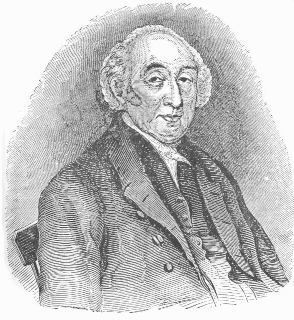
Holmes, the son of parents who are natives of Antrim, County Antrim, and settled in Belfast, is born during a visit by his parents to Dublin in 1765. He enters Trinity College, Dublin in 1782, and graduates B.A. in 1787. He at first devotes himself to medicine, but he soon turns his attention to the law. In 1795, he is called to the bar. He spends a substantial period of his professional life travelling the northeast circuit in Ireland, where he gains a reputation for great ability and legal skill.
Holmes studies law and becomes one of the best-known defenders of the Nationalist leaders in Ireland. He speaks in 1846 in defence of Charles Gavan Duffy, editor of The Nation. Duffy had been indicted over an article written by John Mitchel, which comes to be known as the “Railway Article.” His defence proves successful and his speech on behalf of his client is described by Lord Chief JusticeEdward Pennefather as “the most eloquent ever heard in a court of Justice.”
In 1798, during a parade of the lawyer’s corps of yeomanry, of which he is a member, Holmes throws down his arms on learning that the corps is to be placed under the military authorities, dreading that he might have to act against the populace. To one Joy, a barrister, who had used insulting language to him respecting this circumstance, he sends a challenge, for which he suffers three months’ imprisonment. In 1799, he publishes a satirical pamphlet on the projected Acts of Union, entitled A Demonstration of the Necessity of the Legislative Union of Great Britain and Ireland. With the rising of his brother-in-law, Robert Emmet, on July 23, 1803, he has no connection, although he is arrested on suspicion and imprisoned for some months. This retards his advancement. He declines to receive any favours from the government, refusing in succession the offices of Crown prosecutor, King’s Counsel, and Solicitor-General, and to the last he remains a member of the outer bar.
Holmes has for many years the largest practice of any member of the Irish courts, and is listened to with attention by judges, although he is not always very civil to them. His law arguments form an important set of articles in the Irish Law Reports, and he is an impressive advocate, notably in his speeches in Watson v. Dill, in defence of The Nation newspaper, and his oration on behalf of John Mitchel, tried for treason-felony on May 24, 1848. During the course of his practice he makes over £100,000.
Holmes marries, firstly, Mary Anne Emmet, daughter of Dr. Robert Emmet. She is the sister of Robert Emmet, who leads an unsuccessful rebellion in 1803, and whose brother, Thomas Addis Emmet, is a leading member, with Theobald Wolfe Tone, of the Society of United Irishmen. Both take part in the Irish Rebellion of 1798. The marriage produces one surviving child, a daughter, who later marries George William Lenox-Conyngham, chief clerk of the Foreign Office, and in turn has an only daughter who in 1861 marries Viscount Doneraile.
Holmes marries in 1810 at Childwall, Liverpool, as his second wife, the English educator and writer Eliza Lawrence. She dies in 1811.
After his retirement in 1852, Holmes resides in London with his only child Elizabeth. He dies at the age of 94 at her home, 37 Eaton Place, Belgrave Square, London, on October 7, 1859.
During the course of his life, Holmes is the author of three published works. The first, published in 1799, is entitled A Demonstration of the Necessity of the Legislative Union of Great Britain and Ireland, a satirical pamphlet ridiculing the arguments of its supporters. The next is An Address to the Yeomanry of Ireland, demonstrating the necessity of their declaring their opinions upon Political Subjects. His most important work however, according to Peter Aloysius Sillard, is The Case of Ireland Stated, which apparently goes through six editions, the last in 1847.
(Pictured: Image of Robert Holmes from Michael Doheny’s “The Felon’s Track”)
Ó Brádaigh is born into a middle-class republican family. His father, Matt Brady, is an IRA volunteer who is severely wounded in an encounter with the Royal Irish Constabulary (RIC) in 1919. His mother, May Caffrey, is a Cumann na mBan volunteer and a 1922 graduate of University College Dublin (UCD). His father dies when he is ten and is given a paramilitary funeral led by his former IRA colleagues. His mother, prominent as the Secretary for the County Longford Board of Health, lives until 1974. He is educated at Melview National School at primary level and attends secondary school at St. Mel’s College, leaving in 1950, and graduates from University College Dublin in 1954. That year he takes a job teaching Irish language at Roscommon Vocational School in Roscommon. He is a deeply religious Catholic who refrains from smoking or drinking.
Ó Brádaigh joins Sinn Féin in 1950. While at university, in 1951, he joins the Irish Republican Army. In September 1951, he marches with the IRA at the unveiling of the Seán Russell monument in Fairview Park, Dublin. A teacher by profession, he is also a Training Officer for the IRA. In 1954, he is appointed to the Military Council of the IRA, a subcommittee set up by the IRA Army Council in 1950 to plan a military campaign against Royal Ulster Constabulary (RUC) barracks in Northern Ireland.
On August 13, 1955, Ó Brádaigh leads a ten-member IRA group in an arms raid on Hazebrouck Barracks, near Arborfield, Berkshire, England, a depot for the No. 5 Radar Training Battalion of the Royal Electrical and Mechanical Engineers. It is the biggest IRA arms raid in Britain. Most, if not all, of the weapons are recovered in a relatively short period of time. A van, traveling too fast, is stopped by the police and IRA personnel are arrested. Careful police work leads to weapons that had been transported in a second van and stored in London.
The IRA Border Campaign commences on December 12, 1956. As an IRA General Headquarters Staff (GHQ) officer, Ó Brádaigh is responsible for training the Teeling Column in the west of Ireland. During the Campaign, he serves as second-in-command of the Teeling Column. On December 30, 1956, he partakes in the Teeling Column attack on RUC barracks in Derrylin, County Fermanagh. RUC Constable John Scally is killed in the attack and is the first fatality of the new IRA campaign. Ó Brádaigh and others are arrested by the Garda Síochána across the border in County Cavan the day after the attack. They are tried and jailed for six months in Mountjoy Prison. A leading abstentionist, upon his arrest he refuses to recognize the authority of the Irish government and refuses to renounce violence in exchange for his release.
Upon completing his prison sentence, Ó Brádaigh is immediately interned at the Curragh Camp along with other republicans. On September 27, 1958, he escapes from the camp along with Dáithí Ó Conaill. While a football match is in progress, the pair cuts through a wire fence and escapes from the camp under a camouflage grass blanket. This is an official escape, authorised by the officer commanding (OC) of the IRA internees, Tomás Óg Mac Curtain. He is the first Sinn Féin TD on the run since the 1920s.
In October 1958, Ó Brádaigh becomes the IRA Chief of Staff, a position he holds until May 1959, when Seán Cronin is elected as his replacement. He is arrested in November 1959, refuses to answer questions, and is jailed in Mountjoy Prison under the Offences against the State Act. He is released in May 1960 and, after Cronin is arrested, again becomes Chief of Staff. Although he always emphasises that it is a collective declaration, he is the primary author of the statement ending the IRA Border Campaign in 1962. At the IRA 1962 Convention he indicates that he is not interested in continuing as Chief of Staff.
After Ó Brádaigh’s arrest in December 1956, he takes a leave from teaching at Roscommon Vocational School. He is re-instated and begins teaching again in late 1962, just after he is succeeded by Cathal Goulding in the position of Chief of Staff of the IRA. He remains an active member of Sinn Féin and is also a member of the IRA Army Council throughout the decade.
Ó Brádaigh opposes the decision of the IRA and Sinn Féin to drop abstentionism and to recognise the Westminster parliament in London, the Stormont parliament in Belfast and the Leinster House parliament in 1969/1970. On January 11, 1970, along with Seán Mac Stíofáin, he leads the walkout from the 1970 Sinn Féin Ard Fheis after the majority votes to end the policy of abstentionism, although the vote to change the Sinn Féin constitution fails to receive the required two-thirds majority. The delegates who walk out reconvene at the Kevin Barry Hall in Parnell Square, Dublin, and establish Provisional Sinn Féin.
Ó Brádaigh is voted chairman of the Caretaker Executive of Provisional Sinn Féin. That October, he formally becomes president of the party. He holds this position until 1983. In his presidential address to the 1971 Provisional Sinn Féin Ard Fheis, he says that the first step to achieving a United Ireland is to make Northern Ireland ungovernable. He apparently also serves on the Army Council or the executive of the Provisional Irish Republican Army until he is seriously injured in a car accident on January 1, 1984.
On May 31, 1972, Ó Brádaigh is arrested under the Offences Against the State Act and immediately commences a hunger strike. A fortnight later the charges against him are dropped and he is released. With Dáithí Ó Conaill he develops the Éire Nua policy, which is launched on June 28, 1972. The policy calls for a federal Ireland.
On December 3, 1972, Ó Brádaigh appears on the London Weekend TelevisionWeekend World programme. He is arrested by the Gardaí again on December 29, 1972, and charged in the newly established Special Criminal Court with Provisional IRA membership. In January 1973 he is the first person convicted under the Offences Against the State (Amendment) Act 1972 and is sentenced to six months in the Curragh Camp.
On December 10, 1974, Ó Brádaigh participates in the Feakle talks between the IRA Army Council and Sinn Féin leadership and the leaders of the Protestant churches in Ireland. Although the meeting is raided and broken up by the Gardaí, the Protestant churchmen pass on proposals from the IRA leadership to the British government. These proposals call on the British government to declare a commitment to withdraw, the election of an all-Ireland assembly to draft a new constitution and an amnesty for political prisoners.
The IRA subsequently calls a “total and complete” ceasefire intended to last from December 22, 1974, to January 2, 1975, to allow the British government to respond to proposals. British government officials also hold talks with Ó Brádaigh in his position as president of Sinn Féin from late December to January 17, 1975.
On February 10, 1975, the IRA Army Council, unanimously endorses an open-ended cessation of IRA “hostilities against Crown forces,” which becomes known as the 1975 truce. The IRA Chief of Staff at the time is Seamus Twomey of Belfast. It is reported in some quarters that the IRA leaders mistakenly believe they had persuaded the British Government to withdraw from Ireland and the protracted negotiations between themselves and British officials are the preamble to a public declaration of intent to withdraw. In fact, as British government papers now show, the British entertain talks with the IRA in the hope that this would fragment the movement further and score several intelligence coups during the talks. This bad faith embitters many in the republican movement, and another ceasefire does not happen until 1994.
In late December 1976, along with Joe Cahill, Ó Brádaigh meets two representatives of the Ulster Loyalist Central Co-ordinating Committee (ULCCC), John McKeague and John McClure, at the request of the latter body. Their purpose is to try to find a way to accommodate the ULCCC proposals for an independent Northern Ireland with the Sinn Féin’s Éire Nua programme. It is agreed that if this can be done, a joint Loyalist-Republican approach can then be made to request the British government to leave Ireland. Desmond BoalQC and Seán MacBrideSC are requested and accepted to represent the loyalist and republican positions. For months they have meetings in various places including Paris. The dialogue eventually collapses when Conor Cruise O’Brien, then Minister for Posts and Telegraphs and vociferous opponent of the Provisional IRA, becomes aware of it and condemns it on RTÉ Radio. As the loyalists had insisted on absolute secrecy, they feel unable to continue with the talks as a result.
In the aftermath of the 1975 truce, the Ó Brádaigh/Ó Conaill leadership comes under severe criticism from a younger generation of activists from Northern Ireland, headed by Gerry Adams, who becomes a vice-president of Sinn Féin in 1978. By the early 1980s, Ó Brádaigh’s position as president of Sinn Féin is openly under challenge and the Éire Nua policy is targeted in an effort to oust him. The policy is rejected at the 1981 Sinn Féin Ard Fheis and finally removed from the Sinn Féin constitution at the 1982 Ard Fheis. At the following year’s Ard Fheis, Ó Brádaigh and Ó Conaill resign from their leadership positions, voicing opposition to the dropping of the Éire Nua policy by the party.
On November 2, 1986, the majority of delegates to the Sinn Féin Ard Fheis vote to drop the policy of abstentionism if elected to Dáil Éireann, but not the British House of Commons or the Northern Ireland parliament at Stormont, thus ending the self-imposed ban on Sinn Féin elected representatives from taking seats at Leinster House. Ó Brádaigh and several supporters walk out and immediately assemble at Dublin’s West County Hotel and set up Republican Sinn Féin (RSF). As an ordinary member, he had earlier spoken out against the motion (resolution 162) in an impassioned speech. The Continuity IRA becomes publicly known in 1996. Republican Sinn Féin’s relationship with the Continuity IRA is similar to the relationship between Sinn Féin and the Provisional IRA when Ó Brádaigh was Sinn Féin’s president.
Ó Brádaigh believes RSF to be the sole legitimate continuation of the pre-1986 Sinn Féin, arguing that RSF has kept the original Sinn Féin constitution. RSF readopts and enhances his Éire Nua policy. His party has electoral success in only a few local elections.
Ó Brádaigh remains a vociferous opponent of the Good Friday Agreement, viewing it as a programme to copperfasten Irish partition and entrench sectarian divisions in the north. He condemns his erstwhile comrades in Provisional Sinn Féin and the Provisional IRA for decommissioning weapons while British troops remain in the country. In his opinion, “the Provo sell-out is the worst yet – unprecedented in Irish history.” He condemns the Provisional IRA’s decision to seal off a number of its arms dumps as “an overt act of treachery,” “treachery punishable by death” under IRA General Army Order Number 11.
In July 2005, Ó Brádaigh hands over a portion of his personal political papers detailing discussions between Irish Republican leaders and representatives of the British Government during 1974–1975 to the James Hardiman Library, National University of Ireland, Galway.
In September 2009, Ó Brádaigh announces his retirement as leader of Republican Sinn Féin. His successor is Des Dalton. He is also a long-standing member of the Celtic League, an organization which fosters cooperation between the Celtic people and promotes the culture, identity and eventual self-determination for the people, in the form of six sovereign states, for the Celtic nations – Wales, Cornwall, Brittany, Scotland, Isle of Man and Ireland.
After suffering a period of ill-health, Ó Brádaigh dies on June 5, 2013, at Roscommon County Hospital. His funeral is attended by 1,800 mourners including Fine Gael TD Frank Feighan and is policed by the Garda Emergency Response Unit and Gardaí in riot gear, for “operational reasons,” a show of force believed to have been to deter the republican tradition of firing a three-volley salute of shots over the final place of rest during the graveyard oration. As a result, there are some minor scuffles between gardai and mourners.
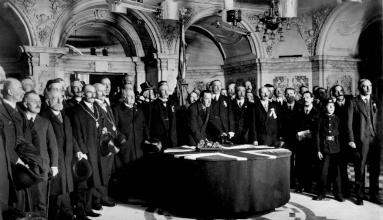
Ulster’s Solemn League and Covenant, commonly known as the Ulster Covenant, is signed by nearly 500,000 people on and before September 28, 1912, in protest against the Third Home Rule Bill introduced by the British Government in the same year.
The Covenant has two basic parts: the Covenant itself, which is signed by men, and the Declaration, which is signed by women. In total, the Covenant is signed by 237,368 men; the Declaration, by 234,046 women. Both the Covenant and Declaration are held by the Public Record Office of Northern Ireland (PRONI). An online searchable database is available on the PRONI website.
In January 1913, the Ulster Volunteers aim to recruit 100,000 men between the ages of 17 and 65 who had signed the Covenant as a unionist militia. A British Covenant, similar to the Ulster Covenant in opposition to the Home Rule Bill, receives two million signatures in 1914.
The majority of the signatories of the Covenant are from Ulster, although the signing is also attended by several thousand southern unionists. Acknowledging this, Carson pays tribute to “my own fellow citizens from Dublin, from Wicklow, from Clare [and], yes, from Cork, rebel Cork, who are now holding the hand of Ulster,” to cheers from the crowd.
The signature of Frederick Hugh Crawford is claimed by him to have been written in blood. However, this is disputed. Based on the results of a forensic test that he carries out in September 2012 at PRONI, Dr. Alastair Ruffell of Queen’s University Belfast asserts that he is 90% positive that the signature is not blood. Crawford’s signature is injected with a small amount of luminol. This substance reacts with iron in blood’s hemoglobin to produce a blue-white glow. The test is very sensitive and can detect tiny traces even in old samples. Crawford’s signature is still a rich red colour today which would be unlikely if it had been blood. Nevertheless, some unionists are not convinced by the evidence.
The Ulster Covenant is used as a template for the “Natal Covenant,” signed in 1955 by 33,000 British-descended Natalians against the nationalistSouth African government’s intention of declaring the Union a republic. It is signed in Durban‘s City Hall. Loosely based on Belfast’s Ulster Covenant, the Ulster scene is almost exactly reproduced.
September 28 is today known as “Ulster Day” to unionists.
(Pictured: Sir Edward Carson signing the Solemn League and Covenant)
The meeting is held under conditions of tight secrecy. Each man has only one assistant with him and there is no briefing for the press afterward. No one expects a firm agreement on any issue of substance. The British appear to be satisfied with a promise to meet again and to keep the communication lines open.
The meeting, the first such tripartite conference since the partition of Ireland 50 years earlier, is itself a considerable accomplishment politically. Even six weeks earlier, it is considered an impossibility by most observers.
At that time, Faulkner is widely regarded as being under such heavy pressure from the right-wing of his Ulster Unionist Party (UUP) that he cannot talk with the Taoiseach. Lynch has been saying that he can meet with Faulkner only as the leader of the Unionist party, not as the Prime Minister of Northern Ireland. That is consistent with Dublin‘s view that the six counties of Ulster are part of the Republic of Ireland.
Heath also seems to have retreated from his previous position. In an angry exchange of telegrams in August, he suggests that the situation in Northern Ireland is a British affair and none of Lynch’s business. The exchange follows the decision to intern suspected members of the Irish Republican Army (IRA) in Ulster without trial. Faulkner, backed by the Heath government, begin arrests of suspects on August 9.
The interment policy arouses a bitter reaction among the Roman Catholics of Ulster, where they make up a third of the population. Lynch denounces the policy. The Catholic opposition members in the Ulster Parliament at Stormont say they will boycott all Government matters until the interned men are released.
What has softened the attitudes of the three leaders is the appalling extent of violence in Belfast and other towns in Northern Ireland since the internments began. In those seven weeks, 17 British soldiers, 36 civilians and one policeman are killed, most of them by IRA bullets and bombs.
The British Government and Faulkner offer broad changes in the constitutional setup of the Ulster regime. They talk about bringing Catholics — non‐Unionists — into the Government for the first time. But internment without trial remains an obstacle even to talking about those ideas with the main opposition group, the Social Democratic and Labor Party (SDLP). The SDLP refuses to join in a proposed conference on political reform while internment goes on.
Ideally, the British would like Lynch to use his influence with the opposition leaders. They want him to urge them to talk about political reform in return for some concession on internment, perhaps the release of some of those currently held. But any such concession might get Faulkner in trouble with his own party or arouse Protestant violence. That is always the trouble in Northern Ireland – any gesture toward one side antagonizes the other.
A new and serious problem for Heath is an apparent waning of the British public’s willingness to bear the military and social burden of Northern Ireland. A poll just before the meeting at Chequers shows that 59% want to bring all British troops home from Ulster at once.
Even Lynch, though he is pledged to the principle of a United Ireland, does not want the hasty withdrawal of British troops. That would almost certainly mean an enlargement of the present terror into civil war.
(From: 3 Prime Ministers Confer on Ulster, The New York Times, September 28, 1971)
Shiels is born on June 24, 1881, in Milltown, Ballybrakes, near Ballymoney, County Antrim, one of seven sons of Robert Shiels, a railway worker, and Eliza Shiels (née Sweeney), who also has one daughter. The family soon moves to Castle Street, Ballymoney, where he attends the local Roman Catholicnational school. His elder brothers emigrate to the United States when young. With there being no chance of further schooling even if he wanted it, he leaves Ireland when he is 19 years old. He works as a casual labourer in many places in western North America: as a farmworker and miner in Idaho and Montana, and as a lumber camp worker in British Columbia, Canada. In 1904 he is employed by the Canadian Pacific Railway to supervise a gang of workers who are building a stretch of railway in Saskatchewan. In a serious accident, he is badly injured. Despite surgery on his back, he is never able to walk again, and he receives a disability pension from the railway company.
After a long convalescence in Canada, Shiels returns to his mother’s house in Ballymoney around 1908. He sets up in business in Main Street as a shipping agent and as an agent for the Canadian Pacific Railway, taking bookings from intending emigrants. He is encouraged by his parish priest, Fr. John Hasson, by a local solicitor, Jack Pinkerton, and by James Pettigrew, a teacher, to write short stories. To try to preserve anonymity in a small community, he at first uses the pseudonym “George Morshiel,” and is successful with Western stories and other short fiction. His friends urge him to try writing dramas, and in 1918 Away from the Moss is produced by the Ulster Literary Theatre in Belfast.
After further success there with two short plays in which Shiels is learning his craft, the Abbey Theatre in Dublin accepts a one-act play, Bedmates, which is performed in January 1921. With great regularity for the next twenty years, he writes twenty-two plays for the Abbey Theatre. His work forms the basis of the repertoire in the 1920s and 1930s and attracts large audiences. Plays such as The New Gossoon (1930) provide Dublin theatregoers with entertainment, but also help form the style of acting and production which for many years characterises the Abbey and its actors. Three of his plays, Paul Twyning (1922), Professor Tim (1925) and The New Gossoon, are later performed in theatres in London and are also published in a 1945 volume, which is twice reprinted. Professor Tim, produced by the touring Abbey Theatre, receives enthusiastic reviews in Philadelphia, and The New Gossoon appears successfully on Broadway in New York City in 1932, 1934, and 1937.
Shiels’s earlier work is perhaps easiest for audiences to enjoy. Comedies such as Moodie in Manitoba (1918) portray characters so realistic that north Antrim people believe with some alarm that it might be possible to identify who Shiels had in mind when he created them, and he is at first somewhat less than popular in Ballymoney. He superbly reproduces local language and thoroughly understands the local way of life. Plays he writes late in his career are first performed by the Group Theatre in Belfast, and in these productions (and in the radio versions broadcast by the BBC) his work becomes widely known, almost beloved, in the north of Ireland. During the first half of the twentieth century amateur drama groups throughout Ireland are much more important in local life than they have been since the advent of television. Probably all such societies have at some time staged a Shiels play, and this tradition continues. His plays contain amusing dialogue, carefully crafted plots, and usually more or less happy endings.
However, Shiels’s later works, notably The Passing Day (1936), first broadcast as a radio play, and The Rugged Path (1940), which breaks all records at the Abbey Theatre in a run of three months, tackle darker subject matter and feature characters still less sympathetic even than the rogues and hypocrites of the earlier work. In The Rugged Path and its sequel, The Summit (1941), he explores the moral crisis facing Ireland after the political changes of the 1920s. One critic sees in it an allegory for the contemporary struggle against Adolf Hitler. His view of life in the small towns and farms of Ireland is never in the slightest rosy-tinted, but in the symbolism of The Passing Day, he achieves “bitter intensity” (The Irish Times review, quoted by Casey).
Shiels’s modesty leads him to refuse an honorary doctorate from Queen’s University Belfast (QUB), in 1931. He is reticent about his experiences and beliefs and does little to foster his own reputation. In one early interview he expresses the belief that Ulster theatre needs dramatic material that reflects the psychology and setting of the region. His own work, at its best, achieves this and more. The very qualities which make his work popular in the north of Ireland permit some metropolitan literary critics to dismiss his plays as “kitchen comedies.” However, with the passage of time, his importance as a chronicler of a vanishing way of life can be set alongside the recognition due to him as a prolific and gifted dramatist.
Shiels suffers from a lengthy illness, and though he undergoes an operation in Ballymoney in 1949, dies soon afterwards at his house, New Lodge, in Carnlough, County Antrim, on September 19, 1949. He is buried in the graveyard of Our Lady and St. Patrick in Ballymoney. In the month that he dies, the Group Theatre and Garvagh Young Farmers’ Club are both rehearsing Shiels plays, and there have since been many productions of his plays in the north and elsewhere. Ballymoney Drama Festival presents a portrait of Shiels to the Abbey Theatre, and a new production of The Passing Day is staged there to celebrate his centenary in 1981.
Warfield is a singer, songwriter, mandolin player and a founding member of The Wolfe Tones, performing with the band for nearly thirty-seven years, writing and recording over 60 songs. As a founding member, he is featured on every album recorded by the band from 1965’s debut album The Foggy Dew through to 1989’s 25th Anniversary.
In 1989, a contract is signed by Warfield, signing rights to an American distributor, Shanachie Records. The contents of this contract are apparently misrepresented to the other members of The Wolfe Tones, resulting in a clause that prevents them from recording any new material. Unable to reverse this agreement, they continue to tour, albeit without any new material. As of July 2017, Warfield has not spoken to his brother and former bandmate Brian Warfield since he left The Wolfe Tones in 2001.
A solo album, Legacy, is released in 1995 as he is still eligible to record under his own name. With Warfield on vocals and mandolin, the music on this album is performed by a new band, although he is still touring with The Wolfe Tones. Legacy is followed by Liberte’ ’98, Sons of Erin, Take Me Home To Mayo and Clear The Way. He also has a video Legacy and two books, The Songs and Ballads of 1798 and The Irish Songster of the American Civil War.
In 2001, after a show played in Limerick, Warfield leaves The Wolfe Tones to concentrate on his own career. Calling themselves “Brian Warfield, Tommy Byrne and Noel Nagle, formerly of The Wolfe Tones,” the remaining three go on to release You’ll Never Beat the Irish (2001) and the subsequent album Child of Destiny (2011).
Warfield has performed his music and songs at American Civil War events and commemorations at such sites as Gettysburg, Sharpsburg and Harrisburg with his band, The Sons of Erin. His 2002 release, Clear the Way, is the second in his Irish Songs in the Civil War series.
The ballad “Take Me Home to Mayo,” written by Belfastman Seamus Robinson as a tribute to Michael Gaughan, is recorded as a duet with Irish American Andy Cooney and is the title track of another 2002 Warfield release.
In 2003, following a complaint by an Ulster Unionist Party (UUP) politician, Roy Beggs, Jr., a radio channel dedicated to the music of Derek Warfield is removed from the in-flight entertainment of Aer Lingus. Beggs complains of the “Blatant promotion of militant, armed republicanism” by the playing of this music, saying it is the same as “the speeches of Osama bin Laden being played on a trans-Atlantic Arabian airline.” Aer Lingus removes the material from their flights stating: “It is something that should not have been on board and we removed it immediately we became aware of it.”
In March 2006, Warfield releases his ninth solo album, a 36-song double CD of Irish songs. On March 1, 2006, his wife Nuala dies, followed by the death of his eldest daughter on September 28, 2007.
Warfield now tours with his new band, Derek Warfield and The Young Wolfe Tones.
A biography of Robert Emmet in two volumes, although not written by Warfield, has been published by him, and a collaboration with Raymond Daly of Tullamore has resulted in the publishing of a critically acclaimed book of lyrics and histories of Irish songs called Celtic and Ireland in Song and Story.






 seamus dubhghaill