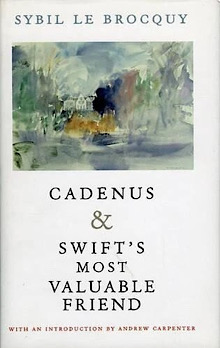
She is born Helen Mary Sybil Staunton on December 21, 1892, in Herbert Street, Dublin, to Dorothy Eleanor Redington and Peter Maurice Staunton. Her father is a barrister who later becomes a solicitor. Though he moves to Aram Lodge, Castlerea, County Roscommon where he practises law, she grows up in Dublin and Howth, going to secondary school in Loreto Abbey, Rathfarnham, and later at Loreto Convent, St. Stephen’s Green. She goes on to study German and singing in Koblenz. She marries Albert le Brocquy on December 30, 1915, and settles in Dublin. They have three children, Louis, Noel and Melanie.
Le Brocquy becomes involved in various women’s movements, helping to organise the Women’s International League for Peace and Freedom in July 1926. She is involved with the League of Nations Association as well as helps to establish Irish Civil Rights, PEN International, and Amnesty International in Ireland. She is an active member of Old Dublin Society and for a time president of the Irish Women Writers’ Society. She acts with the Drama League appearing as Helen Staunton. She writes plays and dramatic pieces which are staged by the Drama League at the Abbey Theatre and broadcast by Radio Éireann.
Her writings and work are often historically investigative, finding W. B. Yeats’s birthplace and arguing that Jonathan Swift had a child by Vanessa. She is involved in the Swift Tercentenary celebrations with Cearbhall Ó Dálaigh. As a result of her work, including with Trinity College Dublin Library and representing the Library on the Royal Irish Academy’s National Committee for Anglo-Irish Literature, she is co-opted to the Cultural Committee of the Department of External Affairs and appointed a Trustee of the National Library of Ireland. She is an excellent organiser and fundraiser and is heavily responsible for securing money for the Gate Theatre, Dublin, in 1970. She also initiates the literary prize, the Book of the Year award.
Le Brocquy becomes ill with an undiagnosed illness and dies on September 4, 1973, at the Meath Hospital, Dublin.
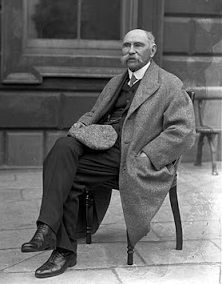
Hyde is born at Longford House in Castlerea, County Roscommon, on January 17, 1860. In 1867, his father is appointed prebendary and rector of Tibohine, and the family moves to neighbouring Frenchpark, in County Roscommon. He is home schooled by his father and his aunt due to a childhood illness. While a young man, he becomes fascinated with hearing the old people in the locality speak the Irish language.
Rejecting family pressure to follow previous generations with a career in the Church, Hyde instead becomes an academic. He enters Trinity College, Dublin (TCD), where he gains a great facility for languages, learning Latin, Greek, Hebrew, French, and German, but his great passion in life is the preservation of the Irish language.
After spending a year teaching modern languages in Canada, Hyde returns to Ireland. For much of the rest of his life he writes and collects hundreds of stories, poems, and folktales in Irish, and translates others. His work in Irish helps to inspire many other literary writers, such as W. B. Yeats and Lady Gregory.
In 1892, Hyde helps establish the Gaelic Journal and in November of that year writes a manifesto called The necessity for de-anglicising the Irish nation, arguing that Ireland should follow her own traditions in language, literature, and even in dress.
In 1893, Hyde founds the Gaelic League (Conradh na Gaeilge) along with Eoin MacNeill and Fr. Eugene O’Growney and serves as its first president. Many of the new generation of Irish leaders who play a central role in the fight for Irish independence in the early twentieth century, including Patrick Pearse, Éamon de Valera, Michael Collins, and Ernest Blythe first become politicised and passionate about Irish independence through their involvement in the Gaelic League. Hyde does not want the Gaelic League to be a political entity, so when the surge of Irish nationalism that the Gaelic League helps to foster begins to take control of many in the League and politicize it in 1915, Hyde resigns as president.
In 1938, Hyde is unanimously elected to the newly created position of President of Ireland, a post he holds until 1945. Hyde is inaugurated on June 26, 1938, in the first inaugural ceremony in the nation’s history. Despite being placed in a position to shape the office of the presidency via precedent, Hyde by and large opts for a quiet, conservative interpretation of the office. In April 1940, he suffers a massive stroke and plans are made for his lying in state and state funeral, but to the surprise of everyone he survives, albeit paralysed and confined to a wheelchair. One of his last presidential acts is a visit to the German ambassador Eduard Hempel on May 3, 1945, to offer his condolences on the death of Adolf Hitler, a visit which remains a secret until 2005.
Hyde leaves office on June 25, 1945, opting not to nominate himself for a second term. He opts not return to his Roscommon home due to his ill-health, but rather moves into the former Secretary to the Lord Lieutenant’s residence in the grounds of Áras an Uachtaráin, where he lived out the remaining four years of his life.
Hyde dies in Dublin on July 12, 1949, at age 89. As a former President of Ireland he is accorded a state funeral which, as a member of the Church of Ireland, takes place in Dublin’s St. Patrick’s Cathedral. Since contemporary rules of the Roman Catholic Church in Ireland at the time prohibit Roman Catholics from attending services in non-Catholic churches, all but one member of the Catholic cabinet remain outside the cathedral grounds while Hyde’s funeral takes place. Hyde is buried in Frenchpark, County Roscommon at Portahard Church.
In the Fine Gael–Labour Partycoalition government which takes office after the 1973 Irish general election, Donegan is appointed as Minister for Defence. In October 1976, he makes a speech on an official visit to the opening of new kitchen facilities in an army barracks at Mullingar, County Westmeath in which he describes as a “thundering disgrace” PresidentCearbhall Ó Dálaigh‘s refusal to sign the Emergency Powers Bill 1976. Ó Dálaigh had instead exercised his powers under Article 26 of the Constitution of Ireland to refer it to the Supreme Court. The Taoiseach, Liam Cosgrave, refuses Donegan’s resignation. On October 21, Fianna Fáil proposes a motion in the Dáil calling on the minister to resign, which is defeated. Ó Dálaigh views the refusal to remove the minister as an affront to his office by the government and resigns on October 22, 1976.
In December 1976, Donegan is appointed as Minister for Lands. In February 1977, this office is restructured as the Minister for Fisheries. He serves in cabinet until the government loses office after the 1977 Irish general election.
Donegan retires from politics at the 1981 Irish general election. He dies at his home in County Louth on November 26,2000, following a long illness. Tributes in the Dáil are led by John Bruton as Fine Gael leader. He is buried in his hometown of Monasterboice, County Louth.
An Taisce is established on a provisional basis in September 1946 and incorporated as a company based on an “association not for profit” in June 1948. It is a charitable non-governmental organisation (NGO) active in the areas of the environment and built heritage in the Republic of Ireland. It considers itself the oldest environmental and non-governmental organisation in the country and is somewhat similar to the National Trust of England, Wales and Northern Ireland but based more directly on the National Trust for Scotland. Its first president is the prominent naturalist Robert Lloyd Praeger.
An Taisce is a membership-based charity, rather than a state or semi-state organisation, or quango, but it does receive government and European Union funding for specific programmes, such as Blue Flag beaches, and Green Schools private-sector funding for, for example, the Irish Business Against Litter surveys, and a mix of State and private funding for the annual National Spring Clean. An Taisce has for decades also had a statutory role in certain planning and environmental processes in the country.
The work of the organisation includes policy recommendation and campaigning in the built and natural heritage areas, the holding in trust of relevant properties, and environmentally relevant education. It has a number of local associations, which may assist in caring for properties, and monitor planning in their areas.
A public meeting to consider the need for a national trust is held in the Mansion House in September 1946, convened by the Royal Irish Academy, the Royal Society of Antiquaries of Ireland, An Óige, the Geographical Society of Ireland, the Dublin Naturalists’ Field Club and the Irish Society for the Preservation of Birds. The meeting resolves to create such a body, and elect both a provisional committee, and a council of 16 plus 4 co-opted members, who secure bankers, auditors and solicitors. After extensive debate, the two-part name is chosen and application is made to form a not-for-profit company. Special approval is sought from the Minister for Trade and Commerce for charity-appropriate memorandum and articles, adhering to the “association not for profit” section of the then Companies Act, with a prohibition on distribution of surpluses, and for permission to omit the word “Limited” from the company name.
An Taisce is an indirect successor to the all-Island National Trust Committee which had ceased to exist in 1946 after the passing of the Northern Ireland National Trust Act.
The organisation is duly incorporated as a company limited by guarantee on June 28, 1948. The initial constitution is modelled on that of the National Trust for Scotland. The first official meeting of the company was held on July 15, 1948, at the Royal Irish Academy’s headquarters, Academy House on Dawson Street, and the first annual general meeting is convened on September 23 of the same year, with formal greetings from the National Trust and the National Trust for Scotland.
Ó Dálaigh, one of four children, is born on February 12, 1911, in Bray, County Wicklow. His father, Richard O’Daly, is a fishmonger with little interest in politics. His mother is Una Thornton. His birth name is registered in English as Carroll O’Daly, which he uses during his legal career, and which is recorded by some publications.
Ó Dálaigh is a committed Fianna Fáil supporter who serves on the party’s National Executive in the 1930s. He becomes Ireland’s youngest Attorney General in 1946, under TaoiseachÉamon de Valera, serving until 1948. Unsuccessful in Dáil and Seanad elections in 1948 and 1951, he is re-appointed as Attorney General of Ireland in 1951. In 1953, he is nominated as the youngest-ever member of the Supreme Court by his mentor, de Valera. Less than a decade later, he becomes Chief Justice of Ireland, on the nomination of Taoiseach Seán Lemass. He is a keen actor in his early years and becomes a close friend of actor Cyril Cusack. It is commonly stated that Ó Dálaigh and Cusack picketed the Dublin launch of Disney‘s Darby O’Gill and the Little People in 1959, for what they felt was the film’s stereotyping of Irish people. However, there is no known contemporary reference to this having occurred.
In 1972, Taoiseach Jack Lynch suggests to the opposition parties that they agree to nominate Ó Dálaigh to become President of Ireland when President de Valera’s second term ends in June of the following year. Fine Gael, confident that its prospective candidate, Tom O’Higgins, will win the 1973 presidential election, having almost defeated de Valera in 1966, turn down the offer. Fianna Fáil’s Erskine H. Childers goes on to win the election that follows.
When Ireland joins the European Economic Community (EEC), Lynch appoints Ó Dálaigh as Ireland’s judge on the European Court of Justice. When President Childers dies suddenly in 1974, all parties agree to nominate Ó Dálaigh to replace him.
Ó Dálaigh’s tenure as president proves to be contentious. While popular with Irish language speakers and with artists, and respected by many republicans, he has a strained relationship with the Government of the 20th Dáil, particularly with Minister Conor Cruise O’Brien and Taoiseach Liam Cosgrave.
Ó Dálaigh’s decision in 1976 to exercise his power to refer a bill to the Supreme Court to test its constitutionality brings him into conflict with the Fine Gael-Labour National Coalition. Following the assassination of the British Ambassador to Ireland, Christopher Ewart-Biggs, by the Provisional Irish Republican Army (IRA), on July 23, 1976, the government announces its intention to introduce legislation extending the maximum period of detention without charge from two to seven days.
Ó Dálaigh refers the resulting bill, the Emergency Powers Bill, to the Supreme Court. When the court rules that the bill is constitutional, he signs the bill into law on October 16, 1976. On the same day, an IRA bomb in Mountmellick, County Laois, kills Michael Clerkin, a member of the Garda Síochána, the country’s police force. Ó Dálaigh’s actions are seen by government ministers to have contributed to the killing of this Garda. On the following day, Minister for DefencePaddy Donegan, visiting a barracks in Mullingar, County Westmeath, to open a canteen, attacks the President for sending the bill to the Supreme Court, calling him a “thundering disgrace.”
Ó Dálaigh’s private papers show that he considered the relationship between the President (as Commander-in-Chief of the Defence Forces) and the Minister for Defence had been “irrevocably broken” by the comments of the Minister in front of the army Chief of Staff and other high-ranking officers. Donegan offers his resignation, but Taoiseach Liam Cosgrave refuses to accept it. This proves the last straw for Ó Dálaigh, who believes that Cosgrave had additionally failed to meet his constitutional obligation to regularly brief the President. He resigns from the presidency on October 22, 1976, “to protect the dignity and independence of the presidency as an institution.” He is succeeded as President of Ireland by Patrick Hillery.
Ó Dálaigh dies of a heart attack on March 21, 1978, less than two years after resigning the presidency. He is buried in Sneem, County Kerry.
Patrick John Hillery, Irish politician and the sixth President of Ireland, dies in Glasnevin, Dublin, at the age of 84 on April 12, 2008, following a short illness. He serves two terms in the presidency and, though widely seen as a somewhat lacklustre President, is credited with bringing stability and dignity to the office. He also wins widespread admiration when it emerges that he has withstood political pressure from his own Fianna Fáil party during a political crisis in 1982.
Following Ireland’s successful entry into the European Economic Community in 1973, Hillery is rewarded by becoming the first Irishman to serve on the European Commission, serving until 1976 when he becomes President. In 1976 the Fine Gael–Labour Party National Coalition under Liam Cosgrave informs him that he is not being re-appointed to the Commission. He considers returning to medicine; however, fate takes a turn when Minister for DefencePaddy Donegan launches a ferocious verbal attack on President Cearbhall Ó Dálaigh, calling him “a thundering disgrace” for referring anti-terrorist legislation to the courts to test its constitutionality. When a furious President Ó Dálaigh resigns, a deeply reluctant Hillery agrees to become the Fianna Fáil candidate for the presidency. Fine Gael and Labour decide it is unwise to put up a candidate in light of the row over Ó Dálaigh’s resignation. As a result, Hillery is elected unopposed, becoming President of Ireland on December 3, 1976.
When Hillery’s term of office ends in September 1983, he indicates that he does not intend to seek a second term, but he changes his mind when all three political parties plead with him to reconsider. He is returned for a further seven years without an electoral contest. After leaving office in 1990, he retires from politics.
Hillery’s two terms as president, from 1976 to 1990, end before the 1998 Good Friday Agreement, which sets terms for an end to violence in Northern Ireland. But he acts at crucial moments as an emollient influence on the republic’s policies toward the north and sets a tone that helps pave the way for eventual peace.
Patrick Hillery dies on April 12, 2008, in his Dublin home following a short illness. His family agrees to a full state funeral for the former president. He is buried at St. Fintan’s Cemetery, Sutton, near Dublin. In the graveside oration, TánaisteBrian Cowen says Hillery was “A humble man of simple tastes, he has been variously described as honourable, decent, intelligent, courteous, warm and engaging. He was all of those things and more.”
Cyril James Cusack, Irish actor who appears in numerous films and television productions in a career lasting more than 70 years, dies in Chiswick, London, England on October 7, 1993. In 2020, he is listed at number 14 on The Irish Times‘s list of Ireland’s greatest film actors.
Cusack is born in Durban, Natal, South Africa, on November 26, 1910. His mother, Alice Violet (née Cole), is an English Cockney actress and chorus girl, and his father, James Walter Cusack, is an Irish mounted policeman in the Colony of Natal, South Africa. His parents separate when he is young and his mother takes him to England, and then to Ireland. His mother and her partner, Brefni O’Rorke, join the O’Brien and Ireland Players.
Cusack makes his first stage performance at the age of seven. He is educated at Newbridge College in Newbridge, County Kildare, then reads law at University College Dublin. He leaves without a degree and joins the Abbey Theatre in 1932. Between then and 1945, he performs in over 60 productions, particularly excelling in the plays of Seán O’Casey. He also performs Irish playwright Teresa Deevy‘s plays Katie Roche and The King of Spain’s Daughter. In 1932 he also joins the Gate Theatre company, appearing with them in many notable productions over the years. In 1947, he forms his own company and stages productions in Dublin, Paris and New York.
In 1963, Cusack joins the Royal Shakespeare Company in London and appears there for several seasons. By this stage he has established a successful career in films, which had started at the age of eight. Also in 1963, he wins a Jacob’s Award for his performance in the Telefís Éireann production of Triptych. He receives honorary degrees in 1977 and 1980 from the National University of Ireland (NUI) and the University of Dublin respectively.
Cusack, who is bilingual in English and Irish, has a leading role in the controversial Irish language film Poitín (1977). He is also offered the role of the First Doctor in Doctor Who.
Cusack’s last stage performance is in Anton Chekhov‘s Three Sisters (1990), in which three of his daughters play the sisters.
Cusack is twice married, firstly to Mary Margaret “Maureen” Kiely (1920–1977), on April 5, 1945. Together they have five children: Paul (1946), Sinéad (1948), Sorcha (1949), Niamh (1959), and Pádraig (1962). He and his second wife, Mary Rose Cunningham (1979–1993), have one daughter, Catherine (1968).
In later life, Cusack becomes a campaigner for conservative causes in Ireland, notably in his opposition to abortion, where he becomes a frequent letter-writer to the main liberal Irish newspaper, The Irish Times. Regarding his Catholic faith, he comments “Religion promotes the divine discontent within oneself, so that one tries to make oneself a better person and draw oneself closer to God.” His religious credentials come under scrutiny following his death and the revelation that he had been unfaithful in his first marriage, with a long-term mistress, Mary Rose Cunningham. He marries Cunningham following his first wife’s death.
On October 7, 1993, Cusack dies at the age of 82 at home in Chiswick, Greater London, from amyotrophic lateral sclerosis (ALS). His acting career had lasted 75 years.
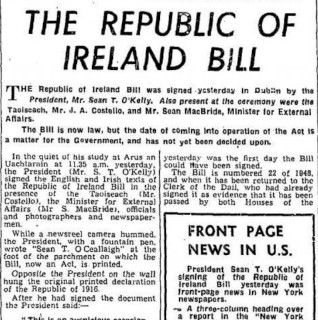
The Republic of Ireland Act 1948 is an Act of the Oireachtas which declares that Ireland may be officially described as the Republic of Ireland, and vests in the President of Ireland the power to exercise the executive authority of the state in its external relations, on the advice of the Government of Ireland. The Act is signed into law on December 21, 1948 and comes into force on April 18, 1949, Easter Monday, the 33rd anniversary of the beginning of the Easter Rising.
The Act repeals the External Relations Act 1936. Under that Act, King George VI acts as the Irish head of state in international relations by accredited ambassadors and on the State’s behalf accepts credentials appointing foreign ambassadors to the State. The Republic of Ireland Act removes this last remaining practical role from the King and vests it instead in the President of Ireland, making the then President of Ireland, Seán T. O’Kelly, unambiguously the Irish head of state.
In 1945, when asked if he plans to declare a Republic, the then TaoiseachÉamon de Valera replies, “we are a republic.” He also insists that Ireland has no king, but simply uses an external king as an organ in international affairs. However, that is not the view of constitutional lawyers including de Valera’s Attorneys General, whose disagreement with de Valera’s interpretation only come to light when the state papers from the 1930s and 1940s are released to historians. Nor is it the view in the international arena, who believe that Ireland does have a king, George VI, who had been proclaimed King of Ireland in December 1936, and to whom they accredit ambassadors to Ireland. King George, in turn, as “King of Ireland” accredits all Irish diplomats. All treaties signed by the Irish Taoiseach or Minister for External Affairs are signed in the name of King George.
In October 1947, de Valera asks his Attorney General, Cearbhall Ó Dálaigh, to draft a bill to repeal the External Relations Act. By 1948 a draft of the bill includes a reference to the state as being a republic. In the end, the draft bill is never submitted to the Oireachtas for approval.
The bill to declare Ireland a republic is introduced in 1948 by the new Taoiseach, John A. Costello of the Fine Gael party. Costello makes the announcement that the bill is to be introduced when he is in Ottawa, during an official visit to Canada. David McCullagh suggests that it is a spur of the moment reaction to offence caused by the Governor General of Canada, Lord Alexander, who is of Northern Irish descent, who allegedly places loyalist symbols before an affronted Costello at a state dinner. What is certain is that an agreement that there be separate toasts for the King and for the President of Ireland is broken. The Irish position is that a toast to the King, instead of representing both countries, would not include Ireland. Only a toast to the King is proposed, to the fury of the Irish delegation. Shortly afterwards Costello announces the plan to declare the republic.
However, according to all but one of the ministers in Costello’s cabinet, the decision to declare a republic had already been made before Costello’s Canadian visit. Costello’s revelation of the decision is because the Sunday Independent had discovered the fact and was about to “break” the story as an exclusive. The evidence of what really happens remains ambiguous. There is no record of a prior decision to declare a republic before Costello’s Canadian trip.
At any rate, the Act is enacted with all parties voting for it. De Valera does suggest that it would have been better to reserve the declaration of the republic until Irish unity had been achieved, a comment hard to reconcile with his 1945 claim that the Irish state was already a republic. Speaking in Seanad Éireann Costello tells senators that as a matter of law, the King is indeed “King of Ireland” and Irish head of state and the President of Ireland is in effect no more than first citizen and a local notable, until the new law comes into force.
The United Kingdom responds to the Republic of Ireland Act by enacting the Ireland Act 1949. This Act formally asserts that the Irish state had, when the Republic of Ireland Act came into force, ceased “to be part of His Majesty’s dominions” and accordingly is no longer within the Commonwealth. Nonetheless the United Kingdom statute provides that Irish citizens will not be treated as aliens under British nationality law. This, in effect, grants them a status similar to the citizens of Commonwealth countries.
Risteárd Earnán Ó Glaisne is born on September 2, 1927, near Bandon, County Cork, the third of four children of George William Giles and his wife, Sara Jane (née Vickery). Educated at Bandon Grammar School and Trinity College Dublin, he graduates with a BA in 1949 and obtains a master’s degree in 1959. At TCD he is greatly influenced by Daithí Ó hUaithne.
Ó Glaisne first becomes interested in the Irish language at school in Bandon. His headmaster gives him a copy of Liam Ó Rinn‘s Peann agus Pár, along with a book of poems by Ivan Turgenev translated into Irish by Ó Rinn. “I suddenly found myself breaking into a world vastly larger than my own world in Irish,” he recalls. “The quality of mind I encountered made me realise I could never again connect Irish only with poteen and potatoes.”
Ó Glaisne further explores the language by making contact with the few native Irish speakers left in the Bandon area. He gradually comes to the conclusion that he is a member of a nation that has an extremely old and in many ways distinguished culture, of which Irish has been historically an integral part. Deciding that Irish best reflects the society in which he grew up and reflects him as an individual, he adopts it as his first language.
On graduating from TCD Ó Glaisne teaches Irish at Avoca School, Blackrock. He later teaches in St. Andrew’s College, Dublin, and at St. Patrick’s Cathedral Grammar School, where he ends his teaching career in 1989. He took a career break in the mid-1960s to study the French educational system and to travel on the Continent.
To perfect his Irish Ó Glaisne holidays on the Great Blasket Island, where he immerses himself in the rich oral culture. He makes many friends among the islanders, and the friendships continue after they are resettled on the mainland in Dún Chaoin. He regularly visits Corca Dhuibhne to meet friends like Muiris Mhaidhc Léan Ó Guithín, one of the last surviving islanders, and to enjoy the annual Ceiliúradh an Bhlascaoid.
Ó Glaisne holds that Protestants have enjoyed a long association with Irish, pointing to 18th-century followers of John Wesley such as Charles Graham, Gideon Ousley and Tomás Breathnach, who evangelised in Irish. He firmly believes that Protestants can be “every whit as Irish” as Roman Catholics. He urges his co-religionists to identify fully with Ireland.
Ó Glaisne is the founder and editor of Focus (1958-66), a monthly magazine that aims to help Protestants “come to an understanding of their cultural heritage.” He is a regular contributor to programmes on RTÉ and RTÉ Raidió na Gaeltachta, and writes for Comhar, Inniú, An tUltach and The Irish Times.
Hyde is born at Longford House in Castlerea, County Roscommon, on January 17, 1860. In 1867, his father is appointed prebendary and rector of Tibohine, and the family moves to neighbouring Frenchpark, in County Roscommon. He is home schooled by his father and his aunt due to a childhood illness. While a young man, he becomes fascinated with hearing the old people in the locality speak the Irish language.
Rejecting family pressure to follow previous generations with a career in the Church, Hyde instead becomes an academic. He enters Trinity College, Dublin, where he gains a great facility for languages, learning Latin, Greek, Hebrew, French, and German, but his great passion in life is the preservation of the Irish language.
After spending a year teaching modern languages in Canada, Hyde returns to Ireland. For much of the rest of his life he writes and collects hundreds of stories, poems, and folktales in Irish, and translates others. His work in Irish helps to inspire many other literary writers, such as W.B. Yeats and Lady Gregory.
In 1892, Hyde helps establish the Gaelic Journal and in November of that year writes a manifesto called The necessity for de-anglicising the Irish nation, arguing that Ireland should follow her own traditions in language, literature, and even in dress.
In 1893, Hyde founds the Gaelic League (Conradh na Gaeilge) along with Eoin MacNeill and Fr. Eugene O’Growney and serves as its first president. Many of the new generation of Irish leaders who play a central role in the fight for Irish independence in the early twentieth century, including Patrick Pearse, Éamon de Valera, Michael Collins, and Ernest Blythe first become politicised and passionate about Irish independence through their involvement in the Gaelic League. Hyde does not want the Gaelic League to be a political entity, so when the surge of Irish nationalism that the Gaelic League helps to foster begins to take control of many in the League and politicize it in 1915, Hyde resigns as president.
In 1938, Hyde is unanimously elected to the newly created position of President of Ireland, a post he holds until 1945. He is inaugurated on June 26, 1938, in the first inaugural ceremony in the nation’s history. He sets a precedent by reciting the Presidential Declaration of Office in Irish. His recitation, in Roscommon Irish, is one of a few recordings of a dialect of which Hyde is one of the last speakers. Upon inauguration, he moves into the long vacant Viceregal Lodge in Phoenix Park, since known as Áras an Uachtaráin.
Despite being placed in a position to shape the office of the presidency via precedent, Hyde by and large opts for a quiet, conservative interpretation of the office.
In April 1940 Hyde suffers a massive stroke and plans are made for his lying-in-state and state funeral, but to the surprise of everyone he survives, albeit paralysed and confined to a wheelchair. One of Hyde’s last presidential acts is a visit to the German ambassador Eduard Hempel on May 3, 1945, to offer his condolences on the death of Adolf Hitler, a visit which remains a secret until 2005.
Hyde leaves office on June 25, 1945, opting not to nominate himself for a second term. He opts not return to his Roscommon home due to his ill-health but rather moves into the former Secretary to the Lord Lieutenant’s residence in the grounds of Áras an Uachtaráin, where he lived out the remaining four years of his life.
Hyde dies in Dublin on July 12, 1949, at age 89. As a former President of Ireland, he is accorded a state funeral which, as a member of the Church of Ireland, takes place in Dublin’s Church of Ireland St. Patrick’s Cathedral. Since contemporary rules of the Roman Catholic Church in Ireland at the time prohibit Roman Catholics from attending services in non-Catholic churches, all but one member of the Catholic cabinet remains outside the cathedral grounds while Hyde’s funeral takes place. Hyde is buried in Frenchpark, County Roscommon at Portahard Church.





 seamus dubhghaill