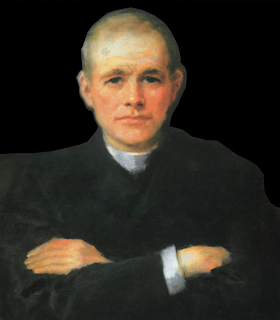
Dinneen is a leading figure in the Irish Texts Society, publishing editions of Geoffrey Keating‘s Foras Feasa ar Éirinn, poems by Aogán Ó Rathaille, Piaras Feiritéar, Tadhg Gaelach Ó Súilleabháin, and other poets. He also writes a novel and a play in Irish, and translates such works as Charles Dickens‘s A Christmas Carol into Irish. His best known work, however, is his Irish–English dictionary, Foclóir Gaedhilge agus Béarla, which is first published in 1904. The stock and plates of the dictionary are destroyed during the Easter Rising of 1916, so Dinneen takes the opportunity to expand the dictionary. A much larger second edition, compiled with the assistance of Liam S. Gógan, is published in 1927. His request to the Irish Texts Society to include Gogan’s name on the title page is refused. Gogan continues to work on the collection of words up to his death in 1979. This complementary dictionary is published online in 2011.
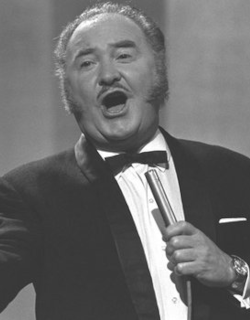
McLaughlin is one of ten children of Patrick McLaughlin, butcher and cattle dealer, and Annie McLaughlin (née Doherty). He starts singing in local churches in the Bogside at the age of seven, and as a teenager adds two years to his age to enlist in the Irish Guards, later serving abroad with the Palestine Police Force, before returning in the late 1930s to join the Royal Ulster Constabulary (RUC).
Known as The Singing Bobby, McLaughlin becomes a local celebrity before starting to work in the UK variety circuit, where he also plays summer seasons in English seaside resorts. The renowned Irish tenor John McCormack (1884–1945) advises him that his voice is better suited to a lighter repertoire than the operatic one he has in mind and urges him to find an agent. He finds the noted impresario Jack Hylton (1892–1965) who books him but is unable to fit his full name on the bill, thus Joseph McLaughlin becomes Josef Locke.
Locke makes an immediate impact when featured in “Starry Way,” a twenty-week summer show at the Opera House Theatre in Blackpool, Lancashire, England in 1946 and is rebooked for the following summer, then starring for three seasons at the Blackpool Hippodrome. He appears in ten Blackpool seasons from 1946 to 1969, not the nineteen seasons he later claims.
Locke makes his first radio broadcast in 1949 and subsequently appears on television programmes such as Rooftop Rendezvous, Top of the Town, All-star Bill and The Frankie Howerd Show. He is signed to the Columbia label in 1947, and his first releases are the two Italian songs “Santa Lucia” and “Come Back to Sorrento.”
In 1947, Locke releases “Hear My Song, Violetta,” which becomes forever associated with him. It is based on a 1936 tango “Hör’ mein Lied, Violetta” by Othmar Klose and Rudolf Lukesch. The song “Hör’ mein Lied, Violetta” is often covered, including by Peter Alexander and is itself based on Giuseppe Verdi‘s La traviata. His other songs are mostly a mixture of ballads associated with Ireland, excerpts from operettas, and familiar favourites.
In 1948, Locke appears in several films produced by Mancunian Films, usually as versions of himself. He plays himself in the film Holidays with Pay. He also appears as “Sergeant Locke” in the 1949 comedy What a Carry On!
In 1958, after Locke has appeared in five Royal Variety Performancetelecasts, and while he is still at the peak of his career, the British tax authorities begin to make substantial demands that he declines to meet. Eventually he flees the country for Ireland, where he lays low for several years. When his differences with the taxman are eventually settled, he relaunches his career in England with tours of the northern variety clubs and summer seasons at Blackpool’s Queen’s Theatre in 1968 and 1969, before retiring to County Kildare, emerging for the occasional concert in England. He later appears on British and Irish television, and in November 1984 is given a lengthy 90-minute tribute in honour of the award he is to receive at the Olympia Theatre commentating his career in show business on Gay Byrne‘s The Late Late Show. He also makes many appearances on the BBC Television‘s long running variety show The Good Old Days.
In 1991, the Peter Chelsom film Hear My Song is released. It is a fantasy based on the notion of Locke returning from his Irish exile in the 1960s to complete an old love affair and save a Liverpool-based Irish night-club from ruination. Locke is played by Ned Beatty, with the singing voice of Vernon Midgley. The film leads to a revival in Locke’s career. A compilation CD is released, and he appears on This Is Your Life in March 1992. He performs in front of the Prince and Princess of Wales at the 1992 Royal Variety Performance, singing “Goodbye,” the final song performed by his character in the film. He announces prior to the song that this will be his final public appearance.
Locke dies at the age of 82 at a nursing home in Clane, County Kildare on October 15, 1999, and is cremated at Glasnevin Cemetery. He is survived by his wife, Carmel, and a son.
On March 22, 2005, a bronze memorial to Locke is unveiled outside the City Hotel on Queen’s Quay in Derry by Phil Coulter and John Hume. The memorial is designed by Terry Quigley. It takes the form of a spiraling scroll divided by lines, representing a musical stave. The spiral suggests the flowing melody of a song and is punctuated by images illustrating episodes in his life, including Locke in police uniform, Blackpool Tower, Carnegie Hall, and the musical notes of the opening lines of “Hear My Song.”
A biography of the singer, entitled Josef Locke: The People’s Tenor, by Nuala McAllister Hart is published in March 2017, the centenary of his birth. The book corrects many myths that the charismatic Locke circulated about his career.
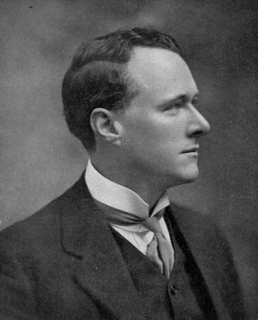
Fagan is born in Belfast on May 18, 1873, the eldest of the five children of Sir James Fagan, a surgeon at the Belfast Royal Hospital and an inspector of Irish reformatories, and Mary Catherine Fagan (née Hughes). He attends Clongowes Wood College near Clane, County Kildare and then moves to England. Initially interested in a career in the church, he begins studying law at Trinity College, Oxford in 1892 but leaves in 1893 without a degree. He works for a time in the Indian Civil Service but abandons this career for the stage.
Fagan begins his career as an actor with the company of Sir Frank Benson for two years, then joining, from 1895 to 1899, the company of Herbert Beerbohm Tree at Her Majesty’s Theatre. There he appears in Katherine and Petruchio, A Man’s Shadow, Julius Caesar, The Musketeers and Carnac Sahib. He starts writing plays in 1899, with The Rebels, for the time forsaking acting. In 1913, he returns to the stage touring as the Rt. Hon. Denzil Trevena in his own play, The Earth. He next writes The Fourth of August (1914) and Doctor O’Toole (1917). In 1917 he produces his first play, his own adaptation of the Eugène Brieux play Damaged Goods at St. Martin’s Theatre. He next produces The Wonder Tales and The Little Brother at the Ambassadors Theatre in London.
Fagan is persuaded by Jane Ellis, the actress who with Alfred Ballard founds the Oxford Playhouse “Red Barn” in 1923, to be its first manager. His first production at the Oxford Playhouse is a restaging of Shaw’s Heartbreak House and numbered Shaw among the audience. He produces The Cherry Orchard, at various theatres, to favourable reviews, popularising Anton Chekhov in Britain. From November 16, 1925, with Dennis Eadie, he presents Juno and the Paycock at the Royalty Theatre, thus bringing Seán O’Casey to the attention of London’s theatre-going public. O’Casey’s The Ploughand the Stars follows the next year.
Fagan receives little support from the University of Oxford or the play-going public and resigns in 1929. His successor is Stanford Holme, who broadens its appeal and, despite the straitened times, makes it financially viable. In 1929, he is a director of the Festival Theatre, Cambridge, where his friend Terence Gray is director. He also produces many works for the Irish Players.
Beginning in the 1920s, several of Fagan’s plays are adapted for film. He moves to Hollywood in 1929 for the filming by Paramount Pictures of his play The Wheel as The Wheel of Life. Other film work includes his co-adaptation of the screenplay for the 1932 film Smilin’ Through, and he co-writes Paramount’s Forgotten Commandments the same year. His play Bella Donna is filmed four times, including posthumously in 1946, and a 1936 film, The Improper Duchess is based on his 1931 play of the same name.
James Bernard Fagan dies in Hollywood, California, on February 17, 1933, at the age of 59 of a heart attack following a bout of influenza.
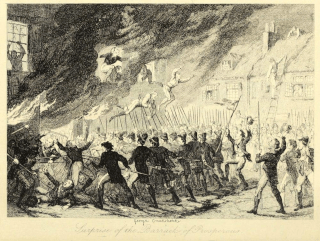
Prosperous is founded by Sir Robert Brooke in 1780 as a village for processing cotton produced in the Americas. When a rebellion spearheaded by the United Irishmen breaks out against British rule in Ireland, rebel forces led by John Esmonde make plans to capture Prosperous. Esmonde has 200 rebels under his command, while Prosperous is garrisoned by elements of the Royal Cork City Militia under the command of Captain Richard Swayne and reinforced by detachments of a Welsh mounted fencible regiment, the Ancient British Regiment of Fencible Cavalry Dragoons (also known as the Ancient Britons), numbering 150 men in all.
On May 24, 1798, Esmonde leads his forces to attack Prosperous. Their entry is preceded by the infiltration of a small rebel vanguard, who with the possible help of female sympathisers residing in Prosperous, scale the walls of the town’s barracks, kill the sentries and open the town gates. The barracks are quickly surrounded and attacked by the rebels who repulse an attempt by the garrison to break out. “Swayne himself was surprised in bed, shot and piked to death and his body burned in a tar barrel.” The remainder of the garrison are trapped in the upper floors of the barracks, which is set on fire by the rebels, causing them to jump in desperation onto the ground below, where they are summarily executed with pikes. While the rebels suffer no known casualties, approximately 40 members of the garrison are killed in the battle.
Ten members of the garrison, all belonging to the Ancient Britons, manage to escape from Prosperous to Dunlavin, County Wicklow, where they participate in the Dunlavin Green executions on May 26. Esmonde is later captured by Crown forces and brought to Dublin for trial. As he had previously enlisted at the rank of lieutenant in the ClaneYeomanry, Esmonde is court-martialled on June 13 and found guilty of being a deserter. He is executed by hanging on June 14 on Carlisle Bridge (now the O’Connell Bridge) with his coat being worn reversed to indicate that he had been convicted of desertion. Prosperous remains under the control of the United Irishmen until June 19, when a detachment of the 5th Dragoon Guards under the command of Lieutenant Colonel Stewart recaptures the town.
Rynne’s father is Stephen Rynne, a writer, broadcaster, author and wit, while his mother, Alice Curtayne, is a writer, hagiographer, lecturer, linguist and scholar. He attends Prosperous National School from 1947 to 1951 and Ring College Waterford from 1951 do 1952. From 1961 to 1968, he attends the Royal College of Surgeons in Ireland. After graduation, he emigrates to Canada with an internship with Hamilton Civic Hospital.
Rynne starts his general practise in Mitchell, Ontario, from 1968 to 1973, where he is introduced to vasectomy. In 1970, he is appointed as the coroner for Perth County, Ontario. In January 1974, he returns to Ireland and establishes a general practise in Clane, County Kildare.
In 1975, Rynne joins Irish Family Planning Association and starts doing vasectomies for them. In 1984, he sells condoms as an act of civil disobedience and gets fined £500. In the following year, he becomes the Chairman of IFPA. In the same year, he founds Clane General Hospital with the opposition from the Catholic Church and the local supporters.
In 1990, Rynne is shot by a man on whom he had carried out a vasectomy eight years previously. According to Rynne, the gunman fires six or seven times with a .22 Long Rifle and shoots him in the right hip. The incident is the subject of a short film The Vasectomy Doctor by Paul Webster.
Curtayne is the youngest child of John Curtayne, founder and proprietor of the Tralee Carriage Works, and his wife Bridget Curtayne (née O’Dwyer). She receives her initial education at local convents before attending La Sainte Union College in Southampton, England. Having taken a typing course, she is engaged as a secretary in Milan, where she remains for four and a half years. This proves to be a formative period in her life. She comes to regard Italy as a second home and is greatly influenced by the work of the Italian Catholicphilosopher, Giovanni Papini.
On leaving Italy Curtayne works for a time in Liverpool. She joins the Liverpool Catholic Evidence Guild, from where she receives her diploma as a diocesan catechist. While in England she also develops an interest in public speaking. Her first book, Catherine of Siena (1929), is followed by numerous publications on religious and historical subjects, including Lough Derg (1933), Patrick Sarsfield (1934), The Trial of Oliver Plunkett (1953), Twenty Tales of Irish Saints for children (1955), and The Irish Story (1962).
Curtayne’s enthusiasm for Italy is reflected in her many publications of Italian interest, including a scholarly work on Dante, and a novel House of Cards (1940), which centres on the experiences of a young Irish woman living in Italy. In 1972 she produces Francis Ledwidge: A Life of the Poet, her well regarded biography of the poet Francis Ledwidge, and in 1974 it is followed by an edition of his complete poems, The Complete Works of Francis Ledwidge. Throughout her journalistic career she is a contributor to various magazines and papers, among them The Irish Times, Irish Independent, The Irish Press, Books on Trial, The Spectator, and The Standard.
During the 1950s and early 1960s Curtayne makes five lecture tours in the United States, speaking on Irish life, history, and literature. In 1959 she receives an honorary doctorate in Humane Letters from Anna Maria College in Paxton, Massachusetts, where she briefly teaches. She is presented with the Key to Worcester City by Mayor James D. O’Brien. She also gives a course of lectures on Dante at Craiglockhart College, Edinburgh, in 1956, and in 1965 she again speaks on Dante in a Radio Éireann Thomas Davis lecture.
In December 1954 The Irish Press sends Curtayne to Rome to write daily reports on the close of the Marian year. She goes to Rome again for the final session of the Second Vatican Council. She is commissioned to send weekly reports to local newspapers, The Nationalist (Carlow) and The Kerryman. She also sends a series of profiles of outstanding personages of this Vatican Council to The Universe and an article for Hibernia journal.
In 1935, Curtayne marries the English-born writer and broadcaster Stephen Rynne, with whom she has two sons and two daughters. They run a farm at Prosperous, County Kildare, and are well known advocates of the values of rural living. One son, Andrew Rynne, becomes a medical practitioner and well known for his liberal views on birth control. Daughter Brigid Rynne later illustrates some of her mother’s books.
Curtayne dies on August 9, 1981, in the Hazel Hall Nursing Home in Clane, County Kildare, and is buried at Killybegs Cemetery.
Born in Derry on March 23, 1917, McLaughlin is the son of a butcher and cattle dealer, and one of nine children. He starts singing in local churches in the Bogside at the age of seven, and as a teenager adds two years to his age to enlist in the Irish Guards, later serving abroad with the Palestine Police Force, before returning in the late 1930s to join the Royal Ulster Constabulary.
Known as The Singing Bobby, McLaughlin becomes a local celebrity before starting to work in the UK variety circuit, where he also plays summer seasons in English seaside resorts. The renowned Irish tenor John McCormack (1884–1945) advises him that his voice is better suited to a lighter repertoire than the operatic one he has in mind and urges him to find an agent. He finds the noted impresario Jack Hylton (1892–1965) who books him but is unable to fit his full name on the bill, thus Joseph McLaughlin becomes Josef Locke.
Locke makes an immediate impact when featured in “Starry Way,” a twenty-week summer show at the Opera House Theatre in Blackpool, Lancashire, England in 1946 and is rebooked for the following summer, then starring for three seasons at the Blackpool Hippodrome. He appears in ten Blackpool seasons from 1946 to 1969, not the nineteen seasons he later claims.
Locke makes his first radio broadcast in 1949 and subsequently appears on television programmes such as Rooftop Rendezvous, Top of the Town, All-star Bill and The Frankie Howerd Show. He is signed to the Columbia label in 1947, and his first releases are the two Italian songs “Santa Lucia” and “Come Back to Sorrento.”
In 1947, Locke releases “Hear My Song, Violetta,” which becomes forever associated with him. It is based on a 1936 tango “Hör’ mein Lied, Violetta” by Othmar Klose and Rudolf Lukesch. The song “Hör’ mein Lied, Violetta” is often covered, including by Peter Alexander and is itself based on Giuseppe Verdi‘s La traviata. His other songs are mostly a mixture of ballads associated with Ireland, excerpts from operettas, and familiar favourites.
In 1948, Locke appears in several films produced by Mancunian Films, usually as versions of himself. He plays himself in the film Holidays with Pay. He also appears as “Sergeant Locke” in the 1949 comedy What a Carry On!
In 1958, after Locke has appeared in five Royal Variety Performancetelecasts, and while he is still at the peak of his career, the British tax authorities begin to make substantial demands that he declines to meet. Eventually he flees the country for Ireland, where he lays low for several years. When his differences with the taxman are eventually settled, he relaunches his career in England with tours of the northern variety clubs and summer seasons at Blackpool’s Queen’s Theatre in 1968 and 1969, before retiring to County Kildare, emerging for the occasional concert in England. He later appears on British and Irish television, and in November 1984 is given a lengthy 90-minute tribute in honour of the award he is to receive at the Olympia theatre commentating his career in show business on Gay Byrne‘s The Late Late Show. He also makes many appearances on the BBC Television‘s long running variety show The Good Old Days.
In 1991, the Peter Chelsom film Hear My Song is released. It is a fantasy based on the notion of Locke returning from his Irish exile in the 1960s to complete an old love affair and save a Liverpool-based Irish night-club from ruination. Locke is played by Ned Beatty, with the singing voice of Vernon Midgley. The film leads to a revival in Locke’s career. A compilation CD is released, and he appears on This Is Your Life in March 1992. He performs in front of the Prince and Princess of Wales at the 1992 Royal Variety Show, singing “Goodbye,” the final song performed by his character in the film. He announces prior to the song that this will be his final public appearance.
Locke dies at the age of 82 in Clane, County Kildare on October 15, 1999, and is survived by his wife, Carmel, and a son.
On March 22, 2005, a bronze memorial to Locke is unveiled outside the City Hotel on Queen’s Quay in Derry by Phil Coulter and John Hume. The memorial is designed by Terry Quigley. It takes the form of a spiraling scroll divided by lines, representing a musical stave. The spiral suggests the flowing melody of a song and is punctuated by images illustrating episodes in his life, including Locke in police uniform, Blackpool Tower, Carnegie Hall, and the musical notes of the opening lines of “Hear My Song.”
A biography of the singer, entitled Josef Locke: The People’s Tenor, by Nuala McAllister Hart is published in March 2017, the centenary of his birth. The book corrects many myths that the charismatic Locke circulated about his career.
Hamilton Rowan is born in the home of his grandfather, William Rowan, in London on May 1, 1751, and lives there with his mother and sister for much of his early life. He is admitted to Queens’ College, Cambridge in 1768, but is expelled from the college and rusticated for an attempt to throw a tutor into the River Cam. He is sent for a period in 1769 to Warrington Academy.
Hamilton Rowan travels throughout the 1770s and 1780s, visiting parts of Europe, the Americas, and North Africa. In 1781 he marries Sarah Dawson in Paris, France. The couple has ten children. He is the godfather of the Irish mathematician William Rowan Hamilton.
Hamilton Rowan returns to Ireland in his thirties, in 1784, to live at Rathcoffey near Clane in County Kildare. He becomes a celebrity and, despite his wealth and privilege, a strong advocate for Irish liberty. That same year he joins the KillyleaghVolunteers, a militia group later associated with radical reform. He first gains public attention by championing the cause of fourteen-year-old Mary Neal in 1788. Neal had been lured into a Dublin brothel and then assaulted by Lord Carhampton. Hamilton Rowan publicly denounces Carhampton and publishes a pamphlet A Brief Investigation of the Sufferings of John, Anne, and Mary Neal in the same year. An imposing figure at more than six feet tall, his notoriety grows when he enters a Dublin dining club threatening several of Mary Neal’s detractors, with his massive Newfoundland at his side and a shillelagh in hand. The incident wins him public applause and celebrity as a champion of the poor.
In 1790 Hamilton Rowan joins the Northern Whig Club, and by October has become a founding member of the Dublin Society of United Irishmen, working alongside famous radicals such as William Drennan and Theobald Wolfe Tone. He is arrested in 1792 for seditious libel when caught handing out “An Address to the Volunteers of Ireland,” a piece of United Irish propaganda. Unknown to him, from 1791 Dublin Castle has a spy in the Dublin Society, Thomas Collins, whose activity is never discovered. From February 1793 Britain and Ireland join the War of the First Coalition against France, and the United Irish movement is outlawed in 1794.
Hamilton Rowan’s reputation for radicalism and bluster grow during this time when he leaves Ireland to confront the Lord Advocate of Scotland about negative comments made in respect to his character and that of members of the Society of United Irishmen. As a prominent member of the Irish gentry, he is an important figure in the United Irishmen and becomes the contact for the Scottish radical societies as a result of his visit. Upon his return to Dublin, he is charged and was found guilty of seditious libel, even though he is excellently defended by the famous John Philpot Curran. He is sentenced to two years imprisonment, receives a fine of £500, and is forced to pay two assurities for good behaviour of £1,000 each. In January 1794 he retires to his apartments in Dublin’s Newgate Prison.
In the years following, Hamilton Rowan spends time in exile in France, the United States and Germany. He is allowed to return to Ireland in 1806. He returns to the ancestral home of Killyleagh Castle, County Down, receiving a hero’s welcome. While he has agreed to be a model citizen under the conditions of his return to Ireland, he remains active in politics and retains his youthful radicalism. Following his last public appearance at a meeting in the Rotunda in Dublin on January 20, 1829, he is lifted up by a mob and paraded through the streets.
Hamilton Rowan dies at the age of 84 in his home on November 1, 1834. He is buried in the vaults of St. Mary’s Church, Dublin.
Fagan is the eldest of the five children of Sir James Fagan, a surgeon at the Belfast Royal Hospital and an inspector of Irish reformatories, and Mary Catherine Fagan, née Hughes. He attends Clongowes Wood College near Clane, County Kildare and then moves to England. Initially interested in a career in the church, he begins studying law at Trinity College, Oxford in 1892 but leaves in 1893 without a degree. He works for a time in the Indian Civil Service but abandons this career for the stage.
Fagan begins his career as an actor with the company of Sir Frank Benson for two years, then joining, from 1895 to 1899, the company of Herbert Beerbohm Tree at Her Majesty’s Theatre. There he appears in Katherine and Petruchio, A Man’s Shadow, Julius Caesar, The Musketeers and Carnac Sahib. He starts writing plays in 1899, with The Rebels, for the time forsaking acting. In 1913 he returns to the stage touring as the Rt Hon. Denzil Trevena in his own play, The Earth. He next writes The Fourth of August (1914) and Doctor O’Toole (1917). In 1917 he produces his first play, his own adaptation of the Brieux play Damaged Goods at St. Martin’s Theatre. He next produces The Wonder Tales and The Little Brother at the Ambassadors Theatre in London.
Fagan takes over the Court Theatre in London’s Sloane Square as a Shakespearean playhouse in 1920. The Times calls his revivals of Twelfth Night, The Merchant of Venice, Henry the Fourth (Part Two) and A Midsummer Night’s Dream “memorable for their freshness, sanity and distinction, and [deserving of] a place in theatrical history.” At the Court, he revives Damaged Goods and, in 1921, with the assistance of the author, produces George Bernard Shaw‘s Heartbreak House, with Edith Evans as “Lady Utterwood.” In 1922 he produces his play The Wheel at the Apollo Theatre. Its success allows him to repay his creditors. Even more successful is his adaptation of Treasure Island at the Savoy Theatre with Arthur Bourchier as “Long John Silver,” which opens December 26, 1922. It is revived every Christmas until the outbreak of World War II.
Fagan is persuaded by Jane Ellis, the actress who with Alfred Ballard founds the Oxford Playhouse “Red Barn” in 1923, to be its first manager. His first production at the Oxford Playhouse is a restaging of Shaw’s Heartbreak House and numbered Shaw among the audience. He produces The Cherry Orchard, at various theatres, to favourable reviews, popularising Anton Chekhov in Britain. From November 16, 1925, with Dennis Eadie, he presents Juno and the Paycock at the Royalty Theatre, thus bringing Seán O’Casey to the attention of London’s theatre-going public. O’Casey’s The Plough follows the next year.
Fagan receives little support from the University of Oxford or the play-going public and resigns in 1929. His successor is Stanford Holme, who broadens its appeal and, despite the straitened times, makes it financially viable. In 1929, he is a director of the Festival Theatre, Cambridge, where his friend Terence Gray is director. He also produces many works for the Irish Players.
Beginning in the 1920s, several of Fagan’s plays are adapted for film. He moves to Hollywood in 1929 for the filming by Paramount Pictures of his play The Wheel as The Wheel of Life. Other film work includes his co-adaptation of the screenplay for the 1932 film Smilin’ Through, and he co-writes Paramount’s Forgotten Commandments the same year. His play Bella Donna is filmed four times, including posthumously in 1946, and a 1936 film, The Improper Duchess is based on his 1931 play of the same name.
James Bernard Fagan dies in Hollywood, California, on February 17, 1933, at the age of 59 of a heart attack following a bout of influenza.
Eoghan Corry, Irish journalist and author regarded as the most extensively traveled writer in Ireland, averaging over 30 countries a year, is born in Dublin on January 19, 1961.
He begins his journalistic career as a sportswriter with The Irish Times and Sunday Tribune where he wins several awards and becomes sports editor. Determined to pursue a career outside of sports journalism, he joins The Sunday Press as a feature writer in 1985 and becomes features editor of The Irish Press in 1986, bringing younger writers and a more contemporary, polemical and literary style to the paper. He revives the literary and travel sections of the paper and is an adjudicator of the Dublin Theatre Festival awards.
When The Irish Press closes in 1995, he becomes Features Editor of the short-lived Evening News, storylines the Gaelic Athletic Association (GAA) museum in Croke Park in 1998 and is founding editor of High Ball magazine. Since then, he has been a columnist, first with The Sunday Business Post and then with the Evening Herald and Irish Independent. As a journalism lecturer in the Dublin Institute of Technology he tells students that “journalism is about pissing people off.”
Since 2002 Corry has edited Ireland’s biggest circulation travel publication, Travel Extra. He has fronted travel shows broadcast in Ireland and the Middle East and is a regular commentator on travel affairs to Raidió Teilifís Éireann (RTÉ) and TG4, and an occasional guest contributor to BBC Northern Ireland. He writes the ten-part series GAA@125, screened on Irish television station TG4 in 2009. He appears on Tonight with Vincent Browne from time to time to preview the next day’s newspapers.
Corry is awarded a lifetime “contribution to the industry” award at the Irish Travel Industry Awards in Dublin on January 22, 2016. He receives the Business Travel Journalist of the year award in London in October 2015. Previous awards include Irish sportswriter of the year, young journalist of the year, Seamus Kelly award, MacNamee award for coverage of Gaelic Games and is short listed for sports book of the year.



 seamus dubhghaill