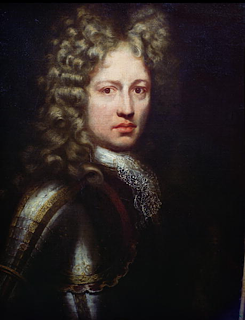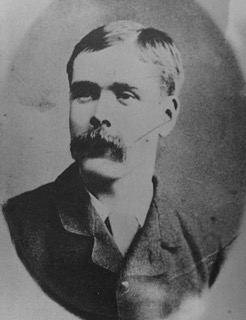
Maolra Seoighe (English: Myles Joyce), is an Irish man who is wrongfully convicted and hanged on December 15, 1882. He is found guilty of the Maumtrasna Murders and is sentenced to death. Though he can only speak Irish, the case is heard in English without any translation service. He is posthumously pardoned in 2018.
Seoighe is the most prominent figure in a controversial trial in 1882 that takes place while Ireland is part of the United Kingdom. Three Irish language speakers are condemned to death for the murder of a local family (John Joyce, his wife Brighid, his mother Mairéad, his daughter Peigí and son Mícheál) in Maumtrasna, on the border between County Mayo and County Galway. It is presumed by the authorities to be a local feud connected to sheep rustling and the Land War. Eight men are convicted on what turns out to be perjured evidence and three of them condemned to death: Maolra Seoighe (a father of five children), Pat Casey and Pat Joyce.
Covering the incident, The Spectator writes the following:
“The Tragedy at Maumtrasna, investigated this week in Dublin, almost unique as it is in the annals of the United Kingdom, brings out in strong relief two facts which Englishmen are too apt to forget. One is the existence in particular districts of Ireland of a class of peasants who are scarcely civilised beings, and approach far nearer to savages than any other white men; and the other is their extraordinary and exceptional gloominess of temper. In remote places of Ireland, especially in Connaught, on a few of the islands, and in one or two mountain districts, dwell cultivators who are in knowledge, in habits, and in the discipline of life no higher than Maories or other Polynesians.”
The court proceedings are carried out in a language the accused do not understand (English), with a solicitor from Trinity College Dublin (TCD), who does not speak Irish. The three are executed in Galway by William Marwood for the crime in 1882. The role of John Spencer, 5th Earl Spencer, who is then Lord Lieutenant of Ireland, is the most controversial aspect of the trial, leading most modern scholars to characterise it as a miscarriage of justice. Research carried out in The National Archives by Seán Ó Cuirreáin, has found that Spencer “compensated” three alleged eyewitnesses to the sum of £1,250, equivalent to €157,000 (by 2016 rates).
As of 2016, nobody has issued an apology or pardon for the executions, though the case has been periodically taken up by various political figures. The then MP for Westmeath, Timothy Harrington, takes up the case, claiming that the Crown Prosecutor for the case George Bolton, had deliberately withheld evidence from the trial. In 2011, two sitting members of the House of Lords, the Liberal Democrat life peers David Alton and Eric Lubbock, request a review of the case. Crispin Blunt, ToryParliamentary Under-Secretary of State for Prisons and Youth Justice, states that Seoighe was “probably an innocent man,” but he does not seek an official pardon.
Seoighe’s final words are: “Feicfidh mé Iosa Críost ar ball beag – crochadh eisean san éagóir chomh maith. … Ara, tá mé ag imeacht … Go bhfóire Dia ar mo bhean agus a cúigear dílleachtaí.” (I will be seeing Jesus Christ soon – he too was also unjustly hanged … I am leaving … the blessings of God on my wife and her five orphans.)
On April 4, 2018, Michael D. Higgins, the President of Ireland, issues a pardon on the advice of the government of Ireland saying “Maolra Seoighe was wrongly convicted of murder and was hanged for a crime that he did not commit”. It is the first presidential pardon relating to an event predating the foundation of the state in 1922 and the second time a pardon has been issued after an execution. Seoighe’s case is not an isolated one, and there are strong similarities with the case of Patrick Walsh who was hanged in the Galway jail on September 22, 1882, just three months before Seoighe for the murders of Martin and John Lydon. The same key players and political factors are active in both cases and his conviction is just as questionable as that of Seoighe.
In September 2009, the story is featured on RTÉ‘s CSI programme under an episode entitled CSI Maamtrasna Massacre. A dramatised Irish language film regarding the affair, entitled Murdair Mhám Trasna, produced by Ciarán Ó Cofaigh is released in 2017.
Alongside his older brother, Connor Maguire, Maguire is a prime mover in the conspiracy which leads to the outbreak of rebellion in Ireland on October 23, 1641. He is tasked with securing County Fermanagh for the rebels, but is only partially successful, with several key fortresses in the county, including Enniskillen Castle, remaining under Protestant settler control. His attempt to murder Sir William Cole immediately prior to the rising fails, but the landowner Arthur Champion is killed in one of the first actions of the rebellion. In November 1641, he joins Felim O’Neill of Kinard at Newry to issue a proclamation in which the rebels claim they are acting in defence of King Charles and Catholicism. In December 1641, the Fermanagh army under Maguire slaughters many of the garrison and refugees in Tully Castle, apparently in retaliation for the killing of the garrison of a Maguire castle which had been taken by assault some days previously. He also destroys Castle Archdale and its neighbouring settler village, and kills eight Protestant settlers at Monea Castle. In early 1642, he is expelled from the Irish Parliament and in the summer of the same year he is made a colonel in Owen Roe O’Neill‘s army in Ulster.
Maguire is appointed Governor of Fermanagh by the authorities of the newly established Confederate Ireland. He commands the rebel reserve in the Battle of Benburb in June 1646. He leads raids into Protestant-held areas in east Ulster, before joining O’Neill in his campaigns in Leinster in the autumn of 1646. Later that year, he raids lands in Connacht controlled by the Royalist commander, Ulick Burke, 1st Marquess of Clanricarde. In August 1647, O’Neill and Maguire move the army to Leinster, where Maguire quarrels so vigorously with O’Neill over the payment of troops that the general orders his arrest and court-martials him. After the court-martial, Maguire and his supporters, about five or six regiments, draw up their forces and threaten to desert. The mutiny soon dissipates and Maguire remains allied to O’Neill.
In 1648, Maguire joins O’Neill in opposing the truce between the Confederates and Royalists. He plays a prominent role in the skirmishes and evasive manoeuvrings that occur between the two sides in central Ireland. In the winter of 1648, Maguire withdraws north and on November 13 he is killed while leading an attack on a fortress near Jamestown, County Leitrim.
O’Farrelly is born Agnes Farrelly on June 24, 1874, in Raffony House, Virginia, County Cavan, one of five daughters and three sons of Peter Dominic Farrelly and Ann Farrelly (née Sheridan), a family with a traditional interest in the Irish language. After her articles Glimpses of Breffni and Meath are published in The Anglo-Celt in 1895, the editor, E. T. O’Hanlon, encourages her to study literature. Graduating from the Royal University of Ireland (BA 1899, MA 1900), she is appointed a lecturer in Irish at Alexandra College and Loreto College. A founder member in 1902, along with Mary Hayden, of the Irish Association of Women Graduates and Candidate Graduates, to promote equal opportunity in university education, she gives evidence to the Robertson (1902) and Fry (1906) commissions on Irish university education, arguing successfully for full co-education at UCD. Appointed lecturer in modern Irish at UCD in 1909, she is also a member of the first UCD governing body and the National University of Ireland (NUI) senate (1914–49). In 1932, on the retirement of Douglas Hyde, she is appointed professor of modern Irish at UCD, holding the position until her retirement in 1947. She is also president of the Irish Federation of University Women (1937–39) and of the National University Women Graduates’ Association (NUWGA) (1943–47).
One of the most prominent women in the Gaelic League, a member of its coiste gnótha (executive committee) and a director of the Gaelic press An Cló-Chumann Ltd, O’Farrelly is a close friend of most of its leading figures, especially Douglas Hyde, Kuno Meyer, and Eoin MacNeill. One of Hyde’s allies in his battle to avoid politicising the league, she is so close to him that students at UCD enjoy speculating about the nature of their friendship. She advocates pan-Celticism, but does not get involved in disputes on the matter within the league. A founder member, and subsequently principal for many years, of the Ulster College of Irish, Cloghaneely, County Donegal, she is also associated with the Leinster and Connacht colleges and serves as chairperson of the Federation of Irish Language Summer Schools.
Having presided at the inaugural meeting of Cumann na mBan in 1914, espousing its subordinate role in relation to the Irish Volunteers, O’Farrelly leaves the organisation soon afterward because of her support for recruitment to the British Army during World War I. A close friend of Roger Casement, in 1916, along with Col. Maurice Moore she gathers a petition that seeks a reprieve of his death sentence. She is a member of a committee of women which negotiate unsuccessfully with Irish Republican Army (IRA) leaders to avoid civil war in 1922, and is heavily defeated as an independent candidate for the NUI constituency in the general elections of 1923 and June 1927. In 1937 she is actively involved in the National University Women Graduates’ Association’s campaign against the constitution, seeking deletion of articles perceived as discriminating against women.
Popular among students at UCD, O’Farrelly has a reputation as a social figure and entertains frequently at her homes in Dublin and the Donegal Gaeltacht. A founder member (1914) and president (1914–51) of the UCD camogie club, she persuades William Gibson, 2nd Baron Ashbourne, to donate the Ashbourne Cup for the camogie intervarsities. She is also president of the Camogie Association of Ireland in 1941–42. A supporter of native Irish industry, she is president of the Irish Industrial Development Association and the Homespun Society, and administrator of the John Connor Magee Trust for the development of Gaeltacht industry. A poet and writer in both Irish and English, often using the pseudonym ‘Uan Uladh’, her principal publications in prose are The reign of humbug (1900), Leabhar an Athar Eoghan (1903), Filidheacht Segháin Uí Neachtáin (1911), and her novel Grádh agus crádh (1901); and in poetry Out of the depths (1921) and Áille an domhain (1927).
There are few surviving records of Sarsfield’s early life, although it is generally agreed he is brought up on the family estates at Tully. While some biographies claim he is educated at a French military college, there is no evidence for this.
Sarsfield fights at Entzheim, Turckheim and Altenheim. He and Hamilton are standing next to Turenne when he is killed by a chance shot at Salzbach in July 1675. He remains in France until the war ends in 1678, then returns to London to join a new regiment being recruited by Thomas Dongan, 2nd Earl of Limerick. However, the Popish Plot then results in Sarsfield and other Catholics being barred from serving in the military.
This leaves Sarsfield short of money, and he becomes involved in an expensive legal campaign to regain Lucan Manor from the heirs of his brother William, who dies in 1675. This ultimately proves unsuccessful amid allegations of forged documents, and in 1681 he returns to London, where he makes two separate attempts to abduct an heiress and is lucky to escape prosecution. When Charles’s Catholic brother James becomes king in 1685, Sarsfield rejoins the army and fights in the decisive Battle of Sedgemoor, which ends the Monmouth Rebellion. James is keen to promote Catholics, whom he views as more loyal, and by 1688 Sarsfield is colonel of a cavalry unit.
After Richard Talbot, 1st Earl of Tyrconnell, is appointed Lord Deputy of Ireland in 1687, he begins creating a Catholic-dominated Irish army and political establishment. Aware of preparations for invasion by his nephew and son-in-law William of Orange, James sends Sarsfield to Dublin in September to persuade Tyrconnell to provide him with Irish troops. This proves unsuccessful, and in November James is deposed by the Glorious Revolution. Sarsfield takes part in the Wincanton Skirmish, one of the few military actions during the invasion. He remains in England until January when he is allowed to join James in France.
Accompanied by French troops and English exiles, James lands in Ireland in March 1689, beginning the Williamite War in Ireland. Sarsfield is promoted brigadier, elected to the 1689 Irish Parliament for County Dublin, and commands cavalry units in the campaign in Ulster and Connacht. When an Irish brigade is sent to France in October, French ambassador Jean-Antoine de Mesmes proposes Sarsfield as its commander. He notes that while “not…of noble birth […], (he) has distinguished himself by his ability, and (his) reputation in this kingdom is greater than that of any man I know […] He is brave, but above all has a sense of honour and integrity in all that he does”.
James rejects this, stating that although unquestionably brave, Sarsfield is “very scantily supplied with brains.” His role at the Battle of the Boyne is peripheral, although the battle is less decisive than often assumed, Jacobite losses being around 2,000 from a force of 25,000. James returns to France, leaving Tyrconnell in control. He is the leader of the “Peace Party,” who want to negotiate a settlement preserving Catholic rights to land and public office. Sarsfield heads the “War Party,” who feel they can gain more by fighting on. It includes the Luttrell brothers, Nicholas Purcell and English Catholic William Dorrington, a former colleague from Monmouth’s Regiment.
The position of the War Party is strengthened by the Declaration of Finglas, which offers the rank and file amnesty but excludes senior officers. French victories in the Low Countries briefly increases hopes of a Stuart restoration, and the Jacobites establish a defensive line along the River Shannon. Sarsfield cements his reputation with an attack on the Williamite artillery train at Ballyneety, widely credited with forcing them to abandon the first siege of Limerick. The Jacobites also retain Athlone, offset by the loss of Kinsale and Cork, which make resupply from France extremely difficult.
With Tyrconnell absent in France, Sarsfield takes control and in December 1690, arrests several leaders of the peace faction. He then bypasses James by asking Louis XIV directly for French support, and requesting the removal of Tyrconnell and the army commander James FitzJames, 1st Duke of Berwick, James’ illegitimate son. The latter, who later describes Sarsfield as “a man […] without sense”, albeit “very good-natured,” leaves Limerick for France in February.
Tyrconnell returns in January 1691, carrying letters from James making Sarsfield Earl of Lucan, an attempt to placate an “increasingly influential and troublesome figure.” A large French convoy arrives at Limerick in May, along with Charles Chalmot de Saint-Ruhe, appointed military commander in an attempt to end the conflict between the factions. Saint-Ruhr and 7,000 others die at Aughrim in July 1691, reputedly the bloodiest battle ever on Irish soil. Sarsfield’s role is unclear: one account claims he quarrels with Saint-Ruhe and is sent to the rear with the cavalry reserves.
The remnants of the Jacobite army regroup at Limerick. Tyrconnell dies of a stroke in August, and in October, Sarsfield negotiates terms of surrender. He is criticised for this, having constantly attacked Tyrconnell for advocating the same thing, while it is suggested the Williamite army is weaker than he judged. However, the collapse of the Shannon line and surrender of Galway and Sligo leaves him little option. Without French supplies, the military position is hopeless, and defections mean his army is dissolving.
The military articles of the Treaty of Limerick preserve the Jacobite army by allowing its remaining troops to enter French service. About 19,000 officers and men, including Sarsfield, choose to leave in what is known as the Flight of the Wild Geese. Sarsfield’s handling of the civil articles is less successful. Most of its protections are ignored by the new regime, although Sarsfield possibly views it as temporary, hoping to resume the war.
On arrival in France, Sarsfield becomes Major-General in the army of exiles, an appointment James makes with great reluctance. In addition to other acts of perceived insubordination, Sarsfield allegedly tells William’s negotiators at Limerick “change but kings with us, and we will fight it over again.” After the planned invasion of England is abandoned in 1692, the exiles become part of the French army, and Sarsfield a French maréchal de camp.
Sarsfield fights at Steenkerque in August 1692, and is fatally wounded at the Battle of Landen in 1693, dying at Huy on August 21, 1693. Despite several searches, no grave or burial record has been found, although a plaque at St. Martin’s Church, Huy, has been set up in commemoration and an announcement in 2023 states that, pending exhumation and identification, his remains have been located. Like much else, his reputed last words, “Oh that this had been shed for Ireland!” are apocryphal.
In Enniskillen, armed Williamite civilians drawn from the local Protestant population organise a formidable irregular military force. The armed civilians of Enniskillen ignore an order from Robert Lundy that they should fall back to Derry and instead launch guerrilla attacks against the Jacobites. Operating with Enniskillen as a base, they carry out raids against the Jacobite forces in Connacht and Ulster, plundering Trillick, burning Augher Castle, and raiding Clones.
A Jacobite army of about 3,000 men, led by Justin McCarthy, Viscount Mountcashel (in the Jacobite peerage), advance on them from Dublin. Lord Mountcashel’s men consist of three regiments of infantry and two of dragoons. The regiments include his own regiment, Mountcashel (approx. 650 men in 13 companies), The O’Brien regiment (also 13 companies of 650 men), and the Lord Bophin (Burke) regiment. He also has the dragoon regiments of Cotter and Clare, each with seven companies of about 350 dragoons. On July 28, 1689, Mountcashel’s force encamps near Enniskillen and bombards the Williamite outpost of Crom Castle to the southeast of Enniskillen. Crom Castle is almost 20 miles (32 km) from Enniskillen by road and about 5 miles (8.0 km) from Newtownbutler.
Two days later, they are confronted by about 2,000 Williamite ‘Inniskilliniers’ under Colonel Berry, Colonel William Wolseley and Gustave Hamilton. The Jacobite dragoons under Antoine Hamilton stumble into an ambush laid by Berry’s men near Lisnaskea and are routed, taking 230 casualties. Mountcashel manages to drive off Berry’s cavalry with his main force but is then faced with the bulk of the Williamite strength under Wolseley. There is some debate in the sources over troop numbers, though it is believed that Mountcashel has a large number of poorly armed conscripts. Unwisely, Mountcashel halts and draws up his men for battle about a mile south of Newtownbutler.
Williamite histories claim that many of the Jacobite troops flee as the first shots are fired. Up to 1,500 of them are hacked down or drowned in Upper Lough Erne when pursued by the Williamite cavalry. Of the 500 men who try to swim across the Lough, only one survives. Approximately 400 Jacobite officers, along with Lord Mountcashel, the Jacobite commander, are captured and later exchanged for Williamite prisoners, with the other Jacobites being killed. These claims seem unlikely, for several reasons. Each Irish regiment includes approximately 40 officers. The entire force, therefore, would include only about 200 officers. Many of these officers are accounted for in an October 1689 roll call, which shows approximately a 15–20% change in the officer roll call since July for the infantry regiments and 5% for the dragoons. This totals some 20–30 officers in all. Also, the Mountcashel regiment’s roll call for October shows that companies which would normally have 50–60 men, have around 25, which results in a loss of approximately 300–400 men for this regiment. The Cotter and Clare dragoons who ride away from the battle do not have significant losses, based on the October 1689 roll call. Assuming the other two infantry regiments suffer similar losses, gives a total loss of 1,200–1,300. Given their officers are recorded in the October roll and show fewer losses than the Mountcashel regiment among officers, there may be fewer losses in the ranks as well. The Williamite histories acknowledge that they captured approximately 400, including men who are later sent to Derry, which would indicate a total loss of killed, wounded, and missing of 800–900, and likely less. This number is necessarily an estimate based on the available data but should be contrasted with Williamite claims that they killed and drowned 2,000. It appears likely that a couple of hundred men from Mountcashel’s regiment may have fled into the bogs toward Lough Erne, and some of them who made it to the river tried to swim and were drowned, leading to the story of the hundreds drowned.
The battle is still commemorated by the Orange Order in Ulster and is mentioned in the traditional unionist song, “The Sash.”
The battle is significant in another way: the regiments on both sides go on to have long and famous histories. On the Williamite side, the Innsikilling Regiment (27th Foot), and on the Jacobite side, the Clare and Mountcashel/Lee/Bulkeley regiments of the Irish Brigade. The two Irish regiments face off again at the Battle of Fontenoy in 1745, where the Irish Brigade famously drives the British army from the battlefield with a charge in the final stage of the battle.
Sir Henry Sidney, English soldier, politician and Lord Deputy of Ireland from 1565 to 1571 and from 1575 to 1578, is born on July 20, 1529, probably in London. He cautiously implements Queen Elizabeth I’s policy of imposing English laws and customs on the Irish.
Sidney is the eldest son of Sir William Sidney of Penshurst, England and Anne Pakenham. William Sidney is a prominent politician and courtier during the reigns of Henry VIII and Edward VI, from both of whom he receives extensive grants of land, including the manor of Penshurst in Kent, which becomes the principal residence of the family.
Sidney is brought up at court as the companion of Prince Edward, afterward King Edward VI, and continues to enjoy the favour of the Crown, serving under Mary I of England and then, particularly, throughout the reign of Queen Elizabeth I. He is instrumental in the Elizabethan conquest of Ireland, serving as Lord Deputy three times. His career is controversial both at home and in Ireland.
Appointed Lord Deputy by Elizabeth in 1565, Sidney faces a major rebellion in Ulster led by the powerful chieftain Shane O’Neill. Failing to subdue O’Neill by force, he intrigues against him with his enemies, the O’Donnells of Tyrconnell and the MacDonnells of Antrim. Finally, O’Neill is assassinated by the MacDonnells in 1567. Nevertheless, Sidney is still not strong enough to destroy completely the power of Ulster’s native chieftains. He does, however, persuade a number of Irish chiefs to submit to Elizabeth’s authority, and he establishes English presidents of Munster and Connacht to control the chiefs. In addition, by refraining from introducing anti-Roman Catholic legislation in the Parliament of Ireland of 1569–71, he makes possible the containment and ultimate defeat in 1573 of a rebellion of Munster Catholics led by James FitzMaurice FitzGerald.
Resenting the Queen’s failure to provide him with an adequate military force, Sidney resigns in 1571, but is reappointed Lord Deputy four years later. His arbitrary taxation arouses popular resentment and leads to his recall in 1578. Thereafter he serves only as president of the Council of Wales and the Marches, living chiefly at Ludlow Castle for the remainder of his life, dying there at the age of 56 on May 5, 1586.
Godert de Ginkel, the commanding general of William III‘s army, begins a ten-day siege of Athlone on June 20, 1691. Athlone is besieged twice during the Williamite War in Ireland (1689–91). The town is situated in the centre of Ireland on the River Shannon and commands the bridge crossing the river into the Jacobite-held province of Connacht. For this reason, it is of key strategic importance.
The army of William III first besieges Athlone in 1690, shortly after their defeat of the main Jacobite army at the Battle of the Boyne. James Douglas and about 7,500 troops attempt to take the town, but the Jacobite garrison’s commander, Colonel Richard Grace, refuses to surrender. Lacking siege artillery, Douglas is forced to withdraw after a week.
In the summer of the following year, the Williamite army, having regrouped at Mullingar under the command of Dutch general Godert de Ginkel, marches via Ballymore to make a second attempt on Athlone.
The Jacobite commander, Charles Chalmot de Saint-Ruhe, marches his main field army from its winter quarters in Limerick to meet the threat. He draws up his force to the west of the town. Other Jacobite troops man fortifications in the ruins of the “English Town,” the eastern half of Athlone, along with a garrison in the “Irish Town” on the western bank. This arrangement is intended to allow the Jacobites to fight a staggered, drawn-out defence, though the advantage is reduced by high ground on the Leinster bank of the Shannon and the fact that the river is running exceptionally low at the time.
Jacobite defences are also hampered by disagreements between James’s Viceroy, Richard Talbot, 1st Earl of Tyrconnell, Saint-Ruhe, and Jacobite general Patrick Sarsfield. When Talbot asserts his seniority and offers advice on the defences to Saint-Ruhe, the latter refuses to recognise Talbot’s command, while Sarsfield sends him a message that his pavilion ropes will be cut if he does not leave immediately. Though Talbot surmises that a large number of the best Jacobite troops will side with him, he chooses to depart for Limerick rather than split the army.
Ginkel opens an assault on the eastern part of Athlone on June 20, which causes the Jacobites to retreat to the west bank of the river, dismantling the bridge in the process. Colonel Grace, who had been superseded as garrison commander by the French officer d’Usson, is killed in a bombardment at the western end of the bridge on the same day.
The Jacobite forces in the western half of Athlone, led by Major-General Thomas Maxwell, a Scottish Catholic, initially hold off the Williamite assault. There is fierce fighting centred on the bridge over the Shannon. The Williamites try to lay planks over the partially wrecked structure, which the Irish Jacobite troops manage to destroy despite coming under intense fire. One such Jacobite sortie, by a small group of volunteers from Maxwell’s dragoon regiment led by a Sergeant Custume or Costy, all of whom are killed, later passes into Irish folklore as an example of bravery. Several attempts by the Williamites to storm the bridge are repulsed with heavy losses.
The Williamite bombardment of the western, Connacht, side of the town is intense, with over 12,000 cannonballs and 600 bombs or mortars fired into the town. John Stevens, serving in the Grand Prior’s Regiment, records that “with the balls and bombs flying so thick, that spot was hell on earth.” During the ten-day bombardment, 32 heavy cannon and mortars fire one shot every minute. Athlone suffers the heaviest bombardment of any city in Britain and Ireland up to this point.
While developing a plan to storm the bridge, Ginkel identifies another potential crossing point at a ford to the south. To test the crossing, on the morning of June 29 he orders a Danish quartermaster and two privates, under sentence of death for cowardice, to ford the river while troops fire over their heads to give the impression they are deserting. All three ford to the western bank and return safely, whereupon Ginkel sends a force of grenadiers, 2,000 strong, to cross there and attack the Jacobite positions from the rear.
Following an argument between Saint-Ruhe and the garrison commander d’Usson, the fortifications on the western side of the city have not been levelled, as Talbot had suggested some days earlier. Saint-Ruhe does not issue an order to demolish them until June 29, apparently believing it impossible that a city could be taken with a relieving army so close by. They remain standing a day later, and a party of Ginkel’s grenadiers hurry to occupy them and raise the drawbridge there, holding off counterattacks from Saint-Ruhe’s army until the main Williamite force can be brought up. Saint-Ruhe detaches two brigades under Major-General John Hamilton to dislodge the Williamites, but after approximately an hour and a half of intense fighting, the Jacobites retreat.
The breakthrough of the Williamites forces the remains of the Jacobite garrison, who have been awaiting reinforcement from the main Jacobite force under Saint-Ruhe, to hastily abandon their positions in Athlone. Maxwell is captured. Accusations of treachery are later levelled at him, partly as he had been a supporter of Talbot’s faction. Saint-Ruhe withdraws into County Galway, passing through Ballinasloe. The Jacobites lose around 1,000 men at Athlone, though the highest estimates suggest losses of over 2,000, including colonels McGuinness, McMahon and O’Gara, in addition to Grace.
Ginkel continues to march toward Limerick, unaware of the position of Saint-Ruhe. On the morning of July 12, the Williamites are confronted by the main Jacobite army drawn up in a strong defensive position at Aughrim. In the ensuing Battle of Aughrim, Ginkel inflicts a crushing defeat on them, effectively ending Jacobite resistance in Ireland.
(Pictured: The powerful Williamites army attack, illustration by Victor Ambrus)
Edgar is the eldest son of Samuel Edgar (1766-1826) and Elizabeth McKee (1771-1839). He attends the Royal Belfast Academical Institution where he excels as a student. He is ordained a minister in the Presbyterian church in 1820. He becomes D.D. of Hamilton College in Kirkland, New York, in 1836, is elected moderator of the Presbyterian Church in Ireland for 1842–43, and obtains LL.D. of New York in 1860.
Edgar forms the Ulster Temperance Movement. In 1834, he tells a parliamentary committee inquiring into the causes and consequences of drunkenness in the United Kingdom that there are 550 “dram shops” in Belfast and 1,700 shops selling intoxicants in Dublin as well as numerous illicit distillers “even in the most civilised districts of Ulster.”
Edgar is also the founder of the Ulster Female Penitentiary in 1839 which is a residential home for prostitutes. He is also instrumental in getting the Deaf, Dumb and Blind Institute set up in Belfast. A meeting which leads to the establishment of the Presbyterian Orphan Society is held in 1866 in his drawing room.
Edgar is also involved in the relief effort by the Presbyterian church in Connacht during the Irish famine. The church is accused of proselytizing during the famine period. In the May Street Presbyterian Church he says, “I hope soon to have an opportunity of directing public attention to spiritual famine in Connacht, but our effort now is to save the perishing body … Our brother is starving, and, till we have satisfied his hunger, we have no time to inquire whether he is Protestant or Romanist.”
Edgar is interested in Gaelic language and culture, and is critical of other Protestant faiths particularly the Church of Ireland (Anglican) for not preaching in the Irish language.
Edgar dies at the age of 68 on August 26, 1866, in Cremore, Rathgar, Dublin, where he had gone to get medical treatment. He is survived by his wife Susanna, and is buried in Balmoral Cemetery, Belfast.
The eldest of the three sons and one daughter of Daniel Sheehan, tenant farmer, and his wife, Ellen (née Fitzgerald). He is educated at the local primary school. In his book Ireland since Parnell (1921) he states that witnessing the ragged poverty of labourers’ and smallholders’ children who attended the school made him determined to do something for the poor. The family’s Fenian tradition and his parents’ eviction from their holding in 1880 form his early years. At the age of sixteen he becomes a schoolteacher.
In 1890, Sheehan takes up journalism, serving as correspondent of the Kerry Sentinel and special correspondent of the Cork Daily Herald in Killarney. He also becomes correspondence secretary to the Kanturk trade and labour council, which campaigns on behalf of agricultural labourers. He manages to get reports of meetings into the Cork papers, and this helps the rapid spread of the association, which in 1890 becomes the Irish Democratic Trade and Labour Federation, under the leadership of Michael Davitt. It is, however, fatally disrupted by the Parnell split. While Sheehan continues to admire Davitt, and despite the pre-split Irish party leadership having opposed the federation as a threat to Charles Stewart Parnell‘s leadership, he becomes a Parnellite, and always remembers his only meeting with Parnell at Tralee, when the chief is presented with a loyal address (drafted by Sheehan) from his Killarney supporters. After Parnell’s death and the defeat of the Second Home Rule Bill, he temporarily drops out of Irish politics.
Following his marriage on February 6, 1894, to Mary Pauline O’Connor of Tralee, Sheehan joins the staff of the Glasgow Observer in pursuit of journalistic experience, then becomes editor of the Catholic News in Preston, Lancashire. In 1898, he returns to Ireland and works on various papers, including the Cork Constitution, before serving as editor of the Skibbereen-based Cork County Southern Star (1899–1901), where his Parnellism brings him into conflict with the Bishop of Ross, Denis Kelly. He expresses sympathy for the newly founded United Irish League (UIL), established by William O’Brien in Connacht with the dual aim of representing western smallholders and using a new land agitation as a vehicle for Irish Party reunion. He does not, however, join the UIL himself.
In August 1894, the Clonmel solicitor J. J. O’Shee, anti-Parnellite MP for West Waterford from 1895, forms the Irish Land and Labour Association (ILLA) to agitate on behalf of agricultural labourers and small tenant farmers. Its appearance reflects the breakdown of the centralised party discipline which had existed before the Parnell split, and recognition that the land war’s prime beneficiaries had been large and middle-sized tenant farmers rather than the nation as a whole. On returning from Britain in 1898, Sheehan throws himself into organising the ILLA and becomes its president. In 1900 there are 100 branches, mostly in Cork, Tipperary, and Limerick. The Irish Party leadership look on this organisation with some suspicion.
At the 1900 United Kingdom general election in Ireland Sheehan seeks the Irish Parliamentary Party (IPP) nomination for South Cork but was defeated by Edward Barry. After the death of Dr Charles Tanner, however, he succeeds in obtaining the IPP nomination for the constituency of Mid Cork, despite the party leadership’s attempts to deny recognition to ILLA branches in order to hand the nomination to its favoured candidate. Sheehan is elected unopposed on May 17, 1901. At the age of 28, he is the youngest Irish member of parliament. Although he has been admitted to the party, his position as a labour representative and his perceived independent base make him something of an outsider.
From October 1904 Sheehan allies himself with O’Brien, writing regularly for the latter’s weekly a TheIrish People. Redmondites accuse him of opportunism, but he always maintains that his personal inclination as an old Parnellite has been towards John Redmond and that his support for O’Brien derives from the older man’s willingness from 1904 to identify himself with the labourers’ campaign. Although their alliance originally likely contains elements of expediency, Sheehan and O’Brien develop a deep personal friendship.
Sheehan’s support for O’Brien leads to a split in the ILLA in 1906, with Tipperary and Waterford branches following O’Shee and Redmond, and Sheehan retaining the support of his Cork base and of some branches in Limerick and Kerry. He serves on the Cork advisory committee which represents tenant interests in land purchase negotiations under the Wyndham Land Act. It’s policy of “conference plus business” combines an offer to negotiate with willing landlords and a threat of agitation against those unwilling to give satisfactory terms. His faction of the ILLA becomes the basis for the grassroots organisation of O’Brien’s followers, and sporadic attempts, financed by O’Brien, are made to spread it outside its Munster base. Both factions of the ILLA claim credit for the passage of the 1906 and 1911 Labourers’ (Ireland) Acts which provide for the allocation of cottages and smallholdings to labourers. In Cork and some other parts of Munster these buildings become popularly known as “Sheehan’s cottages,” a term which long outlives Sheehan’s political career. He also helps to bring about the creation of a “model village” at Tower, near Blarney, the result of cooperation between the local ILLA branch and the rural district council.
At the 1906 general election the Redmond leadership attempts to avoid an open split by allowing O’Brien’s supporters to return unopposed. However, the continuing conflict between the two factions rapidly leads to a formal break. Shortly after the election Sheehan is excluded from the IPP, and thereby deprived of the parliamentary stipend paid to MPs with insufficient resources to maintain themselves. With the support of O’Brien and the small group of O’Brienite MPs, he maintains that the party has no right to exclude an elected MP willing to take the party pledge. After resigning his seat to which he was re-elected without opposition on December 31, 1906, he demands readmission to the party and mounts an unsuccessful lawsuit demanding payment of the stipend. He is subsequently supported from the proceeds of collections outside church gates on Sundays.
Sheehan and the other O’Brienite MPs are readmitted to the party in 1908 as part of an attempt at general reconciliation after the disruptions following the rejection of the Irish Council Bill. Dissensions rapidly reappear over Augustine Birrell‘s 1909 land act, which the O’Brienites see as wriggling out of the financial responsibilities accepted by the British government in the Wyndham land act and as sabotaging land purchase, since landlords will not accept the terms offered. Sheehan’s section of the ILLA is denied official recognition and thereby prevented from sending delegates to a party convention called to consider the bill. At the convention, groups of “heavies”recruited from Joseph Devlin‘s Ancient Order of Hibernians (AOH) exclude delegates with Cork accents, while O’Brienite speakers are howled down. This leads to the formation in March 1909 of the All-for-Ireland League (AFIL), a body based on the existing O’Brienite organisation and advocating O’Brien’s policy of gradually implementing home rule through step-by-step cooperation with moderate unionist supporters of devolution. Although O’Brien’s temporary retirement for health reasons in April 1909 leads to the suspension of the AFIL, it is revived in response to an attempted purge of the O’Brienite MPs by the leadership and by O’Brien’s reappearance in response to the January 1910 general election. Sheehan writes regularly for its paper, the Cork Free Press.
In the general election the O’Brienites hold their seats while two Cork Redmondites are displaced. Sheehan is re-elected for Mid Cork, defeating the Redmondite W. G. Fallon in a campaign marked by widespread rioting and impassioned clerical denunciations of Sheehan. Fallon subsequently attempts to get up a “red scare” against the ILLA. The Cork ILLA later splits over Sheehan’s slightly erratic leadership. While the split is initially personality-driven, the breakaway faction, led by Patrick Bradley and centred in east Cork, moves back toward alignment with Redmond. At the December 1910 election the AFIL consolidates its position in Cork, but is defeated everywhere else. Sheehan retains his Mid Cork seat against a local candidate but is defeated in a simultaneous contest in East Limerick. He is also defeated when he stands for Cork County Council in June 1911, though the AFIL wins control of that body.
Sheehan studies law at University College Cork (UCC) (1908–09), where he is an exhibitioner and prizeman, and at King’s Inns, where he graduated with honours. He is called to the bar in 1911 and practised on the Munster circuit. In 1913–14 he is active in the AFIL’s attempts to avert partition by trying to recruit sections of British political opinion in favour of a conference between the parties. He becomes vice-chairman of the Imperial Federation League. This receives considerable attention among the British political classes but contributes to the decline of the AFIL’s electoral base. The policy of conciliation has been driven to a considerable extent by the belief that it is the only way of achieving home rule. The abolition of the House of Lords’ veto and the introduction of the third home rule bill by the Asquith government undercuts this argument and increases Redmond’s prestige, while AFIL denunciations of Redmondism are seen as driven by personal resentment and playing into the hands of unionists. The decision of the AFIL MPs to abstain from supporting the bill on its final passage through the House of Commons in 1914 as a protest against the prospect of a partition-based compromise is represented by Redmondites as a vote against home rule itself and contributed to AFIL loss of Cork County Council in June 1914.
On the outbreak of World War I, Sheehan supports O’Brien in calling for Irish enlistment for foreign service. In November 1914, at the age of forty-two, he enlists himself and is gazetted as a lieutenant in the Royal Munster Fusiliers. It is claimed that he is almost single-handedly responsible for raising the 9th (service) battalion of this regiment. Three of his sons also enlist. Two of his sons are killed in action with the Royal Flying Corps, and a daughter is disabled by injuries received in an air raid while serving as a nurse. In the spring and summer of 1915 he organises and leads recruiting campaigns in Cork, Limerick, and Clare. This is part of a nationwide drive for recruits, aimed in particular at the farming community, which reflects the realisation that the war is going to last much longer than expected.
In 1915, Sheehan is promoted to the rank of captain and serves with his battalion on the Loos-en-Gohellesalient and at the Battle of the Somme, contributing a series of articles from the trenches to the London Daily Express. Various ailments, including deafness caused by shellfire, and hospitalisation necessitate his transfer to the 3rd Royal Munster Fusiliers (Reserve) Battalion, and he resigns his commission on January 13, 1918, due to ill health. In April 1918 he speaks at Westminster against the bill extending conscription to Ireland, threatening to resist it by force. One of his last parliamentary speeches (in October 1918) is in support of a bill providing land grants for Irish ex-servicemen. With the growth of Sinn Féin and the virtual demise of the AFIL, his position in Cork grows increasingly untenable. The Sheehan family faces intimidation and are obliged to leave their home on the Victoria Road for London, where he has secured the Labour Party nomination for the Limehouse–Stepney division of the East End, later represented by Clement Attlee.
Sheehan is unsuccessful in the 1918 United Kingdom general election, and is obliged to leave politics after a financially disastrous involvement in an Achill Island mining company leads to his bankruptcy. Unable to practise at the bar because of the hearing loss caused by his war service, he returns to journalism and becomes editor and publisher of TheStadium, a daily newspaper for sportsmen. In 1921, shortly before the Anglo-Irish truce, he publishes Ireland since Parnell, a history of recent events heavily dependent on the writings of O’Brien but incorporating some personal reminiscences. It concludes by blaming the outbreak of the IRA guerrilla campaign on provocation by Crown forces, denouncing reprisals, and pleading for British recognition of Dáil Éireann and dominion home rule for an undivided Ireland.
Sheehan moves to Dublin in 1926 after hearing that the threats against him have been lifted. His wife, who has never fully recovered from the stresses and bereavements she has experienced since 1914, dies soon afterward. Sheehan himself becomes managing editor of Irish Press and Publicity Services and, in 1928, publisher and editor of the South Dublin Chronicle. The paper gives critical support to the Irish Labour Party, publishes campaigning articles on slum conditions, and advocates housing reform. In September 1930, he is an unsuccessful Labour candidate for Dublin County Council. In the 1930s, as his health deteriorates further, he works as coordinator for the ex-servicemen’s group the Old Comrades’ Association, editing both northern and southern editions of its annual journal. In 1942, he offers himself to Richard Mulcahy as a Fine Gael candidate for Cork South-East, but is turned down. He dies on November 28, 1948, while visiting his daughter at Queen Anne Street, London. Both he and his wife are buried in Glasnevin Cemetery.
(From: “Sheehan, Daniel Desmond (‘D. D.’)” by Patrick Maume, Dictionary of Irish Biography, http://www.dib.ie, October 2009)
Blount is born in 1563, the second son of James, 6th Baron Mountjoy, and Catherine, only daughter of Sir Thomas Legh. He is among the most distinguished of the family, succeeding as 8th Baron Mountjoy on the death in 1594 of his unmarried elder brother William, 7th Baron Mountjoy. The good fortune of his youthful and handsome looks find favour with Queen Elizabeth I which arouses the jealousy of Robert Devereux, 2nd Earl of Essex, leading to a duel between the two courtiers, who later become close friends.
The downfall of Lord Essex does not damage Blount’s career. After the failure of his rebellion, Essex shocks many by denouncing his sister Penelope, who is Blount’s mistress, as a traitor, which inevitably raises the question of his own possible involvement. But the Crown, anxious to retain Blount’s services, and also to show as much leniency as possible to the defeated rebels, simply ignore the accusation.
On February 24, 1600, Blount lands in Ireland as Lord Deputy following Lord Essex and in the ensuing years brings the Nine Years’ War to an end. The leader of the rebellion, Hugh O’Neill, Earl of Tyrone, writes about Blount’s “refined manners” that he would lose a whole season of campaigning “while waiting until breakfast is prepared to his mind!” Despite this, Blount proves that he is quite qualified to pursue the war.
In early 1600, Blount dispatches Sir Henry Docwra with an army of 4,200 troops to land at Culmore to erect a fortress commanding the shores of Lough Foyle in the northwest of Ulster. To prevent Hugh O’Neill from sending a strong force to repulse Dowcra’s forces, Blount advances in force from Dublin to Newry causing O’Neill to fear a southern advance into Tyrone.
Blount aims to avoid the mistakes of previous Lords-Deputy. After the Battle of Moyry Pass, he has it cleared, and a garrison is established there. It had long been a problem for English forces advancing into Ulster from the south. He also establishes posts with garrisons at Mountnorris and Armagh.
On July 13, 1601, Blount and his army along with Turlough McHenry O’Neill of the Fews who had recently switched to the English side in the war, have a stand-off with Hugh O’Neill’s forces at the River Blackwater. After a few shots in vain from either side, O’Neill’s forces withdraw, and Blount sends his forces to occupy the ruined Blackwater fort destroyed by O’Neill in 1595. Later O’Neill’s forces attack Blount’s camp before withdrawing. In response, the Lord-Deputy sends his forces across the river where they find strong artificially fortified fords, which would have held out against the English.
By July 15, 1601, the Lord-Deputy has secured the surrender of O’Neill’s ally Hugh Magennis. That month, he has a new fort near the old Blackwater fort erected.
Blount reports to the council in England that O’Neill is determined to prevent his forces from advancing into Tyrone and toward Dungannon. As such, he initiates a policy of burning large quantities of corn to induce a famine to drive the rebels out of their strongholds.
Blount sets about trying to entice Hugh’s forces to come out and attack by fetching some materials for the new fort from the Tyrone side of the river as well as burning more corn. Further skirmishes between Blount and O’Neill’s forces ensue during the summer of 1601.
Spanish forces land in Munster in August 1601, forcing Blount to send his forces southward leaving O’Neill remaining in his unbroken heartland of Tyrone. The Spanish arrival culminates in the Siege of Kinsale that December, which sees a major defeat of the rebels and their allies.
O’Neill during this time has also moved south to assist some of his allies, however, after some serious defeats at the hands of the forces of Richard Burke, 4th Earl of Clanricarde of Connacht, he is in no place to offer any effective resistance once Blount marches once more to Tyrone in the summer of 1602.
Blount advances to the location he found the previous summer at the River Blackwater, which commands safe and secure passage into Tyrone, previously inaccessible, and sets about erecting a new fort. Having observed this, O’Neill burns his capital at Dungannon and flees to his last refuge in Glenconkeyne.
Advancing northward through Tyrone, Blount erects a fort in the townland of Magheralamfield, afterward known as Mountjoy Castle. He also christens the new fort at the Blackwater Charlemont Fort after himself.
Once in Tyrone, Blount carries out a campaign of devastation throughout it resulting in the mass hunting of rebels, spoiling of corn, the burning of houses and the killing of churls so as to force the submission of O’Neill and his remaining allies. Most symbolically, Blount has the inauguration site of the O’Neill’s at Tullyhogue Fort destroyed.
On March 30, 1603, six days after the death of Elizabeth and the accession of James I, O’Neill makes peace with Blount, signing the Treaty of Mellifont. Blount continues in office with the more distinguished title of Lord-Lieutenant. He declares amnesty for the rebels and grants them honourable terms, which causes some severe criticism from England. He shows similar moderation in putting down the abortive risings in Cork, Waterford and Wexford, where the aldermen, apparently with some vague idea of gaining greater toleration for Roman Catholics, refuse to proclaim the new King. In Cork, three insurgents are hanged after a summary trial, but the rest are acquitted or pardoned.
As part of the Plantation of Ulster, the majority of the barony of Loughinsholin is detached from County Tyrone and made part of the newly created County Londonderry. The rest of Loughinsholin along with the northern parts of Dungannon barony are merged to create the short-lived barony of Mountjoy. It is later amalgamated with the barony of Dungannon.
On his return to England, Blount serves as one of Sir Walter Raleigh’s judges in 1603, and in the same year King James I appoints him Master-General of the Ordnance as well as creating him Earl of Devonshire, granting him extensive estates. He is one of the founder members of the Spanish Company re-founded by royal charter in 1605.
Toward the end of Blount’s life, on December 26, 1605, at Wanstead House near London, in a ceremony conducted by his chaplain William Laud, afterward Archbishop of Canterbury, he marries his long-time mistress Lady Penelope, formerly wife of Robert Rich, 3rd Baron Rich (later 1st Earl of Warwick) and sister of Robert Devereux, 2nd Earl of Essex.
Blount leaves no legitimate children, and so his hereditary titles become extinct at his death on April 3, 1606, at Savoy House, London.