seamus dubhghaill

Promoting Irish Culture and History from Little Rock, Arkansas, USA


Leave a comment

Death of Peadar Kearney, Composer & Irish Republican

peadar-kearney

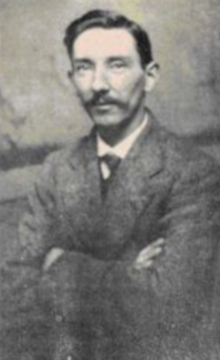
Peadar Kearney, Irish republican and composer of numerous rebel songs, dies in Inchicore, Dublin on November 24, 1942. In 1907 he writes the lyrics to “The Soldier’s Song” (“Amhrán na bhFiann“), now the Irish national anthem. He is the uncle of Irish writers Brendan Behan, Brian Behan, and Dominic Behan.

Kearney was born on December 12, 1883, at 68 Lower Dorset Street, Dublin, above one of the two grocer’s shops owned by his father, John Kearney, originally from Funshog, Collon, County Louth. His mother, Katie (née McGuinness), is from Rathmaiden, Slane, County Meath. He is educated at the Model School, Schoolhouse Lane and St. Joseph’s Secondary C.B.S. in Fairview. He hears Willie Rooney give nationalist lectures on history in the Mechanics’ Institute. For a short time, he attends Belvedere College. Following the death of his father, he is left to support his mother and five younger siblings. He has various menial jobs for three years before being apprenticed to a house painter.

In 1901, the death of Willie Rooney prompts Kearney to join the Willie Rooney Branch of the Gaelic League. He joins the Irish Republican Brotherhood in 1903. He teaches night classes in Irish and numbers Seán O’Casey among his pupils. He finds work with the National Theatre Society and in 1904 is one of the first to inspect the derelict building that becomes the Abbey Theatre. He assists with props and performs occasional walk-on parts at the Abbey until 1916.

Kearney is a co-founder of the Irish Volunteers in 1913 and takes part in the Howth and Kilcoole gun runnings in 1914. In the Easter Rising of 1916 he fights at Jacob’s biscuit factory under Thomas MacDonagh, abandoning an Abbey Theatre tour in England to take part in the Rising. He escapes before the garrison is taken into custody.

Kearney is also active in the Irish War of Independence. On November 25, 1920, he is captured at his home in Summerhill, Dublin and is interned first in Collinstown Camp in Dublin and later in Ballykinler Camp in County Down.

A personal friend of Michael Collins, Kearney at first takes the Free State side in the Irish Civil War but loses faith in the Free State after Collins’s death. He takes no further part in politics, returning to his original trade of house painting.

Kearney’s songs are highly popular with the Irish Volunteers (which later becomes the Irish Republican Army) in the 1913–1922 period. Most popular is “The Soldier’s Song.” He pens the original English lyrics in 1907 and his friend and musical collaborator Patrick Heeney composes the music. The lyrics are published in 1912 and the music in 1916. After 1916 it replaces “God Save Ireland” as the anthem of Irish nationalists. The Irish Free State is established in 1922 and formally adopts the anthem in 1926.

Other well-known songs by Kearney include “Down by the Glenside,” “The Tri-coloured Ribbon,” “Down by the Liffey Side,” “Knockcroghery” (about the village of Knockcroghery) and “Erin Go Bragh” (Erin Go Bragh is the text on the Irish national flag before the adoption of the tricolour).

Peadar Kearney dies in relative poverty in Inchicore on November 24, 1942. He is buried in Glasnevin Cemetery in Dublin.


Leave a comment

Birth of Peadar Toner Mac Fhionnlaoich, Irish Language Writer

peadar-toner-mac-fhionnlaoich

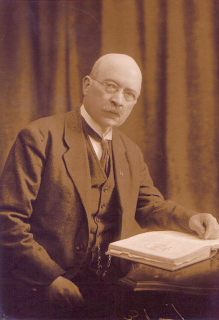
Peadar Toner Mac Fhionnlaoich, Irish language writer during the Gaelic revival known as Cú Uladh (The Hound of Ulster), is born in Allt an Iarainn, County Donegal on October 5, 1857. He writes stories based on Irish folklore, some of the first Irish language plays, and regularly writes articles in most of the Irish language newspapers such as An Claidheamh Soluis.

Mac Fhionnlaoich is the son of Micheal McGinley and Susan Toner. He attends school locally until he is seventeen. He then attends Blackrock College in Dublin for two years. Upon leaving school he enters into the British Civil Service becoming an Inland Revenue Officer. In 1895 he marries Elizabeth Woods (Irish: Sibhéal Ní Uadhaigh) and they have twelve children. He speaks Irish from an early age and keeps an interest in the language throughout his life, first publishing an Irish language short story and poem in The Donegal Christmas Annual 1883. It is not until 1895 while living in Belfast that he becomes involved in the Gaelic Movement.

It is in Mac Fhionnlaoich’s Belfast home that the first meeting of the Ulster branch of the Conradh na Gaeilge takes place in 1895. From this point on he becomes very involved in Conradh na Gaeilge becoming the organisations president on several occasions.

Mac Fhionnlaoich is a member of Seanad Éireann from 1938 to 1942 when he is nominated by Taoiseach Éamon de Valera.

Mac Fhionnlaoich dies at the age of 84 on July 1, 1942, in Dublin. He is buried in Glasnevin Cemetery, Dublin.


Leave a comment

Birth of Michael Cusack, Founder of the Gaelic Athletic Association

michael-cusack

Michael Cusack, teacher and founder of the Gaelic Athletic Association, is born to Irish speaking parents on September 20, 1847 in the parish of Carran on the eastern fringe of the Burren, County Clare during the Great Famine.

Cusack becomes a national school teacher, and after teaching in various parts of Ireland becomes a professor in 1874 at Blackrock College, then known as the French College. In 1877, he establishes his own Civil Service Academy, Cusack’s Academy, in Dublin which proves successful in preparing pupils for the civil service examinations.

A romantic nationalist, Cusack is also “reputed” to have been associated with the Fenian movement. He is active in the Gaelic revival as a member of the Society for the Preservation of the Irish Language which is founded in 1876, and later the Conradh na Gaeilge who in 1879 breaks away from the Society. Also in 1879, he meets Pat Nally, who is a member of the Irish Republican Brotherhood and a leading nationalist and athlete. He finds that Nally’s views on the influence of British landlordism on Irish athletics are the same as his. He recalls how both Nally and himself while walking through the Phoenix Park in Dublin seeing only a handful of people playing sports in the park so depressed them that they agreed it was time to “make an effort to preserve the physical strength of [their] race.” Nally organises a National Athletics Sports meeting in County Mayo in September 1879 which is a success, with Cusack organising a similar event which is open to ‘artisans’ in Dublin the following April.

On November 1, 1884, Cusack, together with Maurice Davin of Carrick-on-Suir, County Tipperary, call a meeting in Hayes’ Commercial Hotel, Thurles, County Tipperary, and found the Gaelic Athletic Association (GAA). Davin is elected president and Cusack becomes its first secretary. Later, Archbishop Thomas William Croke (May 28, 1824 – July 22, 1902), Archbishop of Cashel & Emly, Michael Davitt and Charles Stewart Parnell become patrons. Cusack also becomes involved in the Irish language movement, founding The Celtic Times, a weekly newspaper which focuses on “native games” and Irish culture.

Michael Cusack dies in Dublin at the age of 59 on November 27, 1906.


Leave a comment

Patrick Pearse Arrives in Ros Muc

patrick-pearse-cottage

Patrick Pearse arrives in Ros Muc, County Galway on September 13, 1903, and takes up residence at his cottage in Inbhear.

Born in Dublin on November 10, 1879, Pearse joins the Irish Republican Brotherhood (IRB) in September 1913, becoming Director of Military Organisation of the Irish Volunteers in 1914 and is later co-opted into the IRB’s secretive Military Council, which infiltrates the Volunteers for the Easter Rising.

A writer and Irish language enthusiast long before he becomes a revolutionary, Pearse first comes to Ros Muc in 1903 as a 23-year-old handpicked by Conradh na Gaeilge to act as an Irish examiner.

Pearse develops a strong affinity with the area, buying land on Loch Eileabhrach in 1905, upon which he builds a cottage in 1909. Unusually for a professional at the time, he has it thatched in the style of poor country dwellings and on his regular visits between 1903 and 1915, spends time in the cabins of the poor, soaking up the folklore which finds its way into his writings.

Pearse has a rival for the affections of the locals in the shape of the Lord Lieutenant of Ireland, the Queen’s representative in Ireland. William Ward, 2nd Earl of Dudley also spends summers in the area, where he organises hunts with gentry and children’s fetes.

In response, Pearse organises an evening of Irish festivities for Ros Muc. Pearse gives scholarships to local gaeilgeoiri boys to his St. Enda’s School in Dublin.

Pearse’s last visit to the cottage is in 1915, when he composes the rousing oration for the funeral of Jeremiah O’Donovan Rossa. The following April, he goes one step further, declaring a Republic on the steps of the General Post Office (GPO) in Dublin.

After Pearse’s execution on May 3, 1916, his cottage passes to his mother Margaret. In 1921 it is burned down by the “Black and Tans” and Auxiliaries. Restored by Ó Conghaile and then again by Criostóir Mac Aonghusa, by 1943 Pearse’s sisters Senator Margaret Mary Pearse and Mary Brigid Pearse hand the cottage to the State.

Opened in 2016, a new visitor centre next to Pearse’s Cottage provides an introduction to the Irish language, Gaeltacht culture, and Pearse’s connection to Ros Muc.

(From: “Patrick Pearse’s cottage: a cultural visit to Ros Muc,” Darragh Murphy, The Irish Times, January 13, 2016)


Leave a comment

Birth of Mary Hayden, Historian & Activist

mary-hayden

Mary Teresa Hayden, Irish historian, Irish language activist and campaigner for women’s causes, is born in Dublin on May 9, 1862.

Hayden is educated initially at the Dominican College, Eccles Street and then at Alexandra College in Dublin. She attends the Royal University of Ireland where she graduates with a BA in 1885 and an MA in 1887 in Modern Languages. With Agnes O’Farrelly she campaigns for women’s rights in the university.

A campaigner for gender equality and noted as a public speaker, Hayden is a prominent member of the Irish Women’s Suffrage and Local Government Association. She is a member of the Gaelic League and friends with Patrick Pearse. However, she opposes violence and disapproves of the 1916 Easter Rising.

In 1911 Hayden is elected to the senate of the National University of Ireland and in 1915 is appointed Professor of History at University College Dublin, a position she retains until her death.

Hayden helps to form the Women’s Social and Progressive League as a political party committed to opposing the 1937 constitution of Ireland and any regressive consequences it would entail. She opposes articles 40, 41, and 45 concerning the status of women.

Mary Hayden dies in Dublin on July 12, 1942.


Leave a comment

Birth of Fr. Michael Patrick O’Hickey

michael-patrick-o-hickey

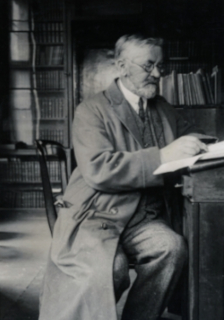
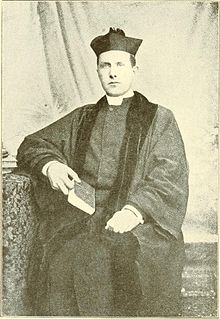
Michael Patrick O’Hickey, Irish Catholic priest and professor of Irish at St. Patrick’s College, Maynooth and an Irish language campaigner, is born in Carrickbeg, County Waterford on March 12, 1860. Sometimes his name appears as Michael Hickey rather than Micheal O’Hickey, or even in Irish as An tAthair Micheál Ó hIcí.

O’Hickey’s mother dies at an early age and his father remarries. He has an older brother Martin, and a younger half-brother Maurice. He studies for the priesthood in St. John’s College, Waterford, and is ordained a priest in 1884. He is an active member of the Conradh na Gaeilge and studies under the noted Irish scholar Sean Plemion.

In 1896 O’Hickey is appointed Professor of Irish in Maynooth College, succeeding Fr. Eugene O’Growney. After clashing with the bishops and establishment, he is dismissed in 1909 from his position as Professor of Irish, for his conduct in the controversy over Irish as a matriculation subject for the new National University of Ireland.

O’Hickey receives support from many Irish nationalists (including Patrick Pearse whom he earlier had disagreements with), Irish language activists, and some of his colleagues including Maynooth’s Theology Professor, Walter McDonald. He appeals his dismissal to the Vatican, but his appeal is refused.

Michael O’Hickey dies in Portlaw, County Waterford on November 19, 1916, and is buried in the Hickey family plot in the Friary Cemetery in Carrickbeg, County Waterford.


Leave a comment

Birth of Writer Pádraig Ó Siochfhradha

padraig-o-siochfhradha

Pádraig Ó Siochfhradha, writer under the pseudonym An Seabhac and promoter of the Irish language, is born in the Gaeltacht near Dingle, County Kerry on March 10, 1883. His brother, Mícheál Ó Siochfhradha is also a writer, teacher, and Irish language storyteller.

Ó Siochfhradha becomes an organiser for Conradh na Gaeilge, cycling all over the countryside to set up branches and promote the Irish language. As a writer, he takes the penname An Seabhac, the Hawk, writing books including An Baile Seo Gainne (1913) and Jimín Mháire Thaidhg (1921), both of which draw on his Dingle youth and are later published in one volume as Seoda an tSeabhaic (1974).

Ó Siochfhradha is a prominent and influential figure of early 20th century Irish culture, a key populariser of the Irish Revival. He is an author, storyteller, folklorist, activist and politician.

Ó Siochfhradha’s nickname is thought to be a consequence of his years as a travelling teacher, when he adopts it as a pseudonym for the writing of his most famous book Jimín Mháire Thaidhg. This book, known in its English translation as Jimeen, is a fictionalised account of life growing up in the country, which follows the tribulations and misadventures of a young boy who cannot stay out of trouble.

Ó Siochfhradha works as a teacher from 1910 until 1922 in Kildare and in the Fermoy region of Kerry. He also works as an editor of The Light, a bilingual magazine which lasts six years, from 1907 to 1913. He is a member of Conradh na Gaeilge from early in his life and a frequent member of the League of Employment, which is an outgrowth of Conradh na Gaeilge. In 1911, a resolution, proposed by him and a colleague, is adopted that helps set the agenda for the ongoing revival of the Irish language. The proposal is to teach Irish to children of secondary school age as a living language rather than an antique one. This strategy persists to the present day.

Ó Siochfhradha becomes an active organiser for the Irish Volunteers in 1913 and is imprisoned three times for his activities. He spends time in Durham Prison in England and on Bere Island, County Cork.

In 1922 Ó Siochfhradha moves to Dublin under the auspices of the Department of Education. It is around this time that he is thought to have taken up residence in 119 Morehampton Road, Donnybrook, where he remains for the rest of his life. He continues to stay active in a large number of writing and political projects. He is secretary to the Irish Manuscripts Commission from October 1928 to October 1932.

During the Irish Civil War, it is said Ó Siochfhradha does his best to reconcile the opposing sides of the conflict. His political sympathies are primarily republican, and he spends a great deal of energy in the 1920s establishing Irish-speaking schools in Dublin. He is a member of Seanad Éireann from 1946–1948, 1951–1954 and 1957–1964, being personally nominated by his friend Taoiseach Éamon de Valera, on each occasion.

Ó Siochfhradha dies on November 19, 1964. His personal papers are on loan to Tralee Library and his archive has been digitised and stored by the University of Limerick.

(From: Stair na hÉireann/History of Ireland (https://stairnaheireann.net), “Pádraig Ó Siochfhradha – An Seabhac”)


Leave a comment

Death of Joan Denise Moriarty, Ballet Dance & Choreographer

joan-denise-moriarty

Joan Denise Moriarty, Irish ballet dancer, choreographer, teacher of ballet and traditional Irish dancer and musician, dies on January 24, 1992. She is a key figure in the development of both amateur and professional ballet in Ireland.

Little is known of Moriarty’s early life. Her year of birth is estimated between 1910 and 1913 but no documentation has been found. The place of her birth is also unknown, and even the country is uncertain. She grows up as the daughter of Michael Augustus Moriarty, an alumnus of Stonyhurst College and contemporary of Sir Arthur Conan Doyle, and his wife, Marion (née McCarthy). The Moriartys are originally from Mallow, County Cork, where her grandfather John Moriarty was a successful solicitor.

Moriarty is brought up in England. She studies ballet until her early teens with Dame Marie Rambert. She is an accomplished Irish step-dancer and traditional musician and becomes the champion Irish step-dancer of Britain on April 24, 1931. She also wins a swimming championship. She is a member of the Liverpool branch of the Conradh na Gaeilge.

In the autumn of 1933 Moriarty returns with her family to their native Mallow in County Cork. In 1934, she sets up her first school of dance there. From 1938 she also gives weekly classes in Cork in the Gregg Hall and Windsor School. During the 1930s she takes part in the Cork Feis, annual arts competitions with a focus on traditional dance and music, competing in Irish step-dancing, warpipes and operatic solo singing. She performs on the warpipes in various public concerts and gives at least two broadcasts. In 1938 she is invited by Seán Neeson, lecturer in Irish music at University College Cork, to perform at a summer school which the Music Department organises for primary school teachers.

Moriarty’s mother dies in February 1940. The following November she moves to Cork where she sets up the Moriarty School of Dancing. The early years during the war are very difficult financially. In the early 1940s she performs with her dancers in musicals and variety shows at the Cork Opera House.

In 1945 the composer Aloys Fleischmann invites Moriarty to perform in his Clare’s Dragoons for baritone, war pipes, choir and orchestra, which had been commissioned by the national broadcasting company, Radio Éireann, for the Thomas Davis centenary. Moriarty agrees on condition that his Cork Symphony Orchestra would play for her Ballet Company’s annual performances, which marks the beginning of a lifelong collaboration.

Branches of the Moriarty School of Dance are established in Bandon, Clonmel, Fermoy, Killarney, Mallow, Tralee, Waterford, and Youghal. Moriarty bequeaths her Cork school to Breda Quinn, a long-standing member of the Cork Ballet Company, who runs it with another Moriarty student, Sinéad Murphy, who creates a new dance school, Cork School of Dance, after Breda’s death in 2009.

Moriarty founds the Cork Ballet Group in 1947, the members recruited from her school. It gives its first performance in June of that year at the Cork Opera House. In 1954 the group is registered as a company under the name “Cork Ballet Company.” The company’s final season is 1993, the year following Moriarty’s death.

Irish Theatre Ballet is founded by Moriarty in the summer of 1959, and gives its first performance in December 1959. It is a small touring company of 10 to 12 dancers, which travels all over Ireland, going to some 70 venues annually with extracts from the classical ballets, contemporary works and folk ballets. In an attempt to resolve the constant financial difficulties, the Arts Council in 1963 insists on a merger with Patricia Ryan’s Dublin National Ballet. The amalgamation does not bring a solution to the financial problems besetting both companies and, after one joint season, the amalgamated company, Irish National Ballet, has to be disbanded in March 1964.

In 1973, the Irish government decides to fund a professional ballet company, the Irish Ballet Company, and entrusts it to Moriarty. Like Irish Theatre Ballet, it is a touring company which travels all over Ireland in two annual seasons. The company has a number of striking successes between 1978 and 1981. In 1983 the name of the company is changed to Irish National Ballet. The severe recession in Ireland during the 1980s and shrinking funds force the Irish National Ballet to disband in 1989.

Moriarty spends almost 60 years working for ballet in Ireland. Her amateur Cork Ballet Company is still the longest-lasting ballet company the country’s history. Her two professional touring companies bring ballet to all parts of Ireland for 21 years. She receives numerous awards for her work, among them an honorary doctorate from the National University of Ireland in 1979.

During the last years of her life, Moriarty suffers ill-health, but continues her work with the Cork Ballet Company, bringing the shows to towns in the county. She dies on January 24, 1992, in Dublin.


2 Comments

Birth of Activist Mary Ellen Spring Rice

mary-ellen-spring-rice

Mary Ellen Spring Rice, Irish nationalist activist during the early 20th century, is born into an aristocratic Anglo-Irish family in London, England on October 14, 1880.

Spring Rice is the daughter of Thomas Spring Rice, 2nd Baron Monteagle of Brandon, and a great-granddaughter of the British Chancellor of the Exchequer, Thomas Spring Rice, 1st Baron Monteagle of Brandon. Her maternal grandfather is the bishop, Samuel Butcher. She is brought up on the family’s Mount Trenchard estate overlooking the River Shannon. It is a progressive, liberal household and independence of thought is encouraged. So too is the Gaelic culture and, at home, she and her brothers are taught how to fluently speak the Irish language.

Before World War I, Spring Rice hosts many Irish nationalist and Conradh na Gaeilge meetings at her home, and she becomes a close friend of Douglas Hyde and her cousin Nelly O’Brien. During 1913 and 1914, she is actively involved in gun-running, most notably the Howth gun-running.

This involves helping to ship weapons to be used in an Irish uprising from Germany into Ireland. Together with Molly Childers, she raises £2,000 towards the purchase of 900 Mauser rifles from Germany, many of which are used in the 1916 Easter Rising. She sails on the Asgard to collect the guns and helps to unload them in Ireland.

During the Irish War of Independence, Spring Rice allows her Mount Trenchard home to be used as a safe house by Irish Republican Army fighters and the family boat is used to carry men and arms over the Shannon Estuary.

Con Collins stays with Spring Rice regularly. She helps train local women as nurses to tend to wounded nationalists and acts as an IRA message carrier between Limerick and Dublin. Throughout this time, she maintains her aristocratic façade and society connections, inviting senior Liberal Party politicians to Mount Trenchard to pressure them to support Irish independence.

Spring Rice starts to suffer from tuberculosis in 1923, and dies unmarried in a sanatorium in Clwyd, Wales, on December 1, 1924. She is buried in Ireland, where her coffin is draped in the Irish tricolour and escorted by an IRA guard of honour.

(Pictured: Mary Ellen Spring-Rice and Molly Childers with the German guns on board Asgard, 1914.)


Leave a comment

Death of Kathleen Clarke, Founder of Cumann na mBan

kathleen-clarke

Kathleen Clarke (née Daly), a founder member of Cumann na mBan, and one of very few privy to the plans of the Easter Rising in 1916, dies in Dublin on September 29, 1972. She is the wife of Tom Clarke and sister of Edward “Ned” Daly, both of whom are executed for their part in the Rising. She is subsequently a Teachta Dála (TD) and senator with both Sinn Féin and Fianna Fáil, and the first female Lord Mayor of Dublin (1939–41).

Kathleen Daly is born into a prominent Fenian family in Limerick on April 11, 1878, the third daughter of Edward and Catherine Daly. Her paternal uncle, John Daly, is at the time imprisoned for his political activities in Chatham and Portland Prisons in England. He is released in 1896 and returns home to Limerick. When Tom Clarke, who had been imprisoned with her uncle, is released in 1898 he travels to Limerick to receive the Freedom of the City and stays with the Daly family.

In 1901 Daly decides to emigrate to the United States to join Tom, who had been there since 1900, having secured work through his Fenian contacts. They marry on July 16, 1901, in New York City. Through his contacts in the Clan na Gael and the Irish Republican Brotherhood (IRB), Tom Clarke continues to be involved in nationalist activity. Kathleen joins the Gaelic League while in the United States and they return to Ireland in November 1907.

In 1914 Clarke becomes a founder member of Cumann na mBan. Her husband forbids her permission to take an active part in the 1916 Easter Rising as she has orders regardless of how the events pan out. As Tom Clarke is the first signatory of the Proclamation of the Irish Republic, he is chosen to be executed for his part in the Easter Rising. Her younger brother, Ned Daly, is also executed for taking part in the rising. She visits both of them before they are executed. After the Rising, Michael Collins establishes contact with her while in prison in his attempts to re-build the IRB network. She also sets up the Irish National Aid Fund to aid those who had family members killed or imprisoned as a result of the Easter Rising, closely aided by Sorcha MacMahon.

Clarke becomes a member of Sinn Féin and in 1917 is elected a member of the party’s Executive. During the German Plot she is arrested and imprisoned in Holloway Prison for eleven months. During the Irish War of Independence, she serves as a District Judge on the Republican Courts in Dublin. In 1919 she is elected as an Alderman for the Wood Quay and Mountjoy Wards of Dublin Corporation and serves until the Corporation is abolished in 1925.

Clarke is elected unopposed as a Sinn Féin TD to the Second Dáil at the 1921 elections for the Dublin Mid constituency. She is not re-elected at the 1922 Irish general election, however, and supports the Anti-Treaty forces during the Irish Civil War. In 1926 she becomes a founder member of Fianna Fáil and has to resign from Cumann na mBan. She is re-elected to the short-lived 5th Dáil at the June 1927 Irish general election as a Fianna Fáil member for the Dublin Mid constituency but loses her seat at the September 1927 Irish general election and does not regain it. She is elected as one of six Fianna Fáil Senators to the Free State Seanad for nine years at the 1928 Seanad election under the leadership of Joseph Connolly. She remains a member of the Seanad until it is abolished in 1936.

In 1930 Clarke is elected to the re-constituted Dublin Corporation for Fianna Fáil along with Robert Briscoe, Seán T. O’Kelly, Thomas Kelly and Oscar Traynor. She serves as the first Fianna Fáil Lord Mayor of Dublin as well as the first female Lord Mayor, from 1939 to 1941. She opposes the Constitution of Ireland as she feels that several of its sections would place women in a lower position that they had been afforded in the Proclamation of the Irish Republic. She is criticised by many in the Fianna Fáil organisation as a result and, while she resigns from the Thomas Clarke Cumann, she remains a member of the Fianna Fáil Ard Chomhairle.

While Clarke does not support the Irish Republican Army (IRA) bombing in England during World War II, she appeals for those sentenced to death by the Irish Government to be given clemency. Ultimately this leads to her breaking with the party completely after her term as Lord Mayor finishes in 1941. She declines to stand as a Fianna Fáil candidate at the 1943 Irish general election.

In 1966, as part of the celebrations of the Easter Rising, Clarke and other surviving relatives are awarded honorary Doctor of Law by the National University of Ireland. Following her death on September 29, 1972, she receives the rare honour of a state funeral. She is buried at Deans Grange Cemetery, Dublin.