McNamee is arrested on August 16, 1986, at his home in Crossmaglen by the British Army and Royal Ulster Constabulary (RUC), then flown to London and charged with conspiracy to cause explosions. At his trial at the Old Bailey, he denies even having sympathy for the IRA, and no evidence is ever presented that he has any paramilitary links. Additionally, the IRA itself states that he is not a member, and never claimed him as a “prisoner of war.” However, his fingerprint is found on electronic circuits in an arms cache that is linked to the Hyde Park bombing. At his trial, he explains that he may have handled the circuits when working for a previous employer, whom he did not know had IRA connections. After five hours of deliberation by the jury, he is found guilty on all charges and sentenced to 25 years in prison.
In September 1994, McNamee and Paul Magee are among six prisoners who escape from Whitemoor Prison, shooting and wounding a prison officer as they do so, before being captured two hours later.
In 1997, McNamee’s case is examined by Channel 4‘s Trial and Error programme. He is later to be the first case referred to the Court of Appeal by the Criminal Cases Review Commission (CCRC), and his conviction is overturned on December 17, 1998, because of other, much more prominent, fingerprints on the same circuits, belonging to known IRA bomb-maker Dessie Ellis, which were not disclosed at McNamee’s original trial. Despite quashing McNamee’s conviction, the appeal judges state, “The Crown makes a strong case that the appellant [McNamee] was guilty of a conspiracy to cause explosions.” Supporters of the campaign to clear his name include the comedianJeremy Hardy.
In February 1999, McNamee reads the IRA Roll of Honour at the Burns and Moley commemoration and the following month he sits with the Caraher family during the trial of Michael Caraher and other members of the Provisional IRA South Armagh Brigadesniper team.
The Battle of Moyry Pass begins on September 20, 1600, ending on October 9, in counties Armagh and Louth, in the north of Ireland, during the Nine Years’ War. It is the first significant engagement of forces following the cessation of arms agreed in the previous year between the Irish leader Hugh O’Neill and the English Crown commander, Robert Devereux, 2nd Earl of Essex.
The battle is fought by the armies of O’Neill and Charles Blount, 8th Baron Mountjoy, a follower of the late Earl of Essex. Mountjoy is determined to pierce O’Neill’s heartland in central and western Ulster by the Moyry Pass. In the course of the two-week assault the English troops establish a garrison near Armagh, taking heavy casualties, and Mountjoy retires with difficulty to Dundalk.
Mountjoy’s strategy for putting down O’Neill’s rebellion is gradually to constrict his territory in Ulster with a ring of fortified garrisons on the borders. To this end, he lands seaborne forces at Derry in the north of the province and at Carrickfergus in the east of Ulster. In September 1600, Mountjoy moves north from Dublin and concentrates at Dundalk in order to mount an expedition further into Ulster and re-establish a garrison at Armagh, which position had been evacuated by the English Crown forces after O’Neill’s victory at the Battle of the Yellow Ford in 1598.
On September 17, 1600, Mountjoy sets out from Dundalk, intending to march to Newry and then on to Armagh. The Moyry Pass (or “Gap of the North”) is the sole point of entry to Ulster as much of the terrain is wooded and mountainous, and it has been well fortified by O’Neill with trenches and barricades. There are three lines of trenches, barricaded with earth and stone, and on the flanks the Irish have made further earth and stone works and “plashed” (twisted) the branches of low-growing trees in order to provide cover for themselves and prevent the English occupying the heights on either side of the Pass.
The English reach the pass on September 20 and set up camp just outside, to the south on Faughart Hill. Taking advantage of a misty day on the 25th, an officer named Thomas Williams (who had commanded the Blackwater Fort during the Battle of the Yellow Ford) makes a sortie into the pass. After heavy fighting he identifies the Irish defence works and returns to the English camp with 12 dead and 30 wounded. For six days heavy rain holds up the fighting, until the weather clears on October 2. The weather is important because the matchlock muskets of the day do not work in wet conditions. On October 2, Sir Samuel Bagnall leads his regiment of infantry into the Pass at the head of four other regiments. The English breach the first barricade, and Thomas Bourke’s regiment leads the way to the second and third lines of defence. The English take the second line only to find themselves in a trap, with gunfire concentrated from three sides. They try to dislodge the Irish from their remaining positions for three more hours before retreating, with the Irish in close pursuit. The English admit 46 killed and 120 wounded, but it is thought that they understated their losses throughout the campaign.
On October 5, Mountjoy sends two regiments on a flanking march over the hill to the west, with one further regiment supported by horsemen advancing up the centre of the Pass. No significant gains are made, and the regiments turn back, reporting casualties of 50 dead and 200 wounded.
By October 9 the privy councilorGeoffrey Fenton complains, “we are now but where we were in the beginning.” Mountjoy retires to Dundalk on either October 8 or 9, but on October 14 word reaches the English camp that O’Neill has abandoned the Pass and retreated to a crannog stronghold at Lough Lurcan. The most likely explanation for O’Neill’s withdrawal from his position of strength is that he is short of ammunition and food and fears a flanking attack on his rear from Newry.
Mountjoy occupies the Moyry Pass on October 17 and dismantles O’Neill’s earthworks. He marches on to Carrickban, just outside Newry, and by Sunday, November 2, sets up camp at Mountnorris, halfway between Newry and Armagh. There he builds an earthwork fort and leaves a garrison of 400 men under the command of Captain Edward Blaney. He then marches back to Dundalk via Carlingford, but is attacked on November 13 by O’Neill, close to the Fathom Pass. Mountjoys men force their way through, and the Lord Deputy claims the army lost 15–20 killed and 60–80 wounded, but a later report suggests the losses are much heavier, with 80 killed.
The battle of Moyry Pass is a stalemate as Mountjoy cannot take the Pass and O’Neill cannot keep it. Mountjoy does establish a garrison at Mountnorris, but has to retire to Dundalk after taking substantial casualties. Mountjoy claims his force lost only 200 men killed and 400 wounded in the fighting from September 20 to November 13, though this may be a considerable underestimate. More, he says, died of disease. The Irish casualties are given by the English as an incredible 900–1,200 killed and wounded, but this is questionable given that the Irish were in a strong defensive position of their own choosing, behind the protection of fieldworks. These figures probably say more about what Mountjoy wanted Queen Elizabeth I to hear than about the actual casualty figures. The following year Mountjoy builds Moyry Castle to secure the pass.
(Pictured: View of the entrance to the Moyry Pass looking north from Faghart Hill)
Campbell is the eldest son of Thomas Campbell and Jane Campbell (née Corneigle), who marry in 1787 and later have four daughters and two younger sons. His father, the son of soldier Archibald Campbell and his wife Alice McNally, is born on February 1, 1763, at Sheepbridge, near Newry, County Down. The Presbyterian minister William Campbell may have been a relation.
Archibald Campbell is born Catholic but joins the Church of Ireland, while his son joins the seceding branch of the Presbyterian church and studies at the University of Glasgow, graduating with a Master of Arts degree in 1786, although he does not appear in the published records of the university. He becomes a teacher but is determined to become a minister, and studies in the Anti-Burgher Divinity Hall in Whitburn, West Lothian (or the Seceder Theological Seminary in Whithorn, Wigtownshire, according to another source) for two months each year for five years. He is ordained a minister in the seceding congregation of Ahorey, County Armagh, probably in 1798. Although at first a member of the Anti-Burgher party in his church, Thomas Campbell begins to believe that divisions between and within denominations are prejudicial to true Christianity. He writes a report in 1804 suggesting that Burgher and Anti-Burgher Presbyterians in Ireland should unite. When this is vetoed in 1805 by the General Associate Synod of Scotland, Thomas Campbell, then moderator of the Irish Seceding Synod, initiates an unsuccessful move to seek independence from Scottish control. His experiences with church authorities undoubtedly increase his belief in the need to rediscover the scriptural basis of religion, freed from man-made creeds.
In 1804, Thomas Campbell sets up an academy at Richhill, County Armagh. In 1798, he is one of the founders of the Evangelical Society of Ulster in which clergymen from differing sects cooperate but resigns when this enterprise is frowned on by seceding authorities.
In poor health in 1806, Thomas Campbell resigns from Ahorey, and goes to the United States in 1807, where he preaches in small congregations around Washington, Pennsylvania. He is soon accused of doctrinal unsoundness, of disciplinary laxity and of administering the sacraments to non-Presbyterians. His appeal to the Associate Synod of North America is unsuccessful, and in 1809 he ceases to be a minister of the seceder church. His liberal views on Christian unity and on the paramount importance of the Bible attract supporters, and in 1809 they found the Christian Association of Washington. He publishes a declaration and address in which he sets out the principles of this body. His followers claim it represents a “second reformation” or a “restoration.” It forms the basis of the doctrine of what becomes America’s most important indigenous religious development, and is regarded as significant in the history of the wider ecumenical movement. He publishes a great many other tracts and articles. Thomas Campbell dies in Bethany, West Virginia, on January 4, 1854.
Thomas had married Jane Corneigle in 1787 and their eldest son Alexander is born on September 12, 1788, in Broughshane, County Antrim, where his father is teaching. His parents intend him for the ministry, and he receives a good education, partly from his father, and religious training from both parents. He is greatly influenced by his strongminded and pious mother. In October 1808 his family sets sail for America to join his father. The ship is wrecked on the island of Islay, off Scotland. All on board are saved, partly thanks to Alexander’s strength and leadership. Rather than continuing the voyage by other means, Alexander spends eight months in the University of Glasgow to prepare himself for the ministry.
In the summer of 1809, the family finally arrives in Pennsylvania, among many emigrants from Ulster. On January 1, 1812, Campbell is ordained as a minister by his father’s Brush Run Church, and quickly takes over the leadership of the fledgling church. By 1812, most of their followers, thenceforth often called Campbellites, have undergone baptism by immersion; a union with the Baptist denomination results, but does not survive after 1830, by which date Campbell’s work on a translation of the Greek New Testament has convinced him that baptism is unscriptural. Controversy between the two groups continues for many years.
A very able preacher and debater, whose public discussions attract much attention, Campbell attacks the creeds and governance of established churches. In 1823, he founds the journal the Christian Baptist. Subsequently in 1830, after the break with the Baptists, he starts the Millennial Harbinger. Both periodicals are largely written by Campbell and his father, Thomas, and are widely influential. He is convinced that church unity will usher in a millennial age of peace and harmony. Primitive Christianity is thus to bring about a utopian future. His book Christianity Restored (1835) is widely read, in Britain as well as in the United States. In 1826, a translation of the Greek New Testament is printed by Campbell’s press in Bethany, West Virginia. Largely based on recent translations by others, it nonetheless contains variant readings by Campbell and furthers his aim of providing followers with authoritative texts on which to base their beliefs. In 1841, he founds Bethany College, West Virginia, and is its president until his death in Bethany on March 4, 1866, when he leaves it $10,000 and a large library.
In 1832, several fledgling churches join the Campbellites, and form a new body called the Christian Church, or Disciples of Christ, which today has over 3,000 congregations in the United States. The two guiding principles of the lifelong beliefs of the Campbells are in the end irreconcilable. An emphasis on the literal interpretation of scripture allows believers to form beliefs at variance from those of co-religionists, and neither Alexander Campbell’s great authority in the denomination nor Thomas Campbell’s emphasis on the need for church unity are enough to prevent the fissions inevitable in a church that so strongly opposes man-made creeds. There are now at least six major divisions of the Church of Christ, one of several alternative names.
On March 2, 1811, Campbell marries Margaret Brown, and thenceforth derives his income from the large farm that had belonged to her family. They have eight children, who all die in their father’s lifetime. Margaret Brown Campbell dies on October 22, 1827. On July 31, 1828, in fulfilment of his wife’s dying request, the widower marries the English-born Selina Huntington Bakewell, and has six children with her. Four of those children survive him. Selina Campbell writes a memoir of her husband, published in 1882, and lives until 1897.
(From: “Campbell, Alexander” by Linde Lunney, Dictionary of Irish Biography, http://www.dib.ie, last revised May 2021)
Frazer grows up in the village of Whitecross, County Armagh, Northern Ireland, as one of nine children, with his parents Bertie and Margaret. He is an ex-member of the Territorial Army and a member of the Free Presbyterian Church of Ulster. He attends a local Catholic school and plays Gaelic football up to U14 level. He describes his early years as a “truly cross-community lifestyle.” Growing up, he is a fan of the American actor John Wayne and wrestling. His father, who is a part-time member of the British Army‘s Ulster Defence Regiment (UDR) and a council worker, is killed by the Provisional Irish Republican Army (IRA) on August 30, 1975. The family home had previously been attacked with petrol bombs and gunfire which Frazer claims were IRA men, due to his father’s UDR membership. He states that his family is well respected in the area including by “old-school IRA men” and receives Mass cards from Catholic neighbours expressing their sorrow over his father’s killing. Over the next ten years, four members of Frazer’s family who are members or ex-members of the Royal Ulster Constabulary (RUC) or British Army are killed by the IRA. An uncle who is also a member of the UDR is wounded in a gun attack.
Soon after his father’s death, the IRA begins targeting Frazer’s older brother who is also a UDR member. Like many South Armagh unionists, the family moves north to the village of Markethill. After leaving school, he works as a plasterer for a period before serving in the British Army for nine years. Following this he works for a local haulage company, then sets up his own haulage company, which he later sells.
During the Drumcree conflict, Frazer is a supporter of the PortadownOrange Order who demand the right to march down the Garvaghy Road against the wishes of local residents. He is president of his local Apprentice Boys club at the time.
For a brief period after selling his haulage firm, Frazer runs “The Spot,” a nightclub in Tandragee, County Armagh, which closes down after two Ulster Protestant civilians who had been in the club, Andrew Robb and David McIlwaine, are stabbed to death in February 2000 by the Ulster Volunteer Force (UVF), after one of them had allegedly made derogatory remarks about dead UVF Mid-Ulster Brigade leader Richard Jameson. Frazer is confronted in an interview on BBC Radio Ulster about the murders by the father of one of the victims, Paul McIlwaine. During the Smithwick Tribunal, set up to investigate allegations of collusion in the 1989 Jonesborough ambush, it is alleged by a member of Garda Síochána that Frazer is a part of a loyalist paramilitary group called the Red Hand Commando. Frazer denies this allegation, saying they put his life in danger.
Frazer applies for a licence to hold a firearm for his personal protection and is turned down, a chief inspector says, in part because he is known to associate with loyalist paramilitaries.
FAIR, founded by Frazer in 1998, claims to represent the victims of IRA violence in South Armagh. It has been criticised by some for not doing the same for victims of loyalist paramilitary organisations or for those killed by security forces.
In February 2006, Frazer is an organiser of the Love Ulster parade in Dublin that has to be cancelled due to rioting. In January 2007, he protests outside the Sinn FéinArd Fheis in Dublin that votes to join policing structures in Northern Ireland. He expresses “outrage at the idea that the ‘law-abiding population’ would negotiate with terrorists to get them to support democracy, law and order.”
In January 2007, Frazer dismisses Police OmbudsmanNuala O’Loan‘s report into security force collusion with loyalist paramilitaries.
In March 2010, Frazer claims to have served a civil writ on deputy First MinisterMartin McGuinness, of Sinn Féin, seeking damages arising from the killing of his father by the Provisional IRA. Both Sinn Féin and the courts deny that any such writ had been served, but in June 2010 Frazer announces that he will seek to progress his claim in the High Court. There has since been no report of any such litigation. He previously pickets McGuinness’s home in Derry in 2007 to demand support for calls for Libya to compensate victims of IRA attacks. Accompanied by two other men, he attempts to post a letter to the house but is confronted by local residents and verbally abused. When McGuinness stands for election in the 2011 Irish presidential election, Frazer announces that he and FAIR will picket the main Sinn Féin election events, however, no such pickets take place.
In September 2010, the Special EU Programmes Body (SEUPB) revokes all funding to FAIR due to “major failures in the organisation’s ability to adhere to the conditions associated with its funding allocation” uncovered following a “thorough audit” of the tendering and administration procedures used by FAIR.
In November 2011, the SEUPB announces that it is seeking the return of funding to FAIR and another Markethill victims’ group, Saver/Naver. FAIR is asked to return £350,000 while Saver/Naver is asked to return £200,000. Former Ulster Unionist Party (UUP) leader Reg Empey demands that the conclusions about FAIR’s finances be released into the public domain.
In January 2012, Frazer announces a protest march to be held on February 25 through the mainly Catholic south Armagh village of Whitecross, to recall the killing of ten Protestant workmen by the South Armagh Republican Action Force (SARAF) in January 1976 in the Kingsmill massacre. He also names individuals whom he accuses of responsibility for the massacre. He later announces that the march is postponed “at the request of the Kingsmills families.” A 2011 report by the Historical Enquiries Team finds that members of the Provisional IRA carried out the attack despite the organisation being on ceasefire.
A delegation including Frazer, UUP politician Danny Kennedy and relatives of the Kingsmill families travel to Dublin in September 2012 to seek an apology from the Taoiseach, Enda Kenny. The apology is sought for what they describe as the Irish government‘s “blatant inaction” over the Kingmills killings. The Taoiseach says he cannot apologise for the actions of the IRA but assures the families there is no hierarchy for victims and their concerns are just as important as any other victims’ families. The families express disappointment although Frazer states he is pleased to have met the Taoiseach.
On November 16, 2012, Frazer announces that he is stepping down as director of FAIR, after he had reviewed a copy of the SEUPB audit report which, he claims, shows no grounds for demanding the reimbursement of funding. He adds, “I will still be working in the victims sector.”
In 2019, the BBC investigative journalism programme Spotlight reports that Frazer distributed assault rifles and rocket launchers from Ulster Resistance to loyalist terror groups who used them in more than 70 murders. A police report on the activities of the former Ulster Defence Association (UDA) boss Johnny Adair states he was receiving weapons from Ulster Resistance in the early 1990s and his contact in Ulster Resistance was Frazer.
In addition to his advocacy for Protestant victims, Frazer contests several elections in County Armagh. He is not elected and, on most occasions, loses his deposit. He runs as an Ulster Independence Movement candidate in the 1996 Forum Elections and the 1998 Assembly elections, and as an independent in the 2003 Assembly elections and a council by-election.
In the 2011 Northern Ireland Assembly election Frazer is listed as a subscriber for the Traditional Unionist Voice (TUV) candidate for the Newry and Armagh constituency, Barrie Halliday, who secures 1.8% of the vote. At Newry Crown Court on Wednesday, June 21, 2017, Pastor Barrie Gordon Halliday is sentenced to nine months in prison, suspended for eighteen months, when he pleads guilty to seventeen counts of VAT repayment fraud.
In November 2012, Frazer announces his intention to contest the 2013 Mid Ulster by-election necessitated by Martin McGuinness’s decision to resign the parliamentary seat to concentrate on his Assembly role. He is quoted in The Irish News in January 2013 as stating that he will not condemn any paramilitary gunman who shoots McGuinness.
Despite his earlier advocacy of Ulster nationalism, in 2013 Frazer declares himself in favour of re-establishing direct rule in Northern Ireland.
Frazer dies of cancer in Craigavon, County Armagh, Northern Ireland, on June 28, 2019. Traditional Unionist Voice (TUV) leader Jim Allister and DUP Assembly member Jim Wells pay tribute to his memory.
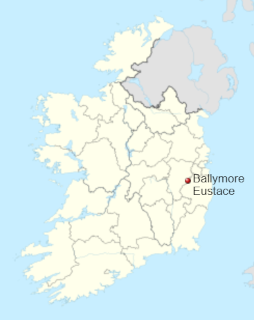
The Battle of Ballymore-Eustace is one of the events in the United Irishrebellion of 1798. It takes place on May 24, 1798, after the stationing of the 9th Dragoons, and members of the Tyrone, Antrim and ArmaghMilitias at Ballymore-Eustace in County Kildare near the border with County Wicklow on May 10. The town has been recently garrisoned by almost 200 soldiers and militia who have been sent to repress sedition in the area. The troops have been dispersed in billets among the populace as per counter-insurgency practice of “free-quarters” where responsibility for the provisioning and sheltering of militia is foisted onto the populace. During this time a quantity of arms are surrendered and letters of protection issued.
On May 23, one hundred twenty soldiers are recalled, leaving a garrison of around 80 men. At around 1:00 a.m. on May 24, the rebel force of approximately 200 attack the town. As in the attacks on Naas and Prosperous, the rebels seek to surprise and overwhelm the garrison by coordinated attacks before it can react and rally against them. The houses containing troops of the 9th Dragoons and the Tyrone Militia are to be attacked simultaneously.
However, the attack on garrison headquarters is miscarried due to lack of coordination and numbers so that the building becomes a rallying point for the Government troops. Captain Beevor is attacked in his own bedchamber by two rebels. Lieutenant Parkinson and some dragoons come to his aid and both rebels are slain. Other isolated billets are attacked but some units manage to cut themselves free and fight their way through the streets to the headquarters. A number of properties, including the Protestant church, are set on fire.
For two hours, the rebels attack the strongpoint but, without artillery, are unable to take the building and lose many men in the process. The momentum has by now slipped away from the rebels and they draw off their attack leaving behind around 50 dead but at a cost to the garrison of at least 12 dead and 5 wounded.
The son of a member of the Royal Air Force (RAF), Keenan is born on July 17, 1941, in Swatragh, County Londonderry, Northern Ireland, before his family moves to Belfast. As a teenager, he moves to England to find work, for a time working as a television repairman in partnership with his brother in Corby, Northamptonshire. During this time, he comes to the attention of the police when he damages a cigarette machine, which leads to police having his fingerprints on file. He returns to Northern Ireland when the Troubles begin and starts working at the Grundig factory in the Finaghy area of Belfast where he acquires a reputation as a radical due to his involvement in factory trade union activities.
Despite his family having no history of republicanism, Keenan joins the Provisional Irish Republican Army in 1970 or 1971, and by August 1971 is the quartermaster of the Belfast Brigade. He is an active IRA member, planning bombings in Belfast and travelling abroad to make political contacts and arrange arms smuggling, acquiring contacts in East Germany, Libya, Lebanon and Syria. In 1972, he travels to Tripoli to meet with Libyan leader Muammar Gaddafi in order to acquire arms and finance from his government. In early 1973 he takes over responsibility for control of the IRA’s bombing campaign in England and also becomes IRA Quartermaster General. In late 1973, he is the linchpin of the kidnap of his former employer at Grundig, director Thomas Niedermayer.
In early 1974, Keenan plans to break Gerry Adams and Ivor Bell out of Long Kesh using a helicopter, in a method similar to Seamus Twomey‘s escape from Mountjoy Prison in October 1973, but the plan is vetoed by Billy McKee. He is arrested in the Republic of Ireland in mid-1974 and sentenced to twelve months imprisonment for IRA membership. On March 17, 1975, he is shot and wounded while attempting to lead a mass escape from Portlaoise Prison. While being held in Long Kesh, Gerry Adams helps to devise a blueprint for the reorganisation of the IRA, which includes the use of covert cells and the establishment of a Southern Command and Northern Command. As the architects of the blueprint, Adams, Bell and Brendan Hughes, are still imprisoned, Martin McGuinness and Keenan tour the country trying to convince the IRA Army Council and middle leadership of the benefits of the restructuring plan, with one IRA member remarking “Keenan was a roving ambassador for Adams.” The proposal is accepted after Keenan wins support from the South Derry Brigade, East Tyrone Brigade and South Armagh Brigade, with one IRA member saying, “Keenan was really the John the Baptist to Adams’ Christ.”
In December 1975, members of an IRA unit based in London are arrested following the six-day Balcombe Street siege. The IRA unit had been active in England since late 1974 carrying out a series of bombings, and a few months after his release from prison Keenan visits the unit in Crouch Hill, London, to give it further instructions. In follow-up raids after the siege, police discover crossword puzzles in his handwriting and his fingerprints on a list of bomb parts. A warrant is issued for his arrest.
Garda Síochána informer Sean O’Callaghan claims that Keenan recommended IRA Chief of Staff Seamus Twomey to authorise an attack on Ulster Protestants in retaliation to an increase in sectarian attacks on Catholic civilians by Protestant loyalist paramilitaries, such as the killing of three Catholics in a gun and bomb attack by the Ulster Volunteer Force (UVF) on Donnelly’s Bar in Silverbridge, County Armagh on December 19, 1975. According to O’Callaghan “Keenan believed that the only way, in his words, to put the nonsense out of the Prods [Protestants] was to just hit back much harder and more savagely than them.” Soon after the sectarianKingsmill massacre occurs, when ten Protestant men returning home from their work are ordered out of a minibus they are travelling in and executed en masse with a machine gun on January 5, 1976.
Keenan is arrested on the basis of the 1975 warrant near Banbridge on March 20, 1979, when the Royal Ulster Constabulary (RUC) stopped two cars travelling north on the main road from Dublin to Belfast and is extradited to England to face charges relating to the Balcombe Street Gang‘s campaign in England. His capture is a blow to the IRA, in particular as he was carrying an address book listing his contacts including Palestinian activists in the United Kingdom. The IRA responds by dispatching Bobby Storey and three other members to break Keenan out of prison using a helicopter, but all four are arrested and remanded to Brixton Prison. Keenan stands trial at the Old Bailey in London in June 1980 defended by Michael Mansfield and is accused of organising the IRA’s bombings in England and being implicated in the deaths of eight people including Ross McWhirter and Gordon Hamilton Fairley. He is sentenced to eighteen years imprisonment after being found guilty on June 25, 1980.
Keenan continues to support Gerry Adams while in prison. In August 1982 Adams is granted permission by the IRA’s Army Council to stand in a forthcoming election to the Northern Ireland Assembly, having been refused permission at a meeting the previous month. In a letter sent from Leicester Prison, Keenan writes that he “emphatically” supports the move and endorses the Army Council’s decision.
Keenan is released from prison in June 1993 and by 1996 is one of seven members of the IRA’s Army Council. Following the events after the IRA’s ceasefire of August 1994, he is openly critical of Gerry Adams and the “tactical use of armed struggle,” or TUAS, strategy employed by the republican movement. After the Northern Ireland peace process becomes deadlocked over the issue of the IRA decommissiong its arms, he and the other members of the Army Council authorise the Docklands bombing which kills two people and marks the end of the IRA’s eighteen-month ceasefire in February 1996.
Keenan outlines the IRA’s public position in May 1996 at a ceremony in memory of hunger striker Seán McCaughey at Milltown Cemetery, where he states, “The IRA will not be defeated…Republicans will have our victory…Do not be confused about decommissioning. The only thing the Republican movement will accept is the decommissioning of the British state in this country.” In the same speech he accuses the British of “double-dealing” and denounces the Irish government as “spineless.”
On February 25, 2001, Keenan addresses a republican rally in Creggan, County Armagh, saying that republicans should not fear “this phase” of “the revolution” collapsing should the Good Friday Agreement fail. He confirms his continued commitment to the Armalite and ballot box strategy, saying that both political negotiations and violence are “legitimate forms of revolution” and that both “have to be prosecuted to the utmost.” He goes on to say, “The revolution can never be over until we have British imperialism where it belongs—in the dustbin of history,” a message aimed at preventing rank-and-file IRA activists defecting to the dissident Real IRA.
Keenan plays a key role in the peace process, acting as the IRA’s go-between with the Independent International Commission on Decommissioning (IICD). Gerry Adams remarks, “There wouldn’t be a peace process if it wasn’t for Brian Keenan.” Keenan resigns from his position on the Army Council in 2005 due to ill-health, and is replaced by Bernard Fox, who had taken part in the 1981 Irish hunger strike. On May 6, 2007, he is guest speaker at a rally in Cappagh, County Tyrone, to commemorate the 20th anniversary of the deaths of the so-called “Loughgall Martyrs,” eight members of the IRA East Tyrone Brigade killed by the Special Air Service (SAS) in 1987.
In July 2002, Keenan is diagnosed as suffering from terminal colorectal cancer. It is alleged by the Irish Independent and The Daily Telegraph that Keenan succeeded Thomas “Slab” Murphy as Chief of Staff of the Provisional IRA at some point between the late 1990s and the mid-2000s before he relinquished the role to deal with his poor health caused by cancer.
Keenan’s last years are spent living with his wife in Cullyhanna, County Armagh, where he dies of cancer on May 21, 2008. He is an atheist and receives a secular funeral, representing a major republican show of strength.
Hughes is born in Bellaghy, County Londonderry, Northern Ireland, on February 28, 1956, into a republican family, the youngest of four brothers in a family of ten siblings. His father, Joseph, had been a member of the Irish Republican Army in the 1920s and one of his uncles had smuggled arms for the republican movement. This results in the Hughes family being targeted when internment is introduced in 1971, and his brother Oliver is interned for eight months without trial in Operation Demetrius. He leaves school at the age of 16 and starts work as an apprentice painter and decorator.
Hughes is returning from an evening out in Ardboe, County Tyrone, when he is stopped at an Ulster Defence Regiment (UDR) checkpoint. When the soldiers realise he comes from a republican family, he is badly beaten. His father encourages him to see a doctor and report the incident to the police, but he refuses, saying he “would get his own back on the people who did it, and their friends.”
Hughes initially joins the Official Irish Republican Army but leaves after the organisation declares a ceasefire in May 1972. He then joins up with Dominic McGlinchey, his cousin Thomas McElwee and Ian Milne, before the three decide to join the Provisional Irish Republican Army in 1973. He, Milne and McGlinchey take part in scores of IRA operations, including daylight attacks on Royal Ulster Constabulary (RUC) stations, bombings, and attacks on off-duty members of the RUC and UDR. Another IRA member describes the activities of Hughes:
“He led a life perpetually on the move, often moving on foot up to 20 miles for one night then sleeping during the day, either in fields and ditches or safe houses; a soldierly sight in his black beret and combat uniform and openly carrying a rifle, a handgun and several grenades as well as food rations.”
On April 18, 1977, Hughes, McGlinchey and Milne are travelling in a car near the town of Moneymore when an RUC patrol car carrying four officers signals them to stop. The IRA members attempt to escape by performing a U-turn but lose control of the car which ends up in a ditch. They abandon the car and open fire on the RUC patrol car, killing two officers and wounding another, before running off through the fields. A second RUC patrol comes under fire while attempting to prevent the men from fleeing, and despite a search operation by the RUC and British Army the IRA members escape. Following the Moneymore shootings, the RUC name Hughes as the most wanted man in Northern Ireland, and issue wanted posters with pictures of Hughes, Milne and McGlinchey. Milne is arrested in Lurgan, County Armagh, in August 1977, and McGlinchey later in the year in the Republic of Ireland.
Hughes is arrested on March 17, 1978, at Lisnamuck, near Maghera in County Londonderry, after an exchange of gunfire with the British Army the night before. British soldiers manning a covert observation post spot Hughes and another IRA volunteer approaching them wearing combat clothing with “Ireland” sewn on their jackets. Thinking they might be from the Ulster Defence Regiment, one of the soldiers stands up and calls to them. The IRA volunteers open fire on the British troops, who return fire. A soldier of the Special Air Service (SAS), Lance Corporal David Jones, is killed and another soldier wounded. Hughes is also wounded and is arrested nearby the next morning.
In February 1980, Hughes is sentenced to a total of 83 years in prison. He is tried for, and found guilty of, the murder of one British Army soldier (for which he receives a life sentence) and wounding of another (for which he receives 14 years) in the incident which leads to his arrest, as well as a series of gun and bomb attacks over a six-year period. Security sources describe him as “an absolute fanatic” and “a ruthless killer.” Fellow republicans describe him as “fearless and active.”
Hughes is involved in the mass hunger strike in 1980 and is the second prisoner to join the 1981 Irish Hunger Strike in the H-Blocks at the Long Kesh Detention Centre. His hunger strike begins on March 15, 1981, two weeks after Bobby Sands began his hunger strike. He is also the second striker to die, at 5:43 p.m. BST on May 12, after 59 days without food, refusing requests from the IRA leadership outside the prison to end the strike after the death of Sands. The journey of his body from the prison to the well-attended funeral near Bellaghy is marked by rioting as the hearse passes through loyalist areas. His death leads to an upsurge in rioting in nationalist areas of Northern Ireland.
Hughes’s cousin Thomas McElwee is the ninth hunger striker to die. Oliver Hughes, one of his brothers, is elected twice to Magherafelt District Council.
Brownlow’s father, grandfather, and great-grandfather had been MPs, and in 1753 he wins a hotly contested by-election in which his opponents accuse him of papist and Jacobite sympathies. The unsuccessful candidate is Francis Caulfeild, brother of James, 1st Earl of Charlemont, his petition to parliament causing a furor and is defeated by only one vote in one of the most celebrated electoral struggles of the day. Brownlow represents the county for over forty years, from 1753 until his death. In 1753, he supports the government on the controversial money bill.
Brownlow marries Judith, daughter of the Rev. Charles Meredyth, Dean of Ardfert, of County Meath, on May 25, 1754. They have two sons. After her death in Lyon, France, in October 1763, he marries Catherine, daughter of Roger Hall of Newry, County Down, on November 25, 1765. They have two sons and five daughters, three who marry into the nobility. In 1758, he is one of the Wide Streets commissioners in Dublin and owns an imposing house in Merrion Square. He is a trustee of the linen board in Ulster, and makes many improvements to his estate, castle, and demesne, the local church, and the town of Lurgan. However, it is alleged that private roads in his demesne were built with public money. He is one of a few landowners in County Armagh who are believed to have misappropriated the unusually high county cess levied by the grand jury, of which he is a member. In 1758, he suggests that salaries be paid to government officials, and one official, Henry Meredyth, his first wife’s uncle, subsequently receives an annual salary of £500.
In June 1763, large numbers of Presbyterian farmers and weavers, calling themselves the Hearts of Oak, in a notable show of dissatisfaction with the privileges of landlords, march on the homes of the gentry to demand redress. Brownlow is in England and avoids a confrontation. Despite the allegations of abuse of public money, he is generally recognised as one of the more independent and reform-minded MPs of the day. He captains a Volunteer troop of dragoons which march from Lurgan to assist Belfast after the French commander François Thurot lands at Carrickfergus in 1760. As one of the supporters of Henry Grattan, he is prominent in the Volunteer movement of the 1780s. He is captain of the Lurgan Volunteer company and lieutenant-colonel of the northern battalion and backs the movement in parliament until displeased by the Volunteer national convention (November 10 – December 2, 1783), which seeks franchise reform and seems to challenge the authority of the existing parliament.
Brownlow subscribes £9,000 to help found the Bank of Ireland in 1783, and in parliament on February 7, 1785, vigorously opposes William Pitt‘s proposals on Ireland’s commercial relations with England, seeing in them the danger that Ireland would become a “tributary nation.” He is appointed a privy councilor in 1765. He organises horse races in his locality and is a talented harpsichord player. After his death on October 28, 1794, the Belfast News Letter prints an unusually long and glowing tribute, expressing admiration for his “incorruptible integrity” and patriotism, as well as two poetic elegies. He is succeeded by his son William Brownlow.
(From: “Brownlow, William” by Linde Lunney, Dictionary of Irish Biography, http://www.dib.ie, October 2009 | Pictured: Portrait of the Right Honorable William Brownlow, oil on canvas by Gilbert Stuart, circa 1790)
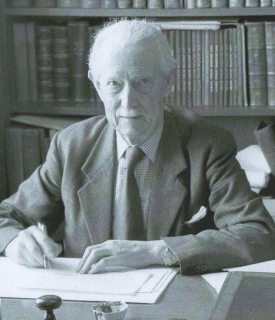
Thomas George Farquhar Paterson, local historian, folklore collector and museum curator, is born on February 29, 1888, in or near Toronto, Ontario, Canada.
Paterson is the eldest child in a family of seven sons and one daughter born to John and Rachel (née Farquhar) Paterson. His parents had emigrated from County Armagh, in what is now Northern Ireland. Their first three children are born in Canada, but the family returns to Ireland in the early 1890s, to the family farm in Cornascreeb, five miles south of Portadown, County Armagh. Also known as George, he attends Aghory national school, and leaves at age 14 to be apprenticed to a grocer in Portadown. In 1911, he takes a position in Couser’s, the leading grocery and wine merchant’s business in Armagh. In time becoming the manager, he is acquainted with the local gentry and clergy.
However, the grocery trade is never Paterson’s main interest. From an early age, he is fascinated by the history and folklore of his native place. He becomes an expert on the genealogy of the gentry as well as of the farming families around Armagh, and also collects material on many aspects of Armagh life. His notebooks eventually contain well over a million words of notes on history, archaeology, dialect, folkways and natural history, as well as drawings and plans of traditional houses, fireside accoutrements and farm implements. His knowledge of history, archaeology and natural history is widely recognised, and in 1931 Armagh County Council asks him to become honorary curator of the small museum established by the Armagh Natural History and Philosophical Society. Four years later, he leaves Couser’s and becomes full-time curator of the museum, re-named the Armagh County Museum. He greatly augments and improves the collections, and in the late 1950s oversees the enlargement of the building. His life’s work culminates in the opening of the new building in 1962. He retires a year later at the age of 75.
Paterson’s work wins the respect of scholars, including Emyr Estyn Evans, a lifelong friend, and material that he records has been cited in a wide variety of books and journal articles. Over one hundred citations are listed in a posthumous bibliography in 1972, and since then hundreds of scholarly works have drawn on his published and unpublished material. His manuscripts are in Armagh County Museum, where they form an important resource.
Paterson publishes a book, Country Cracks: Old Tales from the County of Armagh (1939), and a very large number of articles in newspapers and journals, especially in Seanchas Ardmhacha, Ulster Journal of Archaeology and Ulster Folklife. He sometimes uses the pseudonym “Cornascreeb.” He greatly assists researchers interested in the Armagh background of Alexander Campbell and his father Thomas Campbell and is made an honorary member of the Disciples of Christ Historical Society, based in Nashville, Tennessee.
Paterson is a founder member of the committee that re-establishes the Ulster Journal of Archaeology. He is active in local history societies, and for many years is a member of the Ancient Monuments Advisory Council. He records many local sites for the register of ancient monuments. He is a member of the Northern Ireland committee of the National Trust and seeks to preserve Armagh’s architectural heritage and local industrial archaeology. He donates much important archive material to the Public Record Office of Northern Ireland. He describes and collects folk artefacts, at least thirty years before most academic historians are interested in such objects, and he is a foundation trustee of the Ulster Folk Museum in Cultra, County Down. He is also a member of the first board of the Institute of Irish Studies in Queen’s University Belfast (QUB), from 1965.
Membership of the Royal Irish Academy is an honour not often accorded to someone who has not had a university education, still less to someone who leaves school at the age of 14, but Paterson is elected MRIA in 1941. He is conferred with an honorary MA by QUB in 1944. His service on many public bodies is acknowledged by the award of an Order of the British Empire (OBE).
Paterson never marries and dies in Armagh on April 6, 1971. Hundreds of people contribute to a memorial fund. Some of the money subscribed is used to purchase nineteenth-century drawings for the county museum, and in 1975 the memorial committee also publishes Harvest home: the last sheaf: a selection from the writings of T. G. F. Paterson relating to County Armagh, edited by Emyr Estyn Evans.
Armstrong is born on January 12, 1924, at Carrickfergus, County Antrim, Northern Ireland, one of three sons among six children of James Charlton Armstrong, housepainter and decorator, and his wife Margaret (née Howard). Soon after his birth the family moves to Belfast. He attends Strandtown Primary School. He attends Queen’s University Belfast (QUB) in the early 1940s, where he initially studies political science and later architecture. Having an interest in art, which had been fostered by his father, he takes classes for a short time in the early 1940s at the Belfast School of Art. It is there he meets Gerard Dillon, who introduces him to George Campbell and Daniel O’Neill. He is largely self-taught as an artist. It is his close association with Dillon and Campbell, both some years his senior, that proves to be the most important factor in his development. In Belfast in the early 1940s they associate with the Russian artist Daniel Nietzche, who emphasises to them the importance of personal expression.
After leaving university Armstrong works at the Belfast Gas Office. At this point he is the main support for his widowed mother. Having saved some money, he leaves his job in 1946 to attempt to fulfil his ambition to paint full-time, producing a set of etchings with George Campbell, which are published by Walsh Studios. The following year he takes work as a designer for Ulster Laces in Portadown, County Armagh. In 1957, he leaves for London in the hopes of finding greater opportunities as an artist. His friends Campbell and Dillon are already living there, and he takes lodgings with Dillon’s sister at Abbey Road, north London. Though he continues to paint, he is unable to earn a living and so again has to take other work, this time in a Labour Exchange office. However, he is beginning to gain recognition. In 1957, he is awarded a traveling scholarship by the Council for the Encouragement of Music and the Arts (CEMA), which enables him to travel to Spain. He continues to visit Spain throughout the 1960s, often to see Campbell, who spends much time there.
In 1961 he has his first solo exhibition at the CEMA gallery in Belfast. He comes to live in Dublin in 1962, his work having already been exhibited there at the Irish Exhibition of Living Art in 1957 and 1958. He continues to exhibit there annually from 1961 to 1965. During the 1960s and early 1970s his work is regularly included in the Oireachtas exhibition, at which he is awarded the Douglas Hyde Gold Medal in 1968. He also shows his work with the Ritchie Hendriks Gallery and the Tom Caldwell Gallery in Dublin. Ultimately, he is to have over seventy solo exhibitions throughout his career. By 1969, when he is elected an associate member of the Royal Hibernian Academy (RHA), he has established himself as one of the leading landscape painters in Ireland. In 1972 he becomes a full member of the RHA. He exhibits there regularly until 1977.
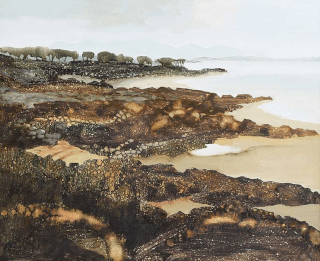
It is during this period that some of Armstrong’s best work is produced. While landscape is his predominant theme, he never sees himself as a painter of particular views, rather he responds to the abstract qualities of a scene. He sees elements such as the sea, rocks or sky as a series of interlocking textures to be rendered expressively in oil paint. The western coastline of Ireland is a vital source of inspiration for him. Roundstone, County Galway, is a favoured base for painting trips in the company of Dillon and Campbell, who by this time are also living in Dublin.
In 1981, a retrospective exhibition of Armstrong’s work is organised by the Arts Council of Northern Ireland. He is represented in many major public and corporate collections in Ireland. From 1971 he lives at 28 Chelmsford Avenue, Ranelagh, Dublin, in a house he shares with Gerard Dillon.
Armstrong dies unmarried on January 13, 1996, in Dublin. The contents of his studio are sold on February 3, 1998.
(From: “Armstrong, Arthur” by Rebecca Minch, Dictionary of Irish Biography, http://www.dib.ie, October 2009, revised November 2013 | Pictured: “Near Ballyhubbock,” oil on board by Arthur Armstrong RHA)



 seamus dubhghaill