The band enjoys moderate success with a couple of single releases, but a projected album flounders because of record company politics. After achieving his musical goals with Juniper, Rice becomes frustrated with the artistic compromises required by the record label and he leaves the band in 1998. The remaining members of Juniper go on to become Bell X1.
After leaving the band Rice works as a farmer in Tuscany and busks throughout Europe before returning to Ireland in 2001 and beginning a solo musical career. He gives a demo recording to his second cousin, music producer David Arnold, who then gives Rice a mobile studio. Over the next year he continues to record his album and then embarks on a tour of Ireland with vocalist Lisa Hannigan, New York drummer Tom Osander, cellist Vyvienne Long, guitarist Mark Kelly and Dublin bassist Shane Fitzsimons.
In 2002 Rice’s debut album, O, reachs No. 8 on the UK Albums Chart and remains on the chart for 97 weeks. It also wins the Shortlist Music Prize and generates three top-30 singles in the UK. He releases his second album, 9, in 2006 and his songs have appeared in numerous films and television episodes. After eight years of various collaborations, he releases his third studio album My Favourite Faded Fantasy on October 31, 2014.
On the morning of October 3, Herrema is driving from his home in Castletroy, County Limerick, to an early-morning meeting at the Ferenka steel plant when he is abducted by two republicans, Marion Coyle and Eddie Gallagher.
Herrema, invariably referred to thereafter as “the Dutch industrialist,” had been dispatched by the parent company in his native Netherlands to troubleshoot the strike-ridden factory, which employs 1,200 at a time when the Irish economy is reeling from the oil crisis and six years of Northern Irelandtroubles.
The kidnappers, banking that TaoiseachLiam Cosgrave’s government will quietly cave in, so as not to scare off other foreign investors, threatens to execute Herrema in 48 hours unless it releases republican prisoners Rose Dugdale, Kevin Mallon (a friend of Coyle’s) and James Hyland. It is the start of a 36-day ordeal for Herrema and his family, sparking the biggest manhunt in the State’s history.
Two weeks later a tape of Herrema’s voice is released, accompanied by demands for a £2 million ransom and a flight to the Middle East. After 18 days the kidnappers are traced to a terraced house in Monasterevin, County Kildare.
When Gardaí smashes the front door down the kidnappers retreat to the house’s box room, where they hole up with the hostage in a stand-off that lasts 18 days, with the world’s media camped outside.
After several days without food or water the kidnappers begin to accept supplies, as well as underpants and a chamber pot, hoisted up in a shopping basket. On day 18, Gallagher claims to be getting severe headaches and neck cramps, which Herrema takes as a sign that he is seeking a way out. Soon afterwards the kidnappers throw their guns out of a window and surrender. Herrema leaves Ireland soon thereafter.
Coyle was sentenced to 15 years, of which she serves nine. Gallagher serves 14 years of his 20-year sentence. In 1978 Gallagher and Dugdale become the first convicted prisoners in the State’s history to be married behind bars.
Herrema eventually returns to Ireland to present an episode of Saturday Live. He and his wife Elizabeth are made honorary Irish citizens in 1975, and he is made a Freeman of the city of Limerick. In 2005, he donates his personal papers to the University of Limerick.
Meagher is educated at Roman Catholicboarding schools. When he is eleven, his family sends him to the Jesuits at Clongowes Wood College in County Kildare. It is at Clongowes that he develops his skill of oratory, becoming at age 15 the youngest medalist of the Debating Society. After six years, he leaves Ireland for the first time, to study in Lancashire, England, at Stonyhurst College, also a Jesuit institution. He returns to Ireland in 1843, with undecided plans for a career in the Austrian army, a tradition among a number of Irish families.
Meagher becomes a member of the Young Ireland Party in 1845 and in 1847 is one of the founders of the Irish Confederation, dedicated to Irish independence. In 1848 he is involved, along with William Smith O’Brien, in an abortive attempt to mount an insurrection against English rule. Arrested for high treason, he is condemned to death, but his sentence is commuted to life imprisonment in Van Diemen’s Land, now Tasmania.
Meagher escapes in 1852 and makes his way to the United States. After a speaking tour of U.S. cities, he settles in New York City, studies law and is admitted to the bar in 1855. He soon becomes a leader of the Irish in New York and, from 1856, edits the Irish News.
At the close of the war, Meagher is appointed secretary of Montana Territory where, in the absence of a territorial governor, he serves as acting governor.
In the summer of 1867, Meagher travels to Fort Benton, Montana, to receive a shipment of guns and ammunition sent by General William Tecumseh Sherman for use by the Montana Militia. On the way to Fort Benton, the Missouri River terminus for steamboat travel, he falls ill and stops for six days to recuperate. When he reaches Fort Benton, he is reportedly still ill.
Sometime in the early evening of July 1, 1867, Meagher falls overboard from the steamboatG. A. Thompson, into the Missouri River. His body is never recovered. Some believe his death to be suspicious and many theories circulate about his death. Early theories included a claim that he was murdered by a Confederate soldier from the war, or by Native Americans. In 1913 a man claims to have carried out the murder of Meagher for the price of $8,000 but then recants. In the same vein, American journalist and novelist Timothy Egan, who publishes a biography of Meagher in 2016, claims Meagher may have been murdered by Montana political enemies or powerful and still active vigilantes. On the frontier men are quick to kill rather than adjudicate. A similar theory shown on Death Valley Days (1960) has him survive the assassination attempt because his aide had been mistakenly murdered when he accepted one of his trademark cigars, and Meagher uses his apparent death as leverage over his political opponents.
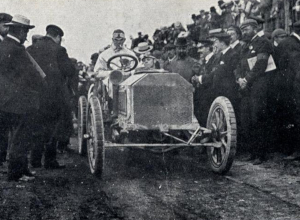
Local laws have to be adjusted, ergo the ‘Light Locomotives (Ireland) Bill’ is passed on March 27, 1903. Kildare and other local councils draw attention to their areas, while Queen’s County (now County Laois) declares that every facility will be given and the roads placed at the disposal of motorists during the proposed race. Eventually Kildare is chosen, partly on the grounds that the straightness of the roads will be a safety benefit. As a compliment to Ireland the British team chooses to race in Shamrock green which thus becomes known as British racing green, although the winning Napier of 1902 had been painted Olive green.
There is considerable public concern about safety after the 1901 Paris-Bordeaux Rally, in which at least eight people had been killed, and severe crashes during the May 24, 1903 Paris-Madrid race where more than 200 cars competed over a distance of 800 miles but which had to be halted at Bordeaux because there had been so many fatalities. To allay these fears, the 1903 race is held over a closed course which is carefully prepared for the event, and is marshaled by 7,000 police officers assisted by troops and club stewards, with strict instructions to keep spectators off the roads and away from corners. The route consists of two loops that comprise a figure of eight, the first being a 52-mile loop that includes Kilcullen, the Curragh, Kildare, Monasterevin, Ballydavis (Port Laoise), Stradbally and Athy, followed by a 40-mile loop through Castledermot, Carlow, and Athy again. The race starts at the Ballyshannon cross-roads near Calverstown.
The official timekeeper of the race is T. H. Woolen of the Automobile Club of Great Britain and Ireland. Ninety one chronographs for timing the race are supplied by the Anglo-Swiss firm Stauffer Son & Co. of La Chaux-de-Fonds and London. Competitors are started at seven-minute intervals and have to follow bicycles through the “control zones” in each town. The 328-mile race is won by the famous Belgian Camille Jenatzy, driving a Mercedes in German colours.
The Society of United Irishmen organisation in Carlow, led by a young brogue-maker named Mick Heydon who had taken over the leadership following the arrest of the previous leader, Peter Ivers, who was arrested with several other leading United Irishmen at Oliver Bond‘s house in March of that year, assemble on the night of May 24 and set off at dawn to attack the county town. Picking up more volunteers along the way, their numbers swell to around 1,200 and they march completely unopposed.
The attack on the town is planned to take place simultaneously from four different directions, through the four main streets. All are to converge on Potato Market.
As the various contingents advance, they are unaware that Colonel Mahon of the Ninth Dragoons has the military in the barracks and the town on the highest alert. Their every move is known to him. A strong party of military is stationed in the courthouse, which is now known as the Deighton Hall, situated immediately to the north of the bridge across the River Burren. Another party with two small cannon is stationed on the bridge. On Graigue bridge, there is an officer’s guard of yeomen. In Dublin Street and to the north, well-armed loyalists fill some large strong houses, but without military support, as the attack is known to be weak from that quarter. Tullow Street is left open and to all appearances undefended against what is expected to be the strongest attack of all. The trap is laid.
When the Rebels enter the town of Carlow, they are joined not only by the Catholic inhabitants but also by people who have secretly arrived there during the previous day and night. A crowd of approximately two hundred people break away and march through Tullow Street but when they reach Potato Market their fortunes change.
The forewarned garrison had prepared a deadly ambush, posting men at every window and rooftop. As the rebels relax after their apparently easy victory, the concealed soldiers pour volley after volley of gunfire into the masses of exposed rebels. Taken completely by surprise, the shocked and poorly armed rebels break and flee only to run into another army ambush. The survivors try to escape by breaking through adjoining houses and cabins which are set afire by the pursuing soldiers causing the deaths of 200 of the inhabitants.
In the meantime, the County Laois Rebels, on their way to aid the Carlow rebels having heard mixed reports of the battle and hearing the fate of their comrades, decide it is too late to help and change their plans. They are led by men called Redmond and Brennan. They proceed to Ballickmoyler instead, some miles outside Carlow in County Laois and there they set fire to many loyalist houses and attack the home of John Whitty, a Protestant clergyman. Twenty-one of the Rebels are killed in the fray but despite this they eventually overcome the loyalist inhabitants.
An estimated 500 rebels and civilians are killed in the streets of the town with no reported losses to the military. Another 150 are executed in the repression over the following ten days. A local man who becomes known as “Paddy the Pointer” is reported to have helped to identify escaped rebels to the military by riding around the town and pointing them out.
A memorial, pictured above, is located at Carlow-Graigue, or Graigue-Cullen as it is now known, where remains of many of those who perished that day were flung into a mass grave.
Mannix’s forthright demands for state aid for the education of Roman Catholics in return for their taxes and his opposition to drafting soldiers for World War I make him the subject of controversy. A zealous supporter of Irish independence, he makes an official journey to Rome in 1920 via the United States, where his lengthy speech making attracts enthusiastic crowds. His campaign on behalf of the Irish, however, causes the British government to prevent him from landing in Ireland, which he finally visits in 1925.
By the 1960s the distinct identity of the Irish community in Melbourne is fading, and Irish Catholics are increasingly outnumbered by Italians, Maltese and other postwar immigrant Catholic communities. Mannix, who turned 90 in 1954, remains active and in full authority, but he is no longer a central figure in the city’s politics. He dies suddenly on November 6, 1963, aged 99, while the Archdiocese of Melbourne is preparing to celebrate his 100th birthday. He is buried in the crypt of St. Patrick’s Cathedral, Melbourne.
Theobald Wolfe Tone, Irish republican and rebel who sought to overthrow English rule in Ireland and who led a French military force to Ireland during the Irish Rebellion of 1798, dies at Provost’s Prison, Dublin on November 19, 1798, from a stab wound to his neck which he inflicted upon himself on November 12. His attempted suicide is the result of being refused a soldier’s execution by firing squad and being sentenced to death by hanging.
Wolfe Tone is born in Dublin on June 20, 1763. The son of a coach maker, he studies law and is called to the Irish bar in 1789 but soon gives up his practice. In October 1791 he helps found the Society of United Irishmen, initially a predominantly Protestant organization that works for parliamentary reforms, such as universal suffrage and Roman Catholic emancipation. In Dublin in 1792 he organizes a Roman Catholic convention of elected delegates that forces Parliament to pass the Catholic Relief Act of 1793. He himself, however, is anticlerical and hopes for a general revolt against religious creeds in Ireland as a sequel to the attainment of Irish political freedom.
By 1794 Wolfe Tone and his United Irishmen friends begin to seek armed aid from Revolutionary France to help overthrow English rule. After an initial effort fails, he goes to the United States and obtains letters of introduction from the French minister at Philadelphia to the Committee of Public Safety in Paris. In February 1796 he arrives in the French capital, presents his plan for a French invasion of Ireland, and is favourably received. The Directory then appoints one of the most brilliant young French generals, Lazare Hoche, to command the expedition and makes Tone an adjutant in the French army.
On December 16, 1796, Wolfe Tone sails from Brest with 43 ships and nearly 14,000 men. But the ships are badly handled and, after reaching the coast of west Cork and Kerry, are dispersed by a storm. He again brings an Irish invasion plan to Paris in October 1797, but the principal French military leader, Napoleon Bonaparte, takes little interest. When insurrection breaks out in Ireland in May 1798, Wolfe Tone can only obtain enough French forces to make small raids on different parts of the Irish coast. In September he enters Lough Swilly, Donegal, with 3,000 men and is captured there.
At his trial in Dublin on November 10, Wolfe Tone defiantly proclaims his undying hostility to England and his desire “in fair and open war to produce the separation of the two countries.” He is found guilty and is sentenced to be hanged. Early in the morning of November 12, 1798, the day he is to be hanged, he cuts his throat with a penknife and dies at the age of 35 in Provost’s Prison, Dublin, not far from where he was born. He is buried in Bodenstown, County Kildare, near his birthplace, and his grave is in the care of the National Graves Association.
O’Toole is born in Castledermot in what is now County Kildare in 1128. His father is Maurice O’Toole, King of Hy Murray. It is common practice in the day for princes of one clan to be given as hostages to another clan, as a guarantee of peace. When he is ten years old O’Toole is given as hostage to Dermot McMurrough, King of Leinster, who treats him very badly. He is sent in chains to a remote place, where he gets very little to eat and does not have enough clothes to keep him warm in the winter. For two years, even though he is a king’s son, he learns what it is like to be poor and to be oppressed.
After two years, it is agreed that O’Toole is to be released. He is sent to a monastery at Glendalough, and the monks make him welcome. It is agreed that his father is to come and collect him there. But he soon comes to love Glendalough and likes joining the monks in prayer. After his two years as a hostage, he realises that wealth and power are not important. He feels very close to God in Glendalough. He asks his father’s permission to stay there and become a monk, to which his father agrees. At the age of only 25 years old, he is elected Abbot of the monastery. As the leader of the community, he encourages the monks in their learning. There is always a welcome in the monastery for the poor. When there is a famine in the area, he sells some of the treasures of Glendalough to provide food for those who are hungry.
In 1162 O’Toole becomes the first Irish-born Archbishop of the Danish city of Dublin. In those days, many of the people of Dublin do not take their Christian religion very seriously. He encourages them to become real Christians. He brings monks to Dublin from France, and they live at Christ Church Cathedral. They help many people to come back to Mass and the Sacraments. O’Toole himself never forgets his own days of poverty. He continues to care for the poor, especially homeless children. He makes room for them in his own house, and they share the food at his table.
The Normans land in Ireland in 1169. The following year they besiege Dublin under their leader, Strongbow. O’Toole meets Strongbow to arrange peace but the Normans attack while the talks are going on. They seize the city and begin killing the citizens and looting their houses. O’Toole saves the lives of many people.
As Archbishop of Dublin, O’Toole participates in the Third Council of the Lateran in Rome in 1179, with some of the other Irish bishops. Pope Alexander III knows that Ireland has been going through a bad time. He knows that many people, including priests, are no longer taking their religion seriously. He entrusts to O’Toole the task of reforming the Church in Ireland.
A new dispute breaks out between the King of England and the Irish Kings. In the spring of 1180, O’Toole leaves Ireland to see if he can help settle the dispute. The English King, Henry II, does not have much time for bishops. He has already arranged to have the Archbishop of Canterbury, Thomas Becket, murdered. He does not welcome O’Toole. He sees a chance to get rid of O’Toole as Archbishop of Dublin and does not let him return to Ireland. Henry has control of Normandy as well as England. O’Toole follows him there. As long as there is a chance of peace, he would not give up trying.
In 1180, O’Toole becomes seriously ill. The monks at Eu in Normandy look after him in their monastery but on November 14, 1180, at the age of 52, he dies. His tomb is in the crypt under the Collegial Church at Eu. Many people still go there to pray. Laurence O’Toole is canonized in 1225 by Pope Honorius III.
(From “St. Laurence O’Toole: a spiritual leader for difficult times,” CatholicIreland.net, November 30, 1999)
Daly is a militant member of the Prisoners’ Relatives Action Committee and the national Hunger Strike Committee. In that campaign, she works with Seamus Costello and soon joins him in the Irish Republican Socialist Party (IRSP) and the Irish National Liberation Army (INLA). After Costello is assassinated, she becomes chairperson, leading the party for two years. During this time, she and her husband are instrumental in opposing Sinn Féin‘s drift towards federalism.
On June 26, 1980, Daly is shot dead at her home in the Andersonstown area of west Belfast. At the time of her assassination, she is in charge of the IRSP prisoners’ welfare.
According to reports in The Irish Times, members of the Ulster Defence Association gain entry to her home with the intention of killing her husband, who is also a republican activist. Daly is captured and tied up while they wait for him to return home. However, he is in Dublin at the time and so does not arrive. After a considerable time, the UDA men decide to kill Daly instead. Muffling the sound of the gun with a cushion, they shoot her in the head and cut the phone lines before fleeing. Her body is discovered when her ten-year-old daughter arrives home from school.
Brown is born in Larne, County Antrim in Northern Ireland. While studying at the Belfast College of Art he joins Billy McFarland’s Showband. Later he forms The Freshmen with some friends. Through Brown’s skillful arrangements, the band is able to reproduce sophisticated vocal harmonies in their covers of songs such as “Papa-Oom-Mow-Mow,” “The Little Old Lady from Pasadena,” and “Carpet Man.”
Brown leaves The Freshmen in the mid-1970s to pursue other musical challenges, albeit with limited success. He later rejoins the band and, in 1977, they have one of their biggest hits with his composition, “Cinderella.” Following the breakup of The Freshmen, he has a minor solo hit in 1980 with his own song, “Look What Jerry Lee Did To Me.”
In his latter years, Brown develops his interest in wildlife, becoming a successful painter of nature scenes, as well as contributing his insights into the natural world on RTÉ 2fm‘s children’s show, Poporama.
Billy Brown dies of a heart attack on June 6, 1999, at his home in Johnstown, County Kildare. In its obituary, the Irish Independent refers to him as “one of the most gifted musicians of his generation.”
In a tribute to Brown following his death, Freshmen founder-member, Maurice Henry, describes his late friend’s pivotal role in the band:
“You could say Billy was The Freshmen and without his talent and innovative musical skills we would certainly not have achieved as much, either as a showband or in our recordings.”