Alongside his older brother, Connor Maguire, Maguire is a prime mover in the conspiracy which leads to the outbreak of rebellion in Ireland on October 23, 1641. He is tasked with securing County Fermanagh for the rebels, but is only partially successful, with several key fortresses in the county, including Enniskillen Castle, remaining under Protestant settler control. His attempt to murder Sir William Cole immediately prior to the rising fails, but the landowner Arthur Champion is killed in one of the first actions of the rebellion. In November 1641, he joins Felim O’Neill of Kinard at Newry to issue a proclamation in which the rebels claim they are acting in defence of King Charles and Catholicism. In December 1641, the Fermanagh army under Maguire slaughters many of the garrison and refugees in Tully Castle, apparently in retaliation for the killing of the garrison of a Maguire castle which had been taken by assault some days previously. He also destroys Castle Archdale and its neighbouring settler village, and kills eight Protestant settlers at Monea Castle. In early 1642, he is expelled from the Irish Parliament and in the summer of the same year he is made a colonel in Owen Roe O’Neill‘s army in Ulster.
Maguire is appointed Governor of Fermanagh by the authorities of the newly established Confederate Ireland. He commands the rebel reserve in the Battle of Benburb in June 1646. He leads raids into Protestant-held areas in east Ulster, before joining O’Neill in his campaigns in Leinster in the autumn of 1646. Later that year, he raids lands in Connacht controlled by the Royalist commander, Ulick Burke, 1st Marquess of Clanricarde. In August 1647, O’Neill and Maguire move the army to Leinster, where Maguire quarrels so vigorously with O’Neill over the payment of troops that the general orders his arrest and court-martials him. After the court-martial, Maguire and his supporters, about five or six regiments, draw up their forces and threaten to desert. The mutiny soon dissipates and Maguire remains allied to O’Neill.
In 1648, Maguire joins O’Neill in opposing the truce between the Confederates and Royalists. He plays a prominent role in the skirmishes and evasive manoeuvrings that occur between the two sides in central Ireland. In the winter of 1648, Maguire withdraws north and on November 13 he is killed while leading an attack on a fortress near Jamestown, County Leitrim.
Clery is the son of Arthur Clery (who also uses the names Arthur Patrick O’Clery and Arthur Ua Cléirigh), a barrister, and Catherine Moylan. His father, who practises in India, publishes books on early Irish history.
Clery’s principal themes include the difficulties of Roman Catholic graduates seeking professional employment, dramatic criticism (he hails Lady Gregory‘s play Kincora as the Abbey Theatre‘s first masterpiece but is repulsed by the works of John Millington Synge), Catholic-Protestant rivalry, tension within the Dublin professional class, and the vagaries of the Gaelic revival movement.
Clery advocates partition on the basis of a two nations theory, first advanced in 1904–1905, possibly in response to William O’Brien‘s advocacy of securing Home Rule through compromise with moderate Unionists. Several of his articles on the subject are reprinted in his 1907 essay collection, The Idea of a Nation.
Clery derives this unusual view for a nationalist from several motives, including a belief that arguments for Irish nationalists’ right to self-determination can be used to justify Ulster Unionists’ right to secede from Ireland, fear that it might be impossible to obtain Home Rule unless Ulster is excluded, and distaste for both Ulster Protestants and Ulster Catholics, whom he sees as deplorably anglicised. He remains a partitionist for the rest of his life. He is not particularly successful as a barrister, but on the establishment of University College Dublin (UCD) in 1909, he is appointed to the part-time post of Professor of the Law of Property.
Clery does not take his seat and does not contest the September 1927 Irish general election since new legislation obliges candidates to pledge in advance that they will take their seat. He is one of the lawyers who advises Éamon de Valera that the Irish Free State is not legally obliged to pay the Land Annuities which had been agreed in the Anglo-Irish Treaty of 1922.
Clery was a close friend of Tom Kettle, with whom he founds a dining club, the “Cui Bono.” Hugh Kennedy is also a lifelong friend. As Auditor of the L & H, he tries to prevent James Joyce from reading a paper praising Henrik Ibsen, asserting that “the effect of Henrik Ibsen is evil,” but Joyce succeeds in reading it after he argues his case with the college president. The principal influence on Clery is the Irish Ireland editor D. P. Moran, to whose weekly paper, The Leader, Clery becomes a frequent contributor. In addition to The Idea of a Nation, he publishes Dublin Essays (1920) and (as Arthur Synan) The coming of the king.
Duggan is the son of William Duggan, a Royal Irish Constabulary (RIC) officer, and Margaret Dunne. He is a cousin of revolutionaries Thomas Burke and Christopher Burke through his mother. His parents meet when his father, a native of County Wicklow, is stationed in Longwood, County Meath, where they marry on October 19, 1874. His father is transferred to County Armagh the following year as officers cannot serve in their wife’s native county.
In 1911, Duggan is living with his parents on St. Brigid’s Road Upper in Drumcondra, Dublin. After his school education, he begins work as a law clerk. During his early years, he becomes heavily involved in politics after he qualifies as a solicitor and sets up a practice at 66 Dame Street in Dublin. He marries Evelyn Kavanagh, and they have one son.
In 1916, as a keen supporter of Irish independence, Duggan is serving in the North Dublin Union in the days approaching the 1916 Easter Rising. One of his close friends, Thomas Allen, is shot while Duggan is at the Four Courts. His efforts to get medical assistance are unsuccessful at Richmond Hospital as the British officer who responds to the call declines the message and does not allow it to go through. Eventually medical assistance is received but it is too late for Allen. In Duggan’s region, the volunteers suffer very few injuries with the most violent fighting taking place on Friday night and Saturday morning.
Duggan suffers the consequences and is subject to court-martial and then sentenced to three years penal servitude. He is interned in Maidstone, Portland and Lewes prisons. Under the general amnesty of 1917, he is released after fourteen months in prison and returns to Dublin where he goes back to studying law.
Duggan retains numerous ministerial posts in the Cumann na nGaedheal government. In 1921, he plays a role in the Irish delegation throughout the Anglo-Irish discussions, then playing a dominant role in liaising with British officials.
After the post-treaty government, Duggan is appointed the Minister for Home Affairs and shortly afterward he becomes the Parliamentary Secretary for the Executive Council and the Minister for Defence. He continues in various roles as a TD until 1933. These include Government Chief Whip from 1927 to 1932. Until 1933, he is a Cumann na nGaedheal TD for Meath. In 1933, he declines to go forward for the general election but is elected to Seanad in April 1933. He also is involved in local politics in Dún Laoghaire as the chairman of the borough council until his death in 1936.
Duggan writes papers which reflect on his engagement in the Easter Rising. In his letters, he writes about the tough times of imprisonment. He also writes about his participation in Sinn Féin and his triumph in being a candidate for the South Meath constituency. Most of his papers consist of letters to his fiancée and later wife, May Duggan, which are written while in prison. His time as a TD is also included. In one letter, which he writes on April 25, 1916, he references “the whole damn family” consisting of information as to how his volunteers and he are being “treated as princes” by the nuns in the nearby convent, receiving help from the children in the area and building barricades. In his letter, he also writes about morale among his comrades and hearing of rumours about a German who had landed in County Kerry. In the note, he states that the letter should be sent to May Duggan who is his fiancée at the time. At the end of the letter he refers to himself as “Edmund” by which he is also known.
Duggan dies suddenly at his home in Dún Laoghaire, Dublin, on June 6, 1936, at the age of 58, and is buried in Glasnevin Cemetery on the north side of Dublin.
Hayes sends a plan for the invasion of Northern Ireland by German troops to Germany in April 1940. This plan later becomes known as Plan Kathleen. He is also known to have met with German agent Hermann Görtz on May 21, 1940, in Dublin shortly after the latter’s parachuting into Ireland on May 5, 1940, as part of Operation Mainau. He is known to have asked Görtz for money and arms to wage a campaign in Northern Ireland, although shortly after this meeting the original Plan Kathleen is discovered. The discovery of the plan leads to the acceleration of joint British and Irish military planning for a German invasion known as Plan W.
Another meeting on August 15, 1940, on Rathgar Road, Dublin, organised by Hayes and attended by senior IRA men Paddy McGrath, Tom Harte and Tom Hunt, is also raided by the Garda Síochána.
On June 30, 1941, Northern-based IRA men kidnap Hayes, accusing him of being a spy. By his own account, he is tortured and “court-martialed” for “treason” by his comrades, and would have been executed, but he buys himself time composing an enormously long confession. He manages to escape on September 8, 1941, and hands himself in to the Garda for protection.
The Officer Commanding (O/C) of the IRA Northern Command, Seán McCaughey, is convicted on September 18, 1941, of the kidnapping. After a long hunger and thirst strike in Portlaoise Prison, he dies on May 11, 1946.
Hayes is later sentenced to five years’ imprisonment by the Special Criminal Court on account of his IRA activities.
Within IRA circles, Hayes is still considered a traitor and an informer. One of the main allegations against him is that he informed the Garda Síochána about IRA arms dumps in Wexford. However, this is later blamed on a Wexford man named Michael Deveraux, an officer of the Wexford Battalion of the IRA who is subsequently abducted and executed by an IRA squad in County Tipperary on Hayes’ orders. George Plant, a Protestant IRA veteran, is later executed in Portlaoise Prison for Devereux’s murder.
After his release, Hayes resumes his clerical position at Wexford County Council. He dies in Enniscorthy on December 28, 1974.
Plunkett’s only grown sibling, a younger brother, from whom he is estranged from about 1916, for reasons not fully clear but connected to his mother’s will, is the noted British naval officer Sir Reginald Drax. Another younger brother dies in infancy.
The title passes to Plunkett at his father’s death in 1899 at a fairly young age. The young Lord Dunsany returns to Dunsany Castle in 1901 after war duty. In that year he is also confirmed as an elector for the Representative Peers for Ireland in the House of Lords.
In 1903, Plunkett meets Lady Beatrice Child Villiers (1880–1970), youngest daughter of Victor Child Villiers, 7th Earl of Jersey, who is then living at Osterley Park. They marry in 1904. Their one child, Randal, is born in 1906. Lady Beatrice is supportive of her husband’s interests and helps him by typing his manuscripts, selecting work for his collections, including the 1954 retrospective short story collection, and overseeing his literary heritage after his death.
The Plunketts are socially active in Dublin and London and travel between homes in Meath, London and Kent, other than during the First and Second World Wars and the Irish War of Independence. He circulates with many literary figures of the time. To many of these in Ireland he is first introduced by his uncle, the co-operative pioneer Sir Horace Plunkett, who also helps to manage his estate and investments for a time. He is friendly, for example, with George William Russell, Oliver St. John Gogarty, and for a time, W. B. Yeats. He also socialises at times with George Bernard Shaw and H. G. Wells and is a friend of Rudyard Kipling.
In 1910 Plunkett commissions a two-story extension to Dunsany Castle, with a billiard room, bedrooms and other facilities. The billiard room includes the crests of all the Lords Dunsany up to the 18th.
Plunkett serves as a second lieutenant in the Coldstream Guards in the Second Boer War. Volunteering in World War I and appointed Captain in the Royal Inniskilling Fusiliers, he is stationed for a time at Ebrington Barracks in Derry, Northern Ireland. Hearing while on leave of disturbances in Dublin during the Easter Rising of 1916, he drives in to offer help and is wounded by a bullet lodged in his skull. After recovery at Jervis Street Hospital and what is then the King George V Hospital (now St. Bricin’s Military Hospital), he returns to duty. His military belt is lost in the episode and later used at the burial of Michael Collins. Having been refused forward positioning in 1916 and listed as valuable as a trainer, he serves in the later war stages in the trenches and in the final period writing propaganda material for the War Office with MI7b. There is a book at Dunsany Castle with wartime photographs, on which lost members of his command are marked.
During the Irish War of Independence, Plunkett is charged with violating the Restoration of Order in Ireland Act 1920, tried by court-martial on February 4, 1921, convicted, and sentenced to pay a fine of 25 pounds or serve three months in prison without labour. The Crown Forces had searched Dunsany Castle and had found two double-barreled shotguns, two rook rifles, four Very pistols, an automatic pistol and a large quantity of pistol ammunition, along with shotgun and rifle ammunition.
During World War II, Plunkett signs up for the Irish Army Reserve and the British Home Guard, the two countries’ local defence forces, and is especially active in Shoreham, Kent, the English village bombed most during the Battle of Britain.
Plunkett’s fame arises chiefly from his prolific writings. He is involved in the Irish Literary Revival. Supporting the Revival, he is a major donor to the Abbey Theatre, and he moves in Irish literary circles. He is well acquainted with W. B. Yeats, Lady Gregory, Percy French, George “AE” Russell, Oliver St. John Gogarty, Padraic Colum and others. He befriends and supports Francis Ledwidge, to whom he gives the use of his library, and Mary Lavin.
Plunkett makes his first literary tour to the United States in 1919 and further such visits up to the 1950s, in the early years mostly to the eastern seaboard and later, notably, to California. His own work and contribution to the Irish literary heritage are recognised with an honorary degree from Trinity College Dublin.
In 1940, Plunkett is appointed Byron Professor of English in the University of Athens in Greece. Having reached Athens by a circuitous route, he is so successful that he is offered a post as Professor of English in Istanbul. However, he has to be evacuated due to the German invasion of Greece in April 1941, returning home by an even more complex route, his travels forming a basis for a long poem published in book form (A Journey, in 5 cantos: The Battle of Britain, The Battle of Greece, The Battle of the Mediterranean, Battles Long Ago, The Battle of the Atlantic, special edition January 1944). Olivia Manning‘s character Lord Pinkrose in her novel sequence the Fortunes of War is a mocking portrait of Dunsany in that period.
In 1947, Plunkett transfers his Meath estate in trust to his son and heir and settles in Kent at his Shoreham house, Dunstall Priory, not far from the home of Rudyard Kipling. He visits Ireland only occasionally thereafter and engages actively in life in Shoreham and London. He also begins a new series of visits to the United States, notably California, as recounted in Hazel Littlefield-Smith’s biographical Dunsany, King of Dreams.
In 1957, Plunkett becomes ill while dining with the Earl and Countess of Fingall at Dunsany, in what proves to be an attack of appendicitis. He dies in hospital in Dublin, at the age of 79, on October 25, 1957. He is buried in the churchyard of the ancient church of St. Peter and St. Paul, Shoreham, Kent. His funeral is attended by many family members, representatives of his old regiment and various bodies in which he had taken an interest, and figures from Shoreham. A memorial service is held at Kilmessan in County Meath, with a reading of “Crossing the Bar,” which coincides with the passing of a flock of geese.
Beatrice survives Plunkett, living mainly at Shoreham and overseeing his literary legacy until her death in 1970. Their son Randal succeeds to the barony and is in turn succeeded by his grandson, the artist Edward Plunkett. Plunkett’s literary rights pass from Beatrice to Edward.
In effect a special extension of the Defence of the Realm Acts, the aim of the Act is to increase convictions of nationalist rebels while averting the need to declare martial law. Under Section 3(6) of the Act, military authorities are empowered to jail any Irish person without charge or trial. Secret courts-martial are established, and lawyers (appointed by Crown agents) can be present only if the death penalty is involved. Inquests of military or police actions are banned.
By the middle of 1920, Ireland is in the throes of a full-fledged rebellion that is barely recognized by the British Government in Ireland headquartered in Dublin Castle. The Irish Republican Army (IRA), the military arm of the Dáil Éireann revolutionary government, is engaged in a guerilla campaign to destroy elements of British power, particularly burning down courthouses and attacking members of the Royal Irish Constabulary (RIC), Britain’s police force in the countryside.
The British response to the increase in violence and the assassination of police officers is twofold. To suppress the IRA “murderers,” Major GeneralHugh Tudor, commander of the RIC and self-styled “Chief of Police,” begins supplementing that body with the employment of World War I veterans known as the “Black and Tans” because of the colour of their surplus World War I uniforms, and an additional temporary force of Auxiliaries. With little discipline and utter indifference to the plight or moral indignation of the Irish population, these groups raid and burn villages, creameries, and farm buildings to intimidate supporters of the IRA.
The second measure is the enactment of the Restoration of Order in Ireland Act (ROIA). The Act is envisioned as a remedy to the problem perceived by Chief Secretary for Ireland Sir Hamar Greenwood that “throughout the greater part of Ireland criminal justice can no longer be administered by the ordinary constitutional process of trial by judge and jury.”
The genesis of the Act may be seen in a Cabinet discussion on May 31, 1920, in which the members focus on the violence in Ireland. Rather than addressing violence as the product of rebellion, Greenwood insists that, “The great task is to crush out murder and arson.” He asserts that the violence is perpetrated by handsomely paid thugs. Commenting on a pending Irish bill, Secretary of State for WarWinston Churchill states, “You should include in the Bill a special tribunal for trying murderers. It is monstrous that we have some 200 murders, and no one hung.” The prime minister agrees that convicted murderers should be hanged but questions whether convictions can be obtained from Catholics. The concern of all is that the civil courts are incapable of strictly administering justice to the revolutionaries because the juries largely consisted of Irish Catholics. The ensuing discussion of possibly imposing court-martial jurisdiction is inconclusive.
After the May 31 meeting, Greenwood investigates the feasibility of imposing martial law in Ireland and raises martial law as the specific subject of a July 23, 1920, conference committee meeting of the Cabinet led by Prime MinisterDavid Lloyd George to which the key members of the Dublin Castle administration are invited. William E. Wylie, the law advisor at Dublin Castle, notes that the RIC is disintegrating through resignations brought on by terrorist attacks, and that with “regard to the Civil Courts, the entire administration of the Imperial Government had ceased.” The civilian participants from Dublin Castle, especially Wylie, maintain that martial law is counter-productive, and will only antagonize the Irish people. As an alternative to martial law, General Tudor argues for the imposition of court-martial jurisdiction. Tudor argues forcefully that court-martial jurisdiction over all crimes will support the Black and Tans and Auxiliaries that he is recruiting. He declaims that “not a single criminal had been brought to justice for murder.” Lloyd George closes the discussion directing the Dublin Castle participants to provide final proposals for enforcement of the laws.
A draft bill to establish military criminal jurisdiction is considered by the Cabinet on July 26. The prime minister’s most telling contribution is his question as to whether a convicted man would be shot or hanged. It appears that he is comforted by the response that the defendant will be tried under the ordinary law which implies death by hanging. The resulting bill is completed by July 30, 1920, and is then quickly pushed through Parliament and receives royal assent on August 9, 1920. The ROIA provides that all crimes punishable under the laws in Ireland can be brought before a court-martial. The court-martial will have the power to impose any punishment authorized by statute or common law including the death penalty. The final step is taken on August 20, 1920, when the final regulations for implementation go into effect.
The combination of growing police and military pressure and recourse to the ROIA lead to increased internments of known or suspected IRA members and a steady increase in convictions to 50-60 per week. This makes it more difficult for IRA soldiers to continue openly working day jobs while carrying on part-time guerrilla activities. As a result, the IRA shifts its approach to guerrilla warfare in the rural counties. Volunteers from IRA units are organized into elite, full-time, mobile flying columns of around 25 men who live off the land and on the run. These flying columns prove to be more suited to ambushes of patrols and convoys and other targets of opportunity, rather than attacks on barracks which had become better defended.
On December 10, 1920, martial law is proclaimed in counties Cork, Kerry, Limerick, and Tipperary. In January 1921 martial law is extended to counties Clare and Waterford.
In a crucial judgement, R (Egan) v Macready, the Irish courts rule that the Act does not give power to impose the death penalty. This would no doubt have proved politically contentious had not hostilities ended the same day.
Despite its name, the courts are of the view that ROIA applies in England as well. Following the creation of the Irish Free State, when the Act is repealed by implication, it is still used to deport ex-members of the Irish Self-Determination League to Ireland.
The senior surviving leader of the 1916 Easter Rising, de Valera is jailed by the British after his death sentence for his participation in the Rising is reduced to life imprisonment. He likes to tell the story that his life was spared because of his American birth, a story he tells the visiting United States presidentJohn F. Kennedy at a State reception in 1963. However, it is most likely that his court-martial is scheduled too late after the public and popular pressure becomes too much on the British Government who call a stop to the executions. British prison authorities are surely glad to see him go. He had led Irish prisoners in acts of defiance in several different prisons.
At Dartmoor Prison, de Valera goes on hunger strike and gets a fellow prisoner off bread and water. When all the Irish prisoners are transferred to Lewes Jail, he organizes a work stoppage and gets another man off bread and water. The exasperated British then split up the Irish prisoners, sending de Valera to Maidstone Prison, whose governor has a reputation for breaking men. De Valera meets him head on, refusing to stand at attention or button his jacket as required in his presence, then piercing his pride by wondering aloud, to the delight of the British prison guards, why a military-age man such as he is not at the front. The governor avoids him after that.
Soon after this, de Valera is transferred to Pentonville Prison for early release. Most of the notable leaders of the 1916 Rising, including Dr. Kathleen Lynn, Thomas Ashe and others, had been released from various British prisons. Before his release, they congregate at Pentonville and say a prayer over the grave of Roger Casement, who had been hanged there.
As a free man, de Valera continues to plague Ireland’s foreign rulers. He is handed a telegram saying that he is going to stand as the Sinn Féin candidate in the East Clare by-election. This is the start of a political career that extends over fifty years.
Plunkett’s only grown sibling, a younger brother, from whom he is estranged from about 1916, for reasons not fully clear but connected to his mother’s will, is the noted British naval officer Sir Reginald Drax. Another younger brother dies in infancy.
The title passes to Plunkett at his father’s death in 1899 at a fairly young age. The young Lord Dunsany returns to Dunsany Castle in 1901 after war duty. In that year he is also confirmed as an elector for the Representative Peers for Ireland in the House of Lords.
In 1903, Plunkett meets Lady Beatrice Child Villiers (1880–1970), youngest daughter of Victor Child Villiers, 7th Earl of Jersey, who is then living at Osterley Park. They marry in 1904. Their one child, Randal, is born in 1906. Lady Beatrice is supportive of her husband’s interests and helps him by typing his manuscripts, selecting work for his collections, including the 1954 retrospective short story collection, and overseeing his literary heritage after his death.
The Plunketts are socially active in Dublin and London and travel between homes in Meath, London and Kent, other than during the First and Second World Wars and the Irish War of Independence. He circulates with many literary figures of the time. To many of these in Ireland he is first introduced by his uncle, the co-operative pioneer Sir Horace Plunkett, who also helps to manage his estate and investments for a time. He is friendly, for example, with George William Russell, Oliver St. John Gogarty, and for a time, W. B. Yeats. He also socialises at times with George Bernard Shaw and H. G. Wells and is a friend of Rudyard Kipling.
In 1910 Plunkett commissions a two-story extension to Dunsany Castle, with a billiard room, bedrooms and other facilities. The billiard room includes the crests of all the Lords Dunsany up to the 18th.
Plunkett serves as a second lieutenant in the Coldstream Guards in the Second Boer War. Volunteering in World War I and appointed Captain in the Royal Inniskilling Fusiliers, he is stationed for a time at Ebrington Barracks in Derry, Northern Ireland. Hearing while on leave of disturbances in Dublin during the Easter Rising of 1916, he drives in to offer help and is wounded by a bullet lodged in his skull. After recovery at Jervis Street Hospital and what is then the King George V Hospital (now St. Bricin’s Military Hospital), he returns to duty. His military belt is lost in the episode and later used at the burial of Michael Collins. Having been refused forward positioning in 1916 and listed as valuable as a trainer, he serves in the later war stages in the trenches and in the final period writing propaganda material for the War Office with MI7b. There is a book at Dunsany Castle with wartime photographs, on which lost members of his command are marked.
During the Irish War of Independence, Plunkett is charged with violating the Restoration of Order in Ireland Act 1920, tried by court-martial on February 4, 1921, convicted, and sentenced to pay a fine of 25 pounds or serve three months in prison without labour. The Crown Forces had searched Dunsany Castle and had found two double-barrelled shotguns, two rook rifles, four Very pistols, an automatic pistol and a large quantity of pistol ammunition, along with shotgun and rifle ammunition.
During World War II, Plunkett signs up for the Irish Army Reserve and the British Home Guard, the two countries’ local defence forces, and is especially active in Shoreham, Kent, the English village bombed most during the Battle of Britain.
Plunkett’s fame arises chiefly from his prolific writings. He is involved in the Irish Literary Revival. Supporting the Revival, he is a major donor to the Abbey Theatre, and he moves in Irish literary circles. He is well acquainted with W. B. Yeats, Lady Gregory, Percy French, George “AE” Russell, Oliver St. John Gogarty, Padraic Colum and others. He befriends and supports Francis Ledwidge, to whom he gives the use of his library, and Mary Lavin.
Plunkett makes his first literary tour to the United States in 1919 and further such visits up to the 1950s, in the early years mostly to the eastern seaboard and later, notably, to California. His own work and contribution to the Irish literary heritage are recognised with an honorary degree from Trinity College Dublin.
In 1940, Plunkett is appointed Byron Professor of English in the University of Athens in Greece. Having reached Athens by a circuitous route, he is so successful that he is offered a post as Professor of English in Istanbul. However, he has to be evacuated due to the German invasion of Greece in April 1941, returning home by an even more complex route, his travels forming a basis for a long poem published in book form (A Journey, in 5 cantos: The Battle of Britain, The Battle of Greece, The Battle of the Mediterranean, Battles Long Ago, The Battle of the Atlantic, special edition January 1944). Olivia Manning‘s character Lord Pinkrose in her novel sequence the Fortunes of War is a mocking portrait of Dunsany in that period.
In 1947, Plunkett transfers his Meath estate in trust to his son and heir and settles in Kent at his Shoreham house, Dunstall Priory, not far from the home of Rudyard Kipling. He visits Ireland only occasionally thereafter and engages actively in life in Shoreham and London. He also begins a new series of visits to the United States, notably California, as recounted in Hazel Littlefield-Smith’s biographical Dunsany, King of Dreams.
In 1957, Plunkett becomes ill while dining with the Earl and Countess of Fingall at Dunsany, in what proves to be an attack of appendicitis. He dies in hospital in Dublin, at the age of 79, on October 25, 1957. He is buried in the churchyard of the ancient church of St. Peter and St. Paul, Shoreham, Kent. His funeral is attended by many family members, representatives of his old regiment and various bodies in which he had taken an interest, and figures from Shoreham. A memorial service is held at Kilmessan in County Meath, with a reading of “Crossing the Bar,” which coincides with the passing of a flock of geese.
Beatrice survives Plunkett, living mainly at Shoreham and overseeing his literary legacy until her death in 1970. Their son Randal succeeds to the barony and is in turn succeeded by his grandson, the artist Edward Plunkett. Plunkett’s literary rights pass from Beatrice to Edward.
The Society of United Irishmen is formed in October 1791 by leading citizens in Belfast who seek a representative government in Ireland based on principles they believe have been modelled by the American and French Revolutions. At their first meeting they embrace the argument of Theobald Wolfe Tone for a “brotherhood of affection” between Irishmen of all religious persuasions. Tone argues that in Ireland the landed AnglicanAscendancy and the English appointed Irish executive employ division between Protestants and Catholics to balance “the one party by the other, plunder and laugh at the defeat of both.”
Despairing of reform, and in the hope of French assistance, in May 1798, the United Irishmen take up arms against the Dublin government and the British Crown. Beginning in Kildare, the insurrection spreads to other counties in Leinster before finally reaching the Presbyterian districts surrounding Belfast. On June 5, the Antrim societies of United Irishmen meet in Templepatrick where they elect textile manufacturer Henry Joy McCracken as their General. The next day McCracken issues a proclamation calling for the United army of Ulster to rise. The initial plan meets with success, as the towns of Larne, Ballymena, Maghera and Randalstown are taken and the bridge at Toome is damaged to prevent the government rushing reinforcements into Antrim from west of the River Bann.
According to the memoirs of James Burns from Templepatrick, Dickey commands the insurgents at Randalstown and kills Samuel Parker, a “traitor, with his own hands, while standing at his own door, where he went for the purpose.”
McCracken leads a body of about 6,000 rebels in an attack on Antrim town. As promised, Catholic Defenders turn out, but in the march upon the town tensions with the Presbyterian United Irish causes some desertions and a delay in McCracken’s planned assault. McCracken’s men are defeated, and his army melts away. On June 15, Dickey, together with McCracken, James Hope, James Orr and about fifty other rebel survivors from Antrim, arrive at Slemish, near Ballymena. There they set up camp for three weeks before leaving under threat of attack from Colonel Green of the Tay Fencibles.
Dickey is captured by the Sutherland fencibles on Divis, a hill northwest of Belfast. He is court-martialed and hanged at Corn Market, Belfast on June 26, 1798. Famously, before his hanging he refuses to wear a black hood saying to the hangman, “Sir, don’t cover my face!” According to local legend he shouts, “Don’t think gentlemen, I am ashamed to show my face among you, I am dying for my country!” However, a loyalist source hostile to the United Irish cause, Henry Joy of the Belfast News Letter, has Dickey on the scaffold recanting his commitment to the “brotherhood of affection” between Catholic and Protestant. He supposedly warned the assembled that had “the Presbyterians of the north succeeded in their [republican] designs, they would ultimately have had to contend with the Roman Catholics.” It is testament to the sentiment that in the north is to largely expunge the memory of his, and McCracken’s, sacrifice.
Dickey is 22 years old at the time of his execution. His head is placed on a spike outside the Market House on Belfast’s High Street.
Dickey’s brother, John Dickey of Crumlin, is also implicated in the rebellion. He is informed on by neighbours who had noticed that he was making pikes and attending secret meetings of the United Irishmen late at night. Arrested and court-martialed, he refuses the terms granted by the government to the “State Prisoners” in Dublin. He is transported to the West Indies for penal servitude but manages to escape and makes his way to the United States.
Prosperous is founded by Sir Robert Brooke in 1780 as a village for processing cotton produced in the Americas. When a rebellion spearheaded by the United Irishmen breaks out against British rule in Ireland, rebel forces led by John Esmonde make plans to capture Prosperous. Esmonde has 200 rebels under his command, while Prosperous is garrisoned by elements of the Royal Cork City Militia under the command of Captain Richard Swayne and reinforced by detachments of a Welsh mounted fencible regiment, the Ancient British Regiment of Fencible Cavalry Dragoons (also known as the Ancient Britons), numbering 150 men in all.
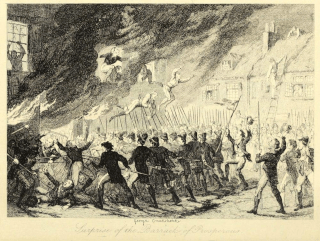
On May 24, 1798, Esmonde leads his forces to attack Prosperous. Their entry is preceded by the infiltration of a small rebel vanguard, who with the possible help of female sympathisers residing in Prosperous, scale the walls of the town’s barracks, kill the sentries and open the town gates. The barracks are quickly surrounded and attacked by the rebels who repulse an attempt by the garrison to break out. “Swayne himself was surprised in bed, shot and piked to death and his body burned in a tar barrel.” The remainder of the garrison are trapped in the upper floors of the barracks, which is set on fire by the rebels, causing them to jump in desperation onto the ground below, where they are summarily executed with pikes. While the rebels suffer no known casualties, approximately 40 members of the garrison are killed in the battle.
Ten members of the garrison, all belonging to the Ancient Britons, manage to escape from Prosperous to Dunlavin, County Wicklow, where they participate in the Dunlavin Green executions on May 26. Esmonde is later captured by Crown forces and brought to Dublin for trial. As he had previously enlisted at the rank of lieutenant in the ClaneYeomanry, Esmonde is court-martialled on June 13 and found guilty of being a deserter. He is executed by hanging on June 14 on Carlisle Bridge (now the O’Connell Bridge) with his coat being worn reversed to indicate that he had been convicted of desertion. Prosperous remains under the control of the United Irishmen until June 19, when a detachment of the 5th Dragoon Guards under the command of Lieutenant Colonel Stewart recaptures the town.



 seamus dubhghaill