seamus dubhghaill

Promoting Irish Culture and History from Little Rock, Arkansas, USA


2 Comments

Death of Republican Activist James Murphy

black-and-tans-and-auxies-dublin-ireland-1921

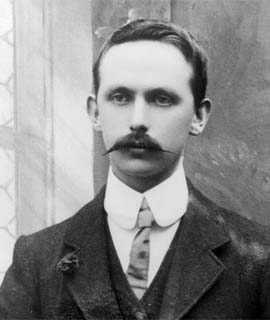
Republican activist James Murphy dies in Mater Hospital, Dublin on February 11, 1921. Before he dies, he declares that he and Patrick Kennedy had been shot by their Auxiliary captors. A court of inquiry is held, and Captain W. L. King, commanding officer of F Company Auxiliary Division of the Royal Irish Constabulary (ADRIC), is arrested for the killings.

James Murphy and Patrick Kennedy are arrested by Auxiliaries in Dublin on February 9 and are taken into the custody of ‘F’ company. Two hours later, constables of the Dublin Metropolitan Police find the two men lying shot, with pails on their heads, in Clonturk Park, Drumcondra. Kennedy is dead and Murphy is fatally wounded. He dies in Mater Hospital, Dublin two days later.

Just before dying Murphy testifies that King had taken them and stated that they were “just going for a drive.” King is arrested for the killings. King and two of his men, Hinchcliffe and Welsh, are court-martialed on February 13-15, but are acquitted after Murphy’s dying declaration is ruled inadmissible and two officers from ‘F’ Company provide perjured alibis for King at the time of the shootings.

King is implicated and court-martialed for the deaths of Conor Clune, Peadar Clancy, and Dick McKee, the latter two leading lights in the Dublin Irish Republican Army, the former a luckless Gaelic League member, who are all captured in Dublin on November 20, 1920, the day before Bloody Sunday. Clune is caught at Vaughn’s Hotel in Parnell Square, Dublin and the two IRA leaders at Lower Gloucester Street, complete with British Army officer uniforms and detonators.

Sometime between then and the next day, in the Dublin Castle guardroom, as news filters in of the deaths of several British intelligence officers, the prisoners are killed in questionable circumstances. According to an official report from Dublin Castle, they attempted to grab rifles and hurl unfused grenades and are killed in that action. The guards of ‘F’ Company in the room at the time are cleared of wrongdoing by a court inquiry. A Major Reynolds of ‘F’ Company is said to have passed details of the killers to Michael Collins. The Times notes that it seems as if the prisoners had been lined up and shot. In a later novel, a Captain Hardy more or less confesses to the killing of one of the prisoners.

Ironically, Captain King is on Michael Collins’s list of British Intelligence officers to be executed on the morning of November 20, 1920, he is not in his room when the assassins arrive but rather, he is interrogating the prisoners in Dublin Castle.

(Pictured: Mixed gunmen of the Royal Irish Constabulary’s Auxiliary Division and Black and Tans contingents, Stair na hÉireann | History of Ireland)

Leave a comment

Birth of Sculptor John Hughes

john-hughes

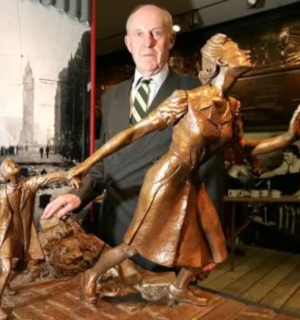
John Hughes, Irish sculptor, is born in Dublin on January 30, 1865.

Hughes is educated at North Richmond Street CBS. He enters the Metropolitan School of Art in Dublin in 1878 and trains as a part-time student for ten years. In 1890 he wins a scholarship to the South Kensington School of Art in London, after which another scholarship takes him to Paris, France. He then studies further in Italy.

Hughes is appointed as teacher to the Metropolitan School of Art in Dublin in 1894 and in 1902 becomes Professor of Sculpture in the Royal Hibernian Academy School. His last residence in Dublin is at 28 Lennox Street, Portobello.

From 1903 Hughes lives in Italy and in France, dying in Nice in 1941.

Hughes’s influences are mainly from the Italian Renaissance and include:


1 Comment

Archibald Hamilton Rowan Tried for Distribution of Seditious Paper

archibald-hamilton-rowan

Archibald Hamilton Rowan, a founding member of the Dublin Society of United Irishmen, is tried on a charge of distributing seditious paper on January 29, 1794.

Hamilton Rowan is born in the home of his grandfather, William Rowan, in London on May 1, 1751, and lives there with his mother and sister for much of his early life. He is admitted to Queens’ College, Cambridge in 1768, but is expelled from the college and rusticated for an attempt to throw a tutor into the River Cam. He is sent for a period in 1769 to Warrington Academy.

Hamilton Rowan travels throughout the 1770s and 1780s, visiting parts of Europe, the Americas, and North Africa. In 1781 he marries Sarah Dawson in Paris, France. The couple has ten children. He is the godfather of the Irish mathematician William Rowan Hamilton.

Hamilton Rowan returns to Ireland in his thirties, in 1784, to live at Rathcoffey near Clane in County Kildare. He becomes a celebrity and, despite his wealth and privilege, a strong advocate for Irish liberty. That same year he joins the Killyleagh Volunteers, a militia group later associated with radical reform. He first gains public attention by championing the cause of fourteen-year-old Mary Neal in 1788. Neal had been lured into a Dublin brothel and then assaulted by Lord Carhampton. Hamilton Rowan publicly denounces Carhampton and publishes a pamphlet A Brief Investigation of the Sufferings of John, Anne, and Mary Neal in the same year. An imposing figure at more than six feet tall, his notoriety grows when he enters a Dublin dining club threatening several of Mary Neal’s detractors, with his massive Newfoundland at his side and a shillelagh in hand. The incident wins him public applause and celebrity as a champion of the poor.

In 1790 Hamilton Rowan joins the Northern Whig Club, and by October has become a founding member of the Dublin Society of United Irishmen, working alongside famous radicals such as William Drennan and Theobald Wolfe Tone. He is arrested in 1792 for seditious libel when caught handing out “An Address to the Volunteers of Ireland,” a piece of United Irish propaganda. Unknown to him, from 1791 Dublin Castle has a spy in the Dublin Society, Thomas Collins, whose activity is never discovered. From February 1793 Britain and Ireland join the War of the First Coalition against France, and the United Irish movement is outlawed in 1794.

Hamilton Rowan’s reputation for radicalism and bluster grow during this time when he leaves Ireland to confront the Lord Advocate of Scotland about negative comments made in respect to his character and that of members of the Society of United Irishmen. As a prominent member of the Irish gentry, he is an important figure in the United Irishmen and becomes the contact for the Scottish radical societies as a result of his visit. Upon his return to Dublin, he is charged and was found guilty of seditious libel, even though he is excellently defended by the famous John Philpot Curran. He is sentenced to two years imprisonment, receives a fine of £500, and is forced to pay two assurities for good behaviour of £1,000 each. In January 1794 he retires to his apartments in Dublin’s Newgate Prison.

In the years following, Hamilton Rowan spends time in exile in France, the United States and Germany. He is allowed to return to Ireland in 1806. He returns to the ancestral home of Killyleagh Castle, County Down, receiving a hero’s welcome. While he has agreed to be a model citizen under the conditions of his return to Ireland, he remains active in politics and retains his youthful radicalism. Following his last public appearance at a meeting in the Rotunda in Dublin on January 20, 1829, he is lifted up by a mob and paraded through the streets.

Hamilton Rowan dies at the age of 84 in his home on November 1, 1834. He is buried in the vaults of St. Mary’s Church, Dublin.


Leave a comment

Death of Helena Molony, Feminist & Labour Activist

helena-moloney

Helena Mary Molony, prominent Irish republican, feminist and labour activist, dies in Dublin on January 28, 1967. She fights in the 1916 Easter Rising and later becomes the second woman president of the Irish Trades Union Congress (ITUC).

Molony is born in Dublin on January 15, 1883, to Michael Molony, a grocer, and Catherine McGrath. Her mother dies early in her life. Her father later remarries, but both became alcoholics, something which influences her years later.

In 1903, inspired by a pro-nationalist speech given by Maud Gonne, Molony joins Inghinidhe na hÉireann and begins a lifelong commitment to the nationalist cause. In 1908 she becomes the editor of the organisation’s monthly newspaper, Bean na hÉireann (Woman of Ireland). The newspaper brings together a nationalist group – Constance Markievicz designs the title page and writes the gardening column, Sydney Gifford writes for the paper and is on its production team and contributors include Eva Gore-Booth, Susan L. Mitchell, and Katharine Tynan, as well as Patrick Pearse, Thomas MacDonagh, George William Russell, Roger Casement, Arthur Griffith and James Stephens.

Molony is central to the school meals activism of the movement. With Maud Gonne, Marie Perolz and others, she organises the supply of daily school meals to children in impoverished areas, and pressures Dublin Corporation and other bodies to provide proper meals to the starved children of Dublin city.

Molony also has a career as an actress and is a member of the Abbey Theatre. However, her primary commitment is to her political work. She is a strong political influence, credited with bringing many into the movement, including Constance Markievicz and Dr. Kathleen Lynn.

As a labour activist, Molony is a close colleague of Markievicz and of James Connolly. In November 1915 Connolly appoints her secretary of the Irish Women Workers’ Union, in succession to Delia Larkin. This union had been formed during the strike at Jacob’s Biscuit Factory that was part of the 1913 Dublin lock-out. She manages the union’s shirt factory in Liberty Hall, founded to give employment to the strikers put out of work and blacklisted after the strike. She is friendly with the family of Thomas MacDonagh and his wife, Muriel, and is the godmother of their daughter Barbara, whose godfather is Patrick Pearse.

Fianna Éireann, the cadet body of the Irish Volunteers, is founded by Constance Markievicz in Molony’s home at 34 Lower Camden Street, Dublin, on August 16, 1909. Markievicz works closely with Molony and Bulmer Hobson in organising the fledgling Fianna. It is during this period of working together in building the Fianna that Molony and Hobson grow close and became romantically linked. However, the relationship does not last.

Molony is a prominent member of Cumann na mBan, the republican women’s paramilitary organisation formed in April 1914 as an auxiliary of the Irish Volunteers. Members of Cumann na mBan train alongside the men of the Irish Volunteers in preparation for the armed rebellion against the English forces in Ireland.

During the 1916 Easter Rising, Molony is one of the Citizen Army soldiers who attacks Dublin Castle. During the defence of City Hall, her commanding officer, Sean Connolly, is killed and she is captured and imprisoned until December 1916.

After the Irish Civil War, Molony becomes the second female president of the Irish Trades Union Congress. She remains active in the republican cause during the 1930s, particularly with the Women’s Prisoner’s Defense League and the People’s Rights Association.

Molony retires from public life in 1946 but continued to work for women’s labour rights. She dies in Dublin on January 28, 1967.


Leave a comment

Formation of the Provisional Government of Ireland

provisional-government-of ireland

A meeting of the members elected to the House of Commons of Southern Ireland is held at the Mansion House in Dublin on January 14, 1922. At the meeting the Anglo-Irish Treaty is ratified by the Irish side in accordance with the Treaty and a Provisional Government is elected for the purposes of Article 17 of the Treaty.

Under the Irish Republic‘s Dáil Constitution adopted in 1919, Dáil Éireann continues to exist after it has ratified the Anglo-Irish Treaty. In protest at the ratification, Éamon de Valera resigns the presidency of the Dáil then seeks re-election from among its members in order to clarify his mandate, but Arthur Griffith defeats him in the vote and assumes the presidency.

Most of the Dáil Ministers become concurrently Ministers of this Provisional Government. Michael Collins becomes Chairman of the Provisional Government (i.e. prime minister). He also remains Minister for Finance of Griffith’s republican administration.

The Provisional Government takes office two days later on January 16, 1922, when British administration hands over Dublin Castle to Collins in person. At this time, Westminster has not formally appointed the new Irish ministers or conferred their government with any powers.

The handover of Dublin Castle to the Provisional Government is one of the earliest and most remarkable events in the short life of the Provisional Government. For centuries Dublin Castle is the symbol, as well as the citadel, of British rule in Ireland. The transfer of its Castle administration to the representatives of the Irish people is greatly welcomed in Dublin. It is regarded as a significant outward and visible sign that British rule is ending.

Following the general election on June 16, 1922, held just before the outbreak of the Irish Civil War, the Second Provisional Government takes power until the creation of the Irish Free State on December 6, 1922.

By mid-1922, Collins in effect lays down his responsibilities as Chairman of the Provisional Government to become Commander-in-Chief of the Irish Army, a formal structured uniformed army that forms around the pro-Treaty Irish Republican Army (IRA). As part of those duties, he travels to his native County Cork. En route home on August 22, 1922, at Béal na Bláth, he is killed in an ambush. Arthur Griffith dies of a cerebral haemorrhage ten days prior to Collins’ assassination. After Collins’ and Griffith’s deaths in August 1922, W. T. Cosgrave becomes both Chairman of the Provisional Government and President of Dáil Éireann, and the distinction between the two posts becomes irrelevant.

On December 6, 1922, the Irish Free State comes into being, and the Provisional Government becomes the Executive Council of the Irish Free State, presided over by a prime minister called the President of the Executive Council. On December 7 the House of Commons of Northern Ireland unanimously exercises its right under the Treaty to opt out of the Free State.

(Pictured: The Provisional Government of Ireland with President Arthur Griffith (front row center) and his cabinet and party includng Michael Collins (to Griffith’s right) likely taken at the Mansion House in February 1922)


Leave a comment

Founding of the Irish Women’s Franchise League

irish-womens-franchise-league

The Irish Women’s Franchise League (IWFL), an organisation for women’s suffrage, is established in Dublin on November 4, 1908. Its founder members include Hanna Sheehy-Skeffington, Francis Sheehy-Skeffington and James H. Cousins. Thomas MacDonagh is also a member. The IWFL has 1,000 members by 1912 but only about fifty of these are active.

In the early 20th century, the Irish Parliamentary Party under John Redmond and his deputy John Dillon is opposed to votes for women, as is the British prime minister, H. H. Asquith.

In June 1912, after a meeting of a number of women’s organisations, Hanna Sheehy-Skeffington and Margaret Cousins with six other members of the IWFL smash government windows in the General Post Office (GPO) and other government buildings. They are arrested, charged, and jailed. The following month Asquith makes a visit to Dublin to address a meeting in the Theatre Royal. Frank Sheehy-Skeffington manages to gain entrance and demands votes for women before being thrown out. Meanwhile Asquith’s carriage is attacked by British suffragists Mary Leigh and Gladys Evans. In that attack John Redmond is injured. Leigh and Evans go on hunger strike in Mountjoy Gaol, and are joined by the imprisoned Irish IWFL members in solidarity.

In March 1913 a bust of John Redmond in the Royal Hibernian Academy is defaced by a suffragist protesting against the failure of the Irish Parliamentary Party to support a Women’s Franchise Bill in the House of Commons. In contrast, as a mark of solidarity with the women, James Connolly travels from Belfast to Dublin to speak at one of the IWFL’s weekly meetings which is held in the Phoenix Park, and members of the Irish Transport and General Workers’ Union (ITGWU) provide protection and offer escorts to women as they leave the meetings.

Hanna Sheehy-Skeffington loses her teaching job in 1913 when she is arrested and put in prison for three months after throwing stones at Dublin Castle. While in jail she starts a hunger strike but is released under the Prisoners (Temporary Discharge of Ill Health) Act 1913 and is soon rearrested.

The league keeps a neutral stance on Home Rule, but is opposed to World War I. After the killing of Francis Sheehy-Skeffington by a British officer in 1916, it supports Sinn Féin.

The Irish Women’s Franchise League publishes a paper, The Irish Citizen, from 1912 to 1920. The paper is edited originally by James H. Cousins.


Leave a comment

Birth of Sir Oliver Plunkett, Archbishop of Armagh

oliver-plunkett

Sir Oliver Plunkett, Catholic Archbishop of Armagh and Primate of All Ireland who was the last victim of the Popish Plot, is born on November 1, 1625, in Loughcrew, County Meath, to parents of Hiberno-Norman ancestors.

Until his sixteenth year, Plunkett’s education is entrusted to his cousin Patrick Plunkett, Abbot of St. Mary’s, Dublin, and brother of Luke Plunkett, the first Earl of Fingall, who later becomes successively Bishop of Ardagh and of Meath. As an aspirant to the priesthood, he sets out for Rome in 1647.

Plunkett is admitted to the Pontifical Irish College in Rome and proves to be an able pupil. He is ordained a priest in 1654 and deputed by the Irish bishops to act as their representative in Rome. Meanwhile, the Cromwellian conquest of Ireland (1649–1653) has defeated the Roman Catholic cause in Ireland. As a result, it is impossible for Plunkett to return to Ireland for many years, so he petitions to remain in Rome. At the Congregation of Propaganda Fide on July 9, 1669, he is appointed Archbishop of Armagh and is consecrated on November 30 at Ghent. He returns to Ireland on March 7, 1670, as the English Restoration of 1660 has begun on a basis of toleration.

Plunkett sets about reorganising the ravaged Roman Church and builds schools both for the young and for clergy. The Penal Laws have been relaxed in line with the Declaration of Breda in 1660 and he is able to establish a Jesuit College in Drogheda in 1670, which becomes the first Catholic-Protestant integrated school in Ireland.

On the enactment of the Test Act in 1673, to which Plunkett does not agree for doctrinal reasons, the college is closed and demolished. Plunkett goes into hiding, travelling only in disguise, and refuses a government edict to register at a seaport to await passage into exile.

In 1678 the so-called Popish Plot, concocted in England by clergyman Titus Oates, leads to further anti-Roman Catholic action. Archbishop Peter Talbot of Dublin is arrested, and Plunkett again goes into hiding. Despite being on the run and with a price on his head, Plunkett refuses to leave his flock.

Plunkett is arrested in Dublin in December 1679 and imprisoned in Dublin Castle. He is tried at Dundalk for conspiring against the state by allegedly plotting to bring 20,000 French soldiers into the country, and for levying a tax on his clergy to support 70,000 men for rebellion. The trial soon collapses as the prosecution witnesses are themselves wanted men and afraid to appear in court. Plunkett is moved to Newgate Prison in London in order to face trial at Westminster Hall. The first grand jury finds no true bill, but he is not released. The second trial is generally regarded as a serious miscarriage of justice as Plunkett is denied defending counsel.

Archbishop Plunkett is found guilty of high treason in June 1681 “for promoting the Roman faith,” and is condemned to death. Plunkett is hanged, drawn, and quartered at Tyburn on July 1, 1681, the last Roman Catholic martyr to die in England. His body is initially buried in two tin boxes in the courtyard of St. Giles in the Fields church. The remains are exhumed in 1683 and moved to the Benedictine monastery at Lamspringe, near Hildesheim in Germany. His head is brought to Rome, and from there to Armagh, and eventually to Drogheda where it has rested in St. Peter’s Church since June 29, 1921. Most of the body is brought to Downside Abbey, England, where the major part is located today, with some parts remaining at Lamspringe.

Sir Oliver Plunkett is canonised in Rome by Pope Paul VI on October 12, 1975, the first new Irish saint in almost seven hundred years, and the first of the Irish martyrs to be beatified. For the canonisation, the customary second miracle is waived.


Leave a comment

Proclamation Banning O’Connell’s Repeal Meeting Issued

daniel-oconnell

On the night of Saturday, October 7, 1843, a proclamation is issued from Dublin Castle banning a Repeal Association meeting called by Daniel O’Connell north of the city at Clontarf on the following day.

The proclamation is written by the Prime Minister of the United Kingdom of Great Britain and Ireland, Sir Robert Peel, who calls the proposed meeting for the restoration of the Parliament of Ireland, abolished in 1801, “an attempt to overthrow the constitution of the British Empire as by law established.”

Two warships, the Rhathemus and the Dee, steam into Dublin Harbour, carrying around 3,000 British troops to ensure the mass rally in favour of Repeal of the Union does not take place. The nationalist newspaper, the Freeman’s Journal, alleges that the troops have been summoned to “cut the people down” and “run riot in the blood of the innocent.”

O’Connell, the charismatic leader of the Repeal Association, has always insisted that his movement is non-violent. On the banning of the meeting and the arrival of troops, he frantically moves to call it off and to prevent “the slaughter of the people.”

Handbills are posted around the streets of Dublin advising his supporters of the meeting’s cancellation. A prominent Dublin builder and O’Connell supporter, Peter Martin, is sent to Clontarf to dismantle the platform erected there. Other activists are sent on horseback to the roads leading into the city to send back the thousands converging on Clontarf for the meeting.

The following day passes without incident. The Freeman’s Journal rages against the “corrupt and impotent Government that has perverted the form of law for the purpose of robbing the people.”

The Warder, a Dublin unionist newspaper, had been urging the suppression of the “plainly illegal under common law” O’Connellite mass meetings for months. The newspaper stops short of calling for civil war in the run–up to the meeting. Now it declares itself satisfied. It congratulates the Conservative government for belatedly seeing sense.

By contrast, the Repeal camp is deeply split. Many, particularly those Young Irelanders grouped around The Nation, blame O’Connell for capitulation to the threat of force and for his unwillingness to confront the British government. They break from him acrimoniously the following year.

With the cancellation of the Clontarf meeting, O’Connell’s strategy of mass mobilisation in pursuit of Irish self government is over. He himself is arrested on charges of “seditious conspiracy” three days later.

(From: “Today in Irish History, The Repeal Meeting at Clontarf is Banned, 8 October 1843, John Dorney, The Irish Story (theirishstory.com), October 8, 2011)


Leave a comment

Birth of Éamonn Ceannt, Irish Republican

eamonn-ceannt

Éamonn Ceannt, Irish republican mostly known for his role in the Easter Rising of 1916, is born into a very religious Catholic family in the little village of Ballymoe, overlooking the River Suck in County Galway on September 21, 1881.

Ceannt, born Edward Thomas Kent, is the sixth of seven children of James Kent and Joanne Galway. His father is a Royal Irish Constabulary officer stationed in Ballymoe. In 1883 he is promoted and transferred to Ardee, County Louth. When his father retires from the force in 1892, the family moves to Dublin. Here he attends the North Richmond Street Christian Brothers School. Two other leaders from the 1916 rising, Seán Heuston and Con Colbert, are educated at the school. Upon finishing school, he goes on to secure a job with the clerical staff of the City Treasurer and Estates and Finances office. He works as an accountant with the Dublin Corporation from 1901-1916.

In 1907 Ceannt joins the Dublin central branch of Sinn Féin and over the following years becomes increasingly determined to see an Independent Ireland. In 1912 he is sworn to the Irish Republican Brotherhood (IRB) by Seán MacDiarmada. This movement is pledged to achieve Irish independence and to do so by using physical force if necessary.

In May 1915, the IRB Military Council, consisting of Joseph Plunkett and Seán MacDiarmada as well as Ceannt, begin plans for a rebellion. Ceannt is one of the seven men to sign the Proclamation of the Irish Republic and is appointed Director of Communications. He is made commandant of the 4th Battalion of the Volunteers and during the Rising is stationed at the South Dublin Union, with more than 100 men under his command, notably his second-in-command Cathal Brugha, and W. T. Cosgrave. The South Dublin Union controls a large area south of Kilmainham around Dolphin’s Barn.

As 3rd Royal Irish come to Mount Brown, a section of Ceannt’s battalion under section commander John Joyce opens fire, killing a number of soldiers. The British cannot break through to Dublin Castle and so bring up more troops from Kilmainham Barracks. A ceasefire allows casualty retrieval. The Volunteers drive back repeated assaults from determined regimental attacks. Ceannt uses a contingent at the Marrowbone Lane Distillery to enfilade the passing soldiers. On Tuesday, April 25, the British could close off the battle but fail to press home the advantage when the 4th Royal Dublin Fusiliers arrive. Ceannt continues to hold out with 20 times fewer men. On Thursday, April 27, a British battalion comes south as far as the Rialto Bridge when Ceannt’s outposts open fire.

The British are forced to tunnel into the buildings and, as Ceannt’s numbers reduce, it is increasingly involved in close quarter fighting. His unit sees intense fighting at times during the week but surrenders when ordered to do so by his superior officer Patrick Pearse.

After the unconditional surrender of the 1916 fighters, Ceannt, along with the other survivors, are brought to Richmond Barracks to be detained. On Monday, May 1, plain clothes detectives known as the “G-men” identify the leaders of the Rising, Ceannt being one of them. He is tried under court martial as demanded by General John Maxwell. Maxwell is determined to afflict the death penalty upon Ceannt and the other leaders of the Rising. However, he faces legal issues which only allow the death penalty to be used if one is found aiding the enemy, being Germany at this time. Not until Maxwell obtains a letter from Patrick Pearse addressed to his mother regarding the communication with the Germans is he legally obliged to deploy the death penalty. From this point Ceannt and his comrades begin facing the prospect of a firing squad. On Tuesday, May 2, he is sent to Kilmainham Gaol to face trial and execution.

Ceannt is held in Kilmainham Gaol until his execution by firing squad on May 8, 1916, aged 34. He is buried at Arbour Hill Prison in Dublin.


Leave a comment

The Capture of Robert Emmet

robert-emmet

Robert Emmet, one of the most famous revolutionaries in Irish history, is captured by the British at the home of a Mrs. Palmer in Harold’s Cross, outside Dublin on August 25, 1803.

Emmet is born at 109 St. Stephen’s Green in Dublin on March 4, 1778. He is the youngest son of Dr. Robert Emmet, a court physician, and his wife Elizabeth Mason. He attends Oswald’s school in Dopping’s-court, off Golden-lane and enters Trinity College, Dublin, in October 1793 at the age of fifteen. In December 1797, he joins the College Historical Society, a debating society.

While he is in college, his brother Thomas and some of his friends become involved in political activism. Emmet becomes secretary of a secret United Irish Committee in college and is expelled in April 1798 as a result. That same year he flees to France to avoid the many British arrests of nationalists that are taking place in Ireland. While in France, he garners the support of Napoleon, who promises to lend support when the upcoming revolution starts.

After the Irish Rebellion of 1798, Emmet is involved in reorganising the defeated Society of United Irishmen. In April 1799, a warrant is issued for his arrest. He escapes and soon after travels to the continent in the hope of securing French military aid. His efforts are unsuccessful, as Napoleon is concentrating his efforts on invading England. He returns to Ireland in October 1802.

In March of the following year, Emmet begins to prepare a new rebellion, with fellow Anglo-Irish revolutionaries Thomas Russell and James Hope. The revolutionaries conceal their preparations, but a premature explosion at one of Emmet’s arms depots kills a man, forcing Emmet to advance the date of the rising before the authorities’ suspicions are aroused.

Despite being unable to secure help from Michael Dwyer‘s Wicklow rebels and many rebels from Kildare turning back due to the scarcity of firearms, the rising begins in Dublin on the evening of July 23, 1803. Failing to seize the lightly defended Dublin Castle, the rising amounts to a large-scale disturbance in the Thomas Street area. Emmet witnesses a dragoon being pulled from his horse and piked to death, the sight of which prompts him to call off the rising to avoid further bloodshed. However, sporadic clashes continue into the night until finally quelled by British military forces.

Emmet flees into hiding, moving from Rathfarnham to Harold’s Cross so that he can be near his sweetheart, Sarah Curran. He is captured on August 25 and taken to Dublin Castle, then later removed to Kilmainham Gaol. Vigorous but ineffectual efforts are made to procure his escape.

Emmet is tried for and found guilty of high treason on September 19, 1803. Chief Justice John Toler, 1st Earl of Norbury sentences Emmet to be hanged, drawn, and quartered, as is customary for conviction of treason. The following day, Emmet is executed in Thomas Street near St. Catherine’s Church. He is hanged and beheaded after his death. Out of fear of being arrested, no one comes forward to claim his remains.

Emmet’s remains are first delivered to Newgate Prison and then returned to Kilmainham Gaol, where the jailer is under instructions to be bury the remains in a nearby hospital’s burial grounds if no one claims them. No remains have been found there and though not confirmed, it appears that he was secretly removed and reinterred in St. Michan’s Church, a Dublin church with strong United Irish associations. There is also speculation that the remains are buried secretly in the vault of a Dublin Anglican church. When inspected in the 1950s, a headless corpse is found in the vault but cannot be identified. The widely accepted theory is that Emmet’s remains are transferred to St. Peter’s Church in Aungier St. under cover of the burial of his sister in 1804. In the 1980s the church is deconsecrated, and all the coffins are removed from the vaults. The church has since been demolished.