Unlike similar organisations of the time, which are antiquarian in nature, the SPIL aims at protecting the status of the Irish language, which is threatened with extinction at the time. Its mission statement says that it is “possible and desirable to preserve the Irish Language in those parts of the Country where it is spoken, with a view to its further extension and cultivation.” Hyde writes that the formation of the society can truly be said to be the first attempt made to recruit the common people to the cause of the Irish language. The society succeeds in having Irish included on the curriculum of primary and secondary schools and third-level colleges in 1878.
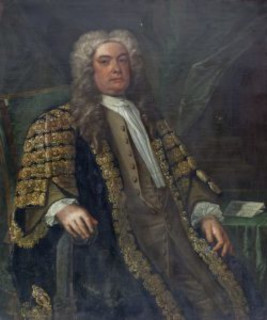
Coghill is the son of John Coghill of Knaresborough, North Yorkshire, judge of the prerogative court and one of the masters in chancery. His mother is the daughter of Tobias Cramer, of Ballyfoyle, County Kilkenny. Two elder sisters and a younger brother, James, survive infancy. He spends his childhood in Dublin.
Coghill occupies a prominent place in the life of Dublin, and is remarkable for his early display of ability. At the age of fourteen he enters the University of Dublin, graduating at the age of eighteen as a Bachelor of Laws. At the age of nineteen he is returned to Parliament and at the age of 26 he becomes judge of the prerogative court.
In Parliament, from 1692 to 1713 Coghill is a representative of the borough of Armagh, and from 1713 until his death in 1739, a representative of the University of Dublin. He is politically close to William Conolly, speaker of the Irish House of Commons, who dies in 1729. Upon Conolly’s death he succeeds him as a commissioner of the revenue. Over the following years he plays a prominent role in parliament, particularly on financial matters. He also builds up a close relationship with John Perceval, the British Prime Minister‘s chief advisor on Irish affairs.
Coghill becomes Chancellor of the Exchequer in 1735 and is regarded as an honest and able supporter of Irish interests. Outside parliament he is very active on boards, commissions and trusts, takes a hand in the building of Dr. Steevens’ Hospital and is pro-vice-chancellor of Trinity College Dublin. He lives in Belvedere House, now in the grounds of St. Patrick’s College, Dublin. He suffers from gout for a large part of his life.
From his father, Coghill, who never married, had inherited a lease from the Corporation of lands in Clonturk, where he erects a house which is afterwards known as Drumcondra House. He moves into Drumcondra House and lives there with his unmarried sister Mary until his death in 1738. He is buried in the family vault in St. Andrew’s Church, Dublin.
Upon Coghill’s death Mary is left, for her lifetime, his lands in the barony of Coolock, rents from his properties in Clonturk, all his household goods, and his coach, chariot and horses. In 1743, she erects the parish church of Clonturk, now Drumcondra Church, and places in it a statue of her brother by the Dutch sculptor Peter Scheemakers.
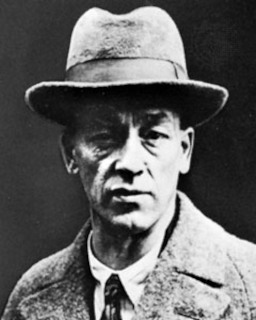
Stephens’ birth is somewhat shrouded in mystery. He claims to have been born on the same day and same year as James Joyce, February 2, 1882, whereas he is in fact probably the same James Stephens who is on record as being born at the Rotunda Hospital in Dublin, on February 9, 1880, the son of Francis Stephens of 5 Thomas’s Court, Dublin, a vanman and a messenger for a stationer’s office, and his wife, Charlotte Collins. His father dies when he is two years old and, when he was six years old, his mother remarries. He is committed to the Meath Protestant Industrial School for boys in Blackrock for begging on the streets, where he spends much of the rest of his childhood. He attends school with his adoptive brothers Thomas and Richard Collins before graduating as a solicitor‘s clerk. They compete and win several athletic competitions despite James’ tiny 4’10” stature. He is known affectionately as “Tiny Tim.” He is much enthralled by the tales of military valour of his adoptive family and would have become a soldier except for his height.
By the early 1900s Stephens is increasingly inclined to socialism and the Irish language and by 1912 is a dedicated Irish Republican. He is a close friend of the 1916 leader Thomas MacDonagh, who is then editor of The Irish Review and deputy headmaster in St. Enda’s School, the radical bilingual Montessori school run by Patrick Pearse and later manager of the Irish Theatre. He spends much time with MacDonagh in 1911. His growing nationalism brings a schism with his adoptive family, but probably wins him his job as registrar in the National Gallery of Ireland, where he works between 1915 and 1925, having previously had an ill-paid job with the Mecredy firm of solicitors.
Stephens produces many retellings of Irish myths. His retellings are marked by a rare combination of humour and lyricism, with Deirdre and Irish Fairy Tales especially often praised. He also writes several original novels, including The Crock of Gold, Etched in Moonlight and Demi-Gods, based loosely on Irish wonder tales. The Crock of Gold in particular has achieved enduring popularity and has often been reprinted.
Stephens begins his career as a poet under the tutelage of poet and painter Æ (George William Russell). His first book of poems, Insurrections, is published in 1909. His last book, Kings and the Moon (1938), is also a volume of verse. His influential account of the 1916 Easter Rising, Insurrection in Dublin, describes the effect of the deaths by execution of his friend Thomas MacDonagh and others as being “like watching blood oozing from under a door.”
Stephens later lives between Paris, London and Dublin. During the 1930s he is a friend of James Joyce, and they wrongly believe that they share a birthday. Joyce, who is concerned about his ability to finish what later becomes Finnegans Wake, proposes that Stephens assist him, with the authorship credited to JJ & S (for “Jameses Joyce & Stephens”, but also a pun on the popular Jameson Irish Whiskey, made by John Jameson & Sons). The plan is never implemented, as Joyce is able to complete the work on his own.
During the last decade of his life Stephens finds a new audience through a series of broadcasts on the BBC.
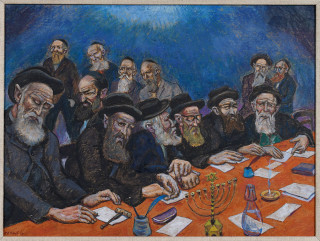
Harry Aaron Kernoff, Irish artist in oils and woodcuts, dies in Dublin on December 25, 1974. Of London/Russian extraction, he is primarily remembered for his sympathetic interest in Dublin and its people. He depicts street and pub scenes, as well as Dublin landmarks with sympathy and understanding. This is particularly evident in his woodcuts.
Born in London on January 10, 1900 to a Russian Jewish father and Spanish mother, Kernoff moves to Dublin in 1914 and becomes a leading figure in Irish modernism. While working as an apprentice in his father’s furniture business, which leads to his woodcuts, he takes night classes at the Dublin Metropolitan School of Art. There, in 1923, he wins the Taylor scholarship and goes on to exhibit at the Royal Hibernian Academy (RHA) every year from 1926. He is elected RHA in 1936.
Kernoff is famously associated with Davy Byrne’s pub. His paintings and woodcuts of Davy Byrne’s pub are documents of his friendship with the original owner. While living in his adopted Dublin Jewish community he produces picture illustrations of his local scenes for a neighbourhood writer and friend, Nick Harris, for his book called Dublin’s Little Jerusalem.
Outside Kernoff’s home in Dublin, where he lives with two unmarried sisters, there is a long-standing sign in the front garden which says “Descendants of the Abravanels.” The Abravanel (or Abrabanel) family is one of the most famous Sephardic Jewish families in history, noted for their large quotas of rabbis, scholars, and members of a variety of scientific and artistic fields, dating from about the 13th century in Lisbon. The emergence of the famous philosopher and scholar Don Isaac Abravanel in the middle of the 16th century brings his works to greater universal recognition.
Kernoff spends the vast majority of his life unappreciated and makes little or nothing from his paintings until a few years before his death, when he begins to be appreciated by contemporary critics. He never marries.
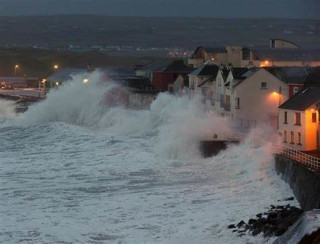
On December 24, 2015, the Electricity Supply Board networks says that around 6,000 customers are without power as a result of Storm Eva. The worst affected areas are Fermoy in County Cork and Kilcoole in County Wicklow. High winds and heavy rain batter the west and northwest as Storm Eva moves across the country.
Eva is the fifth storm to be officially named by Met Éireann on December 22, 2015. An orange wind warning is issued for counties Clare, Galway, Mayo, Sligo and Donegal on the same day. Gales are also expected in the northwest of the United Kingdom, with storm force winds over parts of the Outer Hebrides. There are fears that the storm could cause further disruption to Cumbria in England, where areas were already dealing with the aftermath of flooding from Storm Desmond and in some cases had been flooded twice already. The army and Environment Agency staff are called in to be on stand-by to bolster flood defences.
Rain associated with the passage of Eva causes disruption when rivers burst their banks in the Cumbrian towns of Appleby-in-Westmorland, Keswick and Kendal on the December 22. Appleby-in-Westmorland receives three to four feet of flood water. The village of Glenridding is flooded for the third time in the month. Six thousand houses in Ireland are left without power. In London, Secretary of State for Environment, Food and Rural AffairsLiz Truss convenes a Cabinet Office Briefing Rooms (COBR) meeting to decide on emergency measures, which include the deployment of soldiers from the 2nd Battalion, Duke of Lancaster’s Regiment to the affected areas. On December 24, flood defence gates are closed in Carlisle, Keswick and Cockermouth to limit the damage expected from rainfall and 20 water pumps and two kilometres of temporary flood barriers are transported to northern England. Ferries operating between Dublin and Holyhead are cancelled due to bad weather on the Irish Sea.
The Spire is designed by Ian Ritchie Architects, who sought an “elegant and dynamic simplicity bridging art and technology.” The contract is awarded to SIAC-Radley JV and it is manufactured by Radley Engineering of Dungarvan, County Waterford, and erected by SIAC Construction Ltd & GDW Engineering Ltd.
The first section is installed on December 18, 2002. Construction of the sculpture is delayed because of difficulty in obtaining planning permission and environmental regulations. The Spire consists of eight hollow stainless steel cone sections, the longest being 66 feet, which are installed on January 21, 2003. It is an elongated cone of diameter, 9.8 feet at the base narrowing to 5.9 inches at the top. It features two tuned mass dampers, designed by engineers Arup, to counteract sway. The steel undergoes shot peening to alter the quality of light reflected from it.
The pattern around the base of the Spire is based on a core sample of rock formation taken from the ground where the spire stands and the DNA double helix. The pattern is applied by bead blasting the steel through rubber stencil masks whose patterns are created by water jet cutting based on core sample drawings supplied by the contractor. The design around the 33-foot lower part of the Spire is created by the architects making a 3D pattern model combining the core sample and double helix and then digitally translated to a 2D image drawing supplied to the contractor and used by specialists for cutting the masking material.
At dusk, the base of the monument is lit and the top 33 feet is illuminated through 11,884 holes through which light-emitting diodes shine.
The monument is commissioned as part of a street layout redesign in 1999. O’Connell Street had been in decline for a number of reasons such as the proliferation of fast food restaurants and the opening of bargain shops using cheap plastic shop fronts which were unattractive and obtrusive, the existence of derelict sites and the destruction in 1966 of Nelson’s Pillar following a bombing by former Irish Republican Army (IRA) members.
The Anna Livia monument is installed on the site for the 1988 Dublin Millennium celebrations. In the 1990s, plans are launched to improve the streetscape. The number of trees in the central reservation, which had overgrown and obscured views and monuments, are reduced dramatically. This is controversial, as the trees had been growing for a century. Statues are cleaned and in some cases relocated. Shop-owners are required to replace plastic signage and frontage with more attractive designs. Traffic is re-directed where possible away from the street and the number of traffic lanes is reduced to make it more appealing to pedestrians. The centrepiece of this regeneration is to be a replacement monument for Nelson’s Pillar, the Spire of Dublin, chosen from a large number of submissions in an international competition by a committee chaired by the Lord Mayor of Dublin, Joe Doyle. The Anna Livia monument is moved to make way for the Spire in 2001.
Some opposition initially greets the monument. Supporters compare it to other initially unpopular urban structures such as the Eiffel Tower, while detractors complain that the Spire has little architectural or cultural connection to the city. It has inspired a number of nicknames, as is common with public art in Dublin, including the nail in the Pale, the stiletto in the ghetto, the pin in the bin, the stiffy by the Liffey, the spire in the mire, or the spike.
O’Sullivan is the son of Florence O’Sullivan and Margaret Aloysius O’Sullivan (née Barry) of Denis Quay, Kinsale, County Cork, who were married in Wicklow, County Wicklow in 1895. His father is a solicitor, practising in Kinsale.
O’Sullivan joins the Royal Naval Volunteer Reserve and is commissioned as a Temporary Lieutenant on June 8, 1918. He is sent for training to HMS Hermione, an Astraea-class cruiser, from where he is sent on August 22, 1918, to “Our Allies,” the mother ship for motor launches. He later serves on Motor Launches 386 and 530. While serving on a motor launch in the Mediterranean Sea, he is awarded the Military Cross for bravery during the Second Battle of Durazzo on October 2-3, 1918. He is demobilised on July 8, 1919, with the rank of Lieutenant, but this is later reversed as he had not yet reached the minimum age of 22.
O’Sullivan then qualifies as a solicitor and subsequently joins the Royal Irish Constabulary on July 24, 1920. He is appointed a District Inspector on October 1, 1920.
O’Sullivan is engaged to a Miss Moore, and he meets her near the General Post Office (GPO) on O’Connell Street in Dublin on December 17, 1920. They are walking down Henry Street when he is assassinated by a group of four men. One man shoots him in the head, but Miss Moore manages to grab the revolver from him. A second man shoots him as he lay on the ground. He dies one hour later in nearby Jervis Street Hospital. The cause of death is listed as shock and haemorrhage resulting from bullet wounds. His body is identified by his father. He is buried in the grave of his grandfather.
O’Sullivan had been identified by Ned Kelliher, possibly also from Kinsale, who had trailed him for a week. He points out O’Sullivan to members of Michael Collins‘s Squad, one of whom is Joe Byrne. Miss Moore states that she had been warned some time previously that O’Sullivan was “one of the Black and Tans” and she should have nothing to do with him. She had dismissed the threat.
O’Sullivan’s death is registered on January 7, 1921, on foot of a certificate received from a Military Court of Inquiry, following an inquest held on December 18, 1920.
The assassination is recorded by Joe Byrne in Witness Statement No. 461 to the Bureau of Military History, dated December 16, 1950. “I remember an evening in December 1920, when I was instructed, with others to proceed to Henry Street to assist in the shooting of D.I. O’Sullivan. About four of us comprised the party. A couple of us were detailed not to take part in the actual shooting but to cover off the men who were to do the job. I saw the D.I. being shot by a member of the Squad and when the shooting was over, we returned to Morelands.” Morelands is a shop on Abbey Street, Dublin, used as a base by The Squad.
O’Sullivan’s name is included on the supplementary list of the Glasnevin Cemetery War Memorial.
(From: The Royal Irish Constabulary Forum, irishconstabulary.com | Pictured: Photograph of District Inspector Philip John O’Sullivan, Cork Examiner, December 21, 1920)
Michelle Smith, married name Michelle Smith de Bruin, lawyer and retired Irish swimmer who wins four medals at the 1996 Summer Olympics in Atlanta, is born in Rathcoole, County Dublin on December 16, 1969. As a result of the medals captured in Atlanta, she becomes the most successful Olympian in Ireland and the country’s first woman to capture a gold medal.
Smith begins swimming competitively at age thirteen. Though she develops into one of Ireland’s premier junior swimmers, she realizes that without more advanced facilities and training techniques, she will never be able to compete at the international level. She goes to the United States to attend school and swim at the University of Houston, where she graduates with a degree in communications. Her times steadily improve and she makes the Irish Olympic teams for the 1988 Summer Olympics in Seoul, South Korea and the 1992 Summer Olympics in Barcelona, Spain. At both of those Games, however, she is eliminated in the preliminary rounds.
In 1994 Smith moves to the Netherlands with her coach and future husband, Erik de Bruin, to prepare for the 1996 Games. The next year she emerges as an elite athlete, winning the 200-metre butterfly and the 200-metre individual medley at the 1995 European Aquatics Championships. She continues to improve in 1996, taking 19 seconds off her best time in the 400-metre freestyle. In response to questions about her sudden turnaround, she credits more sophisticated training techniques and a single-minded focus on swimming. She also points out that she is probably the most tested athlete in Irish history and that she had never tested positive for banned substances.
Prior to the Atlanta Games, Ireland had won only five Olympic gold medals, and no medal — gold, silver, or bronze — had been won by Irish women. In one week, however, Smith rewrites the Irish record books. The 26-year-old swimmer wins the gold in three events — the 200-metre individual medley, the 400-metre individual medley, and the 400-metre freestyle — and captures the bronze medal in the 200-metre butterfly. Her triumph, however, is somewhat tarnished by unsubstantiated rumours that she had used performance-enhancing drugs. Some observers question her dramatic improvements in time and point to her marriage to de Bruin, a Dutchdiscus thrower who had been suspended from international competition for steroid use. Smith passes all the pre- and post-Olympic drug tests, however.
Smith’s success continues at the 1997 European Aquatic Championships, where she wins gold medals in the 200-metre butterfly and the 200-metre individual medley. In 1998, however, she receives a four-year ban for tampering with a urine sample during a drug test. She maintains her innocence, but her appeal of the ban before the Court of Arbitration for Sport (CAS) fails. She is 28 at the time, and the ban effectively ends her competitive swimming career. She is not stripped of her Olympic medals, as she has never tested positive for any banned substances.
Smith’s experiences at the CAS has an effect beyond her swimming career. It is there that she develops an interest in the law. After officially announcing her retirement from swimming in 1999, she returns to university, graduating from University College Dublin with a degree in law. In July 2005 she is conferred with the degree of Barrister at Law of King’s Inns, Dublin. While a student at the King’s Inns she wins the highly prestigious internal Brian WalshMoot Court competition. Her book, Transnational Litigation: Jurisdiction and Procedure is published in 2008 by Thomson Round Hall.
In 1996, Smith releases her autobiography, Gold, co-written with Cathal Dervan. She lives in Kells, County Kilkenny with her husband and their two children.
Donal Billings of St. Bridget’s Court in Drumlish, County Longford, a 66-year-old man who put a bomb on a bus during Britain’s Queen Elizabeth‘s visit to Ireland in May 2011, is convicted on December 15, 2016 at the Special Criminal Court of possessing explosives and is sentenced to eight-and-a-half years in prison.
Justice Tony Hunt describes it as an outrageous, dangerous and highly irresponsible act, which recklessly exposed the 31 people on the bus, as well as the emergency services, to the very significant risk of injury or death. He says it was no thanks to Billings that this did not occur.
The court hears that on May 16, 2011, following a phone call to LongfordGarda station, gardaí stopped a bus travelling from Ballina to Dublin at Maynooth. They find a well-made bomb in a bag in the luggage hold with gunpowder, petrol, a timing power unit, battery and a fuse, which if it had exploded could have caused seriously injured or killed the passengers and driver. Threats were also made that there were bombs on another bus and at the Sinn Féin headquarters in Dublin but none were found.
Billings is identified as the caller though phone records, notes, a SIM card and a mobile phone. Two days later he makes another call saying that two mortars have been left in Dublin Castle set for 8:00 PM, during the State banquet for the queen. “I am a member of the Republican Brotherhood Squad A”, he says. “This is for the Queen of Blood, War in Iraq.” Because of the first bomb, the threat is taken very seriously, but no more explosive devices are found.
Two days later a third call threatens there are two more bombs in the toilets in Cork Airport, but again nothing is found.
Billings is identified as a suspect that day and put under surveillance before being arrested at a supermarket car park in Longford. He tells gardaí he had found the SIM card in the car park.
Following the trial, during which interpreters are used to translate proceedings into Irish, Billings is convicted of making bomb threats and possessing explosives. He has previous convictions for possessing explosives in Northern Ireland in 1973 and is sentenced to eight years in prison. He also spent four years in Libya.
(From: “Man sentenced over bomb on bus during Queen Elizabeth’s visit,” RTÉ.ie, the website of Raidió Teilifís Éireann, Thursday, December 15, 2016)
Rising from a domestic Irish political career, MacBride founds or participates in many international organisations of the 20th century, including the United Nations, the Council of Europe and Amnesty International. In addition to the Nobel Peace Prize, he receives the Lenin Peace Prize for 1975–76 and the UNESCO Silver Medal for Service in 1980.
MacBride, nevertheless, has had a violent past. His father is executed following the Easter Rising of 1916, the Irish struggle for liberation from Great Britain. He is only 13 when he joins the Irish Republican Army (IRA). He takes part in the concluding battles of the Irish War of Independence against the British before the Irish Republic is founded in 1921, and in the Irish Civil War that follows. He backs Éamon de Valera in the latter’s refusal to accept Northern Ireland‘s continuing union with England. In the 1930s, he breaks with the IRA and qualifies in law. He defends IRA prisoners in Irish prisons who had been condemned to death.
After World War II he is for a few years Minister for External Affairs for Ireland. He plays a leading part in the establishment of the Council of Europe, and in the preparation of the European Convention on Human Rights of 1950.
MacBride dies in Dublin on January 15, 1988, eleven days before his 84th birthday. He is buried in Glasnevin Cemetery in a grave with his mother and wife, who died in 1976.