seamus dubhghaill

Promoting Irish Culture and History from Little Rock, Arkansas, USA


Leave a comment

Birth of Samuel Lover, Songwriter, Novelist & Painter

samuel-lover-1

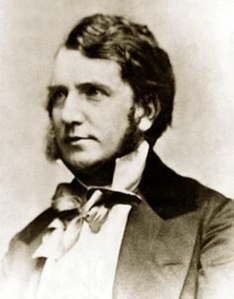
Samuel Lover, Irish songwriter, composer, novelist, and a painter of portraits, chiefly miniatures, is born at 60 Grafton Street in Dublin on February 24, 1797. He is also known as “Ben Trovato” (“well invented”) and is the grandfather of Victor Herbert. He is noted as saying, “When once the itch of literature comes over a man, nothing can cure it but the scratching of a pen.”

Lover goes to school at Samuel Whyte’s at 79 Grafton Street, now home to Bewley’s café. By 1830 he is secretary of the Royal Hibernian Academy and lives at 9 D’Olier Street. In 1835 he moves to London and begins composing music for a series of comic stage works. To some of them, like the operetta Il Paddy Whack in Italia (1841), he contributes both words and music, for others he merely contributes a few songs.

Lover produces a number of Irish songs, of which several – including The Angel’s Whisper, Molly Bawn, and The Four-leaved Shamrock – attain great popularity. He also writes novels, of which Rory O’Moore and Handy Andy are the best known, and short Irish sketches which, with his songs, he combines into a popular entertainment called Irish Nights or Irish Evenings. With the latter, he tours North America between 1846 and 1848. He joins with Charles Dickens in founding Bentley’s Magazine.

Lover’s grandson is composer Victor Herbert whose mother is Lover’s daughter Fanny. Herbert is best remembered for his many successful musicals and operettas that premier on Broadway. As a small child he lives with the Lovers in a musical environment following the divorce of his mother.

Samuel Lover dies on July 6, 1868, in Saint Helier on the island of Jersey. A memorial in St. Patrick’s Cathedral, Dublin summarises his achievements:

“Poet, painter, novelist and composer, who, in the exercise of a genius as distinguished in its versatility as in its power, by his pen and pencil illustrated so happily the characteristics of the peasantry of his country that his name will ever be honourably identified with Ireland.”


Leave a comment

Birth of Sculptor Jerome Connor

jerome-connor

Jerome Connor, recognized world-class Irish sculptor, is born on February 23, 1874, in Coumduff, Annascaul, County Kerry.

In 1888, Connor emigrates to Holyoke, Massachusetts. His father is a stonemason, which leads to Connor’s jobs in New York as a sign painter, stonecutter, bronze founder and machinist. Inspired by his father’s work and his own experience, he would steal his father’s chisels as a child and carve figures into rocks.

It is believed Connor possibly assisted in the manufacture of bronzes such as the Civil War monument in Town Green in South Hadley, Massachusetts erected in 1896 and The Court of Neptune Fountain at the Library of Congress in Washington, D.C., completed in 1898.

Connor joins the Roycroft arts community in 1899 where he assists with blacksmithing and later starts creating terracotta busts and reliefs. Eventually he is recognized as Roycroft’s sculptor-in-residence.

After four years at Roycroft, Connor then works with Gustav Stickley and becomes well known as a sculptor being commissioned to create civic commissions in bronze for placement in Washington, D.C., Syracuse, East Aurora, New York, San Francisco, and in his native Ireland. In 1910, he establishes his own studio in Washington, D.C. From 1902 until his death, he produces scores of designs ranging from small portrait heads to relief panels to large civic commissions realized in bronze.

Connor is a self-taught artist who is highly regarded in the United States where most of his public works can be seen. He appears to be heavily influenced by the work of Irish American sculptor Augustus Saint-Gaudens. He uses the human figure to give expression to emotions, values and ideals. Many of the commissions he receives are for civic memorials and secular figures which he casts in bronze, a pronounced departure from the Irish tradition of stone carved, church sponsored works.

Connor’s best-known work is Nuns of the Battlefield located at the intersection of Rhode Island Avenue NW, M Street and Connecticut Avenue NW in Washington, D.C. It serves as a tribute to the over six hundred nuns who nursed soldiers of both armies during the American Civil War and is one of two monuments in the District that represent women’s roles in the Civil War. The sculpture is authorized by the United States Congress on March 29, 1918, with the agreement that the government will not fund it. The Ancient Order of Hibernians raises $50,000 for the project and Connor is selected since he focuses on Irish Catholic themes, being one himself. Connor, however, ends up suing the Order for nonpayment.

Connor works in the United States until 1925 at which time he moves to Dublin and opens his own studio but suffers from lack of financial support and patrons. In 1926 he is contacted by Roycroft and asked to design and cast a statue of Elbert Hubbard who, with his wife Alice, had died in the sinking of the RMS Lusitania. It is unveiled in 1930 and today stands on the lawn of East Aurora’s Middle School across the street from the Roycroft Chapel building.

While working on the Hubbard statue, Connor receives a commission to create a memorial for all the RMS Lusitania victims. It is to be erected in Cobh, County Cork where many of the victims are buried. The project is initiated by the New York Memorial Committee, headed by William Henry Vanderbilt whose father, Alfred Gwynne Vanderbilt, perished on the RMS Lusitania. He dies before the memorial is completed and based on Connor’s design its installation falls to another Irish artist.

Jerome Connor dies on August 21, 1943, of heart failure and reputably in poverty. There is a now a “Jerome Connor Place” in Dublin and around the corner there is a plaque in his honour on Infirmary Road, overlooking Dublin’s Phoenix Park, his favourite place.


Leave a comment

Lord Randolph Churchill’s Speech at Ulster Hall

Generated by IIPImage

Conservative Party politician Lord Randolph Churchill, father of Winston Churchill, gives what many consider one of the single most destructive speeches in Irish history, inciting militant loyalists at Ulster Hall in Belfast on February 22, 1886.

The Conservative Party in Ulster launches an anti-Home Rule campaign in February 1886. It joins with the Orange Order to organise a huge political rally which is addressed by Lord Churchill.

Protestants in Ulster are very concerned about the prospect of Irish Home Rule. They fear that an Irish parliament will put rural agricultural interests before the needs of the industrial North-East. They believe a Dublin parliament will introduce tariffs which will damage industries in the north. They also fear that they will be discriminated against because of their religion, outnumbered in a Dublin parliament by Catholic representatives.

Churchill has shown disdain for Ulster Unionists up until this time, in private at least, telling Lord Salisbury, “these foul Ulster Tories have always ruined our party,” but as 1886 begins he sees an opportunity to exploit their fears for political gain. He decides that should Prime Minister William Gladstone “went for Home Rule (for Ireland), the Orange Card would be the one to play. Please God may it turn out the ace of trumps and not the two.” This quote leads one to believe he has few real convictions regarding the issue.

“Ulster will fight, and Ulster will be right,” Lord Churchill proclaims to a crowd before he even arrives at Ulster Hall.

Lord Churchill gives a rousing speech at the rally. During his speech, he plays on Protestant fears of Dublin “Catholic” rule and encourages Ulster Protestants to organize against Home Rule, so it does not come upon them “as a thief in the night.” As a result, the Ulster Protestants begin to form paramilitary drilling units.

Churchill achieves a short-term political gain by his playing of the Orange Card, but his most lasting legacy is the unfounded fear of Irish Catholics that he helps to implant in the minds of Ulster Protestants, a tragedy for both traditions on the island. Those fears remain evident over a century later.


Leave a comment

Death of Paul Funge, Painter & Arts Enthusiast

paul-funge

Paul Funge, internationally respected painter and arts enthusiast, dies at Loughlinstown Hospital in the south Dublin suburb of Loughlinstown on February 21, 2011, after a short illness.

A native of Gorey, County Wexford, Funge is a founder of the Project Arts Centre in Dublin and the founder of Gorey Arts Centre in 1970. He is also a founder of the Belltable Arts Centre in Limerick while the regional arts officer for the midwest. In addition, he establishes the Gorey Arts Festival, a three-week summer arts festival, and runs it for more than fifteen years. He is remembered as the man who brought U2 to play at the Gorey Arts Festival in the days before they became an international success.

A painter of portraits and landscapes, Funge teaches art in many schools including Clongowes Wood College and Newbridge College. He also lectures at the National College of Art and Design (NCAD), the University of California, and Kunsthistorisch Instituut in Amsterdam. He is also an inspector for art in the Department of Education for a number of years.

As a portrait artist Funge’s sitters included U2’s Adam Clayton, Frank McGuinness and Colm Tóibín as well as many ministers and academics.

Funge suffers a fall before Christmas 2010, badly fracturing his leg and he is admitted to St. Vincent’s Hospital. On January 6, he transfers from Vincent’s to recuperate at a nursing home in Bray. In early February he takes a turn and develops chest problems. His condition deteriorates and he is admitted to the ICU in Loughlinstown Hospital. Initially he appears to be making a reasonable recovery, but his condition deteriorates again in the days prior to his death.

Following Funge’s death, Eamon Carter, director of Gorey School of Art, pays tribute to him as a visionary who felt passionate about decentralising the arts to areas outside of Dublin.

Carter adds that it had just been announced that the Gorey School of Art is linking up with NCAD to provide a masters in fine arts and it is sad that in the week it receives such good news it also receives the sad news of Funge’s death. “I’m saddened that he wasn’t here to see that because he would have been chuffed obviously,” he said.


Leave a comment

Birth of Seán Mac Stíofáin, Irish Republican Army Commander

sean-mac-stiofain

Seán Mac Stíofáin, Irish Republican Army (IRA) commander and a founding member of the Provisional IRA and its first chief of staff, is born in Leytonstone, London on February 17, 1928.

Mac Stíofáin is born John Stephenson, the son of Protestant parents. He claims Irish ancestry on his mother’s side although the validity of this is uncertain. He leaves school at sixteen, working as a labourer and converting to Catholicism. He also serves in the Royal Air Force during World War II, working as a storeman. After the war, he becomes involved and obsessed with Irish republicanism. He joins the Irish Republican Army in 1949 and helps organise an IRA unit in London.

In 1953, Stephenson leads a raid that steals rifles and mortars from a cadet school armoury in Essex. He is stopped randomly by police, arrested and sentenced to eight years in prison. He serves more than three years behind bars, using this time to learn Irish Gaelic. Released in 1956, he marries an Irish woman, moves to Dublin and changes his name to Seán Mac Stíofáin, the Gaelic form of his birth name.

Mac Stíofáin gradually ascends through the ranks of the IRA, becoming its director of intelligence. The outbreak of the Troubles in 1969 opens up divisions in the IRA over strategy and tactics. While Cathal Goulding and other leaders want to use violence carefully, Mac Stíofáin and his supporters urge open warfare with the Royal Ulster Constabulary (RUC).

In August 1969, Mac Stíofáin leads a raid on the RUC station at Crossmaglen, in defiance of IRA orders. In December, he and four others form a Provisional Army Council. This splinter group becomes the nucleus of the Provisional IRA.

Mac Stíofáin becomes the Provisional IRA’s first chief of staff. He also oversees its rearming and the escalation of its military campaign in Northern Ireland. In July 1972, he represents the Provisional IRA in secret talks with the British government in London. When these talks collapse, he orders an increase in Provisional IRA operations, beginning with the mass bombing of Belfast on July 21, 1972.

Mac Stíofáin remains in charge until November 1972, when a controversial television interview leads to his arrest, imprisonment and removal from the Provisional IRA leadership. He is released the following year but is no longer prominent in the Provisional IRA. He spends the rest of the 1970s working for a Sinn Féin newspaper.

Mac Stíofáin died on May 18, 2001, in Our Lady’s Hospital in Navan, County Meath, after a long illness. He is buried in St. Mary’s Cemetery, Navan. His funeral is attended by Gerry Adams and Martin McGuinness.


Leave a comment

Birth of Sophie Bryant, Mathematician, Educator & Feminist

sophie-bryant

Sophie Willock Bryant, Anglo-Irish mathematician, educator, feminist and activist, is born Sophie Willock in Dublin on February 15, 1850.

Bryant’s father is Rev. Dr. William Willock DD, Fellow and Tutor of Trinity College, Dublin. She is educated at home, largely by her father. As a teenager she moves to London when her father is appointed Professor of Geometry at the University of London in 1863, and she attends Bedford College. At the age of nineteen she marries Dr. William Hicks Bryant, a surgeon ten years her senior, who dies of cirrhosis within a year.

In 1875 Bryant becomes a teacher and is invited by Frances Mary Buss to join the staff of North London Collegiate School. In 1895 she succeeds Buss as headmistress of North London Collegiate, serving until 1918.

When the University of London opens its degree courses to women in 1878, Bryant becomes one of the first women to obtain First Class Honours, in Mental and Moral Sciences, together with a degree in mathematics in 1881, and three years later is awarded the degree of Doctor of Science. In 1882 she is the third woman to be elected to the London Mathematical Society and is the first active female member, publishing her first paper with the Society in 1884. Together with Charles Smith, Bryant edits three volumes of Euclid‘s Elements, for the use of schools (Euclid’s Elements of Geometry, books I and II (1897); Euclid’s Elements of Geometry, books III and IV (1899); Euclid’s Elements of Geometry, books VI and IX (1901)).

Bryant is a pioneer in education for women. She is the first woman to receive a Doctor of Science in England, one of the first three women to be appointed to a Royal Commission, the Bryce commission on Secondary Education in 1894–1895, and one of the first three women to be appointed to the Senate of the University of London. When Trinity College Dublin opens its degrees to women, she is one of the first to be awarded an honorary doctorate. She is also instrumental in setting up the Cambridge Training College for Women, now Hughes Hall, Cambridge. She is also said to be one of the first women to own a bicycle.

Bryant is interested in Irish politics, writes books on Irish history and ancient Irish law (Celtic Ireland (1889), The Genius of the Gael (1913)), and is an ardent Protestant Irish nationalist. She is president of the Irish National Literary Society in 1914. She supports women’s suffrage but advocates postponement until women were better educated.

Bryant loves physical activity and the outdoors. She rows, cycles, swims, and twice climbs the Matterhorn. She dies at the age of 72 in a hiking accident in the Alps near Chamonix, France on August 14, 1922.


Leave a comment

Death of Actor T. P. McKenna

thomas-patrick-mckenna

Character actor Thomas Patrick McKenna, known professionally as T. P. McKenna and for his stage, film, and television work, dies at Royal Free Hospital, Hampstead, London on February 13, 2011, following a long illness.

McKenna is born in Mullagh, County Cavan on September 7, 1929. A prolific theater actor throughout his career, he makes his stage debut in Summer and Smoke by Tennessee Williams at the Pike Theatre in Dublin in 1954.

McKenna makes his film debut in the IRANazi drama The Night Fighters (1960) and from this uncredited beginning he moves up to tenth billing in The Siege of Sidney Street (1960). His next major movie is Girl with Green Eyes (1964), by which time he has also started a successful television career, making his TV debut in Espionage (1963) and over the next few years appears in several more TV shows. His versatility enables him to play three characters in The Avengers (1961). He is also featured in such well-regarded shows as Adam Adamant Lives! (1966), Dixon of Dock Green (1955) and The Saint (1962).

Meanwhile, McKenna’s film career develops along literary lines, and he is featured in Brendan Behan‘s The Quare Fellow (1962), the Sean O’Casey biopic Young Cassidy (1965) and James Joyce‘s Ulysses (1967). He takes smaller parts in such epics as The Charge of the Light Brigade (1968) and Anne of the Thousand Days (1969).

British films such as Perfect Friday (1970) and Villain (1971) allowed McKenna to showcase his suave, urbane persona before trying something different in the controversial Straw Dogs (1971). He appears alongside a young Anthony Hopkins in All Creatures Great and Small (1975) before starring with John Gielgud for the second time, this time in A Portrait of the Artist as a Young Man (1977). Over the next few years his co-stars are as diverse as Leonard Rossiter (Britannia Hospital (1982)), Timothy Dalton (The Doctor and the Devils (1985)), Ben Kingsley (Pascali’s Island (1988)) and Dolph Lundgren (Red Scorpion (1988)). Not all of these films are successes, but he always gives good value for the money and develops themes of his, such as an interest in Irish issues, in The Outsider (1980). His last released film is Valmont (1989), which is unfortunately completely overshadowed by Dangerous Liaisons (1988), which is based on the same novel.

Over the years McKenna makes numerous guest appearances in TV series such as Minder (1979), Casualty (1986), Lovejoy (1986), Inspector Morse (1987), Heartbeat (1992) and Ballykissangel (1996). He is also prominent in TV movies and series, featuring in Charles DickensMasterpiece Theatre: Bleak House (1985), Stendhal‘s Scarlet and Black (1993) and an adaptation of Henry JamesThe American (1998).

McKenna dies on February 13, 2011, at the Royal Free Hospital in Hampstead, London, at the age of 81 following a long period of illness. He is buried alongside his wife at Teampall Cheallaigh Cemetery in his native County Cavan.

Following his death, tributes are paid by President of Ireland Mary McAleese, Prince Charles, and Ireland’s Minister for Tourism, Culture and Sport Mary Hanafin, who says that McKenna was “one of a great generation whose talents on the screen and stage both at home and abroad gave us all great pride in his accomplishments.” In County Cavan, he is commemorated by the T. P. McKenna Drama Scholarships (VEC) and the T. P. McKenna Perpetual Trophy presented as part of the Millrace Annual Drama Festival.


Leave a comment

Publication of the First Issue of “The United Irishman”

john-mitchel

John Mitchel, Irish nationalist activist, author, and political journalist, publishes the first issue of The United Irishman on February 12, 1848.

Mitchel is one of the great propagandists of his day, although the causes he espouses often place him on the wrong side, he is loved and loathed in equal measure. He is one of the few Irishmen to have incurred the wrath of the British government and of the Federal administration of the United States.

Mitchel is born near Dungiven, County Derry in what is now Northern Ireland on November 3, 1815. The son of a Presbyterian clergyman, he creates his own pulpit in a series of journalistic enterprises in Dublin, Tennessee, Virginia and New York.

Mostly raised in Newry, County Down, Mitchel’s first political association is with the Young Ireland movement of the 1840s and the famous The Nation newspaper, founded by Charles Gavan Duffy, Thomas Davis and John Blake Dillon in 1842. But long before the abortive Young Ireland Rebellion of 1848 he has moved on, finding the editorial policies of The Nation rather too bland for his tastes.

Inflamed by the suffering he witnesses on a trip to Galway, it is Mitchel, more than any other writer or politician, who shapes the nationalist perception of an Gorta Mór (Great Famine):

“I could see, in front of the cottages, little children leaning against a fence when the sun shone out for they could not stand, their limbs fleshless, their bodies half-naked, their faces bloated yet wrinkled, and of a pale, greenish hue… I saw Trevelyan’s claw in the vitals of those children: his red tape would draw them to death: in his government laboratory he had prepared for them the typhus poison.”

Responding to such writing, Ireland simmers, angry and ready for rebellion. Fearful of Mitchel’s power, London’s Punch magazine emphasises his international standing by portraying him as an Irish monkey challenging the Great British Lion. The Times thunders against him. When Mitchel produces his own republican newspaper, The United Irishman, which, in its inaugural edition, claims that “the world was weary of Old Ireland and also of Young Ireland” thus attacking both Daniel O’Connell and his younger antagonists with the same broadsword. He aims to be an equal opportunities offender and succeeds admirably.

The United Irishman sells out and is shut down by the British authorities after a mere sixteen issues. In order to silence Mitchel, to rob him of his heroic status and his possible martyrdom, the British government passes the Treason Felony Act 1848, which seeks to treat treason as a common crime. He is later tried before an elegantly and efficiently packed jury, found guilty of treason-felony, and deported to Van Diemen’s Land (Tasmania). The result is one of the greatest works of Irish political history, The Jail Journal, in which Mitchel writes about his own experience of deportation and advocates a far more militaristic approach to Ireland’s “English problem” than would have been popular heretofore.

Mitchel is acclaimed by Patrick Pearse, who declares The Jail Journal to be “the last of the four gospels of the New Testament of Irish nationality, the last and the fieriest and the most sublime.” Éamon de Valera reveres Mitchel, and when in 1943 he imagines Ireland as “the home of a people who valued material wealth only as a basis for right living, of a people who, satisfied with frugal comfort, devoted their leisure to the things of the spirit,” he too is delving into The Jail Journal for his inspiration.

(From: #OTD in 1848 – John Mitchel Publishes First United Irishman, Stair na hÉireann | History of Ireland)


2 Comments

Death of Republican Activist James Murphy

black-and-tans-and-auxies-dublin-ireland-1921

Republican activist James Murphy dies in Mater Hospital, Dublin on February 11, 1921. Before he dies, he declares that he and Patrick Kennedy had been shot by their Auxiliary captors. A court of inquiry is held, and Captain W. L. King, commanding officer of F Company Auxiliary Division of the Royal Irish Constabulary (ADRIC), is arrested for the killings.

James Murphy and Patrick Kennedy are arrested by Auxiliaries in Dublin on February 9 and are taken into the custody of ‘F’ company. Two hours later, constables of the Dublin Metropolitan Police find the two men lying shot, with pails on their heads, in Clonturk Park, Drumcondra. Kennedy is dead and Murphy is fatally wounded. He dies in Mater Hospital, Dublin two days later.

Just before dying Murphy testifies that King had taken them and stated that they were “just going for a drive.” King is arrested for the killings. King and two of his men, Hinchcliffe and Welsh, are court-martialed on February 13-15, but are acquitted after Murphy’s dying declaration is ruled inadmissible and two officers from ‘F’ Company provide perjured alibis for King at the time of the shootings.

King is implicated and court-martialed for the deaths of Conor Clune, Peadar Clancy, and Dick McKee, the latter two leading lights in the Dublin Irish Republican Army, the former a luckless Gaelic League member, who are all captured in Dublin on November 20, 1920, the day before Bloody Sunday. Clune is caught at Vaughn’s Hotel in Parnell Square, Dublin and the two IRA leaders at Lower Gloucester Street, complete with British Army officer uniforms and detonators.

Sometime between then and the next day, in the Dublin Castle guardroom, as news filters in of the deaths of several British intelligence officers, the prisoners are killed in questionable circumstances. According to an official report from Dublin Castle, they attempted to grab rifles and hurl unfused grenades and are killed in that action. The guards of ‘F’ Company in the room at the time are cleared of wrongdoing by a court inquiry. A Major Reynolds of ‘F’ Company is said to have passed details of the killers to Michael Collins. The Times notes that it seems as if the prisoners had been lined up and shot. In a later novel, a Captain Hardy more or less confesses to the killing of one of the prisoners.

Ironically, Captain King is on Michael Collins’s list of British Intelligence officers to be executed on the morning of November 20, 1920, he is not in his room when the assassins arrive but rather, he is interrogating the prisoners in Dublin Castle.

(Pictured: Mixed gunmen of the Royal Irish Constabulary’s Auxiliary Division and Black and Tans contingents, Stair na hÉireann | History of Ireland)


2 Comments

Imprisonment of Fenian Charles Kickham

charles-kickham

Sentenced to fourteen years hard labour for treason, Irish nationalist and Fenian Charles Kickham is incarcerated in Pentonville Prison on February 10, 1865. He is released in 1869, partly due to ill health. He is a contributor to The Irish People and the organiser of the Fenian movement and the Irish Republican Brotherhood (IRB), which the English authorities deem seditious. He also authors a number of novels including the critically acclaimed Knocknagow (1873).

The revolutionary movement which comes to be known as Fenianism is unlike that of 1848 in the character of its leaders. The older political agitation is associated with a brilliant outburst of intellectual effort. The majority of the leaders have left behind high intellectual heritage, or asserted under other skies, and in more favourable circumstances, their possession of great intellectual powers. The Fenian movement, on the other hand, is poor in its literary products. Few of its leading spirits reach to any lofty position since its collapse. The best part of Fenian literature is found in The Irish People, the journalistic organ of the association. Along with Kickham, the chief contributors to the journal are Thomas Clarke Luby and John O’Leary.

Kickham is born at Mullenahone, County Tipperary on May 9, 1828. At the age of thirteen he meets with an accident that deprives him of his hearing. He probably owes the many fine productions of his pen to this accident. At around 18 years of age, he begins to contribute poems and tales to Irish journals and magazines and when The Irish People is started, he becomes one of its chief lead writers. As a result of his involvement in the Fenian movement, he draws the attention of the government and is tried, convicted and sentenced to fourteen years of penal servitude. His comment at the conclusion of the trial is terse: “I have endeavoured to serve Ireland, and now I am prepared to suffer for Ireland.” Four years after his conviction he is released.

Kickham publishes two complete stories, Sally Cavanagh, or The Untenanted Graves, and Knocknagow, or The Homes of Tipperary. These stories have been read wherever there is an Irish home and have made sad or joyous thousands of Irish hearts. They have also found approval in the columns of English and not friendly journals, which have found themselves able to meet him in friendliness on the impartial ground of literature. His books deserve their popularity with the peasant and the approval of the critic. His pictures of life, especially of peasant life, are wonderfully true to nature, full of keen observation, humour, and fidelity. In his attention to minute details and homely incident he resembles in a great degree the style of Erckmann-Chatrian.

Kickham’s ballads are equally popular and are just what ballads for the people should be – simple in language, direct in purpose, and in an easy and common measure. A collected edition of his works is published by Duffy & Son of Dublin.

Charles Kickham dies at the age of 54 on August 22, 1882, at the house of James O’Connor, a former member of the IRB and afterwards MP for Wicklow, 2 Montpelier Place, Blackrock, Dublin, where he had been living for many years and had been cared for by the poet Rose Kavanagh. He is buried in Mullinahone, County Tipperary.

(From: The Cabinet of Irish Literature, Volume 4, edited by T. P. O’Connor)