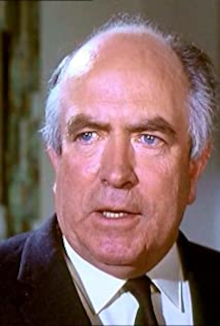
Liam Redmond, Irish character actor known for his stage, film and television roles, dies in Dublin on October 28, 1989, following a lengthy illness.
Redmond is born in Limerick, County Limerick, on July 27, 1913, one of four children born to cabinet-maker Thomas and Eileen Redmond. Educated at the Christian Brothers schools in Dublin, he later attends University College Dublin (UCD) and initially reads medicine before moving into drama.
While Director of the Dramatic Society, Redmond meets and marries the society’s secretary, Barbara MacDonagh, sister of Donagh MacDonagh and daughter of 1916 Easter Rising leader Thomas MacDonagh and Muriel Gifford. They have four children.
Redmond is invited to join the Abbey Theatre in 1935 as a producer by William Butler Yeats, the Irish poet. Yeats writes his play Death of Cú Chulainn for Redmond to star as Cú Chulainn, hero of one of Ireland’s foundational myths.
Redmond makes his acting debut at the Abbey Theatre in 1935 in Seán O’Casey‘s The Silver Tassie. His first stage appearance is in 1939 in New York City in The White Steed. After returning to Britain at the outbreak of World War II he is a regular on the London stage. He is one of the founders of the Writers’, Artists’, Actors’ and Musicians’ Association (WAAMA), a precursor of the Irish Actors’ Equity Association. His insistence that “part-time professionals” – usually civil servants who act on the side – should be paid a higher rate than professional actors for both rehearsal time and performance, effectively wiping out this class, raising the wages and fees of working actors.
Hogan is one of four sons and three daughters of Patrick Hogan, farmer, and Margaret Hogan (née Galvin). His family are staunch nationalists who have been heavily involved in the land struggle. He is the brother of Major General Daniel (Dan) Hogan, who is Chief of Staff of the Defence Forces in the 1920s. On November 19, 1920, Hogan is elected company commander of the Irish Republican Army (IRA) in the Grangemockler area, where he is working on the family farm.
A dedicated footballer, Hogan is the established full back on the Tipperary county football team. During the Irish War of Independence very few championships are completed, and challenge matches are the chief attraction. Following the success of a Kildare–Dublin challenge match, a challenge is organised between Tipperary and Dublin at Croke Park, Dublin, on November 21, 1920.
The day before the match, Hogan travels on the train with the other members of the team. A number of the players, including Hogan, become involved in a fight with soldiers from the Royal Lincolnshire Regiment before throwing them from the train. On arrival at (Kingsbridge) Heuston Station, they quickly go their separate ways anticipating arrest. Michael and Thomas “Tommy” Ryan, the two IRA members on the team, decide to stay at Philip Shanahan‘s pub in Monto that night, rather than Barry’s Hotel as planned. There they learn that “there is a ‘big job coming off” the following day but are unaware of the details.
On the morning of the match, fourteen members of the British intelligence service are assassinated by the IRA. This leads to concerns about the match and the safety of spectators, and the Dublin brigade of the IRA urges that the game be cancelled. Shanahan informs the team of the shooting of the British agents. Ryan claims that Dan Breen advised them it would be better not to attend the match, but instead to return to Tipperary. Leading Gaelic Athletic Association (GAA) officials Jim Nowlan, Dan MacCarthy and Luke O’Toole decide the match should proceed, arguing that a postponement would associate the IRA’s activities with the GAA.
Dublin and Tipperary are two of the best teams in the country at the time (and later contest the 1920 All-Ireland Senior Football Championship final when it is eventually played in 1922), so despite the events of the morning, a large crowd of some 10,000 people are in attendance.
At 3:00 p.m., not long after the match has started, a British military plane flies over and drops a flare, signaling British forces to converge on the ground. Black and Tans enter Croke Park and open fire on the crowd.
Hogan drops to the ground and is crawling to safety when a bullet hits him in the mouth. Tom Ryan, a young spectator from Wexford, enters the pitch to pray beside the dying Hogan and is also fatally shot. Another player, Jim Egan, is wounded, but survives. In all, fourteen people are killed and dozens are wounded and injured. The events of that day come to be known as “Bloody Sunday.”
Hogan’s body is returned to Grangemockler for burial on November 24, 1920. A huge crowd attends the funeral. He is buried in his football colours in a coffin draped with the tricolour. The GAA commemorates him by naming the main stand at Croke Park after him and erecting a monument to his memory at Grangemockler. His football jersey is in the South Tipperary County Museum in Clonmel.
Plunkett’s only grown sibling, a younger brother, from whom he is estranged from about 1916, for reasons not fully clear but connected to his mother’s will, is the noted British naval officer Sir Reginald Drax. Another younger brother dies in infancy.
The title passes to Plunkett at his father’s death in 1899 at a fairly young age. The young Lord Dunsany returns to Dunsany Castle in 1901 after war duty. In that year he is also confirmed as an elector for the Representative Peers for Ireland in the House of Lords.
In 1903, Plunkett meets Lady Beatrice Child Villiers (1880–1970), youngest daughter of Victor Child Villiers, 7th Earl of Jersey, who is then living at Osterley Park. They marry in 1904. Their one child, Randal, is born in 1906. Lady Beatrice is supportive of her husband’s interests and helps him by typing his manuscripts, selecting work for his collections, including the 1954 retrospective short story collection, and overseeing his literary heritage after his death.
The Plunketts are socially active in Dublin and London and travel between homes in Meath, London and Kent, other than during the First and Second World Wars and the Irish War of Independence. He circulates with many literary figures of the time. To many of these in Ireland he is first introduced by his uncle, the co-operative pioneer Sir Horace Plunkett, who also helps to manage his estate and investments for a time. He is friendly, for example, with George William Russell, Oliver St. John Gogarty, and for a time, W. B. Yeats. He also socialises at times with George Bernard Shaw and H. G. Wells and is a friend of Rudyard Kipling.
In 1910 Plunkett commissions a two-story extension to Dunsany Castle, with a billiard room, bedrooms and other facilities. The billiard room includes the crests of all the Lords Dunsany up to the 18th.
Plunkett serves as a second lieutenant in the Coldstream Guards in the Second Boer War. Volunteering in World War I and appointed Captain in the Royal Inniskilling Fusiliers, he is stationed for a time at Ebrington Barracks in Derry, Northern Ireland. Hearing while on leave of disturbances in Dublin during the Easter Rising of 1916, he drives in to offer help and is wounded by a bullet lodged in his skull. After recovery at Jervis Street Hospital and what is then the King George V Hospital (now St. Bricin’s Military Hospital), he returns to duty. His military belt is lost in the episode and later used at the burial of Michael Collins. Having been refused forward positioning in 1916 and listed as valuable as a trainer, he serves in the later war stages in the trenches and in the final period writing propaganda material for the War Office with MI7b. There is a book at Dunsany Castle with wartime photographs, on which lost members of his command are marked.
During the Irish War of Independence, Plunkett is charged with violating the Restoration of Order in Ireland Act 1920, tried by court-martial on February 4, 1921, convicted, and sentenced to pay a fine of 25 pounds or serve three months in prison without labour. The Crown Forces had searched Dunsany Castle and had found two double-barreled shotguns, two rook rifles, four Very pistols, an automatic pistol and a large quantity of pistol ammunition, along with shotgun and rifle ammunition.
During World War II, Plunkett signs up for the Irish Army Reserve and the British Home Guard, the two countries’ local defence forces, and is especially active in Shoreham, Kent, the English village bombed most during the Battle of Britain.
Plunkett’s fame arises chiefly from his prolific writings. He is involved in the Irish Literary Revival. Supporting the Revival, he is a major donor to the Abbey Theatre, and he moves in Irish literary circles. He is well acquainted with W. B. Yeats, Lady Gregory, Percy French, George “AE” Russell, Oliver St. John Gogarty, Padraic Colum and others. He befriends and supports Francis Ledwidge, to whom he gives the use of his library, and Mary Lavin.
Plunkett makes his first literary tour to the United States in 1919 and further such visits up to the 1950s, in the early years mostly to the eastern seaboard and later, notably, to California. His own work and contribution to the Irish literary heritage are recognised with an honorary degree from Trinity College Dublin.
In 1940, Plunkett is appointed Byron Professor of English in the University of Athens in Greece. Having reached Athens by a circuitous route, he is so successful that he is offered a post as Professor of English in Istanbul. However, he has to be evacuated due to the German invasion of Greece in April 1941, returning home by an even more complex route, his travels forming a basis for a long poem published in book form (A Journey, in 5 cantos: The Battle of Britain, The Battle of Greece, The Battle of the Mediterranean, Battles Long Ago, The Battle of the Atlantic, special edition January 1944). Olivia Manning‘s character Lord Pinkrose in her novel sequence the Fortunes of War is a mocking portrait of Dunsany in that period.
In 1947, Plunkett transfers his Meath estate in trust to his son and heir and settles in Kent at his Shoreham house, Dunstall Priory, not far from the home of Rudyard Kipling. He visits Ireland only occasionally thereafter and engages actively in life in Shoreham and London. He also begins a new series of visits to the United States, notably California, as recounted in Hazel Littlefield-Smith’s biographical Dunsany, King of Dreams.
In 1957, Plunkett becomes ill while dining with the Earl and Countess of Fingall at Dunsany, in what proves to be an attack of appendicitis. He dies in hospital in Dublin, at the age of 79, on October 25, 1957. He is buried in the churchyard of the ancient church of St. Peter and St. Paul, Shoreham, Kent. His funeral is attended by many family members, representatives of his old regiment and various bodies in which he had taken an interest, and figures from Shoreham. A memorial service is held at Kilmessan in County Meath, with a reading of “Crossing the Bar,” which coincides with the passing of a flock of geese.
Beatrice survives Plunkett, living mainly at Shoreham and overseeing his literary legacy until her death in 1970. Their son Randal succeeds to the barony and is in turn succeeded by his grandson, the artist Edward Plunkett. Plunkett’s literary rights pass from Beatrice to Edward.
Brady is born in 1527, but his parentage is uncertain, as are most of the details of his early life. He is said to be a graduate of the University of Oxford and later a professor of divinity there, but there is no evidence of this in the college registers.
Brady’s first patron is Edmund Grindal, Bishop of London, under whose auspices he secures a prestigious appointment to the rectorship of St. Mary Aldermary, London, in early 1561. Over the next two years he becomes acquainted with a relative and chief advisor of Queen Elizabeth I, William Cecil. He is eager to return to Ireland and is appointed Bishop of Meath on October 21, 1563, while still in England. He is ideally qualified for this role, being a native of the diocese and a skilled preacher fluent in English and Irish. Arriving in Dublin on December 3, 1563, he is consecrated on December 19, being made a member of the Privy Council of Ireland soon thereafter.
On reaching his diocese, Brady is dismayed at its dilapidated state. His diocesan income scarcely exceeds £60 a year, many of the churches are in ruins, his clergy are uneducated and largely pro-Catholic, and the right to appoint clergy to many parish churches is in the hands of Catholic landowners. Further, the rival Catholic Bishop of Meath, William Walsh, is dedicated, capable, and popular. Although Walsh is belatedly arrested in 1565, his willingness to lead by example and suffer persecution for his beliefs stiffens Catholic resistance in Meath.
Brady is always diligent in attendance at Council meetings. He is vigorous in beating off raids on his diocese by Shane O’Neill, the effective ruler of Ulster. He enjoys the friendship of Sir Henry Sidney, the Lord Deputy of Ireland, who praises his sound judgment, hospitality and blameless private life. His good qualities lead Sidney and Adam Loftus, Archbishop of Armagh, to propose Brady as Archbishop of Dublin, after they have lobbied successfully for the recall of Archbishop Hugh Curwen. However, soon after, Brady and Loftus quarrel, and Loftus blocks Brady’s nomination in order to obtain the See of Dublin for himself.
Nonetheless, Brady retains Sidney’s confidence and finds a new ally in 1567 when Robert Weston becomes Lord Chancellor of Ireland. Weston sympathises with his educational and evangelical bent while gaining the respect of the querulous Loftus, thereby defusing the animosity between Ireland’s leading Protestant clergy.
In 1569, Brady’s diocese is amalgamated with the diocese of Clonmacnoise. He now heads a sprawling diocese that includes Gaelic areas where the crown has very little authority. In practice, he appears to have largely ignored Clonmacnoise. In Meath, a government inquiry in 1575 shows that he has made little headway in spreading the Protestant faith or in restoring the fabric and finances of the church. He has found clergy for nearly every church in the diocese, but most are of a poor standard. He contributes to the diocese’s worsening finances by alienating church land to family and associates. The free school he establishes is also forced to close due to a lack of suitable premises.
Following Sidney’s dismissal as Lord Deputy of Ireland in 1578, Protestant hard-liners begin to dominate the Irish government, causing Brady to lose influence. He complains in 1581 that his letters to London are being opened and read by his colleagues and sometimes being suppressed. His influence declines in Meath also as discontent with the government increases. In 1577, his men capture a number of friars at Navan but are attacked by locals and forced to free their captives. Thereafter, local officials and landowners routinely defy his authority. His conciliatory policies totally discredited, he stays away from Dublin and resides mainly at his episcopal palace at Ardbraccan.
From 1582 Brady suffers from ill health, forcing him to curtail his preaching. He dies on February 14, 1584, and is buried near the parish church at Dunboyne.
Brady marries twice, but little is known of his first wife. In 1568, following the death of his first wife, he marries Weston’s daughter Alice. They had at least four children, including Luke, their eldest son, and Nicholas, grandfather of his namesake the poet. After Brady’s death, his widow marries Sir Geoffrey Fenton and has further issue, including Catherine, Countess of Cork. The poet Nicholas Brady is the bishop’s great-grandson. Maziere Brady, Lord Chancellor of Ireland, is a nineteenth-century descendant of the bishop.
Colbert is the fourth youngest of thirteen children of Michael Colbert, a farmer, and Honora McDermott. His family moves to the village of Athea when he is three years old. He is educated at the local national school. In 1901, his family is living in the townland of Templeathea West. A younger brother, James, and a cousin, Michael Colbert, later serve as Teachtaí Dála (TDs).
Colbert leaves Athea at the age of 16 and goes to live with his sister Catherine in Ranelagh, County Dublin. He continues his education at a Christian Brothers school in North Richmond Street. He is employed as a clerk in the offices of Kennedy’s Bakery in Dublin. In 1911, he is living with Catherine, two other siblings and two boarders at a house on Clifton Terrace, Rathmines. He is a deeply religious Catholic and refrains from smoking or drinking.
Colbert is sworn into the Irish Republican Brotherhood (IRB) by his cousin Art O’Donnell in Art’s home in 1908. He joins Fianna Éireann at its inaugural meeting in 1909 and rises to Chief Scout. The following year he becomes a drill instructor at St. Enda’s School, founded by Patrick Pearse. In 1912, he becomes head of an IRB circle within the Fianna started by Bulmer Hobson. During 1913 he is one of a number of Fianna who conduct military training at the Forester’s Hall in Rutland Square (now Parnell Square), and in November of that year he joins the Provisional Committee of the newly formed Irish Volunteers.
In the weeks leading up to the Rising, Colbert acts as bodyguard for Thomas Clarke. Before the Rising, because he lives out of the city, he stays with the Cooney family in the city centre. During Easter Week, he fights at Watkin’s Brewery, Jameson’s Distillery and Marrowbone Lane. Thomas MacDonagh surrenders to Brigadier GeneralWilliam Lowe at 3:15 p.m. on Sunday, April 30. MacDonagh then goes around the garrisons under his command to arrange for their surrender.
Colbert surrenders with the Marrowbone Lane Garrison along with the South Dublin Union Garrison, which had been led by Éamonn Ceannt. When the order to surrender is issued, he assumes the command of his unit to save the life of his superior officer, who is a married man.
They are marched to Richmond Barracks, where Colbert is later court-martialed. Transferred to Kilmainham Gaol, he is told on Sunday, May 7, that he is to be shot the following morning. He writes no fewer than ten letters during his time in prison. During this time in detention, he does not allow any visits from his family. Writing to his sister, he says a visit “would grieve us both too much.”
The night before his execution Colbert sends for Mrs. Ó Murchadha, who is also being held prisoner. He tells her he is “proud to die for such a cause. I will be passing away at the dawning of the day.” Holding his Bible, he tells her he is leaving it to his sister. He hands her three buttons from his volunteer uniform, telling her, “They left me nothing else.” He then asks her to say a Hail Mary for the souls of the departed when she hears the volleys of shots in the morning for Éamonn Ceannt, Michael Mallin and himself. The soldier who is guarding the prisoner begins crying according to Mrs. Ó Murchadha, and records him as saying, “If only we could die such deaths.”
The next morning, May 8, 1916, Colbert is shot by firing squad.
Colbert Railway Station in Limerick, Con Colbert Road in Dublin and the Fianna Fáilcumann in the University of Limerick are named in his honor. Colbert Street in his native Athea, County Limerick, is named after him, as is the local community hall. Colbert Avenue and Colbert Park Janesboro, Limerick, are also named after him.
On May 4, 1958, a plaque is erected over a bed in Barringtons Hospital, County Limerick. The plaque has since disappeared.
In May 2016, one hundred years after his execution, a full-scale limestone sculpture of Colbert is unveiled at the gable of his one-time house in Moanleana, County Limerick.
Sullivan, the second of six sons of Daniel Sullivan, house painter, and his wife, Catherine (née Baylor), a teacher, is born on May 15, 1829, in Bantry, County Cork. A popular date for Sullivan’s birth appears in many histories as 1830, but his gravestone reads 1829. He is educated in the local national school. One of his brothers is Timothy Daniel Sullivan, the Lord Mayor of Dublin from 1886 to 1888.
During the Great Famine of 1845 to 1847, Sullivan is employed as a clerk in connection with the relief works started by the government. Deeply influenced by the distress he witnesses, he afterward joins the Confederate Club formed in Bantry in support of the revolutionary movement of the Young Irelanders and is the organiser of the enthusiastic reception given by the town to William Smith O’Brien in July 1848 during the insurgent leader’s tour of the southern counties. Early in 1853, he goes to Dublin to seek employment as an artist. An exhibition of the arts and industries of Ireland is held in Dublin that year, and he is engaged to supply pencil sketches to the Dublin Expositor, a journal issued in connection with the exhibition. Subsequently, he obtains a post as a draughtsman in the Irish valuation office, and afterward as a reporter on the Liverpool Daily Post.
In 1855, Sullivan becomes assistant editor of The Nation, and subsequently editor and proprietor. From 1861 to 1884, in conjunction with his elder brother, T. D. Sullivan, he makes The Nation one of the most potent factors in the Irish Nationalist cause and also issues the Weekly News and Zozimus. Called to the Irish bar in 1876, he is a “special call” of the Inner Temple in 1877 and is made QC in 1881. He mainly practices at the English bar, though he acts in some political cases in Ireland.
As a member of the Dublin Corporation, Sullivan secures a magnificent site for the Grattan Monument, toward which he donates £400, the amount of a subscription by his admirers while he is undergoing imprisonment for a political offence in 1868. The monument is formally unveiled in January 1876. Between 1878 and 1882 he is engaged in many notable trials. His last great case is on November 30, 1883, when he is a colleague of Lord Russell in the defence of Patrick O’Donnell for the murder of James Carey, an informer.
Sullivan suffers another heart attack while on holiday in Bantry in September 1884 and spends his last days with William Martin Murphy at Dartry, County Dublin. Murphy regards him as a father figure, attributing his success to Sullivan’s early advice and journalistic training. Sullivan dies on October 17, 1884, at Dartry Lodge, Rathmines, Dublin. He is buried at Glasnevin Cemetery. With his wife, Frances Genevieve Donovan, whom he marries on April 27, 1861, and who outlives him by nearly forty years, he has a family of three sons and five daughters. His second son and namesake, Alexander Martin Sullivan, is the last to hold the rank of Serjeant-at-law (Ireland).
In addition to his labours, Sullivan is a great temperance reformer. He also writes two notable books, The Story of Ireland and New Ireland and contributes many sketches (including some verse) to Irish Penny Readings (1879–85). Some of his correspondence is located in the Isaac Butt papers in the National Library of Ireland.
Mitchell is the younger son of David William Mitchell, owner of a Dublin ironmongery and furniture business, and Francis Elizabeth Mitchell (née Kirby). His elder brother David becomes president of the Royal College of Physicians of Ireland (RCPI) and his sister Lillias is a noted weaver and teacher. He is educated at The High School, Dublin, and Trinity College Dublin (TCD), where he is a scholar in 1933 and receives a gold medal the following year. In 1934 he is appointed assistant to the professor of geology at TCD, and later is lecturer in geology (1940), reader in Irish archaeology (1959) and professor of Quaternary studies – a personal chair (1965). He is an efficient administrator and serves TCD successively as registrar, senior lecturer, and tutor, and after retirement is briefly a pro-chancellor of the university.
Mitchell’s major research focuses on the evolution of Ireland during the last two million years, particularly during the Quaternary since the retreat of the glacial ice over Ireland, and the effect man has had on this landscape. His interest in Quaternary studies begins in 1934, when he is appointed by the Royal Irish Academy (RIA) as an assistant to the Danish botanist and Quaternary geologistKnud Jessen, who uses the distribution of ancient pollen grains to reconstruct vegetational history. From 1940 he publishes a series of papers on topics such as the distribution of Irish giant deer and reindeer remains in Ireland, lacustrine deposits in County Meath, interglacial deposits in southeast Ireland, the palynology of Irish raised bogs, cave deposits, fossil pingos in County Wexford, bog flows, and the deposits of the older Pleistocene period in Ireland. His major study in this field is the documentation (1965) of the vegetational history of Littleton bog, County Tipperary, which has given its name to the present interglacial – the Littletonian warm stage.
Mitchell does not confine his studies to Ireland but also carries out work in Glasgow, Cornwall, and the Isle of Man. In 1957, he helps organise the British Association for the Advancement of Science meeting in Dublin and is later chairman of the Geological Society of London sub-commission on British and Irish Quaternary stratigraphy, which produces a comprehensive report in 1973. He is a frequent broadcaster on radio and a prolific author of academic papers, and in later life writes several acclaimed books, including The Irish Landscape (1976), which goes through two further editions as Reading the Irish Landscape (1986, 1997), and a volume of semi-autobiography, The Way That I Followed (1990).
In 1940, Mitchell marries Lucy Margaret (‘Pic’) (1911–87), daughter of E. J. Gwynn, provost of TCD. They have two daughters. For many years they live at Townley Hall, near Drogheda, County Louth, which had been TCD’s agricultural facility. A 1985 portrait by David Hone is displayed at Trinity College Dublin.
(From: “Mitchell, George Francis (‘Frank’)” by Patrick N. Wyse Jackson, Dictionary of Irish Biography, http://www.dib.ie, October 2009)
Hone is born in Fitzwilliam Place, Dublin on October 26, 1831. He is the son of Brindley Hone, a merchant and director of the Midland Great Western Railway.
Though a member of a very artistic family, Hone’s initial training is as an engineer at Trinity College Dublin followed by a brief period of work for the Irish Railway before going to Paris in 1853 to study painting. He first studies under Adolphe Yvon, the French military painter, and later Thomas Couture, who is one of the earliest exponents of realism and from whom he learns principles which influence his work throughout his career.
Most of Hone’s later paintings are landscapes, very often enlivened with animals and occasionally with figures. In France he is influenced by the painter Gustav Courbet who is taking a new and quite revolutionary realistic approach. His closest painting tips are, however, from another French impressionist, Jean-Baptiste-Camille Corot. He becomes a close friend of one of Corot’s followers at the Barbizon school of landscape painting. At Barbizon he learns to appreciate colour, texture and tone in the landscape and applies it in strong and confident brushworks to the painting of Irish subjects on his return. In Paris he also works closely with artist Édouard Brandon, also a follower of Corot.
Hone’s paintings which are completed in France have many similarities to those that he completes at his country farm in County Dublin, but the finish is perhaps more polished and professional in the later Irish works.
From 1876, except for four years, Hone exhibits at the Royal Hibernian Academy (RHA). He is elected a full member in 1880 and in 1894 becomes Professor of Painting. His exhibition with John Butler Yeats in 1901 is one of the turning points for the history of Irish art as it is their paintings which convince Sir Hugh Lane that Dublin should have a gallery of modern art.
Nathaniel Hone dies in Dublin on October 14, 1917. After his death his widow bequeaths the contents of his studio to the National Gallery of Ireland. He rarely dates his work, so it is difficult to establish chronology. The similarity of many of his motifs and subjects often make it difficult to tell whether a view is Irish or French. Equally it is difficult to chart his developments on stylistic grounds alone.
(Pictured: Nathaniel Hone, the younger, self-portrait as an old man)
Duffy is born in Nice, France, on July 17, 1884, the daughter of the Irish nationalist Sir Charles Gavan Duffy, one of the founders of The Nation and his third wife, Louise (née Hall) from Cheshire, England. Her mother dies when she is four. She is then raised in Nice by her Australian half-sisters from her father’s second marriage. It is a well-to-do and culturally vibrant home where she is exposed to political figures and ideas.
Duffy’s first visit to Ireland is in 1903, at the age of 18, when her father dies and is buried in Glasnevin Cemetery. This is when she first hears Irish spoken. She finds a grammar book in a bookshop and becomes curious. Her father was not an Irish speaker, though her grandmother in the early 1800s was likely fluent.
Duffy spends the years between 1903 and 1907 between France and England. She takes courses through Cusack’s College in London so that she can matriculate.
Duffy decides to continue her studies in Dublin but cannot afford to move until she receives a small inheritance from her grandmother on the Hall side of the family. Once in Ireland in 1907, at the age of 23, she begins her university studies, taking arts. She lives in the Women’s College, Dominican Convent, as women are not allowed to attend lectures in the Royal University of Ireland. She goes occasionally to the Gaeltacht to learn Irish. Graduating in 1911 with a Bachelor of Arts from University College Dublin (UCD), she is one of the first women to do so.
Given the lack of teachers, even without a full qualification, Duffy then teaches in Patrick Pearse‘s St. Ita’s school for girls in Ranelagh. She studies with the Dominicans again in Eccles Street, gaining a Teaching Diploma from Cambridge University.
A supporter of women’s suffrage, Duffy speaks at a mass meeting in Dublin in 1912 in favour of having the Home Rule bill include a section to grant women the vote. She also joins the Irish republican women’s paramilitary organisation Cumann na mBan, as a founding member in April 1914, serving on the provisional committee with Mary Colum, as a co-secretary.
Duffy is aware that being a suffragist and a nationalist are not necessarily the same thing, realising her involvement in Cumann na mBan is in support of nationalism. When St. Ita’s closes due to funding problems in 1912, she takes the opportunity to complete her qualifications. After receiving her Cambridge teacher’s diploma in 1913, she returns to UCD to study for a Master of Arts degree.
Duffy is in fact working on her master’s thesis during the Easter break in 1916 when the rumour comes to her that the Rising has begun in Dublin city centre. She walks to the Rebel headquarters in the GPO where she tells Pearse, one of the leaders, that she does not agree with the violent uprising.
Duffy spends all of Easter week working in the GPO kitchens with other volunteers like Desmond FitzGerald and a couple of captured British soldiers, ensuring the volunteers are cared for. The women in the GPO are given the opportunity to leave under the protection of the Red Cross on the Thursday as the shelling of the building has caused fires, but almost all of them refuse. In the end, she is among the second group of the people to leave the GPO on the Friday, tunnelling through the walls of the buildings to avoid coming under fire.
Duffy’s group makes it to Jervis Street Hospital where they spend the night. The next day, Saturday, Pearse formally surrenders. She heads for Jacob’s Biscuit Factory, another volunteer position, on the morning after the surrender, to see what is happening. There she finds a holdout of volunteers who are unaware of the surrender or that the fighting is over.
After 1916 Duffy is elected to the Cumann na mBan’s executive and in 1918 is one of the signatories to a petition for self-determination for Ireland which is presented to President Woodrow Wilson by Hanna Sheehy-Skeffington. During her time in the GPO, she had collected names of the volunteers and promised to take messages to their families. This possibly influences her in being involved in the National Aid Association and Volunteers Dependants Fund. In the aftermath of the rebellion there are 64 known dead among the volunteers, while 3,430 men and 79 women are arrested. Families need support. These organisations are able to arrange funding from the United States.
In 1917, Duffy co-founds and runs Scoil Bhríde, as a secondary school for girls in Dublin through the medium of Gaelic. It is still in operation as a primary school. Her co-founder is Annie McHugh, who later marries Ernest Blythe. The end of the Rising leads to the Irish War of Independence (1919-21). During this time, she is mostly focused on the school. However, it is raided by the military and Duffy later admits it is in fact used for rebel meetings and to safeguard documents. In October 1920, the Irish leader Michael Collins meets Archbishop Patrick Clune there in secret. In an effort to support the nationwide boycott of the police, the Royal Irish Constabulary (RIC), in 1920, she has a leaflet sent to all branches of Cumann na mBan which states in part that the RIC are the “eyes and ears of the enemy. Let those eyes and ears know no friendship.”
The war ends with the Anglo-Irish Treaty in 1921. The result is the Irish Civil War which lasts until 1923. Duffy is a supporter of the Treaty, which her brother had signed, and as such she leaves Cumann na mBan and joins Cumann na Saoirse, in which she is instrumental in founding as an Irish republican women’s organisation which supports the Pro-Treaty side.
Once the civil war is over, Duffy leaves the political arena and returns to education. She especially needs to focus on funding in the early years of the school. She works with UCD’s Department of Education from 1926, once Scoil Bhríde is recognised as a teacher training school. She publishes educational documents like School Studies in The Appreciation of Art with Elizabeth Aughney and published by UCD in 1932.
Until her retirement, Duffy also lectures on the teaching of French. She retires as principal in 1944.
Recognising the importance of her first-hand experience and with a good political understanding, Duffy records her memories of the events in which she has taken part. In 1949, she gives an account of her life in relation to nationalist activities to the Bureau of Military History. She is involved in a Radio Éireann broadcast in 1956 about the women in the Rising. In 1962, she takes part in the RTÉ TV program Self Portrait broadcast on March 20, 1962. In March 1966 she gives a lecture in UCD to mark the 50th anniversary of the Rising which is published in The Easter rising, 1916, and University College Dublin (1966).
Duffy dies, unmarried, on October 12, 1969, aged 85, and is interred in the family plot in Glasnevin Cemetery.
In 2014, An Post issues a stamp to commemorate the centenary of the founding of Cumann na mBan. In 2016, for the centenary, a documentary is produced, discussing seven of the women, including Duffy, who were involved in the Easter Rising.
D’Alton is born to Joseph D’Alton and his wife Mary Brennan, at the height of the Land Wars in Ireland. He is baptised four days later, on October 15, 1882, with Michael and Mary Brennan acting as his godparents. His mother has a daughter, Mollie Brennan, from a previous marriage, she remarries again after the Cardinal’s father dies in 1883.
D’Alton occupies important roles at the National Seminary and is successively Professor of Ancient Classics (1912), Greek (1922), Vice-President (1934), and President (1936). He is raised to the rank of Monsignor on June 27, 1938.
D’Alton is named Archbishop of Armagh and thus Primate of All Ireland on June 13, 1946, and is created Cardinal Priest of Sant’ Agata de’ Goti in Rome by Pope Pius XII in the consistory of January 12, 1953. As a cardinal elector in the 1958 papal conclave, he gives a hint of the difficulties involved in that papal conclave and achieving unanimity in the voting.
One highlight of D’Alton’s time in Armagh is the Patrician Year Celebrations in 1961, marked by the Irish Catholic hierarchy as the 1,500th anniversary of the death of Saint Patrick and as such an opportunity to promote the “spiritual empire” created by the Irish Catholic church in the wider anglophone world. He writes a pastoral letter to mark the occasion.
Cardinal D’Alton is seen to be more ecumenical in outlook than other members of the Irish hierarchy. He tries to broker talks between the Irish Free State and the United Kingdom to ease the tensions between both countries, even going so far as to address the situation regarding the Irish ports, but to little avail.
In 1952, D’Alton becomes the first individual from the Republic of Ireland to receive an honorary degree from Queen’s University Belfast (QUB), when he is conferred with a Doctorate in Literature. He already possesses a Doctor of Divinity, so this degree is a recognition of his earlier works such as Horace and His Age: A Study in Historical Background (1917), Roman Literary Theory and Criticism: A Study in Tendencies (1931), and Selections from St. John Chrysostom (1940).
In D’Alton’s hometown of Claremorris, the Dalton Inn Hotel and Dalton Street (formerly Church Street) are named after him. A plaque commemorating him is unveiled at the Dalton Inn Hotel on September 28, 2023. Plans to canonise him have been discussed.



 seamus dubhghaill