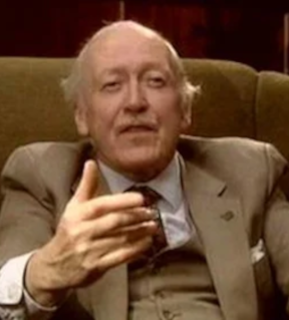
Dowling is born in Kimmage, Dublin, on September 7, 1929, the sixth of four sons and three daughters of William Dowling, a ship’s captain, and his wife Mary (née Kelly). His father is violent toward the family and leaves when he is a toddler. Helped by money provided by a priest, the Dowlings move in 1934 from the basement of his maternal uncle’s flat in Merrion Square, Dublin, to a house in Mount Merrion, County Dublin. In 1942, financial necessity forces the family’s move to a smaller residence in Marlborough Road, Donnybrook, Dublin.
Dowling is educated at St. Mary’s College in Rathmines, Dublin, having previously attended KilmacudNational School and CBS Dún Laoghaire, both in County Dublin. He is a bright student, but with his fees in arrears, the dean of studies induces him to leave school early in September 1945 for a clerkship with the Standard Life Assurance Company. A few years later, he finds his vocation when he accompanies a girlfriend to the academy of acting run by Brendan Smith. He signs up in 1948 for a two-year course during which he performs in and stage-manages academy plays and stage-manages for Smith’s professional company. Upon quitting Standard Life in June 1950, he spends a year touring Ireland with Smith’s company, both as an actor and the touring group’s manager.
Dowling comes to prominence in the 1950s for his role as Christy Kennedy in the long-running radio soap opera, The Kennedys of Castleross, and as a member of the Abbey Theatre company. He returns to the Abbey as artistic director from 1987 to 1990.
Following two months in the United States in 1969 lecturing and directing at Loyola University Chicago, he spends periods during 1972–74 directing for the Missouri Repertory Theatre and lecturing and directing at the University of Missouri – Kansas City. On extended leave from the Abbey, he directs in various American theatres throughout 1975, the year he married Olwen O’Herlihy, daughter of the Irish actor Dan O’Herlihy. After his request for six months leave each year is refused, he quits the Abbey in 1976, having done over a hundred major roles for the company.
Dowling marries actress Brenda Doyle in 1952. They have four daughters, including actress Bairbre Dowling, before divorcing in 1975. In 1975, he marries Olwen O’Herlihy, with whom he has a son.
Politician Richard Boyd Barrett is the biological son of Dowling and recording artist and actress Sinéad Cusack from a 1966 relationship while both are at the Abbey Theatre. Boyd Barrett is adopted as an infant. Dowling contacts Boyd Barrett after his connection with Cusack is publicly revealed in 2007. Their relationship is made known after his death.
Dowling dies on May 10, 2013, in Massachusetts General Hospital due to complications arising from surgery. Following a funeral service at the First Congregational Church of Chester, his remains are interred in the nearby cemetery.
Dowling receives honorary doctorates from Westfield State University in Massachusetts, and from Kent State University, John Carroll University and the College of Wooster, all in Ohio. His papers, from 1976 onward, are housed at the Kent State University and John Carroll University libraries.
Chancellor is born at 8 Fitzwilliam Place, Dublin, on January 9, 1910. Her parents are John William Chancellor, a Dublin clockmaker, jeweler, and photographer, and Cicely Chancellor (née Granger). They marry in Billericay, Essex, in 1904. She has an elder sister, Joyce Fanny, who also becomes an actress. She attends Nightingale Hall and Alexandra College, going on to train as a secretary.
Chancellor’s first appearance on stage is as a fairy in a benefit performance at the Gaiety Theatre in 1914. She appears again at the Gaiety in 1922 as Gwennie in F. Anstey‘s The Man from Blankley’s, and then studies drama under Frank Fay. In the 1920s, she acts in the Dublin Drama League’s productions in the Abbey Theatre. Once she joins the Gate Theatre her career progresses, establishing her as one of the principal actresses in the Gate by the early 1930s.
Chancellor plays Naomi alongside Orson Welles in a production of Jud Süss in October 1931. Welles becomes infatuated with her and later describes her as “the sexiest thing that ever lived.” In 1931, she debuts in J. B. Fagan‘s production of The New Gossoon by George Shiels as Biddy Henley at the Apollo Theatre. Her most noted roles are as Toots in Youth’s the Season in 1932 by Mary Manning, Laura in a production of Carmilla in 1932, based on the Gothicnovella by Sheridan Le Fanu, Ophelia in 1932 and Cicely in The Importance of Being Earnest in 1933. Touring with the Gate company in 1935, she plays Stella in its production of Lord Longford‘s Yahoo performed in the Westminster Theatre, London. She stars with James Mason in the Gate’s production of Pride and Prejudice in 1937. Disappointed with the parts she is getting at the Gate after that and much to the annoyance of Micheál Mac Liammóir and Hilton Edwards, she joins Lord Longford’s first provincial tour in 1937.
In the late 1930s, Chancellor works more often in London. Following her appearance as Baby Furze in the 1938 production of Spring Meeting by Molly Keane and John Perry, she is nominated as “Star of the Future” by the Daily Mail. She acts alongside Alec Guinness and Peggy Ashcroft in 1940 in Clemence Dane‘s Cousin Muriel at the Globe Theatre, directed by John Gielgud.
Chancellor returns to the Gaiety Theatre in 1941 to act with Hilton Edwards in a production of Caesar and Cleopatra by George Bernard Shaw, a production that marks the 75th anniversary of the Gaiety. The press welcomes her return to the company, but her fellow actors are disturbed by the fact she is then living with Denis Johnston, the husband of fellow actress Shelah Richards. After Johnston’s divorce, they marry in March 1945 in Dungannon, County Tyrone. She partly retires from acting to raise their sons, but also due to her increasing deafness that had begun in her teens.
In 1969, Chancellor returns to Ireland with her family and settles in Dalkey, County Dublin. She dies in Dún Laoghaire on April 27, 1984, and is buried in the close of St. Patrick’s Cathedral, Dublin.
Cuffe joins the Green Party in 1982, and campaigns with Students Against the Destruction of Dublin (SADD) in the 1980s. He is twice elected to Dublin City Council, in 1991 and 1999, for the South Inner City electoral area. In 1996, he launches a free bikes scheme in which bicycles are placed around Dublin city centre for use by the public.
In June 2003, Cuffe steps down as the Green Party’s environment spokesperson after it is revealed that he held shares worth $70,000 in a number of oil exploration companies which he had inherited when his late mother had left him $1.3 million in her will. He is re-elected at the 2007 Irish general election.
Following the 2007 election, the Green Party forms a coalition government with two other political parties and a number of independent TDs. Just after the election, on May 28, 2007, Cuffe writes in his blog: “A deal with Fianna Fáil would be a deal with the Devil. We would be spat out after 5 years and decimated as a party.” He loses his seat at the 2011 Irish general election.
While Cuffe is minister, the Oireachtas enacts the Planning and Development (Amendment) Act 2010 to address land-use planning failures and over-zoning of development land. The legislation reforms the way development plans and local area plans are made and, for the first time in Irish legislation, includes a definition of Anthropogenic Climate Change and required energy use to be taken into account in planning decisions. He publishes the Climate Change Response Bill 2010, and an update of the National Spatial Strategy. He is head of the Irish delegation at the 2010 United Nations Climate Change Conference in Cancún, Mexico.
Cuffe promotes healthy eating for children, school gardens and local markets. He publishes bills to address climate change, noise pollution, and heritage protection. In January 2011, he launches a new policy of allowing bicycles on off-peak Dublin Area Rapid Transit (DART) trains.
Cuffe resigns as Minister of State on January 23, 2011, when the Green Party withdraws from government.
At the 2014 Irish local elections, Cuffe is elected to Dublin City Council for Dublin North Inner City area, on the 13th count. He is appointed chairperson for the Dublin City Council Transportation Committee in 2014. As a member of the Central Area Committee for Dublin City Council, he works to provide a site for the Gaelscoil Choláiste Mhuire primary school on Dominick Street in 2017. He introduces 30 km/h speed limits to residential and school areas of Dublin and also advocates for a car-free College Green. He calls for an increase in affordable housing in Dublin, specifically for people with different incomes. Speaking on the Strategic Development Zone in the Dublin Docklands, he states, “We have seen a lot of cranes in the Docklands but not a lot of homes. Particularly affordable homes.” He proposes a Motion declaring a Climate Emergency which is approved at a meeting of the Council on May 13, 2019.
Cuffe is selected as the Green Party candidate for the Dublin constituency at the 2019 European Parliament elections. He tops the poll, receiving 63,849 votes and is elected as an MEP on the 13th count, with 17.54% first preference votes. He is also re-elected to Dublin City Council, but due to the prohibition on a dual mandate, this seat is co-opted to fellow Green Party member Janet Horner.
Cuffe is President of the European Forum for Renewable Energy Sources (EUFORES), a cross-party European parliamentary network gathering members of European, regional and national parliaments of the EU, and works to promote renewable energy and energy efficiency.
McGarry is born at 17 Pembroke Cottages, Dundrum, Dublin, on August 2, 1886. An active member of the Irish Republican Brotherhood, he is a close friend of Bulmer Hobson and is frequently arrested or imprisoned by British authorities for his activities with the IRB during the early 1900s. He participates in the 1916 Easter Rising as an aide-de-camp to Tom Clarke and is sentenced to eight years penal servitude for his role in the failed rebellion.
McGarry is sent to Frongoch internment camp in Wales but is eventually released. He assists Michael Collins in his efforts to reorganise the Irish Republican Brotherhood and, at the Volunteer Executive Meeting held in late 1917, he is elected General Secretary of the Irish Volunteers.
On the night of May 17, 1918, McGarry is arrested, along with seventy-three other Irish nationalist leaders, and deported to England, where they are held in custody without charge. The day following their arrest, he and the others are charged with conspiring “to enter into, and have entered into, treasonable communication with the German enemy.” In his absence, Harry Boland is selected for the Supreme Council and becomes his successor as president of the IRB.
McGarry is only imprisoned a short time when he takes part in the famous escape from Lincoln Jail with Seán Milroy and Éamon de Valera on February 3, 1919. He and Milroy manage to smuggle out a postcard, a comical sketch of McGarry to his wife, allowing a copy of the key to their cell to be made. They are later assisted by Harry Boland and Michael Collins who await them outside the prison.
A month later, McGarry gives a dramatic speech at a Sinn Féin concert held at the Mansion House, Dublin, before going into hiding.
Throughout the Irish War of Independence, McGarry serves as a commander and is eventually elected to Second Dáil in the 1921 Irish elections as a Sinn Féin Teachta Dála (TD) representing Dublin Mid. He, like the majority of those in the Irish Republican Brotherhood, supports the Anglo-Irish Treaty and is involved in debates against de Valera during the controversy, most especially discussing the status of Sinn Féin as a political entity.
McGarry is re-elected as a Pro-Treaty Sinn Féin TD in the 1922 Irish general election, siding with the Free State government during the Irish Civil War. Liam Lynch and other members of the anti-Treaty Irish Republican Army plan the assassination of McGarry among other TDs supporting the Public Safety Bill. As one anti-Treaty volunteer tells Ernie O’Malley, “Seán McGarry was often drunk in Amiens Street and the boys wanted to shoot him and the Staters there, but I wouldn’t let them.”
On December 10, 1922, shortly before the first meeting of the Free State parliament, a fire is deliberately set by irregulars (anti-Treatyites) at McGarry’s family home. His seven-year-old son, Emmet, is badly burned and dies as a result. McGarry is one of four targeted by anti-Treatyites during the December Free State executions. De Valera publicly denounces the attack.
After retiring from politics, McGarry works for the Irish Hospitals Trust, writes articles for newspapers and journals, and engages in broadcasting. After residing from the mid-1920s at several addresses in Dún Laoghaire, from 1938 he lives at 25 Booterstown Avenue, Blackrock, Dublin. With his wife Tomasina he has two sons and one daughter. He dies suddenly on December 9, 1958, of a heart attack in his son’s home at 44 Richmond Avenue, Monkstown, County Dublin.
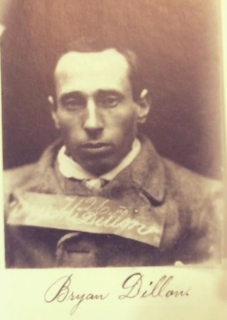
Dillon is born in Glanmire, County Cork, in 1830. As a child, he is injured in a heavy fall which results in curvature of the spine and general ill health. His family moves to a house near the corner of Old Youghal Road and Ballyhooly Road. He attends the School of Art for several years and becomes quite talented with brush and pencil. He lives through the Great Famine and becomes an ardent nationalist.
Dillon is appointed a Fenian leader in Cork by James Stephens, the head of the Irish Republican Brotherhood. Under his supervision the Fenian recruits drill on the Fair Field and at Rathpeacon and are hoping for a rebellion in 1865 when the Fenians are at their strongest. He often associates with other Cork Fenians such as John J. Geary, James Mountaine and John Lynch. He chairs the Fenian meetings at Geary’s pub.
In September 1865, police arrest Fenian leaders James Stephens and Jeremiah O’Donovan Rossa in Dublin, and Dillon in Cork. The police search his home and find a pair of field glasses, some drawings and some incriminating letters sewn into the mattress of his bed. He is remanded in Cork City Gaol until his trial.
On December 18, Dillon and another Cork Fenian, John Lynch, are tried together in the dock in Cork Courthouse by Judge Keogh. The charges are primarily based on information provided by an informer named John Warner, an ex-military pensioner. Isaac Butt and Mr. Waters represent the defendants. The charges are “in one indictment with having conspired to depose the Queen, &c., and with illegally drilling and being drilled in furtherance of that design.” Both are found guilty, based primarily on the testimony of informants, although John Warner’s account is very weak and unsatisfactory under cross-examination. The defendants are sentenced to ten years’ penal servitude.
Dillon is brought under armed guard by train from Cork to Dublin and then thrown into Mountjoy Gaol. He spends nearly a month there and suffers from lack of sleep. In January 1866, he and John Sarsfield Casey are handcuffed together on the tough and rough sea crossing between Kingstown and Holyhead. On arrival at Holyhead, they are then taken by train to Pentonville Prison. This is a very cold prison, and he becomes seriously ill in May 1866. He is transferred to the hospital wing of Woking Convict Invalid Prison, and this is to be his home for the next four-and-a-half years. Here he becomes Convict Number 2658.
In 1870, after five years imprisonment, a commission is set up to investigate the Fenian prisoners, and on account of his bad health, this commission recommends that Dillon be allowed home to Cork. In January 1871 he is transferred to Millbank PrisonLondon and is set free two weeks later on February 8. The following day he arrives in Dublin and after a few days’ rest, he returns to Cork by train. All along the route thousands of people wait on the platforms to greet him and read special addresses of welcome. The train reaches Cork at 8:00 p.m. and even though a carriage and pair are waiting, he is glad to seek refuge in the first covered car he can find, so dense is the crowd all around him wanting to shake his hand. The triumphal procession from the station to his home then begins and the hills all along the route are lighted with tar barrels.
Amid emotional scenes Dillon meets his family and afterwards appears at one of the windows of the house and thanks the people of Ireland for the great reception he has received everywhere on his journey home to Cork. He is now in very poor health and his mother begins the task of nursing him back to health. Everything that loving care and money could do is done, and from New York comes a cheque for £50 from the generous-hearted O’Donovan Rossa. Other friends also contribute, but all to no avail. On Saturday, August 17, 1872, he dies at his home surrounded by his sorrowing relatives.
Dillon’s funeral is one of the biggest ever seen in Cork. The cortege is headed by the Barrack Street Band, and at least ten other bands take part. All have their instruments dressed in sombre black. On Monday, August 18, his remains are privately borne to St. Joseph’s cemetery, to a temporary resting place, as it has been decided to build a vault in the family burial ground in Rathcooney which will not be ready for a few days. Later the funeral route travels from Turners Cross along Anglesea Street, South Mall, Grand Parade, Patrick Street, McCurtain Street and St. Luke’s. The funeral procession stops outside his home and prayers are recited for the repose of his soul. The procession then moves on toward Ballyvolane and up the steep hill toward the graveyard at Rathcooney. On arrival at the newly built tomb, so dense is the crowd milling around the hearse that considerable difficulty is experienced in getting the coffin to the grave. The priests then read the burial service, and, in a hushed silence, Canon Freeman asks the entire assembly to kneel and recite the Lord’s Prayer aloud. He blesses the grave, and the mortal remains of Brian Dillon are lowered to rest. The coffin is then covered, and after Colonel Ricard O’Sullivan Burke‘s oration, the crowd quietly disperses.
Today Dillon’s name is inscribed in the National Monument on the Grand Parade and in street names like Dillon’s Cross, Brian Dillon Park and Brian Dillon Crescent. The Brian Dillons GAA club in the same area of Cork city is also named after him.
The Solomons come to Ireland from England in 1824. Solomons is the son of Maurice Solomons (1832–1922), an optician whose practice is mentioned in James Joyce‘s Ulysses. His grandmother, Rosa Jacobs Solomons (1833–1926), is born in Hull in England. His elder brother Edwin (1879–1964) is a stockbroker and prominent member of the Dublin Jewish community. His sister Estella Solomons (1882–1968) is a leading artist, and a member of Cumann na mBan during the 1916 Easter Rising. She marries poet and publisher Seumas O’Sullivan. His younger sister Sophie is a trained opera singer.
Solomons attends St. Andrew’s College, Dublin, where he is very interested in rugby. He earns ten international rugby caps for Ireland between 1908 and 1910. He studies medicine at Trinity College, Dublin, becomes a medical doctor, and is Master of the Rotunda Hospital in Dublin from 1926 to 1933, surprising those who felt that a Jew would never hold the post. When his term ends in 1933, his name is intimately linked with that of the hospital when James Joyce writes in Finnegans Wake, “in my bethel of Solyman’s I accouched my rotundaties.” He serves as president of the Royal College of Physicians of Ireland (RCPI) in the late 1940s and practices from No. 30 Lower Baggot Street.
In a biography of Solomons he is described as “World famous obstetrician & gynaecologist, Rugby international, horseman, leader of Liberal Jewry & of Irish literary & artistic renaissance.”
Following a brief courtship, Solomons marries Gertrude Levy, who had studied with his sister Sophie at the Royal Academy of Music, London, in the liberal synagogue in London in 1916. His second son, Dr. Michael Solomons (1919–2007), is a distinguished gynaecologist, a pioneer of family planning in Ireland, and a veteran of the bitter and divisive 1983 constitutional amendment campaign.
Solomons is a friend of the founder of Sinn Féin and TD, Arthur Griffith. He contributes to the purchase of a house for Griffith. He is a founding member and the first president of the Liberal Synagogue in Dublin. He establishes a dispensary for Jewish women with Ada Shillman. In retirement he is inspector of qualifying examinations and visitor of medical schools in midwifery for the general medical council. A volume of memoirs is published in 1956. He is an art collector, including the works of Jean Cooke.
Solomons dies on September 11, 1965, at his home, Laughton Beg, Rochestown Avenue, Dún Laoghaire. The Bethel Solomons medal is awarded annually to an outstanding student in midwifery at the hospital.
Aengus Fanning, Irish journalist and editor of the Sunday Independent from 1984 until his death, dies on January 17, 2012, following a battle with lung cancer. He is also a former editor of farming for the Irish Independent. He is listed at number 31 on a list of “most influential people” in Irish society compiled for Village magazine.
Fanning is born on April 22, 1944, in the family home at Cloonbeg Terrace, Tralee, County Kerry, the fourth child among five sons and one daughter of Arnold (‘Paddy’) Fanning, a teacher, and his wife Clara (née Connell). Originally from Rostrevor, County Down, his mother is born a Presbyterian and converts to Catholicism to marry his father, though neither is religious. His father is a noted organiser of local theatrical productions, having written a one-act play, Vigil, which is staged in the Abbey Theatre in 1929.
Fanning has a keen interest in sport, having represented Kerry in Gaelic football in his youth. He is also passionate about cricket. He also plays the clarinet and is a jazz fan. He is a graduate of University College Cork (UCC).
In May 1964 Fanning is hired as a reporter by his uncle, James Fanning, the owner of the Midland Tribune in Birr, County Offaly, and pursues an unglamorous beat covering court sittings, local authority meetings and GAA matches. Needing a better salary to start a family, he joins Independent Newspapers (IN) in Dublin as a general reporter in May 1969, and soon after marries Mary O’Brien from Streamstown, County Offaly. They settle in Dún Laoghaire, County Dublin, and have three sons.
Fanning covers the Northern Irelandtroubles during 1969–70, before reporting increasingly on farming matters, becoming the IN group’s agricultural correspondent in 1973, as Ireland’s European Economic Community (EEC) accession sparks a farming boom. He is made head of news analysis at the Irish Independent in 1982, improving the op-ed page and using it to advocate more market-driven economic policies.
Fanning is appointed editor of the mid-to-upmarket Sunday Independent in 1984 from. Under his leadership, the newspaper adopts what Irish newspaper historian John Horgan calls a “new emphasis on pungent opinion columns, gossip and fashion” which results in the paper overtaking its main rival, The Sunday Press. For a time, his deputy editor is journalist Anne Harris.
In a 1993 interview with Ivor Kenny in the book Talking to Ourselves, Fanning describes himself as a classical liberal who is opposed to both Ulster loyalist and Provisional Irish Republican Army terrorism. He also expresses a strong advocacy of the free market, arguing that the goal of a good newspaper is to be as commercially successful as possible:
“If three or four papers out of 15 are successful and the others are not, they might say they’re not driven by the market, they have some higher vocation: to serve the public interest or some pompous stuff like that. That’s how they feel good about themselves. Fair enough, if that’s how they want to explain the world. It’s a grand excuse for relative failure… I think we live or die by the market, it will always win through.”
Fanning recruits a number of noted writers to contribute to the newspaper, including historians Conor Cruise O’Brien and Ronan Fanning, journalists Shane Ross and Gene Kerrigan, poet Anthony Cronin and novelist Colm Tóibín. However, his editorship is not without controversy. The columns published by Eamon Dunphy and Terry Keane draw criticism. Michael Foley notes some Irish commentators criticised Fanning’s Sunday Independent, claiming the newspaper was publishing “a mix of sleaze and prurience.”
Fanning also defends the controversial Mary Ellen Synon, who calls the Paralympics games “perverse.” One of the more bizarre incidents occurs in 2001 when he is involved in fisticuffs with a colleague at the newspaper – operations editor Campbell Spray.
Diagnosed with lung cancer in April 2011, Fanning spends his last months undergoing treatment in St. Vincent’s University Hospital, Dublin, dying there on January 17, 2012, at the age of 69. His remains are cremated at Mount Jerome Crematorium.
Anne Harris, Fanning’s second wife, succeeds him as editor and lasts three years. As well as pioneering changes in the domestic print media’s role, Fanning’s Sunday Independent led Irish society’s turn towards free market hedonism, catching the public mood better than its more conventionally liberal rivals by rendering this cultural transformation in an exuberant, somewhat parodied form, and without regard for lingering post-Catholic inhibitions.
O’Connor is educated in St. Mary’s College, Dublin, and then in Clongowes Wood College, County Kildare, a public school run by the Jesuit order. It is also attended by the man who later condemns O’Connor to death, his close friend Kevin O’Higgins. He studies experimental physics, logic, and metaphysics. He also attends the College of Science, Merrion Street. He takes a BA (1906) and receives a B.Eng (1911). In 1910, he takes his Bachelor of Engineering and Bachelor of Arts degrees at University College Dublin (UCD), then known as the National University. Prominent in the university’s Literary and Historical Society, he advocates militant constitutional nationalism as one of the many society members active in the Young Ireland branch of the United Irish League.
During the subsequent Irish War of Independence (1919-21) O’Connor is Director of Engineering of the Irish Republican Army (IRA), a military organisation descended from the Irish Volunteers. The specialist skills of engineering and signaling are essential to the development of the 5th Battalion, Dublin Brigade. Its men are forbidden frontline duty as their contribution is regarded as vital, their number too small. But units only expand on an incremental local basis, disappointing General Richard Mulcahy.
O’Connor is also involved in the Republican breakout from Strangeways Prison in Manchester, England, on October 25, 1919. Michael Collins takes a particular interest in the escape and actually visits Austin Stack in the prison under a false name to finalise the arrangements. IRA men hold up traffic while a ladder is propped up against the outside of a prison wall. In all six prisoners escape, among them Piaras Beaslaí.
O’Connor refuses to accept the Anglo-Irish Treaty of 1921, which establishes the Irish Free State. It is ratified by a narrow vote in Dáil Éireann, the Irish parliament. He and many like him feel that the Treaty copper-fastens the partition of the six counties of Northern Ireland and undermines the Irish Republic declared in 1916.
On January 10, a meeting is held at O’Connor’s home in Monkstown, Dublin. In attendance are all senior anti-Treaty IRA officers except Liam Mellows. O’Connor is appointed to chair this grouping, known as the Republican Military Council. It is agreed that an IRA convention should be called without delay; failing this, a separate GHQ will be formed. At a further meeting in O’Connor’s office on March 20, a temporary IRA GHQ staff is elected under Liam Lynch as chief of staff. O’Connor remains in charge of engineering.
On March 26, 1922, the anti-Treaty officers of the IRA hold a convention in Dublin, in which they reject the Treaty and repudiate the authority of the Dáil. However, they are prepared to discuss a way forward. The convention meets again on April 9. It creates a new army constitution and places the army under a newly elected executive of 16 men, including O’Connor, that are to choose an army council and headquarters staff. Asked by a journalist if this development means the anti-Treatyites ware proposing a “military dictatorship” in Ireland, O’Connor replies, “You can take it that way if you want.”
On April 14, 1922, O’Connor is one of a number of IRA leaders in a 200-strong force that occupies the Four Courts building in the centre of Dublin in defiance of the Provisional Government. They intend to provoke the British troops, who are still in the country, into attacking them, which they believe will restart the war with Britain and re-unite the IRA against their common enemy. They also occupy other smaller buildings regarded as being associated with the former British administration, such as the Ballast Office and the Freemasons‘ Hall in Molesworth Street, but the Four Courts remains the focus of interest. On June 15, O’Connor sends out men to collect the rifles that belong to the mutineers of the Civic Guards.
Michael Collins tries desperately to persuade the IRA men to leave the Four Courts. At the Third IRA Convention on June 18, the Executive is split over whether the Irish Government should demand that all British troops leave within 72 hours. A motion to this effect, opposed by Lynch, is narrowly defeated, whereupon O’Connor and others leave the meeting to set up a separate GHQ. The IRA effectively splits into two factions opposed to the government.
On June 22, 1922, Sir Henry Wilson is assassinated in London by two IRA men, Reginald Dunne and Joseph O’Sullivan, each a former British soldier. Some now argue that this was done on the orders of Michael Collins, who had been a close friend of Dunne’s in the London Irish Republican Brotherhood (IRB). Prime MinisterDavid Lloyd George writes an angry letter to Collins, which includes the line “…still less can Mr. Rory O’Connor be permitted to remain his followers and his arsenal in open rebellion in the heart of Dublin… organizing and sending out from this centre enterprises of murder not only in the area of your Government…”
On June 28, 1922, after the Four Courts garrison has kidnapped J. J. “Ginger” O’Connell, a general in the National Army, Collins gives orders for the shelling of the Four Courts with borrowed artillery lent by Winston Churchill. The shelling leads to the Four Courts catching fire, damaging parts of the building in addition to destroying numerous government documents. O’Connor is one of 130 men that surrender on June 30, some of whom are arrested and imprisoned in Mountjoy Prison. This incident marks the official start of the Irish Civil War, as fighting breaks out openly around the country between pro- and anti-Treaty factions.
On December 8, 1922, along with three other republicans, Liam Mellows, Richard Barrett and Joe McKelvey, captured with the fall of the Four Courts, O’Connor is executed by firing squad in reprisal for the anti-Treaty IRA’s killing of Free State Teachta Dála (TD) Sean Hales. The execution order is signed by Kevin O’Higgins. O’Connor had been best man at O’Higgins’s wedding on October 27, 1921. Their deaths remain a symbol of the bitterness and division of the Irish Civil War. O’Connor, one of 77 republicans executed by the Provisional Government, is seen as a martyr by the Republican movement in Ireland.
On O’Connor’s execution, the equestrienne Joan de Sales La Terriere, a close friend of his, names her son in his honour. “Rory O’Connor Place” in Arklow is named in his honour. There is also a pub in Crumlin, Dublin, named after him and a housing estate near Dún Laoghaire, County Dublin, called “Rory O’Connor Park.” A Sinn Féincumann (UCD) is named after him.
(Pictured: Rory O’Connor addressing members of the IRA’s Dublin City Brigade at Smithfield, April 1922)
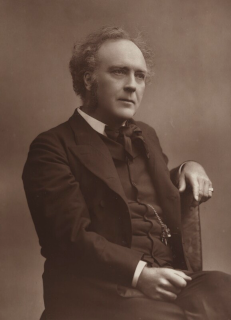
Brooke is born in the rectory of Glendoen, near Letterkenny, County Donegal on November 14, 1832, the eldest son of the Rev. Richard Sinclair Brooke, later incumbent of the Mariners’ Church, Kingstown (now Dún Laoghaire). His maternal grandfather, Joseph Stopford, is then rector of the parish. He is educated at Trinity College, Dublin. He is ordained in the Church of England in 1857 and holds various charges in London. From 1863 to 1865 he is chaplain to Victoria, Princess Royal in Berlin. In 1869, with his brother Edward, he makes long tours of Counties Donegal and Sligo, and spends much time at Kells, County Meath studying Irish antiquities. Between 1866 and 1875 he is the minister at St. James’s Chapel, a proprietary chapel. After it closes, he takes services at Bedford Chapel, Bloomsbury where he continues to attract large congregations. In 1875, he becomes chaplain in ordinary to Queen Victoria. But in 1880 he secedes from the Church, being no longer able to accept its leading dogmas, and officiates as an independent preacher for some years at Bedford Chapel, Bloomsbury.
Bedford Chapel is pulled down about 1894, and from that time Brooke has no church of his own, but his eloquence and powerful religious personality continues to make themselves felt among a wide circle. A man of independent means, he is always keenly interested in literature and art, and a fine critic of both. The two-volume Life and Letters of Stopford Brooke, written by his son-in-law L. P. Jacks and published in 1917, contains many details of different facets of his life.
In 1890-1891 Brooke takes the lead in raising the funds to purchase Dove Cottage, William Wordsworth’s home in Grasmere from 1800 to 1808, and establishing it “for the eternal possession of those who love English poetry all over the world.” Dove Cottage is now administered by the Wordsworth Trust.
Brooke publishes in 1865 his Life and Letters of FW Robertson (of Brighton), and in 1876 writes an admirable primer of English Literature, followed in 1892 by The History of Early English Literature down to the accession of Alfred the Great, and English Literature from the Beginnings to the Norman Conquest (1898).
Brooke gives the inaugural lecture to the Irish Literary Society, London, on “The Need and Use of Getting Irish Literature into the English Tongue” at Bloomsbury House, March 11, 1893. He delivers a sermon on “The Kingdom of God Within” to the International Council of Unitarian and Other Liberal Religious Thinkers and Workers, meeting in London in May 1901. He continues preaching at Bedford Chapel and to unitarian congregations throughout Britain until forced to retire because of ill-health in 1895.
Adrian Hardiman, Irish judge who serves as a Judge of the Supreme Court of Ireland from 2000 to 2016, dies in Portobello, Dublin, on March 7, 2016. He writes a number of important judgments while serving on the Court. He also presides, as does each Supreme Court judge on a rotating basis, over the Court of Criminal Appeal.
Hardiman joins Fianna Fáil while a student in University College Dublin and stands unsuccessfully for the party in the local elections in Dún Laoghaire in 1985. In 1985, he becomes a founder member of the Progressive Democrats but leaves the party when he is appointed to the Supreme Court. He remains very friendly with the former party leader and ex-Tánaiste, Michael McDowell, who is a close friend at college, a fellow founding member of the party, and best man at his wedding.
Hardiman is called to the Irish Bar in 1974 and receives the rare honour of being appointed directly from the Bar to Ireland’s highest court. Prior to his elevation to the Supreme Court in 2000, he has a successful practice as a barrister, focusing on criminal law and defamation.
Politically, Hardiman supports the liberal side in Ireland’s debates over abortion, being active in the “anti-amendment” campaign during the 1982 Abortion Referendum and later represents the Well Woman Centre in the early 1990s. After his death, he is described by Joan Burton as a liberal on social issues. But he could be an outspoken opponent of Political Correctness, such as when he rejects the Equality Authority‘s attempt to force Portmarnock Golf Club to accept women as full members. He also believes that certain decisions, such as those involving public spending, are better left to elected politicians rather than unelected judges, regardless of how unpopular that might sometimes be in the media (which he tends to hold in low esteem) and among what he describes as the “chattering classes.”
Hardiman’s concern for individual rights is not confined to Ireland. In February 2016, he criticizes what he describes as the radical undermining of the presumption of innocence, especially in sex cases, by the methods used in the UK‘s Operation Yewtree inquiry into historical sex allegations against celebrities, and he also criticizes “experienced lawyer” and then United States presidential candidate Hillary Clinton for allegedly declaring in January that “every accuser was to be believed, only to amend her view when asked if it applied to women who had made allegations against her husband”, former U.S. PresidentBill Clinton.
In a tribute following his death in 2016, PresidentMichael D. Higgins says Justice Hardiman “was one of the great legal minds of his generation”, who was “always committed to the ideals of public service.” He is described as a “colossus of the legal world” by Chief JusticeSusan Denham.
One commentator writes that “Hardiman’s greatest contribution …was the steadfast defence of civil liberties and individual rights” and that “He was a champion of defendants’ rights and a bulwark against any attempt by the Garda Síochána to abuse its powers.”






 seamus dubhghaill