The S-Plan contains many precise instructions for acts of destruction which have as their object the paralysis of all official activity in England and the greatest possible destruction of British defence installations. It divides the IRA campaign into two main lines: propaganda and offensive (military) action.
Operations are strictly concentrated on the island of Britain, in and around centres of population where IRA volunteers can operate freely without drawing attention. No attacks on targets in Northern Ireland or other areas under British control are planned as part of the S-Plan.
Sources of funding for the campaign are not known, but once the campaign is operational, the weekly expenses for operations in the field amount to approximately £700. Operational units are expected to raise any money needed themselves, and the men who act within IRA teams are unpaid and expected to support themselves while on missions.
On January 12, 1939, the IRA Army Council sends an ultimatum, signed by Patrick Fleming, to British Foreign SecretaryLord Halifax. The communiqué duly informs the British government of “The Government of the Irish Republic’s” intention to go to “war.”
On Sunday, January 15, with no reply from the British Government, a proclamation is posted in public places throughout Ireland announcing the IRA’s declaration of war on Britain. This proclamation is written by Joseph McGarrity, leader of Clan na Gael in the United States, and is signed by six members of the Army Council – Stephen Hayes, Patrick Fleming, Peadar O’Flaherty, George Oliver Plunkett, Larry Grogan and Seán Russell.
The five deaths during the Coventry bombing on August 25, 1939, effectively ends the campaign. By late 1940 the introduction of the Treason Act 1939 and the Offences Against the State Act 1939 in Ireland, and the Prevention of Violence (Temporary Provisions) Act in Britain lead to many IRA members interned in Ireland, arrested in Britain, or deported from Britain. The granting of extra powers to the Irish Justice Minister under the Emergency Powers Act in January 1940 leads to 600 IRA volunteers being imprisoned and 500 interned during the course of World War II alone.
The final figures resulting from the S-Plan are cited as 300 explosions, ten deaths and 96 injuries.
(Pictured: The aftermath of an IRA bike bomb in Coventry on August 25, 1939)
Tibble sees Quinn fleeing from the police after he has been noticed acting suspiciously near a house in which Quinn and fellow members of the Balcombe Street Gang are later found to have been preparing bombs. Tibble chases Quinn on his motorbike and, while attempting to stop him, is fatally shot twice in the chest.
Quinn escapes to Dublin in the aftermath of the shooting and serves a short prison sentence after his arrest for assaulting a police officer there. After his release in 1978 he returns to his hometown of San Francisco but is arrested in 1981 and later extradited to England in February 1988 where he is convicted of murder and jailed for life with a recommended minimum term of 35 years.
Quinn serves eleven years before he is released in April 1999, aged 51, along with the rest of the Balcombe Street Gang, under the terms of the Good Friday Agreement. While with the IRA, Quinn adopts an Irish accent and is tagged with the nickname “Yankee Joe” because of his American origins.
Admitted to the Irish Bar, Sampson becomes Junior Counsel to John Philpot Curran and helps him provide legal defences for many members of the Society of United Irishmen. A member of the Church of Ireland, he is disturbed by anti-Catholic violence and contributes writings to the Society’s newspapers. He is arrested at the time of the Irish Rebellion of 1798, imprisoned, and compelled to leave Ireland for exile in Europe.
Shipwrecked at Pwllheli in Wales, Sampson makes his way to exile in Porto, Portugal, where he is again arrested, imprisoned in Lisbon, and then expelled. After living some years in France, and then Hamburg, he flees to England ahead of the approach of Napoleon‘s armies where he is re-arrested. After unsuccessfully petitioning for a return to Ireland, he arrives in New York City on July 4, 1806.
In the United States, Sampson successfully continues his career in the law, eventually sending for his family. He sets up a business publishing detailed accounts of the court proceedings in cases with popular appeal. In 1809 he reports on the case of a Navy Lieutenant Renshaw prosecuted for dueling. That same year he handles a case against Amos and Demis Broad, accused of brutally beating their slave, Betty, and her 3-year-old daughter where Sampson succeeded in having both slaves manumitted. The authorities in Ireland had disbarred Sampson, which causes him some bitter amusement, as it does not affect his work in the United States.
Sampson’s most important case in the United States is in 1813 and is referred to as “The Catholic Question in America.” Police investigating the misdemeanor of receiving stolen goods question the suspects’ priest, the Reverend Mr. Kohlman. He declines to give any information that he has heard in confession. The priest is called to testify at the trial in the Court of General Sessions in the City of New York. He again declines. The issue whether to compel the testimony is fully briefed and carefully argued on both sides, with a detailed examination of the common law. In the end, the confessional privilege is accepted for the first time in a court of the United States.
William Sampson dies on December 28, 1836, and is buried in the Riker Family graveyard on Long Island in what is now East Elmhurst, Queens, New York. He is later reinterred in Green-Wood Cemetery in Brooklyn, where he is now buried in the same plot as Matilda Witherington Tone and William Theobald Wolfe Tone, the wife and son of the Irish revolutionary Wolfe Tone, and his daughter Catherine, the wife of William Theobald Wolfe Tone.
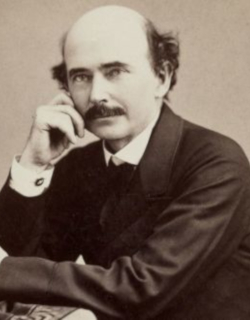
Educated in England, Boucicault begins acting in 1837 and in 1840 submits his first play to Lucia Elizabeth Vestris at Covent Garden, however it is rejected. His second play, London Assurance (1841), which foreshadows the modern social drama, is a huge success and is frequently revived into the 20th century. Other notable early plays were Old Heads and Young Hearts (1844) and The Corsican Brothers (1852).
In 1853 Boucicault and his second wife, Agnes Robertson, arrive in New York City, where his plays and adaptations are long popular. He leads a movement of playwrights that produces in 1856 the first copyright law for drama in the United States. His play The Poor of New York, based on the panics of 1837 and 1857, has a long run at Wallack’s Theatre in 1857 and is presented elsewhere as, for example, The Poor of Liverpool. The Octoroon (1859) causes a sensation with its implied attack on slavery.
Boucicault and his actress wife join Laura Keene’s theatre in 1860 and begin a series of his popular Irish plays — The Colleen Bawn, or The Brides of Garryowen (1860), Arrah-na-Pogue (1864), The O’Dowd (1873), andThe Shaughraun (1874). Returning to London in 1862, he provides Joseph Jefferson with a successful adaptation of Rip Van Winkle (1865). In 1872 he returns to the United States, where he remains, except for a trip to Australia that results in his third marriage (for which he renounced the legitimacy of his second marriage). Among his associates in the 1870s is the young David Belasco. At the time of his death on September 18, 1890, in New York City, he is a poorly paid teacher of acting. He is buried in Mount Hope Cemetery, Hastings, Westchester County, New York.
About 150 plays are credited to Boucicault, who, as both writer and actor, raises the stage Irishman from caricature to character. To the American drama he brings a careful construction and a keen observation and recording of detail. His concern with social themes prefigures the future development of drama in both Europe and America.
(Pictured: Dionysius Boucicault, taken 1890 or before. Photograph: Harvard Theatre Collection/Wikimedia Commons)
The band enjoys moderate success with a couple of single releases, but a projected album flounders because of record company politics. After achieving his musical goals with Juniper, Rice becomes frustrated with the artistic compromises required by the record label and he leaves the band in 1998. The remaining members of Juniper go on to become Bell X1.
After leaving the band Rice works as a farmer in Tuscany and busks throughout Europe before returning to Ireland in 2001 and beginning a solo musical career. He gives a demo recording to his second cousin, music producer David Arnold, who then gives Rice a mobile studio. Over the next year he continues to record his album and then embarks on a tour of Ireland with vocalist Lisa Hannigan, New York drummer Tom Osander, cellist Vyvienne Long, guitarist Mark Kelly and Dublin bassist Shane Fitzsimons.
In 2002 Rice’s debut album, O, reachs No. 8 on the UK Albums Chart and remains on the chart for 97 weeks. It also wins the Shortlist Music Prize and generates three top-30 singles in the UK. He releases his second album, 9, in 2006 and his songs have appeared in numerous films and television episodes. After eight years of various collaborations, he releases his third studio album My Favourite Faded Fantasy on October 31, 2014.
Wilde is born on October 16, 1854, at 21 Westland Row, Dublin (now home of the Oscar Wilde Centre, Trinity College), the second of three children born to Anglo-Irish Sir William Wilde and Jane Wilde, two years behind his brother William. His parents are successful Anglo-Irish intellectuals in Dublin. He learns to speak fluent French and German. At university, he reads Greats. He demonstrates himself to be an exceptional classicist, first at Trinity College Dublin, then at Magdalen College, Oxford. He becomes associated with the emerging philosophy of aestheticism, led by two of his tutors, Walter Pater and John Ruskin. After university, he moves to London into fashionable cultural and social circles.
As a spokesman for aestheticism, Wilde tries his hand at various literary activities: he publishes a book of poems, lectures in the United States and Canada on the new “English Renaissance in Art” and interior decoration, and then returns to London where he works prolifically as a journalist. Known for his biting wit, flamboyant dress and glittering conversational skill, he becomes one of the best-known personalities of his day.
At the turn of the 1890s, Wilde refines his ideas about the supremacy of art in a series of dialogues and essays, and incorporates themes of decadence, duplicity, and beauty into what would be his only novel, The Picture of Dorian Gray (1890). The opportunity to construct aesthetic details precisely, and combine them with larger social themes, draw him to write drama. He writes Salome (1891) in French while in Paris, but it is refused a licence for England due to an absolute prohibition on the portrayal of Biblical subjects on the English stage. Unperturbed, he produces four society comedies in the early 1890s, which make him one of the most successful playwrights of late-Victorian London.
At the height of his fame and success, while The Importance of Being Earnest (1895) is still being performed in London, Wilde has John Douglas, 9th Marquess of Queensberry prosecuted for criminal libel. The Marquess is the father of Wilde’s lover, Lord Alfred Douglas. The libel trial unearths evidence that causes him to drop his charges and leads to his own arrest and trial for gross indecency with men. After two more trials he is convicted and sentenced to two years of hard labour, the maximum penalty, and is jailed from 1895 to 1897. During his last year in prison, he writes De Profundis, published posthumously in 1905, a long letter which discusses his spiritual journey through his trials, forming a dark counterpoint to his earlier philosophy of pleasure. On his release, he leaves immediately for France, never to return to Ireland or Britain. There he writes his last work, The Ballad of Reading Gaol (1898), a long poem commemorating the harsh rhythms of prison life.
By November 25, 1900, Wilde has developed meningitis, then called “cerebral meningitis”. On November 29, he is conditionally baptised into the Catholic Church by Fr. Cuthbert Dunne, a Passionist priest from Dublin. He dies of meningitis on November 30, 1900. Different opinions are given as to the cause of the disease. Richard Ellmann claims it is syphilitic. Merlin Holland, Wilde’s grandson, believes this to be a misconception, noting that Wilde’s meningitis followed a surgical intervention, perhaps a mastoidectomy. Wilde’s physicians, Dr. Paul Cleiss and A’Court Tucker, report that the condition stems from an old suppuration of the right ear treated for several years and makes no allusion to syphilis.
Wilde is initially buried in the Cimetière parisien de Bagneux outside Paris. In 1909 his remains are disinterred and transferred to Père Lachaise Cemetery, inside the city. In 2011, the tomb is cleaned of the many lipstick marks left there by admirers and a glass barrier is installed to prevent further marks or damage.
In 2017, Wilde is among an estimated 50,000 men who are pardoned for homosexual acts that are no longer considered offences under the Policing and Crime Act 2017. The Act is known informally as the Alan Turing law.
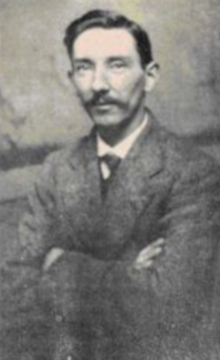
Kearney was born on December 12, 1883, at 68 Lower Dorset Street, Dublin, above one of the two grocer’s shops owned by his father, John Kearney, originally from Funshog, Collon, County Louth. His mother, Katie (née McGuinness), is from Rathmaiden, Slane, County Meath. He is educated at the Model School, Schoolhouse Lane and St. Joseph’s Secondary C.B.S. in Fairview. He hears Willie Rooney give nationalist lectures on history in the Mechanics’ Institute. For a short time, he attends Belvedere College. Following the death of his father, he is left to support his mother and five younger siblings. He has various menial jobs for three years before being apprenticed to a house painter.
In 1901, the death of Willie Rooney prompts Kearney to join the Willie Rooney Branch of the Gaelic League. He joins the Irish Republican Brotherhood in 1903. He teaches night classes in Irish and numbers Seán O’Casey among his pupils. He finds work with the National Theatre Society and in 1904 is one of the first to inspect the derelict building that becomes the Abbey Theatre. He assists with props and performs occasional walk-on parts at the Abbey until 1916.
Kearney is a co-founder of the Irish Volunteers in 1913 and takes part in the Howth and Kilcoole gun runnings in 1914. In the Easter Rising of 1916 he fights at Jacob’s biscuit factory under Thomas MacDonagh, abandoning an Abbey Theatre tour in England to take part in the Rising. He escapes before the garrison is taken into custody.
A personal friend of Michael Collins, Kearney at first takes the Free State side in the Irish Civil War but loses faith in the Free State after Collins’s death. He takes no further part in politics, returning to his original trade of house painting.
Kearney’s songs are highly popular with the Irish Volunteers (which later becomes the Irish Republican Army) in the 1913–1922 period. Most popular is “The Soldier’s Song.” He pens the original English lyrics in 1907 and his friend and musical collaborator Patrick Heeney composes the music. The lyrics are published in 1912 and the music in 1916. After 1916 it replaces “God Save Ireland” as the anthem of Irish nationalists. The Irish Free State is established in 1922 and formally adopts the anthem in 1926.
Other well-known songs by Kearney include “Down by the Glenside,” “The Tri-coloured Ribbon,” “Down by the Liffey Side,” “Knockcroghery” (about the village of Knockcroghery) and “Erin Go Bragh” (Erin Go Bragh is the text on the Irish national flag before the adoption of the tricolour).
Peadar Kearney dies in relative poverty in Inchicore on November 24, 1942. He is buried in Glasnevin Cemetery in Dublin.
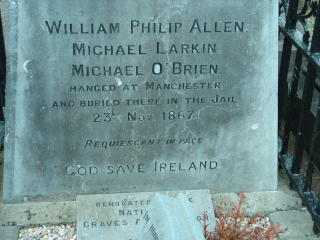
Fenians William Philip Allen, Michael Larkin, and Michael O’Brien, known as the Manchester Martyrs, are publicly hanged for the murder of a police officer in Manchester, England on November 23, 1867, during an incident that becomes known as the Manchester Outrages.
The three are members of the Irish Republican Brotherhood, also known as the Fenians, an organisation dedicated to ending British rule in Ireland, and are among a group of 30–40 Fenians who attack a horse-drawn police van transporting two arrested leaders of the Brotherhood, Thomas J. Kelly and Timothy Deasy, to Belle Vue Gaol. Police Sergeant Charles Brett, traveling inside with the keys, is shot and killed as the attackers attempt to force the van open by blowing the lock. Kelly and Deasy are released after another prisoner in the van takes the keys from Brett’s body and passes them to the group outside through a ventilation grill. The pair escape and make their way to safety in the United States. They are never recaptured, despite an extensive search.
Two others are also charged and found guilty of Brett’s murder, Thomas Maguire and Edward O’Meagher Condon, but their death sentences are overturned — O’Meagher Condon’s through the intercession of the United States government as he is an American citizen, and Maguire’s because the evidence given against him is considered unsatisfactory. Allen, Larkin, and O’Brien are publicly hanged on a temporary structure built on the wall of Salford Gaol on November 23, 1867, in front of a crowd of 8,000–10,000 people.
The bodies of the three men are buried in the New Bailey Prison graveyard, from which they are transferred to Strangeways Prison cemetery when New Bailey Prison is closed in 1868. In 1991 their remains are cremated and reinterred at Blackley Cemetery in Manchester.
Brett is the first Manchester City Police officer to be killed on duty, and he is memorialised in a monument in St. Ann’s Church. Allen, Larkin, and O’Brien are also memorialised, both in Manchester, where the Irish community makes up more than 10 percent of the population, and in Ireland, where they are regarded by many as inspirational heroes.
(Pictured: Manchester Martyrs monument, Glasnevin Cemetery, Dublin)
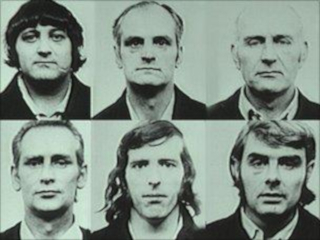
Hugh Callaghan, Patrick Hill, Robert Hunter, Noel McIlkenny, William Power, and John Walker, known as the “Birmingham Six,” are arrested on November 22, 1974, in connection with pub bombings which took place earlier in the week.
The Birmingham pub bombings take place on November 21, 1974, and are attributed to the Provisional Irish Republican Army. Explosive devices are placed in two central Birmingham pubs, the Mulberry Bush at the foot of the Rotunda and the Tavern in the Town in New Street. The resulting explosions, at 8:25 PM and 8:27 PM, collectively are the most injurious attacks in England since World War II. Twenty-one people are killed and 182 are injured. A third device, outside a bank in Hagley Road, fails to detonate.
Five of the six arrested are Belfast-born Roman Catholics, while John Walker is a Roman Catholic born in Derry. All six have lived in Birmingham since the 1960s. All the men except for Callaghan leave the city early on the evening of November 21 from New Street Station, shortly before the explosions. They are travelling to Belfast to attend the funeral of James McDade, a Provisional IRA member who had accidentally killed himself on November 14 when his bomb detonates prematurely while he is planting it at a telephone exchange in Coventry.
When they reach Heysham they and others are subject to a Special Branchstop and search. The men do not tell the police of the true purpose of their visit to Belfast, a fact that is later held against them. While the search is in progress the police are informed of the Birmingham bombings. The men agree to be taken to Morecambe police station for forensic tests.
On the morning of November 22, after the forensic tests and questioning at the hands of the Morecambe police, the men are transferred to the custody of West Midlands Serious Crime Squad police unit. Callaghan is taken into custody on the evening of November 22.
The Birmingham Six are charged with murder and conspiracy to cause explosions on May 12, 1975. The trial begins on June 9, 1975, at the Crown Court sitting at Lancaster Castle, before Justice Nigel Bridge and a jury. The jury finds the six men guilty of murder. On August 15, 1975, they are each sentenced to twenty-one life sentences.
On November 28, 1974, the Birmingham Six appear in court for a second time after they had been remanded into custody at HM Prison Winson Green, all showing bruising and other signs of ill-treatment. Fourteen prison officers are charged with assault in June 1975 but are ultimately acquitted. The Six bring a civil claim for damages against the West Midlands Police in 1977, but it is struck out on January 17, 1980, by the Court of Appeal (Civil Division).
In March 1976 the Birmingham Six’s first application for leave to appeal is dismissed by the Court of Appeal, presided over by John Widgery. Their second full appeal, in 1991, is allowed. New evidence of police fabrication and suppression of evidence, the successful attacks on both the confessions and the 1975 forensic evidence causes the Crown to decide not to resist the appeals. The Court of Appeal states that in light of the fresh scientific evidence, the convictions are both unsafe and unsatisfactory. On March 14, 1991, the Birmingham Six are set free.
In 2001, a decade after their release, the six men are awarded compensation ranging from £840,000 to £1.2 million.
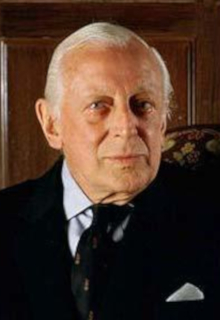
Alistair Cooke, British journalist, television personality, and broadcaster, who describes himself as a “Lancastrian Irishman,” is born in Salford, Lancashire, England on November 20, 1908. He is best known for his lively and insightful interpretations of American history and culture.
From the late 1930s, Cooke reports and comments on American affairs for BBC Radio and several major British newspapers. His weekly 15-minute program, Letter from America, broadcast from 1946 to 2004, is one of the longest-running series on radio. The texts of many broadcasts are collected in One Man’s America (1952) and Talk About America (1968). From 1956 to 1961 he hosts and narrates the weekly television “magazine” Omnibus, which wins numerous broadcasting awards.
Cooke’s interpretation of the American experience culminates in his BBC-produced television series America: A Personal History of the United States (1972–1973). In thirteen installments, filmed on location throughout the United States, he surveys some 500 years of American history in an eclectic and personal but highly coherent narrative. Alistair Cooke’s America (1973), the book based on the award-winning program, is a best-seller in the United States. From the 1970s to the early 1990s, as host of Masterpiece Theatre, he serves as an interpreter of British culture through the presentation of BBC dramatic television programming to American audiences.
Cooke’s other works include the critical biography Douglas Fairbanks: The Making of a Screen Actor (1940), Generation on Trial: The USA v. Alger Hiss (1950), based on his coverage of a celebrated Congressional investigation, The Vintage Mencken (1955), The Patient Has the Floor (1986), America Observed (1988), Memories of the Great and the Good (2000) and, with Robert Cameron, The Americans (1977).
On March 2, 2004, at the age of 95, following advice from his doctors, Cooke announces his retirement from Letter from America—after 58 years, the longest-running speech radio show in the world.
Alistair Cooke dies at midnight on March 30, 2004 at his home in New York City. He had been ill with heart disease, but dies of lung cancer, which had spread to his bones. He is cremated and his ashes are clandestinely scattered by his family in New York’s Central Park.




 seamus dubhghaill