O’Brien is one of five children of Pierce O’Brien, a gentleman landowner, and Sophia Angel St John O’Brien. Her first cousin is woodcarver Sophia St John Whitty. She attends the Mercy Convent in Ennis, going on to win a scholarship to the Dublin Metropolitan School of Art. While there she studies under William Orpen and Alfred E. Child who teach her the art of stained glass.
Among O’Brien’s first commissions is the St. Ita window for St. Brendan’s cathedral in Loughrea, County Galway, in 1904, which is designed by Sarah Purser. She joins An Túr Gloine in 1906, beginning her career there by designing Angel of the Annunciation window in the Enniskillen convent chapel. For a window in the Wilson private chapel at Coolcarrigan House, Naas, County Kildare, in 1912, she incorporates Celtic design, some drawing on the Book of Durrow. In 1914, she tours the cathedrals of Paris, Rouen, and Chartres with Purser and Wilhelmina Geddes. She designs three windows depicting St. John, St. Flannan, and St. Munchin, for the Honan Chapel at University College Cork in 1916. Her 1923 design of the centenary memorial window in St. Andrew’s church, Lucan, represents the parable of the Good Shepherd. When in 1925 An Túr Gloine becomes a cooperative society, she becomes a shareholder along with Ethel Rhind, Evie Hone, and Michael Healy.
O’Brien’s 1926 lunetteThe Spirit of Night represents night, twilight, and dawn, and is for the private home of Keng Chee in Singapore, which is later demolished. The window of St. Catherine of Siena for the Sacred Heart convent chapel in Newton, Massachusetts dates from 1927. Her 1931 St. Patrick window, for the De La Salle school, East Coast Rd., Singapore, commissioned by architect Denis Santry, is the only extant stained-glass work by an Irish artist in that country. Much like Rhind, O’Brien also employs opus sectile, such as in her 1936 Mass in Penal Days in the Franciscan friary, Athlone, County Westmeath. She contributes two windows, Pelican and Lamb and Host and Chalice: Wheat and Grapes, to the ten windows An Túr Gloine produces for Brophy College Chapel, Phoenix, Arizona in 1937. From 1937 until 1947, she works on 22 opus sectile panels for the Protestant Church in Ennis.
Purser retires from An Túr Gloine in 1940, and O’Brien succeeds her as director, going on to purchase it and the contents in 1944. She rents a section of the premises to fellow stained-glass artist Patrick Pollen from 1954 onwards. She exhibits at the 1953 Irish Exhibition of Living Art, and the 1958 exhibition of the Arts and Crafts Society of Ireland. When the An Túr Gloine studios are damaged by fire in 1958, she rebuilds them and reopens by 1959. She is an active member of the Soroptimists and the Guild of Irish Art Workers. The last work she completes is a three-light window for the Church of St. Multose, Kinsale, County Cork, in 1962. A commission for two windows for the private chapel of Áras an Uachtaráin for PresidentÉamon de Valera is left unfinished at her death.
O’Brien dies in Dublin on July 18, 1963, and is buried in Whitechurch Parish Graveyard, County Dublin. She is commemorated in a window designed by Pollen in St. Laurence O’Toole chapel, Christ Church Cathedral, Dublin, where for forty years she made floral arrangements. Over 150 of her An Túr Gloine drawings from notebooks are now in the National Gallery of Ireland.
(Pictured: Stained glass window in the south wall of Ferns Cathedral, Ferns, County Wexford)
The East Clare Brigade plans to raid the Limerick train to take mail which will reveal the identity of a local spy. The eight IRA men, under the command of John McCormack, build a stone barricade across the tracks and put a red flag on top to stop the train. They will then board the train and take what they need. Tom Bentley, an IRA volunteer from Cratloe, is aboard the train so he can signal his comrades if there are British soldiers or Black and Tans on the train.
When the driver, a republican and supporter of the cause of Irish freedom, sees the barricade, he knows an ambush is about to take place but he also knows there are 30 British soldiers of the Royal Scots Regiment onboard and, should an ambush take place, the IRA will be out numbered and certainly outgunned. He smashes through the stone barricade, which is for the best, as McCormack does not see the signal from Bentley, their man on the train.
As the train passes, McCormack takes a pot shot at a soldier on the train, which turns out to be a bad idea. Once the train reaches Cratloe station, the soldiers make all civilians disembark and at gunpoint force the train driver to return to Woodcock Hill. McCormack knows the soldiers will alert the local military barracks and enemy troops will soon swarm the area. He climbs a telegraph pole to cut the wire but the shears break. He sends Lieutenant James O’Halloran to a nearby house to get replacement shears.
Gleeson and McCarthy are in charge of a group of volunteers waiting at the top of a field armed with rifles. When they see that something is delaying the cutting of the telegraph wires, they walk down the field to see what is happening. When they reach the edge of the tracks, the train comes around the bend one hundred yards from them. The Scots train their two machine guns and rifles on the fleeing volunteers. McCarthy is wounded during the opening volley and falls to the ground. As the rest of the ambushing party scatters, Gleeson realizes that McCarthy is not with them.
Gleeson races down the open field through a hail of British rifle and machine gun fire. He reaches McCarthy and helps him to his feet. In a desperate attempt to escape, Gleeson draws his revolver and staggers uphill supporting McCarthy with one arm and firing back at the British soldiers with his free hand.
They have only covered a short distance when Gleeson is shot and both men collapse to the ground. Gleeson is unable to continue but McCarthy manages to stagger on. Within a few seconds, the advancing British soldiers surround Gleeson and shoot him dead where he lay. McCarthy carries on through the fields but is soon outrun and is captured and killed by Lieutenant A. Gordan and a group of the Royal Scots, who shoot him several times and stab him with their bayonets.
Meanwhile, on the southern side of the railway track, McCormack is lying flat, hidden from the British soldiers. In order to make good his escape, he needs to climb over a thick fence of wire and hedge in full view of the soldiers. The train is only a short distance away and if the British soldiers make a search of the area, he is likely to become the third casualty the day. When he realises McCormack’s difficulty, James O’Halloran attempts to draw the British soldiers’ fire and attention and give McCormack a chance to escape. From behind a stone pier, O’Halloran opens fire on the British soldiers. He comes under heavy rifle fire but stands his ground and succeeds in wounding one of them before his rifle jams and he is forced to retreat. By this time, O’Halloran’s action has allowed McCormack to escape unseen. All the other IRA volunteers also manage to get away safely.
When the fighting ends, the British soldiers go to the scene of the killings and force a number of farm labourers to help them remove the two bodies. McCarthy’s body had been placed on a wicker gate and Michael Doherty and another farm labourer are ordered to carry it. Doherty lifts back the covering that has been placed over McCarthy’s body and sees that his throat has been cut and his chest is riddled with bullet wounds. Immediately, Doherty receives a blow of a rifle butt from one of the Royal Scots, who replaces the covers on McCarthy’s body.
Both bodies are taken to the house of the Collins family where the soldiers guard them until British reinforcements arrive and take them to Limerick. Gleeson and McCarthy are buried in the Republican plot in Meelick churchyard alongside Patrick White, who had been shot by a British sentry at Spike Island Prison, County Cork, earlier in the month.
This event, subsequently known as The Meelick Ambush, is the only occasion in County Clare during the Irish War of Independence when two Republicans are killed in action fighting against the British forces.
Boycott is born on March 12, 1832, at Burgh St. Peter, Norfolk, England, eldest surviving son of William Boycatt (1798–1877), rector of Wheatacrebury, Norfolk, and Elizabeth Georgiana Boycatt (née Beevor). The family name is changed to Boycott by his father in 1862. Educated at a boarding school in Blackheath, London, and the Royal Military Academy, Woolwich, he is commissioned ensign in the 39th (Dorsetshire) Regiment of Foot on February 15, 1850, and serves briefly in Ireland. He sells his commission on December 17, 1852, having attained the rank of captain, marries Annie Dunne of Queen’s County (County Laois) in 1852, and leases a farm in south County Tipperary.
In 1855, Boycott leaves for Achill Island, County Mayo, where he sub-leases 2,000 acres and acts as land agent for a friend, Murray McGregor Blacker, a local magistrate. He settles initially near Keem Strand but after some years builds a fine house near Dooagh overlooking Clew Bay. He clashes with local landowners and agents and is regularly involved in litigation. Twice summonsed unsuccessfully for assault (1856, 1859), he is involved (1859–60) in a bitter dispute with a land agent over salvage rights for shipwrecks, one of the few lucrative activities on the island. Achill’s remoteness and the difficulties of wresting a living from its harsh environment adds a roughness to the island’s social relations and probably aggravates Boycott’s tendency to high-handedness.
In 1873, Boycott inherits money and moves to mainland County Mayo, leasing Lough Mask House near Ballinrobe and its surrounding 300 acres. He also becomes agent for John Crichton, 3rd Earl Erne‘s neighbouring estate of 1,500 acres, home to thirty-eight tenant farmers paying rents of £500 a year, of which he receives 10 per cent as agent. He also serves as a magistrate and is unpopular because of his brusque and authoritarian manner, and for denying locals such traditional indulgences as collecting wood from the Lough Mask estate or taking short cuts across his farm. In April 1879, he purchases the 95-acre Kildarra estate between Claremorris and Ballinlough and an adjoining wood for £1,125, taking out a mortgage of £600 which stretches his finances.
Boycott is no brutal tyrant, but he is aloof, stubborn, and pugnacious, and believes that the Irish peasantry is prone to idleness and require firm handling. Such qualities and beliefs are unremarkable enough, but in the peculiar circumstances of the land war in County Mayo, they are enough to catapult this rather ordinary man to worldwide notoriety.
In autumn 1879, concerted land agitation begins in County Mayo, and on August 1, 1879, Boycott receives a notice threatening his life unless he reduces rents. He ignores it and evicts three tenants, which embitter relations on the estate. Lough Mask House is placed under Royal Irish Constabulary (RIC) surveillance beginning in November 1879. In August 1880, his farm labourers, encouraged by the Irish National Land League, strike successfully for a wage increase from 7s. –11s. to 9s. –15s. Since the harvest is poor, Lord Erne allows a 10 per cent rent abatement. But in September 1880, when Boycott demands the rent, most tenants seek a 25 per cent abatement. Lord Erne refuses, and on September 22, Boycott attempts to serve processes against eleven defaulters. Servers and police are attacked by an angry crowd of local women and forced to take refuge in Boycott’s house. Almost immediately he is subjected to the ostracism against land grabbers advocated by Charles Stewart Parnell in his September 19 speech at Ennis, County Clare. This weapon proves as devastating against an English land agent as an Irish land-grabber. His servants leave him, labourers refuse to work his land, his walls and fences are destroyed, and local traders refuse to do business with him. He is jeered on the roads, is hissed and hustled by hostile crowds in Ballinrobe, and requires police protection.
The campaign against Boycott is largely orchestrated by Fr. John O’Malley, a local parish priest and president of the Neale branch of the Irish National Land League. It is probably O’Malley who coins the term “boycott” as an alternative to the word “ostracise,” which he believes would mean little to the local peasantry. Propagated by O’Malley’s friend, the American journalist, James Redpath, it is adopted by advocates and opponents alike.
On October 22, 1880, before his story breaks on the world, Boycott gives evidence of his treatment to the Bessborough Commission in Galway. He publicises his plight in an October 18, 1880, letter to The Times, and in a long interview with The Daily News on October 24, which is reprinted in Irish unionist newspapers and arouses considerable sympathy for him. Although he rarely uses his former military rank, he becomes universally known as “Captain Boycott,” since it suits both sides to portray him as someone of social standing. Letters of support appear in unionist papers and the Belfast News Letter sets up a “Boycott Relief Fund” and proposes a relief expedition, portraying Boycott as a peaceable English gentleman unjustly subjected to intimidation.
The prospect of hundreds of armed loyalists descending on County Mayo alarms the government, who announced on November 8 that they will provide protection for a small group of labourers to harvest Boycott’s crops. On November 12, fifty-seven loyalists from counties Cavan and Monaghan, “the Boycott Relief Expedition,” arrive at Lough Mask with an escort of almost a thousand troops. After harvesting Boycott’s crops, they leave on November 26. The entire operation costs £10,000 – about thirty times the value of the crops. Although the expedition passes off largely without incident, it focuses international media attention on the affair and establishes the word “boycott” in English and several other languages as a standard term for communal ostracism.
On November 27, Boycott and his wife go to the Hammam hotel, Dublin, where he receives death threats. On December 1, he travels to London and then to the United States (March–May 1881) to see Murray McGregor Blacker, the friend from his time on Achill Island who has since settled in Virginia. In an interview with the New York Herald, he criticises the liberal government’s weakness toward the Land League and claims that the Irish land question is an intractable problem that can only be solved in the long term by emigration and industrialisation.
Boycott returns to Lough Mask on September 19, 1881, and at an auction in Westport is mobbed and burned in effigy. This, however, is the last outburst of hostility against him, and as the land agitation wanes so does his unpopularity. Although unsuccessful in efforts to win compensation from the government, he receives a public subscription of £2,000. He remains in County Mayo as Lord Erne’s agent until February 1886, when he obtains the post of land agent for Sir Hugh Adair in Flixton, Suffolk, but he keeps the small Kildarra estate, where he continues to holiday. On December 12, 1888, he gives evidence of his treatment to the parliamentary commission on “Parnellism and crime.”
After suffering from ill-health for some years, Boycott dies at Flixton on June 19, 1897, and is buried in the churchyard of Burgh St. Peter. A British-made film, Captain Boycott (1947), stars Cecil Parker in the title role.
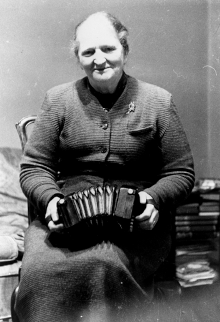
Markham is born on January 8, 1886, at Gower, Cooraclare, County Clare, the youngest in the large family of Michael Markham, farmer, and Margaret Markham (née Keane). She attends national school in Cooraclare from 1893 to 1899. Although she does not speak or understand the Irish language, as do her father and likely her mother, the Rosary is recited in Irish at home. She and a sister are the only siblings not to emigrate. Her mother plays the fiddle, while her older sister Margaret (Maggie) plays the concertina and probably influences her to do likewise. She has no single teacher and acquires tunes and her style of playing from neighbours and family friends. She begins to play a two-row German-type concertina at house dances throughout west Clare and becomes very much in demand.
In 1914, Markham marries Michael (Miko) Crotty from Gowerhass, the townland next to Gower. Miko had been in the United States for a couple of years and uses the money earned there to buy a public house on the Market Square in Kilrush, now known as “Crotty’s Pub.” They live in the Square in Kilrush and Miko bottles his own whiskey. The pub is an important venue for Irish traditional music, especially for those who wish to hear Crotty play. She remains relatively unknown outside of Clare until the early 1950s, and there are a relatively small number of recordings of her playing the concertina. The broadcaster Ciarán Mac Mathúna conducts recording sessions in her house in 1955 and she is to be heard on A Job of Journeywork, his programme on Radio Éireann. She possesses a number of concertinas, but the Lachenal that she purchases in the 1950s is her favourite and the one with which she is most closely identified. In 1954, she is a founder member and the first president of the Clare branch of Comhaltas Ceoltóirí Éireann. During her time as president, the All Ireland Fleadh is held in Ennis in 1956.
Crotty often sings the traditional song “An draighneán donn,” which is one of her favourites. Among tunes she enjoys playing are the “Ewe reel,” the “Dublin reel,” and “The maid of Mount Cisco,” along with “The wind that shakes the barley.” Her straight style of playing for dancing and dancers increases her popularity. Seán Ó Riada regards her as one of the finest concertina players he ever heard. Although she does not read or write staff notation, she creates a written code for herself by giving the concertina keys a number and by using a symbol for the press or draw movement on the concertina keys.
Crotty suffers from severe angina which necessitates visits for medical treatment to Dublin, where she becomes friends with fiddle player Kathleen Harrington (née Gardiner). They attend the Pipers’ Club in Thomas Street, play together on Radio Éireann, and travel together to fleadhanna.
Crotty dies on December 27, 1960, of an anginal attack while at her home. She is buried in (old) Shanakyle cemetery. She loses her first three children, and a son drowns in the River Shannon in 1945. Another son, Thomas, becomes a priest. A festival, ‘Éigse Mrs Crotty’, is held in her memory each summer in Kilrush. Her son Paddy gives three perpetual trophies for presentation at the All-Ireland Fleadh Cheoil.
(From: “Crotty, Elizabeth (‘Lizzie’)” by Ríonach uí Ógáin, Dictionary of Irish Biography, http://www.dib.ie, October 2009)
Flannery edits the Dominican bi-monthly journal entitled Doctrine and Life from 1958 to 1988, while at St. Saviour’s Priory, Dublin, where he also serves as prior from 1957 to 1960. He also edits the Religious Life Review. During and after the Second Vatican Council he makes available in English all the documents from the event.
From August 1969, Flannery is a member of the executive committee of the Northern Relief Coordination Committee, raising funds on behalf of the families of those interned without trial in Northern Ireland during the early 1970s.
Flannery embodies the post-Vatican II conception of the priest as a social catalyst engaged by the gospel, closer to his flock than to the clerical hierarchy. He has a great gift for friendship, is indefatigably interested in people, and courts religious affairs commentators and journalists at a time when the hierarchy ignores them, magnifying his influence.
Flannery dies of a heart attack on October 21, 2008, at Kiltipper Woods Care Centre, Dublin. Following a funeral mass at St. Saviour’s Priory, he is buried in the Dominican plot at Glasnevin Cemetery, Dublin, on October 24, 2008.
At the 1961 Irish general election, Mac Giolla unsuccessfully contests the Tipperary North constituency for Sinn Féin. In 1962, he becomes President of Sinn Féin and is one of the people who moves the party to the left during the 1960s. In 1969, Sinn Féin splits, and he remains leader of Official Sinn Féin. It is also in 1962 that he marries May McLoughlin who is also an active member of Sinn Féin as well as Cumann na mBan, the women’s section of the IRA. In 1977, the party changes its name to Sinn Féin the Workers Party and in 1982 it becomes simply the Workers’ Party.
In 1999, Mac Giolla writes to the chairman of the Flood Tribunal calling for an investigation into revelations that former Dublin Assistant City and County Manager George Redmond had been the official supervisor at the election count in Dublin West and was a close associate of Liam Lawlor. In 2003, Redmond is convicted of corruption by a Dublin court but subsequently has his conviction quashed due to conflicting evidence.
In his eighties Mac Giolla continues to be active and is a member of the group which campaigns to prevent the demolition of No. 16 Moore Street in Dublin city centre, where the surrender after the Easter Rising was completed. He also serves on the Dublin ’98 committee to commemorate the 200th anniversary of the Irish Rebellion of 1798.
Tomás Mac Giolla dies in Beaumont Hospital in Beaumont, Dublin on February 4, 2010, after a long illness.
(Pictured: Tomás Mac Giolla, former president of the Workers’ party and lord mayor of Dublin in 2007, by Niall Carson, PA Wire, Press Association Images)
Flannery edits the Dominican bi-monthly journal entitled Doctrine and Life from 1958 to 1988, while at St. Saviour’s Priory, Dublin, where he also serves as prior from 1957 to 1960. He also edits the Religious Life Review. He publishes many English language documents on the Second Vatican Council.
Thomas (Tom) Steele, engineer and political activist, is born on November 3, 1788, at Derrymore, County Clare, the son of William Steele, gentleman, and Catherine Steele (née Bridgeman).
In July 1805 Steele enters Trinity College Dublin, graduating BA in the spring of 1810. He then studies at Magdalene College, Cambridge, where he graduates MA in 1820, becoming an associate member of the Institution of Civil Engineers in the same year. In 1821 he inherits Cullane House, near Craggaunowen, County Clare, on the death of his uncle. Of an enthusiastic and adventurous nature, in 1823 he decides to support the cause of the liberals in Spain who had rebelled against the autocratic rule of Ferdinand VII in 1820. Mortgaging the house and lands at Cullane, he purchases a large quantity of arms and ships them to Spain on board the ship Iris. Commissioned in the Legion Estrenjera of the liberal army, he distinguishes himself in the Battle of Trocadero and the defence of Madrid. He later publishes an account of his experiences, Notes on the war in Spain (London, 1824).
Returning from Spain with his fortunes ruined, Steele begins experiments with underwater diving apparatus, patenting “Steele’s improved diving-bell” in 1825. In the same year he becomes a partner in the Vigo Bay Co., which attempts to recover gold and silver bullion from Spanish ships which sank in Vigo Bay in 1702. After extensive diving operations using Steele’s diving-bell, the company is wound up at an acrimonious meeting of shareholders in September 1826. Despite claims by some of the shareholders that bullion had been found, the scheme is a total failure.
Steele is involved in the Catholic Association and, a close friend of Daniel O’Connell, is active in the emancipation campaign although himself a protestant. In 1828 he seconds O’Connell’s nomination for Clare in the general election of that year. Appointed by O’Connell as ‘Head Pacificator,’ he tours the country collecting weapons and discouraging the rural population from engaging in faction fighting. There is a certain irony in this appointment, as Steele’s own volatile temper is well known. A noted duelist, he fights an inconclusive duel in 1829 with William Smith O’Brien, who had opposed O’Connell’s second candidature for County Clare. In 1828 he is a founder of the Limerick Independent Club.
An associate of the diving pioneers John and Charles Deane, Steele dives on the wreck of the Intrinsic, off the Clare coast in January 1836, using their new diving helmet. He then begins developing equipment to provide underwater illumination, and in 1840 dives with the Deane brothers off Plymouth on the wreck of Henry VIII‘s ship, the Mary Rose. Yet he is in serious financial difficulties, which are not helped by some of his more eccentric building projects. It is said of him that “he seemed utterly incapable of rationally estimating the value of money in his own case.” He begins renovating, at great expense, a ruined castle that stands on his land at Cullane. He also later has a large standing stone, known as the ‘Umbilicus Hiberniae’ (‘Navel of Ireland’), removed from Birr, King’s County (now County Offaly), and taken to his house. At Cullane it is set up as an altar and used for mass whenever O’Connell or members of the Catholic Association visit. It is not returned to Birr until 1974.
Known as “Honest Tom Steele,” Steele is deeply devoted to O’Connell, and is one of his key lieutenants during the repeal campaigns of the 1830s and 1840s. He takes his title and responsibilities as O’Connell’s “Head Pacificator” so seriously and generally expresses himself with such long-winded pomposity that he becomes something of a figure of fun for opponents of O’Connell and for many of the younger men in the Repeal Association. Tried on conspiracy charges after the prohibition of the Clontarf monster meeting, he is one of the six “traversers” imprisoned with O’Connell in Richmond jail from May to September 1844. Strongly supporting O’Connell’s repudiation of physical force, he chairs and takes a prominent part in the peace resolution debates of July 1846 in which the Young Ireland group walks out of the Repeal Association.
After the death of O’Connell on May 15, 1847, Steele falls into a deep depression and, financially ruined, jumps from Waterloo Bridge in London on April 19, 1848. Pulled from the river by a Thames boatman, he survives for a number of weeks. Former political opponents, including Lord Brougham, offer financial help but he refuses. He dies on June 15, 1848, and his remains are taken to Dublin, where he is waked at Conciliation Hall, the headquarters of the Repeal Association, on Burgh Quay. He is buried in Glasnevin Cemetery, beside O’Connell’s tomb. He appears as one of the figures on the O’Connell memorial in O’Connell Street, Dublin.
Steele never marries but harbours an unrequited passion for a Miss Eileen Crowe of Ennis, County Clare, and is often to be seen standing on a large rock, which comes to be known as “Steele’s Rock,” on the banks of the River Fergus in Ennis as he tries to catch a glimpse of Miss Crowe, who lives across the river.
(From: “Steele, Thomas (Tom)” by David Murphy, Dictionary of Irish Biography, http://www.dib.ie | Pictured: (L to R) Thomas Steele, Daniel O’Connell and O’Gorman Mahon by Joseph Patrick Haverty)
At the 1992 Irish general election, Upton stands again in Dublin South-Central, and in Labour’s “Spring Tide” surge at that election, he tops the poll with nearly 12,000 first-preference votes, a remarkable 1.48 quotas. He is re-elected at the 1997 Irish general election with a considerably reduced vote.
In the 28th Dáil Upton is appointed as Labour’s spokesperson on Justice, Equality and Law Reform. A leading critic of Labour’s 1999 merger with the Democratic Left, he nonetheless becomes the party’s spokesman on communications and sport after the merger.
Upton dies suddenly of a heart attack on February 22, 1999, at the UCD Veterinary College, where he is an occasional lecturer. He is taken to St. Vincent’s Hospital, and his death is officially confirmed. He is survived by his wife and their four children. Politicians of all parties pay glowing tributes to him for his outspoken but “erudite and incisive” contributions to politics and to Irish culture.
The by-election for Upton’s Dáil seat in Dublin South-Central is held on October 27, 1999, and won for the Labour Party by his sister Mary Upton.
Following Upton’s death, the University College Dublin branch of the Labour party is named in his honour due to his involvement with the college. It has since been renamed to honour the Spanish Civil War veteran Charlie Donnelly.
“Barry’s is a world of sharp edges, of precisely defined yet utterly unpredictable musical objects. His music sounds like no one else in its diamond-like hardness, its humour, and sometimes, its violence.” He often conceives of material independently of its instrumental medium, recycling ideas from piece to piece, as in the reworking of Triorchic Blues from a violin to a piano piece to an aria for countertenor in his television operaThe Triumph of Beauty and Deceit:
“It seemed to me unprecedented: the combination of the ferociously objective treatment of the material and the intense passion of the working-out, and both at an extreme of brilliance. And the harmony – that there was harmony at all, and that it was so beautiful and lapidary. It functions, again, irrationally, but powerfully, to build tension and to create structure. It wasn’t just repetitive. It builds. And the virtuosity, the display of it, that combination of things seemed, to me, to be new, and a major way forward.”
Barry’s most recent opera, The Importance of Being Earnest, has become a huge success after its world premiere at Los Angeles and European premiere at the Barbican Centre, London. A critic comments:
“He writes ‘what he likes’ in the way Strindberg does, not trying to characterise his characters, but letting them perform his own specialties, a kind of platform for his own musical specialties. As in Strindberg where you feel every sentence stands for itself and the characters are sort of borrowed for the use of saying them (borrowed to flesh out the text, rather than the other way round), that they’ve been out for the day. In Gerald’s opera the whole apparatus – for that’s what it is – takes on a kind of surrealistic shape, like one person’s torso on someone else’s legs being forced to walk, half the characters in the opera and half the composer.”
It is written in The Irish Times that “no other Irish composer springs to mind who carries the same aura of excitement and originality or whose music means so much to such a wide range of listeners. Certainly, there has been no Irish premiere that has made the impression of The Conquest of Ireland since Barry’s opera The Intelligence Park was seen at the Gate Theatre in 1990.”
In a 2013 guide to Barry’s musical output, Tom Service of The Guardian praises Chevaux-de-frise (1988), The Bitter Tears of Petra von Kant (2005), Lisbon (2006), Beethoven (2008), and The Importance of Being Earnest (2012).