McGeown joins the IRA’s youth wing, Fianna Éireann, in 1970. He is first arrested at the age of 14, and in 1973 he is again arrested and interned in Long Kesh Detention Centre until 1974. In November 1975, he is arrested and charged with possession of explosives, bombing the Europa Hotel, and IRA membership. At his trial in 1976 he is convicted and receives a five-year sentence for IRA membership and two concurrent fifteen-year sentences for the bombing and possession of explosives, and is imprisoned at Long Kesh with Special Category Status.
In March 1978, McGeown attempts to escape along with Brendan McFarlane and Larry Marley. The three have wire cutters and dress as prison officers, complete with wooden guns. The escape is unsuccessful, and results in McGeown receiving an additional six-month sentence and the loss of his Special Category Status.
McGeown is transferred into the Long Kesh Detention Centre’s H-Blocks where he joins the blanket protest and dirty protest, attempting to secure the return of Special Category Status for convicted paramilitary prisoners.He describes the conditions inside the prison during the dirty protest in a 1985 interview:
“There were times when you would vomit. There were times when you were so run down that you would lie for days and not do anything with the maggots crawling all over you. The rain would be coming in the window and you would be lying there with the maggots all over the place.“
In late 1980, the protest escalates and seven prisoners take part in a fifty-three-day hunger strike, aimed at restoring political status by securing what are known as the “Five Demands:”
The right not to wear a prison uniform.
The right not to do prison work.
The right of free association with other prisoners, and to organise educational and recreational pursuits.
The right to one visit, one letter and one parcel per week.
Full restoration of remission lost through the protest.
The strike ends before any prisoners die and without political status being secured. A second hunger strike begins on March 1, 1981, led by Bobby Sands, the IRA’s former Officer Commanding (OC) in the prison. McGeown joins the strike on July 9, after Sands and four other prisoners have starved themselves to death. Following the deaths of five other prisoners, his family authorises medical intervention to save his life after he lapses into a coma on August 20, the 42nd day of his hunger strike.
McGeown is released from prison in 1985, resuming his active role in the IRA’s campaign and also working for Sinn Féin, the republican movement’s political wing. In 1988, he is charged with organising the Corporals killings, an incident where two plain-clothes British Army soldiers are killed by the IRA. At an early stage of the trial his solicitor, Pat Finucane, argues there is insufficient evidence against McGeown, and the charges are dropped in November 1988. McGeown and Finucane are photographed together outside Crumlin Road Courthouse, a contributing factor to Finucane being killed by the Ulster Defence Association (UDA) in February 1989. Despite suffering from heart disease as a result of his participation in the hunger strike, McGeown is a member of Sinn Féin’s Ard Chomhairle and is active in its Prisoner of War Department. In 1993, he is elected to Belfast City Council.
McGeown is found dead in his home on October 1, 1996, after suffering a heart attack. Sinn Féin chairman Mitchel McLaughlin says his death is “a great loss to Sinn Féin and the republican struggle.” McGeown is buried in the republican plot at Belfast’s Milltown Cemetery. His death is often referred to as the “11th hunger striker.” In 1998, the Pat McGeown Community Endeavour Award is launched by Sinn Féin president Gerry Adams, with Adams describing McGeown as “a modest man with a quiet, but total dedication to equality and raising the standard of life for all the people of the city.” A plaque in memory of McGeown is unveiled outside the Sinn Féin headquarters on the Falls Road on November 24, 2001, and a memorial plot on Beechmount Avenue is dedicated to the memory of McGeown, Kieran Nugent and Alec Comerford on March 3, 2002.
In the 19th century, association football outside of Ulster is largely confined to Dublin and a few provincial towns. The British Army teams play a role in the spread of the game to these areas, especially in Munster, as local clubs are initially reliant on them to form opposition teams, leading to the nickname “the garrison game.” Association football is played in relatively few Catholic schools as middle-class schools favour rugby union while others favour Gaelic games. The Irish Football Association (IFA) had been founded in 1880 in Belfast as the football governing body for the whole of Ireland, which was then a part of the United Kingdom and considered a Home Nation. The Leinster Football Association was an affiliate, founded in 1892 to foster the game in Leinster, outside of the Ulster heartlands. This was followed by the establishment of the Munster Football Association in 1901.
By 1913, the Leinster FA becomes the largest divisional association within the IFA, displacing the North East Ulster Football Association, yet all but two clubs in the 1913–14 Irish League are based in Ulster. While this largely reflects the balance of footballing strength within Ireland, southern members feel the IFA is doing little to promote the game outside of the professional clubs in its northern province. In the other provinces, association football is also under pressure from the Gaelic Athletic Association (GAA), which has banned members from playing or watching the sport as it is considered a “foreign” game. Furthermore, there is a growing feeling in Dublin of alleged Belfast bias when it comes to hosting matches and player selection for internationals. This view is not helped by the composition of the IFA’s sub-committees, with over half of the membership consisting of delegates hailing from the North-East, and the International Committee, who chooses the national team, containing just one member from Leinster. The Belfast members are mainly unionist, while the Dublin members are largely nationalist. World War I increases the gulf between the northern teams and the clubs in the south as the Irish League is suspended and replaced by regional leagues, foreshadowing the ultimate split. Tensions are then exacerbated by the Irish War of Independence of 1919–21, which disrupts contact between northern and southern clubs further and prevents resumption of the Irish League. The security situation prompts the IFA to order the March 1920-21 Irish Cup semi-final replay between Glenavon and Shelbourne to be replayed in Belfast, rather than in Dublin as convention dictates. This proves to be the final straw and the Leinster FA confirms their decision to disaffiliate from the IFA at a meeting on June 8, 1921.
The Football Association of Ireland (FAI) is formed in Dublin on September 2, 1921, by the Leinster FA. The Free State League (originally the Football League of Ireland and now the League of Ireland) is founded in June of that year when the Leinster FA withdraws from the IFA. This is the climax of a series of disputes about the alleged Belfast bias of the IFA. Both bodies initially claim to represent the entire island. The split between Southern Ireland (which becomes the Irish Free State in December 1922) and Northern Ireland (which comes into existence as a jurisdiction in 1921) does not produce a split in the governing bodies of other sports, such as the Irish Rugby Football Union (IRFU). The Munster Football Association, originally dominated by British Army regiments, falls into abeyance on the outbreak of World War I, and is re-established in 1922 with the help of the FAI, to which it affiliates. The Falls League, based in the Falls Road of nationalist West Belfast, affiliates to the FAI, and from there Alton United wins the FAI Cup in 1923. However, when the FAI applies to join FIFA in 1923, it is admitted as the Football Association of the Irish Free State (FAIFS) based on a 26-county jurisdiction. (This jurisdiction remains, although Derry City, from Northern Ireland, are given an exemption, by agreement of FIFA and the IFA, to join the League of Ireland in 1985.) Attempts at reconciliation followed. At a 1923 meeting, the IFA rejects an FAIFS proposal for it to be an autonomous subsidiary of the FAIFS. A 1924 meeting in Liverpool, brokered by the English FA, almost reaches agreement on a federated solution, but the IFA insists on providing the chairman of the International team selection committee. A 1932 meeting agrees on sharing this role, but founders when the FAIFS demands one of the IFA’s two places on the International Football Association Board (IFAB). Further efforts to reach agreement are made through a series of conferences between the IFA and FAI from 1973 to 1980 during the height of the Troubles in Northern Ireland.
The IFA does not feel obliged to refrain from selecting Free State players for its international team. The name Football Association of Ireland is readopted by the FAIFS in 1936, in anticipation of the change of the state’s name in the pending Constitution of Ireland, and the FAI begins to select players from Northern Ireland based on the Constitution’s claim to sovereignty there. A number of players play for both the FAI “Ireland” (against FIFA members from mainland Europe) and the IFA “Ireland” (in the British Home Championship, whose members had withdrawn from FIFA in 1920). Shortly after the IFA rejoins FIFA in 1946, the FAI stops selecting Northern players. The IFA stops selecting southern players after the FAI complains to FIFA in 1950.
From the late 1960s, association football begins to achieve more widespread popularity. Donogh O’Malley, TD and then Minister for Education, begins a new programme of state-funded schools in 1966, many with association football pitches and teams. The Gaelic Athletic Association’s ban on members playing “foreign” games is lifted in 1971. RTÉ television, founded in 1962, and British television (available nearly everywhere on cable or microwave relay from the 1970s), broadcast association football regularly. Above all, the increasing success of the international side from the late 1980s gives increased television exposure, more fans, and more funds to the FAI.
However, increased media exposure also highlights some inadequacies of its hitherto largely amateur organisation. In January 1999, the FAI announces a planned national association football stadium, to be called Eircom Park after primary sponsors Eircom. This is to be a 45,000-seat stadium in City West, modeled on the GelreDome in Arnhem. It gradually becomes apparent that the initial forecasts of cost and revenue have been very optimistic. FAI and public support for the project is also undermined by the announcement of the Stadium Ireland in Abbotstown, which would have 65,000 seats and be available free to the FAI, being funded by the state. The Eircom Park project is finally abandoned in March 2001, amid much rancour within the FAI.
During preparation for the 2002 FIFA World Cup, the captain of the senior football team, Roy Keane, leaves the training camp and returns to his home. He is critical of many aspects of the organisation and preparation of the team for the upcoming games, and public opinion in Ireland is divided. As a result of the incident, the FAI commissions a report from consultants Genesis into its World Cup preparations. The “Genesis Report” makes a number of damning criticisms regarding corruption and cronyism within the association, but is largely ignored. The complete report is never published for legal reasons. The FAI subsequently produces its own report of itself titled “Genesis II” and implements a number of its recommendations.
In 2002, the FAI announces a deal with British Sky Broadcasting to sell broadcasting rights to Ireland’s international matches, as well as domestic association football, to be televised on its satellite subscription service. The general public feels it should be on RTÉ, the free-to-air terrestrial service, in spite of their offering much lower rates. Faced with the prospect of the government legislating to prevent any deal, the FAI agrees to accept an improved, but still lower, offer from RTÉ.
Following the respectable performance of the national team in the 2002 FIFA World Cup, the team’s fortunes decline under the management of Mick McCarthy, Brian Kerr and Steve Staunton.
In September 2006, Lars-Christer Olsson, CEO of UEFA, is quoted as anticipating that Lansdowne Road in Dublin (actually owned by the Irish Rugby Football Union) will stage the UEFA Cup Final in 2010, and that the FAI and the IFA will co-host the 2011 UEFA European Under-21 Championship. The 2010 final is ultimately awarded to Hamburg, but in January 2009, UEFA nameS Lansdowne Road as the host stadium for the renamed 2011 UEFA Europa League Final. In August 2010, an FAI spokesman says they will have repaid all of their stadium debt of €46 million within 10 years despite the disastrous sale of 10-year tickets for premium seats at the Aviva Stadium.
In November 2007, the FAI moves to new headquarters at the National Sports Campus in Abbotstown. Its headquarters since the 1930s had been a Georgian terraced house at 80 Merrion Square, which is sold for a sum variously reported as “in excess of €6m” and “almost €9m.”
In October 1964, during the general election campaign, a photo of McMillen is placed in the window of the election office in Divis Street flanked on one side by the Starry Plough flag and on the other by the tricolour. His campaign draws national attention after Ian Paisley demands that police remove the tricolour from McMillen’s election offices. The RUC raids the premises and confiscates the flag, sparking several days of rioting during which McMillen leads several thousand protesters in defiantly displaying the tricolour. He recalls the IRA gaining a “couple of dozen recruits” following the election, but he finishes at the bottom of the poll with 3,256 votes (6%). Around this time, he succeeds Billy McKee as the Officer commanding (OC) of the Belfast Brigade.
McMillen is keen to work for the unity of Protestant and Catholic workers. Roy Garland recalls that McMillan’s grandfather was master of an Orange lodge in Edinburgh and McMillan knew of that heritage and the meaning of the colours of the Irish flag. He prominently displays in his election offices a verse of a poem by John Frazier, a Presbyterian from County Offaly: “Till then the Orange lily be your badge my patriot brother. The everlasting green for me and we for one and other.”
In 1967, McMillen is involved in the formation of the Northern Ireland Civil Rights Association (NICRA) and is a member of a three-man committee which draws up the Association’s constitution. The NICRA’s peaceful activities result in violent opposition from many unionists, leading to fears that Catholic areas will come under attack. In May 1969, when asked at an IRA army council meeting by Ruairí Ó Brádaigh how many weapons the Belfast Brigade has for defensive operations, McMillen states they have only one pistol, a machine gun and some ammunition.
By August 14, 1969, serious rioting has broken out in Belfast and Catholic districts come under attack from both civilian unionists and the RUC. McMillen’s IRA command by this point still has only a limited number of weapons because the leadership in Dublin are reluctant to release guns. While he is involved in some armed actions on this day, he is widely blamed by those who established the Provisional IRA for the IRA’s failure to adequately defend Catholic neighbourhoods from Ulster loyalist attack. He is arrested and temporarily detained by the RUC on the morning of August 15 but is released shortly afterward.
McMillen’s role in the 1969 riots is very important within IRA circles, as it is one of the major factors contributing to the split in the movement in late 1969. In a June 1972 lecture organised by Official Sinn Féin in Dublin, he defends his conduct, stating that by 1969 the total membership of the Belfast IRA is approximately 120 men, and their armaments have increased to a grand total of 24 weapons, most of which are short-range pistols.
In September, McMillen calls a meeting of IRA commanders in Belfast. Billy McKee and several other republicans arrive at the meeting armed and demand McMillen’s resignation. He refuses, but many of those unhappy with his leadership break away and refuse to take orders from him or the Dublin IRA leadership. Most of them join the Provisional Irish Republican Army, when this group splits off from the IRA in December 1969. McMillen himself remains loyal to the IRA’s Dublin leadership, which becomes known as the Official IRA. The split rapidly develops into a bitter rivalry between the two groups. In April 1970, he is shot and wounded by Provisional IRA members in the Lower Falls area of Belfast.
In June 1970, McMillen’s Official IRA have their first major confrontation with the British Army, which had been deployed to Belfast in the previous year, in an incident known as the Falls Curfew. The British Army mounts an arms search in the Official IRA stronghold of the Lower Falls, where they are attacked with a grenade by Provisional IRA members. In response, the British flood the area with troops and declare a curfew. This leads to a three-day gun battle between 80 to 90 Official IRA members led by McMillen and up to 3,000 British troops. Five civilians are killed in the fighting and about 60 are wounded. In addition, 35 rifles, 6 machine guns, 14 shotguns, grenades, explosives and 21,000 rounds of ammunition, all belonging to the OIRA, are seized. McMillen blames the Provisionals for instigating the incident and then refusing to help the Officials against the British.
This ill-feeling eventually leads to an all-out feud between the republican factions in Belfast in March 1971. The Provisionals attempt to kill McMillen again, as well as his second-in-command, Jim Sullivan. In retaliation, McMillen has Charlie Hughes, a young PIRA member, killed. Tom Cahill, brother of leading Provisional Joe Cahill, is also shot and wounded. After these deaths, the two IRA factions in Belfast negotiate a ceasefire and direct their attention instead at the British Army.
When the Northern Ireland authorities introduce internment in August 1971, McMillen flees Belfast for Dundalk in the Republic of Ireland, where he remains for several months. During this time, the Official IRA carries out many attacks on the British Army and other targets in Northern Ireland. However, in April 1972, the organisation in Belfast is badly weakened by the death of their commander in the Markets area, Joe McCann. In May of that year, the Dublin leadership of the OIRA calls a ceasefire, a move which McMillen supports. Nevertheless, in the year after the ceasefire, his command kills seven British soldiers in what they term “retaliatory attacks.” McMillen serves on the Ard Chomhairle (leadership council) of Official Sinn Féin.
By 1974, a group of OIRA members around Seamus Costello are unhappy with the ceasefire. In December 1974, they break away from the Official movement, forming the Irish Republican Socialist Party (IRSP) and the Irish National Liberation Army (INLA). Some OIRA members under McMillen’s command, including the entire Divis Flats unit, defect to the new grouping. This provokes another intra-republican feud in Belfast. The feud begins with arms raids on OIRA dumps and beatings of their members by the INLA. McMillen, in response is accused of drawing up a “death list” of IRSP/INLA members and even of handing information on them over to the loyalist Ulster Volunteer Force (UVF).
The first killing comes on February 20, 1975, when the OIRA shoot dead an INLA member named Hugh Ferguson in west Belfast. A spate of shootings follows on both sides.
On April 28, 1975, McMillen is shot dead by INLA member Gerard Steenson, as he is shopping in a hardware shop on Spinner Street with his wife Mary. He is hit in the neck and dies at the scene. His killing is unauthorised and is condemned by INLA/IRSP leader Seamus Costello. Despite this, the OIRA tries to kill Costello on May 9, 1975, and eventually kills him two years later. McMillen’s death is a major blow to the OIRA in Belfast.
McLaverty is born on July 5, 1904, at Magheross, near Carrickmacross, County Monaghan, the son of Michael McLaverty, a waiter, and Kathleen McLaverty (née Brady). His father works in a hotel in the town until they move to Rathlin Island, and later to Belfast, when he is five years old. He attends St. Malachy’s College in the city, where an inspiring teacher instills in him a love of William Shakespeare‘s writings. He entered Queen’s University Belfast (QUB) in October 1924 and studies physics. He obtains a B.Sc. in 1928 and immediately takes his H.Dip.Ed., completing his teaching practice in St. Mary’s University College, Strawberry Hill, London. The following year he begins teaching at St. John’s Primary School in Colinward Street, west Belfast. He is admitted to the degree of M.Sc. at QUB in 1933.
In 1933, McLaverty marries Mary Conroy (formerly Giles), a young widow and fellow teacher at St. John’s. They have two sons and two daughters.
During his time at St. John’s, McLaverty writes his first five novels and fifteen short stories. In the 1930s he has developed a distinctive style in precise, unsentimental, but compassionate short stories. By the late 1930s, however, he switches his energies from short stories to the novel. Call My Brother Back (1939) contrasts the traditional world of Rathlin Island with the northern troubles in a family context. Another novel, Lost Fields (1941), and his collection of short stories, The White Mare (1943), explore the Belfast of his childhood and deal with the underlying tensions in Irish rural life. In the period 1949–55 he publishes five other novels: Three Brothers (1948), Truth in the Night (1951), School for Love (1954), The Choice (1958), and Brightening Day (1965). These novels deal with ordinary people and the dilemmas they encounter in their families and communities. His writings are influenced by Anton Chekhov, Leo Tolstoy, Katherine Mansfield, Gerard Manley Hopkins, and the Irish short story writers Liam O’Flaherty and Daniel Corkery.
As headmaster of St. Thomas’s intermediate school, a large school for boys in Ballymurphy, off the Falls Road, McLaverty gives his first job to the young Seamus Heaney, in whom he cultivates an interest in the writings of Chekhov and Tolstoy and the Irish writers Mary Lavin and Patrick Kavanagh. He deems Heaney to be the only genius he has ever met, and his work and success are a great source of pride and joy to him. His encouragement of the young John McGahern is of as much benefit to McLaverty himself, as their short but intense correspondence give him the energy to resume his writings.
Between his resignation from St. Thomas’s in 1963 and the early 1970s he teaches part-time at St. Joseph’s training college and St. Dominic’s High School, one of Belfast’s best-known grammar schools. In 1981 his old alma mater recognises his contribution to literature by awarding him an honorary master’s degree. In the same year he wins the American Irish literary fellowship, a prestigious literary award of $10,000, in recognition of his “impressive body of work as a short story writer and novelist.”
McLaverty dies on March 22, 1992, in County Down, Northern Ireland.
(From: “McLaverty, Michael” by Éamonn Ó Ciardha, Dictionary of Irish Biography, http://www.dib.ie, October 2009)
The 1973 Northern Ireland border poll is a referendum held in Northern Ireland on March 8, 1973, on whether Northern Ireland should remain part of the United Kingdom or join with the Republic of Ireland to form a united Ireland. It is the first time that a major referendum has been held in any region of the United Kingdom. The referendum is boycotted by nationalists and results in a conclusive victory for remaining in the UK. On a voter turnout of 58.7 percent, 98.9 percent vote to remain in the United Kingdom, meaning the outcome among registered voters is not affected by the boycott.
The Unionist parties support the “UK” option, as do the Northern Ireland Labour Party (NILP) and the Alliance Party of Northern Ireland (APNI). However, the Alliance Party is also critical of the poll. While it supports the holding of periodic plebiscites on the constitutional link with Great Britain, the party feels that to avoid the border poll becoming a “sectarian head count,” it should ask other relevant questions such as whether the people support the UK’s white paper on Northern Ireland. Nevertheless, on February 5, 1973, the party’s chairman, Jim Hendron, states that “Support for the position of Northern Ireland as an integral part of the United Kingdom is a fundamental principle of the Alliance Party, not only for economic reasons but also because we firmly believe that a peaceful solution to our present tragic problems is only possible within a United Kingdom context. Either a Sinn Féin all-Ireland republic or a Vanguard-style Ulster republic would lead to disaster for all our people.”
The Social Democratic and Labour Party (SDLP), however, calls for a boycott of the referendum, urging its members on January 23, 1973 “to ignore completely the referendum and reject this extremely irresponsible decision by the British Government.” Gerry Fitt, leader of the SDLP, says he has organised a boycott to stop an escalation in violence.
The civil authorities are prepared for violence on polling day. They put in place mobile polling stations which can be rushed into use if there is bomb damage to scheduled poll buildings. Two days before the referendum a British soldier, Guardsman Anton Brown of the 2nd Battalion, Coldstream Guards, is shot dead in Belfast as the army searches for weapons and explosives which can be used to disrupt the upcoming referendum.
As a political response to the referendum, the Provisional Irish Republican Army also plants four car bombs in London that day, two of which detonate, causing one death and injuring over two hundred.
The vote results in an overwhelming majority of those who voted stating they wish to remain in the UK. The nationalist boycott contributes to a turnout of only 58.7% of the electorate. In addition to taking a majority of votes cast, the UK option receives the support of 57.5% of the total electorate. According to the BBC, less than 1% of the Catholic population turn out to vote.
The referendum electorate consists of 1,030,084 adults registered to vote out of a total population of approximately 1,529,993.
The Government of the United Kingdom takes no action on receipt of the referendum result, as the result is in favour of the status quo (Northern Ireland remaining part of the UK). It is followed by an Assembly election on June 28, 1973.
Brian Faulkner, who had been the sixth and last Prime Minister of Northern Ireland, claims the result leaves “no doubt in any one’s mind what the wishes of Ulster’s people are. Despite an attempted boycott by some, almost 600,000 electors voted for the maintenance of the union with Great Britain.” He also claims that the poll showed that a “quarter of the [N.I.] Catholic population who voted … voted for the maintenance of the union” and that the result is a “blow … against IRA mythology.”
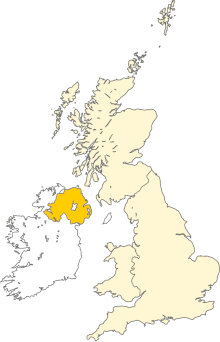
(Pictured: Map of Northern Ireland (yellow) within the United Kingdom.)
Spence, the sixth of seven children, is born and raised in the Shankill Road area of West Belfast in Northern Ireland, the son of William Edward Spence, a member of the Ulster Volunteers who fought in World War I, and Isabella “Bella” Hayes. The family home is 66 Joseph Street in an area of the lower Shankill known colloquially as “the Hammer.” He is educated at the Riddel School on Malvern Street and the Hemsworth Square school, finishing his education at the age of fourteen. He is also a member of the Church Lads’ Brigade, a Church of Ireland group, and the Junior Orange Order. His family has a long tradition of Orange Order membership.
Spence takes various manual jobs in the area until joining the British Army in 1957 as a member of the Royal Ulster Rifles. He rises to the rank of Provost Sergeant (battalion police). He is stationed in Cyprus and sees action fighting against the forces of Colonel Georgios Grivas. He serves until 1961 when ill-health forces him to leave. He then finds employment at the Harland & Wolff shipyard in Belfast, where he works as a stager (builder of the scaffolding in which the ships are constructed), a skilled job that commands respect among working class Protestants and ensures for him a higher status within the Shankill.
From an early age Spence is a member of the Prince Albert Temperance Loyal Orange Lodge, where fellow members include John McQuade. He is also a member of the Royal Black Institution and the Apprentice Boys of Derry. Due to his later involvement in a murder, he is expelled from the Orange Order and the Royal Black Institution. The Reverend Martin Smyth is influential in his being thrown out of the Orange Order.
Spence’s older brother Billy is a founding member of Ulster Protestant Action (UPA) in 1956, and he is also a member of the group. He is frequently involved in street fights with republicans and garners a reputation as a “hard man.” He is also associated loosely with prominent loyalists such as Ian Paisley and Desmond Boal and is advised by both men in 1959 when he launches a protest against Gerry Fitt at Belfast City Hall after Fitt had described Spence’s regiment as “murderers” over allegations that they had killed civilians in Cyprus. He, along with other Shankill Road loyalists, break from Paisley in 1965 when they side with James Kilfedder in a row that follows the latter’s campaigns in Belfast West. Paisley intimates that Kilfedder, a rival for the leadership of dissident unionism, is close to Fine Gael after learning that he had attended party meetings while a student at Trinity College Dublin (TCD). The Shankill loyalists support Kilfedder and following his election as MP send a letter to Paisley accusing him of treachery during the entire affair.
Spence claims that he is approached in 1965 by two men, one of whom was an Ulster Unionist Party MP, who tells him that the Ulster Volunteer Force is to be re-established and that he is to have responsibility for the Shankill. He is sworn in soon afterward in a ceremony held in secret near Pomeroy, County Tyrone. Because of his military experience, he is chosen as the military commander and public face of the UVF when the group is established. However, RUC Special Branch believes that his brother Billy, who keeps a much lower public profile, is the real leader of the group. Whatever the truth of this intelligence, Spence’s Shankill UVF team is made up of only around 12 men on its formation. Their base of operations is the Standard Bar, a pub on the Shankill Road frequented by Spence and his allies.
On May 7, 1966, a group of UVF men led by Spence petrol bomb a Catholic-owned pub on the Shankill Road. Fire also engulfs the house next door, killing the elderly Protestant widow, Matilda Gould (77), who lives there. On May 27, he orders four UVF men to kill an Irish Republican Army (IRA) member, Leo Martin, who lives on the Falls Road. Unable to find their target, the men drive around in search of any Catholic instead. They shoot dead John Scullion (28), a Catholic civilian, as he walks home. Spence later writes “at the time, the attitude was that if you couldn’t get an IRA man you should shoot a Taig, he’s your last resort.” On June 26, the same gang shoots dead Catholic civilian Peter Ward (18) and wounds two others as they leave a pub on Malvern Street in the lower Shankill. Two days later, the government of Northern Ireland uses the Special Powers Act to declare the UVF illegal. Shortly after, Spence and three others are arrested.
In October 1966, Spence is sentenced to life imprisonment for the murder of Ward, although he has always claimed his innocence. He is sent to Crumlin Road Prison. During its July 12, 1967, march, the Orange lodge to which he belongs stops outside the prison in tribute to him. This occurs despite him having been officially expelled from the Orange Order following his conviction. His involvement in the killings gives him legendary status among many young loyalists and he is claimed as an inspiration by the likes of Michael Stone. Tim Pat Coogan describes Spence as a “loyalist folk hero.” The murder of Ward is, however, repudiated by Paisley and condemned in his Protestant Telegraph, sealing the split between the two.
Spence appeals against his conviction and is the subject of a release petition organised by the Ulster Constitution Defence Committee, although nothing comes of either initiative. Despite the fact that control of the UVF lay with his closest ally, Samuel “Bo” McClelland, from prison he is often at odds with the group’s leadership, in particular with regards to the 1971 McGurk’s Bar bombing. Spence now argues that UVF members are soldiers and soldiers should not kill civilians, as had been the case at McGurk’s Bar. He respects some Irish republican paramilitaries, who he feels also live as soldiers, and to this end he writes a sympathetic letter to the widow of Official IRA leader Joe McCann after he is killed in 1972.
Spence is granted two days leave in early July 1972 to attend the wedding of his daughter Elizabeth to Winston Churchill “Winkie” Rea. The latter had formally asked Spence for his daughter’s hand in marriage during a prison visit. Met by two members of the Red Hand Commando upon his release, Spence is informed of the need for a restructuring within the UVF and told not to return to prison. He initially refuses and goes on to attend his daughter’s wedding. Afterward a plot is concocted where Jim Curry, a Red Hand Commando member, will drive Spence back to prison but the car is to be stopped and Spence “kidnapped.” As arranged, the car in which he is a passenger is stopped in Springmartin and he is taken away by UVF members. He remains at large for four months and during that time gives an interview to ITV‘s World in Action in which he calls for the UVF to take an increased role in the Northern Ireland conflict against the Provisional IRA. At the same time, he distances himself from any policy of random murders of Catholics. He also takes on responsibility for the restructuring, returning the UVF to the same command structure and organisational base that Edward Carson had utilised for the original UVF, with brigades, battalions, companies, platoons and sections. He also directs a significant restocking of the group’s arsenal, with guns mostly taken from the security forces. He gives his permission for UVF brigadier Billy Hanna to establish the UVF’s Mid-Ulster Brigade in Lurgan. His fugitive status earns him the short-lived nickname the “Orange Pimpernel.” He is arrested along with around thirty other men at a UVF drinking club in Brennan Street, but after giving a false name, he is released.
Spence’s time on the outside comes to an end on November 4 when he is captured by Colonel Derek Wilford of the Parachute Regiment, who identifies him by tattoos on his hands. He is sent directly to Long Kesh Detention Centre soon afterward, where he shares a cell with William “Plum” Smith, one of the Red Hand Commandos whom he had met upon his initial release and who had since been jailed for attempted murder.
Spence soon becomes the UVF commander within the Long Kesh Detention Centre. He runs his part of Long Kesh along military lines, drilling inmates and training them in weapons use while also expecting a maintenance of discipline. As the loyalist Long Kesh commander, he initially also has jurisdiction over the imprisoned members of the Ulster Defence Association (UDA), although this comes to an end in 1973 when, following a deterioration in relations between the two groups outside the prison walls, James Craig becomes the UDA’s Maze commander. By this time Spence polarises opinion within the UVF, with some members fiercely loyal to a man they see as a folk hero and others resenting his draconian leadership and increasing emphasis on politics, with one anonymous member even labelling him “a cunt in a cravat.”
Spence begins to move toward a position of using political means to advance one’s aims, and he persuades the UVF leadership to declare a temporary ceasefire in 1973. Following Merlyn Rees‘ decision to legalise the UVF in 1974, Spence encourages them to enter politics and support the establishment of the Volunteer Political Party (VPP). However, his ideas are abandoned as the UVF ceasefire falls apart that same year following the Ulster Workers’ Council strike and the Dublin and Monaghan bombings. The carnage of the latter shocks and horrifies Spence. Furthermore, the VPP suffers a heavy defeat in West Belfast in the October 1974 United Kingdom general election, when the DUP candidate, John McQuade, captures six times as many votes as the VPP’s Ken Gibson.
Spence is increasingly disillusioned with the UVF, and he imparts these views to fellow inmates at Long Kesh. According to Billy Mitchell, Spence quizzes him and others sent to Long Kesh about why they are there, seeking an ideological answer to his question. When the prisoner is unable to provide one, Spence then seeks to convince them of the wisdom of his more politicised path, something that he accomplishes with Mitchell. David Ervine and Billy Hutchinson are among the other UVF men imprisoned in the mid-1970s to become disciples of Spence. In 1977, he publicly condemns the use of violence for political gain, on the grounds that it is counterproductive. In 1978, he leaves the UVF altogether. His brother Bobby, also a UVF member, dies in October 1980 inside the Maze, a few months after the death of their brother Billy.
Released from prison in 1984, Spence soon becomes a leading member of the UVF-linked Progressive Unionist Party (PUP) and a central figure in the Northern Ireland peace process. He initially works solely for the PUP but eventually also sets up the Shankill Activity Centre, a government-supported scheme to provide training and leisure opportunities for unemployed youths.
Spence is entrusted by the Combined Loyalist Military Command (CLMC) to read out their October 13, 1994, statement that announces the loyalist ceasefire. Flanked by his PUP colleagues Jim McDonald and William Plum Smith, as well as Ulster Democratic Party (UDP) members Gary McMichael, John White and David Adams, he reads the statement from Fernhill, a former Cunningham family home on their former Glencairn estate in Belfast’s Glencairn area. This building had been an important training centre for members of Edward Carson’s original UVF. A few days after the announcement, he makes a trip to the United States along with the PUP’s David Ervine and Billy Hutchinson and the UDP’s McMichael, Adams and Joe English. Among their engagements is one as guests of honour of the National Committee on American Foreign Policy. He goes on to become a leading advocate for the Good Friday Agreement.
In August 2000, Spence is caught up in moves by Johnny Adair‘s “C” Company of the UDA to take control of the Shankill by forcing out the UVF and other opponents. Due to his involvement in the peace process and the eventual Good Friday Agreement, the authorities insist against his wishes to install additional security measures to the doors and windows. As a result, when Adair’s men try to force their way into Spence’s Shankill home, they only manage to push a long stick through a partially open window of the bungalow and dislodge a few of his military frames off the opposite wall. There is no other damage and other than that small disruption no one is able to gain any physical entry into the property. When Spence’s wife dies three years later, he says that C Company is responsible for her death, as the events had taken on her health.
On May 3, 2007, Spence reads out the statement by the UVF announcing that it will keep its weapons but put them beyond the reach of ordinary members. The statement also includes a warning that activities could “provoke another generation of loyalists toward armed resistance.” He does not specify what activities or what is being resisted.
Spence marries Louie Donaldson, a native of the city’s Grosvenor Road, on June 20, 1953, at Wellwood Street Mission, Sandy Row. The couple has three daughters, Elizabeth (born 1954), Sandra (1956) and Catherine (1960). Louie dies in 2003. Spence, a talented footballer in his youth with Old Lodge F.C., is a lifelong supporter of Linfield F.C.
Spence dies in a Belfast hospital at the age of 78 on September 25, 2011. He had been suffering from a long-term illness and was admitted to hospital 12 days prior to his death. He is praised by, among others, PUP leader Brian Ervine, who states that “his contribution to the peace is incalculable.” Sinn Féin‘s Gerry Kelly claims that while Spence had been central to the development of loyalist paramilitarism, “he will also be remembered as a major influence in drawing loyalism away from sectarian strife.”
However, a granddaughter of Matilda Gould, a 74-year-old Protestant widow who had died from burns sustained in the UVF’s attempted bombing of a Catholic bar next door to her home, objects to Spence being called a “peacemaker” and describes him as a “bad evil man.” The unnamed woman states, “When you go out and throw a petrol bomb through a widow’s window, you’re no peacemaker.”
Spence’s funeral service is held in St. Michael’s Church of Ireland on the Shankill Road. Notable mourners include Unionist politicians Dawn Purvis, Mike Nesbitt, Michael McGimpsey, Hugh Smyth and Brian Ervine, UVF chief John “Bunter” Graham and UDA South Belfast brigadier Jackie McDonald. In accordance with his wishes, there are no paramilitary trappings at the funeral or reference to his time in the UVF. Instead, his coffin is adorned with the beret and regimental flag of the Royal Ulster Rifles, his former regiment. He is buried in Bangor, County Down.
Living in the nationalist Beechmount neighbourhood of the Falls, he stands for the Falls as a candidate for the Dock Labour Party in a city council by-election in 1956, but loses to Paddy Devlin of the Irish Labour Party, who later becomes his close ally. In 1958, he is elected to Belfast City Council as a member of the Irish Labour Party.
Many sympathetic British Members of Parliament (MPs) are present at a civil rights march in Derry on October 5, 1968, when Fitt and others are beaten by the Royal Ulster Constabulary. Fitt also supports the 1969 candidacy of Bernadette Devlin in the Mid Ulster by-election who runs as an anti-abstentionist ‘Unity‘ candidate. Devlin’s success greatly increases the authority of Fitt in the eyes of many British commentators, particularly as it produces a second voice on the floor of the British House of Commons who challenge the Unionist viewpoint at a time when Harold Wilson and other British ministers are beginning to take notice.
In August 1970, Fitt becomes the first leader of a coalition of civil rights and nationalist leaders who create the Social Democratic and Labour Party (SDLP). By this time Northern Ireland is charging headlong towards near-civil war and the majority of unionists remain hostile.
After the collapse of Stormont in 1972 and the establishment of the Northern Ireland Assembly in 1973 Fitt becomes deputy chief executive of the short-lived Power-Sharing Executive created by the Sunningdale Agreement.
Fitt becomes increasingly detached from both his own party and also becomes more outspoken in his condemnation of the Provisional Irish Republican Army. He becomes a target for republican sympathisers in 1976 when they attack his home. He becomes disillusioned with the handling of Northern Ireland by the British government. In 1979, he abstains from a crucial vote in the House of Commons which brings down the Labour government, citing the way that the government had failed to help the nationalist population and tried to form a deal with the Ulster Unionist Party.
In 1979, Fitt is replaced by John Hume as leader of the SDLP and he leaves the party altogether after he agrees to constitutional talks with British Secretary of StateHumphrey Atkins without any provision for an ‘Irish dimension’ and then sees his decision overturned by the SDLP party conference. Like Paddy Devlin before him, he claims the SDLP has ceased to be a socialist force.
In 1981, he opposes the hunger strikes in the Maze prison in Belfast. His seat in Westminster is targeted by Sinn Féin as well as by the SDLP. In June 1983, he loses his seat in Belfast West to Gerry Adams, in part due to competition from an SDLP candidate. The following month, on October 14, 1983, he is created a UK life peer as Baron Fitt, of Bell’s Hill in County Down. His Belfast home is firebombed a month later and he moves to London.
Gerry Fitt dies in London on August 26, 2005, at the age of 79, after a long history of heart disease.
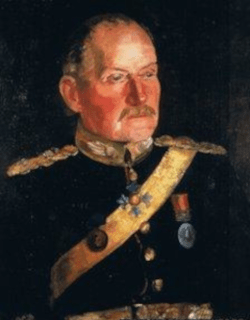
Colonel Frederick Hugh Crawford, CBE, JP, an officer in the British Army, is born in Belfast on August 21, 1861. A staunch Ulster loyalist, he is one of the lesser-known figures in Ulster Unionist history but one who is hugely influential because of his involvement in what is known as the Larne gun-running incident, when he is responsible for smuggling over 25,000 guns and ammunition into the North on the night of April 24, 1914. This makes him a hero for Northern Ireland‘s unionists.
According to the 1911 census for Ireland, Crawford is living in Marlborough Park, Belfast, with his wife of 15 years, Helen, and four of their five children: Helen Nannie, Marjorie Doreen, Ethel Bethea and Malcolm Adair Alexander. His other child, Stuart Wright Knox, is recorded as a pupil at Ballycloghan National School, Belfast. Stuart would become a lieutenant colonel in the British Army, before being invalided in 1944. Malcolm, after being a member of the Colonial Police, joins the Royal Ulster Constabulary (RUC), advancing to District Inspector. In 1931, Malcolm becomes a Justice of the Peace for Singapore.
Crawford works as an engineer for White Star Line in the 1880s, before returning from Australia in 1892. In 1894, he enlists with the Mid-Ulster Artillery regiment of the British Army, before being transferred to the Donegal Artillery, with which he serves during the Boer Wars, earning himself the rank of major.
In 1898, Crawford is appointed governor of Campbell College, Belfast. Two of his children, Stuart Wright Knox and Malcolm Adair Alexander, both attend Campbell College.
In 1911, Crawford becomes a member of the Ulster Unionist Council. On September 28, 1912, he is in charge of the 2,500 well-dressed stewards and marshals that escort Sir Edward Carson and the Ulster Unionist leadership from the Ulster Hall in central Belfast to the nearby City Hall on Donegall Square for the signing of the Ulster Covenant, which he allegedly signs in his own blood. With the formation of the Ulster Volunteers in 1913, he is made their Director of Ordnance.
With regard to Irish Home Rule, Crawford is strongly partisan and backs armed resistance to it, being contemptuous of those who use political bluffing. His advocation of armed resistance is evident when he remarks, at a meeting of the Ulster Unionist Council, that his heart “rejoiced” when he heard talk of looking into using physical force. At another meeting he even goes as far as asking some attendees to step into another room where he has fixed bayonets, rifles and cartridges laid out.
In 1910, the Ulster Unionist Council plans for the creation of an army to oppose Home Rule and approaches Crawford to act as their agent in securing weapons and ammunition. He tries several times to smuggle arms into Ulster, however, vigilant customs officials seize many of them at the docks. Despite this, the meticulously planned and audacious Larne gun-running of April 1914, devised and carried out by Crawford, is successful in bringing in enough arms to equip the Ulster Volunteer Force.
By the 1920s Crawford remains as stoic in his beliefs, remarking in a letter in 1920 that “I am ashamed to call myself an Irishman. Thank God I am not one. I am an Ulsterman, a very different breed.” In March 1920, he begins to reorganize the UVF and in May 1920 he appeals to Carson and James Craig for official government recognition. He states, “We in Ulster will not be able to hold our men in hand much longer…we will have the Protestants…killing a lot of the well-known Sinn Féin leaders and hanging half a dozen priests.” In 1921, he attempts to create an organisation intended to be a “Detective Reserve,” but called the “Ulster Brotherhood,” the aims of which are to uphold the Protestant religion and political and religious freedom, as well as use all means to “destroy and wipe out the Sinn Féin conspiracy of murder, assassination and outrage.” This organisation only lasts for a few months after failing to gain acceptance from the political authorities.
In 1921, Crawford is included in the Royal Honours List and appointed a CBE. In 1934, he writes his memoirs, titled Guns for Ulster.
Crawford dies on November 5, 1952, and is buried in the City Cemetery, Falls Road, Belfast. Upon news of his death, he is described by the then Prime Minister of Northern Ireland, Sir Basil Brooke, as being “as a fearless fighter in the historic fight to keep Ulster British.”
An earlier “Fianna” is organised “to serve as a Junior Hurling League to promote the study of the Irish Language” on June 26, 1902, at the Catholic Boys’ Hall, Falls Road, in West Belfast, the brainchild of Bulmer Hobson. Hobson, a Quaker influenced by suffragism and nationalism, joins the Irish Republican Brotherhood in 1904 and is an early member of Sinn Féin during its monarchist-nationalist period, alongside Arthur Griffith and Constance Markievicz. Hobson later relocates to Dublin and the Fianna organisation collapses in Belfast. Markievicz, inspired by the rapid growth of Robert Baden-Powell‘s Boy Scouts, forms sometime before July 1909 the Red Branch Knights, a Dublin branch of Irish National Boy Scouts. After discussions involving Hobson, Markievicz, suffragist and labour activist Helena Molony and Seán McGarry, the Irish National Boy Scouts change their name to Na Fianna Éireann at a meeting in 34 Lower Camden Street, Dublin, on August 16, 1909, at which Hobson is elected as president, thus ensuring a strong IRB influence, Markievicz as vice-president and Pádraig Ó Riain as secretary. Seán Heuston is the leader of the Fianna on Dublin’s north side, while Cornelius “Con” Colbert is the leader on the south side. The Fianna forms as a Nationalist alternative to Powell’s Scouts with the aim to achieve the full independence of Ireland by training and teaching scouting and military exercises, Irish history, and the Irish language.
The Fianna finds its first years difficult and by 1912 has barely 1,000 members and a skeleton structure outside of the cities of Dublin, Cork, Belfast and Galway. But in the next couple of years the momentum of events carries the Fianna forward. It is involved in initiating the militarisation of the IRB, the launch of the Irish Volunteers and showing solidarity with the striking Irish Transport and General Workers’ Union (ITGWU). It is also crucial to the success of the Howth and Kilcoole gun-running operations. Alongside these headline-grabbing activities, the Fianna continues with classes, drilling, camps and protests and reaps the benefits of an expanding membership and structure. When the fighting starts, the Fianna are not found wanting either. In 1916, Na Fianna members are present in all areas that mobilise and fight alongside all the other Republican organisations. They continue to fight throughout the Irish War of Independence and Irish Civil War. Seeing comrades being killed in action or executed or suffering imprisonment does not dim their enthusiasm for the fight. In Na Fianna Éireann’s March 1922 Árd Fheis, the 187 delegates representing 30,000 members vote unanimously to reject the Anglo-Irish Treaty.
The Fianna are declared an illegal organisation by the government of the Irish Free State in 1931. This is reversed when Fianna Fáil comes to power in 1932 but re-introduced in 1938. During the splits in the Republican movement of the later part of the 20th century, the Fianna and Cumann na mBan support Provisional Sinn Féin in 1969 and Republican Sinn Féin in 1986. The Fianna have been a proscribed organisation in Northern Ireland since 1920.
While the events in which the Fianna members are involved over the revolutionary years have a special place in Irish history, the specific role of the Fianna is absent from most written histories. This, allied with the failure to adequately commemorate the organisation’s centenary, marks a kind of revisionism of omission.
Born John Gerard Smyth, upon joining the Norbertine Roman Catholic religious order in 1945, he changes his name to Brendan. The Norbertines, also known as the “Premonstratensians,” are aware of Smyth’s crimes as early as the late 1970s, yet they do not report him to either the Garda Síochána or the Royal Ulster Constabulary (RUC). He is moved from parish to parish and between dioceses and countries whenever allegations are made. In some cases, the order does not inform the diocesan bishop that Smyth has a history of sexual abuse and should be kept away from children. He abuses children in parishes in Rhode Island and North Dakota and at one time works in Boston and is suspected of similar actions while on pastoral work in Wales and Italy. Norbertine Father Bruno Mulvihill makes several attempts to alert church authorities about the abuse committed by Smyth.
Smyth’s first conviction follows the reporting to police of his abuse of four siblings in Belfast’s Falls Road. After his arrest in 1991, he flees to the Republic of Ireland, where he spends the next three years on the run, staying mostly at Kilnacrott Abbey. This leads to the collapse of the Fianna Fáil–Labour Party coalition government in December 1994 when the poor handling of an extradition request from the RUC by the Irish Attorney General‘s office leads to a further delay of Smyth’s trial. An award-winning UTVCounterpoint programme on the scandal by journalist Chris Moore, followed by a book, accuses the head of the Norbertines and the Archbishop of Armagh of mishandling the case, and the Norbertines of negligence and a failure to tell others of Smyth’s crimes, enabling him to sexually abuse large numbers of children for 40 years.
Smyth dies in prison of a heart attack at the age of 70 on August 22, 1997, after collapsing in the exercise yard, one month into a 12-year prison sentence. The Norbertines hold his funeral before dawn and cover his grave with concrete to deter vandalism. He is buried in Kilnacrott Abbey, which is later put up for sale with 44 acres of land, including the grave.
On October 27, 2005, the title “Reverend” is removed from his gravestone following a campaign by one of Smyth’s victims.
Reviewers of the case differ as to whether there is a deliberate plot to conceal Smyth’s behaviour, incompetence by his superiors at Kilnacrott Abbey, or some combination of factors. Cahal Daly, both as Bishop of Down and Connor, a diocese where some of the abuse takes place, and later as Cardinal Archbishop of Armagh, is recorded as having been privately furious at the Norbertine “incompetence.” Smyth’s activities are investigated by the Northern Ireland Historical Institutional Abuse Inquiry, finding that: “…despite knowing his history of abusing children, the Norbertine religious order moved Smyth to different dioceses where he abused more children…”
In 2010, Daly’s successor as Roman Catholic Archbishop of Armagh, Cardinal Seán Brady, faces “huge pressure to resign” after he admits that in 1975, he witnessed two teenage boys sign oaths of silence after testifying in a Church inquiry against Smyth. Survivor groups see this as evidence of collusion, but Brady says he “did not have the authority” to turn Smyth in. On March 17, 2010, the Deputy First Minister of Northern Ireland, Martin McGuinness, calls for Brady to resign.
In 2013, some of Smyth’s alleged Rhode Island victims between 1965 and 1968, both male and female, call for the Diocese of Providence to investigate Smyth. As of 2019, he is among those listed by the Diocese of Providence as being “credibly accused” of committing sex abuse.
Module 6 of the 2014-2016 Northern Ireland Historical Institutional Abuse Inquiry is dedicated to Smyth’s crimes in Northern Ireland.
A two-part dramatisation of the Smyth case, Brendan Smyth: Betrayal of Trust, is broadcast by the BBC on March 13, 2011, with Ian Beattie in the title role and Richard Dormer as Chris Moore.
(Pictured: Father Brendan Smyth, Our Lady of Mercy, East Greenwich, Rhode Island, USA, c. 1965)




 seamus dubhghaill