Mitchell is the younger son of David William Mitchell, owner of a Dublin ironmongery and furniture business, and Francis Elizabeth Mitchell (née Kirby). His elder brother David becomes president of the Royal College of Physicians of Ireland (RCPI) and his sister Lillias is a noted weaver and teacher. He is educated at The High School, Dublin, and Trinity College Dublin (TCD), where he is a scholar in 1933 and receives a gold medal the following year. In 1934 he is appointed assistant to the professor of geology at TCD, and later is lecturer in geology (1940), reader in Irish archaeology (1959) and professor of Quaternary studies – a personal chair (1965). He is an efficient administrator and serves TCD successively as registrar, senior lecturer, and tutor, and after retirement is briefly a pro-chancellor of the university.
Mitchell’s major research focuses on the evolution of Ireland during the last two million years, particularly during the Quaternary since the retreat of the glacial ice over Ireland, and the effect man has had on this landscape. His interest in Quaternary studies begins in 1934, when he is appointed by the Royal Irish Academy (RIA) as an assistant to the Danish botanist and Quaternary geologistKnud Jessen, who uses the distribution of ancient pollen grains to reconstruct vegetational history. From 1940 he publishes a series of papers on topics such as the distribution of Irish giant deer and reindeer remains in Ireland, lacustrine deposits in County Meath, interglacial deposits in southeast Ireland, the palynology of Irish raised bogs, cave deposits, fossil pingos in County Wexford, bog flows, and the deposits of the older Pleistocene period in Ireland. His major study in this field is the documentation (1965) of the vegetational history of Littleton bog, County Tipperary, which has given its name to the present interglacial – the Littletonian warm stage.
Mitchell does not confine his studies to Ireland but also carries out work in Glasgow, Cornwall, and the Isle of Man. In 1957, he helps organise the British Association for the Advancement of Science meeting in Dublin and is later chairman of the Geological Society of London sub-commission on British and Irish Quaternary stratigraphy, which produces a comprehensive report in 1973. He is a frequent broadcaster on radio and a prolific author of academic papers, and in later life writes several acclaimed books, including The Irish Landscape (1976), which goes through two further editions as Reading the Irish Landscape (1986, 1997), and a volume of semi-autobiography, The Way That I Followed (1990).
In 1940, Mitchell marries Lucy Margaret (‘Pic’) (1911–87), daughter of E. J. Gwynn, provost of TCD. They have two daughters. For many years they live at Townley Hall, near Drogheda, County Louth, which had been TCD’s agricultural facility. A 1985 portrait by David Hone is displayed at Trinity College Dublin.
(From: “Mitchell, George Francis (‘Frank’)” by Patrick N. Wyse Jackson, Dictionary of Irish Biography, http://www.dib.ie, October 2009)
MacEoin is born Vincent O’Rahilly McGuone to Malachy McGuone, owner of the Central Hotel in Pomeroy and a wine and spirit merchant, and Catherine (née Fox). He has three siblings. Both of his parents are nationalists, and name all their children after leaders of the Easter Rising in 1916. Under the First Dáil in 1918, his father is appointed a judge. This results in him being interned on the prison ship Argenta on Larne Lough from 1922 to 1923. The family moves to Dublin after his release. His father dies in 1933, which leads to his wife running a workingmen’s café in East Essex Street. The family later lives on Marlborough Road, Donnybrook.
MacEoin attends boarding school at Blackrock College and is then articled to the architectural practice of Vincent Kelly in Merrion Square. As an active republican, he lives in a house on Northumberland Road from late 1939 to May 1940 where he helps in the production and distribution of an Irish Republican Army (IRA) weekly newspaper, War News. The IRA is banned by the Irish government in 1936, and its bombing campaign in Britain in 1939 is viewed by the government as a threat to Irish neutrality. MacEoin is among a group of republicans arrested in June 1940 and imprisoned in Arbour Hill Prison for a year. Once released, he is rearrested and interned at the Curragh for three years. He is sentenced to 3-months imprisonment in October 1943 for possession of incriminating documents. He is also charged with possession of ammunition, but testifies he was given the rounds against his will and never appears to have engaged in any violence. During his internment, he is taught the Irish language by Máirtín Ó Cadhain and is exposed to the socialist views of his fellow inmates. It is at this time that he adopts the Irish form of his name, Uinseann MacEoin.
While imprisoned in the 1940s, MacEoin continues his studies by correspondence and qualifies as an architect in 1945 at University College Dublin (UCD). His designs for a memorial garden in 1946 to those who died during the Irish War of Independence are commended. In 1959, he designs the site in Ballyseedy, County Kerry, for a monument by Yann Goulet commemorating those killed in the Irish Civil War and members of the IRA from Kerry who died. In 1948, he qualifies in town planning and takes up a position with Michael Scott‘s architectural practice. He works for a short time with Dublin Corporation, with their housing department, before establishing his own practice in 1955.
During the 1950s, MacEoin is a contributing editor on interior design in Hugh McLaughlin‘s magazine Creation, becoming editor of Irish Architect and Contractor in 1955. He enters into a partnership with Aidan Kelly in 1969 as MacEoin Kelly and Associates. In the early 1970s, he designs a shopping and housing development outside Dundalk, called Ard Easmuinn. Throughout the 1960s and 1970s, he continues as an influential architectural journalist, founding and editing Build from 1965 to 1969, and later Plan. His company, Pomeroy Press, publishes Plan along with other serials such as Stream and Field. He writes a large proportion of the copy in these periodicals, much under his own name, but he also uses pseudonyms, in particular in Plan as “Michael O’Brien.” He writes about his strong views on social housing, national infrastructure, and foreign and slum landlords, often libelously.
Despite his republican and socialist views, MacEoin is a staunch advocate for the preservation of Georgian Dublin, and campaigns for their preservation. On this topic, he writes letters to newspapers, takes part in television and radio discussions, writes comment pieces and editorials, speaks at public hearings, and takes part in direct protests such as sit-ins in buildings including those on Baggot Street, Pembroke Street, Hume Street, and Molesworth Street. He is also an active member of the Irish Georgian Society, and he campaigns actively against the road widening schemes in Dublin the 1970s and 1980s.
MacEoin and his wife purchase five Georgian houses on Mountjoy Square and three on Henrietta Street in the 1960s, all almost derelict. They refurbish them and lease them out, under the company name Luke Gardiner Ltd. He renames the 5 Henrietta Street property James Bryson House. His architectural practice moves into one of the Mountjoy Square houses. Along with fellow campaigners, Mariga Guinness and Deirdre Kelly, this demonstrates that these buildings can be salvaged and are not the dangerous structures other architects and developers claim them to be. He also purchases and saves Heath House, near Portlaoise, County Laois, living there toward the end of his life. He offers free conservation and architectural advice to community groups and is a volunteer on the renovation works on projects including Tailors’ Hall.
MacEoin remains politically active, joining Clann na Poblachta, the Wolfe Tone Societies (WTS), the Dublin Civic Group, the Northern Ireland Civil Rights Association (NICRA) and the Irish Anti-Apartheid Movement. To what extent he is involved in republican or IRA activities after 1945 is not clear. However, in March 1963, he is called a witness to a case in Scotland involving a Glasgowbookmaker by the name of Samuel Docherty and the Royal Bank of Scotland. Docherty claims the bank owes him £50,000. MacEoin testifies that in February 1962 he had travelled with £50,000 in cash from Dublin to lodge to Docherty’s account in the Royal Bank of Scotland in Belfast, as a loan. When asked about the origin of this large sum of money, he states it was supplied by another person but does not divulge that person’s name. This immediately triggers the court’s suspicions, and the judge warns MacEoin he will be contempt of court if he does not name the supplier of the money. He is placed in police custody for the day, and eventually he agrees to give the name in writing in confidence to the judge. The judge ultimately rules that Docherty is guilty of attempted fraud and perjury and that MacEoin’s involvement reeks of criminality. However, no further action is ever brought forward against Docherty or MacEoin.
In Sinn Féin‘s 1971 Éire Nua social and economic programme, MacEoin writes the chapter on “Planning,” and attends meetings in Monaghan in the early 1970s on the Dáil Uladh, a parliament for the 9-county Ulster province. In 1981, during the republican hunger strikes, one of his Mountyjoy Square houses is used as the national headquarters of the National H-Block Committee. Following the 1986 Sinn Féin split, he supports Republican Sinn Féin. He is a founding member of the Constitutional Rights Campaign in 1987, a group which aims to protect the rights of Irish citizens in the European Economic Community (EEC), having campaigned against Ireland joining the EEC in the early 1970s. In 1978, he is sentenced to two weeks in Mountjoy Prison for non-payment of a fine issued for not having a television licence. He had refused to buy one to protest the lack of Irish language programming.
As an environmentalist, MacEoin opposes private car ownership, and advocates for cycleways and the redevelopment of the railway lines. He writes about the “greenhouse effect” as early as 1969. As a hill walker and mountaineer, he claims to be the first Irishman to register successful climbs of all 284 Scottish peaks, known as the Munros, in 1987. He also climbs in the Alps and the Pyrenees.
MacEoin writes three books on his memories, and those of his former comrades: Survivors (1980), on the lives of leading Irish republicans, Harry (1986), a part biography part autobiography of Harry White, and The IRA in the twilight years 1923–48 (1997). He also publishes a novel, Sybil: a tale of innocence (1992) with his publishing house, Argenta, under the name Eoin O’Rahilly. He also interviews and records dozens of Republicans as part of his research for his books. These recordings are later converted into a digital oral history archive held in trust by the Irish Defence Forces.
MacEoin marries Margaret Russell in 1956 in Navan, County Meath. They have a daughter and two sons.
MacEoin dies in a nursing home in Shankill, Dublin, on December 21, 2007. His estate at the time of his death is valued at over €3 million. His son, Nuada, takes over his father’s architectural practice.
Daly is born in Limerick on October 18, 1845. His father works in James Harvey & Son’s Timber Yard. At the age of sixteen, he joins his father working as a lath splitter. At eighteen he is sworn in as a member of the IRB, also known as the Fenians, and becomes fully involved in Republican activities. When he is refused absolution in confession because he admits to being a Fenian, he decides that from then on, his loyalty will no longer be to “faith and Fatherland” but to “God and Fatherland.”
On November 22, 1866, Daly and his brother Edward are arrested at their family home having been betrayed by an informer, for running a munitions factory in the Pennywell district close to their home. He is released on bail in February 1867 toughened and more dedicated by the experience.
On March 5, 1867, the ill-prepared Fenian Rising takes place. Daly takes charge of the Limerick detachment of the IRB. Limerick is one of the few areas where the Fenians are able to make some show of force, however weak. Through lack of numbers, they fail to make a significant impact on the vastly superior forces arrayed against them. Moving out of the city, he moves his men into the country and joins up with other Fenians in an attack on the Royal Irish Constabulary (RIC) barracks at Kilmallock. The attack is repelled, and Daly disperse his men.
After this Daly flees the country by stowing away first on a boat, the Hollywood, to England, and from London then on board the Cornelius Grenfel to the United States.
Life in America for working class immigrants is particularly tough and Daly’s first job on leaving the ship is digging a cellar. He then obtains work in a white lead factory and works for a while as a mason’s helper before getting a reasonably good job as a brakeman on a tram system. He is to recall these experiences in his Recollections of Fenians and Fenianism.
In 1869, Daly return to Ireland and takes up his old job in the timber yard, and also his Republican activities. He begins to help reorganise the IRB and takes part in a number of agitations to keep the IRB agenda in the public view. He becomes a leading voice in the Amnesty Association to help in the release of those Fenians still in jail.
In November 1869, a major tenants’ right meeting takes place in the city. The IRB objects to the meeting because the issue of the prisoners is not on the agenda. In what comes to be known as “The Battle of the Markets,” the IRB charges the platform and succeeds in dismantling it. Though the organisers of the meeting attempt to hold some form of gathering, Daly and the IRB refuse to relent. It is Daly’s opinion that “it was one of the greatest moral victories ever achieved.” The issue of the political prisoners is to keep him occupied for much of the 1870s. In 1876, he is again arrested for disturbing another home rule gathering, though on being brought before the court he is acquitted.
During the Land War Daly is a member of the Supreme Council of the IRB and becomes organiser for Connacht and Ulster.
In the summer of 1883, Daly moved to Birmingham, England, and settles in the home of James Egan, an old friend from Limerick and a generally inactive IRB man. E.G. Jenkinson, head of Special Branch, is informed that Daly is on his way to Britain from the United States. He has been asked by the Supreme Council to deliver the graveside oration at the funeral of Charles J. Kickham while in the United States. When he arrives, a plain-clothes detective is assigned to follow him at all times. As a result of this, Special Branch are alerted to the importance of John Torley in Glasgow, Robert Johnston in Belfast and Mark Ryan in London of the IRB.
Jenkinson uses agent provocateurs in his attempts to convict Republicans. One such recruit is a publican and local IRB man named Dan O’Neill. Both Jenkinson and a Major Nicholas Gosselin persuade O’Neill to betray Daly. O’Neill then asks Daly to deliver sealed cases to some associates in London, and on April 11, he is arrested as he is about to board the train for London, and explosives are found in the case he is carrying. The police then raid the home of James Egan where explosives are “allegedly found buried” in Egan’s garden in addition to some documents.
In Chatham prison Daly becomes friends with Tom Clarke, who would later marry his niece Kathleen and who was a leader of the 1916 Easter Rising. While in prison he claims that he is being poisoned with belladonna which causes an investigation by a commission of inquiry in 1890. It is admitted by prison officials as an error by a warder. A series of articles in the Daily Chronicle in 1894 analyse prison methods. Daly gives an interview to the Chronicle which appears on September 12, 1896.
Daly is elected three times as Mayor of Limerick City, from 1899 to 1901. He jointly finances with Patrick McCartan the IRB newspaper Irish Freedom in 1910.
Daly dies on June 30, 1916, at his home, 15 Barrington Street, Limerick. He never marries. A tall, energetic, and gregarious man, he is a simple but often effective propagandist for the separatist cause.
In 1928, Madge Daly, a niece of Daly, presents the Daly cup to William P. Clifford, the then-chairman of the Limerick GAA county board. Since then, the Daly cup is presented to the winners of the Limerick Senior Hurling Championship.
(Pictured: Irish Republican and Fenian John Daly in the ceremonial garb of the Mayor of Limerick, circa 1900)
The play is a tragicomedy about a small rural town in Ireland where many of the townspeople are extras in a Hollywood film. The story centres on Charlie Conlon and Jake Quinn, who, like much of the town, are employed as extras for the filming. The key point in the play is when a local teenager commits suicide, by drowning himself with stones in his pockets, after he is humiliated by one of the film stars. The script calls upon the cast of two to perform all 15 characters (men and women), often switching gender and voice swiftly and with minimal costume change. Comedy also derives from the efforts of the production crew to create the proper “Irish feel” – a romanticised ideal that often conflicts with the reality of daily life.
The play is first shown as a DubbleJoint Production premiering in West Belfast in August 1996. The set design, by Jack Kirwan, is simple – a backcloth depicting the cloudy sky above the Blasket Islands, a row of shoes (symbolising the myriad characters) and a trunk, a box, and two tiny stools. The lighting design is originally by James C. McFetridge and this design is used in both the London West End and the Broadway versions of the show.
The show moves to the Edinburgh Festival Fringe in 1999. It then returns to Ireland and has a brief run in Dublin before moving to London‘s Tricycle Theatre. It then transfers to the New Ambassadors Theatre in London’s West End. The show, however, proves so successful, its run is extended and moves to the Duke of York’s Theatre up the road, where it remains for three years.
The original cast of Hill and Campion take the show to Broadway and, as its West End run continues to play to packed houses, actors line up to play Charlie and Jake, most notably Bronson Pinchot, Rupert Degas and Simon Delaney.
The play wins the Irish Times/ESB Irish Theatre Award for Best Production in 1999, wins two Laurence Olivier Awards in 2001 for Best New Comedy and Best Actor (Conleth Hill) and is also nominated for three Tony Awards in 2001.
The play is revived at London’s Tricycle Theatre in 2011, with Jamie Beamish as Charlie and Owen McDonnell as Jake, and at the Tron Theatre, Glasgow in 2012 performed by Robbie Jack and Keith Fleming.
For the 20th anniversary of the first production, The Dukes in Lancaster and The Theatre Chipping Norton co-produce a touring production which opens at The Dukes on February 25, 2016, and tours 35 venues between then and May 28, 2016. Charlie de Bromhead plays Jake and Conan Sweeny plays Charlie.
The original version of the play is created in collaboration with theatre director Pam Brighton, who later sues Marie Jones for co-authorship rights. Brighton loses the case in the high court, and subsequently becomes bankrupt.
Born in Blackwater Street off Grosvenor Road in west Belfast in 1916, White is one of ten children (five sons and five daughters) of Billy White, water technician with Belfast Corporation, and his wife Kathleen (née McKane). As a boy he sings in the choir of Clonard Monastery. He plays in a céilí band as a teenager and is a lifelong aficionado of Irish music and plays the banjo and other string instruments (often smuggling guns in their cases). As a young man he is also an active member of Granuaile GAA club, playing hurling and Gaelic football.
White works as a plumber and joins the Irish Republican Army (IRA) at an early age, being imprisoned several times during the 1930s. He travels to England to take part in the IRA’s “S-Plan” bombing campaign of 1939 to 1940, then returns to Dublin to pass his bomb-making skills on to new recruits, including Brendan Behan. He then returns to England to become the IRA’s Manchester Operations Officer but, after a bomb he is working on goes off in the flat he is renting, he flees to Glasgow, then back to Ireland.
Shortly after returning to Ireland, White is arrested while giving a lecture on explosives in County Offaly and is interned at the Curragh Camp. The republican prisoners are split into two groups, one led by Pearse Kelly, and the other by Liam Leddy. White is unhappy with the situation and refuses to take sides. Shortly after his arrival, IRA Chief of StaffSeán McCool is also interned, and is concerned that the locations of many of the IRA’s arms caches are known only to him. McCool asks him to get the information to the new leadership by “signing out,” declaring that he is no longer involved with a paramilitary group. He refuses as doing so would be breaking IRA orders, but McCool persists, suggesting that he could resign from the army before signing out, thereby not contravening IRA rules. Once released, he immediately rejoins the IRA and passes on the information. He is also made IRA Quartermaster General by Chief of StaffCharlie Kerins. However, he is suspected of involvement in the killing of a police officer, Dinny O’Brien – something which he always denies – and has to go on the run.
In October 1942, White and a comrade are cornered in a house. Here the details are unclear. Tim Pat Coogan claims that White is in a house in Donnycarney in County Dublin with Maurice O’Neill (executed in Mountjoy Prison on November 12, 1942), while Danny Morrison claims that White is at a wedding reception in Cavan with Paddy Dermody. Both agree that there is a shoot-out in which one officer is killed, enabling White to escape, but he falls down a railway embankment and hides for two days before emerging, hoping that the police hunt is over. In Coogan’s version, he catches a bus to Dublin, covered in blood and mud; while, according to Morrison, he is assisted by a sympathetic soldier who helps him recover and cycles to Dublin with him. They agree that he reaches a safe house once in the capital. Morrison claims that the Donnycarney shootout occurs four months later and that White travels north, rather than returning to Dublin a second time.
On arrival in the north, White is made Officer Commanding of the IRA Northern Command. Kerins is arrested in Dublin in June 1944 and later tried for murder and hanged. White becomes the only member of the IRA leadership still free. A wanted man, he travels around until work is arranged for him by supporters in Altaghoney, County Londonderry, Northern Ireland. There, he works as a handyman and barber and sets up a dance band, also managing to acquire some explosives from a local Royal Ulster Constabulary (RUC) officer who wants rocks cleared from his field. For at least part of his time in Altaghoney, he serves as the IRA Chief of Staff.
White is finally captured and tried in October 1946 and is handed over to the Irish authorities. He is sentenced to death, but this is reduced to twelve years’ imprisonment on appeal, a defence in which his former comrade Seán MacBride is involved. He is actually released early in 1948 following a change in government which leaves Mac Bride in a ministerial post.
Following his release, White remains active in the IRA, but in a less high-profile way, as he is married and settles in Dublin. He supports the Provisional IRA following its split in 1970 and is involved in smuggling weapons across the border.
White publishes his autobiography in 1985, actually ghostwritten by Uinseann MacEoin. Entitled Harry, it attracts press attention for naming the IRA members who killed Kevin O’Higgins, names which Peadar O’Donnell separately confirms. White’s nephew, Danny Morrison, becomes a prominent Irish republican from the 1970s onward.
The 32CSM has been described as the “political wing” of the now defunct Real Irish Republican Army (RIRA), but this is denied by both organisations. The group originates in a split from Sinn Féin over the Mitchell Principles.
Those present at the initial meeting are opposed to the direction taken by Sinn Féin and other mainstream republican groups in the Northern Ireland peace process, which leads to the Belfast Agreement (also known as the Good Friday Agreement) the following year. The same division in the republican movement leads to the paramilitary group now known as the Real IRA breaking away from the Provisional Irish Republican Army at around the same time.
Most of the 32CSM’s founders had been members of Sinn Féin. Some had been expelled from the party for challenging the leadership’s direction, while others felt they had not been properly able to air their concerns within Sinn Féin at the direction its leadership had taken. Bernadette Sands McKevitt, wife of Michael McKevitt and a sister of hunger strikerBobby Sands, is a prominent member of the group until a split in the organisation.
The name refers to the 32 counties of Ireland which are created during the Lordship and Kingdom of Ireland. With the partition of Ireland in 1920–22, twenty-six of these counties form the Irish Free State which is abolished in 1937 and is now known as Ireland since 1949. The remaining six counties of Northern Ireland remain part of the United Kingdom. Founder Bernadette Sands McKevitt says in a 1998 interview with the Irish Mirror that people did not fight for “peace” – “they fought for independence” – and that the organisation reaffirms to the republican position in the 1919 Irish Declaration of Independence.
Before the referendums on the 1998 Good Friday Agreement, the 32CSM lodges a legal submission with the United Nations challenging British sovereignty in Ireland. The referendums are opposed by the 32CSM but are supported by 71% of voters in Northern Ireland and by 94% in the Republic of Ireland. It is reported in February 2000 that the group established a “branch” in Kilburn, London.
In November 2005, the 32CSM launches a political initiative titled Irish Democracy, A Framework for Unity.
On May 24, 2014, Gary Donnelly, a member of the 32CSM, is elected to the Derry City and Strabane District Council. In July 2014, a delegation from the 32CSM travels to Canada to take part in a six-day speaking tour. On arrival the delegation is detained and refused entry into Canada.
In 2015, the 32CSM organises a demonstration in Dundee, Scotland, in solidarity with the men convicted of shooting Constable Stephen Carroll, the first police officer to be killed in Northern Ireland since the formation of the PSNI. The organisation says the “Craigavon Two” are innocent and have been victims of a miscarriage of justice.
The group is currently considered a Foreign Terrorist Organization (FTO) in the United States, because the group is considered to be inseparable from the Real IRA, which is designated as an FTO. At a briefing in 2001, a spokesman for the U.S. Department of State states that “evidence provided by both the British and Irish governments and open-source materials demonstrate clearly that the individuals who created the Real IRA also established these two entities to serve as the public face of the Real IRA. These alias organizations engage in propaganda and fundraising on behalf of and in collaboration with the Real IRA.” The U.S. Department of State’s designation makes it illegal for Americans to provide material support to the Real IRA, requires U.S. financial institutions to block the group’s assets and denies alleged Real IRA members visas into the U.S.
The 32CSM also operates outside of the island of Ireland to some extent. The Gaughan/Stagg Cumann covers England, Scotland and Wales, and has an active relationship of mutual promotion with a minority of British left-wing groups and anti-fascist organisations. The James Larkin Republican Flute Band in Liverpool, and the West of Scotland Band Alliance, the largest section of which is the Glasgow-based Parkhead Republican Flute Band, are also supporters of the 32CSM. As of 2014, the 32CSM’s alleged paramilitary wing, the Real IRA, is reported to have been still involved in attempts to perpetrate bombings in Britain as part of the Dissident Irish Republican campaign, which has been ongoing since 1998.
Carroll marries clothing designer Helena Reilly in Glasgow in 1923. They have four children, actress Helena Carroll, musician and producer Theresa Perez, journalist Kathleen Carroll and son Brian Carroll who resides in London. He is grandfather to Helena Perez Reilly and great grandfather to Paul Vincent Reilly. His brother, Niall Carroll, is a film critic.
Carroll founds two theater groups in Glasgow: the Curtain Theatre company, with Grace Ballantine and Molly Urquhart, in 1933 and the Glasgow Citizens Theatre in 1943. He remains the director and playwright in residence of the Citizens Theatre until his death.
The Wayward Saint is made into an opera in Germany in the 1960’s and his daughter Theresa commissions and produces an opera of his Beauty is Fled from the collection Plays for My Children which opens at Phoenix Symphony Hall in the 1970s as part of Theresa’s “Children’s Opera Series.”
Carroll dies at the age of 68 from undisclosed causes in Bromley, Kent, England on October 20, 1968.
Doherty is educated at St. Joseph’s College, Lochwinnoch, and is a site engineer who likes building stone walls. He is the brother of former Provisional Irish Republican Army (IRA) member Hugh Doherty, known for his involvement in the Balcombe Street siege. According to The TimesGuide to the House of Commons, he is married with three daughters and two sons.
Over a two-and-a-half-year period, Doherty spends £16,000 on printer cartridges, an amount that he admits is “probably excessive.”
In 2012, to some surprise, Doherty writes to the Arts Council of Northern Ireland in support of funding for the loyalist Castlederg Young Loyalist Flute Band. He praises the band for reaching out to “all sections of the community.” The band had sought support for its funding application from a community group who then, unbeknownst to the band, reached out to Doherty. A spokesman for the band, whose website includes sections on IRA atrocities, the controversial B Specials and lyrics to songs, including one glorifying Ulster Volunteer Force (UVF) terrorist Brian Robinson, distances themselves from the application, claiming the band is unaware of Doherty’s support and does not want it. He adds that “The band harbours nothing but contempt for Irish republicanism and its attacks on their community.” Four of the band’s members are killed by the IRA.
Born to Irish emigrants in Scotland, McCabe moves with his family to Ireland in the early 1940s. He lives on a farm near Lackey Bridge, just outside Clones, County Monaghan. He is educated at Castleknock College.
McCabe’s play King of the Castle causes a minor scandal when first staged in 1964, and is protested by the League of Decency. He writes his award-winning trilogy of television plays, consisting of Cancer, Heritage and Siege, because he feels he has to make a statement about the Troubles. His 1992 novel Death and Nightingales is hailed by Irish writer Colm Tóibín as “one of the great Irish masterpieces of the century” and a “classic of our times” by Kirkus Reviews.
McCabe defends fellow novelist Dermot Healy, who had been negatively reviewed by Eileen Battersby in The Irish Times in 2011, using the Joycean invective “shite and onions”, provoking controversy in the Irish literary community.
Fintan O’Toole notes how living in Monaghan, just across the border from County Fermanagh, informed McCabe’s writing, and described him as “the great laureate of…indeterminacy, charting its inevitably tragic outcomes while holding somehow to the notion that it might someday become a blessing.”
McCabe dies at the age of 90 on August 27, 2020, in Cavan, County Cavan. He is survived by his wife Margot, his four children, Ruth, Marcus, Patrick and Stephen, and thirteen grandchildren.
Michael Barrett, Irish activist and a member of the Fenians, is executed on May 26, 1868, for his part in the Clerkenwell Gaol explosion in December 1867. From all the evidence, it is likely he is not guilty. He is the last man to be publicly hanged in England.
Barrett is born in 1841 in Drumnagreshial in the Ederney area of County Fermanagh. As a young man and in search of work, he moves to Glasgow where, at the age of 27, he joins the Irish Republican Brotherhood (IRB), often referred to as Fenians. In the 1860s, the IRB is a political movement that dominates Irish Republican politics and defies the Catholic Church, middle-class nationalists who advocate milder approaches and Irish Unionists. Tens of thousands of Irishmen in both Ireland and Great Britain are recruited into its ranks.
The Clerkenwell bombing is the most infamous action carried out by the Fenians in mainland Britain. It results in a long-lived backlash that foments much hostility against the Irish community in Britain.
The events that lead up to the bombing start with the arrest in November 1867 of Ricard O’Sullivan Burke, a senior Fenian arms agent who planned the “prison-van escape” in Manchester a few months earlier. O’Sullivan-Burke is subsequently imprisoned on remand in the Middlesex House of Detention, Clerkenwell. On December 13, an attempt to rescue him is made by blowing a hole in the prison wall. The explosion is seriously misjudged. It demolishes not only a large section of the wall, but also a number of tenement houses opposite in Corporation Lane (now Corporation Row), killing 12 people and wounding up to 120 more.
The bombing has a traumatic effect on British working-class opinion. The radical, Charles Bradlaugh, condemns the incident in his newspaper, the National Reformer, as an act “calculated to destroy all sympathy, and to evoke the opposition of all classes.”
The day before the explosion, Prime MinisterBenjamin Disraeli bans all political demonstrations in London in an attempt to put a stop to the weekly meetings and marches that are being held in support of the Fenians. He fears that the ban might be challenged, but the explosion has the effect of turning public opinion in his favour.
Months earlier, Barrett had been arrested in Glasgow for illegally discharging a firearm and allegedly false evidence is used to implicate him in the Clerkenwell Prison explosion. In court, he produces witnesses who testify that he had been in Scotland on the date of the incident. The main case against him rests on the evidence of Patrick Mullany, a Dubliner known to have given false testimony before and whose price is a free passage to Australia, who tells the court that Barrett had informed him that he had carried out the explosion with an accomplice by the name of Murphy. After two hours of deliberation the jury pronounces Barrett guilty. On being asked if he has anything to say before sentence is passed, he delivers an emotional speech from the dock.
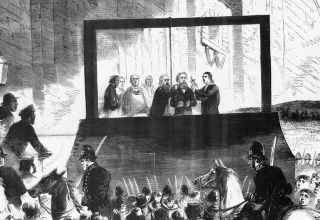
Barrett is executed outside the walls of Newgate Prison on May 26, 1868, before a crowd of two thousand who boo, jeer and sing “Rule, Britannia!” and “Champagne Charlie” as his body drops. His execution is the last public hanging to take place in England. The hangman is William Calcraft.
Until their transfer to the City of London Cemetery, Barrett’s remains lay for 35 years in a lime grave inside the walls of Newgate Prison. When the prison is demolished in 1903 his remains are taken to their present resting place. Today the grave is a place of Fenian pilgrimage and is marked by a small plaque.
After the explosion, the Prime Minister Disraeli advocates the suspension of the Habeas Corpus Act 1862 in Great Britain, as is already the case in Ireland. Greater security measures are quickly introduced. Thousands of special constables are enrolled to aid the police and at Scotland Yard a special secret service department is established to meet the Fenian threat. Although a number of people are arrested and brought to trial, Barrett is the only one to receive the death sentence.
Within days of the explosion, the Liberal Party leader, William Ewart Gladstone, then in opposition, announces his concern about Irish Nationalist grievances and says that it is the duty of the British people to remove them. Later, he says that it is the Fenian action at Clerkenwell that turned his mind towards Home Rule. When Gladstone discovers at Hawarden later that year that Queen Victoria had invited him to form a government, he famously states, “my mission is to pacify Ireland.”


 seamus dubhghaill