Crawford works as an engineer for White Star Line in the 1880s, before returning from Australia in 1892. In 1894 he enlists with the Mid Ulster Artillery regiment of the British Army, before being transferred to the Donegal Artillery, with which he serves during the Boer Wars, earning himself the rank of major.
In 1898, Crawford is appointed governor of Campbell College in Belfast. In 1911 he becomes a member of the Ulster Unionist Council. On September 28, 1912, he is in charge of the 2,500 well-dressed stewards and marshals that escort Edward Carson and the Ulster unionist leadership from the Ulster Hall in Belfast to the City Hall for the signing of the Ulster Covenant, which he is alleged to sign in his own blood. With the formation of the Ulster Volunteers in 1913, he is made their Director of Ordnance.
Crawford in regard to Irish Home Rule is strongly partisan and backs armed resistance in opposing it, being contemptuous of those who use political bluffing. In 1910 the Ulster Unionist Council plans for the creation of an army to oppose Home Rule, and approaches Crawford to act as their agent in securing weapons and ammunition. He tries several times to smuggle arms into Ulster, however vigilant customs officials seize many of them at the docks. Despite this, the meticulously planned and audacious Larne gun-running of April 1914, devised and carried out by Crawford, is successful in bringing in enough arms to equip the Ulster Volunteers.
By the 1920s Crawford remains as stoic in his belief’s remarking in a letter in 1920 that “I am ashamed to call myself an Irishman. Thank God I am not one. I am an Ulsterman, a very different breed.” In 1921 he attempts to create an organisation called the Ulster Brotherhood, the aims of which are to uphold the Protestant religion, political and religious freedom as well as use by all means to “destroy and wipe out the Sinn Féin conspiracy of murder, assassination and outrage.” However, this organisation only lasts completely unofficially for a few months after failing to gain acceptance with the political authorities. Also, in 1921 he is included in the Royal Honours List and granted a CBE. In 1934 he writes his memoirs, entitled Guns for Ulster.
Frederick Hugh Crawford dies November 5, 1952, and is buried in the City Cemetery, Falls Road, Belfast. Upon news of his death, he is described by the then Prime Minister of Northern Ireland, Sir Basil Brooke, as being “as a fearless fighter in the historic fight to keep Ulster British.”
(Pictured: Colonel Crawford is shown second from the left in this loyalist mural in East Belfast’s Ballymacarrett Road)
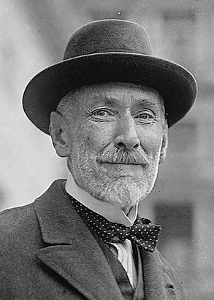
Threatened by lung trouble in 1879, Plunkett goes to the United States and spends ten years as a cattle rancher in the Bighorn Mountains of Wyoming. He returns to Ireland in 1889 and devotes himself to the agricultural cooperative movement, first organizing creameries and then, in 1894, the Irish Agricultural Organisation Society, a forerunner of similar societies in England, Wales, and Scotland. A moderate Unionist member of Parliament for South County Dublin from 1892 to 1900, he becomes vice president (1899–1907) of the new Department of Agriculture and Technical Instruction for Ireland, which he has been instrumental in creating.
Plunkett’s later experience convinces him of the need for the independence of an Ireland without partition inside the Commonwealth, and he fights strongly for this goal, as chairman of the Irish Convention (1917–18) and, in 1919, as founder of the Irish Dominion League and of the Plunkett Foundation for Cooperative Studies, an agricultural research and information centre. He is appointed to the first Senate of the Irish Free State (1922–23). His house in Dublin is bombed and burned during in the Irish Civil War and he lives in England thereafter. In 1924 the Plunkett Foundation also moves to England. In 1924 he presides over a conference in London on agricultural co-operation in the British Commonwealth and in 1925 he visits South Africa to help the movement there.
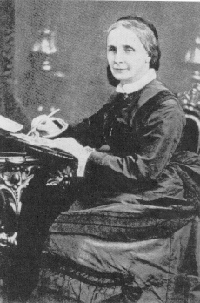
Lawless is born at Lyons Demesne below Lyons Hill, Ardclough, County Kildare. Her grandfather is Valentine Lawless, 2nd Baron Cloncurry, a member of the Society of United Irishmen and son of a convert from Catholicism to the Church of Ireland. Her father is Edward Lawless, 3rd Baron Cloncurry, thus giving her the title of “The Honourable.” In contrast, her brother Edward Lawless is a landowner with strong Unionist opinions, a policy of not employing Roman Catholics in any position in his household, and chairman of the Property Defence Association set up in 1880 to oppose the Irish National Land League and “uphold the rights of property against organised combination to defraud.” The prominent Anglo-Irish unionist and later nationalist, Home Rule politician Horace Plunkett is a cousin. Lord Castletown, Bernard FitzPatrick, 2nd Baron Castletown is also a cousin. It is widely believed that she is a lesbian and that Lady Sarah Spencer, dedicatee of A Garden Diary (1901) is her lover.
Lawless spends part of her childhood with the Kirwans of Castle Hackett, County Galway, her mother’s family, and draws on West of Ireland themes for many of her works. She occasionally writes under the pen name “Edith Lytton.”
Lawless writes nineteen works of fiction, biography, history, nature studies and poetry, many of which are widely read at the time. She is most famous today for her Wild Geese poems (1902).
Some critics identify a theme of noble landlord and noble peasant in her fourth book, Hurrish, a Land War story set in The Burren of County Clare which is read by William Ewart Gladstone and said to have influenced his policy. It deals with the theme of Irish hostility to English law. In the course of the book a landlord is assassinated, and Hurrish’s mother, Bridget, refuses to identify the murderer, a dull-witted brutal neighbour. The book is criticised by Irish-Ireland journals for its “grossly exaggerated violence,” it’s embarrassing dialect, staid characters.
Her reputation is damaged by William Butler Yeats who accuses her in a critique of having “an imperfect sympathy with the Celtic nature” and for adopting “theory invented by political journalists and forensic historians.” Despite this, Yeats includes her novels With Essex in Ireland (1890) and Maelcho (1894) in his list of the best Irish novels.
Emily Lawless dies at Gomshall, Surrey, on October 19, 1913. Her papers are preserved in Marsh’s Library in Dublin.
William Edward Hartpole Lecky, Irish historian and political theorist, is born at Newtown Park, near Dublin, on March 26, 1838. His major work is an eight-volume History of England during the Eighteenth Century.
In 1860, Lecky publishes anonymously a small book entitled The Religious Tendencies of the Age, but upon leaving college he turns to historiography. In 1861 he publishes Leaders of Public Opinion in Ireland, containing brief sketches of Jonathan Swift, Henry Flood, Henry Grattan, and Daniel O’Connell, originally anonymous and republished in 1871. The essay on Swift, rewritten and amplified, appears again in 1897 as an introduction to an edition of Swift’s works. Two surveys follow: A History of the Rise and Influence of Rationalism in Europe (2 vols., 1865), and A History of European Morals from Augustus to Charlemagne (2 vols., 1869). The latter arouses criticism, with its opening dissertation on “the natural history of morals.”
Lecky then concentrates on his major work, A History of England during the Eighteenth Century, Vols. i. and ii. which appear in 1878, and Vols. vii. and viii., which complete the work, in 1890. In the “cabinet” edition of 1892, in twelve volumes, A History of Ireland in the Eighteenth Century is separated out.
A volume of Poems (1891) is less successful. In 1896, he publishes two volumes entitled Democracy and Liberty, in which he considers modern democracy. The pessimistic conclusions at which he arrives provoked criticism both in the UK and the United States, which is renewed when he publishes in a new edition (1899) his low estimate of William Ewart Gladstone, then recently dead.
In The Map of Life (1899) Lecky discusses in a popular style ethical problems of everyday life. In 1903 he publishes a revised and enlarged edition of Leaders of Public Opinion in Ireland, in two volumes, with the essay on Swift omitted and that on O’Connell expanded into a complete biography. A critic of the methods by which the Act of Union is passed, Lecky, who grew up as a moderate Liberal, is opposed to Gladstone’s policy of Home Rule and, in 1895, he is returned to parliament as Unionist member for University of Dublin constituency in a by-election. In 1897, he is made a privy councillor, and among the coronation honours in 1902, he is nominated an original member of the new Order of Merit.
William Edward Hartpole Lecky dies in London on October 22, 1903.
Sadlier publishes roughly sixty novels and numerous stories in her lifetime. She writes for Irish immigrants in both the United States and Canada, encouraging them to attend mass and retain the Catholic faith. In so doing, Sadlier also addresses the related themes of anti-Catholicism, the Great Famine, emigration, and domestic work. Her writings are often found under the name Mrs. J. Sadlier.
Upon the death of her father, Francis, a merchant, Mary Madden emigrates to Sainte-Marthe, Quebec in 1844, where she marries publisher James Sadlier, also from Ireland, on November 24, 1846. Sadlier publishes much of her work in the family’s Catholic magazine, The Tablet. Sadlier experiences her most productive literary period after her marriage and is most creative after the time all of her children are born. While living in Canada, Sadlier publishes eighteen books — five novels, one collection of short stories, a religious catechism, and nine translations from the French — in addition to assorted magazine articles she contributes to the Pilot and American Celt free of charge. In New Lights (1853), Sadlier deals with the Great Famine for the first time. The book proves one of her most popular, going through at least eight editions in fifty years. In this novel, Sadlier focuses a polemical attack on the Protestant practice of converting Irish peasants by promising them soup but condemns peasant retaliation and violence.
In the early 1860s, the couple moves to New York City. The Sadlier’s New York home becomes the hub of literary activity in the Catholic community, and Sadlier also enjoys the company of the brightest Irish writers in the United States and Canada, including New York Archbishop John Hughes, editor Orestes Brownson, and Thomas D’Arcy McGee. She holds weekly salons in her Manhattan home, as well as her summer home on Far Rockaway on Long Island. Her closest friend is D’Arcy McGee, a poet, Irish nationalist exile and Canadian statesman known as one of the founding “Fathers of Confederation” who helps bring about Canada’s independence. McGee and Sadlier share an interest in a “national poetry” that does not only capture the spirit of a people but inspires them to political and national independence. While McGee, as a man, can take part in political rallies and organize Irish American support for Home Rule, Sadlier, as a woman, directs her support for Irish independence into literature. McGee’s biographer notes that Sadlier’s success inspires him to write emigrant novels and is planning a novel on this subject at the time of his assassination by an Irish American radical in 1868. His death is a crushing blow to Sadlier and her husband. Sadlier edits a collection of McGee’s poetry in 1869 in tribute to his memory.
Sadlier remains in New York for nine years before returning to Canada, where she dies in Montreal on April 5, 1903. In later years she loses the copyright to all her earlier works, many of which remain in print. One of Mary Anne’s daughters, Anna Theresa Sadlier, also becomes a writer.
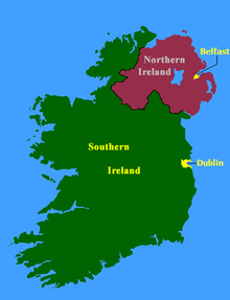
The Act is intended to establish separate Home Rule institutions within two new territories of Ireland – the six northeastern counties of Antrim, Armagh, Down, Fermanagh, Londonderry, and Tyrone are to form “Northern Ireland,” while the remaining 26 counties of the country are to form “Southern Ireland.” Each territory is to be self-governing, except in areas specifically reserved to the Parliament of the United Kingdom such as defence, foreign affairs, international trade, and currency. Provision is made for their future reunification under common Home Rule institutions.
Home Rule never takes effect in Southern Ireland due to the Irish War of Independence, which results instead in the Anglo-Irish Treaty and the establishment in 1922 of the Irish Free State. However, the institutions set up under this Act for Northern Ireland continue to function until they are suspended by the British parliament in 1972 as a consequence of the Troubles.
Patrick Henry Pearse, teacher, barrister, poet, writer, nationalist, and political activist who is one of the leaders of the 1916 Easter Rising, is born in Dublin on November 10, 1879. Pearse’s father, James, is a stone worker who works on church buildings in Dublin and his mother, Margaret, comes from a family that has endured the Great Famine in 1846 and has left County Meath for Dublin. Here she brings up four children, Patrick being the second. Pearse has a comfortable childhood as his father is in constant work.
It is at school that Pearse first develops a love of Irish history. He is also taught the Irish language for the first time and while still a teenager, Patrick joins the Gaelic League, an organisation that wants to promote the Irish language and Irish literature. Pearse graduates with a law degree from the King’s Inns and, in 1901, he starts a BA course in modern languages but is called to the Bar in Dublin.
Regardless of his law training, Pearse is more interested in what he is learning about Ireland as a nation. All his knowledge about law has been based around the English language and he wants to know more about what he considers to be the rightful language of Ireland. This is not the Gaelic used in Dublin. Pearse has convinced himself that the real Irish language is based in Connaught, and he teaches himself the dialect of the area. Connaught is also a region that has been severely affected by the Great Famine. Therefore, the number of people who speak what Pearse considers to be proper Gaelic have been greatly reduced. From 1903 to 1909, Pearse develops his involvement in the Gaelic League’s An Claidheamh Soluis (The Sword of Light) which seeks to expand the use of Gaelic in Irish life, and, in particular, literature.
By 1909, Pearse has developed some political leanings. He cannot accept the impact England, and all things English have on Ireland and the Irish people, but his concern is more for Irish culture rather than Irish politics. Pearse wants Irish history and culture taught as compulsory subjects in both Irish schools and colleges. He breaks with the Roman Catholic Church when its national college, St. Patrick’s College, Maynooth, demotes courses in Irish history/culture to topics for trainee priests. He is keen for Maynooth to have compulsory Irish courses simply because priests then have a major influence in the areas where they work. However, all of Pearse’s protests fall on deaf ears. As a result, he founds his own school in Dublin, an “Irish-Ireland” school called St. Enda’s School.
Between 1909 and 1912, Pearse becomes more interested and involved in politics. Despite a limited income and the problems of keeping St. Edna’s on an even financial keel, Pearse launches his own newspaper called An Barr Buadh (The Trumpet of Victory). At this time the Home Rule issue has reared its head again. Sinn Féin and other republican movements have far more impact than Pearse, who seems to many to be no more than a political maverick. Many feel that Pearse is out of his depths in politics and that his input into Irish politics is no more than romanticism with an Irish slant.
By 1913, Pearse has become more depressed about the way Ireland is going under the rule of London. Those who know him, describe him as becoming more and more melancholy as the year progresses. Others believe that he is becoming more fanatical. He helps to organise the Irish Volunteers, the public face of the outlawed Irish Republican Brotherhood, before the outbreak of World War I. In 1914, he is sent on a fund-raising tour of America by Clan na Gael, an organisation that aids the Irish Republican Brotherhood. While the tour is a reasonable success financially, not many Americans are swayed by Pearse’s speeches.
By the time World War I starts, Pearse has taken an extreme political stance. He wants full Irish independence – not what the suspended Home Rule Bill of 1912 offers. He does not support the part Ireland plays in the war effort. He also splits the Irish Volunteers. He takes a small number of these men with him when John Redmond gives his agreement to suspend the Home Rule Bill until the war is over. By now, Pearse has become extreme. He publishes a pamphlet called The Murder Machine which is a severe condemnation of the Irish educational system. He also realises that with London totally focused on the war in Europe, the time is ripe to overthrow British rule in Ireland.
However, in this respect, Pearse is totally wrong. The young men who have volunteered to fight in the war have done so because they want to. Pearse has no mass support in Ireland whereas John Redmond has far more public support in the south. He also assumes incorrectly that all those in southern Ireland are completely against British rule. What Pearse fails to recognise, is that many people in Dublin itself rely on the British for work. They may not like this, but work brings in money regardless of where or who it comes from.
Those who participate in the Easter Uprising of 1916 are in the minority. Pearse decides to take command of the rebellion, and he reads aloud the declaration of independence at the General Post Office. Pearse also is one of the signatories of “Poblacht na hÉireann” (To the People of Ireland).
If Pearse expects the actions of the rebels in Dublin to spark off other uprisings in other Irish cities and towns, he is mistaken. In Dublin, the people of the city fail to offer the rebels any support. In fact, some Dubliners take the opportunity of the rebellion to loot the shops in Sackville Street. The Uprising is doomed from the start.
During the rebellion, Pearse says, “When we are all wiped out, people will blame us for everything, condemn us…. (but) in a few years they will see the meaning of what we tried to do.” Ironically, he is correct in this assessment.
On Friday, April 28, 1916, Pearse surrenders to the British army. By the following day all the rebels have surrendered. As they are paraded through the streets of Dublin before going to Kilmainham Gaol, they are jeered and verbally abused by Dubliners who have seen parts of their city destroyed. They blame Pearse and his followers rather than the British.
At Kilmainham Gaol, Pearse is charged with treason by a military court and sentenced to death. On May 16, Pearse is shot by firing squad. Eventually fourteen other rebel leaders are also executed by firing squad. Pearse’s body, and those of the other leaders, are thrown into a pit without a coffin or a burial service. Ironically, it is in death that Pearse finds real fame.
No one knows the fate of the rebel leaders until after the executions. Many in Ireland are horrified at the way they have been treated. If Pearse had not received national support during his life, his movement certainly received it after his death. Pearse had written that he wanted his fame and deeds to “live after me.” In death, Patrick Pearse is known as the “First President of Ireland” and Irish history and culture become part of the educational system after 1922.
The Irish National Land League, one of the most important political organizations in Irish history which seeks to help poor tenant farmers, is founded at the Imperial Hotel in Castlebar, County Mayo, on October 21, 1879. Its primary aim is to abolish landlordism in Ireland and enable tenant farmers to own the land they work on. The national organization is modeled on the Land League of Mayo, which Michael Davitt had helped found earlier in the year.
At the founding meeting Charles Stewart Parnell is elected president of the league. Davitt, Andrew Kettle, and Thomas Brennan are appointed as honorary secretaries. This unites practically all the different strands of land agitation and tenant rights movements under a single organisation.
Parnell, Davitt, John Dillon, and others including Cal Lynn then go to the United States to raise funds for the League with spectacular results. Branches are also set up in Scotland, where the Crofters Party imitates the League and secures a reforming Act in 1886.
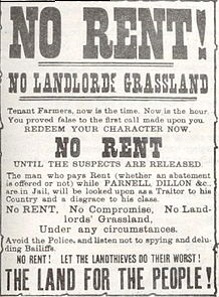
The government introduces the Landlord and Tenant (Ireland) Act 1870, which proves largely ineffective. It is followed by the marginally more effective Land Acts of 1880 and 1881. These establish a Land Commission that starts to reduce some rents. Parnell together with all of his party lieutenants including Father Eugene Sheehy, known as “the Land League priest,” go into a bitter verbal offensive and are imprisoned in October 1881 under the Protection of Person and Property Act 1881 in Kilmainham Gaol for “sabotaging the Land Act.” It is from here that the No-Rent Manifesto is issued, calling for a national tenant farmer rent strike until “constitutional liberties” are restored and the prisoners freed. It has a modest success In Ireland and mobilizes financial and political support from the Irish Diaspora.
Although the League discourages violence, agrarian crimes increase widely. Typically, a rent strike is followed by eviction by the police and the bailiffs. Tenants who continue to pay the rent can be subject to a boycott by local League members. Where cases go to court, witnesses would change their stories, resulting in an unworkable legal system. This in turn leads on to stronger criminal laws being passed that are described by the League as “Coercion Acts.”
The bitterness that develops helps Parnell later in his Home Rule campaign. Davitt’s views as seen in his famous slogan: “The land of Ireland for the people of Ireland” is aimed at strengthening the hold on the land by the peasant Irish at the expense of the alien landowners. Parnell aims to harness the emotive element, but he and his party are strictly constitutional. He envisions tenant farmers as potential freeholders of the land they have rented.
Daniel O’Connell, Irish political leader often referred to as The Liberator or The Emancipator, is born on August 6, 1775, at Carhan near Cahersiveen, County Kerry, to the O’Connells of Derrynane, a once-wealthy Roman Catholic family, that has been dispossessed of its lands.
Raised by his uncle, Daniel learns the Irish language and Irish lore in Kerry. O’Connell does part of his schooling in France during the revolution. On May 19, 1798, O’Connell is called to the Irish Bar and becomes a barrister. Four days later, the United Irishmen stage their rebellion which is put down by the British with great bloodshed. O’Connell does not support the rebellion. He believes that the Irish need to assert themselves politically rather than by force. The violent excesses he witnesses in France, the slaughter of the 1798 Rising, and finally his own killing of a man in a duel in 1815 leads him to renounce violence forever.
Moving into politics, O’Connell founds the Catholic Association in 1823, creating one of the first massive political movements in Europe or the Americas. The Catholic Association embraces other aims to better Irish Catholics, such as electoral reform, reform of the Church of Ireland, tenants’ rights, and economic development.
When he is elected to Parliament in 1828, he is unable to take his seat as members of parliament have to take the Oath of Supremacy, which is incompatible with Catholicism. Fear of the reaction of his millions of followers leads to the passage of the Roman Catholic Relief Act 1829. O’Connell works for Home Rule for Ireland for the rest of his days but never achieves it. The British ban his mass Repeal of the Union rallies in 1843 and jail him for a time. The movement loses momentum at that point and the long years of hard work wear “The Liberator” down.
O’Connell dies at the age of 71 of cerebral softening on May15, 1847, in Genoa, Italy, while on a pilgrimage to Rome. His time in prison seriously weakens him and the appallingly cold weather he has to endure on his journey is likely the final blow. According to his dying wish, his heart is buried in Rome at Sant’Agata dei Goti, then the chapel of the Irish College, and the remainder of his body in Glasnevin Cemetery in Dublin, beneath a round tower.
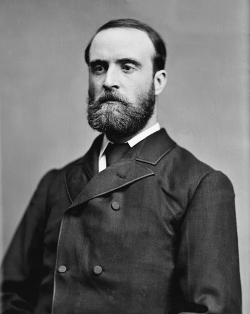
Born into a wealthy and powerful Anglo-IrishProtestant landowning family, Parnell enters the House of Commons in 1875. He is a land reform agitator and becomes leader of the Home Rule League in 1880, insisting on operating independently of the Liberals, and winning great influence by his balancing of constitutional, radical, and economic issues, and by his skillful use of parliamentary procedure. He is imprisoned in Kilmainham Gaol in 1882 but, being a very capable negotiator, is released when he renounces violent extra-Parliamentary action in an informal agreement, the Kilmainham Treaty, with British Prime Minister William Ewart Gladstone. That same year he reforms the Home Rule League as the Irish Parliamentary Party, which he controls minutely as Britain’s first disciplined democratic party.
The hung Parliament of 1885 sees him hold the balance of power between Gladstone’s Liberals and Lord Salisbury‘s Conservatives. His power is one factor in Gladstone’s adoption of Home Rule as the central tenet of the Liberal Party. His reputation peaks in 1889-1890 when letters published in The Times linking him to the Phoenix Park murders of 1882 are shown to have been forged by Richard Pigott. However, the Irish Parliamentary Party splits in 1890 after the revelation of Parnell’s long adulterous love affair, causing many English Liberals, many of them nonconformists, to refuse to work with him, and strong opposition from Catholic bishops. He heads a small minority faction until his death in 1891.
In describing Parnell, Gladstone says, “I do not say the ablest man; I say the most remarkable and the most interesting. He was an intellectual phenomenon.” Liberal leader H. H. Asquith calls him as one of the three or four greatest men of the 19th century, while Lord Haldane describes him as the strongest man the House of Commons has seen in 150 years. Historian A.J.P. Taylor says, “More than any other man he gave Ireland the sense of being an independent nation.”
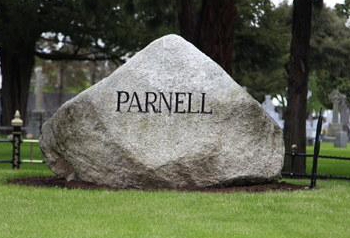
Charles Stewart Parnell dies of pneumonia at age 45 in his home at 10 Walsingham Terrace, Hove, England on October 6, 1891, in the arms of his wife Katharine. Though an Anglican, his funeral on October 11 is at the Irish National nondenominational Glasnevin Cemetery in Dublin and is attended by more than 200,000 people. His notability is such that his gravestone of unhewn Wicklow granite, erected in 1940, reads only “Parnell.”




 The
The 

 seamus dubhghaill