seamus dubhghaill

Promoting Irish Culture and History from Little Rock, Arkansas, USA


Leave a comment

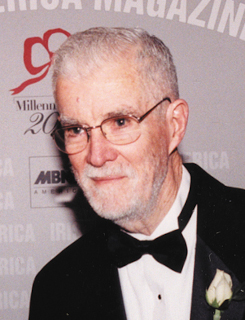
Death of Eoin McKiernan, Scholar of Irish Studies

eoin-mckiernan

Eoin McKiernan, early scholar in the interdisciplinary field of Irish Studies in the United States and the founder of the Irish American Cultural Institute (IACI), dies in Saint Paul, Minnesota on July 18, 2004. He is credited with leading efforts to revive and preserve Irish culture and language in the United States.

Born John Thomas McKiernan in New York City on May 10, 1915, McKiernan adopts the old Irish form of his name, Eoin, early in his life. While in college, he wins a scholarship to study Irish language in the Connemara Gaeltacht in the west of Ireland. In 1938, he marries Jeannette O’Callaghan, whom he met while studying Irish at the Gaelic Society in New York City. They raise nine children.

McKiernan attends seminary at Cathedral College of the Immaculate Conception and St. Joseph’s College in New York, leaving before ordination. He earns degrees in English and Classical Languages (AB, St. Joseph College, NY, 1948), Education and Psychology (EdM, UNH, 1951), and American Literature and Psychology (PhD, Penn State, 1957). Later in life, he is awarded honorary doctorates from the National University of Ireland, Dublin (1969), the College of Saint Rose, Albany (1984), Marist College, Poughkeepsie (1987) and the University of St. Thomas, Saint Paul (1996).

Passion for Irish culture is the dominant undercurrent of a distinguished teaching career in secondary (Pittsfield, NH, 1947–49) and university levels (State University of New York at Geneseo, 1949–59, and University of St. Thomas in Saint Paul, MN, 1959–72). McKiernan serves as an officer of the National Council of College Teachers of English, is appointed by the Governor of New York to a State Advisory Committee to improve teacher certification standards and serves as a Consultant to the U.S. Department of Education in the early 1960s.

McKiernan suggests to the Irish government in 1938 that a cultural presence in the United States would promote a deeper understanding between the two countries, but he eventually realises that if this is to happen, he will have to lead the way. His opportunity comes in 1962, when he is asked to present a series on public television. Entitled “Ireland Rediscovered,” the series is so popular that another, longer series, “Irish Diary,” is commissioned. Both series air nationwide. The enthusiastic response provides the impetus to establish the Irish American Cultural Institute (IACI) in 1962. In 1972 he resigns from teaching to devote his energy entirely to the IACI.

Under McKiernan’s direction, the IACI publishes the scholarly journal Eire-Ireland, with subscribers in 25 countries, and the informational bi-monthly publication Ducas. The IACI still sponsors the Irish Way (an immersion program for U.S. teenagers), several speaker series, a reforestation program in Ireland (Trees for Ireland), theatre events in both countries and educational tours in Ireland. He continues these educational Ireland tours well into his retirement. At his suggestion, the Institute finances the world premiere of A. J. Potter‘s Symphony No. 2 in Springfield, Massachusetts.

Troubled by the biased reporting of events in Northern Ireland in the 1970s, McKiernan establishes an Irish News Service, giving Irish media and public figures direct access to American outlets. In the 1990s, he is invited by the Ditchley Foundation to be part of discussions aimed at bringing peace to that troubled area and is a participant in a three-day 1992 conference in London dealing with civil rights in Northern Ireland. Organized by Liberty, a London civil rights group, the conference is also attended by United Nations, European Economic Community, and Helsinki representatives.

McKiernan also founds Irish Books and Media, which is for forty years the largest distributor of Irish printed materials in the United States. In his eighth decade, he establishes Irish Educational Services, which funds children’s TV programs in Irish and provided monies for Irish language schools in Northern Ireland. Irish America magazine twice names him one of the Irish Americans of the year. In 1999, they choose him as one of the greatest Irish Americans of the 20th century.

McKiernan dies on July 18, 2004, in Saint Paul, Minnesota. On his death, The Irish Times refers to him as the “U.S. Champion of Irish culture and history . . . a patriarch of Irish Studies in the U.S. who laid the ground for the explosion of interest in Irish arts in recent years.”


Leave a comment

President Mary Robinson Meets Queen Elizabeth II

robinson-elizabeth-visit-1993

Mary Robinson, the first female president of Ireland, becomes the first Irish head of state to meet with a British monarch when she visits Queen Elizabeth II on May 27, 1993.

For much of the 20th century, relations between Ireland and its nearest neighbour are cool. Temperatures drop significantly over the economic war in the 1930s and Ireland’s neutrality in World War II. The sense of unfinished business permeates diplomacy during the Troubles, but by 1990 there is significant warmth in trade, tourism, business and even politics.

The newly elected Robinson makes a big play of reaching out to Irish emigrants and sees the opportunity to help Anglo-Irish relations. And so, on her 49th birthday, she pops in for tea with the British head of state.

None of Robinson’s predecessors had set foot in Britain, other than to change planes. Even when President Patrick Hillery is invited to the wedding of Prince Charles and Lady Diana Spencer in 1981, he is advised by the Government of Ireland to decline the invitation.

But Robinson decides she will not be pushed around, and successfully insists she be allowed to join other heads of state at the opening of a European bank in London. Next, she asks the government if she might be able to travel to the University of Cambridge to deliver a speech and receive an honorary degree. It is only after he reluctantly agrees that Taoiseach Charlie Haughey realises that the Chancellor of the University is the Queen’s husband, Prince Philip.

Robinson meets the royal, the world remains on its axis, and a precedent is set. “Partly because I’ve never been fazed by royalty of any kind, least of all the British royal family, I felt entirely relaxed,” she recalls in her authorised biography.

Robinson next meets the prince at a memorial service for the victims of an Irish Republican Army (IRA) bombing in Warrington, where she is applauded as she leaves the church. Soon, she is meeting royals all over the place, at rugby matches and memorial ceremonies, and in a television interview says that she would like to meet the Queen.

By February 1993, Haughey has been replaced by Albert Reynolds and he grants permission for Robinson to travel for a strictly personal visit. The visit does not happen in a vacuum – Reynolds is in secret discussions with Republicans that would end in the IRA ceasefire – and the Taoiseach is keen not to give any suggestion that this is a State visit, which would require a reciprocal visit.

Robinson’s party arrives at Buckingham Palace at 4:55 PM on May 27 where they are greeted by the Queen’s private secretary, Sir Robert Fellowes. Robinson’s staff pushes the Palace to allow press photographers, reckoning that a historic moment should be captured.

Robinson, in an Ib Jorgensen fuchsia suit, later donated to Madame Tussauds waxworks, and her husband Nick are brought up to the first floor to meet the Queen for a friendly and informal tea party that lasts 30 minutes. They sip a blend of Chinese and India tea in Minton cups, exchange signed photographs of themselves, and discuss the prospects for peace. The President also hands over an extra present of a hand-turned wooden cup from Spiddal.

Afterwards, the ground-breaking photographs are taken and published all over the world, including the front page of the Irish Independent. “Palace Talks Prepare Way for State Visit” runs the lead headline over a piece by Bernard Purcell and Gene McKenna. They go on, reporting the President as saying the visit is “symbolic of the maturing relationship between Ireland and Britain.”

In 1996 President Robinson’s 15th visit to Britain is upgraded to an Official Visit, and she leaves office the following year.

Robinson’s successor, Mary McAleese, takes things further, and meets Queen Elizabeth II several times in London and at World War I commemorations on the continent. In May 2011 McAleese welcomes Queen Elizabeth II on her four-day State Visit to Ireland and in April 2014 President Michael D. Higgins makes the first State Visit to the UK.

(Pictured: President Mary Robinson with the Queen outside Buckingham Palace in 1993. Photo: Eamonn Farrell/Photocall Ireland | “Flashback 1993: The first Irish head of state meeting with a British monarch” by Ger Siggins, Independent.ie, May 22, 2016)


Leave a comment

Bill Clinton Begins Four Day Irish Visit

clinton-guildhall-square

Former U.S. president Bill Clinton begins a four-day visit to the Republic of Ireland and Northern Ireland on May 20, 2001 to try to advance the peace process. He spends time both north and south of the border, fulfilling engagements in Belfast, Derry, Enniskillen and Dublin.

Clinton’s goal is to use his influence to try to enhance the electoral fortunes of the parties that support the Good Friday Agreement, particularly David Trimble‘s Ulster Unionist Party, who are under pressure from Ian Paisley‘s anti-agreement Democratic Unionist Party (DUP).

Clinton arrives at Farranfore Airport, County Kerry, before heading to a round of golf at Ballybunion Golf Club with the former Irish deputy prime minister and Labour Party leader Dick Spring. He spends the night at Dromoland Castle, County Clare, before two days of public engagements in Dublin.

Trimble has vowed to quit as head of the Stormont Executive, where his party shares power with Sinn Féin, if the Irish Republican Party (IRA) has not started to get rid of its guns by July 1. Paisley, however, has accused Trimble and British Prime Minister Tony Blair of breaking their promises to the people of Northern Ireland by allowing into government a party linked to a terrorist group, without prior arms decommissioning.

While Clinton is no longer the most powerful man in the world, his charisma and his past efforts to keep the peace process moving are still appreciated by many. He receives Northern Ireland political leaders countless times at the White House and gives support and encouragement by phone during difficult periods of the peace talks.

Clinton delivers a lecture at Trinity College Dublin and attends a gala for peace and reconciliation at Dublin Castle, before travelling to Derry and then on to Belfast, where he receives an honorary degree from the former peace talks chairman George Mitchell, now chancellor of Queen’s University Belfast.

The leader of the Social Democratic and Labour Party (SDLP), John Hume, who welcomes Clinton to Derry, says the former president has done a great deal of good for all the people of Ireland. But the Democratic Unionist Party (DUP) deputy leader, Peter Robinson, claims that Clinton and Blair could have a negative effect on Trimble’s campaign. “As a unionist, I wouldn’t like to be sitting next to either of them just before an election,” he said. “Blair’s name is associated with the now-broken pledges he wrote on a board here just before the [Good Friday agreement] referendum, so for him to come over and moralise now won’t do much good. And Clinton is so disgraced and powerless that, while he might prop up the nationalist SDLP and Sinn Féin vote, he’ll have no impact on unionists voters.”

(Pictured: Bill Clinton and SDLP leader John Hume at public address at Guildhall Square in Derry. Sinn Féin leader Gerry Adams and Chelsea Clinton are in the second row.)


Leave a comment

The Battle of Culloden

culloden-moor-memorial

The Battle of Culloden, the final confrontation of the Jacobite rising of 1745 known in Scotland as simply “The ’45,” is fought on April 16, 1746. The Jacobite army of Charles Edward Stuart, also known as Bonnie Prince Charlie, is decisively defeated by a British government force under William Augustus, Duke of Cumberland, on Drummossie Moor near Inverness in the Scottish Highlands. It is the last pitched battle fought on British soil.

Charles is the eldest son of James Francis Edward Stuart, the exiled Stuart claimant to the British throne. Believing there is support for a Stuart restoration in both Scotland and England, he lands in Scotland in July 1745. The Jacobite Army is often assumed to have been largely composed of Gaelic-speaking Catholic Highlanders. In reality nearly a quarter of the rank and file are recruited in Aberdeenshire, Forfarshire and Banffshire, with another 20% from Perthshire. Although the army is predominantly Scots it contains a few English recruits plus significant numbers of Irish, Scottish and French professionals in French service with the Irish Brigade and Garde Écossaise.

After amassing his army of Scots Jacobite supporters, Charles takes Edinburgh by September and defeats a British government force at Prestonpans. The government recalls 12,000 troops from the Continent to deal with the rising. A Jacobite invasion of England reaches as far as Derby before turning back, having attracted relatively few English recruits.

The Jacobites, with limited French military support, attempt to consolidate their control of Scotland, whereby early 1746 they are opposed by a substantial government army. A scrambled Jacobite victory at Falkirk fails to change the strategic situation. With supplies and pay running short and with the government troops resupplied and reorganised under the Duke of Cumberland, son of British monarch George II, the Jacobite leadership has few options left other than to stand and fight. The two armies eventually meet at Culloden, on terrain that gives Cumberland’s larger, well-rested force the advantage.

The battle lasts only an hour, with the Jacobites suffering a bloody defeat with between 1,500 and 2,000 killed or wounded. Approximately 300 government soldiers are killed or wounded. While perhaps as many as 6,000 Jacobites remain in arms in Scotland, the leadership takes the decision to disperse, effectively ending the rising. The men of the combined Irish regiments, under the command of Brigadier Walter Stapleton, are the last off the field, covering the retreat of Prince Charles and the remnants of his army. The Irish had given their blood to the cause of a Stuart King for the last time. Most of the surviving Irish surrender at Inverness. The prince himself eventually manages to make his escape to France.

Culloden and its aftermath continue to arouse strong feelings. The University of Glasgow awards the Duke of Cumberland an honorary doctorate, but many modern commentators allege that the aftermath of the battle and subsequent crackdown on Jacobite sympathisers were brutal, earning Cumberland the sobriquet “Butcher.” Efforts are subsequently made to further integrate the comparatively undeveloped Scottish Highlands into the Kingdom of Great Britain. Civil penalties are introduced to undermine the Scottish clan system, which had provided the Jacobites with the means to rapidly mobilise an army.

Today, a visitor centre is located near the site of the battle. This centre is first opened in December 2007, with the intention of preserving the battlefield in a condition similar to how it was on April 16, 1746. One difference is that it currently is covered in shrubs and heather. During the 18th century, however, the area was used as common grazing ground, mainly for tenants of the Culloden estate. Those visiting can walk the site by way of footpaths on the ground and can also enjoy a view from above on a raised platform. Possibly the most recognisable feature of the battlefield today is the 20-foot-tall memorial cairn, erected by Duncan Forbes in 1881. In the same year Forbes also erects headstones to mark the mass graves of the clans.


Leave a comment

Birth of Sophie Bryant, Mathematician, Educator & Feminist

sophie-bryant

Sophie Willock Bryant, Anglo-Irish mathematician, educator, feminist and activist, is born Sophie Willock in Dublin on February 15, 1850.

Bryant’s father is Rev. Dr. William Willock DD, Fellow and Tutor of Trinity College, Dublin. She is educated at home, largely by her father. As a teenager she moves to London when her father is appointed Professor of Geometry at the University of London in 1863, and she attends Bedford College. At the age of nineteen she marries Dr. William Hicks Bryant, a surgeon ten years her senior, who dies of cirrhosis within a year.

In 1875 Bryant becomes a teacher and is invited by Frances Mary Buss to join the staff of North London Collegiate School. In 1895 she succeeds Buss as headmistress of North London Collegiate, serving until 1918.

When the University of London opens its degree courses to women in 1878, Bryant becomes one of the first women to obtain First Class Honours, in Mental and Moral Sciences, together with a degree in mathematics in 1881, and three years later is awarded the degree of Doctor of Science. In 1882 she is the third woman to be elected to the London Mathematical Society and is the first active female member, publishing her first paper with the Society in 1884. Together with Charles Smith, Bryant edits three volumes of Euclid‘s Elements, for the use of schools (Euclid’s Elements of Geometry, books I and II (1897); Euclid’s Elements of Geometry, books III and IV (1899); Euclid’s Elements of Geometry, books VI and IX (1901)).

Bryant is a pioneer in education for women. She is the first woman to receive a Doctor of Science in England, one of the first three women to be appointed to a Royal Commission, the Bryce commission on Secondary Education in 1894–1895, and one of the first three women to be appointed to the Senate of the University of London. When Trinity College Dublin opens its degrees to women, she is one of the first to be awarded an honorary doctorate. She is also instrumental in setting up the Cambridge Training College for Women, now Hughes Hall, Cambridge. She is also said to be one of the first women to own a bicycle.

Bryant is interested in Irish politics, writes books on Irish history and ancient Irish law (Celtic Ireland (1889), The Genius of the Gael (1913)), and is an ardent Protestant Irish nationalist. She is president of the Irish National Literary Society in 1914. She supports women’s suffrage but advocates postponement until women were better educated.

Bryant loves physical activity and the outdoors. She rows, cycles, swims, and twice climbs the Matterhorn. She dies at the age of 72 in a hiking accident in the Alps near Chamonix, France on August 14, 1922.


Leave a comment

Birth of Poet John Harold Hewitt

john-harold-hewitt

Poet John Harold Hewitt is born in Belfast on October 28, 1907. He is the most significant Belfast poet to emerge prior to the 1960s generation of Northern Irish poets that includes Seamus Heaney, Derek Mahon and Michael Longley.

After attending Agnes Street National School, Hewitt attends the Royal Belfast Academical Institution from 1919 to 1920 before moving to Methodist College Belfast, where he is a keen cricketer. In 1924, he starts an English degree at Queen’s University Belfast, obtaining a BA in 1930, which he follows by obtaining a teaching qualification from Stranmillis College, Belfast.

From November 1930 to 1957, Hewitt holds positions in the Belfast Museum & Art Gallery. His radical socialist ideals prove unacceptable to the Belfast Unionist establishment and he is passed over for promotion in 1953. Instead in 1957 he moves to Coventry, a city still rebuilding following its devastation during World War II. He is appointed Director of the Herbert Art Gallery & Museum where he works until retirement in 1972.

Hewitt is appointed the first writer-in-residence at Queen’s University Belfast in 1976. His collections includes The Day of the Corncrake (1969) and Out of My Time: Poems 1969 to 1974 (1974). He is also made a Freeman of the City of Belfast in 1983, and is awarded honorary doctorates at the University of Ulster and Queen’s University Belfast.

Hewitt has an active political life, describing himself as “a man of the left,” and is involved in the British Labour Party, the Fabian Society and the Belfast Peace League. He is attracted to the Ulster dissenting tradition and is drawn to a concept of regional identity within the island of Ireland, describing his identity as Ulster, Irish, British and European. He officially opens the Belfast Unemployed Resource Centre (BURC) Offices on May Day 1985.

John Hewitt dies in Belfast on June 22, 1987. His life and work are celebrated in two prominent ways – the annual John Hewitt International Summer School and, less conventionally, the John Hewitt Bar and Restaurant, a Belfast pub is named after him. The bar is named after him as he officially opens the Belfast Unemployed Resource Centre, which owns the establishment. It is a popular meeting place for local writers, musicians, journalists, students and artists. Both the Belfast Festival at Queen’s and the Belfast Film Festival use the venue to stage events.


Leave a comment

Bill Clinton Receives Honorary Doctorate at DCU

bill-clinton-receives-honorary-doctorate-dcu

Former United States president Bill Clinton is conferred with an honorary doctorate at Dublin City University on October 17, 2017, for his crucial role in the Northern Ireland peace process.

“It was really quite something, there’s never been any peace agreement exactly like it before,” says Clinton on the Good Friday Agreement. “It broke like a thunder cloud across the world and other people were fighting in other places and they had this talk to say ‘well really do I want to put our children’s generation through this? Or if they can pull this off after all those decades maybe we could too.’”

Clinton says universities should be a place for open discussion about if people should live in individual tribes, or as communities with shared values and respect for one another, especially in today’s political climate.

“It is no exaggeration to say that the success of the Northern Ireland peace process is in very many ways due to the fact that President Clinton took the view that it was a conflict that could be resolved by his personal input and by the power and influence of the United States of America,” said Gary Murphy, from the School of Law and Government in the president’s introductory citation.

“There can be little doubt that the conflict in Northern Ireland was ultimately resolved because that great beacon of liberty, the United States of America, decided that it could use its influence to make a vital difference. That fateful decision was taken in the Oval Office by President Bill Clinton.”

“There was no electoral gain for him taking it. If anything, his initial forays into the Northern Ireland peace process were greeted with skepticism by both republicans and unionists in Northern Ireland and by downright distrust and suspicion in the corridors of power in London. But Bill Clinton persevered, and thanks to that perseverance we have peace in Ireland today.”

Also celebrated at the ceremony is Dr. Martin Naughton, KBE, founder of Glen Electric and one of Ireland’s most successful entrepreneurs and business leaders. From humble roots in Newry, County Down he becomes the global leader in electric heating and credits his success to his family ethos of honesty, morality, decency and integrity.

Sr. Stanislaus Kennedy is awarded the honorary doctorate for her longstanding work with the homeless and marginalised. She is the founder of Focus Ireland, which is now the largest voluntary organisation in Ireland, and has written many books on mindfulness and the importance of spirituality.

“As president I am often asked why DCU awards honorary doctorates, but Ireland has no national honours system, so it’s important that we recognise and honour outstanding achievements and role model individuals,” says Brian MacCraith.

(From The College View, http://www.thecollegeview.com, October 22, 2017)


Leave a comment

Death of Actress Maureen Toal

maureen-toal

Maureen Toal, stage and television actress whose professional career lasts for more than sixty years, dies on August 24, 2012.

Toal is born in Fairview, Dublin on September 7, 1930. She begins performing at the Abbey Theatre in Dublin in 1946, when she is just sixteen years old. She becomes a fixture at the theater, portraying some of the strongest roles on the stage including Bessie Burgess in The Plough and the Stars and the Widow Quinn in The Playboy of the Western World. She also appears in several one woman shows, including Baglady, which is written by Irish playwright Frank McGuinness.

In 1952, Toal marries fellow Irish actor Milo O’Shea. They divorce in 1974.

Playwright John B. Keane writes the role of Mame Fadden in his play The Change in Mame Fadden specifically for Toal. Hugh Leonard also pens characters in his plays A Life and Great Big Blonde with the intention of casting Toal in the roles. Toal is best known to Irish television audiences for her role as Teasy McDaid on RTÉ One‘s Glenroe during the 1990s.

In 2010, Toal is awarded an honorary doctorate in literature at University College Dublin for which McGuinness delivers the citation, describing her as “our greatest actress.” He also praises her performances including Maggie in Arthur Miller‘s After the Fall and particularly her lead roles in his own plays, The Factory Girls and Baglady, where, he says, she tells the toughest of stories with devastating honesty. “Hers is the look out of which were fashioned the masks of comedy and tragedy.”

Maureen Toal dies in her sleep at her home in Sandycove, Dublin, on August 24, 2012, two weeks before her 82nd birthday. She is survived by her son, Colm O’Shea, two sisters, one brother, and three grandchildren.


Leave a comment

Birth of John Ireland, First Archbishop of St. Paul

John Ireland, the third Roman Catholic bishop and first Roman Catholic archbishop of Saint Paul, Minnesota, is born in Burnchurch, County Kilkenny, on September 11, 1838. He becomes both a religious as well as civic leader in Saint Paul during the turn of the 20th century.

Ireland is known for his progressive stance on education, immigration and relations between church and state, as well as his opposition to saloons and political corruption. He promotes the Americanization of Catholicism, especially in the furtherance of progressive social ideals. He is a leader of the modernizing element in the Roman Catholic Church during the Progressive Era. He creates or helps to create many religious and educational institutions in Minnesota. He is also remembered for his acrimonious relations with Eastern Catholics.

Ireland’s family immigrates to the United States in 1848 and eventually moves to Saint Paul, Minnesota, in 1852. One year later Joseph Crétin, first bishop of Saint Paul, sends Ireland to the preparatory seminary of Meximieux in France. Ireland is consequently ordained in 1861 in Saint Paul. He serves as a chaplain of the Fifth Minnesota Volunteer Infantry Regiment in the American Civil War until 1863 when ill health leads to his resignation. Later, he is famous nationwide in the Grand Army of the Republic.

Ireland is appointed pastor at Saint Paul’s cathedral in 1867, a position which he holds until 1875. In 1875, he is made coadjutor bishop of St. Paul and in 1884 he becomes bishop ordinary. In 1888 he becomes archbishop with the elevation of his diocese and the erection of the ecclesiastical province of Saint Paul. Ireland retains this title for thirty years until his death in 1918. Before Ireland dies, he burns all of his personal papers.

Ireland is awarded an honorary doctorate (LL.D.) by Yale University in October 1901, during celebrations for the bicentenary of the university.

Ireland is personal friends with Presidents William McKinley and Theodore Roosevelt. At a time when most Irish Catholics are staunch Democrats, Ireland is known for being close to the Republican party. He opposes racial inequality and calls for “equal rights and equal privileges, political, civil, and social.” Ireland’s funeral is attended by eight archbishops, thirty bishops, twelve monsignors, seven hundred priests and two hundred seminarians.

A friend of James J. Hill, Archbishop Ireland has his portrait painted in 1895 by the Swiss-born American portrait painter Adolfo Müller-Ury almost certainly on Hill’s behalf, which is exhibited at M. Knoedler & Co., New York, January 1895 and again in 1897.


Leave a comment

Birth of James Hamilton, First Governor of Northern Ireland

james-hamilton

James Albert Edward Hamilton, 3rd Duke of Abercorn, is born in Hamilton Place, Piccadilly, London, on November 30, 1869. Styled Marquess of Hamilton between 1885 and 1913, he is a British peer and Unionist politician. He serves as the first Governor of Northern Ireland, a post he holds between 1922 and 1945. He is a great-grandfather of Diana, Princess of Wales.

Hamilton is the eldest son of James Hamilton, 2nd Duke of Abercorn, and godson of the Prince of Wales. His mother, Lady Mary Anna, is the fourth daughter of Richard Curzon-Howe, 1st Earl Howe. He is educated at Eton College and subsequently serves first in the Royal Inniskilling Fusiliers until 1892 when he joins the 1st Life Guards. He is later transferred as major to the North Irish Horse.

In early 1901 he accompanies his father on a special diplomatic mission to announce the accession of King Edward to the governments of Denmark, Sweden and Norway, Russia, Germany, and Saxony.

In the 1900 general election, Hamilton stands successfully as Unionist candidate for Londonderry City, and three years later he becomes Treasurer of the Household, a post he holds until the fall of Arthur Balfour‘s Conservative administration in 1905. After serving for a time as an Opposition whip, Hamilton succeeds his father as third Duke of Abercorn in 1913. In 1922, he is appointed governor of the newly created Northern Ireland. He also serves as Lord Lieutenant of Tyrone from 1917 until his death, having previously been a Deputy Lieutenant for County Donegal. Abercorn proves a popular royal representative in Northern Ireland and is reappointed to the post in 1928 after completing his first term of office. In 1931, he declines the offer of the governor generalship of Canada, and three years later he is again reappointed governor for a third term. He remains in this capacity until his resignation in July 1945.

Abercorn is made the last non-royal Knight of the Most Illustrious Order of Saint Patrick in 1922. In 1928 he becomes a Knight of the Most Noble Order of the Garter and is also the recipient of an honorary degree from the Queen’s University Belfast. He receives the Royal Victorian Chain in 1945, the same year he is sworn of the Privy Council.

Abercorn marries Lady Rosalind Cecilia Caroline Bingham, only daughter of Charles Bingham, 4th Earl of Lucan and his wife Lady Cecilia Catherine Gordon-Lennox at St. Paul’s Church, Knightsbridge, on November 1, 1894. They have three daughters and two sons.

Abercorn dies at his London home on September 12, 1953, and is buried at Baronscourt in County Tyrone.