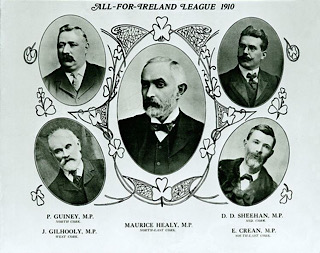
Guiney is the eldest son of Timothy Guiney, a shopkeeper and later clerk of Kanturkpoor law union, and Ellen Carver. He is educated at St. Patrick’s Monastery, Mountrath, County Laois. He serves three terms of imprisonment for activity in the Land War and later Plan of Campaign movement during the 1880s under the Coercion Act. He becomes a farmer and serves as councillor for Newmarket and on the Cork County Council (1908–11) as well as Chair of Newmarket Agricultural Society, Newmarket Gaelic League and Newmarket Old-Age Pensions Committee.
(Pictured: All-for-Ireland League group portrait of five of its Members of Parliament, in the “Cork Free Press”, 30 July 1910. These are: Patrick Guiney (North Cork), James Gilhooly (West Cork), Maurice Healy (North-east Cork), D. D. Sheehan (Mid Cork), and Eugene Crean (South-east Cork))
The eldest of the three sons and one daughter of Daniel Sheehan, tenant farmer, and his wife, Ellen (née Fitzgerald). He is educated at the local primary school. In his book Ireland since Parnell (1921) he states that witnessing the ragged poverty of labourers’ and smallholders’ children who attended the school made him determined to do something for the poor. The family’s Fenian tradition and his parents’ eviction from their holding in 1880 form his early years. At the age of sixteen he becomes a schoolteacher.
In 1890, Sheehan takes up journalism, serving as correspondent of the Kerry Sentinel and special correspondent of the Cork Daily Herald in Killarney. He also becomes correspondence secretary to the Kanturk trade and labour council, which campaigns on behalf of agricultural labourers. He manages to get reports of meetings into the Cork papers, and this helps the rapid spread of the association, which in 1890 becomes the Irish Democratic Trade and Labour Federation, under the leadership of Michael Davitt. It is, however, fatally disrupted by the Parnell split. While Sheehan continues to admire Davitt, and despite the pre-split Irish party leadership having opposed the federation as a threat to Charles Stewart Parnell‘s leadership, he becomes a Parnellite, and always remembers his only meeting with Parnell at Tralee, when the chief is presented with a loyal address (drafted by Sheehan) from his Killarney supporters. After Parnell’s death and the defeat of the Second Home Rule Bill, he temporarily drops out of Irish politics.
Following his marriage on February 6, 1894, to Mary Pauline O’Connor of Tralee, Sheehan joins the staff of the Glasgow Observer in pursuit of journalistic experience, then becomes editor of the Catholic News in Preston, Lancashire. In 1898, he returns to Ireland and works on various papers, including the Cork Constitution, before serving as editor of the Skibbereen-based Cork County Southern Star (1899–1901), where his Parnellism brings him into conflict with the Bishop of Ross, Denis Kelly. He expresses sympathy for the newly founded United Irish League (UIL), established by William O’Brien in Connacht with the dual aim of representing western smallholders and using a new land agitation as a vehicle for Irish Party reunion. He does not, however, join the UIL himself.
In August 1894, the Clonmel solicitor J. J. O’Shee, anti-Parnellite MP for West Waterford from 1895, forms the Irish Land and Labour Association (ILLA) to agitate on behalf of agricultural labourers and small tenant farmers. Its appearance reflects the breakdown of the centralised party discipline which had existed before the Parnell split, and recognition that the land war’s prime beneficiaries had been large and middle-sized tenant farmers rather than the nation as a whole. On returning from Britain in 1898, Sheehan throws himself into organising the ILLA and becomes its president. In 1900 there are 100 branches, mostly in Cork, Tipperary, and Limerick. The Irish Party leadership look on this organisation with some suspicion.
At the 1900 United Kingdom general election in Ireland Sheehan seeks the Irish Parliamentary Party (IPP) nomination for South Cork but was defeated by Edward Barry. After the death of Dr Charles Tanner, however, he succeeds in obtaining the IPP nomination for the constituency of Mid Cork, despite the party leadership’s attempts to deny recognition to ILLA branches in order to hand the nomination to its favoured candidate. Sheehan is elected unopposed on May 17, 1901. At the age of 28, he is the youngest Irish member of parliament. Although he has been admitted to the party, his position as a labour representative and his perceived independent base make him something of an outsider.
From October 1904 Sheehan allies himself with O’Brien, writing regularly for the latter’s weekly a TheIrish People. Redmondites accuse him of opportunism, but he always maintains that his personal inclination as an old Parnellite has been towards John Redmond and that his support for O’Brien derives from the older man’s willingness from 1904 to identify himself with the labourers’ campaign. Although their alliance originally likely contains elements of expediency, Sheehan and O’Brien develop a deep personal friendship.
Sheehan’s support for O’Brien leads to a split in the ILLA in 1906, with Tipperary and Waterford branches following O’Shee and Redmond, and Sheehan retaining the support of his Cork base and of some branches in Limerick and Kerry. He serves on the Cork advisory committee which represents tenant interests in land purchase negotiations under the Wyndham Land Act. It’s policy of “conference plus business” combines an offer to negotiate with willing landlords and a threat of agitation against those unwilling to give satisfactory terms. His faction of the ILLA becomes the basis for the grassroots organisation of O’Brien’s followers, and sporadic attempts, financed by O’Brien, are made to spread it outside its Munster base. Both factions of the ILLA claim credit for the passage of the 1906 and 1911 Labourers’ (Ireland) Acts which provide for the allocation of cottages and smallholdings to labourers. In Cork and some other parts of Munster these buildings become popularly known as “Sheehan’s cottages,” a term which long outlives Sheehan’s political career. He also helps to bring about the creation of a “model village” at Tower, near Blarney, the result of cooperation between the local ILLA branch and the rural district council.
At the 1906 general election the Redmond leadership attempts to avoid an open split by allowing O’Brien’s supporters to return unopposed. However, the continuing conflict between the two factions rapidly leads to a formal break. Shortly after the election Sheehan is excluded from the IPP, and thereby deprived of the parliamentary stipend paid to MPs with insufficient resources to maintain themselves. With the support of O’Brien and the small group of O’Brienite MPs, he maintains that the party has no right to exclude an elected MP willing to take the party pledge. After resigning his seat to which he was re-elected without opposition on December 31, 1906, he demands readmission to the party and mounts an unsuccessful lawsuit demanding payment of the stipend. He is subsequently supported from the proceeds of collections outside church gates on Sundays.
Sheehan and the other O’Brienite MPs are readmitted to the party in 1908 as part of an attempt at general reconciliation after the disruptions following the rejection of the Irish Council Bill. Dissensions rapidly reappear over Augustine Birrell‘s 1909 land act, which the O’Brienites see as wriggling out of the financial responsibilities accepted by the British government in the Wyndham land act and as sabotaging land purchase, since landlords will not accept the terms offered. Sheehan’s section of the ILLA is denied official recognition and thereby prevented from sending delegates to a party convention called to consider the bill. At the convention, groups of “heavies”recruited from Joseph Devlin‘s Ancient Order of Hibernians (AOH) exclude delegates with Cork accents, while O’Brienite speakers are howled down. This leads to the formation in March 1909 of the All-for-Ireland League (AFIL), a body based on the existing O’Brienite organisation and advocating O’Brien’s policy of gradually implementing home rule through step-by-step cooperation with moderate unionist supporters of devolution. Although O’Brien’s temporary retirement for health reasons in April 1909 leads to the suspension of the AFIL, it is revived in response to an attempted purge of the O’Brienite MPs by the leadership and by O’Brien’s reappearance in response to the January 1910 general election. Sheehan writes regularly for its paper, the Cork Free Press.
In the general election the O’Brienites hold their seats while two Cork Redmondites are displaced. Sheehan is re-elected for Mid Cork, defeating the Redmondite W. G. Fallon in a campaign marked by widespread rioting and impassioned clerical denunciations of Sheehan. Fallon subsequently attempts to get up a “red scare” against the ILLA. The Cork ILLA later splits over Sheehan’s slightly erratic leadership. While the split is initially personality-driven, the breakaway faction, led by Patrick Bradley and centred in east Cork, moves back toward alignment with Redmond. At the December 1910 election the AFIL consolidates its position in Cork, but is defeated everywhere else. Sheehan retains his Mid Cork seat against a local candidate but is defeated in a simultaneous contest in East Limerick. He is also defeated when he stands for Cork County Council in June 1911, though the AFIL wins control of that body.
Sheehan studies law at University College Cork (UCC) (1908–09), where he is an exhibitioner and prizeman, and at King’s Inns, where he graduated with honours. He is called to the bar in 1911 and practised on the Munster circuit. In 1913–14 he is active in the AFIL’s attempts to avert partition by trying to recruit sections of British political opinion in favour of a conference between the parties. He becomes vice-chairman of the Imperial Federation League. This receives considerable attention among the British political classes but contributes to the decline of the AFIL’s electoral base. The policy of conciliation has been driven to a considerable extent by the belief that it is the only way of achieving home rule. The abolition of the House of Lords’ veto and the introduction of the third home rule bill by the Asquith government undercuts this argument and increases Redmond’s prestige, while AFIL denunciations of Redmondism are seen as driven by personal resentment and playing into the hands of unionists. The decision of the AFIL MPs to abstain from supporting the bill on its final passage through the House of Commons in 1914 as a protest against the prospect of a partition-based compromise is represented by Redmondites as a vote against home rule itself and contributed to AFIL loss of Cork County Council in June 1914.
On the outbreak of World War I, Sheehan supports O’Brien in calling for Irish enlistment for foreign service. In November 1914, at the age of forty-two, he enlists himself and is gazetted as a lieutenant in the Royal Munster Fusiliers. It is claimed that he is almost single-handedly responsible for raising the 9th (service) battalion of this regiment. Three of his sons also enlist. Two of his sons are killed in action with the Royal Flying Corps, and a daughter is disabled by injuries received in an air raid while serving as a nurse. In the spring and summer of 1915 he organises and leads recruiting campaigns in Cork, Limerick, and Clare. This is part of a nationwide drive for recruits, aimed in particular at the farming community, which reflects the realisation that the war is going to last much longer than expected.
In 1915, Sheehan is promoted to the rank of captain and serves with his battalion on the Loos-en-Gohellesalient and at the Battle of the Somme, contributing a series of articles from the trenches to the London Daily Express. Various ailments, including deafness caused by shellfire, and hospitalisation necessitate his transfer to the 3rd Royal Munster Fusiliers (Reserve) Battalion, and he resigns his commission on January 13, 1918, due to ill health. In April 1918 he speaks at Westminster against the bill extending conscription to Ireland, threatening to resist it by force. One of his last parliamentary speeches (in October 1918) is in support of a bill providing land grants for Irish ex-servicemen. With the growth of Sinn Féin and the virtual demise of the AFIL, his position in Cork grows increasingly untenable. The Sheehan family faces intimidation and are obliged to leave their home on the Victoria Road for London, where he has secured the Labour Party nomination for the Limehouse–Stepney division of the East End, later represented by Clement Attlee.
Sheehan is unsuccessful in the 1918 United Kingdom general election, and is obliged to leave politics after a financially disastrous involvement in an Achill Island mining company leads to his bankruptcy. Unable to practise at the bar because of the hearing loss caused by his war service, he returns to journalism and becomes editor and publisher of TheStadium, a daily newspaper for sportsmen. In 1921, shortly before the Anglo-Irish truce, he publishes Ireland since Parnell, a history of recent events heavily dependent on the writings of O’Brien but incorporating some personal reminiscences. It concludes by blaming the outbreak of the IRA guerrilla campaign on provocation by Crown forces, denouncing reprisals, and pleading for British recognition of Dáil Éireann and dominion home rule for an undivided Ireland.
Sheehan moves to Dublin in 1926 after hearing that the threats against him have been lifted. His wife, who has never fully recovered from the stresses and bereavements she has experienced since 1914, dies soon afterward. Sheehan himself becomes managing editor of Irish Press and Publicity Services and, in 1928, publisher and editor of the South Dublin Chronicle. The paper gives critical support to the Irish Labour Party, publishes campaigning articles on slum conditions, and advocates housing reform. In September 1930, he is an unsuccessful Labour candidate for Dublin County Council. In the 1930s, as his health deteriorates further, he works as coordinator for the ex-servicemen’s group the Old Comrades’ Association, editing both northern and southern editions of its annual journal. In 1942, he offers himself to Richard Mulcahy as a Fine Gael candidate for Cork South-East, but is turned down. He dies on November 28, 1948, while visiting his daughter at Queen Anne Street, London. Both he and his wife are buried in Glasnevin Cemetery.
(From: “Sheehan, Daniel Desmond (‘D. D.’)” by Patrick Maume, Dictionary of Irish Biography, http://www.dib.ie, October 2009)
As a member of the Irish Parliamentary Party (IPP), Harrington represents Westmeath from February 1883 to November 1885. In 1885 he is elected for the new constituency of Dublin Harbour, which he represents until his death. He serves as Lord Mayor of Dublin three times from 1901 to 1904.
Harrington owns two newspapers, United Ireland and the Kerry Sentinel, and is a member of the so-called Bantry band of prominent nationalist politicians from the Bantry vicinity. They are also more pejoratively known as the Pope’s brass band. Tim Healy is another prominent member of this unofficial group.
In 1884, Harrington publishes a pamphlet, “Maamtrasna Massacres – Impeachment of the Trials,” in which he dismantles the Crown Prosecution’s case against the eight men accused of the murders of the Joyce family on August 17, 1882. He provides evidence that Crown Prosecutor George Bolton had deliberately suppressed evidence that would have acquitted Maolra Seoighe (English: Myles Joyce), who was hanged, and four men who were sentenced to twenty years of penal servitude.
Thereafter Harrington becomes excluded from Redmond’s closed circle of confidants, retains sympathy with O’Brien, and represents the interests of the tenant farmers at the 1902 Land Conference negotiations which lead to the enactment of the unprecedented WyndhamLand Purchase (Ireland) Act 1903.
On September 7, 1901, as the Lord Mayor of Dublin, Harrington kicks off at the official ceremony to open Bohemian F.C.‘s new home, Dalymount Park.
Harrington retains the party nomination for the Dublin Harbour constituency in the January 1910 United Kingdom general election, largely because of local divisions about who should succeed him and because an O’Brienite offer to pay his election expenses deters rivals from going to the polls. He decides that the finely balanced result of the general election means that every nationalist vote would be required at Westminster. He therefore travels to London, but shortly after attending the parliamentary party meeting on February 23 he suffers a stroke. After some days’ recuperation he is brought home to Dublin, but his condition deteriorates and he dies on March 12, 1910, at his home, 70 Harcourt Street. He is buried near the Parnell circle at Glasnevin Cemetery.
Harrington is celebrated by a statue erected in 2001 at the east end of Castletownbere near the Millbrook bar.
Thomas “Tom” Michael Kettle, parliamentarian, writer, and soldier, is born on February 9, 1880, in Artane, Dublin, the seventh among twelve children of Andrew Kettle, farmer and agrarian activist, and his wife, Margaret (née McCourt). His father’s record in nationalist politics and land agitation, including imprisonment in 1881, is a valuable political pedigree.
The family is prosperous. Kettle and his brothers attend Christian Brothers’ O’Connell School in Richmond Street, Dublin, before being sent to board at Clongowes Wood College, County Kildare. Popular, fiery, and something of a prankster, he soon proves to be an exceptional scholar and debater, as well as a keen athlete, cyclist, and cricketer. He enrolls in 1897 at University College Dublin (UCD), his contemporaries including Patrick Pearse, Oliver St. John Gogarty and James Joyce. He thrives in student politics, where his rhetorical genius soon wins him many admirers and is recognised in his election as auditor of the college’s Literary and Historical Society. He also co-founds the Cui Bono Club, a discussion group for recent graduates. In 1899, he distributes pro-Boer propaganda and anti-recruitment leaflets, arguing that the British Empire is based on theft, while becoming active in protests against the Irish Literary Theatre‘s staging of The Countess Cathleen by W. B. Yeats. In 1900, however, he is prevented from taking his BA examinations due to a mysterious “nervous condition” – very likely a nervous breakdown. Occasional references in his private diaries and notes suggest that he is prone to bouts of depression throughout his life. He spends the following two years touring in Europe, including a year at the University of Innsbruck, practising his French and German, before taking a BA in mental and moral science of the Royal University of Ireland (RUI) in 1902. He continues to edit the college newspaper, remaining active in student politics. He participates, for example, in protests against the RUI’s ceremonial playing of “God Save the King” at graduations as well as its senate’s apparent support for government policy, threatening on one occasion to burn publicly his degree certificate.
In 1903, Kettle is admitted to the Honourable Society of King’s Inns to read law and is called to the bar two years later. Nonetheless, he soon decides on a career in political journalism. Like his father, he is a keen supporter of the Irish Parliamentary Party (IPP), and in 1904 is a co-founder of the resonantly titled Young Ireland Branch of the United Irish League. Here he comes to the notice of John Redmond, who offers him the prospect of a parliamentary seat, but he chooses instead to put his energies into editing the avowedly pro-Irish-party paper, The Nationist, in which he promises that a home rule administration will uphold women’s rights, industrial self-sufficiency, and Gaelic League control of Irish education. He hopes that the paper will offer a corrective alternative to The Leader, run by D. P. Moran, but in 1905 he is compelled to resign the editorship due to an article thought to be anti-clerical. In July 1906, he is persuaded to stand in a by-election in East Tyrone, which he wins with a margin of only eighteen votes. As one of the youngest and most talented men in an ageing party, he is already tipped as a potential future leader. His oratory is immediately put to good use by the party in a propaganda and fund-raising tour of the United States, as well as on the floor of the House of Commons, where his oratorical skills earn him a fearsome reputation. He firmly advocates higher education for Catholics and the improvement of the Irish economy, while developing a close alliance with Joseph Devlin and the Ancient Order of Hibernians (AOH).
Kettle meanwhile makes good use of his connections to ArchbishopWilliam Walsh, the UCD Sodality of the Blessed Virgin Mary, and the Catholic Graduates and Undergraduates Association, as well as political support, to secure the professorship of national economics. T. P. Gill, of the Department of Agriculture and Technical Instruction, exceptionally acts as his referee. His detractors regard the appointment as a political sinecure and Kettle as a somewhat dilettantish “professor of all things,” who frequently neglects his academic duties. However, he takes a keen interest in imperial and continental European economies. He does publish on fiscal policy, even if always taking a pragmatic interest in wider questions, greatly impressing a young Kevin O’Higgins, later Vice-President of the Executive Council of the Irish Free State. He has little time for what he regards as the abstract educational and economic idealism of D. P. Moran. He acknowledges that the “Hungarian policy” of Arthur Griffith has contributed significantly to a necessary debate about the economy, but argues that the Irish are “realists,” that Ireland’s natural resources ought to be scientifically measured, and that the imperial connection is crucial to Ireland’s future development. The achievement of home rule would, he asserts, encourage a healthy self-reliance as opposed to naive belief in self-sufficiency.
Kettle is encouraged by the heightened atmosphere of the constitutional crisis over the 1909 David Lloyd Georgebudget, culminating in the removal of the House of Lords veto, which has been an obstacle to home rule. He is also a supporter of women’s enfranchisement, while stressing that the suffragist cause should not delay or deflect attention from the struggle for home rule. He holds his East Tyrone seat in the January 1910 United Kingdom general election but decides not to stand at the general election in December of the same year. Returning to an essentially journalistic career, he publishes a collection of essays outlining his constitutional nationalist position. He opposes suffragette attacks on private property, but, in contrast, supports the Dublin strikers in 1913, highlighting their harsh working and living conditions. He tries without success to broker an agreement between employers and workers though a peace committee he has formed, on which his colleagues include Joseph Plunkett and Thomas P. Dillon. His efforts are not assisted, however, by an inebriated appearance at a crucial meeting. Indeed, by this time his alcoholic excesses are widely known, forcing him to attend a private hospital in Kent.
In spite of deteriorating health, Kettle becomes deeply involved in the Irish Volunteers formed in November 1913 to oppose the Ulster Volunteers. His appraisal of Ulster unionism is somewhat short-sighted, dismissing it as being “not a party [but] merely an appetite,” and calling for the police to stand aside and allow the nationalists to deal with unionists, whose leaders should be shot, hanged, or imprisoned. These attitudes are mixed in with a developing liberal brand of imperialism based on dominion federalism and devolution, warmly welcoming a pro-home-rule speech by Winston Churchill with a Saint Patrick’s Day toast to “a national day and an empire day.” Nevertheless, he uses his extensive language skills and wide experience of Europe to procure arms for the Irish Volunteers. He is in Belgium when the Germans invade, and the arms he procured are confiscated by the Belgian authorities, to whom they were donated by Redmond on the outbreak of war.
On his return to Dublin, Kettle follows Redmond’s exhortation to support the war effort. He is refused an immediate commission on health grounds, but is eventually granted the rank of lieutenant, with responsibilities for recruitment in Ireland and England. He makes further enemies among the advanced nationalists of Sinn Féin, taunting the party for its posturing and cowardly refusal to confront Ulster unionists, the British Army, and German invaders alike. Coming from a staunchly Parnellite tradition, he is no clericalist, yet he is a devout if liberal Catholic, imbued by his Jesuit schooling with a cosmopolitan admiration for European civilisation which has been reinforced by his European travels, and in particular has been outraged by the German destruction of the ancient university library of Louvain. Despite a youthful flirtation with the philosophy of Friedrich Nietzsche, he comes to regard “Prussianism” as the deadliest enemy of European civilisation and the culture of the Ten Commandments, there not being “room on earth for the two.” He increasingly believes that the German threat is so great that Irish farmers’ sons ought to be conscripted to defend Ireland. He also believes that considerable good might come out of the conflict, exhorting voters in East Galway to support what is practically a future home rule prime minister, cabinet, and Irish army corps. He unsuccessfully seeks nomination as nationalist candidate in the 1914 East Galway by-election in December. Nevertheless, he continues to work tirelessly on behalf of the party, publishing reviews, translations, and treatises widely in such journals as the Freeman’s Journal, The Fortnightly Review, and the Irish Ecclesiastical Record.
As a recruiting officer based far from the fighting, Kettle is stung by accusations of cowardice from advanced nationalists. He had tried repeatedly to secure a front-line position, but was rejected, effectively because of his alcoholism. He is appalled by trench conditions and the prolongation of the war, a disillusionment further encouraged by the Easter Rising, in which his brother-in-law, Francis Sheehy-Skeffington, is murdered by a deranged Anglo-Irish officer, J. C. Bowen-Colthurst. He senses that opinion in Ireland is changing, anticipating that the Easter insurgents will “go down in history as heroes and martyrs,” while he will go down, if at all, as “a bloody British officer.” Nevertheless, he regards the cause of European civilisation as greater than that of Ireland, remaining as determined as ever to secure a combat role. Despite his own poor health and the continuing intensity of the Somme campaign, he insists on returning to his unit, the 9th Battalion, Royal Dublin Fusiliers.
Kettle’s writings demonstrate the mortal danger he is placing himself in, evident not least in his frequently quoted poem, “To my daughter, Betty, the gift of God,” as well as letters settling debts, apologising for old offences, and providing for his family – his wealth at death being less than £200. He has no death wish, wearing body armour frequently, but as Patrick Maume notes, “As with Pearse, there is some self-conscious collusion with the hoped-for cult.” He is killed on September 9, 1916, during the Irish assault on German positions at Ginchy.
Kettle marries Mary Sheehy, alumna of UCD, student activist, suffragist, daughter of nationalist MPDavid Sheehy, and sister-in-law of his friend Francis Sheehy Skeffington, on September 8, 1909. In 1913 the couple has a daughter, Elizabeth.
Kettle is commemorated by a bust in St. Stephen’s Green, Dublin, and in the House of Commons war memorial in London. He is a man of great passions and proven courage. George William Russell put his sacrifice on a par with Thomas MacDonagh and the Easter insurgents:
“You proved by death as true as they, In mightier conflicts played your part, Equal your sacrifice may weigh, Dear Kettle, of the generous heart (quoted in Summerfield, The myriad minded man, 187).
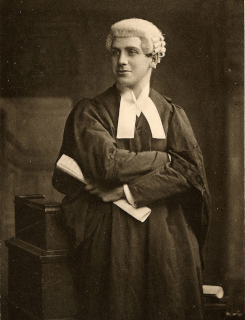
(From: “Kettle, Thomas Michael (‘Tom’)” by Donal Lowry, Dictionary of Irish Biography, http://www.dib.ie, October 2009 | Pictured: Tom Kettle as a barrister when called to the Irish law bar in 1905)
Together with his brother Norman, Leslie’s early education begins at home where a German governess, Clara Woelke, is their first teacher. As children the brothers have more contact with servants than they have with their parents. His own daughter, Anita, says, “In my parents’ view schools performed the same functions that kennels did for dogs. They were places where pets could be conveniently deposited while their owners travelled.”
Leslie is educated at Ludgrove School, then Eton College and King’s College, Cambridge. While at Cambridge University he becomes a Roman Catholic and a supporter of Irish Home Rule. He adopts an anglicised Irish variant of his name (“Shane”). Not overly impressed by Eton, as a lower boy he and his roommates occupy “an old, battered warren betwixt the chapel cemetery and Wise’s horse yard … [T]he food was wretched and tasteless … As for thrashings which tyrannised rather than disciplined our house, they were excessive. Bullying was endemic and Irish boys were ridiculed, especially on St Patrick’s Day.”
Leslie refuses to send his own sons to Eton. They are educated at Roman Catholic Benedictine schools: Jack at Downside School and Desmond at Ampleforth College.
During the war Leslie is in a British Ambulance Corps, until invalided out. He is then sent to Washington, D.C. to help the British Ambassador, Sir Cecil Spring Rice, soften Irish American hostility toward England and obtain American intervention in the war in the aftermath of the 1916 Easter Rising in Dublin and the execution of its leaders. But he also looks to Ireland for inspiration when writing and edits a literary magazine that contains much Irish verse. He becomes a supporter of the ideals of Irish nationalism, although not physical force republicanism.
In the 1918 United Kingdom general election in Ireland, the Irish Parliamentary Party loses massively to Sinn Féin, putting an end to Leslie’s political career, but as the first cousin of Winston Churchill he remains a primary witness to much that is said and done outside the official record during the negotiation of the Anglo-Irish Treaty of 1921. Disappointed, he feels unwanted in Ireland and abandoned by the British. Like many members of the landed gentry from the 1880s who were obliged to turn to other occupations, he can no longer rely on income from landholdings.
Leslie writes extensively, in a wide range of styles, in verse, prose, and polemic, over several decades. His writings include The End of a Chapter (1916), while hospitalised during World War I, The Oppidan (1922), a roman à clef about his life and contemporaries at Eton, an edition of the Letters of Herbert Cardinal Vaughan to Lady Herbert of Lea (1942), and a biography Mrs. Fitzherbert: a life chiefly from unpublished sources (1939), together with an edition of her letters (with Maria Anne Fitzherbert), The letters of Mrs. Fitzherbert and connected papers; being the second volume of the life of Mrs. Fitzherbert (1944). He also writes Mark Sykes: His Life and Letters (1923), a biography of the English traveler, Conservative Party politician and diplomatic advisor. He advises budding novelist Scott Fitzgerald on the title of his first novel, they share correspondence with the future Mnsg. William A. Hemmick, who is Fitzgerald’s teacher at the Newman School.
A passionate advocate of reforestation, Leslie finds the business of running an estate uncreative and boring, and transfers the estate entailed to him to his eldest son, John Norman Leslie, who succeeds as the 4th Baronet. He transfers St. Patrick’s Purgatory on Lough Derg to the Roman Catholic Bishop of Clogher, Eugene O’Callaghan.
The wealth of the Leslies wanes by the 1930s following the Wall Street crash of 1929 and a farm that is loss making. In his unpublished memoirs, Leslie writes “a gentleman’s standing in his world was signalled by his list of clubs and it was worth paying hundreds of pounds in subs.” They continue to maintain their lifestyle, involving attendance at the London season and the entertainment of distinguished visitors, including Anthony Eden at Glaslough. At the outbreak of World War II in 1939 he joins the Home Guard. He spends the remainder of his life between Glaslough and London.
Leslie’s first wife, Marjorie, dies on February 8, 1951. On May 30, 1958, at the Catholic Church of St. Peter & Edward, Westminster, he marries Iris Carola Frazer, who is the daughter of Charles Miskin Laing and Etheldreda Janet Laing.
Boland is born on September 16, 1870, at 135 Capel Street, Dublin, to Patrick Boland, businessman, and Mary Donnelly. Following the death of his mother in 1882, he is placed with his six siblings under the guardianship of his uncle, Nicholas Donnelly, auxiliary bishop of Dublin.
Boland is educated at two private Catholic schools, the Catholic University School, Dublin, and Birmingham Oratory in Birmingham, England, where he becomes head boy. His secondary education at the two schools help give him the foundation and understanding to play an influential role in the politics of Great Britain and Ireland at the beginning of the 20th century, when he is a member of the Irish Parliamentary Party, which pursues constitutional Home Rule.
In 1892, Boland graduates with a BA from London University. He studies for a semester in Bonn, Germany, where he is a member of Bavaria Bonn, a student fraternity that is member of the Cartellverband. He studies law at Christ Church, Oxford, graduating with a BA in 1896 and MA in 1901. Although called to the Bar in 1897, he never practises.
Boland is the first Olympic champion in tennis for Great Britain and Ireland at the first modern Olympics, which take place in Athens in 1896. He visits his friend Thrasyvoulos Manos in Athens during the Olympics, and Manos, a member of the organising committee, enters Boland in the tennis tournament. He promptly wins the singles tournament, defeating Friedrich Traun of Germany in the first round, Evangelos Rallis of Greece in the second, Konstantinos Paspatis of Greece in the semifinals, and Dionysios Kasdaglis of Greece in the final.
Boland then enters the doubles event with Traun, the German runner whom he had defeated in the first round of the singles. Together, they win the doubles event. They defeat Aristidis and Konstantinos Akratopoulos of Greece in the first round, have a bye in the semifinals, and defeat Demetrios Petrokokkinos of Greece and Dimitrios Kasdaglis in the final. When the Union Jack and the German flag are run up the flagpole to honour Boland and Traun’s victory, Boland points out to the man hoisting the flags that he is Irish, adding “It [the Irish flag]’s a gold harp on a green ground, we hope.” The officials agreed to have an Irish flag prepared.
Following a visit to County Kerry, Boland becomes concerned about the lack of literacy among the native population. He also has a keen interest in the Irish Language.
Boland’s patriotic stand is well received in nationalist circles in Ireland. This and a lifelong friendship with John Redmond gain for him an invitation to stand as a candidate for the Irish Parliamentary Party in the safe seat of South Kerry, which he holds from 1900 to 1918. He is unopposed in the general elections of 1900 and 1906, and the first of 1910. In the second election of 1910 he is challenged by a local man, T. B. Cronin, who stands as an independent nationalist in the interest of William O’Brien. Boland stands down at the 1918 United Kingdom general election.
In 1908, Boland is appointed a member of the commission for the foundation of the National University of Ireland (NUI). From 1926 to 1947, he is General Secretary of the Catholic Truth Society. He receives a papal knighthood, becoming a Knight of St. Gregory in recognition for his work in education. In 1950, he is awarded an honorary Doctor of Law by the NUI.
Boland marries Eileen Moloney at SS Peter and Edward, Palace Street, Westminster, on October 22, 1902, the daughter of an Australian Dr. Patrick Moloney. They have one son and five daughters. His daughter Honor Crowley succeeds her husband Frederick Crowley upon his death sitting as Fianna FáilTD for South Kerry from 1945 until her death in 1966. His daughter Bridget Boland is a playwright who notably writes The Prisoner and co-writes the script for Gaslight, and, among other books, co-authors Old Wives’ Lore for Gardeners with her sister, Maureen Boland.




 seamus dubhghaill