seamus dubhghaill

Promoting Irish Culture and History from Little Rock, Arkansas, USA


Leave a comment

Birth of William Pirrie, 1st Viscount Pirrie

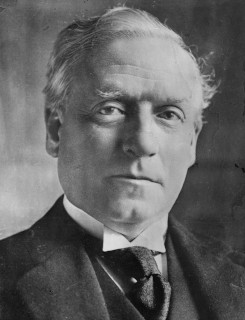
William James Pirrie, 1st Viscount PirrieKPPCPC (Ire), a leading British shipbuilder and businessman, is born on May 31, 1847, in Quebec City, Canada East, Province of Canada. He is chairman of Harland & Wolff, shipbuilders, between 1895 and 1924, and also serves as Lord Mayor of Belfast between 1896 and 1898.

Pirrie is taken back to Ireland when he is two years old and spends his childhood at Conlig House, also known as Little Clandeboye ConligCounty Down. Belonging to a prominent family, his nephews included J. M. Andrews, who later becomes Prime Minister of Northern IrelandThomas Andrews, builder of RMS Titanic, and Sir James Andrews, 1st Baronet, the Lord Chief Justice of Northern Ireland.

Pirrie is educated at the Royal Belfast Academical Institution before entering Harland & Wolff shipyard as a gentleman apprentice in 1862. Twelve years later he is made a partner in the firm, and on the death of Sir Edward Harland in 1895, he becomes its chairman, a position he holds until his death. As well as overseeing the world’s largest shipyard, he is elected Lord Mayor of Belfast in 1896, and is re-elected to the office as well as made an Irish Privy Counsellor the following year. He becomes Belfast’s first honorary freeman in 1898, and serves in the same year as High Sheriff of Antrim and subsequently of County Down. In February 1900, he is elected President of the UK Chamber of Shipping, where he had been vice-president the previous year. He helps finance the Liberals in Ulster in the 1906 United Kingdom general election, and that same year, at the height of Harland & Wolff’s success, he is raised to the peerage as Baron Pirrie, of the City of Belfast.

In 1907, Pirrie is appointed Comptroller of the Household to the Lord Lieutenant of Ireland, and in 1908 is appointed Knight of St Patrick (KP). Pro-Chancellor of Queen’s University of Belfast (QUB) from 1908 to 1914, he is also in the years before World War I a member of the Committee on Irish Finance as well as Lord Lieutenant of Belfast.

In February 1912, after chairing a famous meeting of the Ulster Liberal Association at which Winston Churchill defends the government’s policy of Home Rule for Ireland, Pirrie is jeered on the streets of Belfast, and assaulted as he boards a steamer in Larne: pelted with rotten eggs, herrings, and bags of flour. In 1910, the Ulster Liberal Association, an overwhelmingly Protestant body, with a weekly newspaper, and branch network throughout Ulster, adopts (in opposition to the Ulster Liberal Unionist Association) an explicitly pro-home rule position.

In the months leading up to the 1912 sinking of the RMS Titanic, Pirrie is questioned about the number of life boats aboard the Olympic-class ocean liners. He responds that the great ships are unsinkable and the rafts are to save others. This haunts him for the rest of his life. In April 1912, Pirrie is to travel aboard RMS Titanic, but illness prevents him.

During the war Pirrie is a member of the War Office Supply Board, and in 1918 becomes Comptroller-General of Merchant Shipbuilding, organising British production of merchant ships.

In 1921, Pirrie is elected to the Senate of Northern Ireland, and that same year is created Viscount Pirrie of the City of Belfast, in the honours for the opening of the Parliament of Northern Ireland in July 1921, for his war work and charity work. In Belfast he is, on other grounds, already a controversial figure: a Protestant employer associated as a leading Liberal with a policy of Home Rule for Ireland.

In March 1924, Pirrie, his wife, and her sister sail on a Royal Mail Steam Packet Company liner from Southampton on a business trip to South America. They travel overland from Buenos Aires to Chile, where they embark aboard the Pacific Steam Navigation Company‘s Ebro. Pirrie comes down with pneumonia in Antofagasta, and his condition worsens when the ship reaches Iquique. At Panama City two nurses embark to care for him. By then he is very weak, but insists on being brought on deck to see the canal. He admires how Ebro is handled through the locks.

Pirrie dies at sea off Cuba on June 7, 1924. His body is embalmed. On June 13, Ebro reaches Pier 42 on the North River in New York City, where Pirrie’s friend Andrew Weir, 1st Baron Inverforth and his wife meet Viscountess Pirrie and her sister. UK ships in the port of New York lower their flags to half-mast, and Pirrie’s body is transferred to Pier 59, where it is embarked on White Star Line‘s RMS Olympic, one of the largest ships Pirrie ever built, to be repatriated to the UK. He is buried in Belfast City Cemetery. The barony and viscountcy die with him. Lady Pirrie dies on June 19, 1935. A memorial to Pirrie in the grounds of Belfast City Hall is unveiled in 2006.

Leave a comment

Birth of Charles Lanyon, Civil Engineer & Architect

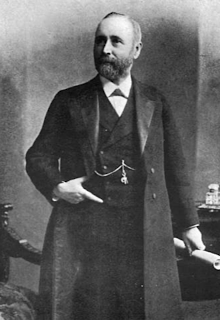
Sir Charles Lanyon, DL, JP, civil engineer and architect, is born on January 6, 1813, at Eastbourne, Sussex, England, third son of John Jenkinson Lanyon, purser in the Royal Navy, and Catherine Lanyon (née Mortimer). His work is most closely associated with Belfast, Northern Ireland.

Following his local education, Lanyon becomes an apprentice civil engineer with Jacob Owen in Portsmouth. When Owen is made senior Engineer and Architect of the Irish Board of Works and moves to Dublin, Lanyon follows. In 1835 he marries Owen’s daughter, Elizabeth Helen. They have ten children, including Sir William Owen Lanyon, an army officer and future administrator of the Transvaal in southern Africa.

Lanyon is county surveyor in County Kildare briefly, a post he exchanges for its equivalent in County Antrim, based in Belfast, when the incumbent, Thomas Jackson Woodhouse, resigns in 1836. By 1842, he has built the Antrim coast road between Larne and Portrush, through spectacular natural surroundings. He designs the lofty three-arched Glendun viaduct on this route near Cushendun, an early example of his versatile talent for monumental display as well as the Ormeau Bridge over the River Lagan. He remains county surveyor of Antrim until 1861 when he resigns from the post to concentrate on private work and other interests.

Lanyon is elected Mayor of Belfast in 1862, and Conservative MP for the city between 1865 and 1868. In 1868 he is also knighted and serves on the Select Committee on Scientific Instruction.

Lanyon loses his Belfast parliamentary seat in 1868 to William Johnston but continues to serve as a Belfast Town councillor until 1871. From 1862 to 1886 he is Belfast Harbour Commissioner. He serves as Deputy Lieutenant for County Antrim and is appointed High Sheriff of Antrim in 1876. He is also a Justice of the Peace for many years.

Lanyon’s other business interests include being director of the Blackstaff Flax Spinning Company and chairman of several railway companies. He is made director of the Northern Counties Railway in 1870 but resigns in 1887 because of ill-health. Alongside his business activities he is an active Freemason and serves as Provincial Deputy Grand Master of Belfast and North Down between 1863 and 1868, Provincial Deputy Grand Master of Antrim between 1868 and 1883 and Provincial Grand Master of Antrim between 1883 and 1889.

Lanyon lives at The Abbey, a grand house in Whiteabbey, County Antrim, which eventually becomes a sanitorium during World War I and is now part of Whiteabbey Hospital. His wife dies in 1858, and his son William dies from cancer at the age of 44 in 1887. He dies at The Abbey on May 31, 1889, and is buried in Knockbreda Cemetery, Belfast, in a tomb also of his design.


Leave a comment

Death of John Havelock Nelson, Composer & Conductor

John Havelock Nelson, composer and conductor, dies in Belfast, Northern Ireland, on August 5, 1996. He makes an immense contribution to the development of the cultural life of the province – and beyond – over the second half of the 20th century.

Nelson is born of middle-class parents in Cork, County Cork, on May 25, 1917, his distinctive forename being taken from a cousin of his mother who lost his life in World War I. Despite his birthplace, both his parents’ ancestral roots lie firmly in Northern Ireland.

Nelson’s father Robert comes from Larne, County Antrim, where he was raised. However, the early years of his mother Grace are quite eventful. She is born in the Belgian Congo on account of her father’s placement there as a missionary in the latter years of the 19th century (his family hail from Tobermore, County Londonderry). She is eventually sent home at an early age, due to the threat of malaria, and is raised in Belfast by an aunt and uncle who have no family of their own. It appears that Nelson inherits his musical genes from both parents. Although his father is trained as a chartered accountant, he is a capable baritone singer who studies in the early 1900s with C. J. Brennan, later to become the organist and choirmaster at St. Anne’s Cathedral, Belfast). Meanwhile, his mother shows talent as a pianist during her upbringing in her adopted city and by her early 20s is offering her services as an accompanist.

By chance, this is how his parents meet. They marry in 1916, shortly before their arrival in Cork where Robert takes up his first accountancy job. Within a month of Nelson’s birth, the family moves to Dublin where his father has secured a better post, eventually settling near Dún Laoghaire, just south of the capital city. From the age of five, now the eldest of four brothers born a year apart, he starts piano lessons and makes such rapid progress that, by the age of ten, he is able to play in a piano trio and to accompany his father in informal concerts. By the age of twelve, he wins a scholarship to the Royal Irish Academy of Music, Dublin, giving him the opportunity to study piano and theory and helping him to establish his core musical skills. Soon he adds conducting and organ lessons to his study programme.

As far as Nelson’s general education is concerned, this is completed at St. Andrew’s College, Dublin, where he excels in English, history and the sciences. By his late teens, he is determined to pursue a professional career as a musician. His father, however, exercises caution in this regard, advising him to take a science degree in the first instance. Consequently, he gains entry to Trinity College Dublin (TCD) in 1935 to read Natural Science, then makes a decision the following year to change to Medical Science. By 1939, he completes his primary degree in Medical Science, leading to doctoral research in bacteriology. At the same time, he begins a 4-year music degree at TCD while remaining musically active outside the university in relation to his piano studies, and also co-founds and conducts the Dublin Orchestral Players, a body that continues to provide an invaluable platform for amateur performers. He completes his university studies in 1943, graduating with a PhD in Medical Science and a primary Music degree. Seven years later he also completes a doctorate in Music from the same university.

His university career now behind him, like many fellow Irishmen, Nelson feels a desire to contribute to the World War II effort and applies for a commission in the medical branch of the Royal Air Force (RAF) in 1944. Eventually, he is called up and located at RAF Halton, Buckinghamshire, where he remains until after the end of the War, only returning to Dublin for his marriage in 1945. By nature, an outgoing, sociable person, he wastes no time in immersing himself in music-making activities when off duty, both inside and outside his RAF base. It is during this immediate post-war period that he becomes convinced that he wants to pursue a career in music. By chance, his attention is drawn to a BBC advertisement regarding a number of regional posts for staff accompanists, including Northern Ireland. His application is successful, and he reports for duty at BBC Northern Ireland in March 1947, where he remains for the next 30 years. In his new post, his main role is to play and accompany on the piano. To this end, he becomes involved in a number of new radio programmes, notably Children’s Hour. Elsewhere, he composes and arranges music for adult dramas and serials, the best known being The McCooeys. Another responsibility is to assist in auditioning local musicians for broadcasting opportunities, a process that uncovers much local talent, including a young James Galway. While his activities revolve around radio work in the 1950s, the next 20 years embrace opportunities arising from the new medium of television, including the popular Songs of Praise which involve him as conductor.

Nelson’s decision to retire from the BBC in 1977 enables him to focus fully on his free-lance career which had been running parallel, up until then, with his broadcasting work. In this capacity he is able to give full rein to his diverse range of musical skills as choral and orchestral conductor, chamber musician, music-festival adjudicator, composer and arranger. One should not overlook his role as animateur in founding the Studio Symphony Orchestra (1947) and the Studio Opera Group (1950). Both became integral parts of the local cultural scene during Nelson’s lifetime. His contribution as a festival adjudicator is an important activity, notably when undertaking tours abroad, including to Canada and the Caribbean. His visits to the latter area lead him to form the Trinidad and Tobago Opera Company shortly after his BBC retirement. In his busy lifestyle, he makes time to satisfy his creative energy as a composer and arranger. In total he publishes over 100 pieces, many inspired by his love of Irish traditional song and are of short duration and scored for a variety of vocal combinations. His enjoyment of his reputation as a piano accompanist of international standing is confirmed by his association with some of the leading Irish and British professional singers of the period, including Bernadette Greevy (soprano), Margaret Marshall (soprano), Peter Pears (tenor) and Ian Wallace (bass-baritone).

During his lifetime, Nelson’s outstanding services to music, both inside and outside the province, are recognised by a number of awards. The first of these is an OBE in 1966, followed in the latter part of his life by four honorary doctorates, three from local universities. A gifted and versatile musician, his personality is described by one colleague as “magnetic”- he has the unique ability to reach out to everybody irrespective of their age, status and position in life in whatever role he performs. In his best-known role as a conductor, a critic says of him that, “Dr. Nelson has a remarkable touch in getting people to do what he wants in the pleasantest way possible.” His vision and determination help to establish a vibrant music culture throughout Northern Ireland, an achievement that will remain his lasting legacy.

Nelson is survived by his three children and eight grandchildren; his wife Hazel having predeceased him in 1983.

(From: “John Havelock Nelson (1917-1996),” Dictionary of Ulster Biography, http://www.newulsterbiography.co.uk)


Leave a comment

Birth of Sir Edward Carson, Politician, Barrister & Judge

Edward Henry Carson, Baron Carson, Irish unionist politician, barrister and judge, known as the “uncrowned king of Ulster,” is born on February 9, 1854, at 4 Harcourt Street, in Dublin. He serves as the Attorney General and Solicitor General for England, Wales and Ireland as well as the First Lord of the Admiralty for the British Royal Navy.

Although Carson is to become the champion of the northern province, he is born into a Protestant family in southern Ireland. He is educated at Portarlington School, Wesley College, Dublin, and Trinity College Dublin, where he reads law and is an active member of the College Historical Society. He graduates BA and MA.

From 1877, early in his Irish legal career, he comes to mistrust the Irish nationalists. As senior Crown prosecutor, he sternly enforces the Criminal Law and Procedure (Ireland) Act 1887, securing numerous convictions for violence against Irish estates owned by English absentee landlords. He is appointed Solicitor-General for Ireland and elected to the British House of Commons in 1892, is called to the English bar at Middle Temple on April 21, 1893, and serves as Solicitor General for England and Wales from 1900 to 1905. During these years he achieves his greatest success as a barrister. In 1895, his cross-examination of Oscar Wilde largely secures the Irish writer’s conviction for homosexuality.

On February 21, 1910, Carson accepts the parliamentary leadership of the anti-Home Rule Irish Unionists and, forfeiting his chance to lead the British Conservative Party, devotes himself entirely to the Ulster cause. His dislike of southern Irish separatism is reinforced by his belief that the heavy industry of Belfast is necessary to the economic survival of Ireland. The Liberal government (1908–16) under H. H. Asquith, which in 1912 decides to prepare a Home Rule bill, cannot overcome the effect of his extra-parliamentary opposition. The Solemn League and Covenant of resistance to Home Rule, signed by Carson and other leaders in Belfast on September 28, 1912, and afterward by thousands of Ulstermen, is followed by his establishment of a provisional government in Belfast in September 1913. Early in that year he recruits a private Ulster army, the Ulster Volunteer Force, that openly drills for fighting in the event that the Home Rule Bill is enacted. In preparation for a full-scale civil war, he successfully organizes the landing of a large supply of weapons from Germany at Larne, County Antrim, on April 24, 1914. The British government, however, begins to make concessions to Ulster unionists, and on the outbreak of World War I he agrees to a compromise whereby the Home Rule Bill is enacted but its operation suspended until the end of the war on the understanding that Ulster’s exclusion will then be reconsidered.

Appointed Attorney General for England in Asquith’s wartime coalition ministry on May 25, 1915, Carson resigns on October 19 because of his dissatisfaction with the conduct of the war. In David Lloyd George’s coalition ministry (1916–22) he is First Lord of the Admiralty from December 10, 1916, to July 17, 1917, and then a member of the war cabinet as minister without portfolio until January 21, 1918.

Disillusioned by the Government of Ireland Act 1920 that partitions Ireland and establishes what is essentially a Home Rule parliament in Belfast, Carson declines an invitation to head the Northern Ireland government and resigns as Ulster Unionist Party leader in February 1921. Accepting a life peerage, he serves from 1921 to 1929 as Lord of Appeal in Ordinary and takes the title Baron Carson of Duncairn.

Carson retires in October 1929. In July 1932, during his last visit to Northern Ireland, he witnesses the unveiling of a large statue of himself in front of Parliament Buildings at Stormont. The statue is sculpted by Leonard Stanford Merrifield, cast in bronze and placed upon a plinth. The inscription on the base reads “By the loyalists of Ulster as an expression of their love and admiration for its subject.” It is unveiled by James Craig, 1st Viscount Craigavon, in the presence of more than 40,000 people.

Carson lives at Cleve Court, a Queen Anne house near Minster-in-Thanet in the Isle of Thanet, Kent, bought in 1921. It is here that he dies peacefully on October 22, 1935. A warship brings his body to Belfast for the funeral. Thousands of shipworkers stop work and bow their heads as HMS Broke steams slowly up Belfast Lough, with his flag-draped coffin sitting on the quarterdeck. Britain gives him a state funeral on Saturday, October 26, 1935, which takes place in Belfast’s St. Anne’s Cathedral. He remains the only person to have been buried there. From a silver bowl, soil from each of the six counties of Northern Ireland is scattered onto his coffin, which had earlier been covered by the Union Jack. At his funeral service the choir sings his own favourite hymn, “I Vow to Thee, My Country.”


Leave a comment

Execution of James Dickey, Member of the Society of United Irishmen

James Dickey, a young barrister from a Presbyterian family in Crumlin, County Antrim, in the north of Ireland, is hanged at Corn Market, Belfast, on June 26, 1798. He is active in the Society of United Irishmen and is hanged with Henry Joy McCracken for leading rebels at the Battle of Antrim.

The Society of United Irishmen is formed in October 1791 by leading citizens in Belfast who seek a representative government in Ireland based on principles they believe have been modelled by the American and French Revolutions. At their first meeting they embrace the argument of Theobald Wolfe Tone for a “brotherhood of affection” between Irishmen of all religious persuasions. Tone argues that in Ireland the landed Anglican Ascendancy and the English appointed Irish executive employ division between Protestants and Catholics to balance “the one party by the other, plunder and laugh at the defeat of both.”

Despairing of reform, and in the hope of French assistance, in May 1798, the United Irishmen take up arms against the Dublin government and the British Crown. Beginning in Kildare, the insurrection spreads to other counties in Leinster before finally reaching the Presbyterian districts surrounding Belfast. On June 5, the Antrim societies of United Irishmen meet in Templepatrick where they elect textile manufacturer Henry Joy McCracken as their General. The next day McCracken issues a proclamation calling for the United army of Ulster to rise. The initial plan meets with success, as the towns of Larne, Ballymena, Maghera and Randalstown are taken and the bridge at Toome is damaged to prevent the government rushing reinforcements into Antrim from west of the River Bann.

According to the memoirs of James Burns from Templepatrick, Dickey commands the insurgents at Randalstown and kills Samuel Parker, a “traitor, with his own hands, while standing at his own door, where he went for the purpose.”

McCracken leads a body of about 6,000 rebels in an attack on Antrim town. As promised, Catholic Defenders turn out, but in the march upon the town tensions with the Presbyterian United Irish causes some desertions and a delay in McCracken’s planned assault. McCracken’s men are defeated, and his army melts away. On June 15, Dickey, together with McCracken, James Hope, James Orr and about fifty other rebel survivors from Antrim, arrive at Slemish, near Ballymena. There they set up camp for three weeks before leaving under threat of attack from Colonel Green of the Tay Fencibles.

Dickey is captured by the Sutherland fencibles on Divis, a hill northwest of Belfast. He is court-martialed and hanged at Corn Market, Belfast on June 26, 1798. Famously, before his hanging he refuses to wear a black hood saying to the hangman, “Sir, don’t cover my face!” According to local legend he shouts, “Don’t think gentlemen, I am ashamed to show my face among you, I am dying for my country!” However, a loyalist source hostile to the United Irish cause, Henry Joy of the Belfast News Letter, has Dickey on the scaffold recanting his commitment to the “brotherhood of affection” between Catholic and Protestant. He supposedly warned the assembled that had “the Presbyterians of the north succeeded in their [republican] designs, they would ultimately have had to contend with the Roman Catholics.” It is testament to the sentiment that in the north is to largely expunge the memory of his, and McCracken’s, sacrifice.

Dickey is 22 years old at the time of his execution. His head is placed on a spike outside the Market House on Belfast’s High Street.

Dickey’s brother, John Dickey of Crumlin, is also implicated in the rebellion. He is informed on by neighbours who had noticed that he was making pikes and attending secret meetings of the United Irishmen late at night. Arrested and court-martialed, he refuses the terms granted by the government to the “State Prisoners” in Dublin. He is transported to the West Indies for penal servitude but manages to escape and makes his way to the United States.


Leave a comment

The Battle of Antrim

The Battle of Antrim is fought on June 7, 1798, in County Antrim during the Irish Rebellion of 1798 between British troops and Irish insurgents led by Henry Joy McCracken. The British win the battle, beating off a rebel attack on Antrim town following the arrival of reinforcements but the county governor, John O’Neill, 1st Viscount O’Neill, is fatally wounded.

The outbreak of the United Irish rebellion in Leinster on May 23 had prompted calls from Ulster United Irishmen to take to the field in support of their southern comrades. However, the organisation in Ulster had been severely damaged in a brutal disarmament campaign the previous year, and the new leadership are less radical and are not willing take to the field without French assistance, which is expected daily.

After waiting for two weeks while the rebellion rages in the south, the grassroots United Irish membership in Antrim decides to hold a number of meetings independent of their leaders. The outcome is the election of Henry Joy McCracken as their adjutant general and the decision to rise immediately. McCracken, together with James Hope, quickly formulate a plan to attack and seize all government outposts in County Antrim and then for the main attack to fall on Antrim town. Then using artillery seized at Antrim, the rebels are to march on Belfast in conjunction with the United Irish rebels in County Down.

McCracken has high hopes that many members of the militia will desert and join him, as disaffection is believed to be widespread, evidenced by the execution of four of the Monaghan militia for treason in Belfast in May.

On 6 June, McCracken and James Hope issue a proclamation calling for the United army of Ulster to rise. The initial plan meets with success, as the towns of Larne, Ballymena, Portaferry and Randalstown are taken and the bridge at Toome damaged to prevent the government from rushing reinforcements into Antrim from west of the River Bann. The rebels then assemble at Donegore Hill in preparation for the march and attack on Antrim town, where an emergency meeting of the county’s magistrates called by the county governor, Lord O’Neill, is due to take place.

Although almost 10,000 rebels assemble at Donegore, many display reluctance for the coming fight and stay on the hill in reserve or desert later so that probably fewer than 4,000 actually take part in the attack. The United Irishmen in Ulster are mostly Presbyterian, but are joined with Catholic Defenders and the tension between the two groups on the march likely causes some desertions. These difficulties lead to a loss of momentum, and the attack is delayed. McCracken is forced to make adjustments to his plan of attack, which had envisaged a simultaneous overwhelming assault on the town from four separate points.

The town is garrisoned by a small force of about 200 yeomen, cavalry under Lt. Col. William Lumley and armed volunteers but they also have four artillery pieces and the delay in the rebel attack allows them to send requests for assistance to Belfast and Lisburn from where reinforcements are already on the way. The garrison forms themselves at the base of the demesne wall of Antrim Castle, with artillery to the front and cavalry to the rear with their flanks anchored by the Market House and Presbyterian Meeting House. A part of the Scottish Quarter in the town is also burned by the garrison as it is perceived to be a stronghold of rebel sympathisers.

The attack finally begins shortly before 3:00 p.m. when the rebels begin a cautious march through the town. As rebel front ranks arrive to face the garrison’s defensive line, artillery opens fire on the rebels, causing them to pull back out of range. Large clouds of dust and smoke are thrown up which, together with the fires from the Scottish Quarter, obscure the garrison’s view of events.

The rebel withdrawal is mistaken for a full retreat and the cavalry moves out to pursue and rout the supposed fleeing rebels. The cavalry effectively runs into a gauntlet of rebels who are protected by a long churchyard wall and stationed in houses along the main street, suffering heavy losses to the gunfire and pikes of the rebels.

After routing the cavalry, the rebels attack the remainder of the garrison, which then begins to pull back to the safety of the castle wall. This is mistaken by a newly arrived rebel column as an attack on them, causing them to flee in panic. In the confusion, the county commander, Lord O’Neill, trapped with his magistrates, is fatally wounded by James Clements who avoids trial by joining the army. A rebel attempt to seize the artillery is only narrowly beaten off by troops stationed behind the demesne wall.

At this critical juncture, British reinforcements from Belfast arrive outside the town and, assuming it to be held by the rebels, begin to shell it with their artillery. This prompts more desertions and the rebel army begins to disintegrate, but their withdrawal is protected by a small band under James Hope which fights a successful rearguard action from the church grounds along the main street. This allows the bulk of the rebels to withdraw safely.

When the military enters the town, they begin a spree of looting, burning and murder, of which the most enthusiastic perpetrators are reported to be the Monaghan militiamen, who are anxious to prove their loyalty and expunge the shame of the recent executions of their comrades for sedition. The town of Templepatrick is burned to the ground and Old Stone Castle is razed to the ground. McCracken, Hope and their remaining supporters withdraw northward, establishing camps of ever dwindling size along the route of their retreat until news of the defeat at Ballynahinch causes their final dispersion. McCracken is arrested by yeomen on July 7 and is hanged in Belfast on July 17, having refused an offer of clemency in return for informing on his comrades.

Commemoration of the centenary of the battle, marked by a nationalist parade in Belfast on June 6, 1898, provokes loyalist riots.


Leave a comment

Death of Irish Writer Amanda McKittrick Ros

Anna Margaret Ross (née McKittrick), Irish writer known by her pen name Amanda McKittrick Ros, dies on February 2, 1939, at Larne, County Antrim, Northern Ireland. She publishes her first novel, Irene Iddesleigh, at her own expense in 1897. She writes poetry and a number of novels. Her works are not read widely, and her eccentric, over-written, “purple” circumlocutory writing is alleged by some critics to be some of the worst prose and poetry ever written.

Ros is born in Drumaness, County Down, on December 8, 1860, the fourth child of Eliza Black and Edward Amlave McKittrick, Principal of Drumaness High School. She is christened Anna Margaret at Third Ballynahinch Presbyterian Church on January 27, 1861. In the 1880s she attends Marlborough Teacher Training College in Dublin, is appointed Monitor at Millbrook National School, Larne, County Antrim, finishes her training at Marlborough and then becomes a qualified teacher at the same school.

During Ros’s first visit to Larne, she meets Andrew Ross, a widower of 35, who is station master there. She marries him at Joymount Presbyterian Church, Carrickfergus, County Antrim, on August 30, 1887.

Ros writes under the pen name Amanda McKittrick Ros, possibly in an attempt to suggest a connection to the noble de Ros family of County Down. She is strongly influenced by the novelist Marie Corelli. She writes, “My chief object of writing is and always has been, to write, if possible, in a strain all my own. This I find is why my writings are so much sought after.” She imagines “the million and one who thirst for aught that drops from my pen,” and predicts that she will “be talked about at the end of a thousand years.”

Ros’s “admirers” include Aldous Huxley, Siegfried Sassoon, C. S. Lewis and Mark Twain. The publication of her novel Irene Iddesleigh is financed by her husband in 1897 as a gift to her on their tenth wedding anniversary. Twain considers the novel “one of the greatest unintentionally humorous novels of all time.” A reader sends a copy of the novel to humorist Barry Pain, who in an 1898 review calls it “a thing that happens once in a million years,” and sarcastically terms it “the book of the century.” He reports that he is initially entertained, but soon “shrank before it in tears and terror.” Ros retorts in her preface to Delina Delaney by branding Pain a “clay crab of corruption,” suggesting that he is so hostile only because he is secretly in love with her. But Ros claims to make enough money from her second novel, Delina Delaney, to build a house, which she names Iddesleigh.

In Ros’s last novel, Helen Huddleson, all the characters are named after various fruits: Lord Raspberry, Cherry Raspberry, Sir Peter Plum, Christopher Currant, the Earl of Grape, Madame Pear. Of Pear, Ros writes, “she had a swell staff of sweet-faced helpers swathed in stratagem, whose members and garments glowed with the lust of the loose, sparkled with the tears of the tortured, shone with the sunlight of bribery, dangled with the diamonds of distrust, slashed with sapphires of scandals…”

Ros believes that her critics lack sufficient intellect to appreciate her talent and is convinced that they conspire against her for revealing the corruption of society’s ruling classes, thereby disturbing “the bowels of millions.”

Andrew Ross dies in 1917, and Ros marries Thomas Rodgers, a County Down farmer, in 1922.

Ros dies at the Royal Victoria Hospital in Belfast on February 2, 1939, under the name Hannah Margaret Rodgers.

Belfast Public Libraries have a large collection of manuscripts, typescripts and first editions of Ros’s work. Manuscript copies include Irene Iddesleigh, Sir Benjamin Bunn and Six Months in Hell. Typescript versions of all the above are held together with Rector Rose, St. Scandal Bags and The Murdered Heiress among others. The collection of first editions covers all her major works including volumes of her poetry, Fumes of Formation and Poems of Puncture, together with lesser-known pieces such as Kaiser Bill and Donald Dudley: The Bastard Critic. The collection includes hundreds of letters addressed to Ros, many with her own comments in the margins. Also included are typed copies of her letters to newspapers, correspondence with her admiring publisher T. S. Mercer, an album of newspaper cuttings and photographs, and a script for a BBC broadcast from July 1943.

A few enthusiasts have kept Ros’s legend alive. A biography, O Rare Amanda!, is published in 1954. A collection of her most memorable passages is published in 1988 under the title Thine in Storm and Calm. In 2007 her life and works are fêted at a Belfast literary festival.

Denis Johnston, the Irish playwright, writes a radio play entitled Amanda McKittrick Ros which is broadcast on BBC Home Service radio on July 27, 1943, and subsequently. The play is published in The Dramatic Works of Denis Johnston vol. 3. He acquires a collection of papers from Ros including the unfinished typescript of Helen Huddleson. These can now be seen as part of the Denis Johnston collection in the library of the Ulster University at Coleraine, Northern Ireland.


Leave a comment

Birth of George Henry Perrott Buchanan, Poet, Novelist & Journalist

George Henry Perrott Buchanan, poet, novelist, and journalist is born on January 9, 1904, in Kilwaughter, County Antrim, in what is now Northern Ireland.

Buchanan is the second child and younger of two sons and one daughter of the Rev. Charles Henry Leslie Buchanan (1863–1939) and Florence Buchanan (née Moore). He is educated at Larne Grammar School in Larne, County Antrim, Campbell College, Belfast, and Queen’s University Belfast (QUB). He works for the Northern Whig (1921) and is a founder member of the Northern Drama League, Belfast (1923). After moving to London, he joins The Daily Graphic, becomes a reviewer (1928–40) for The Times Literary Supplement, sub-editor (1930–35) of The Times, and columnist and drama critic (1935–38) for the News Chronicle.

During World War II, Buchanan serves as an operations officer in RAF Coastal Command (1940–45). His service includes a period in Sierra Leone, operational liaison with Free France in French Equatorial Africa, and night attacks on U-boats in the Bay of Biscay. After the war, he lives in Limavady, County Londonderry, Northern Ireland, for nearly ten years, which he later describes as a period of regeneration. During this time, he broadcasts for BBC Radio and becomes chairman of the NI town and country development committee (1949–53) and a member (from 1954) of the executive council of the European Society of Culture (Venice), and later president of its London centre.

A versatile writer with wide-ranging concerns, Buchanan publishes his first journal, Passage Through the Present, in 1932. It is followed by six novels, including A London Story (1935) and Naked Reason (1971). His plays include A Trip to the Castle (1960) and War Song (1965). The Politics of Culture (1977) is one of several collections of essays, and Green Seacoast (1959) and Morning Papers (1965) are autobiographical. His writing has been noted for its integrity and for the diversity of its ideas. Recurrent themes are the importance of common experience, living sensitively in the present, and the impoverishment of urban life. He believes in the power of ideas and the creative nature of journalism in the modern world. Despite his prosaic style, he writes poetry from his teenage years. It “was always the base from which everything else was motivated. . . [it] affected, and perhaps energised, everything I did. Its pressure led me to special attitudes in journalism, in the theatre, in the novel.” He publishes his first collection, Bodily Responses, in 1958. Other collections include Annotations (1970) and Inside Traffic (1976). In order to bring the variety of his work to a wider audience, Frank Ormsby devotes a supplement in the Honest Ulsterman (1978) to Buchanan, whom he believes is almost forgotten in Ireland and has been unjustly neglected.

Buchanan lives at 18A Courtnell Street, London W2. He marries four times, first to Winifred Mary Corn (1938-45), secondly to Noel Pulleyne Ritter (1949-51), thirdly to the Hon. Janet Hampden Margesson (1952-68), with whom he had two daughters, and fourthly to Sandra Gail McCloy (1974-89). He dies on June 28, 1989, in Richmond, London, and is cremated at Mortlake Crematorium, Richmond.

(From: “Buchanan, George Henry Perrott” by Helen Andrews, Dictionary of Irish Biography, http://www.dib.ie, October 2009 | Pictured: George Henry Perrott Buchanan by Howard Coster, 10 x 8 inch film negative, 1935, transferred from Central Office of Information, 1974)


Leave a comment

Birth of Robin Eames, Primate of All Ireland & Archbishop of Armagh

Robert Henry Alexander “Robin” Eames, Anglican Primate of All Ireland and Archbishop of Armagh from 1986 to 2006, is born in Belfast on April 27, 1936, the son of a Methodist minister.

Eames spends his early years in Larne, with the family later moving to Belfast. He is educated at the city’s Belfast Royal Academy and Methodist College Belfast before going on to study at Queen’s University Belfast, graduating LL.B. (Upper Second Class Honours) in 1960 and earning a Ph.D. degree in canon law and history in 1963. During his undergraduate course at Queen’s, one of his philosophy lecturers is his future Roman Catholic counterpart, Cahal Daly.

Turning his back on legal studies for ordination in the Church of Ireland, Eames embarks on a three-year course at the divinity school of Trinity College, Dublin in 1960, but finds the course “intellectually unsatisfying.” In 1963 he is appointed curate assistant at Bangor Parish Church, becoming rector of St. Dorothea’s in Belfast in 1966, the same year he marries Christine Daly.

During his time at St. Dorothea’s, in the Braniel and Tullycarnet area of east Belfast, Eames develops a “coffee bar ministry” among young people but is interrupted by the Troubles. He turns down the opportunity to become dean of Cork and in 1974 is appointed rector of St. Mark’s in Dundela in east Belfast, a church with strong family links to C. S. Lewis.

On May 9, 1975, at the age of 38, Eames is elected bishop of the cross-border Diocese of Derry and Raphoe. Five years later, on May 30, 1980, he is translated to the Diocese of Down and Dromore. He is elected to Down and Dromore on April 23 and that election is confirmed on May 20, 1980. In 1986, he becomes the 14th Archbishop of Armagh and Primate of All Ireland since the Church of Ireland’s break with Rome. It is an appointment that causes some level of astonishment among other church leaders.

Drumcree Church, a rural parish near Portadown, becomes the site of a major political incident in 1996, when the annual Orangemen‘s march is banned by the Chief Constable of the Royal Ulster Constabulary from returning to the centre of Portadown via the nationalist Garvaghy Road after attending worship at Drumcree Church. Public unrest and violence escalate over the next three summers as other parades come under first police and later commission sanction.

Eames, as diocesan bishop and civil leader finds himself immersed in the search for a resolution to the issue. Within the wider Church of Ireland there is unease as it is a broad church in theology and politics including within its congregations nationalists in the south and unionists in the north. Eames, along with the rector of Drumcree, has to navigate this political and social controversy and seeks political assistance to diffuse tension. Some bishops in the Republic of Ireland call for Eames to close the parish church, including Bishop John Neill who later becomes Archbishop of Dublin. He refuses to do so, believing this action could precipitate greater unrest and possible bloodshed.

Eames is, for many years, a significant figure within the general Anglican Communion. In 2003, the self-styled ‘divine optimist’ is appointed Chairman of the Lambeth Commission on Communion, which examines significant challenges to unity in the Anglican Communion. The Commission publishes its report, the Windsor Report, on October 18, 2004.

At the Church of Ireland General Synod in 2006 Eames announces his intention to retire on December 31, 2006. Church law permits him to continue as primate until the age of 75 but he resigns, in good health, at the age of 69. On January 10, 2007, the eleven serving bishops of the Church of Ireland meet at St. Patrick’s Cathedral in Dublin and elect Alan Harper, Bishop of Connor, as Eames’s successor.


Leave a comment

Introduction of the Third Home Rule Bill

Prime Minister of the United Kingdom Herbert Henry Asquith, a member of the Liberal Party, introduces the Third Home Rule Bill on April 11, 1912, which would provide self-government for Ireland, an apparent triumph for Nationalist leader John Redmond.

As a minority party after 1910 elections, the Liberal Party depends on the Irish vote, controlled by John Redmond. To gain Irish support for the budget and the parliament bill, Asquith promises Redmond that Irish Home Rule will be the highest priority. It proves much more complex and time-consuming than expected. Support for self-government for Ireland had been a tenet of the Liberal Party since 1886, but Asquith has not been as enthusiastic, stating in 1903 (while in opposition) that the party should never take office if that government would be dependent for survival on the support of the Irish Nationalist Party. After 1910, though, Irish Nationalist votes are essential to stay in power. Retaining Ireland in the Union is the declared intent of all parties, and the Nationalists, as part of the majority that keep Asquith in office, are entitled to seek enactment of their plans for Home Rule, and to expect Liberal and Labour support. The Conservatives, with die-hard support from the Protestant Orange Order of Ulster, are strongly opposed to Home Rule. The desire to retain a veto for the House of Lords on such bills has been an unbridgeable gap between the parties in the constitutional talks prior to the December 1910 United Kingdom general election.

The cabinet committee (excluding Asquith) that in 1911 plans the Third Home Rule Bill opposes any special status for Protestant Ulster within majority-Catholic Ireland. In 1913, Asquith writes to Winston Churchill, stating that the Prime Minister has always believed and stated that the price of Home Rule should be a special status for Ulster. In spite of this, the bill as introduced in April 1912 contains no such provision and is meant to apply to all Ireland. Neither partition nor a special status for Ulster is likely to satisfy either side. The self-government offered by the bill is very limited, but Irish Nationalists, expecting Home Rule to come by gradual parliamentary steps, favours it. The Conservatives and Irish Unionists oppose it. Unionists begin preparing to get their way by force if necessary, prompting nationalist emulation. Though very much a minority, Irish Unionists are generally better financed and more organised.

Since the Parliament Act the Unionists can no longer block Home Rule in the House of Lords, but only delay Royal Assent by two years. Asquith decides to postpone any concessions to the Unionists until the bill’s third passage through the House of Commons, when he believes the Unionists will be desperate for a compromise. Biographer Roy Jenkins concludes that had Asquith tried for an earlier agreement, he would have had no luck, as many of his opponents wanted a fight and the opportunity to smash his government. Sir Edward Carson, MP for the University of Dublin and leader of the Irish Unionists in Parliament, threatens a revolt if Home Rule is enacted. The new Conservative leader, Bonar Law, campaigns in Parliament and in Northern Ireland, warning Ulstermen against “Rome Rule,” that is, domination by the island’s Catholic majority. Many who oppose Home Rule feel that the Liberals have violated the Constitution by pushing through major constitutional change without a clear electoral mandate, with the House of Lords, formerly the “watchdog of the constitution,” not reformed as had been promised in the preamble of the 1911 Act and thus justified actions that in other circumstances might be treason.

The passions generated by the Irish question contrast with Asquith’s cool detachment, and he writes about the prospective partition of the county of Tyrone, which has a mixed population, deeming it “an impasse, with unspeakable consequences, upon a matter which to English eyes seems inconceivably small, and to Irish eyes immeasurably big.” As the House of Commons debate the Home Rule bill in late 1912 and early 1913, unionists in the north of Ireland mobilise, with talk of Carson declaring a Provisional Government and Ulster Volunteer Forces (UVF) built around the Orange Lodges, but in the cabinet, only Churchill views this with alarm.

These forces, insisting on their loyalty to the British Crown but increasingly well-armed with smuggled German weapons, prepare to do battle with the British Army, but Unionist leaders are confident that the army will not aid in forcing Home Rule on Ulster. As the Home Rule bill awaits its third passage through the House of Commons, the so-called Curragh incident occurs in March 1914. With deployment of troops into Ulster imminent and threatening language by Churchill and the Secretary of State for War, John Seely, around sixty army officers, led by Brigadier General Hubert Gough, announce that they would rather be dismissed from the service than obey. With unrest spreading to army officers in England, the Cabinet acts to placate the officers with a statement written by Asquith reiterating the duty of officers to obey lawful orders but claiming that the incident had been a misunderstanding. Seely then adds an unauthorised assurance, countersigned by Sir John French, the professional head of the army, that the government has no intention of using force against Ulster. Asquith repudiates the addition, and requires Seely and French to resign, taking on the War Office himself, retaining the additional responsibility until hostilities against Germany begin.

Within a month of the start of Asquith’s tenure at the War Office, the UVF lands a large cargo of guns and ammunition at Larne, but the Cabinet does not deem it prudent to arrest their leaders. On May 12, Asquith announces that he will secure Home Rule’s third passage through the House of Commons (accomplished on May 25), but that there will be an amending bill with it, making special provision for Ulster. But the House of Lords make changes to the amending bill unacceptable to Asquith, and with no way to invoke the Parliament Act on the amending bill, Asquith agrees to meet other leaders at an all-party conference on July 21 at Buckingham Palace, chaired by King George V. When no solution can be found, Asquith and his cabinet plans further concessions to the Unionists, but this does not occur as the crisis in Europe erupts into war.

In September 1914, after the outbreak of the conflict, Asquith announces that the Home Rule bill will go on the statute book as the Government of Ireland Act 1914 but will not go into force until after the war. He adds that in the interim a bill granting special status to Ulster will be considered. This solution satisfies neither side.

(Pictured: H.H. Asquith, former Prime Minister of the United Kingdom)