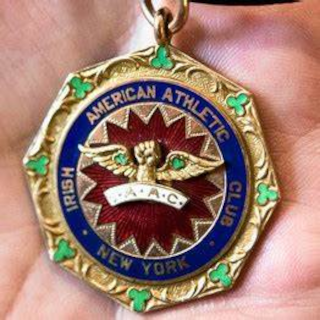
The Irish American Athletic Club, an amateur athletic organization based in Queens, New York, is established on January 30, 1898, originally as the Greater New York Irish Athletic Association. They shorten the name to the Irish American Athletic Club a few years later. They purchase a plot of land in what is then called Laurel Hill, Long Island, near Calvary Cemetery, Queens, and build a state-of-the-art athletic facility on what is farmland. The stadium, called Celtic Park, formally reopens after renovations on May 9, 1901, and until the facility is sold for housing in 1930, some of the greatest American athletes train or compete on Celtic Park’s track and field. The Irish American Athletic Club adopts a winged fist adorned with American flags and shamrocks as their emblem, with the Irish Gaelic motto “Láim Láidir Abú” or “A strong hand will be victorious,” and are often referred to as the “Winged Fists.” At one time they have clubs in Boston, Chicago, San Francisco and Yonkers, New York.
The Irish American Athletic Club is predominantly composed of Irish-born and first generation Irish American athletes, but many of the athletes who compete for the Winged Fist organization are neither.
The Irish American Athletic Club wins the Amateur Athletic Union national outdoor track and field team championship titles in 1904, 1906, 1907, 1908, 1910, 1911, 1912, 1913, 1914 and 1916. They also win the national indoor track and field team championship titles in 1906, 1908, 1909, 1911, 1913, 1914 and 1915. Individual athletes of the IAAC win 81 national outdoor championships titles and 36 individual national indoor championship titles.
In 1912–13, 1913–14, 1914–15 and 1916–17 the Irish American Athletic Club has a team, the New York Irish-Americans, represented in the American Amateur Hockey League. The team is coached by James C. “Jimmy” O’Brien and has on its roster for various seasons future NHL players Tom McCarthy and Moylan McDonnell. John McGrath and Patsy Séguin also play for the club.
Before the largest crowd that has ever assembled to see a track meet in the United States, on September 9, 1916, the Irish American Athletic Club defeats the New York Athletic Club at the Amateur Athletic Union’s National Championships, by a score of 38 to 27. Before a crowd of 30,000 spectators at Newark, New Jersey‘s Weequahic Park, the Irish American Athletic Club wins what is to be their last national championship title. The club disbands a year later when the United States becomes a combatant in World War I.
Jack “Legs” Diamond, an Irish Americangangster in Philadelphia and New York City during the Prohibition era also known as John Nolan and Gentleman Jack, is born in Philadelphia on July 10, 1897, to Sara and John Moran, who emigrated from Ireland to Philadelphia in 1891. A bootlegger and close associate of gambler Arnold Rothstein, he survives a number of attempts on his life between 1916 and 1931, causing him to be known as the “clay pigeon of the underworld.” In 1930, his nemesis Dutch Schultz remarks to his own gang, “Ain’t there nobody that can shoot this guy so he don’t bounce back?”
In 1899, Diamond’s younger brother Eddie is born. He and Eddie both struggle through grade school, and their mother suffers from severe arthritis and other health problems. She passes away on December 24, 1913, following complications brought on by a bacterial infection and a high fever. John Moran then moves his family to Brooklyn, New York.
Diamond soon joins a Manhattan street gang called the Hudson Dusters. His first arrest for burglary occurs when he breaks into a jewelry store on February 4, 1914. He serves in the United States Army in World War I but is convicted and jailed for desertion in 1918 or 1919. He serves two years of a three- to five-year sentence at Leavenworth Military Prison. After being released in 1921, he becomes a hired thug and later personal bodyguard for crime boss Arnold Rothstein.
Diamond is known for leading a rather flamboyant lifestyle. He is an energetic individual, his nickname “Legs” derived either from his being a good dancer or from how fast he could escape his enemies. His wife Alice is never supportive of his life of crime but does not do much to dissuade him from it. He is a womanizer, with his best-known mistress being a showgirl and dancer, Marion “Kiki” Roberts.
In the late 1920s, Prohibition is in force, and the sale of beer and other alcoholic beverages is illegal in the United States. Diamond travels to Europe to acquire beer and narcotics but fails. However, he does obtain liquor, which is dumped overboard in partially full barrels that float to Long Island as ships enter New York Harbor. He pays children a nickel for every barrel they bring to his trucks.
Following the death of Jacob “Little Augie” Orgen, Diamond oversees illegal alcohol sales in downtown Manhattan via the Hotsy Totsy Club, an establishment partly owned by Diamond on Broadway. This work brings him into conflict with Dutch Schultz, who wants to move beyond his base in Harlem. He also runs into trouble with other gangs in the city. On July 14, 1929, he and fellow gang member Charles Entratta shoot three drunken brawlers in the Hotsy Totsy Club. Two of the brawlers, William Cassidy and Simon Walker, are killed, while the survivor, Peter Cassidy, is severely wounded. The club’s bartender, three waiters, and the hat check girl vanish, with one of them being found shot dead in New Jersey. He is not charged but is forced to close the club.
In 1930, Diamond and two henchmen kidnap truck driver Grover Parks in Cairo, New York, demanding to know where he had obtained his load of hard cider. When Parks denies carrying anything, Diamond and his men beat and tortured Parks, eventually letting him go. A few months later, he is charged with the kidnapping of James Duncan. He is sent to Catskill, New York, for his first trial, but is acquitted. However, he is convicted in a federal case on related charges and sentenced to four years in jail. He is tried in December 1931 in Troy, New York, also for kidnapping, and is once again acquitted.
On August 23, 1930, Diamond, under the false name John Nolan, boards the ocean liner SS Belgenland, bound for Europe. The New York City Police Department (NYPD) suspect that he might have left the U.S. aboard RMS Olympic or RMS Baltic, but he is not found on either ship when they reach Europe. The NYPD then sends a wireless telegraph message to the crew of SS Belgenland, who reply that a man similar to Diamond’s description is among the passengers. Diamond spends much of the voyage in the ship’s smoking-room playing poker, with one report claiming that he won thousands of dollars in this game. The SS Belgenland‘s officers, however, refute this, saying his winnings were small.
The NYPD telegraphs police in England, France and Belgium with the warning that Diamond is an undesirable character. When SS Belgenland reaches Plymouth on August 31, Scotland Yard officers tell Diamond he will not be allowed to land in England. He tells reporters that he wants to travel to the French spa town of Vichy for “the cure.” He disembarks in Antwerp on September 1, where Belgian police take him to their headquarters. Eventually, he agrees to voluntarily leave Belgium and is put on a train to Germany. When his train reaches Aachen, German police arrest him. On September 6, the German government decides to deport Diamond. He is driven to Hamburg and put on the cargo ship Hannover for passage to Philadelphia.
On September 23, Hannover arrives in Philadelphia, and Diamond is immediately arrested by the Philadelphia police. At a court hearing that day, the judge says he will release him if he leaves Philadelphia within the hour. Diamond agrees.
On October 24, 1924, Diamond is shot and wounded by shotgun pellets, reportedly after trying to hijack liquor trucks belonging to a rival crime syndicate.
On October 16, 1927, Diamond tries to stop the murder of “Little Augie” Orgen. His brother Eddie is Orgen’s bodyguard, but Diamond substitutes for Eddie that day. As Orgen and he are walking down a street on Manhattan’s Lower East Side, three young men approach them and start shooting. Orgen is fatally wounded, and Diamond is shot twice below the heart. He is taken to Bellevue Hospital, where he eventually recovers. Police interview him in the hospital, but he refuses to identify any suspects or help the investigation in any way. Police initially suspect that he is an accomplice and charge him with homicide, but the charge is dropped. The assailants are supposedly hired by Lepke Buchalter and Jacob “Gurrah” Shapiro, who are seeking to encroach on Orgen’s garment-district labor rackets.
On October 12, 1930, Diamond is shot and wounded at the Hotel Monticello on Manhattan’s West Side. Two men force their way into his room and shoot him five times. Still in his pajamas, he staggers into the hallway and collapses. When asked later by the police commissioner how he managed to walk out of the room, he says he drank two shots of whiskey first. He is rushed to the Polyclinic Hospital, where he eventually recovers. He is discharged from Polyclinic on December 30, 1930.
On April 21, 1931, Diamond is arrested in Catskill on assault charges for the Parks beating in 1930. Two days later, he is released from the county jail on $25,000 bond. Five days later, he is again shot and wounded at the Aratoga Inn, a roadhouse near Cairo. After eating in the dining room with three companions, he is shot three times and collapses by the front door. A local resident drives him to a hospital in Albany, where he eventually recovers. On May 1, while he is still in the hospital, the New York State Police seize over $5,000 worth of illegal beer and alcohol from his hiding places in Cairo and at the Aratoga Inn.
In August 1931, Diamond and Paul Quattrocchi go on trial for bootlegging. The same month, he is convicted and sentenced to four years in state prison. In September 1931, he appeals his conviction.
On December 18, 1931, Diamond’s enemies finally catch up with him. He is staying in a rooming house on Dove Street in Albany while on trial for kidnapping in Troy. On the night of his acquittal, December 17, he and his family and friends visit a restaurant in Albany. At 1:00 a.m., he and mistress, Marion “Kiki” Roberts, entertain themselves at the Rain-Bo Room of the Kenmore Hotel on North Pearl Street.
At 4:30 a.m., Diamond drunkenly goes back to the rooming house and passes out on his bed. Two gunmen enter his room about an hour later. One man holds Diamond down and the other shoots him three times in the back of the head.
There is much speculation as to who is responsible for the murder. Likely candidates include Schultz, the Oley Brothers, the Albany Police Department, and relatives of Red Cassidy, another Irish American gangster at the time. According to author William Kennedy in his book O Albany, Dan O’Connell, who runs the local Democraticpolitical machine, orders Diamond’s execution, which is carried out by the Albany police.
Given the power that the O’Connell machine holds in Albany and its determination to prevent organized crime, other than their own, from threatening their monopoly of vice in the city, some accept this account of the story. For those believing this theory, William Fitzpatrick’s promotion to chief of police is said to be a reward for executing Diamond. In 1945, Chief Fitzpatrick is shot and killed in his own office by John McElveney, an Albany police detective. McElveney is sentenced to 20 years to life in prison. He is released in 1957 when his sentence is commuted by GovernorW. Averell Harriman.
On December 23, 1931, Diamond is buried at Mount Olivet Cemetery in Maspeth, Queens. There is no church service or graveside ceremony. Family and spectators numbering 200 attend the interment. No criminal figures are spotted.
On July 1, 1933, Alice Kenny Diamond, Diamond’s 33-year-old widow, is found shot to death in her Brooklyn apartment. It is speculated that she is shot by Diamond’s enemies to keep her quiet.
Cooney is encouraged to become a professional fighter by his father. His brother, Tommy Cooney, is also a boxer and reaches the finals of the New York Golden Gloves Sub-Novice Heavyweight division. His grandparents lived in Placentia, Newfoundland, in Canada.
Fighting as an amateur, Cooney wins international tournaments in England, Wales, and Scotland, as well as the New York Golden Gloves titles. He wins two New York Golden Gloves Championships, defeating Larry Derrick to win the 1973 160-lb Sub-Novice Championship and Earlous Tripp to win the 1976 Heavyweight Open Championship. In 1975 he reaches the finals of the 175-lb Open division, but is defeated by Johnny Davis. He trains at the Huntington Athletic Club in Long Island, New York, where his trainer is John Capobianco. His amateur record consists of 55 wins and 3 losses.
When Cooney turns professional, he signs with co-managers Mike Jones and Dennis Rappaport. He is trained by Victor Valle. Known for his big left-hook and his imposing size, he has his first paid fight on February 15, 1977, beating Billy Jackson by a knockout in one round. Nine wins follow and he gains attention as a future contender, although his opponents are carefully chosen. He moves up a weight class and fights future world cruiserweight champion S. T. Gordon in Las Vegas, winning by a fourth round disqualification. He has eleven more wins, spanning 1978 and 1979. Among those he defeats are Charlie Polite, former U.S. heavyweight champion Eddie Lopez, and Tom Prater. These are not rated contenders, however.
By 1980, Cooney is being featured on national television. Stepping up, he beats one-time title challengers Jimmy Young and Ron Lyle, both by knockout. The Young fight is stopped because of cuts sustained by Young. By then Cooney is ranked number 1 by the World Boxing Council (WBC) and eager for a match with champion Larry Holmes.
In 1981, Cooney defeats former world heavyweight champion Ken Norton by knockout just 54 seconds into the first round with a blisteringly powerful attack. This ties the record set in 1948 by Lee Savold for the quickest knockout in a main event in Madison Square Garden. Since his management team is unwilling to risk losing a big future pay day with Holmes by having him face another viable fighter, Cooney does not fight for 13 months after defeating Norton.
The following year, Holmes agrees to fight Cooney with the fight held on June 11, 1982. With a purse of ten million dollars for the challenger, it is the richest fight in boxing history to that time. The promotion of the fight takes on racial overtones that are exaggerated by the promoters, something Cooney does not agree with. He believes that skill, not race, should determine if a boxer is good. However, if he wins, he would become the first Caucasian world heavyweight champion since SwedeIngemar Johansson defeated Floyd Patterson 23 years earlier. Don King calls Cooney “The Great White Hope.” The bout draws attention worldwide, and Larry Holmes vs. Gerry Cooney is one of the biggest closed-circuit/pay-per-view productions in history, broadcast to over 150 countries.
Cooney fights bravely after he is knocked down briefly in the second round. He is fined three points for repeated low blows. After 12 rounds, the more skillful and experienced Holmes finally wears him down. In round 13, his trainer, Victor Valle, steps into the ring, forcing the referee to stop the fight. Two of the three judges would have had Cooney ahead after the 12th round if it were not for the point deductions. He and Holmes become friends after the fight, a relationship that endures for them. On December 14, 1982, he fights Harold Rice, the heavyweight champion of Connecticut, in a four-round bout. No winner is declared, so he tells the crowd following the bout, “This is only an exhibition. I’m sorry if I disappointed anybody. I’m trying to work myself back in shape so I can knock out Larry Holmes. Everything is OK. I felt a little rusty, but that is normal. It has been a while. I felt good in front of the people.”
After a long layoff, Cooney fights in September 1984, beating Phillip Brown by a 4th-round knockout in Anchorage, Alaska. He fights once more that year and wins, but personal problems keep him out of the ring.
Although Cooney fights only three official bouts in five years following his loss to Holmes, in 1987 he challenges former world heavyweight and world light heavyweight champion Michael Spinks in a title bout. He appears past his prime and Spinks, boxing carefully with constant sharp counters, knocks him out in the fifth round. His last fight is in 1990. He is knocked out in a match-up of power-punching veterans in two rounds by former world champion George Foreman. He does stagger Foreman in the first round, but he is over-matched, and Foreman knocks him out two minutes into the second round.
The losses to Holmes, Spinks, and Foreman exposes Cooney’s Achilles’ heel: his inability to clinch and tie up his opponent when hurt. In the Foreman fight, he rises from a second-round knockdown and stands in the center of the ring as Foreman delivers the coup de grâce.
Cooney compiles a professional record of 28 wins and 3 losses, with 24 knockouts. Not a single one of his fights ever goes the distance in a 12 or 15-round match. He is ranked number 53 on The Ring‘s list of “100 Greatest Punchers of All Time.”
Cooney founds the Fighters’ Initiative for Support and Training, an organization which helps retired boxers find jobs. He is deeply involved in J.A.B., the first union for boxers. He becomes a boxing promoter for title bouts featuring Roberto Durán, Héctor Camacho, and George Foreman. He is a supporter of the “hands are not for hitting” program, which tries to prevent domestic violence. He guides young fighters in the gym. In June 2010, he becomes the co-host of “Friday Night at the Fights” on Sirius XM radio.
Cooney resides in Fanwood, New Jersey, with his wife Jennifer and two of their three children, Jackson and Sarah. His son Chris resides in New York. He has been inducted into the Hall of Fame at Walt Whitman High School (New York), where he graduated.
Mitchel is born to James Mitchel, a New York City fire marshal, and Mary Purroy who works as a schoolteacher until her marriage. His father is Irish, and Presbyterian in faith, the son of the famous Irish nationalistJohn Mitchel, and a veteran of the Confederate States Army. Two of his uncles were killed fighting for the Confederacy. His maternal grandfather, Venezuelan-born Juan Bautista Purroy, was that country’s consul in New York, which makes Mitchel the first Mayor of New York City of Latino descent. His great-grandfather, José Joaquin de Purroy, was a lawyer from Spain who settled in Venezuela. He graduates from a Catholic secondary school at Fordham Preparatory School in the late 1890s. He obtains his bachelor’s degree from Columbia College in 1899 and graduates from New York Law School in 1902 with honors. He then pursues a career as a private attorney.
In December 1906, Mitchel’s career takes flight when he is hired by family friend and New York City corporation counsel William B. Ellison to investigate the office of John F. Ahearn, borough president of Manhattan, for incompetence, waste and inefficiency. As a result, Ahearn is dismissed as borough president of Manhattan. He begins his career as assistant corporation counsel and then becomes a member of the Commissioners of Accounts, from which he investigates city departments. He gains results and recognition for his thorough and professional investigations into various city departments and high-ranking officials. Along with the help of Henry Bruère and other staff members of the Bureau of Municipal Research, he turns the insignificant Commissioners of Accounts into an administration of importance.
The young Mitchel’s reputation as a reformer garners him the support of the anti-Tammany forces. In 1909, he is elected president of the New York City Board of Aldermen, an organization similar to the current New York City Council. As president of the Board of Aldermen, he is able to enact fiscal reforms. He cuts waste and improves accounting practices. Also, he unsuccessfully fights for a municipal-owned transit system and the city sees him vote against allowing the Interborough Rapid Transit and the Brooklyn Rapid Transit companies permission to extend their existing subway and elevated lines. For a six-week period in 1910 after current Mayor William J. Gaynor is injured by a bullet wound, he serves as acting mayor. His biggest accomplishment during his short tenure is the act of neutrality during a garment industry strike.
As the mayoral election approaches in 1913, the Citizens Municipal Committee of 107 sets out to find a candidate that will give New York “a non-partisan, efficient and progressive government.” They are assisted in this endeavor by the Fusion Executive Committee, led by Joseph M. Price of the City Club of New York. After nine ballots, Mitchel is nominated as a candidate for mayor. During his campaign, he focuses on making City Hall a place of decency and honesty. He also focuses on business as he promises New Yorkers that he will modernize the administrative and financial machinery and the processes of city government.
At the age of 34, Mitchel is elected mayor on the Republican Party slate as he wins an overwhelming victory, defeating Democratic candidate Edward E. McCall by 121,000 votes, thus becoming the second youngest mayor of New York City. He is often referred to as “The Boy Mayor of New York.”
Mitchel’s administration introduces widespread reforms, particularly in the Police Department, which has long been highly corrupt, and which is cleaned up by Mitchel’s Police CommissionerArthur H. Woods. Woods is able to break up gangs and in his first year in office and he arrests more than 200 criminals. Woods also launches an attack on robbery, prostitution, pickpocketing and gambling. Woods ultimately transforms the police department into a crime-fighting machine. Mitchel aims to get rid of corruption wherever he sees it. His administration sets out to restructure and modernize New York City and its government. He is able to expand the city’s regulatory activities, runs the police department more honestly and efficiently and, much like in 1910, he maintains impartiality during garment and transportation workers strikes in 1916.
At 1:30 p.m. on April 17, 1914, Michael P. Mahoney fires a gun at the mayor as Mitchel is getting in his car to go to lunch. The bullet ricochets off a pedestrian and hits Frank Lyon Polk, New York City’s corporation counsel, in the chin.
Mitchel’s early popularity is soon diminished due to his fiscal policies and vision of education. He is heavily criticized for combining vocational and academic courses. He begins to trim the size of the Board of Education and attempts to control teachers’ salaries.
Mitchel advocates universal military training to prepare for war. In a speech at Princeton University on March 1, 1917, he describes universal military training as “the [only] truly democratic solution to the problem of preparedness on land.” His universal military training alienates New Yorkers and is not popular. Many feel he focuses too much on military patriotism and is indifferent to politics. This soon leads to a loss of support for his re-election bid in 1917.
Mitchel runs again for mayor in the highly charged wartime election of 1917. His re-election bid takes a hit as many New Yorkers feel he is socializing with the social elite, focuses too much on the economy and efficiency and his concern on military preparedness. He narrowly loses the Republican primary to William M. Bennett after a contentious recount but then runs for re-election as a pro-war Fusion candidate.
Mitchel’s main campaign theme is patriotism, with a media campaign that denounces Germans, Irish, and Jews as unpatriotic sympathizers with the enemy cause. He runs against Republican Bennett, antiwar SocialistMorris Hillquit, and the Tammany Hall Democrat John F. Hylan. Hylan ridicules and denounces Mitchel’s upper-class reform as an affront to democracy and to the voters. He wins by a landslide without taking a clear position on the war. Mitchel barely beats Hillquit for second place.
After failing to get re-elected, Mitchel joins the Air Service as a flying cadet, completing training in San Diego and obtaining the rank of major. On the morning of July 6, 1918, when returning from a short military training flight to Gerstner Field, near Lake Charles, Louisiana, his plane suddenly goes into a nosedive, causing him to fall from his plane due to an unfastened seatbelt. He plummets 500 feet to his death, his body landing in a marsh about a half mile south of the field.
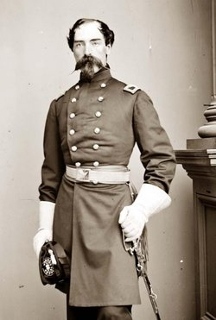
When the unit is originally mustered out of service, the 90-day enlistment terms having expired, Nugent accepts a commission as a captain in the regular army. He is immediately assigned to the 13th Infantry Regiment whose commanding officer, General William Tecumseh Sherman, personally requests. Taking a leave of absence to return to New York, he assists Thomas Francis Meagher in organizing the Irish Brigade. The newly reformed 69th Infantry Regiment is the first unit assigned to the Irish Brigade and, with Nugent as its colonel, he leads the “Fighting 69th” at the Battles of Seven Pines, Gaines’ Mill, Savage’s Station, White Oak Swamp, Glendale, and Malvern Hill.
Nugent is wounded, shot in the stomach, at the Battle of Fredericksburg and is eventually forced to resign his command. He is appointed acting assistant provost marshal for the southern district of New York, which includes New York City and Long Island, by the U.S. Department of War. An Irishman and Democrat, his appointment is thought to assure the Irish American population that conscription efforts would be carried out fairly. The Irish-American, a popular Irish language newspaper, writes that the selection is a “wise and deservedly popular one.” He does encounter resistance from city officials wanting him to remain uninvolved, however by mid-June he reports to his superior officer and provost marshal general Colonel James Fry that conscription efforts are “nearing completion without serious incident.”
Understanding the seriousness of the situation, Nugent attempts to keep the draft selections quiet and in isolated parts of the city. In Manhattan however, lotteries are placed in the heart of Irish tenement and shanty neighborhoods where the draft is most opposed.
In the ensuing New York City draft riots, Nugent takes command of troops and attempts to defend the city against the rioters. Despite issuing the cancellation of the draft, the riots continue for almost a week. His home on West 86th Street is looted and burned by the rioters during that time, his wife and children barely escaping from their home. Upon breaking into his house, furniture is destroyed, and paintings of Nugent and Meagher are slashed, although Brigadier General Michael Corcoran‘s is left untouched.
On October 28, Nugent is relieved of his post and succeeded by General William Hayes. Returning to active duty, he assumes command of the Irish Brigade in November 1864, shortly after the death of Corcoran, and is present at the Battle of Spotsylvania Court House, the Siege of Petersburg and the Appomattox campaign. As its last commanding officer, he and the Irish Brigade also march in the victory parade held in Washington, D.C. following Robert E. Lee‘s surrender at Appomattox Court House.
Nugent is brevetted Brigadier General for distinguished leadership of the 69th Regiment on March 13, 1865. The veterans of the Irish Brigade are honorably discharged and mustered out three months later. Nugent, however, remains in the regular U.S. Army for the next twenty years, a formidable “Indian fighter” during the America Indian Wars with the 13th and 24th Infantry Regiments. In 1879, he retires at the rank of major and resides in New York where he is involved in the Grand Army of the Republic, the War Veterans’ Association of the 7th Regiment and an honorary member of The Old Guard.
Nugent becomes ill in his old age, complications arising from his wounds suffered at Fredericksburg, and remains bedridden for two months before his death at his McDonough Street home in Brooklyn on June 20, 1901. In accordance with his last wishes, he is buried at Cypress Hills National Cemetery, located in the Cypress Hills neighborhood of Brooklyn.
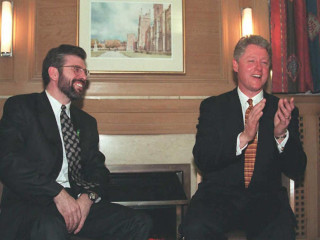
Some of the fifty people at the luncheon, most of them Irish American members of Congress, think Clinton might forgo a handshake because he is under tremendous pressure from Britain’s Prime MinisterJohn Major not to give Adams a warm embrace. But Clinton does not hesitate although the handshake comes after photographers have left the room.
“Gerry was concerned about the protocol of how he should go up to the President, but when he walked up, the President gave him a very big handshake,” says RepresentativePeter T. King, a Republican from Seaford, Long Island, who sits to the right of Adams at the lunch. After an awkward moment of silence, the room explodes with applause.
The President and the Sinn Féin leader speak for five minutes. Later Adams says, “The engagement was positive, was cordial.”
According to Rep. King, Clinton says he is committed to making the Irish peace effort succeed and, while talking to Adams, puts his fist in front of him and says, “This is going to work.” Adams says Clinton does not urge him to make sure the IRA disarms, something Major asked the President to do. Clinton invites Adams to a White House reception scheduled for the following day and, according to his aides, plans to speak to Major over the weekend in an effort to patch up their differences.
The tone at the luncheon is often light. Clinton jokes that finally he is at a place where people will not criticize him for taking a drink of Guinness. Also, Bruton hails Gingrich as an honorary Irishman, noting that his mother apparently descended from the Doherty clan of County Donegal.
Wearing a white carnation tinged with green, Gingrich gives the Taoiseach a bowl of Georgia peanuts and a book on the history of the United States Capitol. Telling Gingrich that he is not the first person to consider overhauling welfare, Bruton gives him an 1840’s book about welfare reform in Ireland.
Dongan is born in 1634 into an old Gaelic Norman (Irish Catholic) family in Castletown Kildrought (now Celbridge), County Kildare. He is the seventh and youngest son of Sir John Dongan, Baronet, Member of the Irish Parliament, and his wife Mary Talbot, daughter of Sir William Talbot, 1st Baronet and Alison Netterville. As Stuart supporters, following the overthrow of King Charles I, the family goes to King Louis XIV‘s France, although they manage to hold onto at least part of their Irish estates. His family gives their name to the Dongan Dragoons, a premier military regiment.
After the Treaty of Nijmegen ends the Franco-Dutch War in 1678, Dongan returns to England in obedience to the order that recalls all English subjects fighting in service to France. Fellow officer James, Duke of York, arranges to have him granted a high-ranking commission in the army designated for service in Flanders and a pension. That same year, he is appointed Lieutenant-Governor of English Tangier, which had been granted to England as part of the dowry of Catherine of Braganza. He serves as part of the Tangier Garrison which defends the settlement.
In September 1682, James, Lord Proprietor of the Province of New York, appoints Dongan as Vice-admiral in the Navy and provincial governor (1683–1688) to replace Edmund Andros. James also grants him an estate on Staten Island. The estate eventually becomes the town of Castleton. Later, another section of the island is named Dongan Hills in honour of Dongan.
Dongan lands in Boston on August 10, 1683, crosses Long Island Sound, and passes through the small settlements in the eastern part of the island as he makes his way to Fort James, arriving on August 25.
At the time of Dongan’s appointment, the province is bankrupt and in a state of rebellion. He is able to restore order and stability. On October 14, 1683, he convenes the first-ever representative assembly in New York history at Fort James. The New York General Assembly, under the wise supervision of Dongan, passes an act entitled “A Charter of Liberties.” It decrees that the supreme legislative power under the Duke of York shall reside in a governor, council, and the people convened in general assembly; confers upon the members of the assembly rights and privileges making them a body coequal to and independent of the British Parliament; establishes town, county, and general courts of justice; solemnly proclaims the right of religious liberty; and passes acts enunciating certain constitutional liberties; right of suffrage; and no martial law or quartering of the soldiers without the consent of the inhabitants.
Dongan soon incurs the ill will of William Penn who is negotiating with the Iroquois for the purchase of the upper Susquehanna Valley. Dongan goes to Albany and declares that the sale would be “prejudicial to His Highness’s interests.” The Cayugas sell the property to New York with the consent of the Mohawk. Years later, when back in England and in favor at the Court of James, Penn uses his influence to prejudice the king against Dongan.
On July 22, 1686, Governor Dongan grants Albany a municipal charter. Almost identical in form to the charter awarded to New York City just three months earlier, the Albany charter is the result of negotiations conducted between royal officials and Robert Livingston and Pieter Schuyler. The charter incorporates the city of Albany, establishing a separate municipal entity in the midst of the Van Rensselaer Manor.
Dongan establishes the boundary lines of the province by settling disputes with Connecticut on the east, with the French Governor of Canada on the north, and with Pennsylvania on the south, thus marking out the present limits of New York State.
James later consolidates the colonial governments of New York, New Jersey and the United Colonies of New England into the Dominion of New England and appoints Edmund Andros, the former Governor-General of New York, as Governor-General. Dongan transfers his governorship back to Andros on August 11, 1688.
Dongan executes land grants establishing several towns throughout New York State including the eastern Long Island communities of East Hampton and Southampton. These grants, called the Dongan Patents, set up Town Trustees as the governing bodies with a mission of managing common land for common good. The Dongan Patents still hold force of law and have been upheld by the Supreme Court of the United States with the Trustees—rather than town boards, city councils or even the State Legislature—still managing much of the common land in the state.
Dongan lives in London for the last years of his life and dies on December 14, 1715. He is buried in the St. Pancras Old Church churchyard, London.
(Pictured: Portrait of Thomas Dongan, 2nd Earl of Limerick, from Castleton Manor, Staten Island licensed under the Creative Commons Attribution-Share Alike 4.0 International license)
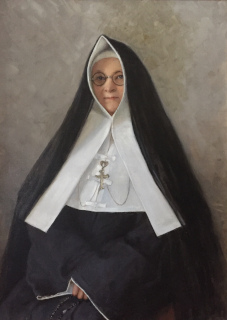
Butler is the seventh child of John Butler, gentleman farmer, and Ellen (née Forrestal). She attends the Sisters of Mercy school in New Ross, County Wexford, entering the Congregation of the Sacred Heart of Mary in Béziers, France in 1876. She takes the name Marie Joseph when she is sent to Porto, Portugal in 1879, professing in 1880. From 1880 to 1903 she teaches in Porto and Braga, becoming superior of the school in 1893.
In 1903 Butler is appointed head of the congregation’s school at Sag Harbor, Long Island, New York, with the responsibility to extend the influence of the order in there. Her cousin, James Butler, gives her a site in Tarrytown, New York in 1907 where she founds the first Marymount school that year, and then the first Marymount college in 1918. She acts as president of the college, with the institution being granted a charter from the University of the State of New York to award bachelor’s degrees in 1924. She is elected Mother General of her order in 1926 and serves until her death, being the first American superior elected to the international congregation of the Catholic Church. She introduces a unique educational system incorporating high religious and academic standards with the aim of preparing young women for a changing society. She becomes a citizen of the United States in 1927.
Under her influence, the order founds fourteen schools, including a novitiate in New York, three Marymount schools and three colleges, and 23 foundations internationally with Marymount schools in Rome, Paris, and Quebec, and a novitiate in Ferrybank, Waterford, County Waterford.
Butler dies on April 23, 1940, in Tarrytown and is buried there. In 1954 her spiritual writings are published as As an eagle: the spiritual writings of Mother Butler R.S.H.M. by J.K. Leahy. She is put forward as a candidate for canonisation in 1948.
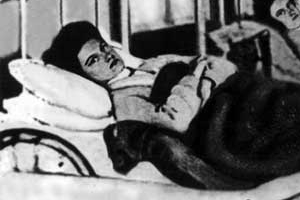
Mallon is presumed to have infected 51 people, three of whom die, over the course of her career as a cook. She is twice forcibly isolated by public health authorities and dies after a total of nearly three decades in isolation.
Mallon is born on September 23, 1869, in Cookstown, County Tyrone in what is now Northern Ireland. She immigrates to the United States in 1883 at the age of fifteen and lives with her aunt and uncle.
From 1900 to 1907, Mallon works as a cook in the New York City area for seven families. In 1900, she works in Mamaroneck, New York, where, within two weeks of her employment, residents develop typhoid fever. In 1901, she moves to Manhattan, where members of the family for whom she works develop fevers and diarrhea, and the laundress dies. Mallon then goes to work for a lawyer but leaves after seven of the eight people in that household become ill.
In 1906, Mallon takes a position in Oyster Bay, Long Island, and within two weeks ten of the eleven family members are hospitalized with typhoid. She changes jobs again and similar occurrences happen in three more households. She works as a cook for the family of a wealthy New York banker, Charles Henry Warren. When the Warrens rent a house in Oyster Bay for the summer of 1906, Mallon goes along as well. From August 27 to September 3, six of the eleven people in the family come down with typhoid fever. The disease at that time is “unusual” in Oyster Bay, according to three medical doctors who practice there. Mallon is subsequently hired by other families and outbreaks follow her.
In late 1906, one family hires a typhoid researcher named George Soper to investigate. Soper publishes the results on June 15, 1907, in the Journal of the American Medical Association. He believes Mallon might be the source of the outbreak, but she repeatedly turns him away.
Mallon attracts so much media attention that she is called “Typhoid Mary” in a 1908 issue of the Journal of the American Medical Association. Later, in a textbook that defines typhoid fever, she is again called “Typhoid Mary.”
The New York City Health Inspector determines her to be a carrier. Under sections 1169 and 1170 of the Greater New York Charter, Mallon is held in isolation for three years at a clinic located on North Brother Island.
Upon her release, Mallon is given a job as a laundress. In 1915, Mallon starts another major outbreak, this time at Sloane Hospital for Women in New York City. Twenty-five people are infected and two die. She again leaves, but the police are able to locate and arrest her when she brings food to a friend on Long Island. After arresting her, public health authorities return her to quarantine on North Brother Island on March 27, 1915.
Mallon spends the rest of her life in quarantine at the Riverside Hospital. Six years before her death, she is paralyzed by a stroke. She dies in North Brother Island, East River, New York, on November 11, 1938, of pneumonia. An autopsy finds evidence of live typhoid bacteria in her gallbladder. Mallon’s body is cremated, and her ashes are buried at Saint Raymond’s Cemetery in the Bronx.
Admitted to the Irish Bar, Sampson becomes Junior Counsel to John Philpot Curran and helps him provide legal defences for many members of the Society of United Irishmen. A member of the Church of Ireland, he is disturbed by anti-Catholic violence and contributes writings to the Society’s newspapers. He is arrested at the time of the Irish Rebellion of 1798, imprisoned, and compelled to leave Ireland for exile in Europe.
Shipwrecked at Pwllheli in Wales, Sampson makes his way to exile in Porto, Portugal, where he is again arrested, imprisoned in Lisbon, and then expelled. After living some years in France, and then Hamburg, he flees to England ahead of the approach of Napoleon‘s armies where he is re-arrested. After unsuccessfully petitioning for a return to Ireland, he arrives in New York City on July 4, 1806.
In the United States, Sampson successfully continues his career in the law, eventually sending for his family. He sets up a business publishing detailed accounts of the court proceedings in cases with popular appeal. In 1809 he reports on the case of a Navy Lieutenant Renshaw prosecuted for dueling. That same year he handles a case against Amos and Demis Broad, accused of brutally beating their slave, Betty, and her 3-year-old daughter where Sampson succeeded in having both slaves manumitted. The authorities in Ireland had disbarred Sampson, which causes him some bitter amusement, as it does not affect his work in the United States.
Sampson’s most important case in the United States is in 1813 and is referred to as “The Catholic Question in America.” Police investigating the misdemeanor of receiving stolen goods question the suspects’ priest, the Reverend Mr. Kohlman. He declines to give any information that he has heard in confession. The priest is called to testify at the trial in the Court of General Sessions in the City of New York. He again declines. The issue whether to compel the testimony is fully briefed and carefully argued on both sides, with a detailed examination of the common law. In the end, the confessional privilege is accepted for the first time in a court of the United States.
William Sampson dies on December 28, 1836, and is buried in the Riker Family graveyard on Long Island in what is now East Elmhurst, Queens, New York. He is later reinterred in Green-Wood Cemetery in Brooklyn, where he is now buried in the same plot as Matilda Witherington Tone and William Theobald Wolfe Tone, the wife and son of the Irish revolutionary Wolfe Tone, and his daughter Catherine, the wife of William Theobald Wolfe Tone.





 seamus dubhghaill