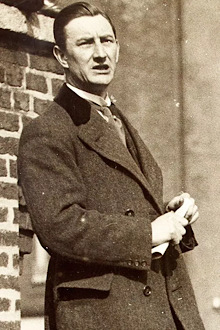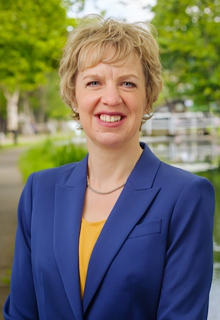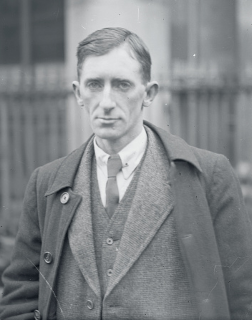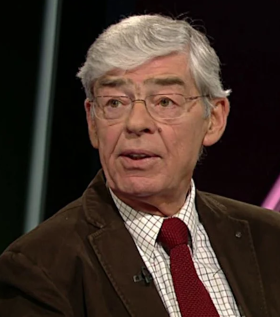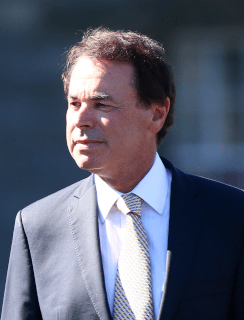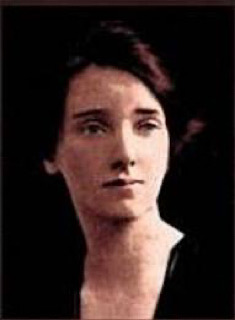
Traynor is born in Dublin on March 21, 1886, into a strongly nationalist family. He is educated by the Christian Brothers. In 1899, he is apprenticed to John Long, a famous woodcarver. As a young man he is a noted footballer and tours Europe as a goalkeeper with Belfast Celtic F.C. whom he plays with from 1910 to 1912. He rejects claims soccer is a foreign sport calling it “a Celtic game, pure and simple, having its roots in the Highlands of Scotland.”
When the Irish Civil War breaks out in June 1922, Traynor takes the Anti-Treaty IRA side. The Dublin Brigade is split, however, with many of its members following Michael Collins in taking the pro-Treaty side. During the Battle of Dublin, he is in charge of the Barry’s Hotel garrison, before making their escape. He organises guerilla activity in south Dublin and County Wicklow, before being captured by Free State troops in September. He is then imprisoned for the remainder of the war.
In 1936, Traynor is first appointed to the Cabinet as Minister for Posts and Telegraphs. In September 1939, he is appointed Minister for Defence and holds the portfolio to February 1948. In 1948, he becomes President of the Football Association of Ireland, a position he holds until his death. He serves as Minister for Defence in several Fianna Fáil governments and as Minister for Justice, where he is undermined by his junior minister, and later Taoiseach, Charles Haughey, before he retires in 1961.
Traynor dies in Dublin at the age of 77 on December 14, 1963. He has a road named in his memory, running from the Malahide Road through Coolock to Santry in Dublin’s northern suburbs.
Molloy’s father, Michael Edward Molloy, is originally from Ballyhaunis, County Mayo, and runs a successful wholesale drapery business in the city. His mother, Rita Stanley, hails from Clifden, County Galway. He is educated at Coláiste Iognáid and University College Galway. Before entering politics, he works for several years in printing, the clothing industry and his family’s drapery firm.
Molloy’s early political career is marked by his loyalty to Fianna Fáil’s leadership under TaoiseachJack Lynch. He quickly rises through the ranks and is appointed Minister for Local Government in 1970, a position he holds until 1973. His tenure as Minister for Local Government is characterised by his efforts to modernise and streamline local government structures in Ireland. His tenure in Fianna Fáil sees him as a stalwart of the party’s establishment, though tensions with its leadership grow over the years, particularly with Charles Haughey.
In opposition from 1973, Molloy serves as the frontbench spokesman, where he becomes involved in a high-profile dispute with James Tully, the Labour Minister for Local Government, over the controversial redrawing of constituencies, known as the “Tullymander.” Molloy, along with fellow Fianna Fáil member Brendan Crinion, used Dáil privilege to accuse Tully of having an improper commercial relationship with a builder in County Meath. The accusation is strongly denied by Tully and Molloy and Crinion later withdraw the charge. Despite this, Molloy faces severe repercussions, being forced to resign from his frontbench position. He is subsequently condemned by a judicial tribunal and censured by the Dáil for abusing parliamentary privilege.
When Fianna Fáil returns to office in 1977, Molloy becomes Minister for Defence in the final government of Jack Lynch.
In 1986, Molloy resigns from Fianna Fáil and joins the newly formed Progressive Democrats, spearheaded by Haughey’s arch-rival Desmond O’Malley. Molloy’s move is seen as a major break from the political establishment, as the Progressive Democrats advocate for low-tax, market-oriented economic policies and a more liberal economic agenda. His decision is driven by his dissatisfaction with the direction of Fianna Fáil under Haughey’s leadership and his belief that the party has become increasingly alienating.
In 1989, Molloy contests the European Parliament elections but is unsuccessful in his attempt. Following the 1989 Irish general election, Molloy, along with newly elected MEP for MunsterPat Cox, represents the Progressive Democrats in the lengthy negotiations with Fianna Fáil to form a coalition government. Once the negotiations conclude, he is reinstated in the Cabinet as Minister for Energy under Taoiseach Charles Haughey, who had previously caused Molloy’s political humiliation a decade earlier. Over the following three years, Molloy and his Progressive Democrat colleague Desmond O’Malley have a working relationship with their former Fianna Fáil colleagues, though tensions grow due to resentment over their presence in the Cabinet. The issue comes to a head when Molloy and O’Malley make it clear they will not serve in a Cabinet that includes Brian Lenihan Snr, following his controversial remarks during the 1990 Irish presidential election about alleged phone calls to PresidentPatrick Hillery from 1982.
In January 1992, Haughey faces further complications when Seán Doherty reveals information about the phone tapping of journalists dating back to 1982. Despite this, the coalition government ends when Albert Reynolds, Haughey’s successor, calls for a general election after accusing O’Malley of giving “dishonest” evidence to the Beef Tribunal. Molloy strongly denounces Reynolds’ accusation, describing it as “outrageous,” and criticises him for what he perceives as a “lack of generosity” in recent North-South negotiations, in which Molloy had represented the Progressive Democrats in talks with British Unionists.
Molloy stands at the European Parliament elections again in 1994 but is again unsuccessful.
Molloy resigns as a minister and quits politics just before the 2002 Irish general election amid controversy surrounding his involvement in the rape case of Barbara Naughton. The controversy stems from a letter Molloy sent to then Minister for Justice, John O’Donoghue, on behalf of a constituent whose relative had been convicted of rape. The letter, which requests the temporary release of the individual pending an appeal, leads to public criticism. The case is high-profile, involving a Connemara man sentenced to eleven years for the systematic abuse of his young daughter. During the trial, the judge, Philip O’Sullivan, notes that someone acting on Molloy’s behalf had tried to contact him in his chambers to clarify whether he had received certain correspondence from the victim’s sister, which the judge describes as “quite improper.” In response to the backlash, Molloy resigns, describing the letter as a “human error of judgment,” but insisting it was not intended to be dishonest. He retires from politics after the election.
Molloy is a member of Fianna Fáil for over 20 years, but his views are not always in line with the mainstream of the party, particularly under the leadership of Charles Haughey. His decision to leave Fianna Fáil in 1986 and join the Progressive Democrats is motivated by ideological differences, notably the party’s move toward a more conservative, state-controlled economy. Molloy, on the other hand, embraces a platform of fiscal conservatism, with an emphasis on reducing taxes, deregulation, and the liberalisation of the economy.
In terms of social issues, Molloy is ahead of his time in advocating for progressive policies, particularly on women’s rights. In a survey conducted in 1976 by the Women’s Political Association (WPA), Molloy scores among the highest of any member of the Dáil for his progressive stance on issues affecting women. He supports measures such as divorce, contraception, and family law reform, which are seen as highly controversial at the time. His responses to the WPA’s questions reveal that he holds views that are in stark contrast to many of his colleagues within Fianna Fáil. His progressive views on women’s rights are notable, as he is the only member of Jack Lynch’s cabinet who consistently supports reformist policies on issues like family law and the role of women in public life.
In 1972, Molloy marries Phyllis Barry, a Montessori teacher from Foxrock, County Dublin, whose father is a cousin of the executed revolutionary Kevin Barry. The couple meet while campaigning in a by-election in mid-Cork. Together, they have four children: Sinead, Sorcha, Donnacha, and Dara.
In 2004, Bacik’s book Kicking and Screaming: Dragging Ireland into the 21st Century, is published by The O’Brien Press.
In 2007, she contested the Seanad Éireann elections for the third time in the Dublin University constituency, and is elected to the third seat, behind sitting Independent senators Shane Ross and David Norris. She initially sits as an Independent senator.
In February 2009, Bacik is included in an ‘All Star Women’s Cabinet’ in the Irish Independent. In March 2009, she confirmed claims made on a TV programme that she had taken two voluntary pay cuts of 10% in addition to a pension levy. In June 2009, she is the Labour Party candidate for the Dublin Central by-election. She comes in third with 17% of the first preference votes. She joins the Labour Party group in the Seanad in September 2009, and becomes Labour Party Seanad spokesperson for both Justice and Arts, Sports and Tourism. In November 2009, a feature by Mary Kenny of the Irish Independent includes Bacik in a list of women who “well deserved their iconic status.”
In May 2010, Bacik seeks Labour’s nomination to contest the next election in the Dublin South-East constituency but is not selected. In December 2010, she is added to the ticket as the second candidate beside Labour Party leader, Eamon Gilmore, in the Dún Laoghaire constituency for the 2011 Irish general election. Gilmore tops the poll, with Bacik receiving 10.1% of first preference votes but she is not elected. She is re-elected to Seanad Éireann at the subsequent election, after which she becomes Deputy Leader of the Seanad. She holds her seat in the Seanad in 2016 and in 2020.
On April 27, 2021, after the resignation of Eoghan Murphy from his Dáil seat in Dublin Bay South, Bacik announces her intention to stand in the upcoming by-election. She campaigns with an emphasis on providing affordable housing, as well as improving healthcare and childcare, tackling climate change, and achieving “a true republic in which church and state are separated.” During the campaign, she describes herself as having “more bills passed into law than any other Senator, on issues such as workers’ conditions, women’s health rights, and LGBT equality”. She also campaigns on increasing the number of sports amenities for children in the area, calling for unused Defence Forces football fields at the Cathal Brugha Barracks to be freed up for local sports, with the suggestion rejected by Fine GaelMinister for DefenceSimon Coveney. Fine Gael complains to RTÉ after she features prominently on National Treasures, a prime-time TV show broadcast by RTÉ during the campaign. RTÉ has strict rules about fair coverage of candidates during campaigns. The national broadcaster blames an “inadvertent error” for the programme being shown three days before the election. A steering group within the broadcaster tells Fine Gael that “the broadcast should not have happened.” Consequentially, RTÉ has to show a special report on the by-election on Prime Time to “ensure fair coverage is given to all candidates.”
Bacik wins this election, receiving 8,131 (30.2%) first-preference votes. It is her fourth attempt as a Labour candidate, and she expresses her delight at the success at the count centre in the RDS. Following the election, she is described by The Irish Times as “a formidable activist and public intellectual” and that Fine Gael’s perceived antipathy towards their former TD, Kate O’Connell, may have contributed to the surge in support to Bacik from women voters. The newspaper claims that her election is “a long overdue morale boost” for Labour.
In March 2022, Bacik confirms she will run to succeed Alan Kelly as Labour Party leader. Kelly states that he believes that Bacik will succeed him. On March 24, 2022, she is confirmed as Labour Party leader unopposed at a party conference in Dublin. In a speech, she says she will focus on the rising cost of living and the serious and global problems facing the country. She pledges that Labour will fight the next election as a “standalone party” rather than joining any left-wing alliance.
A native of Carlanstown, near Kells in the north of County Meath, Tully is educated in Carlanstown schools and in St Patrick’s Classical School in Navan. He is elected to Dáil Éireann as a Labour Party TD for the Meath constituency at the 1954 Irish general election. He loses his seat at the 1957 Irish general election, but is re-elected at the 1961 Irish general election and serves until 1982. When Labour enters into a coalition government with Fine Gael in 1973, he is appointed Minister for Local Government. While serving in that post he gains prominence for a massive increase in the building of public housing, and notoriety for an attempt to gerrymander Irish constituencies to ensure the re-election of the National Coalition at the 1977 Irish general election. His electoral reorganisation effort via the Electoral (Amendment) Act 1974, which comes to be called a “Tullymander,” backfires spectacularly and helps engineer a landslide for the opposition, Fianna Fáil. He is regarded as a conservative within the Labour Party, though tends to support party decisions, even if he disagrees with them. For many years he is opposed to coalition, though finding the years in opposition fruitless, he changes his mind and becomes increasingly in favour of coalition with Fine Gael.
Also as Minister for Local Government, Tully decides on alterations to the plans for the controversial Dublin CorporationCivic Offices.
Tully is appointed deputy leader of the Labour Party under Michael O’Leary in 1981, and Minister for Defence in the short-lived 1981–82 Fine Gael-Labour Party government. In that capacity he travels to Cairo, in 1981, as the Republic of Ireland‘s representative in Egypt‘s annual October 6 military victory parade. While in the reviewing stand, next to PresidentAnwar Sadat, he suffers a shrapnel injury to his face when Sadat was assassinated by members of Egyptian Islamic Jihad who had infiltrated the Egyptian Army.
In 1982, a few months after the event, Tully retires from politics. He dies ten years later, on May 20, 1992, at the age of 76.
(Pictured: Portrait of James Tully taken from his 1954 election poster)
Mulcahy is second-in-command to Thomas Ashe in an encounter with the armed Royal Irish Constabulary (RIC) at Ashbourne, County Meath, during the 1916 Easter Rising, one of the few stand-out victories won by republicans in that week and generally credited to Mulcahy’s grasp of tactics. In his book on the Rising, Charles Townshend principally credits Mulcahy with the defeat of the RIC at Ashbourne, for conceiving and leading a flanking movement on the RIC column that had engaged with the Irish Volunteers. Arrested after the Rising, he is interned at Knutsford and at the Frongoch internment camp in Wales until his release on December 24, 1916.
Mulcahy and Michael Collins are largely responsible for directing the military campaign against the British during the Irish War of Independence. During this period of upheaval in 1919, he marries Mary Josephine (Min) Ryan, sister of Kate and Phyllis Ryan, the successive wives of Seán T. O’Kelly. Her brother is James Ryan. O’Kelly and Ryan both later serve in Fianna Fáil governments.
Mulcahy supports the Anglo-Irish Treaty of December 1921. Archive film shows that Mulcahy, as Minister of Defence, is the Irish officer who raises the Irish tricolour at the first hand-over of a British barracks to the National Army in January 1922. He is defence minister in the Provisional Government on its creation and succeeds Collins, after the latter’s assassination, as Commander-in-Chief of the Provisional Government’s forces during the subsequent Irish Civil War.
Mulcahy earns notoriety through his order that anti-Treaty activists captured carrying arms are liable for execution. A total of 77 anti-Treaty prisoners are executed by the Provisional Government. He serves as Minister for Defence in the new Free State government from January 1924 until March 1924, but resigns in protest because of the sacking of the Army Council after criticism by the Executive Council over the handling of the “Army Mutiny,” when some National Army War of Independence officers almost revolt after he demobilises many of them at the end of the Irish Civil War. He re-enters the cabinet as Minister for Local Government and Public Health in 1927.
After the resignation of W. T. Cosgrave as Leader of Fine Gael in 1944, Mulcahy becomes party leader while still a member of the Seanad. Thomas F. O’Higgins is parliamentary leader of the party in the Dáil at the time and Leader of the Opposition. Facing his first general election as party leader, Mulcahy draws up a list of 13 young candidates to contest seats for Fine Gael. Of the eight who run, four are elected. He is returned again to the 12th Dáil as a TD for Tipperary at the 1944 Irish general election. While Fine Gael’s decline had been slowed, its future is still in doubt.
Following the 1948 Irish general election Mulcahy is elected for Tipperary South, but the dominant Fianna Fáil party finishes six seats short of a majority. However, it is 37 seats ahead of Fine Gael, and conventional wisdom suggests that Fianna Fáil is the only party that can possibly form a government. Just as negotiations get underway, however, Mulcahy realises that if Fine Gael, the Labour Party, the National Labour Party, Clann na Poblachta and Clann na Talmhan band together, they would have only one seat fewer than Fianna Fáil and, if they can get support from seven independents, they will be able to form a government. He plays a leading role in persuading the other parties to put aside their differences and join forces to consign the then Taoiseach and Fianna Fáil leader Éamon de Valera, to the opposition benches.
Mulcahy initially seems set to become Taoiseach in a coalition government. However, he is not acceptable to Clann na Poblachta’s leader, Seán MacBride. Many Irish republicans had never forgiven him for his role in the Irish Civil War executions carried out under the Cosgrave government in the 1920s. Consequently, MacBride lets it be known that he and his party will not serve under Mulcahy. Without Clann na Poblachta, the other parties would have 57 seats between them — 17 seats short of a majority in the 147-seat Dáil. According to Mulcahy, the suggestion that another person serve as Taoiseach comes from Labour leader William Norton. He steps aside and encourages his party colleague John A. Costello, a former Attorney General of Ireland, to become the parliamentary leader of Fine Gael and the coalition’s candidate for Taoiseach. For the next decade, Costello serves as the party’s parliamentary leader while Mulcahy remained the nominal leader of the party.
Mulcahy goes on to serve as Minister for Education under Costello from 1948 until 1951. Another coalition government comes to power at the 1954 Irish general election, with Mulcahy once again stepping aside to become Minister for Education in the Second Inter-Party Government. The government falls in 1957, but he remains as Fine Gael leader until October 1959. In October the following year, he tells his Tipperary constituents that he does not intend to contest the next election.
Alan Martin Dukes, former Fine Gaelpolitician, is born in Drimnagh, Dublin, on April 20, 1945. He holds several senior government positions and serves as a Teachta Dála (TD) from 1981 to 2002. He is one of the few TDs to be appointed a minister on their first day in the Dáil.
The Dukes family originally comes from the north of England. His grandfather serves with the Royal Engineers in World War I and settles in County Cork and then County Kerry afterward where he works with the Post Office creating Ireland’s telephone network.
Dukes is educated by the Christian Brothers at Coláiste Mhuire, Dublin, and is offered several scholarships for third level on graduation, including one for the Irish language. His interest in the Irish language continues to this day, and he regularly appears on Irish-language television programmes.
On leaving school he attends University College Dublin (UCD), where he captains the fencing team to its first-ever Intervarsity title.
In the 1979 European Parliament election, Dukes stands as a Fine Gael candidate in the Munster constituency. He has strong support among the farming community, but the entry of T. J. Maher, a former president of the IFA, as an independent candidate hurts his chances of election. Maher tops the poll.
This minority Fine Gael–Labour Partycoalition government collapses in February 1982 on the budget but returns to power with a working majority in December 1982. Dukes is again appointed to cabinet, becoming Minister for Finance less than two years into his Dáil career.
He faces a difficult task as finance minister. Ireland is heavily in debt while unemployment and emigration are high. Many of Fine Gael’s plans are deferred while the Fine Gael–Labour Party coalition disagrees on how to solve the economic crisis. The challenge of addressing the national finances is made difficult by electoral arithmetic and a lack of support from the opposition Fianna Fáil party led by Charles Haughey. He remains in the Department of Finance until a reshuffle in February 1986 when he is appointed Minister for Justice.
This is a difficult time for the country. Haughey’s Fianna Fáil runs on promises to increase spending and government services, and attacking the cutbacks favoured by Fine Gael. However, on taking office, the new Taoiseach and his finance minister Ray MacSharry immediately draw up a set of cutbacks including a spate of ward and hospital closures. This presents a political opportunity for the opposition to attack the government.
However, while addressing a meeting of the TallaghtChamber of Commerce, Dukes announces, in what becomes known as the Tallaght Strategy that: “When the government is moving in the right direction, I will not oppose the central thrust of its policy. If it is going in the right direction, I do not believe that it should be deviated from its course, or tripped up on macro-economic issues.”
This represents a major departure in Irish politics whereby Fine Gael will vote with the minority Fianna Fáil Government if it adopts Fine Gael’s economic policies for revitalising the economy. The consequences of this statement are huge. The Haughey government is able to take severe corrective steps to restructure the economy and lay the foundations for the economic boom of the nineties. However, at a snap election in 1989, Dukes does not receive electoral credit for this approach, and the party only makes minor gains, gaining four seats. The outcome is the first-ever coalition government for Fianna Fáil, whose junior partner is the Progressive Democrats led by former Fianna Fáil TD Desmond O’Malley.
Initially, Fianna Fáil’s Brian Lenihan Snr is the favourite to win. However, after several controversies arise, relating to the brief Fianna Fáil administration of 1982, and Lenihan’s dismissal as Minister for Defence midway through the campaign, the Labour Party’s Mary Robinson emerges victorious. To many in Fine Gael, the humiliation of finishing third is too much to bear and a campaign is launched against Dukes’ leadership. He is subsequently replaced as party leader by John Bruton.
Bruton brings Dukes back to the front bench in September 1992, shortly before the November 1992 Irish general election. In February 1994, Dukes becomes involved in a failed attempt to oust Bruton as leader and subsequently resigns from the front bench. Bruton becomes Taoiseach in December 1994 and Dukes is not appointed to cabinet at the formation of the government.
In 2001, Dukes backs Michael Noonan in his successful bid to become leader of Fine Gael.
After 21 years, Dukes loses his Dáil seat at the 2002 Irish general election. This contest sees many high-profile casualties for Fine Gael, including Deputy LeaderJim Mitchell, former deputy leader Nora Owen and others. Many local commentators feel that Dukes’ loss is due to a lack of attention to local issues, as he is highly involved in European projects and has always enjoyed a national profile.
He retires from frontline politics in 2002 and is subsequently appointed Director General of the Institute of International and European Affairs. He remains active within Fine Gael and serves several terms as the party’s vice-president. From 2001 to 2011, he is President of the Alliance française in Dublin, and in June 2004, the French Government appoints him an Officer of the Legion of Honour. In April 2004, he is awarded the Commander’s Cross of the Order of Merit of the Republic of Poland.
In December 2008, Dukes is appointed by Finance Minister Brian Lenihan Jnr as a public interest director on the board of Anglo Irish Bank. The bank is subsequently nationalised, and he serves on the board until the Irish Bank Resolution Corporation (IBRC) is liquidated in 2013.
Dukes has lived in Kildare since first being elected to represent the Kildare constituency in 1981. His wife Fionnuala (née Corcoran) is a former local politician and serves as a member of Kildare County Council from 1999 until her retirement in 2009. She serves as Cathaoirleach of the council from 2006 to 2007, becoming only the second woman to hold the position in the body’s one-hundred-year history. They have two daughters.
Shatter is the son of Reuben and Elaine Shatter, an English couple who meet by chance when they are both on holiday in Ireland in 1947. He is educated at The High School, Dublin, Trinity College Dublin (TCD) and the Europa Institute of the University of Amsterdam. In his late teens, he works for two months in Israel on a kibbutz. He is a partner in the Dublin law firm Gallagher Shatter (1977-2011). As a solicitor he acts as advocate in many seminal and leading cases determined both by the Irish High and Supreme Courts. He is the author of one the major academic works on Irish family law which advocates substantial constitutional and family law reform.
Under Shatter’s steerage, a substantial reform agenda is implemented with nearly 30 separate pieces of legislation published, many of which are now enacted including the Personal Insolvency Act 2012, Criminal Justice Act 2011, DNA Database Act, and the Human Rights and Equality Commission Act.
Under Shatter’s guidance, major reforms are introduced in 2011 into Ireland’s citizenship laws and a new Citizenship Ceremony is created. He both devises and pilots Ireland’s first ever citizenship ceremony which takes place in June 2011 and a new inclusive citizenship oath which he includes in his reforming legislation. During his time as Minister, he clears an enormous backlog of citizenship applications, and 69,000 foreign nationals become Irish citizens. Some applications had lain dormant for 3 to 4 years. He introduces a general rule that save where there is some real complication, all properly made citizenship applications should be processed within a six-month period. He also takes steps to facilitate an increased number of political refugees being accepted into Ireland and creates a special scheme to facilitate relations of Syrian families already resident in Ireland who are either caught up in the Syrian civil war, or in refugee camps elsewhere as a result of the Syrian civil war, to join their families in Ireland.
Shatter enacts legislation before the end of July 2011 to facilitate access to financial documentation and records held by third parties in investigations into banking scandals and white-collar crime. The legislation is first used by the Gardaí in September 2011.
During Ireland’s Presidency of the Council of the European Union in 2013, Shatter chairs the Justice and Home Affairs Council (JHA) meetings and, in January 2013, in Dublin Castle, the meeting of EU Defence Ministers. Under his guidance, Ireland plays a more active role than in the past in EU defence matters and in deepening Ireland’s participation in NATO’s partnership for peace. During the Irish Presidency, substantial progress is made at the European Union level in the adoption and development of new legislation and measures across a broad range of Justice and Home Affairs issues.
Shatter implements substantial reform in the Department of Defence and restructures the Irish Defence Forces. He is a strong supporter of the Irish Defence Forces participation in international peacekeeping and humanitarian engagements and is an expert on the Middle East. As a member of the Irish Parliament and as Minister on many occasions, he visits Irish troops participating in United Nations (UN) missions in the Middle East. Under his watch contracts are signed for the acquisition of two new naval vessels with an option to purchase a third. All three naval vessels are now part of the Irish Naval Service and have been actively engaged in recent years in rescuing drowning refugees in the Mediterranean Sea attempting to enter Europe.
As Minister for Defence he enacts legislation to grant a pardon and an amnesty to members of the Irish Defence Forces who deserted during World War II to fight on the allied side against Nazi Germany and gives a state apology for their post-war treatment by the Irish State.
Shatter is the minister responsible for two amendments to the Constitution of Ireland which are passed in referendums: the Twenty-ninth Amendment in 2011 to allow for the reduction of judges’ pay, and the Thirty-third Amendment in 2013 to establish a Court of Appeal. Just prior to his resignation from government, the draft legislation to create the court is published and the court is established and sitting by October 2014.
The jurisdictions of the courts are extended for the first time in 20 years and the maximum civil damages payable for the emotional distress of bereaved relations following a negligent death is increased.
As a politician, Shatter plays a lead role in effecting much of the constitutional and legislative change he advocates. He is a former chairperson of FLAC (the Free Legal Advice Centres), a former chairperson of CARE, an organisation that campaigns for childcare and children’s legislation reform in the 1970s and a former President of the Irish Council Against Blood Sports.
Shatter is a founder member of the Irish Soviet Jewry Committee in 1970 and pioneers a successful all party Dáil motion on the plight of Soviet Jewry (1984) and visits various refuseniks in Moscow in 1985. He is a former chairperson of the Oireachtas Foreign Affairs Committee (1996-97) and initiates the creation of an Ireland/Israel Parliamentary Friendship group in 1997, leading a number of visits to Israel by members of the Dáil Éireann and Seanad Éireann.
Shatter is the author of the satirical book Family Planning Irish Style (1979), and the novel Laura (1989). In 2017 his biography, Life is a Funny Business, is published by Poolbeg Press and in 2019 Frenzy and Betrayal: The Anatomy of a Political Assassination is published by Merrion Press. In 2023, his book Cyril’s Lottery of Life, a comedic book with an English solicitor from a small town as its protagonist, is published.
Quinlan goes to school in nearby Loher. He and his wife Carmel have a son, Leo, who is sixteen when his father serves in the Congo, and later becomes a commandant, the same rank his father held when in Katanga, although the father retires with the higher rank of colonel.
“A” Company, 35th Battalion (UN service) of the Irish Army United Nations Operation in the Congo (ONUC) contingent, commanded by Quinlan, is attacked by Katangese Gendarmerie troops loyal to President Moïse Tshombe and the State of Katanga. Quinlan’s lightly armed company is besieged in Jadotville, and resists Katangese assaults for six days. A relief force of Irish, Indian and Swedish troops is unsuccessful in their attempts to reach Quinlan’s position.
Quinlan’s company suffers five wounded in action during the six-day siege. On the other hand, up to 300 Katangese troops are killed, including thirty mercenaries, and an indeterminate number are wounded, with figures ranging from 300 to 1,000. Quinlan, however, has no access to resupply and reinforcements and, with his transport destroyed by Katanga’s Fouga Magister jet, a breakout is virtually impossible. In the end, with his position untenable, without any clear orders or promise of assistance, having run out of ammunition and food and low on water, he accepts a second offer to surrender to the Katangese.
Although suffering no loss of life, Quinlan’s company are held as prisoners of war and hostages for approximately one month. The Katangese barter the Irish soldiers for prisoners in the custody of the Congolese government. After being released, “A” Company are returned to their base in Elisabethville (now Lubumbashi). Some weeks later, Quinlan finds himself involved in active combat again, this time with his company in support of Swedish UN troops. Eventually they are reinforced with fresh troops from Ireland. After weeks of fighting and their six-month tour of duty now complete, “A” Company is rotated home to Ireland that December.
In its immediate aftermath, the Irish state does not give much recognition to the Battle of Jadotville, and no Irish soldier receives any decoration for actions at Jadotville. This may have been because of a perceived shame that “A” Company had surrendered and an unwillingness to highlight political or strategic errors at higher levels by the UN mission. Quinlan, however, recommends a number of his men for the Military Medal for Gallantry (MMG), Ireland’s highest award for military valour, for their actions during the battle.
Quinlan never serves overseas again and retires as a full colonel after forty years with the Irish Army.
Quinlan dies on August 27, 1997, unaware that his reputation will be restored nine years after his death. His wife does not live to see his official rehabilitation either, dying two years after her husband.
The veterans of Jadotville are dissatisfied with the Irish Defence Forces‘ refusal to acknowledge the battle and the implied black mark on the reputation of their commander. Following a long campaign for recognition, in 2004 the then Minister for Defence, Willie O’Dea, agrees to hold a review of the battle. An inquiry by the Defence Forces clears Quinlan and “A” Company of allegations of soldierly misconduct. A commemorative stone recognising the soldiers of “A” Company is erected on the grounds of Custume Barracks in Athlone in 2005. A commissioned portrait of Quinlan is installed in the Congo Room of the Irish Defence Forces’ UN School.
In 2016, the Irish government awards a Presidential Unit Citation to “A” Company, the first in the State’s history. In October 2017, a plaque commemorating Quinlan is unveiled by former TaoiseachEnda Kenny at Coomakista Pass, County Kerry.
In November 2020, an Independent Review Group commissioned by Irish Defence Minister Simon Coveney recommends that Quinlan receive the Distinguished Service Medal (DSM).
Quinlan’s tactics at Jadotville influence subsequent training programmes, and are, according to RTÉ, “cited in military textbooks worldwide as the best example of the use of the so-called perimeter defence.”
Quinlan is played by Jamie Dornan in the film The Siege of Jadotville (2016), which is adapted from Declan Power‘s book, The Siege at Jadotville: The Irish Army’s Forgotten Battle (2005). His wife Carmel is played by Fiona Glascott. Colonel Quinlan’s son, Commandant Leo Quinlan, says that Dornan bears an uncanny resemblance to his father, and gets everything about him right except his County Kerry accent, which is so strong that “if he had done my father’s accent, you’d need subtitles.” Quinlan’s grandson Conor is a member of the film’s cast.
In the Fine Gael–Labour Partycoalition government which takes office after the 1973 Irish general election, Donegan is appointed as Minister for Defence. In October 1976, he makes a speech on an official visit to the opening of new kitchen facilities in an army barracks at Mullingar, County Westmeath in which he describes as a “thundering disgrace” PresidentCearbhall Ó Dálaigh‘s refusal to sign the Emergency Powers Bill 1976. Ó Dálaigh had instead exercised his powers under Article 26 of the Constitution of Ireland to refer it to the Supreme Court. The Taoiseach, Liam Cosgrave, refuses Donegan’s resignation. On October 21, Fianna Fáil proposes a motion in the Dáil calling on the minister to resign, which is defeated. Ó Dálaigh views the refusal to remove the minister as an affront to his office by the government and resigns on October 22, 1976.
In December 1976, Donegan is appointed as Minister for Lands. In February 1977, this office is restructured as the Minister for Fisheries. He serves in cabinet until the government loses office after the 1977 Irish general election.
Donegan retires from politics at the 1981 Irish general election. He dies at his home in County Louth on November 26,2000, following a long illness. Tributes in the Dáil are led by John Bruton as Fine Gael leader. He is buried in his hometown of Monasterboice, County Louth.
Mac Aonghusa is the son of Criostóir Mac Aonghusa, a writer and Irish language activist, and Mairéad Ní Lupain, a nurse and native Irish speaker. The eldest of four siblings, he grows up speaking Irish as his first language and allegedly does not learn English until the age of eleven. His parents are left-wing Irish republicans who support Fianna Fáil and associate with the like-minded Máirtín Ó Cadhain and Peadar O’Donnell. His parents split when he is ten years of age. His mother takes his siblings away to Dublin while he and his father remain in Rosmuc, a remote village and part of the Galway Gaeltacht. As a teenager he is educated at Coláiste Iognáid (also known as St. Ignatius College), a bilingual school in Galway.
Upon leaving school, Mac Aonghusa first works as an actor at the Abbey Theatre in Dublin, performing in Irish language productions. In 1952, he becomes involved in Radio Éireann, first as an actor but later as a reader of short stories before advancing to becoming a newsreader, presenter and interviewer. As he advances his career, he works for RTÉ, UTV and BBC television from the 1960s. In 1962, he begins presenting An Fear agus An Sceal (The Man & his Story) on RTÉ television, an Irish language show which sees him interviewing a different guest of note about their life each episode. That same year he wins a Jacob’s Award for An Fear agus an Sceal, which he continues to host until 1964.
As well as attracting awards, An Fear agus an Sceal also brings controversy. Two interviews, one with Máirtín Ó Cadhain, one with Con Lehane, both criticise the measures practised by the Fianna Fáil government during World War II to suppress and imprison Irish republicans. In response, the Fianna Fáil government intervenes with RTÉ, and those episodes are not aired. This is not to be Mac Aonghusa’s only run-in with the Fianna Fáil government. After he recorded a programme in which he questioned the effectiveness of Ireland’s civil defence measures in the face of nuclear war, then Minister for DefenceKevin Boland has the episode suppressed. He once again runs afoul of the Fianna Fáil government when, after criticising the party in his anonymous weekly political gossip column in the Sunday Independent, then Minister for AgricultureNeil Blaney sees to it that the column is dropped. He is not deterred and returns anonymously as “Gulliver” in The Sunday Press and a gossip column on the back page of The Hibernia Magazine.
The latter half of Mac Aonghusa’s 1960s/70s broadcasting career is primarily associated with the Irish language current events show Féach, which he both presents and edits. He resigns from Féach in 1972 following a bitter dispute with the broadcaster and commentator Eoghan Harris.
In 1959, Mac Aonghusa writes a series of six articles for The Irish Times in which he vehemently opposes the Fianna Fáil government’s proposal to abolish single transferable vote in Ireland in favour of first-past-the-post voting. He contends that first-past-the-post voting gives too much influence to party bosses, while proportional representation gives even small minorities representation, preventing them from feeling excluded by the state such as nationalists in Northern Ireland. In the referendum held on the matter on June 17, 1959, voters reject first past the vote by a margin of 2%. Fianna Fáil attempts to repeal proportional representation again in the late 60s, at which point Mac Aonghusa once again throws himself into the fight, leading a group called “Citizens for PR.” In the referendum of 1968, voters reject the first past the post system by over 20%. He later recalls that his defence of proportional representation his greatest achievement in politics.
In the 1960s, both Mac Aonghusa and his wife, Catherine, join the Sean Connolly branch of the Labour Party in Dublin. The branch had established a reputation as a haven for intellectuals who want a branch to themselves away from the many other Labour branches dominated by trade unionists. The branch comes to advocate for expressly socialist policies combined with on-the-ground grass-roots campaigning. Through the Sean Connolly Branch, both he and his wife begin to develop significant influence over the leader of the Labour party Brendan Corish.
In the 1965 Irish general election, Mac Aonghusa stands on behalf of the Labour party in the Louth constituency but is not elected. In 1966, he publishes a book of speeches by Corish, the speeches themselves mostly having been ghostwritten by his wife Catherine. The introduction of the book proclaims that Corish had developed a “brand of democratic republican socialism … broadened by experience and built firmly on Irish‐Ireland roots” and had rid the party of “do‐nothing backwoodsmen”, thereby becoming the “first plausible and respected Labour leader in Ireland”. It is at this same time that he is elevated to vice-chairman of the party. As vice-chair, he tries to convince Corish to stand in the 1966 Irish presidential election. When he fails to do so, he supports Fine Gael‘s Tom O’Higgins in his bid for the presidency. O’Higgins comes within 0.5% of beating the incumbent, an ageing Éamon de Valera.
It was around this same time that Mac Aonghusa becomes active in the Wolfe Tone Societies, a republican organisation linked almost directly to Sinn Féin. He suggests that republicans with “progressive views” should join the Labour party. In 1966, alongside Máirtín Ó Cadhain and other Gaeilgeoirí, he counter-protests and disrupts the Language Freedom Movement, an organisation seeking the abolition of compulsory Irish in the education system. For this, he and his allies are criticised as acting illiberally, while he maintains that those who oppose the Irish language are “slaves” unworthy of tolerance.
Mac Aonghusa’s open disdain for the conservative and trade union wings of the Labour, as well as his open embrace of republican sensibilities and tendency to make pronouncements on Labour policy without first consulting the party’s structures, bring him many internal enemies. An attempt is made to censure him for backing breakaway trade unions, but he is able to survive this. In 1966, he encourages the formation of the Young Labour League, an unofficial youth wing of the party led by Brian Og O’Higgins, son of former Sinn Féin president Brian O’Higgins. Mirroring his own position, the Youth League are Corish loyalists that openly rebel against the views of Labour’s conservative deputy leader James Tully. When the youth league begins publishing their own weekly newsletter, Labour’s administrative council condemns it after discovering material which is “violently” critical of Tully and other Labour conservatives. An ensuing investigation into the newsletter leads to Mac Aonghusa admitting that he had financed it and written some of the content, but not the anti-Tully material. After he refuses to co-operate with further investigations into the matter, he is expelled on January 12, 1967 for “activities injurious” to the party. In the aftermath, he portrays himself a left-wing martyr purged by a right-wing “Star chamber,” a tactic that garners him sympathy. Nevertheless, his expulsion is confirmed at the October 1967 party conference, despite one last appeal. His wife leaves the party alongside him.
In the aftermath of his expulsion from Labour, Mac Aonghusa expresses an interest in the social democratic wing of Fine Gael, which had been developing under Declan Costello since the mid-1960s. However, he does not join the party and instead runs as an independent candidate in the 1969 Irish general election in Dún Laoghaire–Rathdown. When he is not elected, he begins to refocus on the revival of the Irish language and with nationalist politics rather than being elected himself.
Upon the onset of the Troubles, Mac Aonghusa is initially supportive of Official Sinn Féin, however by 1972 he comes to resent them and, through the Ned Stapleton Cumann, their secret influence over RTÉ. During the Arms Crisis in 1970, he supports Charles Haughey and Neil Blaney, who stand accused of arranging to supply weapons to the Provisional IRA, in the pages of the New Statesman and other left‐wing journals. In this time period, he warns editors not to reprint his material in the Republic of Ireland as there is a de facto ban on him, and indeed, official attempts are made to block the transmission of his telexed reports.
Despite his earlier famed stark criticism of Fianna Fáil, Mac Aonghusa’s defence of Haughey leads to a friendship between the two men which results in him becoming one of Haughey’s loudest defenders throughout the rest of his career. His columns in The Sunday Press and Irish language paper Anois are accused of descending into self-parody in their stringent defences of Haughey.
During the 1970s, Mac Aonghusa writes a number of books covering significant figures in Irish republicanism. In order, he releases books on James Connolly, Patrick Pearse, Wolfe Tone and Éamon de Valera. In his work on De Valera, he emphasises what he perceives as the more radical aspects of the Fianna Fáil founder. During 1974 and 1975, he works as a United Nations Special Representative to the Southern Africa region with Seán MacBride, where they involve themselves in the South African Border War, and during which time Mac Aonghusa becomes involved in setting up a radio station in Namibia, linked to the South West Africa People’s Organisation (SWAPO) nationalist party.
In the 1980s, Haughey twice appoints Mac Aonghusa to the Arts Council as well as naming him president of Bord na Gaeilge (1989-93). This is an issue as Mac Aonghusa is already president of Conradh na Gaeilge. Being head of the main Irish language lobbying body as well as the state body responsible for the Irish language has an obvious conflict of interest. In 1991, following the announcement by Haughey that the government is to fund the creation of an Irish-language television station (launched in 1996 as Teilifís na Gaeilge), an elated Mac Aonghusa suggests that Haughey would be “remembered among the families of the Gael as long as the Gaelic nation shall survive.”
In 1992 there are calls for Mac Aonghusa to step down from Bord na Gaeilge after he pronounces that “every respectable nationalist” in West Belfast should vote for Sinn Féin’s Gerry Adams over the Social Democratic and Labour Party (SDLP) candidate Joe Hendron in the 1992 United Kingdom general election as he considers a defeat for Adams “a victory for British imperialism.” Nevertheless, he simultaneously advises voters in South Down to vote for the SDLP’s Eddie McGrady over Sinn Féin. He rails against his detractors at the Conradh na Gaeilge ardfheis that year, declaring that “The mind of the slave, of the slíomadóir, of the hireling and the vagabond is still fairly dominant in Ireland.”
As of 1995, Mac Aonghusa continues to label himself a socialist. In the foreword to the book, he writes about James Connolly that is released that year, he declares that “the abolition of capitalism is essential if the great mass of the people in all parts of the globe are to be emancipated.”
However, with the recent collapse of the Soviet Union in mind, Mac Aonghusa declares that the Stalinist regimes of Eastern Europe have not been socialist and argues that the social democracies of Scandinavia are what James Connolly had envisioned as the desired socialist society. In the same text, he accuses the Irish education system as well as Ireland’s media of obfuscating Connolly’s views on socialism and nationalism.
Mac Aonghusa battles through ill health in his final years but remains able to continue writing a number of books. His last publication, Súil Tharam (2001), comes just two years before his death in Dublin on September 28, 2003.
In 1955, Mac Aonghusa marries Catherine Ellis, a member of the Church of Ireland from Belfast. For her married name, she chooses to use “McGuinness,” the English language equivalent of Mac Aonghusa. Catherine McGuinness goes on to become a Senator and a Judge of the Circuit Court, High Court and Supreme Court over the course of her legal career. Together they have three children together.