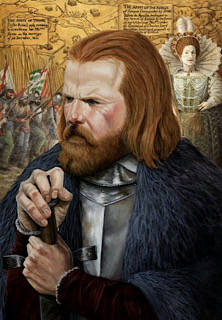
Doire Leathan is on the eastern shores of Teelin Bay, being just across from the village of Teelin. The battle is part of the ongoing succession dispute for the leadership of the Gaelic lordship of O’Donnell. A combined force of Irish clans and ScottishRedshankmercenaries hired by Iníon Dubh (pronounced “In-neen Doo”) defeat and kill Sir Domhnall Ó Domhnaill (Sir Donnell O’Donnell). The Tanist of Tír Conaill, Sir Domhnall’s younger half-brother and Iníon Dubh’s son, Red Hugh O’Donnell, is still imprisoned in Dublin Castle, but later rises following a subsequent escape to lead Clan O’Donnell and is a prominent figure during the Nine Years’ War.
According to the Annals of the Four Masters, “The son of O’Donnell, i.e. Donnell, the son of Hugh, son of Manus, son of Hugh Duv, son of Hugh Roe, son of Niall Garv, son of Turlough of the Wine, attempt to depose his father, after he had grown weak and feeble from age, and after his other son had been imprisoned in Dublin; so that Donnell brought under his power and jurisdiction that part of Tirconnell from the mountain westwards, i.e. from Bearnas to the River Drowes; and also the people of Boylagh and Tir-Boghaine. It was a cause of great anguish and sickness of mind to Ineenduv, the daughter of James Mac Donnell, that Donnell should make such an attempt, lest he might attain the chieftainship of Tirconnell in preference to her son, Hugh Roe, who was confined in Dublin, and who she hoped would become chief, whatever time God might permit him to return from his captivity; and she, therefore, assembled all the Kinel-Connell who were obedient to her husband, namely, O’Doherty, with his forces; Mac Sweeny-na dTuath (Owen Oge), with his forces; and Mac Sweeny Fanad, with his forces; with a great number of Scots along with them. After Donnell O’Donnell had received intelligence that this muster had been made to oppose him, he assembled his forces to meet them. These were they who rose up to assist him on this occasion: Mac SweenyBanagh (Donough, the son of Mulmurry); a party of the Clan Sweeney of Munster, under the conduct of the three sons of Owen, the son of Mulmurry, son of Donough, son of Turlough, and their forces; and O’Boyle (Teige Oge, the son of Teige, son of Turlough), with all his forces, assembled. The place where the son of O’Donnell happened to be stationed along with these chieftains was Doire-leathan at the extremity of Tir-Boghaine, to the west of Gleann Choluim Cille. The other party did not halt until they came to them to that place; and a battle ensued between them, which was fiercely fought on both sides. The Scots discharged a shower of arrows from their elastic bows, by which they pierced and wounded great numbers, and, among the rest, the son of O’Donnell himself, who, being unable to display prowess or defend himself, was slain at Doire-leathan, on one side of the harbour of Telinn, on the 14th of September. Seldom before that time had his enemies triumphed over him; and the party by whom he was slain had not been by any means his enemies until they encountered on this occasion; and although this Donnell was not the rightful heir of his father, it would have been no disgrace to Tirconnell to have elected him as its chief, had he been permitted to attain to that dignity. In this conflict were slain along with Donnell the three sons of Owen, son of Mulmurry, son of Donough above mentioned, together with two hundred others, around Donnell.”
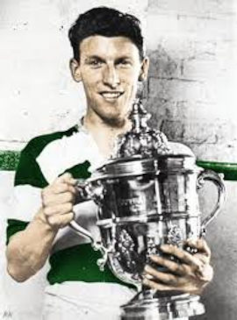
(Pictured: Hugh Roe O’Donnell, otherwise known in history and lore as Red Hugh O’Donnell)
In the 19th century, association football outside of Ulster is largely confined to Dublin and a few provincial towns. The British Army teams play a role in the spread of the game to these areas, especially in Munster, as local clubs are initially reliant on them to form opposition teams, leading to the nickname “the garrison game.” Association football is played in relatively few Catholic schools as middle-class schools favour rugby union while others favour Gaelic games. The Irish Football Association (IFA) had been founded in 1880 in Belfast as the football governing body for the whole of Ireland, which was then a part of the United Kingdom and considered a Home Nation. The Leinster Football Association was an affiliate, founded in 1892 to foster the game in Leinster, outside of the Ulster heartlands. This was followed by the establishment of the Munster Football Association in 1901.
By 1913, the Leinster FA becomes the largest divisional association within the IFA, displacing the North East Ulster Football Association, yet all but two clubs in the 1913–14 Irish League are based in Ulster. While this largely reflects the balance of footballing strength within Ireland, southern members feel the IFA is doing little to promote the game outside of the professional clubs in its northern province. In the other provinces, association football is also under pressure from the Gaelic Athletic Association (GAA), which has banned members from playing or watching the sport as it is considered a “foreign” game. Furthermore, there is a growing feeling in Dublin of alleged Belfast bias when it comes to hosting matches and player selection for internationals. This view is not helped by the composition of the IFA’s sub-committees, with over half of the membership consisting of delegates hailing from the North-East, and the International Committee, who chooses the national team, containing just one member from Leinster. The Belfast members are mainly unionist, while the Dublin members are largely nationalist. World War I increases the gulf between the northern teams and the clubs in the south as the Irish League is suspended and replaced by regional leagues, foreshadowing the ultimate split. Tensions are then exacerbated by the Irish War of Independence of 1919–21, which disrupts contact between northern and southern clubs further and prevents resumption of the Irish League. The security situation prompts the IFA to order the March 1920-21 Irish Cup semi-final replay between Glenavon and Shelbourne to be replayed in Belfast, rather than in Dublin as convention dictates. This proves to be the final straw and the Leinster FA confirms their decision to disaffiliate from the IFA at a meeting on June 8, 1921.
The Football Association of Ireland (FAI) is formed in Dublin on September 2, 1921, by the Leinster FA. The Free State League (originally the Football League of Ireland and now the League of Ireland) is founded in June of that year when the Leinster FA withdraws from the IFA. This is the climax of a series of disputes about the alleged Belfast bias of the IFA. Both bodies initially claim to represent the entire island. The split between Southern Ireland (which becomes the Irish Free State in December 1922) and Northern Ireland (which comes into existence as a jurisdiction in 1921) does not produce a split in the governing bodies of other sports, such as the Irish Rugby Football Union (IRFU). The Munster Football Association, originally dominated by British Army regiments, falls into abeyance on the outbreak of World War I, and is re-established in 1922 with the help of the FAI, to which it affiliates. The Falls League, based in the Falls Road of nationalist West Belfast, affiliates to the FAI, and from there Alton United wins the FAI Cup in 1923. However, when the FAI applies to join FIFA in 1923, it is admitted as the Football Association of the Irish Free State (FAIFS) based on a 26-county jurisdiction. (This jurisdiction remains, although Derry City, from Northern Ireland, are given an exemption, by agreement of FIFA and the IFA, to join the League of Ireland in 1985.) Attempts at reconciliation followed. At a 1923 meeting, the IFA rejects an FAIFS proposal for it to be an autonomous subsidiary of the FAIFS. A 1924 meeting in Liverpool, brokered by the English FA, almost reaches agreement on a federated solution, but the IFA insists on providing the chairman of the International team selection committee. A 1932 meeting agrees on sharing this role, but founders when the FAIFS demands one of the IFA’s two places on the International Football Association Board (IFAB). Further efforts to reach agreement are made through a series of conferences between the IFA and FAI from 1973 to 1980 during the height of the Troubles in Northern Ireland.
The IFA does not feel obliged to refrain from selecting Free State players for its international team. The name Football Association of Ireland is readopted by the FAIFS in 1936, in anticipation of the change of the state’s name in the pending Constitution of Ireland, and the FAI begins to select players from Northern Ireland based on the Constitution’s claim to sovereignty there. A number of players play for both the FAI “Ireland” (against FIFA members from mainland Europe) and the IFA “Ireland” (in the British Home Championship, whose members had withdrawn from FIFA in 1920). Shortly after the IFA rejoins FIFA in 1946, the FAI stops selecting Northern players. The IFA stops selecting southern players after the FAI complains to FIFA in 1950.
From the late 1960s, association football begins to achieve more widespread popularity. Donogh O’Malley, TD and then Minister for Education, begins a new programme of state-funded schools in 1966, many with association football pitches and teams. The Gaelic Athletic Association’s ban on members playing “foreign” games is lifted in 1971. RTÉ television, founded in 1962, and British television (available nearly everywhere on cable or microwave relay from the 1970s), broadcast association football regularly. Above all, the increasing success of the international side from the late 1980s gives increased television exposure, more fans, and more funds to the FAI.
However, increased media exposure also highlights some inadequacies of its hitherto largely amateur organisation. In January 1999, the FAI announces a planned national association football stadium, to be called Eircom Park after primary sponsors Eircom. This is to be a 45,000-seat stadium in City West, modeled on the GelreDome in Arnhem. It gradually becomes apparent that the initial forecasts of cost and revenue have been very optimistic. FAI and public support for the project is also undermined by the announcement of the Stadium Ireland in Abbotstown, which would have 65,000 seats and be available free to the FAI, being funded by the state. The Eircom Park project is finally abandoned in March 2001, amid much rancour within the FAI.
During preparation for the 2002 FIFA World Cup, the captain of the senior football team, Roy Keane, leaves the training camp and returns to his home. He is critical of many aspects of the organisation and preparation of the team for the upcoming games, and public opinion in Ireland is divided. As a result of the incident, the FAI commissions a report from consultants Genesis into its World Cup preparations. The “Genesis Report” makes a number of damning criticisms regarding corruption and cronyism within the association, but is largely ignored. The complete report is never published for legal reasons. The FAI subsequently produces its own report of itself titled “Genesis II” and implements a number of its recommendations.
In 2002, the FAI announces a deal with British Sky Broadcasting to sell broadcasting rights to Ireland’s international matches, as well as domestic association football, to be televised on its satellite subscription service. The general public feels it should be on RTÉ, the free-to-air terrestrial service, in spite of their offering much lower rates. Faced with the prospect of the government legislating to prevent any deal, the FAI agrees to accept an improved, but still lower, offer from RTÉ.
Following the respectable performance of the national team in the 2002 FIFA World Cup, the team’s fortunes decline under the management of Mick McCarthy, Brian Kerr and Steve Staunton.
In September 2006, Lars-Christer Olsson, CEO of UEFA, is quoted as anticipating that Lansdowne Road in Dublin (actually owned by the Irish Rugby Football Union) will stage the UEFA Cup Final in 2010, and that the FAI and the IFA will co-host the 2011 UEFA European Under-21 Championship. The 2010 final is ultimately awarded to Hamburg, but in January 2009, UEFA nameS Lansdowne Road as the host stadium for the renamed 2011 UEFA Europa League Final. In August 2010, an FAI spokesman says they will have repaid all of their stadium debt of €46 million within 10 years despite the disastrous sale of 10-year tickets for premium seats at the Aviva Stadium.
In November 2007, the FAI moves to new headquarters at the National Sports Campus in Abbotstown. Its headquarters since the 1930s had been a Georgian terraced house at 80 Merrion Square, which is sold for a sum variously reported as “in excess of €6m” and “almost €9m.”
The Land Purchase (Ireland) Act 1903, also known as the Wyndham Land Act, is enacted on August 14, 1903, and allows for entire estates to be purchased by the occupying tenantry, subsidized by the state.
It differs from earlier legislation which initially advanced to tenants the sum necessary to purchase their holdings, repayable over a period of years on terms determined by an independent commission, while the Wyndham Act finishes off absentee landlords‘ control over tenants and makes it easier for tenants to purchase land, facilitating the transfer of about 9 million acres (36,000 km2) up to 1914. By then, 75% of occupiers are buying out their landlords under the 1903 Act and the later Irish Land Act 1909 of Augustine Birrell, which extends the 1903 act by allowing for the compulsory purchase of tenanted farmland by the Land Commission, but falls far short in its financial provisions. In all, under these pre-1921 Land Acts over 316,000 tenants purchase their holdings amounting to 11.5 million acres (47,000 km2) out of a total of 20 million acres (81,000 km2) in the country.
The Acts provide Irish tenant farmers with more rights than tenant farmers in the rest of the United Kingdom. Munster tenants avail of land purchase in exceptionally high numbers, encouraged by their Irish Land and Labour Association‘s leader D. D. Sheehan after he and O’Brien establish an Advisory Committee to mediate between landlords and tenants on purchase terms which produce a higher take-up of land purchase than in any other province.
Historian Robert K. Webb gives most of the credit for the Wyndham Act to Conservative leader Arthur Balfour. He says the Act is “a complete success. By the time the Irish Free State was created in 1922, the system of peasant proprietorship had become universal… A land problem more than a century old had been solved, though it had taken more than 30 years of educating Parliament and landlords to do it. The scheme was intended as well to ‘kill Home Rule by kindness.’”
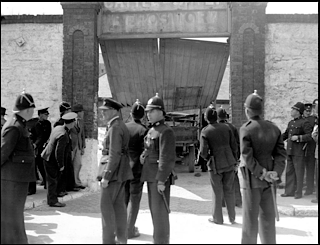
The Copley Street riot occurs on August 13, 1934, at the Copley Street Repository, Cork, County Cork, after Blueshirts opposed to the collection of annuities from auctioned cattle ram a truck through the gate of an ongoing cattle auction. The Broy Harriers open fire and one man, 22 year old Michael Lynch, is killed and several others injured.
Following the Irish War of Independence (1919–21), Britain relinquishes its control over much of Ireland. However, aspects of the Anglo-Irish Treaty, which had marked the end of the war, lead to the Irish Civil War (1922–23). The aftermath leaves Ireland with damaged infrastructure and hinders its early development.
Éamon de Valera, who had voted against the Anglo-Irish treaty and headed the Anti-Treaty movement during the civil war, comes to power following the 1932 Irish general election and is re-elected in 1933. While the treaty stipulates that the Irish Free State should pay £3.1 million in land annuities to Great Britain, and despite advice that an economic war with Britain could have catastrophic consequences for Ireland (as 96% of exports are to Britain), de Valera’s new Irish government refuses to pay these annuities – though they continue to collect and retain them in the Irish exchequer.
This refusal leads to the Anglo-Irish trade war (also known as the “Economic War”), which persists until 1935, when a new treaty, the Anglo-Irish Trade Agreement, is negotiated in 1938. During this period, a 20% duty is imposed on animals and agricultural goods, resulting in significant losses for Ireland. Specifically, poultry trade declines by 80%, butter trade by 50% and cattle prices drop by 50%. Some farmers are forced to kill and bury animals because they cannot afford to maintain them.
In 1933, Fine Gael emerges as a political party—a merger of Cumann na nGaedheal and the National Centre Party. Fine Gael garners substantial support from rural farmers who are particularly affected by the Economic War. They strongly object to the collection of land annuities by the Fianna Fáil government. The Blueshirts, a paramilitary organisation founded as the Army Comrades Association in 1932 and led by former Garda CommissionerEoin O’Duffy, transforms into an agrarian protest organisation, mobilising against seizures, cattle auctions, and those tasked with collecting annuities.
O’Duffy, a key figure in Irish politics, encourages farmers to withhold payment of land annuities to the government. Arising from this stance, Gardaí start to seize animals and farm equipment, auctioning them to recover the outstanding funds. While seized cattle are auctioned, local farmers rarely participate. Instead, Northern Ireland dealers, often associated with the name O’Neill, are the primary buyers. These auctions are protected by the Broy Harriers, an armed auxiliary group linked to the police.
By 1934, tensions escalate, and a series of anti-establishment incidents are attributed to the Blueshirts. These incidents range from minor acts of violence, such as breaking windows, to more serious offenses like assault and shootings.
On August 13, 1934, an auction takes place at Marsh’s Yard on Copley Street in Cork, featuring cattle seized from farms in Bishopstown and Ballincollig. The police establish a cordon by 10:00 a.m., with 300 officers on duty. Lorries arrived at 11:00 a.m.
Around noon, three thousand protestors assemble. Within twenty-five minutes, an attempt is made to breach the yard gate by ramming it with a truck. According to Oireachtas records, there are approximately 20 men in the truck which they run against the gate. The Minister for JusticeP. J. Ruttledge, says that the truck “with those people in it charged through those cordons of Guards; that several Guards jumped on to the lorry and tried to divert the driver by catching hold of the steering wheel and trying to twist it.” Some contemporary news sources suggest that the ramming truck knocked down the surrounding police cordon “like ninepins and crush[ed] a police inspector against a gate.” Later sources suggest that the senior officer (a superintendent) was injured in a fall, while attempting to avoid being struck, rather than being hit directly by the truck.
A man named Michael Lynch, wearing the distinctive blue shirt, and approximately 20 others reportedly manage to enter the yard. As soon as they enter the yard they are fired upon by armed “special branch” police detectives who are in the yard. Lynch later succumbs to his injuries at the South Infirmary. Thirty-six others are wounded. Despite the violence, the auction proceeds after a one-hour delay.
Following the shooting, a riot ensues, but when news of Lynch’s death reaches the participants, they cease rioting, kneel, and recited a Rosary.
The funeral of Michael Lynch occurs on August 15, 1934. The funeral procession is planned to depart from Saints Peter and Paul’s Church, Cork at 2:30 PM.
The occasion allows for a significant show of force for Eoin O’Duffy and the Blueshirts, and features Roman salutes and military drills. Farmers in Munster reportedly stop work for an hour, and Blueshirt members ask shopkeepers to close their businesses, as a show of respect for the “martyr.” Lynch is afforded a “full Blueshirt burial,” and the coffin is adorned with the flag of the Blueshirts (the Army Comrades Association).
According to the Minister for Justice, at the funeral W. T. Cosgrave stands beside O’Duffy as the Blueshirt leader gives an oration saying, “We are going to carry on until our mission is accomplished […] those 20 brave men, whose deed will live for ever, not only in Cork but in every county in Ireland, broke through in the lorry […] all Blueshirts should try to emulate his bravery and nobleness. Every Blueshirt is prepared to go the way of Michael for his principles.”
The court grants the family £300 in 1935. This is appealed to the High Court, followed by the Supreme Court, which dismisses the case. In the Supreme Court, Henry Hanna describes the Broy Harriers as “an excrescence” upon the Garda Síochána.
When the matter is discussed in the Seanad in September 1934, and before a vote is taken to “[condemn] the action of the members of the special branch of the Gárda Síochána […] on Monday, the 13th August 1934,” the senators who support Éamon de Valera’s government walk out.
In August 1940, a memorial is unveiled on the tomb of Lynch in Dunbulloge Cemetery in Carrignavar, County Cork, consisting of a limestone Celtic cross and pedestal. The pedestal is engraved with a quote from the American orator, William Jennings Bryan: “The humblest citizen of all the land, when clad in the armour of a righteous cause is stronger than all the hosts of error.”
(Pictured: Aftermath of the ramming of Marsh’s Yard, Copley Street, that leads to the death of Michael Lynch and the Copley Street Riot on August 13, 1934)
Sir Henry Sidney, English soldier, politician and Lord Deputy of Ireland from 1565 to 1571 and from 1575 to 1578, is born on July 20, 1529, probably in London. He cautiously implements Queen Elizabeth I’s policy of imposing English laws and customs on the Irish.
Sidney is the eldest son of Sir William Sidney of Penshurst, England and Anne Pakenham. William Sidney is a prominent politician and courtier during the reigns of Henry VIII and Edward VI, from both of whom he receives extensive grants of land, including the manor of Penshurst in Kent, which becomes the principal residence of the family.
Sidney is brought up at court as the companion of Prince Edward, afterward King Edward VI, and continues to enjoy the favour of the Crown, serving under Mary I of England and then, particularly, throughout the reign of Queen Elizabeth I. He is instrumental in the Elizabethan conquest of Ireland, serving as Lord Deputy three times. His career is controversial both at home and in Ireland.
Appointed Lord Deputy by Elizabeth in 1565, Sidney faces a major rebellion in Ulster led by the powerful chieftain Shane O’Neill. Failing to subdue O’Neill by force, he intrigues against him with his enemies, the O’Donnells of Tyrconnell and the MacDonnells of Antrim. Finally, O’Neill is assassinated by the MacDonnells in 1567. Nevertheless, Sidney is still not strong enough to destroy completely the power of Ulster’s native chieftains. He does, however, persuade a number of Irish chiefs to submit to Elizabeth’s authority, and he establishes English presidents of Munster and Connacht to control the chiefs. In addition, by refraining from introducing anti-Roman Catholic legislation in the Parliament of Ireland of 1569–71, he makes possible the containment and ultimate defeat in 1573 of a rebellion of Munster Catholics led by James FitzMaurice FitzGerald.
Resenting the Queen’s failure to provide him with an adequate military force, Sidney resigns in 1571, but is reappointed Lord Deputy four years later. His arbitrary taxation arouses popular resentment and leads to his recall in 1578. Thereafter he serves only as president of the Council of Wales and the Marches, living chiefly at Ludlow Castle for the remainder of his life, dying there at the age of 56 on May 5, 1586.
The eldest of the three sons and one daughter of Daniel Sheehan, tenant farmer, and his wife, Ellen (née Fitzgerald). He is educated at the local primary school. In his book Ireland since Parnell (1921) he states that witnessing the ragged poverty of labourers’ and smallholders’ children who attended the school made him determined to do something for the poor. The family’s Fenian tradition and his parents’ eviction from their holding in 1880 form his early years. At the age of sixteen he becomes a schoolteacher.
In 1890, Sheehan takes up journalism, serving as correspondent of the Kerry Sentinel and special correspondent of the Cork Daily Herald in Killarney. He also becomes correspondence secretary to the Kanturk trade and labour council, which campaigns on behalf of agricultural labourers. He manages to get reports of meetings into the Cork papers, and this helps the rapid spread of the association, which in 1890 becomes the Irish Democratic Trade and Labour Federation, under the leadership of Michael Davitt. It is, however, fatally disrupted by the Parnell split. While Sheehan continues to admire Davitt, and despite the pre-split Irish party leadership having opposed the federation as a threat to Charles Stewart Parnell‘s leadership, he becomes a Parnellite, and always remembers his only meeting with Parnell at Tralee, when the chief is presented with a loyal address (drafted by Sheehan) from his Killarney supporters. After Parnell’s death and the defeat of the Second Home Rule Bill, he temporarily drops out of Irish politics.
Following his marriage on February 6, 1894, to Mary Pauline O’Connor of Tralee, Sheehan joins the staff of the Glasgow Observer in pursuit of journalistic experience, then becomes editor of the Catholic News in Preston, Lancashire. In 1898, he returns to Ireland and works on various papers, including the Cork Constitution, before serving as editor of the Skibbereen-based Cork County Southern Star (1899–1901), where his Parnellism brings him into conflict with the Bishop of Ross, Denis Kelly. He expresses sympathy for the newly founded United Irish League (UIL), established by William O’Brien in Connacht with the dual aim of representing western smallholders and using a new land agitation as a vehicle for Irish Party reunion. He does not, however, join the UIL himself.
In August 1894, the Clonmel solicitor J. J. O’Shee, anti-Parnellite MP for West Waterford from 1895, forms the Irish Land and Labour Association (ILLA) to agitate on behalf of agricultural labourers and small tenant farmers. Its appearance reflects the breakdown of the centralised party discipline which had existed before the Parnell split, and recognition that the land war’s prime beneficiaries had been large and middle-sized tenant farmers rather than the nation as a whole. On returning from Britain in 1898, Sheehan throws himself into organising the ILLA and becomes its president. In 1900 there are 100 branches, mostly in Cork, Tipperary, and Limerick. The Irish Party leadership look on this organisation with some suspicion.
At the 1900 United Kingdom general election in Ireland Sheehan seeks the Irish Parliamentary Party (IPP) nomination for South Cork but was defeated by Edward Barry. After the death of Dr Charles Tanner, however, he succeeds in obtaining the IPP nomination for the constituency of Mid Cork, despite the party leadership’s attempts to deny recognition to ILLA branches in order to hand the nomination to its favoured candidate. Sheehan is elected unopposed on May 17, 1901. At the age of 28, he is the youngest Irish member of parliament. Although he has been admitted to the party, his position as a labour representative and his perceived independent base make him something of an outsider.
From October 1904 Sheehan allies himself with O’Brien, writing regularly for the latter’s weekly a TheIrish People. Redmondites accuse him of opportunism, but he always maintains that his personal inclination as an old Parnellite has been towards John Redmond and that his support for O’Brien derives from the older man’s willingness from 1904 to identify himself with the labourers’ campaign. Although their alliance originally likely contains elements of expediency, Sheehan and O’Brien develop a deep personal friendship.
Sheehan’s support for O’Brien leads to a split in the ILLA in 1906, with Tipperary and Waterford branches following O’Shee and Redmond, and Sheehan retaining the support of his Cork base and of some branches in Limerick and Kerry. He serves on the Cork advisory committee which represents tenant interests in land purchase negotiations under the Wyndham Land Act. It’s policy of “conference plus business” combines an offer to negotiate with willing landlords and a threat of agitation against those unwilling to give satisfactory terms. His faction of the ILLA becomes the basis for the grassroots organisation of O’Brien’s followers, and sporadic attempts, financed by O’Brien, are made to spread it outside its Munster base. Both factions of the ILLA claim credit for the passage of the 1906 and 1911 Labourers’ (Ireland) Acts which provide for the allocation of cottages and smallholdings to labourers. In Cork and some other parts of Munster these buildings become popularly known as “Sheehan’s cottages,” a term which long outlives Sheehan’s political career. He also helps to bring about the creation of a “model village” at Tower, near Blarney, the result of cooperation between the local ILLA branch and the rural district council.
At the 1906 general election the Redmond leadership attempts to avoid an open split by allowing O’Brien’s supporters to return unopposed. However, the continuing conflict between the two factions rapidly leads to a formal break. Shortly after the election Sheehan is excluded from the IPP, and thereby deprived of the parliamentary stipend paid to MPs with insufficient resources to maintain themselves. With the support of O’Brien and the small group of O’Brienite MPs, he maintains that the party has no right to exclude an elected MP willing to take the party pledge. After resigning his seat to which he was re-elected without opposition on December 31, 1906, he demands readmission to the party and mounts an unsuccessful lawsuit demanding payment of the stipend. He is subsequently supported from the proceeds of collections outside church gates on Sundays.
Sheehan and the other O’Brienite MPs are readmitted to the party in 1908 as part of an attempt at general reconciliation after the disruptions following the rejection of the Irish Council Bill. Dissensions rapidly reappear over Augustine Birrell‘s 1909 land act, which the O’Brienites see as wriggling out of the financial responsibilities accepted by the British government in the Wyndham land act and as sabotaging land purchase, since landlords will not accept the terms offered. Sheehan’s section of the ILLA is denied official recognition and thereby prevented from sending delegates to a party convention called to consider the bill. At the convention, groups of “heavies”recruited from Joseph Devlin‘s Ancient Order of Hibernians (AOH) exclude delegates with Cork accents, while O’Brienite speakers are howled down. This leads to the formation in March 1909 of the All-for-Ireland League (AFIL), a body based on the existing O’Brienite organisation and advocating O’Brien’s policy of gradually implementing home rule through step-by-step cooperation with moderate unionist supporters of devolution. Although O’Brien’s temporary retirement for health reasons in April 1909 leads to the suspension of the AFIL, it is revived in response to an attempted purge of the O’Brienite MPs by the leadership and by O’Brien’s reappearance in response to the January 1910 general election. Sheehan writes regularly for its paper, the Cork Free Press.
In the general election the O’Brienites hold their seats while two Cork Redmondites are displaced. Sheehan is re-elected for Mid Cork, defeating the Redmondite W. G. Fallon in a campaign marked by widespread rioting and impassioned clerical denunciations of Sheehan. Fallon subsequently attempts to get up a “red scare” against the ILLA. The Cork ILLA later splits over Sheehan’s slightly erratic leadership. While the split is initially personality-driven, the breakaway faction, led by Patrick Bradley and centred in east Cork, moves back toward alignment with Redmond. At the December 1910 election the AFIL consolidates its position in Cork, but is defeated everywhere else. Sheehan retains his Mid Cork seat against a local candidate but is defeated in a simultaneous contest in East Limerick. He is also defeated when he stands for Cork County Council in June 1911, though the AFIL wins control of that body.
Sheehan studies law at University College Cork (UCC) (1908–09), where he is an exhibitioner and prizeman, and at King’s Inns, where he graduated with honours. He is called to the bar in 1911 and practised on the Munster circuit. In 1913–14 he is active in the AFIL’s attempts to avert partition by trying to recruit sections of British political opinion in favour of a conference between the parties. He becomes vice-chairman of the Imperial Federation League. This receives considerable attention among the British political classes but contributes to the decline of the AFIL’s electoral base. The policy of conciliation has been driven to a considerable extent by the belief that it is the only way of achieving home rule. The abolition of the House of Lords’ veto and the introduction of the third home rule bill by the Asquith government undercuts this argument and increases Redmond’s prestige, while AFIL denunciations of Redmondism are seen as driven by personal resentment and playing into the hands of unionists. The decision of the AFIL MPs to abstain from supporting the bill on its final passage through the House of Commons in 1914 as a protest against the prospect of a partition-based compromise is represented by Redmondites as a vote against home rule itself and contributed to AFIL loss of Cork County Council in June 1914.
On the outbreak of World War I, Sheehan supports O’Brien in calling for Irish enlistment for foreign service. In November 1914, at the age of forty-two, he enlists himself and is gazetted as a lieutenant in the Royal Munster Fusiliers. It is claimed that he is almost single-handedly responsible for raising the 9th (service) battalion of this regiment. Three of his sons also enlist. Two of his sons are killed in action with the Royal Flying Corps, and a daughter is disabled by injuries received in an air raid while serving as a nurse. In the spring and summer of 1915 he organises and leads recruiting campaigns in Cork, Limerick, and Clare. This is part of a nationwide drive for recruits, aimed in particular at the farming community, which reflects the realisation that the war is going to last much longer than expected.
In 1915, Sheehan is promoted to the rank of captain and serves with his battalion on the Loos-en-Gohellesalient and at the Battle of the Somme, contributing a series of articles from the trenches to the London Daily Express. Various ailments, including deafness caused by shellfire, and hospitalisation necessitate his transfer to the 3rd Royal Munster Fusiliers (Reserve) Battalion, and he resigns his commission on January 13, 1918, due to ill health. In April 1918 he speaks at Westminster against the bill extending conscription to Ireland, threatening to resist it by force. One of his last parliamentary speeches (in October 1918) is in support of a bill providing land grants for Irish ex-servicemen. With the growth of Sinn Féin and the virtual demise of the AFIL, his position in Cork grows increasingly untenable. The Sheehan family faces intimidation and are obliged to leave their home on the Victoria Road for London, where he has secured the Labour Party nomination for the Limehouse–Stepney division of the East End, later represented by Clement Attlee.
Sheehan is unsuccessful in the 1918 United Kingdom general election, and is obliged to leave politics after a financially disastrous involvement in an Achill Island mining company leads to his bankruptcy. Unable to practise at the bar because of the hearing loss caused by his war service, he returns to journalism and becomes editor and publisher of TheStadium, a daily newspaper for sportsmen. In 1921, shortly before the Anglo-Irish truce, he publishes Ireland since Parnell, a history of recent events heavily dependent on the writings of O’Brien but incorporating some personal reminiscences. It concludes by blaming the outbreak of the IRA guerrilla campaign on provocation by Crown forces, denouncing reprisals, and pleading for British recognition of Dáil Éireann and dominion home rule for an undivided Ireland.
Sheehan moves to Dublin in 1926 after hearing that the threats against him have been lifted. His wife, who has never fully recovered from the stresses and bereavements she has experienced since 1914, dies soon afterward. Sheehan himself becomes managing editor of Irish Press and Publicity Services and, in 1928, publisher and editor of the South Dublin Chronicle. The paper gives critical support to the Irish Labour Party, publishes campaigning articles on slum conditions, and advocates housing reform. In September 1930, he is an unsuccessful Labour candidate for Dublin County Council. In the 1930s, as his health deteriorates further, he works as coordinator for the ex-servicemen’s group the Old Comrades’ Association, editing both northern and southern editions of its annual journal. In 1942, he offers himself to Richard Mulcahy as a Fine Gael candidate for Cork South-East, but is turned down. He dies on November 28, 1948, while visiting his daughter at Queen Anne Street, London. Both he and his wife are buried in Glasnevin Cemetery.
(From: “Sheehan, Daniel Desmond (‘D. D.’)” by Patrick Maume, Dictionary of Irish Biography, http://www.dib.ie, October 2009)
Patrick “Paddy” Coad, Irish football player and manager, is born at 100 Lower Yellow Road in Waterford, County Waterford, on April 14, 1920. He plays as a forward for Waterford, Glenavon, Shamrock Rovers and Ireland. Although known, primarily, as a maker of goals, he scores 126 goals in the League of Ireland and a further 41 in the FAI Cup. In 1946–47, he is top goal scorer in the League of Ireland. As a player manager, he also guides Shamrock Rovers to three League of Ireland titles and two FAI Cups, before he returns to Waterford and guides them to their first league title in 1966. He is appointed manager of Limerick in September 1967.
Coad is educated at De La Salle College Waterford and first distinguishes himself as a sportsman playing hurling and table tennis, becoming a Munster champion at the latter sport. He also begins to play football with Corinthians, a local junior club based in the Lower Yellow Road area of Waterford. He is soon spotted by Waterford, making his League of Ireland debut in 1937 at the young age of seventeen. He then moves to the Northern Ireland Football League (NIFL) club Glenavon but returns to Waterford after the start of World War II. He is a member of the Waterford team that finishes as a runner up to Cork United in both the League of Ireland and the FAI Cup. Waterford could have won the league title, but their players refuse to turn up for a play-off game against Cork after a dispute over bonus payments.
Coad signs with Shamrock Rovers in 1942 and on February 8 makes his debut against Brideville in the FAI Cup. During his early seasons with the club, he plays alongside Peter Farrell, Tommy Eglington, Jimmy McAlinden and Tommy Breen. He also helps Rovers win the FAI Cup three times. In November 1949, after the untimely death of Jimmy Dunne, he reluctantly accepts the position of player manager. He brings in many young players, including Liam Tuohy, and the team becomes known as Coad’s Colts. The Colts win 19 trophies between 1954 and 1959. Under his guidance, Rovers win three League of Ireland titles and the FAI Cup twice. In 1957, they also make their debut in the European Cup. Despite losing 9–2 on aggregate to Manchester United, Coad at the age of 37, dominates the away game at Old Trafford. He makes two appearances in the European Cup. On May 2, 1955, he is rewarded with a benefit game against Chelsea F.C. with Rovers winning 3-2.
Coad returns home to manage the Blues in 1960. In the 1965–66 League of Ireland season Waterford wins the Championship for the first time. Coad reflects on his legacy: “To bring the first title to my native Waterford leaves everything else in the shade.”
Between 1946 and 1952, Coad also makes eleven appearances and scored three goals for Ireland. He makes his debut on September 30, 1946, in a 1–0 defeat to England. On March 2, 1947, he scores his first goal for Ireland in a 3–2 win against Spain. During this game he also sets up both of Ireland’s other goals for Davy Walsh. On May 22, 1949, he scores the only goal, a penalty, in a 1–0 win over Portugal. His third goal for Ireland comes on May 30, 1951, in 3–2 away win over Norway. Ireland is 2–0 down until Peter Farrell and Alf Ringstead level the score. Then in the 82nd minute Coad scores from 20 yards to win the game. He plays his last game for Ireland in a 6–0 away defeat against Spain on June 1, 1952.
After his professional playing career Coad works for twelve years as a commercial traveler for B. P. Ganley Ltd, a bacon and pork distributor in Waterford. He and his wife, Bud, have two daughters and a son. He is ill for six months prior to his death on March 8, 1992, at his daughter’s home in Waterford.
Coad’s brother, Seamus, plays for Waterford in the late 1960s and manages the team in the 1990s. Seamus’ sons Gary and Nigel Coad continue the family name by lining out for the Blues under their father before both going on to win many trophies locally. Amazingly, both Gary and Nigel become only the third set of second-generation brothers to play together for Waterford, following Paddy and Seamus, the Hales and Fitzgeralds. In 2012, Seamus’ grandson, Conor, becomes the latest Coad to play for Waterford United.
The Shamrock Rovers Player of the Year trophy is named after Paddy Coad.
Mhac an tSaoi is influenced by her stays in the Dingle Peninsula in County Kerry with her uncle, Monsignor De Brún, at his parish of Dún Chaoin. Monsignor de Brún, similarly to his sister, is a distinguished linguist and Celticist, the literary translator of Homer, Dante Alighieri, Sophocles, and Jean Racine into Modern Irish, “and one of the most distinguished literary figures of his time.”
Mhac an tSaoi studies Modern Languages and Celtic Studies at UCD, before going to further research at the Dublin Institute for Advanced Studies and at the University of Paris. She writes the famous work of Christian poetry in Munster Irish, Oíche Nollag (“Christmas Eve”), when she is only 15-years of age.
Mhac an tSaoi spends two years studying in post-war Paris (1945–47) before joining the Irish diplomatic service and is working at the Irish embassy in Madrid when she commits herself to writing poetry in Irish following her discovery of the works of Federico García Lorca.
She remains a prolific poet and is credited, along with Seán Ó Ríordáin and Máirtín Ó Direáin, with reintroducing literary modernism into Irish literature in the Irish language, where it had been dormant since the 1916 execution of Patrick Pearse, in the years and decades following World War II. Her poetry draws on the vernacular spoken by the native Irish speakers of the Munster Gaeltacht of West Kerry during the first half of the twentieth century. Formally, she draws on the song metres of the oral tradition and on older models from the earlier literary tradition. In later work, she explores looser verse forms but continues to draw on the remembered dialect of Dún Chaoin and on a scholarly knowledge of the older literature.
Mhac an tSaoi is elected to Aosdána in 1996 but resigns in 1997 after Francis Stuart is elevated to the position of Saoi. She had voted against Stuart because of his role as an Abwehr spy and in radio propaganda broadcasts from Nazi Germany aimed at neutral Ireland during World War II.
In 2001, she publishes an award-winning novel A Bhean Óg Ón… about the relationship between the 17th-century County Kerry poet and Irish clan chief Piaras Feiritéar and Meg Russell, the woman for whom he composed some of the greatest works of love poetry ever written in the Irish language.
Her poems Jack and An Bhean Óg Ón are both featured on the Leaving Certificate Irish course, at both Higher and Ordinary Levels, from 2006 to 2010. Her literary translation of Rainer Maria Rilke‘s Duino Elegies from Austrian German into the Irish language is published in 2013.
Mhac an tSaoi marries Irish politician, writer, and historian Conor Cruise O’Brien in a Roman Catholic wedding Mass in Dublin in 1962. This makes her the stepmother to O’Brien’s children from his 1939 civil marriage. Her mother is deeply embarrassed by the exposure of the relationship and staunchly opposes the match, as she has long been a close friend of O’Brien’s Presbyterian first wife. Despite their subsequent marriage, the exposure of their extramarital relationship ends Mhac an tSaoi’s diplomatic and civil service career. They later adopted two children, Patrick and Margaret.
She then lives with her husband in New York City, where he becomes a professor at New York University (NYU) after the Congo Crisis destroys O’Brien’s diplomatic career. He is long blamed by the United Nations for the escalation of the Congo Crisis.
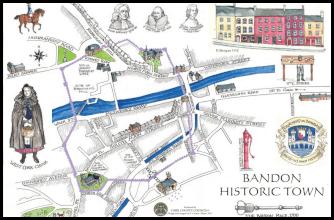
The Capture of Bandon begins on February 23, 1689, when the town of Bandon, County Cork, is forcibly seized from its rebellious Protestant inhabitants by force of Irish Army troops under Justin McCarthy. The skirmishing at the town takes place during the early stages of the Williamite War in Ireland. The Jacobite success at Bandon helps suppress any chance of a general Munster uprising against the rule of James II similar to that which occurs in Ulster the same year. The slogan “No Surrender!” is believed to have been first used at Bandon and subsequently taken up, more famously, by the defenders at the Siege of Derry later in the year.
In 1685, the Catholic James II comes to the throne. This leads to a sharp reversal of government policy in Ireland, which had previously favoured the Protestant inhabitants. This is quickly changed by James’ representative Richard Talbot, 1st Earl of Tyrconnell. Under Talbot’s administration, the army and civil government are mostly purged of Protestants, who are replaced by Catholics. In Bandon, the previous town burgesses are replaced by Catholic nominees.
Talbot’s actions lead to a growing hostility amongst the Protestant inhabitants across the island toward the King and his Irish government. Bandon is a historic centre of Protestants, dating back to the Plantation of Munster in the Elizabethan era and is a natural focus of dissent against James’s rule. In 1688, a similar opposition in England leads to the Glorious Revolution, in which William III successfully invades with a Dutch Army. Many Protestants now believe William to be their rightful King while Catholics, and some Protestants, remain loyal to James. During the growing turmoil, many rural County Cork Protestants come to shelter in Bandon.
Fearing a potential outbreak of rebellion in Bandon will occur, the government sends a detachment of the Irish Army under Captain Daniel O’Neill to take the town. They reportedly enter on a Sunday morning while the inhabitants are attending church services. The following day, February 24, sometimes referred to as “Black Monday,” the townspeople rise and attack the soldiers. Various sources say between three and eight of the redcoats are killed and the remainder are driven out of the town. Using their captured weapons, the Protestants then make an effort to prepare Bandon to withstand an assault.
Having received word about the growing rebellion in the county, Talbot in Dublin has already dispatched six companies of infantry under Justin McCarthy, an experienced Irish Catholic soldier. Instead of immediately assaulting Bandon, McCarthy first seizes nearby Cork, another major centre of Protestants in the south of the country and clamps down on other potential dissidents. He then proceeds to Bandon with his troops, plus some cavalry and artillery. Although they had previously hung out a banner proclaiming “No Surrender,” the defenders negotiate a surrender in exchange for generous conditions. Despite the usual punishment for rebellion being death, the town corporation is fined £1,000 and the walls are ordered to be demolished.
The comparatively light terms imposed on the town are part of a wider attempt by King James to convince Protestants of his goodwill toward them. It angers more hardline Catholics, including McCarthy’s nephew, Donough MacCarthy, 4th Earl of Clancarty, who wants a harsher punishment for the rebels.
The fighting at Bandon is part of a succession of defeats of locally raised Protestant troops both across Munster (at Castlemartyr) and Ireland as a whole, with the Ulster-raised Army of the North suffering heavy defeats at the Break of Dromore and the Battle of Cladyford. The advance of the mainly Catholic Jacobite Army is halted by the successful Protestant defence of Enniskillen and Derry. The arrival of large-scale reinforcements under Frederick Schomberg and King William reverse the tide, and Dublin is captured following the Battle of the Boyne in 1690. The same year, Bandon is re-taken by Protestant forces following John Churchill, 1st Duke of Marlborough‘s successful Siege of Cork. The walls are not rebuilt, as they are becoming increasingly militarily obsolete.
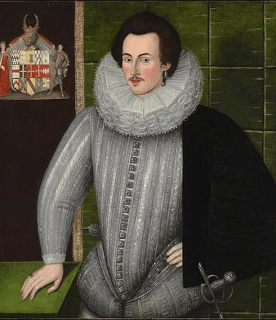
Blount is born in 1563, the second son of James, 6th Baron Mountjoy, and Catherine, only daughter of Sir Thomas Legh. He is among the most distinguished of the family, succeeding as 8th Baron Mountjoy on the death in 1594 of his unmarried elder brother William, 7th Baron Mountjoy. The good fortune of his youthful and handsome looks find favour with Queen Elizabeth I which arouses the jealousy of Robert Devereux, 2nd Earl of Essex, leading to a duel between the two courtiers, who later become close friends.
The downfall of Lord Essex does not damage Blount’s career. After the failure of his rebellion, Essex shocks many by denouncing his sister Penelope, who is Blount’s mistress, as a traitor, which inevitably raises the question of his own possible involvement. But the Crown, anxious to retain Blount’s services, and also to show as much leniency as possible to the defeated rebels, simply ignore the accusation.
On February 24, 1600, Blount lands in Ireland as Lord Deputy following Lord Essex and in the ensuing years brings the Nine Years’ War to an end. The leader of the rebellion, Hugh O’Neill, Earl of Tyrone, writes about Blount’s “refined manners” that he would lose a whole season of campaigning “while waiting until breakfast is prepared to his mind!” Despite this, Blount proves that he is quite qualified to pursue the war.
In early 1600, Blount dispatches Sir Henry Docwra with an army of 4,200 troops to land at Culmore to erect a fortress commanding the shores of Lough Foyle in the northwest of Ulster. To prevent Hugh O’Neill from sending a strong force to repulse Dowcra’s forces, Blount advances in force from Dublin to Newry causing O’Neill to fear a southern advance into Tyrone.
Blount aims to avoid the mistakes of previous Lords-Deputy. After the Battle of Moyry Pass, he has it cleared, and a garrison is established there. It had long been a problem for English forces advancing into Ulster from the south. He also establishes posts with garrisons at Mountnorris and Armagh.
On July 13, 1601, Blount and his army along with Turlough McHenry O’Neill of the Fews who had recently switched to the English side in the war, have a stand-off with Hugh O’Neill’s forces at the River Blackwater. After a few shots in vain from either side, O’Neill’s forces withdraw, and Blount sends his forces to occupy the ruined Blackwater fort destroyed by O’Neill in 1595. Later O’Neill’s forces attack Blount’s camp before withdrawing. In response, the Lord-Deputy sends his forces across the river where they find strong artificially fortified fords, which would have held out against the English.
By July 15, 1601, the Lord-Deputy has secured the surrender of O’Neill’s ally Hugh Magennis. That month, he has a new fort near the old Blackwater fort erected.
Blount reports to the council in England that O’Neill is determined to prevent his forces from advancing into Tyrone and toward Dungannon. As such, he initiates a policy of burning large quantities of corn to induce a famine to drive the rebels out of their strongholds.
Blount sets about trying to entice Hugh’s forces to come out and attack by fetching some materials for the new fort from the Tyrone side of the river as well as burning more corn. Further skirmishes between Blount and O’Neill’s forces ensue during the summer of 1601.
Spanish forces land in Munster in August 1601, forcing Blount to send his forces southward leaving O’Neill remaining in his unbroken heartland of Tyrone. The Spanish arrival culminates in the Siege of Kinsale that December, which sees a major defeat of the rebels and their allies.
O’Neill during this time has also moved south to assist some of his allies, however, after some serious defeats at the hands of the forces of Richard Burke, 4th Earl of Clanricarde of Connacht, he is in no place to offer any effective resistance once Blount marches once more to Tyrone in the summer of 1602.
Blount advances to the location he found the previous summer at the River Blackwater, which commands safe and secure passage into Tyrone, previously inaccessible, and sets about erecting a new fort. Having observed this, O’Neill burns his capital at Dungannon and flees to his last refuge in Glenconkeyne.
Advancing northward through Tyrone, Blount erects a fort in the townland of Magheralamfield, afterward known as Mountjoy Castle. He also christens the new fort at the Blackwater Charlemont Fort after himself.
Once in Tyrone, Blount carries out a campaign of devastation throughout it resulting in the mass hunting of rebels, spoiling of corn, the burning of houses and the killing of churls so as to force the submission of O’Neill and his remaining allies. Most symbolically, Blount has the inauguration site of the O’Neill’s at Tullyhogue Fort destroyed.
On March 30, 1603, six days after the death of Elizabeth and the accession of James I, O’Neill makes peace with Blount, signing the Treaty of Mellifont. Blount continues in office with the more distinguished title of Lord-Lieutenant. He declares amnesty for the rebels and grants them honourable terms, which causes some severe criticism from England. He shows similar moderation in putting down the abortive risings in Cork, Waterford and Wexford, where the aldermen, apparently with some vague idea of gaining greater toleration for Roman Catholics, refuse to proclaim the new King. In Cork, three insurgents are hanged after a summary trial, but the rest are acquitted or pardoned.
As part of the Plantation of Ulster, the majority of the barony of Loughinsholin is detached from County Tyrone and made part of the newly created County Londonderry. The rest of Loughinsholin along with the northern parts of Dungannon barony are merged to create the short-lived barony of Mountjoy. It is later amalgamated with the barony of Dungannon.
On his return to England, Blount serves as one of Sir Walter Raleigh’s judges in 1603, and in the same year King James I appoints him Master-General of the Ordnance as well as creating him Earl of Devonshire, granting him extensive estates. He is one of the founder members of the Spanish Company re-founded by royal charter in 1605.
Toward the end of Blount’s life, on December 26, 1605, at Wanstead House near London, in a ceremony conducted by his chaplain William Laud, afterward Archbishop of Canterbury, he marries his long-time mistress Lady Penelope, formerly wife of Robert Rich, 3rd Baron Rich (later 1st Earl of Warwick) and sister of Robert Devereux, 2nd Earl of Essex.
Blount leaves no legitimate children, and so his hereditary titles become extinct at his death on April 3, 1606, at Savoy House, London.