seamus dubhghaill

Promoting Irish Culture and History from Little Rock, Arkansas, USA


2 Comments

Birth of Robert Nugent, Civil War and Indian Wars Officer

robert-nugent

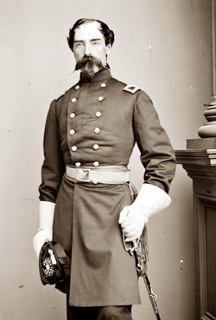
Brigadier General Robert Nugent, Irish-born American United States Army officer during the American Civil War and the American Indian Wars, is born on June 27, 1824, in Kilkeel, County Down, in what is now Northern Ireland.

Nugent serves with the Irish Brigade‘s 69th Infantry Regiment, from its days as a National Guard unit and into its incorporation into the Union Army at the start of the war. He is one of its senior officers at the First Battle of Bull Run.

When the unit is originally mustered out of service, the 90-day enlistment terms having expired, Nugent accepts a commission as a captain in the regular army. He is immediately assigned to the 13th Infantry Regiment whose commanding officer, Colonel William Tecumseh Sherman, personally requests. Taking a leave of absence to return to New York, he assists Thomas Francis Meagher in organizing the Irish Brigade. The newly reformed 69th Infantry Regiment is the first unit assigned to the Irish Brigade and, with Nugent as its colonel, he leads the “Fighting 69th” at the Battles of Fair Oaks, Gaines’ Mill, Savage’s Station, White Oak Swamp, Glendale and Malvern Hill.

Nugent is shot in the stomach at the Battle of Fredericksburg and is eventually forced to resign his command. He is appointed acting assistant provost marshal for the southern district of New York, which includes New York City and Long Island, by the United States War Department. An Irishman and Democrat, his appointment is thought to assure the Irish American population that conscription efforts would be carried out fairly. The Irish American, a popular Irish language newspaper, writes that the selection is a “wise and deservedly popular one.” He encounters resistance from city officials wanting to remain uninvolved, however by mid-June reports to his superior officer and provost marshal general Colonel James Barnet Fry that conscription efforts are “nearing completion without serious incident.”

Understanding the seriousness of the situation, Nugent attempts to keep the draft selections quiet and in isolated parts of the city. In Manhattan however, lotteries are placed in the heart of Irish tenement and shanty neighborhoods where the draft is most opposed.

In the ensuing New York City draft riots, Nugent takes command of troops and attempts to defend the city against the rioters. Despite issuing the cancellation of the draft, the riots continue for almost a week. His home on West 86th Street is looted and burned by the rioters during that time, his wife and children barely escaping from their home. Upon breaking into his house, furniture is destroyed, and paintings of Nugent and Meagher are slashed, although a painting of Brigadier General Michael Corcoran is reportedly left untouched.

On October 28, Nugent is relieved of his post and succeeded by General William Hays. Returning to active duty, he assumes command of the Irish Brigade in November 1864, shortly after the death of Corcoran. He is present at the battle of Battle of Spotsylvania Court House, the Siege of Petersburg and the Appomattox Campaign. As its last commanding officer, he and the Irish Brigade also march in the victory parade held in Washington, D.C. following Robert E. Lee‘s surrender at Appomattox Court House.

Nugent is brevetted Brigadier General for distinguished leadership of the 69th Regiment on March 13, 1865. The veterans of the Irish Brigade are honorably discharged and mustered out three months later. Nugent remains in the regular U.S. Army for the next twenty years, a formidable “Indian fighter” during the American Indian Wars with the 13th and 24th Infantry Regiments. In 1879, he retires at the rank of major and resides in New York where he is involved in the Grand Army of the Republic, the War Veterans’ Association of the 7th Regiment and an honorary member of The Old Guard.

Nugent becomes ill in his old age, complications arising from his wounds suffered at Fredericksburg, and remains bedridden for two months before his death at his McDonough Street home in Brooklyn on June 20, 1901. In accordance with his last wishes, he is buried at Cypress Hills National Cemetery.


Leave a comment

Birth of John Hughes, 1st Archbishop of New York

john-joseph-hughes

John Joseph Hughes, prelate of the Roman Catholic Church in the United States and the fourth Bishop and first Archbishop of the Archdiocese of New York, is born in the hamlet of Annaloghan, near Aughnacloy, County Tyrone in Northern Ireland on June 24, 1797.

Hughes is the third of seven children of Patrick and Margaret (née McKenna) Hughes. He and his family suffer religious persecution in their native land. He is sent with his elder brothers to a day school in the nearby village of Augher, and afterwards attends a grammar school in Aughnacloy. The family emigrates to the United States in 1816 and settles in Chambersburg, Pennsylvania. Hughes joins them there the following year.

After several unsuccessful applications to Mount St. Mary’s College in Emmitsburg, Maryland, he is eventually hired as a gardener at the college. During this time, he befriends Mother Elizabeth Ann Seton, who is impressed by Hughes and persuades the Rector to reconsider his admission. Hughes is subsequently admitted as a regular student of Mount St. Mary’s in September 1820.

On October 15, 1826, Hughes is ordained to the priesthood by Bishop Henry Conwell at St. Joseph’s Church in Philadelphia. His first assignment is as a curate at St. Augustine’s Church in Philadelphia, where he assists its pastor by celebrating Mass, hearing confessions, preaching sermons, and other duties in the parish.

Hughes is chosen by Pope Gregory XVI as the coadjutor bishop of the Diocese of New York on August 7, 1837. He is consecrated bishop at St. Patrick’s Old Cathedral on January 7, 1838, with the title of the titular see of Basilinopolis, by the Bishop of New York, John Dubois, his former Rector.

Hughes campaigns actively on behalf of Irish immigrants and attempts to secure state support for parochial schools. Although this attempt fails, he founds an independent Catholic school system which becomes an integral part of the Catholic Church’s structure at the Third Plenary Council of Baltimore (1884), which mandates that all parishes have a school and that all Catholic children be sent to those schools. In 1841, Hughes founds St. John’s College in New York City which is now Fordham University.

Hughes is appointed Apostolic Administrator of the diocese due to Bishop Dubois’ failing health. As coadjutor, he automatically succeeds Dubois upon the bishop’s death on December 20, 1842, taking over a diocese which covers the entire state of New York and northern New Jersey. He is a staunch opponent of Abolitionism and the Free-Soil movement, whose proponents often express anti-Catholic attitudes. Hughes also founds the Ultramontane newspaper New York Freeman to express his ideas.

Hughes becomes an archbishop on July 19, 1850, when the diocese is elevated to the status of archdiocese by Pope Pius IX. As archbishop, he becomes the metropolitan for the Catholic bishops serving all the dioceses established in the entire Northeastern United States. To the dismay of many in New York’s Protestant upper-class, Hughes foresees the uptown expansion of the city and begins construction of the current St. Patrick’s Cathedral on Fifth Avenue between 50th and 51st Street, laying its cornerstone on August 15, 1858. At the request of President Abraham Lincoln, Hughes serves as semiofficial envoy to the Vatican and to France in late 1861 and early 1862. Lincoln also seeks Hughes’ advice on the appointment of hospital chaplains.

Hughes serves as archbishop until his death. He is originally buried in St. Patrick’s Old Cathedral, but his remains are exhumed in 1882 and re-interred in the crypt under the altar of the new cathedral he had begun.


Leave a comment

Birth of John Robert Gregg, Inventor of Gregg Shorthand

john-robert-gregg

John Robert Gregg, educator, publisher, humanitarian, and the inventor of the eponymous shorthand system Gregg shorthand, is born in Shantonagh, County Monaghan on June 17, 1867.

Gregg is the youngest child of Robert and Margaret Gregg. They move to Rockcorry in 1872. Robert Gregg, who is of Scottish ancestry, is stationmaster at the Bushford railway station in Rockcorry. He and his wife raise their children as strict Presbyterians and send their children to the village school in Rockcorry. On Gregg’s second day of class, he is caught whispering to a schoolmate, which prompts the schoolmaster to hit the two children’s heads together. This incident profoundly damages Gregg’s hearing for the rest of his life, rendering him unable to participate fully in school, unable to understand his teacher. This ultimately leads to him unnecessarily being perceived as dull or mentally challenged by his peers, teachers, and family.

In 1877, one of Robert Gregg’s friends, a journalist named Annesley, visits the village for a weekend. He is versed in Pitman Shorthand and takes verbatim notes of the sermon at the village church. This causes the preacher to sweat and stutter out of fear that his sermon, which he has plagiarized from a famous preacher, would be made public through Annesley’s notes. That day, Robert Gregg sees the shorthand skill as a powerful asset, so he makes it mandatory for his children to learn Pitman shorthand, with the exception of John, who is considered by his family too “simple” to learn it. None of the children succeed in fully learning the system. On his own, John Robert learns a different shorthand system, that of Samuel Taylor, published in a small book by Odell. He teaches himself the system fully since he does not require the ability to hear in order to learn from the book.

Due to hardships on the family, Gregg has to leave school before the age of 13 in order to support his family’s income. He works in a law office, earning five shillings a week.

Gregg professes he initially set out to improve the English adaptation by John Matthew Sloan of the French Prévost Duployan shorthand, while working with one of Sloan’s sales agents, Thomas Malone. Malone publishes a system called Script Phonography, of which Gregg asserts a share in authorship is owed to him. Angered by Malone, Gregg resigns from working with him and encouraged by his older brother Samuel, publishes and copyrights his own system of shorthand in 1888. It is put forth in a brochure entitled Light-Line Phonography: The Phonetic Handwriting which he publishes in Liverpool, England.

In 1893, he emigrates to the United States, where he publishes in the same year Gregg Shorthand. The method meets with great success in the new country, and Gregg settles in Chicago where he authors numerous books for the Gregg Publishing Company on the subjects of shorthand and contemporary business practices.

John Robert Gregg dies in New York City, at the age of 80, on February 23, 1948.


Leave a comment

Birth of Mary Colum, Literary Critic & Author

mary-colum

Mary Colum (née Maguire), literary critic and author, is born in Collooney, County Sligo on June 14, 1884, the daughter of Charles Maguire and Catherine Gunning. She is the author of several books, including the autobiographical Life and the Dream (1947), and From These Roots: The Ideas that Have Made Modern Literature (1937), a collection of her criticism.

Maguire’s mother dies in 1895, leaving her to be reared by her grandmother, Catherine, in Ballysadare, County Sligo. She attends boarding school in St. Louis’ Convent in Monaghan, County Monaghan.

Educated at Royal University of Ireland Maguire is founder of the Twilight Literary Society which leads her to meet William Butler Yeats. She regularly attends the Abbey Theatre and is a frequent visitor amongst the salons, readings and debates there. After graduation in 1909 she teaches with Louise Gavan Duffy at St. Ita’s, a companion school to Patrick Pearse‘s St. Enda’s School. She is active with Thomas MacDonagh and others in national and cultural causes and co-founds The Irish Review (1911–14) with David Houston, MacDonagh and others. She, along with her husband, Padraic Colum, whom she marries in July 1912, edit the magazine for some months of its four-year run. She is encouraged by Yeats to specialise in French literary criticism and to translate Paul Claudel.

Colum and her husband move to New York City in 1914, living occasionally in London and Paris. In middle age she is encouraged to return to writing and becomes established as a literary generalist in American journals, including Poetry, Scribner’s Magazine, The Nation, The New Republic, The Freeman, The New York Times Book Review, The Saturday Review of Literature, and the New-York Tribune.

Colum associates with James Joyce in Paris and discourages him from duping enquirers about the origins of the interior monologue in the example of Édouard Dujardin. She accepts Joyce’s very ill daughter, Lucia, for a week in their Paris flat at the height of her “hebephrenic” attack, while herself preparing for an operation in May 1932. She serves as the literary editor of The Forum magazine from 1933–1941 and commences teaching comparative literature with Padraic at Columbia University in 1941.

She rebuts Oliver St. John Gogarty‘s intemperate remarks about Joyce in The Saturday Review of Literature in 1941.

Colum’s publications become increasingly sparse in the 1950s as her arthritis and neuralgia grow more and more severe. She dies in New York City on October 22, 1957. At the time of her death, she is working on Our Friend James Joyce with her husband, each writing various chapters. It is assembled posthumously by Padraic Colum and is published by Doubleday on August 22, 1958.

Colum’s letters are held in Scribner’s Archive, Princeton University Library, while a collection of her papers is held at the State University of New York.


Leave a comment

“The Beauty Queen of Leenane” Wins Four Tony Awards

the-beauty-queen-of-leenane

After being nominated in six categories, Galway’s Druid Theatre Company wins four Tony Awards on June 8, 1998, for its production of The Beauty Queen of Leenane, a 1996 comedy by Irish playwright Martin McDonagh.

The play receives its world premiere when the Druid Theatre Company opens the production at the Town Hall Theatre, Galway on February 1, 1996. It then tours Ireland, stopping off in Longford, Kilkenny and Limerick. It transfers to London‘s West End, where it opens at the Royal Court Theatre on February 29, 1996.

The Druid production returns to Ireland to embark on an extensive national tour, playing in Galway, Cork, Kerry, Limerick, Fermanagh, Donegal and Derry amongst others. The play returns to London where it is revived at the Duke of York’s Theatre on November 29, 1996, for several months.

The play is produced as part of Druid’s Leenane Trilogy, which includes two other plays by Martin McDonagh, in 1997 where it plays as part of another Irish and UK tour, which includes stops at the Olympia Theatre, Dublin and the Royal Court Theatre in London again.

The play receives its American premiere opening Off-Broadway on February 11, 1998, presented by the Atlantic Theatre Company at the Linda Gross Theater. It transfers to the Walter Kerr Theater on Broadway where it opens on April 14, 1998. It receives six Tony Award nominations, winning four for Best Supporting Actor (Tom Murphy), Best Actress (Marie Mullen), Best Supporting Actress (Anna Manahan), and Best Director (Garry Hynes), the first female recipient of a Tony Award for directing a play.

The play is produced in Australia in 1998 and again in 1999. The 1999 production is a tour by the Royal Court Theatre Company, appearing at the Adelaide Festival Centre (May – June 1999) and Wharf 1 (July 1999) and directed by Garry Hynes. The production returns to Ireland in 2000 as part of a final national tour.

The play is revived in July 2010 at the Young Vic Theatre in the West End, starring Irish actress Rosaleen Linehan. The production transfers to Dublin’s Gaiety Theatre where Linehan reprises her role opposite Derbhle Crotty. It then returns to the Young Vic for another run, closing in September 2011.

The Druid Theatre Company presents a revival in 2016–2017. The production starts in Ireland in Galway at the Town Hall Theatre in September 2016, and then tours to The Everyman in Cork, the Lime Tree Theatre in Limerick and the Gaiety Theatre, Dublin. The play then tours in the United States starting in November 2016. The play runs at the Mark Taper Forum in Los Angeles in November 2016 then opens at the Brooklyn Academy of Music in New York City, running from January 11, 2017, to February 5. The production returns to Ireland, playing at The Gaiety Theatre from March 28 to April 15, 2017.


Leave a comment

Death of Victor Herbert, Composer, Cellist and Conductor

victor-herbert

Victor August Herbert, an Irish-born, German-raised American composer, cellist and conductor, dies suddenly of a heart attack on May 26, 1924, shortly after his final show, The Dream Girl, begins its pre-Broadway run in New Haven, Connecticut.

Herbert is born in Dublin on February 1, 1859, to Protestants Edward Herbert and Fanny Herbert (née Lover). At age three and a half, shortly after the death of his father, he and his mother move to live with his maternal grandparents in London, England, where he received encouragement in his creative endeavours. His grandfather is the Irish novelist, playwright, poet and composer Samuel Lover. The Lovers welcome a steady flow of musicians, writers and artists into their home. He joins his mother in Stuttgart, Germany in 1867, a year after she marries a German physician, Carl Schmidt of Langenargen. In Stuttgart he receives a strong liberal education at the Eberhard-Ludwigs-Gymnasium, which includes musical training.

Herbert initially plans to pursue a career as a medical doctor. Although his stepfather is related by blood to the German royal family, his financial situation is not good by the time Herbert is a teenager. Medical education in Germany is expensive, and so he focuses instead on music. He initially studies the piano, flute and piccolo but ultimately settles on the cello, beginning studies on that instrument with Bernhard Cossmann from age 15 to age 18. He then attends the Stuttgart Conservatory. After studying cello, music theory and composition under Max Seifritz, he graduates with a diploma in 1879.

Although Herbert enjoys important careers as a cello soloist and conductor, he is best known for composing many successful operettas that premiere on Broadway from the 1890s to World War I. He is also prominent among the Tin Pan Alley composers and is later a founder of the American Society of Composers, Authors, and Publishers (ASCAP). A prolific composer, Herbert produces two operas, a cantata, 43 operettas, incidental music to 10 plays, 31 compositions for orchestra, nine band compositions, nine cello compositions, five violin compositions with piano or orchestra, 22 piano compositions and numerous songs, choral compositions and orchestrations of works by other composers, among other music.

In the early 1880s, Herbert begins a career as a cellist in Vienna, Austria, and Stuttgart, Germany, during which he begins to compose orchestral music. Herbert and his opera singer wife, Therese Förster, move to the United States in 1886 when both are engaged by the Metropolitan Opera. He continues his performing career, while also teaching at the National Conservatory of Music of America, conducting and composing. His most notable instrumental compositions are his Cello Concerto No. 2 in E minor, Op. 30 (1894), which enters the standard repertoire, and his Auditorium Festival March (1901). He leads the Pittsburgh Symphony Orchestra from 1898 to 1904 and then founds the Victor Herbert Orchestra, which he conducts throughout the rest of his life.

Herbert begins to compose operettas in 1894, producing several successes, including The Serenade (1897) and The Fortune Teller (1898). Some of the operettas that he writes after the turn of the 20th century are even more successful: Babes in Toyland (1903), Mlle. Modiste (1905), The Red Mill (1906), Naughty Marietta (1910), Sweethearts (1913) and Eileen (1917). After World War I, with the change of popular musical tastes, he begins to compose musicals and contributes music to other composers’ shows. While some of these are well-received, he never again achieves the level of success that he enjoyed with his most popular operettas.

A healthy man throughout his life, Herbert dies suddenly of a heart attack at the age of 65 on May 26, 1924, shortly after his final show, The Dream Girl, began its pre-Broadway run in New Haven. He is survived by his wife and two children, Ella Victoria Herbert Bartlett and Clifford Victor Herbert. He is entombed in Woodlawn Cemetery in The Bronx, New York City.

Herbert and his music are celebrated in the 1939 film The Great Victor Herbert, where he is portrayed by Walter Connolly, and which also features Mary Martin. He is also portrayed by Paul Maxey in the 1946 film Till the Clouds Roll By. Many of Herbert’s own works are made into films, and his music has been used in numerous films and television shows. A Chicago elementary school is named for him. During World War II the Liberty ship SS Victor Herbert is built in Panama City, Florida, and named in his honor.


Leave a comment

Birth of Dennis Day, Radio, TV & Film Personality

dennis-day

Dennis Day, American singer, radio, television and film personality and comedian of Irish descent, is born Owen Patrick Eugene McNulty on May 21, 1916 in The Bronx borough of New York City.

Day is the second of five children born to Irish immigrants Patrick McNulty and Mary (née Grady) McNulty. He graduates from Cathedral Preparatory School and Seminary in New York City, and attends Manhattan College in the Bronx, where he sings in the glee club.

Mary Livingstone, wife of comedian Jack Benny, brings Day to Benny’s attention after hearing him on the radio during a visit to New York. She takes a recording of Day’s singing to Benny, who then goes to New York to audition Day. The audition results in Day’s role on the Benny program.

Day appears for the first time on Benny’s radio show on October 8, 1939, taking the place of another famed tenor, Kenny Baker. He remains associated with Benny’s radio and television programs until Benny’s death in 1974. He is introduced as a young, naive boy singer, a character he keeps through his whole career.

Besides singing, Day is an impressionist. On the Benny program, he performs impressions of various noted celebrities of the era, including Ronald Colman, Jimmy Durante and James Stewart.

From 1944 through 1946 Day serves in the United States Navy as a Lieutenant. While in service he is temporarily replaced on the Benny radio program by fellow tenor Larry Stevens. On his return to civilian life, he continues to work with Benny while also starring on his own NBC show, A Day in the Life of Dennis Day (1946–1951). His last radio series is a comedy/variety show that airs on NBC’s Sunday afternoon schedule during the 1954–55 season.

An attempt is made to adapt A Day in the Life Of Dennis Day as an NBC filmed series, produced by Jerry Fairbanks for Dennis’ sponsor, Colgate-Palmolive, featuring the original radio cast, but gets no farther than an unaired 1949 pilot episode. Eventually, his own TV series, The Dennis Day Show, is first telecast on NBC on February 8, 1952, and then in the 1953–1954 season. Between 1952 and 1978, he makes numerous TV appearances as a singer, actor and voice for animation, such as the Walt Disney feature Johnny Appleseed, handling multiple characters. His last televised work with Benny is in 1970, when they both appear in a public service announcement together to promote savings and loans.

Although his career is mainly radio and TV-based, Day also appears in a few films. These include Buck Benny Rides Again (1940) opposite Jack Benny, Sleepy Lagoon (1943), Music in Manhattan (1944), I’ll Get By (1950), Golden Girl (1951), The Girl Next Door (1953), and Won Ton Ton, the Dog Who Saved Hollywood (1976) as a singing telegraph man. For the soundtrack of My Wild Irish Rose (1947), a biopic about Chauncey Olcott, Day provides the singing voice to the acting of Dennis Morgan.

Dennis Day dies on June 22, 1988, of amyotrophic lateral sclerosis (ALS), more commonly known as Lou Gehrig’s disease, in Los Angeles, California. His star on the Hollywood Walk of Fame is at 6646 Hollywood Boulevard. He is interred in Holy Cross Cemetery in Culver City.


Leave a comment

Birth of Frank Harte, Traditional Irish Singer

frank-harte

Frank Harte, traditional Irish singer, music collector, architect and lecturer, is born in Chapelizod, County Dublin on May 14, 1933. He emigrates to the United States for a short period, but later returns to Ireland where he works as an architect, lecturer at Dublin Institute of Technology in Rathmines, Dublin and in later life fully engages in songs in many ways.

Harte’s introduction to Irish traditional singing comes from a chance listening to an itinerant who is selling ballad sheets at a fair in Boyle, County Roscommon. He begins collecting early in life and by the end of his life has assembled a database of over 15,500 recordings.

Harte becomes a great exponent of the Dublin street ballad, which he prefers to sing unaccompanied. He is widely known for his distinctive singing, his Dublin accent having a rich nasal quality complementing his often high register. His voice mellows considerably by the time of his later recordings, allowing for an expressive interpretation of many love songs such as “My Bonny Light Horseman” on the album My Name is Napoleon Bonaparte. This is contrasted sublimely by his cogent interpretation of the popular “Molly Malone.” He also becomes more accustomed to singing with accompaniment which is not strictly part of the Irish singing tradition and does not come naturally to him.

Though Irish Republican in his politics, Harte believes that the Irish song tradition need not be a sectarian or nationalist preserve. He believes that songs are a key to understanding the past often saying, “those in power write the history, while those who suffer write the songs, and, given our history, we have an awful lot of songs.” Though considered a stalwart of traditional Irish singing and well aware of it, he does not consider himself to be a sean-nós singer.

Harte wins the All-Ireland Fleadh Cheoil singing competition on a number of occasions and in 2003 receives the Traditional Singer of the Year award from the Irish-language television channel TG4.

Harte records several albums and makes numerous television and radio appearances, most notably the Singing Voices series he writes and presents for RTÉ Radio, which is produced by Peter Browne in 1987. He is a regular at the Sunday morning sessions at The Brazen Head pub, along with Liam Weldon who runs the session. He is also an enthusiastic supporter of An Góilín Traditional Singer’s Club.

Harte appears at many American festivals including The Blarney Star in New York City, Gaelic Roots in Boston College, The Catskills Irish Arts Week, The Greater Washington Ceili Club Festival in Maryland and the Milwaukee Irish Fest and for seventeen years he is a veritable staple at the Irish Week every July in the Augusta Heritage Festival in Elkins, West Virginia where he often performs with Mick Moloney.

Frank Harte dies of a heart attack, aged 72, on June 27, 2005. His influence is still evident in singers such as Karan Casey and he continues to be remembered fondly in sessions and folk clubs on both sides of the Irish Sea.


Leave a comment

Birth of John Brougham, Actor & Dramatist

john-brougham

John Brougham, Irish American actor and dramatist, is born in Dublin on May 9, 1814.

Brougham’s father is an amateur painter and dies young. His mother is the daughter of a Huguenot, whom political adversity has forced into exile. He is the eldest of three children. Both of his siblings die in youth, and the father being dead, and the widowed mother left penniless, he is reared in the family and home of an uncle.

Brougham is prepared for college at an academy at Trim, County Meath, twenty miles from Dublin, and subsequently is sent to the University of Dublin. There he acquires classical learning and forms interesting and useful associations and acquaintances. He also becomes interested in private theatricals. He falls in with a crowd that puts on their own shows, cast by drawing parts out of a hat. Though he most always trades off larger roles so he can pay attention to his studies, he takes quite an interest in acting. He is a frequent attendant, moreover, at the Theatre Royal in Hawkins Street.

Brougham is educated with the intention of his becoming a surgeon and walks the Peth Street Hospital for eight months. However, misfortune comes upon his uncle, so he is obliged to provide for himself. Before leaving the university he, by chance, becomes acquainted with the actress Lucia Elizabeth Vestris.

Brougham goes to London in 1830 and, after a brief experience of poverty, suddenly determines to become an actor. He is destitute of everything except fine apparel, and he has actually taken the extreme step of offering himself as a cadet in the service of the East India Company. But, being dissuaded by the enrolling officer, who lends him a guinea and advises him to seek other employment, and happening to meet with a festive acquaintance, he seeks recreation at the Tottenham Theatre where Madame Vestris is acting.

Brougham’s acquaintance with Madame Vestris leads to him being engaged at the theatre, and he thus makes his first appearance on the London stage in July in Tom and Jerry, in which he plays six characters. In 1831 he is a member of Madame Vestris’s company and writes his first play, a burlesque. He remains with Madame Vestris as long as she and Charles Mathews retain Covent Garden Theatre, and he collaborates with Dion Boucicault in writing London Assurance, the role of Dazzle being one of those with which he becomes associated. His success at small or “low” comic roles such as Dazzle earn him the nickname “Little Johnny Brougham,” a moniker which he embraces, and which boosts his popularity with working-class audiences.

In 1840 Brougham manages the Lyceum Theatre, for which he writes several light burlesques, but in 1842 he moves to the United States, where he becomes a member of William Evans Burton‘s company, for which he writes several comedies, including Met-a-mora; or, the Last of the Pollywogs, a parody of John A. Stone and Edwin Forrest’s Metamora; or The Last of the Wamponoags, and Irish Yankee; or, The Birthday of Freedom.

Later Brougham is the manager of Niblo’s Garden, and in 1850 opens Brougham’s Lyceum, which, like his next speculation, the lease of the Bowery Theatre, is not a financial success, despite the popularity of such works as Po-ca-hon-tas; or, The Gentle Savage. He is later connected with James William Wallack‘s and Augustin Daly‘s theatres and writes plays for both.

In 1860 Brougham returns to London, where he adapts or writes several plays, including The Duke’s Motto for Charles Fechter. In November 1864 he appears at the Theatre Royal in his native Dublin in the first performance of Dion Boucicault’s Arrah-na-Pogue with Boucicault, Samuel Johnson and Samuel Anderson Emery in the cast.

After the American Civil War Brougham returns to New York City. Brougham’s Theatre is opened in 1869 with his comedies Better Late than Never and Much Ado About a Merchant of Venice, but this managerial experience is also a failure due to disagreements with his business partner, James Fisk. He then takes to playing the stock market. His last appearance onstage is in 1879 as “O’Reilly, the detective” in Boucicault’s Rescued.

John Brougham dies in Manhattan on June 7, 1880.


Leave a comment

U.S. Senate Inquiry into the RMS Titanic Sinking

william-alden-smith

The April 15, 1912 sinking of the RMS Titanic, the trans-Atlantic passenger liner built by Harland & Wolff in Belfast, results in an inquiry by the United States Senate, which begins at the Waldorf-Astoria Hotel in New York City  on April 19, 1912. Chaired by Senator William Alden Smith (R-Michigan), the inquiry is a subcommittee of the Senate’s Committee on Commerce. The hearings later move to the Russell Senate Office Building in Washington, D.C. and conclude on May 25, 1912 with a return visit to New York.

Seven senators serve on the subcommittee, with three Republicans and three Democrats in addition to Smith as chair. The other six senators are Jonathan Bourne (R-Oregon), Theodore E. Burton (R-Ohio), Duncan U. Fletcher (D-Florida), Francis G. Newlands (D-Nevada), George Clement Perkins (R-California), and Furnifold McLendel Simmons (D-North Carolina). The composition of the subcommittee is carefully chosen to represent the conservative, moderate and liberal wings of the two parties.

During 18 days of official investigations, punctuated by recesses, testimony is recorded from over 80 witnesses. These include surviving passengers and crew members, as well as captains and crew members of other ships in the vicinity, expert witnesses, and various officials and others involved in receiving and transmitting the news of the disaster. The evidence submitted varies from spoken testimony and questioning, to the deposition of correspondence and affidavits. Subjects covered include the ice warnings received, the inadequate (but legal) number of lifeboats, the handling of the ship and its speed, RMS Titanic‘s distress calls, and the handling of the evacuation of the ship.

The final report is presented to the United States Senate on May 28, 1912. It is nineteen pages long and includes 44 pages of exhibits, and summarises 1,145 pages of testimony and affidavits. Its recommendations, along with those of the British inquiry that concludes on July 3, 1912, lead to many changes in safety practices following the disaster.

The report is strongly critical of established seafaring practices and the roles that RMS Titanic‘s builders, owners, officers and crew had played in contributing to the disaster. It highlights the arrogance and complacency that had been prevalent aboard the ship and more generally in the shipping industry and the British Board of Trade. However, it does not find the International Mercantile Marine Company, an American consortium, or the White Star Line negligent under existing maritime laws, as they had merely followed standard practice, and the disaster could thus only be categorised as an “act of God.”

The inquiry is heavily criticised in Britain, both for its conduct and for Smith’s style of questioning. Many newspapers publish scathing editorial cartoons depicting Smith in unflattering terms. The British government is also hostile towards the inquiry. The British Ambassador to the United States, James Bryce, demands that President William Howard Taft dissolve the committee and refuses to recognise its jurisdiction.

Some British writers, however, applaud the inquiry. G. K. Chesterton contrasts the American objective of maximum openness with what he calls Britain’s “national evil,” which he describes as being to “hush everything up; it is to damp everything down; it is to leave the great affair unfinished, to leave every enormous question unanswered.” The American reaction is also generally positive. The American press welcomes Smith’s findings and accepts his recommendations, commending the senator for establishing the key facts of the disaster.

(Pictured: U.S. Senator William Alden Smith, chairman of the Senate inquiry into the RMS Titanic disaster)