seamus dubhghaill

Promoting Irish Culture and History from Little Rock, Arkansas, USA


Leave a comment

Birth of Garbhan Downey, Novelist & Editor

Garbhan Downey, novelist and editor, is born in Derry, County Londonderry, Northern Ireland, on February 24, 1966. He is the former Director of Communications and Marketing for Culture Company 2013, which delivers Derry’s City of Culture year.

Downey is a product of St. Columb’s College, the Catholic grammar school whose past pupils include John Hume, Seamus Heaney and Brian Friel.

Downey cuts his teeth in journalism editing University College Galway’s student magazine in the late 1980s. After graduating with an MSc in computing from the University of Ulster, he works as an entertainment columnist with the Derry Journal and then as a staff reporter with the Londonderry Sentinel, before moving to The Irish News to become the paper’s Derry correspondent.

Downey’s offbeat reports of the 1994 FIFA World Cup for The Irish News are subsequently compiled for his first book, Just One Big Party. He spends six years as a BBC news producer in Derry and Belfast, before joining the Derry News as editor in 2001. During his period as editor (2001–2004), the Derry News wins two Newspaper Society awards for Fastest Circulation Growth in the United Kingdom.

Since 2004, Downey has published six comic novels set in the criminal underbelly of post-ceasefire Ireland. His books have been described as “a superb blend of comedy, political dirty tricks, grisly murder and bizarre twists.”

A former deputy-president of the Union of Students in Ireland, Downey is one of the organisers of a student occupation of government offices in Dublin on Budget Day 1988 in protest against education cutbacks.

In June 2002, the Police Service of Northern Ireland (PSNI) get a court order to force Downey to hand over pictures the Derry News had captured of the Real Irish Republican Army attacking a communications post.

In 2006, Downey helps establish the new Northern Ireland literary review Verbal and edits the publication for its first six issues.

A lifelong political anorak, in 2007, Downey works as an election pundit for TV3 (Ireland), alongside the Irish comedian Brendan O’Carroll. In 2010, he wins a contest to predict the winners of Northern Ireland’s 18 Westminster constituencies, missing out on just one, Naomi Long, who surprisingly beat First Minister Peter Robinson in Belfast East. He donates his prize, a framed Ian Knox cartoon, to Long by way of apology.

Downey’s 2010 comedy-thriller The American Envoy is the first novel issued by an Irish publishing house as a Kindle e-book, simultaneously with its paperback release.

In June 2011, Downey is appointed Director of Media for Culture Company 2013, the body tasked with delivering Derry’s UK City of Culture year.

Downey is married to Una McNally, and they have two children.


Leave a comment

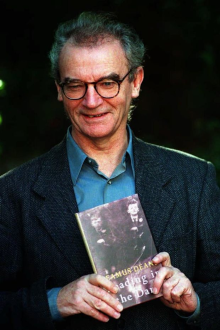
Birth of Seamus Deane, Poet, Novelist, Critic & Historian

Seamus Francis Deane, Irish poet, novelist, critic, and intellectual historian, is born in Derry, County Londonderry, Northern Ireland on February 9, 1940. He is noted for his debut novel, Reading in the Dark, which wins several literary awards and is nominated for the Booker Prize in 1996.

Deane is the fourth child of Frank Deane and Winifred (Doherty) and is brought up as part of a Catholic nationalist family. He attends St. Columb’s College in his hometown, where he befriends fellow student Seamus Heaney. He then attends Queen’s University Belfast (BA and MA) and Pembroke College, Cambridge (PhD). Although he too becomes noted for his poetry, he chooses to go into academia instead. He workws as a teacher in Derry, with Martin McGuinness being one of his students. McGuinness later recalls how Deane was “gentle, kind and never raised his voice at all, an ideal teacher who was very highly thought of.”

After graduating from Cambridge, Deane teaches at the Reed College in Portland, Oregon during the 1960s and the University of California, Berkeley during the 1970s. Over the next two decades, he teaches American college juniors part-time at the School of Irish Studies in the Ballsbridge section of Dublin. He is a professor of Modern English and American Literature at University College Dublin (UCD) until 1992. He subsequently relocates to the University of Notre Dame in South Bend, Indiana, as the Donald and Marilyn Keough Chair of Irish Studies, from which he retires as professor emeritus.

Deane is a member of the Royal Irish Academy and a founding director of the Field Day Theatre Company, together with Heaney, Tom Paulin, and David Hammond.

Deane is the co-editor of Field Day Review, an annual journal of Irish studies. He also serves as general editor of the Penguin Classic James Joyce series and of Critical Conditions, a series in Irish Studies which is jointly published by the University of Notre Dame Press and Cork University Press. He co-founds the book series Field Day Files, which contains key works by David Lloyd, Joe Cleary, Marjorie Howes, and Kerby A. Miller.

The first collection of Deane’s poetry, Gradual Wars, is published in 1972 and receives the AE Memorial Award for Literature. His first novel, Reading in the Dark, is published in 1996 and is partly autobiographical. It wins the 1996 Guardian Fiction Prize and the 1996 South Bank Show Award for Literature, is a New York Times Notable Book, wins The Irish Times International Fiction Prize and the Irish Literature Prize in 1997, besides being shortlisted for the Booker Prize in 1996. The novel is translated into more than twenty languages. He is also the general editor of the monumental Field Day Anthology of Irish Writing, which is 4,000 pages long and whose first volumes are released in 1990. It is later criticised for excluding the voices and experiences of Irish women. He responds to this by stating, “To my astonishment and dismay, I have found that I myself have been subject to the same kind of critique to which I have subjected colonialism … I find that I exemplify some of the faults and erasures which I analyse and characterize in the earlier period.”

Deane’s first marriage is to Marion Treacy. Together, they have four children. He is in a civil partnership with Emer Nolan until his death. They have one child together.

Following a short illness, Deane dies at the age of 81 on May 12, 2021 at Beaumont Hospital in Dublin.


Leave a comment

Death of Dame Jean Iris Murdoch, Novelist & Philosopher

Dame Jean Iris Murdoch DBE, Irish and British novelist and philosopher, dies in Oxford, England, on February 8, 1999. She is best known for her novels about good and evil, sexual relationships, morality, and the power of the unconscious. In 2008, The Times ranks her twelfth on a list of “The 50 greatest British writers since 1945.”

Murdoch is born on July 15, 1919, in Phibsborough, Dublin, the daughter of Irene Alice (née Richardson) and Wills John Hughes Murdoch. Her father, a civil servant, comes from a mainly Presbyterian sheep farming family from Hillhall, County Down. In 1915, he enlists as a soldier in King Edward’s Horse and serves in France during World War I before being commissioned as a second lieutenant. Her mother trains as a singer before Iris is born and is from a middle-class Church of Ireland family in Dublin. Her parents first meet in Dublin when her father is on leave and are married in 1918. Iris is the couple’s only child. When she is a few weeks old the family moves to London, where her father had joined the Ministry of Health as a second-class clerk.  She is a second cousin of the Irish mathematician Brian Murdoch.

Murdoch is brought up in Chiswick and educated in progressive independent schools, entering the Froebel Demonstration School in 1925 and attending Badminton School in Bristol as a boarder from 1932 to 1938. In 1938 she goes up to Somerville College, Oxford, with the intention of studying English, but switches to “Greats“, a course of study combining classics, ancient history, and philosophy. At Oxford she studies philosophy with Donald M. MacKinnon and attends Eduard Fraenkel‘s seminars on Agamemnon. She is awarded a first-class honours degree in 1942. After leaving Oxford she goes to work in London for HM Treasury. In June 1944 she leaves the Treasury and goes to work for the United Nations Relief and Rehabilitation Administration (UNRRA). At first, she is stationed in London at the agency’s European Regional Office. In 1945 she is transferred first to Brussels, then to Innsbruck, and finally to Graz, Austria, where she works in a refugee camp. She leaves the UNRRA in 1946.

From 1947 to 1948 Murdoch studies philosophy as a postgraduate at Newnham College, Cambridge. She meets Ludwig Wittgenstein at Cambridge but does not hear him lecture, as he had left his Trinity College professorship before she arrives. In 1948 she becomes a fellow of St. Anne’s College, Oxford, where she teaches philosophy until 1963. From 1963 to 1967 she teaches one day a week in the General Studies department at the Royal College of Art.

In 1956 Murdoch marries John Bayley, a literary critic, novelist, and from 1974 to 1992 Warton Professor of English at Oxford University, whom she had met in Oxford in 1954. The unusual romantic partnership lasts more than forty years until Murdoch’s death. Bayley thinks that sex is “inescapably ridiculous.” She in contrast has “multiple affairs with both men and women which, on discomposing occasions, Bayley witnesses for himself.”

Murdoch’s first novel, Under the Net, is published in 1954 and is selected in 1998 as one of Modern Library’s 100 best English-language novels of the 20th century. She had previously published essays on philosophy, and the first monograph about Jean-Paul Sartre published in English. She goes on to produce 25 more novels and additional works of philosophy, as well as poetry and drama.

Murdoch’s 1978 novel The Sea, the Sea wins the Booker Prize. Her other books include The Bell (1958), A Severed Head (1961), The Red and the Green (1965), The Nice and the Good (1968), The Black Prince (1973), Henry and Cato (1976), The Philosopher’s Pupil (1983), The Good Apprentice (1985), The Book and the Brotherhood (1987), The Message to the Planet (1989), and The Green Knight (1993).

In 1976 she is named a Commander of the Order of the British Empire and in 1987 is made a Dame Commander of the Order of the British Empire by Queen Elizabeth II for services to literature. She is awarded honorary degrees by the University of Bath (D.Litt, 1983), University of Cambridge (1993) and Kingston University (1994), among others. She is elected a Foreign Honorary Member of the American Academy of Arts and Sciences in 1982.

Murdoch’s last novel, Jackson’s Dilemma, is published in 1995. She is diagnosed with Alzheimer’s disease in 1997 and dies on February 8, 1999, in Oxford. There is a bench dedicated to her in the grounds of Lady Margaret Hall, Oxford, where she enjoyed walking.


Leave a comment

Death of Brinsley MacNamara, Writer & Playwright

John Weldon (alternatively “A. E. Weldon”), Irish writer, playwright, and the registrar of the National Gallery of Ireland, dies in Dublin on February 4, 1963. He adopts the pseudonymBrinsley MacNamara,’ the first name deriving from Richard Brinsley Sheridan, the second from a relative on his mother’s side, and uses it throughout his subsequent career as novelist and playwright.

Weldon is born on September 6, 1890, in Hiskinstown, Delvin, County Westmeath, the eldest son of James Weldon, a schoolteacher, originally of Ballinea, Mullingar, and Fanny Weldon (née Duncan). He attends his father’s school at Delvin until he is eighteen, and the relationship between father and son is to remain rather formal and strict.

Stimulated by the visiting fit-up theatrical companies and of news from Dublin of the Abbey Theatre, in September 1908 he takes the lead in a local staging of a political melodrama, Robert Emmet by Henry C. Mangan. The following summer he leaves for Dublin, ostensibly to become a civil servant but in fact to audition as an actor at the Abbey Theatre. His acting career with the Abbey Theatre begins in September 1910 with a role in R. J. Ryan’s The Casting-out of Martin Whelan.

MacNamara is the author of several novels, the most well-known of which is his first, The Valley of the Squinting Windows (1918), its title a byword for small-town hypocrisy and begrudgery. The work itself is an uneasy fusion of a satiric portrait of gossipy, prying women and dipsomaniacally drinking men with a naturalist tragedy in which the sins of the past repeat themselves in the lives of the younger characters. The novel’s frank treatment of sexual matters is eclipsed as a cause of offence by the unflattering portrayal of almost all the inhabitants of the fictional village called Garradrimna, a place that local people feel would be automatically identified as Delvin. In the ensuing controversy the novelist’s father, James Weldon (widely suspected of being the author), and his school are subject to boycott. His attempts to seek legal redress in 1923 are unsuccessful.

MacNamara continues to write for many years after this controversial first work, and locates most of his later fiction in Garradrimna, in the Irish Midlands. Among his plays are The Glorious Uncertainty (1923) and Look at the Heffernans! (1926). His work is part of the literature event in the art competition at the 1924 Summer Olympics in Paris.

In 1925 McNamara is appointed registrar to the National Gallery of Ireland in Dublin, a position he holds until his retirement in 1960. In 1932 he becomes one of the first members of the Irish Academy of Letters, and in 1935 joins the board of directors of the Abbey Theatre.

MacNamara marries Helena Degidon, a schoolteacher, in 1920. His later years are dogged by increasing ill health and he dies at Sir Patrick Dun’s Hospital, Dublin, on February 4, 1963.


Leave a comment

Death of Hannah Lynch, Feminist, Novelist, Journalist & Translator

Hannah Lynch, Irish feminist, novelist, journalist and translator, dies in Paris, France on January 9, 1904, where she spends much of her working life.

Lynch is born in Dublin on March 25, 1859. Her father, who is a committed, non-violent Fenian, dies when she is young. Her mother, Anna Theresa Calderwood, is married twice. She grows up in a very female house with her mother and ten sisters and half-sisters. Her stepfather is James Cantwell, also a Fenian, who runs the Star and Garter Hotel. After finishing school, she works as a sub-editor for a provincial paper and as a governess in Europe.

A nationalist like her father and stepfather, Lynch is an executive member of the Ladies’ Land League and as a result closely associates with Fanny Parnell. She writes extensively, producing short stories and satirical sketches, as well as Land War fiction, travel writing, translations and literary criticism. Her satirical pieces include “A Dublin Literary Coterie Sketched by a Non-Pretentious Observer” (1888) and “My Friend Arcanieva” (1895). She publishes William O’Brien‘s paper United Ireland from France, after it is suppressed in Ireland. She disagrees with William Butler Yeats on the literary merit of Emily Lawless, calling her work “highly polished literary stories.”

Lynch also writes fiction on the subject of political and cultural affairs in Ireland, sometimes meeting controversy. Her first novel, Through Troubled Waters (1885), is a fictionalised version of a real-life incident in Galway in which the daughters of a prosperous landowning family are murdered to make way for the sons to inherit the land. The novel also depicts the rural clergy as complicit, by denouncing the victims from the pulpit. The newspaper United Ireland strongly criticises the novel, claiming it peddles in anti-Irish stereotypes for a British audience. She responds by stating that she had intended the book for an Irish publisher and audience, and that she should not be asked “to prove my patriotism at the expense of truth.”

Lynch publishes across Ireland, the United Kingdom and from Paris. By 1896, she has settled in Paris, having also lived in both Spain and Greece. She speaks Greek and French. She then returns to lecture in Ireland and is a part of the salons of Paris in the Belle Époque as well as the Irish Literary Revival in Dublin. She is friends with the historian, biographer and literary critic Arvède Barine (pseudonym of Louise-Cécile Vincens), the writers Mabel and Mary Robinson, and the medievalist Gaston Paris. Her work however does not bring significant income, and she is forced to apply to the Royal Literary Fund for help on multiple occasions. Eventually it takes a toll on her health. She spends time in hospital in Margate, England in 1903.

Lynch dies in Paris on January 9, 1904.


Leave a comment

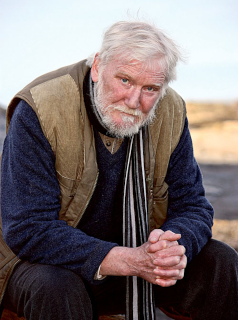
Birth of Dermot Healy, Novelist, Playwright, Poet & Short Story Writer

Dermot Healy, Irish novelist, playwright, poet and short story writer, is born in Finnea, County Westmeath, on November 9, 1947. A member of Aosdána, he is also part of its governing body, the Toscaireacht. He is described variously as a “master,” a “Celtic Hemingway” and as “Ireland’s finest living novelist.”

Healy is the son of a Guard. As a child the family moves to Cavan, where he attends the local secondary school. In his late teens he moves to London and works in a succession of jobs, including barman, security man and as a labourer. He later returns to Ireland, settling in Ballyconnell, County Sligo, a small settlement on the Atlantic coast.

Often overlooked due to his relatively low public profile, Healy’s work is admired by his Irish literary predecessors, peers and successors alike, many of whom idolise him. Among the writers to have spoken highly of him are Seamus Heaney, Eugene McCabe, Roddy Doyle, Patrick McCabe and Anne Enright.

Healy’s work is influenced by an eclectic range of writers from around the world, including Anna Akhmatova, John Arden, Isaac Babel, Matsuo Bashō, Samuel Beckett, Jorge Luis Borges, Angela Carter, J. M. Coetzee, Emily Dickinson, Maria Edgeworth, T. S. Eliot, Hermann Hesse, Nâzım Hikmet, Aidan Higgins, Miroslav Holub, Eugène Ionesco, Franz Kafka, Mary Lavin, Federico García Lorca, Guy de Maupassant, Edgar Allan Poe, Sylvia Plath, Ezra Pound, William Shakespeare and Robert Louis Stevenson. Healy writes in a shed and is fascinated by etymology. However, on being a writer, he is quoted as saying, “I know writing is what I do but I still don’t see myself as one.”

Healy is longlisted for the Booker Prize with his novel A Goats Song. He wins the Hennessy Literary Award (1974 and 1976), the Tom-Gallon Trust Award (1983), and the Encore Award (1995). In 2011, he is shortlisted for the Poetry Now Award for his 2010 poetry collection, A Fool’s Errand. Long Time, No See is nominated for the International Dublin Literary Award, the world’s most valuable literary award for a single work in the English language, by libraries in Russia and Norway.

Healy dies at his home in Ballyconnell on June 29, 2014, while awaiting an ambulance after suddenly being taken ill. He is laid to rest at Carrigans Cemetery following funeral mass by Fr. Michael Donnelly at St. Patrick’s Church in Maugherow.


Leave a comment

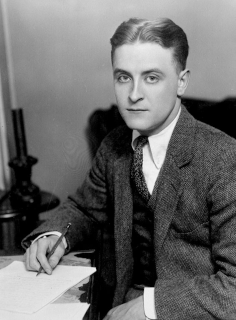
Birth of Novelist F. Scott Fitzgerald

Francis Scott Key Fitzgerald, American novelist, essayist, short story and screenwriter, is born into an Irish Catholic family on September 24, 1896, in Saint Paul, Minnesota. He is best known for his novels depicting the flamboyance and excess of the Jazz Age, a term he popularized. During his lifetime, he publishes four novels, four collections of short stories, and 164 short stories. Although he achieves temporary popular success and fortune in the 1920s, he receives critical acclaim only after his death and is now widely regarded as one of the greatest American writers of the 20th century.

The son of middle-class Irish Catholics Edward and Mary McQuillan Fitzgerald, Fitzgerald is raised primarily in New York. He attends Princeton University but owing to a failed relationship with socialite Ginevra King and a preoccupation with writing, he drops out in 1917 to join the United States Army. While stationed in Alabama, he romances Zelda Sayre, a Southern debutante who belongs to Montgomery‘s exclusive country-club set. Although she rejects Fitzgerald initially, because of his lack of financial prospects, she agrees to marry him after he publishes the commercially successful This Side of Paradise (1920). The novel becomes a cultural sensation and cements his reputation as one of the eminent writers of the decade.

Fitzgerald’s second novel, The Beautiful and Damned (1922), propels him further into the cultural elite. To maintain his affluent lifestyle, he writes numerous stories for popular magazines such as The Saturday Evening Post, Collier’s: The National Weekly, and Esquire. During this period, he frequents Europe, where he befriends modernist writers and artists of the “Lost Generation” expatriate community, including Ernest Hemingway. His third novel, The Great Gatsby (1925), receives generally favorable reviews but is a commercial failure, selling fewer than 23,000 copies in its first year. Despite its lackluster debut, The Great Gatsby is now widely praised, with some labeling it the “Great American Novel.” Following the deterioration of his wife’s mental health and her placement in a mental institute for schizophrenia, he completes his final novel, Tender Is the Night (1934).

Struggling financially because of the declining popularity of his works amid the Great Depression, Fitzgerald turns to Hollywood, writing and revising screenplays. While living in Hollywood, he cohabits with columnist Sheilah Graham, his final companion before his death. After a long struggle with alcoholism, he attains sobriety only to die of a heart attack on December 21, 1940, at the age of 44. His friend Edmund Wilson completes and publishes an unfinished fifth novel, The Last Tycoon (1941), after Fitzgerald’s death.

At the time of his death, the Roman Catholic Church denies the family’s request that Fitzgerald, a non-practicing Catholic, be buried in the family plot in the Catholic St. Mary’s Cemetery in Rockville, Maryland. He is buried instead with a simple Protestant service at Rockville Union Cemetery. When Zelda Fitzgerald dies in a fire at the Highland Mental Hospital in 1948, she is originally buried next to him at Rockville Union. In 1975, Fitzgerald’s daughter Scottie successfully petitions to have the earlier decision revisited, and her parents’ remains are moved to the family plot in Saint Mary’s.


Leave a comment

Birth of Charles Lever, Novelist & Raconteur

Charles James Lever, Irish novelist and raconteur, is born in Amiens Street, Dublin, on August 31, 1806. According to Anthony Trollope, his novels were just like his conversation.

Lever is the second son of James Lever, an architect and builder, and is educated in private schools. His escapades at Trinity College, Dublin (1823–1828), where he earns a degree in medicine in 1831, are drawn on for the plots of some of his novels. The character Frank Webber in the novel Charles O’Malley is based on a college friend, Robert Boyle, who later becomes a clergyman. He and Boyle earn pocket-money singing ballads of their own composing in the streets of Dublin and play many other pranks which he embellishes in the novels Charles O’Malley, Con Cregan and Lord Kilgobbin.

Before seriously embarking upon his medical studies, Lever visits Canada as an unqualified surgeon on an emigrant ship. Arriving in Canada, he journeys into the backwoods, where he is affiliated to a tribe of Native Americans but has to flee because his life is in danger, as later his character Bagenal Daly does in his novel The Knight of Gwynne.

Back in Europe, Lever pretends he is a student from the University of Göttingen and travels to the University of Jena and then to Vienna. He loves German student life and several of his songs, such as “The Pope He Loved a Merry Life,” are based on student-song models. His medical degree earns him an appointment to the Board of Health in County Clare and then as a dispensary doctor in Portstewart, County Londonderry, but his conduct as a country doctor earns him the censure of the authorities.

In 1833 Lever marries his first love, Catherine Baker, and in February 1837, after varied experiences, he begins publishing The Confessions of Harry Lorrequer in the recently established Dublin University Magazine. Before Harry Lorrequer appears in volume form (1839), he has settled on the strength of a slight diplomatic connection as a fashionable physician in Brussels.

In 1842 Lever returns to Dublin to edit the Dublin University Magazine and gathers round him a typical coterie of Irish wits. In June 1842 he welcomes William Makepeace Thackeray, the author of The Snob Papers, to Templeogue, four miles southwest of Dublin, on his Irish tour. The O’Donoghue and Arthur O’Leary (1845) make his native land an impossible place for Lever to continue in. Thackeray suggests London, but Lever requires a new field of literary observation and anecdote. His creative inspiration exhausted, he decides to renew it on the continent. In 1845 he resigns his editorship and goes back to Brussels, whence he starts upon an unlimited tour of central Europe in a family coach. Now and again, he halts for a few months and entertains to the limit of his resources in some ducal castle or other which he hires for an off season.

Depressed in spirit as Lever is, his wit is unextinguished. He is still the delight of the salons with his stories, and in 1867, after a few years’ experience of a similar kind at La Spezia, he is cheered by a letter from Lord Derby offering him the more lucrative consulship of Trieste. The $600 annual salary does not atone to Lever for the lassitude of prolonged exile. Trieste, at first “all that I could desire,” became with characteristic abruptness “detestable and damnable.”

Lever’s depression, partly due to incipient heart disease, partly to the growing conviction that he is the victim of literary and critical conspiracy, is confirmed by the death of his wife on April 23, 1870, to whom he is tenderly attached. He visits Ireland in the following year and seems alternately in high and low spirits. Death had already given him one or two runaway knocks, and, after his return to Trieste, he fails gradually, dying suddenly, however, and almost painlessly, from heart failure on June 1, 1872, at his home, Villa Gasteiger. His daughters, one of whom, Sydney, is believed to have been the real author of A Rent in a Cloud (1869), are well provided for.


Leave a comment

Birth of Mervyn Wall, Novelist & Playwright

Mervyn Wall, novelist and playwright who writes under the pseudonym of Eugene Welply, is born in Dublin on August 23, 1908. He attends Belvedere College and works as a civil servant from 1934-48. He is a member of the Irish Academy of Letters.

Wall is probably the last survivor of the remarkably gifted generation which emerged from University College Dublin (UCD) in the 1930s. It includes Brian O’Nolan, Donagh MacDonagh, Cyril Cusack, Liam Redmond, Denis Devlin, Niall Sheridan, and the shortlived poet Charles Donnelly who dies in the Spanish Civil War. Brian O’Nolan/Flann O’Brien’s novel At Swim-Two-Birds contains portraits of many of these people, under fictitious names, and evokes the whole ambience of intellectual student life in Dublin at the time.

Like other literary civil servants of the period, Wall often takes a satirical view of bureaucracy. Unlike Brian O’Nolan, however, he can play the bureaucrats at their own game and by most accounts he is a highly efficient public servant in his own right. His late novel Hermitage (1982) has some sharp sidelights on the world of Green Tape.

Wall makes his mark mainly as a novelist, but he begins as a playwright and has at least two works performed in the Abbey Theatre. His first real success comes in 1946 with The Unfortunate Fursey, in which he creates a mythical monk who is tormented by the Devil. The picaresque humour and fantasy of the story are enjoyed by the public as essentially good-natured farce, but it is possible that he also intends it as oblique satire on the Irish clergy in general, at a time when any open criticism of them might invite trouble. Fergus Linehan later turns it into a successful musical.

The first Fursey book has successors, and all of them are published in a single volume in 1985, entitled The Complete Fursey. During the 1950s Wall writes two “serious” novels of social criticism, Leaves for the Burning and No Trophies Raise, in which his satirical sense takes a more direct route. They are praised at the time by respected critics and are still well worth rereading.

Apart from his writing, Wall has a distinguished career in Radio Éireann, where he and his colleagues, the novelist Francis MacManus and the poet Roibeard O Farachain, make up a literary and administrative trio nicknamed “Frank, Incense and Mer” by a staff wit. He later becomes secretary of the Arts Council, a sometimes-difficult job which he handles with tact and fairness.

Wall is himself a witty, observant, sometimes catty man in a generation famous for its wit. He and his wife Fanny, who is known as a leading music critic, are for decades an almost indispensable duo in Dublin cultural and social life, although Wall, in spite of his various public roles, is at heart a home loving and industrious man who never seeks publicity.

Wall dies on May 19, 1997, just eight months after his wife, in St. Michael’s Hospital, Dún Laoghaire, after a short illness.

If and when a fullscale cultural history of Ireland in the 1940s and 1950s comes to be written, Wall’s place in it should be assured. As a successful, long term civil servant, he learned how to work the system in favour of literature and the arts in an age when patronage of them was thin on the ground.


Leave a comment

Birth of Novelist & Playwright Molly Keane

Molly Keane, née Mary Nesta Skrine, Irish novelist and playwright who writes as M. J. Farrell, is born in Ryston Cottage, Newbridge, County Kildare, on July 20, 1904.

Keane’s mother is a poet who writes under the pseudonym Moira O’Neill. Her father is a fanatic for horses and hunting. She grows up at Ballyrankin in County Wexford and refuses to go to boarding school in England as her siblings had done. She is educated by her mother, governesses, and at a boarding school in Bray, County Wicklow. Relationships between her and her parents are cold and she states that she had no fun in her life as a child. Her own passion for hunting and horses is born out of her need for fun and enjoyment. Reading does not feature much in her family and, although her mother writes poetry, it is of a sentimental nature, “suitable to a woman of her class.”

Keane claims she had never set out to be a writer, but at seventeen she is bedbound due to suspected tuberculosis, and turns to writing out of sheer boredom. It is then she writes her first book, The Knight of Cheerful Countenance, which is published by Mills & Boon. She writes under the pseudonym “M. J. Farrell,” a name over a pub that she had seen on her return from hunting. She explains writing anonymously because “for a woman to read a book, let alone write one was viewed with alarm: I would have been banned from every respectable house in County Carlow.”

In her teenage years Keane spends much of her time in the Perry household in Woodruff, County Tipperary. Here she befriends the two children of the house, Sylvia and John Perry. She later collaborates with John in writing a number of plays. Among them is Spring Meeting, directed by John Gielgud in 1938, and one of the hits of the West End that year. She and Gielgud become life long friends.

It is through the Perry family that Molly meets Bobby Keane, whom she marries in 1938. He belongs to a County Waterford squirearchical family, the Keane baronets. The couple goes on to have two daughters, Sally and Virginia.

Keane loves Jane Austen, and like Austen’s, her ability lay in her talent for creating characters. This, with her wit and astute sense of what lay beneath the surface of people’s actions, enables her to depict the world of the big houses of Ireland in the 1920s and 1930s. She “captured her class in all its vicious snobbery and genteel racism.” She uses her married name for her later novels, several of which, including Good Behaviour and Time After Time, have been adapted for television. Between 1928 and 1956, she writes eleven novels, and some of her earlier plays, under the pseudonym “M. J. Farrell.” She was a member of Aosdána.

Keane’s husband dies suddenly in 1946, after which she moves to Ardmore, County Waterford, a place she knows well, and lives there with her two daughters. Following the failure of a play shortly after her husband’s death, she publishes nothing for twenty years. In 1981 Good Behaviour comes out under her own name. The manuscript, which had languished in a drawer for many years, is lent to a visitor, the actress Peggy Ashcroft, who encourages her to publish it. The novel is warmly received and is short-listed for the Man Booker Prize.

Keane dies at the age of 91 on April 22, 1996 in her Cliffside home in Ardmore. She is buried beside the Church of Ireland church, near the centre of the village.