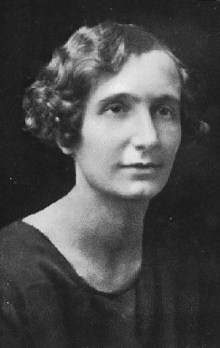
Janet McNeill, prolific Irish novelist and playwright, is born on September 14, 1907, in Dublin. Author of more than 20 children’s books, as well as adult novels, plays, and two opera libretti, she is best known for her children’s comic fantasy series My Friend Specs McCann.
McNeill is born to Rev. William McNeill, a minister at Adelaide Road Presbyterian Church, and Jeannie Patterson (Hogg) McNeill. In 1913, the family moves to Birkenhead, Merseyside, England, where her father becomes minister at Trinity Road Church. She attends public school in Birkenhead and studies classics at the University of St. Andrews in St. Andrews, Scotland, completing a MA degree in 1929. While at university, she is involved in writing and acting with the College Players. In 1924, the family returns to Ireland due to her father’s failing health, and Rev. McNeill becomes the minister of a village church in Rostrevor, County Down, Northern Ireland, while Janet joins the Belfast Telegraph as a secretary.
In 1933, McNeill marries Robert Alexander, the chief engineer in the Belfast city surveyor’s department, and the couple settles in Lisburn, where they raise their four sons. One son is the zoologist Professor Robert McNeill Alexander, CBE, FRS. Though she plans to write her first novel early on, she finds it impossible to write seriously until the children grow up, saying, “It was four years before I had a baby and twenty-five before I produced the book.”
In 1946, McNeill wins a prize in a BBC competition for her play Gospel Truth. She begins writing radio dramas, which are broadcast by the BBC. She suffers an intracerebral hemorrhage in 1953. During her recovery, she begins writing novels both for adults and children, producing a large body of work between 1955 and 1964. Her popular children’s character, Specs McCann, who debuts in a 1955 book and makes several reappearances, also inspires a newspaper cartoon strip by Rowel Friers, a Belfast artist and friend of hers.
Her 1944 novel The Maiden Dinosaur is her first to be published in the United States, twenty-two years later. She also has three writing credits on television with series and plays. Several of her plays are staged at the Ulster Group Theatre.
In 1964, McNeill’s husband retires, and the couple moves to Bristol, South West England. She writes one more novel after she leaves Northern Ireland but continues to write children’s books for another decade. During this time, she writes her only children’s play, published as Switch On, Switch Off, and other plays (1968), which presents different moral themes in scenes set in “domestic and workplace settings in contemporary England.” Her children’s book The Battle of St. George Without is televised by the BBC in 1969.
In her adult fiction, McNeill focuses on the lifestyle and social mores of Belfast and Ulster in the mid-twentieth century. Her characters are primarily “menopausal, middle-aged, middle-class Protestants.” She depicts the “dreary, Ulster religiosity” of ministers and laymen alike, and the class conventions and sexual repression of middle-aged, upper-middle-class women. The theme of suppressing self-identity and goals, both by wives in deference to their husbands and parents on behalf of their children, pervades her adult novels.
McNeill has a number of health problems and dies in Bristol in October 1994.
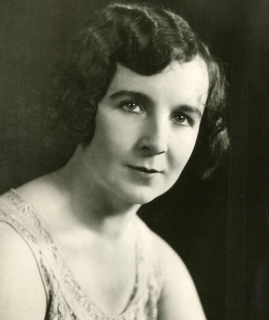
Geraldine Dorothy Cummins, spiritualist medium, novelist and playwright, dies in Cork, County Cork, on August 24, 1969. She begins her career as a creative writer, but increasingly concentrates on mediumship and “channelled” writings, mostly about the lives of Jesus and Saint Paul, though she also publishes on a range of other topics. Her novels and plays typically document Irish life in a naturalist manner, often exploring the pathos of everyday life.
Cummins is born in Cork, on January 24, 1890, the daughter of the physician Ashley Cummins, professor of medicine at the National University of Ireland and sister to Mary Hearn and Iris Cummins. In her youth she is an athlete, becoming a member of the Irish Women’s International Hockey Team. She is also active as a suffragette. Her desire to follow her father in a medical career is vetoed by her mother, so she begins a literary career as a journalist and creative writer. From 1913 to 1917 she writes three plays for the Abbey Theatre in collaboration with Suzanne R. Day, the most successful of which is the comedy Fox and Geese (1917). She publishes the novel The Land they Loved in 1919, a naturalistic study of working class Irish life.
As she concentrates on mediumship, Cummins’s literary work tails off. However, she continues to publish creative literature in her later years. Her solo-written play, Till Yesterday Comes Again, is produced by the Chanticleer Theatre, London, in 1938. She also publishes another novel, Fires of Beltane (1936) and a short-story collection Variety Show (1959).
Literary critic Alexander G. Gonzalez says that Cummins work tries to encompass the full range of Irish social life, from the aristocracy to the lower classes. In this respect she is influenced by Somerville and Ross. Gonzalez considers her short story The Tragedy of Eight Pence to be the “finest” of her writings, the tale of a “happily married woman trying to shield her ill husband from the knowledge that his death will leave her penniless.”
Cummins begins to work as a medium following prompting from Hester Dowden and E. B. Gibbes. She receives alleged messages from her spirit-guide “Astor” and is an exponent of automatic writing. Her books are based on these communications. In 1928 she publishes The Scripts of Cleophas, which provides channelled material on early Christian history complementing Acts of the Apostles and St. Paul’s writings, supposed to have been communicated by the spirit of Cleophas, one of Paul’s followers. This is later supplemented by Paul in Athens (1930) and The Great Days of Ephesus (1933).
Cummins’s next work describes human progress through spiritual enlightenment. The Road to Immortality (1932) provides a glowing vision of the afterlife. Its contents are purportedly communicated from the “other side” by the psychologist and psychic researcher Frederic W. H. Myers. Unseen Adventures (1951) is a spiritual autobiography. She also publishes several books of spiritually-derived knowledge about details of the life of Jesus.
During World War II Cummins allegedly works as a British agent, using her personal contacts to identify pro-Nazi factions within the Irish Republican movement. She also employs her psychic activities to support the Allied cause, sending channelled messages from sympathetic spirits to Allied leaders to support the war effort. This includes information from Theodore Roosevelt, Arthur Balfour and Sara Roosevelt, Franklin D. Roosevelt‘s mother.
In the 1940s and 50s Cummins works with psychiatrists to develop a model for using spiritualism to treat mental illness, ideas she explores in Perceptive Healing (1945) and Healing the Mind (1957). She collaborates with a psychiatrist who uses the pseudonym R. Connell on both books. Their method is for her to “read” an object associated with the patient and thus identify either childhood traumas or experiences of ancestors which have created the problem. This includes treating a patient who is concerned about his homosexual desires by discovering that this derives from the fact that his Huguenot ancestors were humiliated by Catholics in the 18th century.
Cummins’s biography of writer and spiritualist Edith Somerville is published in 1952. She also writes The Fate of Colonel Fawcett (1955) which offers her psychic insights into the disappearance of the explorer Percy Fawcett in Brazil in 1925. She claims she had received psychic messages from Fawcett in 1936. He was still alive at that time, informing her that he had found relics of Atlantis in the jungle, but was ill. In 1948 she has a message from Fawcett’s spirit reporting his death. Her last book is an account of her conversations with the spirit of Winifred Coombe Tennant, Swan on a Black Sea; a Study in Automatic Writing; the Cummins-Willett Scripts (1965).
The automatic writing and alleged channeled material from Cummins have been examined and have been described by some psychical researchers to be the product of her own subconscious. For example, Harry Price, who studies various mental mediums including Cummins, writes that “there is no question that most of the automatic writing which has been published is the product of the subconscious.” Paranormal researcher Hilary Evans notes that unlike most spiritualists, Cummins does not accept the phenomena at face value and questions the source of the material.
According to the psychical researcher Eric Dingwall information published in Cummins’ scripts allegedly from Winifred Coombe Tennant are discovered to be erroneous. Biographer Rodger Anderson writes that although spiritualists consider Cummins completely honest “some suspected that she occasionally augmented her store of knowledge about deceased persons by normal means if by doing so she could bring comfort to the bereaved.”
Cummins’ book The Fate of Colonel Fawcett (1955), contains her automatist scripts allegedly from the spirit of Colonel Fawcett. Spiritualists claim the scripts are evidence for survival. However, the psychical researcher Simeon Edmunds notes that before his disappearance Fawcett had written articles for The Occult Review. Cummins also contributes articles to the same review and Edmunds suggests it is likely she had read the work of Fawcett. Edmunds concludes the scripts are a case of subliminal memory and unconscious dramatization.
Other researchers such as Mary Rose Barrington have suspected fraud as Cummins had long standing connections with friends and families of the deceased that she claimed to have contacted and could have easily obtained information by natural means. The classical scholar E. R. Dodds writes that Cummins worked as a cataloguer at the National Library of Ireland and could have taken information from various books that would appear in her automatic writings about ancient history. Her writings were heavily influenced by literature and religious texts. Dodds also studies her book Swan on a Black Sea which was supposed to be an account of spirit conversation but writes there is evidence suggestive of fraud as Cummins had received some of the information by natural means.
D’Arcy is born to a Russian-Jewish mother and an Irish Catholic father. She works in small theatres in Dublin from the age of fifteen and later becomes an actress.
D’Arcy is married in 1957 to English playwright and author John Arden. They write several plays together which are highly critical of the British presence in Ireland. They settle in Galway in 1971 and establish the Galway Theatre Workshop in 1976. The couple has five sons, one of whom predeceases his mother.
The couple writes a number of stage pieces and improvisational works for amateur and student players, including The Happy Haven (1960) and The Workhouse Donkey (1964). She writes and produces many plays, including The Non-Stop Connolly Show (1977).
D’Arcy has also written a number of books, including Tell Them Everything (1981), Awkward Corners (with John Arden, 1988), and Galway’s Pirate Women: A Global Trawl (1996).
As an activist, in 1961, D’Arcy joins the anti-nuclear Committee of 100, led by Bertrand Russell. In 1981, her peace-activism results in her incarceration in Armagh Jail, after defacing a wall at the Ulster Museum. Her book Tell Them Everything (Pluto Press, 1981) tells the story of her time during the Armagh and H-Blockdirty protests and is one of the earliest accounts about the Armagh women, their republicanism and imprisonment.
D’Arcy also directs Yellow Gate Women (2007), a film about the attempts by women of Greenham Common Women’s Peace Camp to outwit the British and United States military at RAF Greenham Common with bolt cutters and legal challenges. Challenging censorship since 1987, she runs a women’s kitchen pirate radio from her home in Galway.
In 2011, D’Arcy refuses to stand for a minute’s silence to honour Police Service of Northern Ireland (PSNI) officer Ronan Kerr, killed by dissident republicans, at an Aosdána meeting. Her actions are deliberate, she tells the media afterwards, which attracts fierce criticism of her perceived support for armed republican groups in Northern Ireland.
Along with Niall Farrell, D’Arcy is arrested in October 2012 for scaling the perimeter fence of Shannon Airport, in protest at the use of the airport as a stopover for U.S. military flights. As a consequence of her trespassing on airport property, she is imprisoned in 2014 after she refuses to sign a bond saying that she will not trespass on non-public parts of Shannon Airport.
Boland is born on September 16, 1870, at 135 Capel Street, Dublin, to Patrick Boland, businessman, and Mary Donnelly. Following the death of his mother in 1882, he is placed with his six siblings under the guardianship of his uncle, Nicholas Donnelly, auxiliary bishop of Dublin.
Boland is educated at two private Catholic schools, the Catholic University School, Dublin, and Birmingham Oratory in Birmingham, England, where he becomes head boy. His secondary education at the two schools help give him the foundation and understanding to play an influential role in the politics of Great Britain and Ireland at the beginning of the 20th century, when he is a member of the Irish Parliamentary Party, which pursues constitutional Home Rule.
In 1892, Boland graduates with a BA from London University. He studies for a semester in Bonn, Germany, where he is a member of Bavaria Bonn, a student fraternity that is member of the Cartellverband. He studies law at Christ Church, Oxford, graduating with a BA in 1896 and MA in 1901. Although called to the Bar in 1897, he never practises.
Boland is the first Olympic champion in tennis for Great Britain and Ireland at the first modern Olympics, which take place in Athens in 1896. He visits his friend Thrasyvoulos Manos in Athens during the Olympics, and Manos, a member of the organising committee, enters Boland in the tennis tournament. He promptly wins the singles tournament, defeating Friedrich Traun of Germany in the first round, Evangelos Rallis of Greece in the second, Konstantinos Paspatis of Greece in the semifinals, and Dionysios Kasdaglis of Greece in the final.
Boland then enters the doubles event with Traun, the German runner whom he had defeated in the first round of the singles. Together, they win the doubles event. They defeat Aristidis and Konstantinos Akratopoulos of Greece in the first round, have a bye in the semifinals, and defeat Demetrios Petrokokkinos of Greece and Dimitrios Kasdaglis in the final. When the Union Jack and the German flag are run up the flagpole to honour Boland and Traun’s victory, Boland points out to the man hoisting the flags that he is Irish, adding “It [the Irish flag]’s a gold harp on a green ground, we hope.” The officials agreed to have an Irish flag prepared.
Following a visit to County Kerry, Boland becomes concerned about the lack of literacy among the native population. He also has a keen interest in the Irish Language.
Boland’s patriotic stand is well received in nationalist circles in Ireland. This and a lifelong friendship with John Redmond gain for him an invitation to stand as a candidate for the Irish Parliamentary Party in the safe seat of South Kerry, which he holds from 1900 to 1918. He is unopposed in the general elections of 1900 and 1906, and the first of 1910. In the second election of 1910 he is challenged by a local man, T. B. Cronin, who stands as an independent nationalist in the interest of William O’Brien. Boland stands down at the 1918 United Kingdom general election.
In 1908, Boland is appointed a member of the commission for the foundation of the National University of Ireland (NUI). From 1926 to 1947, he is General Secretary of the Catholic Truth Society. He receives a papal knighthood, becoming a Knight of St. Gregory in recognition for his work in education. In 1950, he is awarded an honorary Doctor of Law by the NUI.
Boland marries Eileen Moloney at SS Peter and Edward, Palace Street, Westminster, on October 22, 1902, the daughter of an Australian Dr. Patrick Moloney. They have one son and five daughters. His daughter Honor Crowley succeeds her husband Frederick Crowley upon his death sitting as Fianna FáilTD for South Kerry from 1945 until her death in 1966. His daughter Bridget Boland is a playwright who notably writes The Prisoner and co-writes the script for Gaslight, and, among other books, co-authors Old Wives’ Lore for Gardeners with her sister, Maureen Boland.
Having begun his career as a freelance musician, playing with the BBC Philharmonic orchestra and English National Opera North, an accident ends Cusack’s career as a musician, resulting in him pursuing a career in arts administration. Initially he focuses on the classical music sector, working at two leading concert venues in London, the Wigmore Hall and the Southbank Centre.
In 1992, Cusack makes his first move into theatre following his appointment as Administrative Director of West Yorkshire Playhouse in Leeds, alongside Jude Kelly, where he produces a number of plays including the touring production of Five Guys Named Moe for Cameron Mackintosh Limited. In 1996, he is appointed Head of Planning of the Royal National Theatre under the outgoing artistic director, Sir Richard Eyre, and subsequently with Sir Trevor Nunn and Sir Nicholas Hytner. In 2009, he becomes the National Theatre’s Associate Producer. During this period, he produces numerous productions for tour both in the UK and internationally, taking the work of the National Theatre to five continents. Alongside this, he works as a touring consultant for the Abbey Theatre in Dublin, the Royal Court Theatre, London, Fiery Angel in London’s West End, Canadian Stage in Toronto, Bangarra Dance Theatre in Sydney, TheEmergencyRoom and Corn Exchange in Dublin and Galway International Arts Festival. In June 2016, he is appointed Executive Producer of Wales Millennium Centre in Cardiff. In addition to this, he is Consultant Producer to the National Centre for the Performing Arts (India) in Mumbai.
As well as his theatre producing work, Cusack offers representation to a number of Irish artists including the director Annie Ryan, the composer Mel Mercier and the British playwrightMatt Wilkinson.
In 2023, Cusack is the recipient of the Olwen Wymark Award from the Writers’ Guild of Great Britain for his championing of new writing which is presented at the 18th Annual Awards Ceremony in London.
Mac Liammóir is born Alfred Willmore on October 25, 1899. He is born to a Protestant family living in the Kensal Green district of London.
As Alfred Willmore, he is one of the leading child actors on the English stage, in the company of Noël Coward. He appears for several seasons in Peter Pan. He studies painting at London’s Slade School of Fine Art, continuing to paint throughout his lifetime. In the 1920s he travels all over Europe. He is captivated by Irish culture and learns the Irish language which he speaks and writes fluently. He changes his name to an Irish version, presenting himself in Ireland as a descendant of Irish Catholics from Cork. Later in his life, he writes three autobiographies in Irish and translates them into English.
While acting in Ireland with the touring company of his brother-in-law Anew MacMaster, Mac Liammóir meets the man who becomes his partner and lover, Hilton Edwards. Their first meeting takes place in the Athenaeum, Enniscorthy, County Wexford. Deciding to remain in Dublin, where they live at Harcourt Terrace, the pair assists with the inaugural production of Galway‘s Irish language theatre, An Taibhdhearc. The play is Mac Liammóir’s version of the mythical story Diarmuid agus Gráinne, in which Mac Liammóir plays the lead role as Diarmuid.
Mac Liammóir and Edwards then throw themselves into their own venture, co-founding the Gate Theatre in Dublin in 1928. The Gate becomes a showcase for modern plays and design. Mac Liammóir’s set and costume designs are key elements of the Gate’s success. His many notable acting roles include Robert Emmet/The Speaker in Denis Johnston‘s The Old Lady Says “No!” and the title role in Hamlet.
In 1948, Mac Liammóir appears in the NBC television production of Great Catherine with Gertrude Lawrence. In 1951, during a break in the making of Othello, he produces Orson Welles‘s ghost-story Return to Glennascaul which is directed by Hilton Edwards. He plays Iago in Welles’s film version of Othello (1951). The following year, he goes on to play ‘Poor Tom’ in another Welles project, the TV film of King Lear (1953) for CBS.
Mac Liammóir claims when talking to Irish playwright Mary Manning, to have had a homosexual relationship with General Eoin O’Duffy, former Garda Síochána Commissioner and head of the paramilitary Blueshirts in Ireland, during the 1930s. The claim is revealed publicly by RTÉ in a documentary, The Odd Couple, broadcast in 1999. However, Mac Liammóir’s claims have not been substantiated.
Mac Liammóir’s life and artistic development are the subject of a major study by Tom Madden, The Making of an Artist. Edwards and Mac Liammóir are the subject of a biography, titled The Boys by Christopher Fitz-Simon.
Micheál Mac Liammóir dies at his and Edwards’s Dublin home, 4 Harcourt Terrace, at the age of 78 on March 6, 1978. Edwards and Mac Liammóir are buried alongside each other at St. Fintan’s Cemetery, Sutton, Dublin.
Born Alice Izabella, she is one of ten children born to grocer Moses Crowe and Therese Eglinton. From an early age, she shows an interest in the theatre, and regularly attends productions in both the Gaiety and Abbey theatres. Having completed her education, she joins a convent but soon after abandons the idea of becoming a nun. In October 1921, she enters the Abbey School of Acting. She has a career with the Abbey Theatre from 1921 to 1970.
Upon her entry to the Abbey School of Acting, Crowe makes her debut in 1921 in the play The Revolutionist, taking the lead role of Nora Mangan. She plays her last role of Miss Hatty in Grogan and the Ferret, after which she retires. During nearly five decades, she stars in many plays, some of which include The Marriage of Columbine (1921) and Juno and the Paycock (1924). Between 1931 and 1953, she appears in the Abbey Theatre productions of plays by Irish playwrightTeresa Deevy including A Disciple (1931), Katie Roche (1936, 1937, 1949, 1953), Temporal Powers (1932, 1937) and The Reapers (1930).
Also in 1964, Crowe appears in the Aldwych Theatre‘s production of Juno and the Paycock in London. She works in the Abbey for the vast majority of her career, except for when she is on a six-month tour for Peg O’ My Heart, touring Northern Ireland and England.
In 1924, when the play Grasshopper is being produced, Crowe meets her husband, Peter Judge, also known as F. J. McCormick. They are married in 1925 and the marriage produces a daughter and a son.
O’Sullivan’s father, John, is originally from Bantry, County Cork, and moves to London as a young man where he eventually becomes a successful tailor. His mother, Mary Ann O’Sullivan (née Murphy), is born in Inniscarra, County Cork. He is the youngest of thirteen children, all born in London, although only eleven survive to adulthood. As a boy he attends St. Edmund’s College, Ware. On January 25, 1915, his eighteenth birthday, he enlists into the Royal Munster Fusiliers, and later transfers to the London Regiment and serves with the rank of lance corporal during World War I, losing a leg at Ypres in 1917.
Upon being discharged from the army in 1918, O’Sullivan is employed by the Ministry of Munitions and, when the war ends, is transferred to the Ministry of Labour where he works as a messenger. The Ministry of Labour is located in Montagu House, adjacent to Scotland Yard, and later demolished and replaced by the present-day Ministry of Defence.
O’Sullivan becomes a member of the IRA detachment in London and is named by Rex Taylor as being responsible for the execution of Vincent Fovargue as a British spy at the Ashford Golf Links, Middlesex, on April 2, 1921. Fovargue is left with a label pinned to his body stating, “Let spies and traitors beware, IRA.” Fovargue had been an officer in the Dublin brigade of the IRA.
O’Sullivan’s brother, Patrick, is the first Vice-Commandant of the London IRA during its early days in 1919 but is seconded to the Cork No. 1 Brigade during the Irish War of Independence. Patrick also serves in the London Regiment during World War I, along with another brother, Aloysius, who is discharged from the army in 1916 suffering from shell shock. Patrick is also wounded in a gas attack during World War I. He fights with the Anti-Treaty IRA during the Irish Civil War and is wounded ten days after his brother is executed. Shortly before that, he crosses over to England to participate in an abortive attempt to rescue Dunne and his brother.
In 1923, John O’Sullivan tries to have the remains of his son and Dunne released for a funeral Mass. But it is not until after the abolition of capital punishment in the United Kingdom that Patrick O’Sullivan, with the assistance of the Irish RepublicanNational Graves Association, is able to arrange for the bodies of O’Sullivan and Dunne to be sent to Ireland for burial. In mid-August 1929, Irish Republicans in London unveil a plaque commemorating Dunne and O’Sullivan. In 1967, after some political and diplomatic debate by the British and Irish governments, the British Government allows the bodies of Dunne and O’Sullivan to be exhumed. They are subsequently reburied in Dean’s Grange Cemetery, County Dublin.
(Pictured: Photograph of IRA member Joseph O’Sullivan taken before his 1922 execution)
Ervine is born in Ballymacarrett, Belfast on December 28, 1883. He is considered to be the founding father of modern Northern Irish drama.
Although accepted to study at Trinity College, Dublin, circumstances force Ervine to leave school at the age of 15 to begin working in an insurance office.
Two years later, Ervine immigrates to London, where he discovers a love for the theatre. He begins his writing career with Mixed Marriage (1911), an Ulster tragedy, and produces three plays between 1911 and 1915. In 1915, after a meeting with William Butler Yeats in London, he becomes the director of the Abbey Theatre in Dublin. It is, however, not a happy appointment as his personality and politics clash with the management of the theatre.
Ervine then joins the Royal Dublin Fusiliers and fights in Flanders, losing a leg in the conflict. Returning home, he feels increasingly alienated by nationalism and more attracted to the unionism of his family background. He becomes a vehement detractor of the south, describing Ireland in a letter to George Bernard Shaw as brimming with “bleating Celtic Twilighters, sex-starved Daughters of the Gael, gangsters and gombeen men.”
Ervine is a distinctively Ulster orientated writer, focusing on a naturalistic portrayal of rural and urban life. His most famous and popular work amongst his Northern Irish audience is Boyd’s Shop (1936), which becomes one of the Ulster Group Theatre’s stalwart productions. The play is a classic of the homely yet sincere Ulster genre and centres around the struggles of the folk that Ervine grew up with in his grandmother’s shop on the Albertbridge Road. Ervine creates in Boyd’s Shop a template for Ulster theatre that is to dominate until the advent of Samuel Thompson‘s Over the Bridge.
Ervine’s reactionary unionism and anti-southern hatred becomes more pronounced as he ages and eclipses his more subtle characteristics and abilities as a writer. Although many of his novels and plays are at times clouded by his prejudices, they are also very often capable of tremendous feeling and humanity showing he is a writer of note.
St. John Greer Ervine dies at the age of 87 at Fitzhall, Ipling, Sussex on January 24, 1971.
O’Brien is the youngest child of “a strict, religious family.” From 1941 to 1946 she is educated by the Sisters of Mercy, a circumstance that contributes to a “suffocating” childhood. “I rebelled against the coercive and stifling religion into which I was born and bred. It was very frightening and all pervasive. I’m glad it has gone.” She is fond of a nun as she deeply misses her mum and tries to identify the nun with her mother.
In 1950, O’Brien is awarded a licence as a pharmacist. In Ireland, she reads such writers as Leo Tolstoy, William Makepeace Thackeray, and F. Scott Fitzgerald. In 1954, she marries, against her parents’ wishes, the Irish writer Ernest Gébler and the couple moves to London. They have two sons, but the marriage is dissolved in 1964. Gébler dies in 1998.
In London, O’Brien purchases Introducing James Joyce, with an introduction written by T. S. Eliot. When she learns that James Joyce‘s A Portrait of the Artist as a Young Man is autobiographical, it makes her realise where she might turn, should she decide to write herself. In London she starts work as a reader for Hutchinson, where on the basis of her reports she is commissioned, for £50, to write a novel. Her first novel, The Country Girls (1960), is often credited with breaking silence on sexual matters and social issues during a repressive period in Ireland following World War II.
This novel is the first part of a trilogy of novels which includes The Lonely Girl (1962) and Girls in Their Married Bliss (1964). Shortly after their publication, these books are banned and, in some cases burned, in her native country due to their frank portrayals of the sex lives of their characters. Her novel A Pagan Place (1970) is about her repressive childhood. Her parents are vehemently against all things related to literature and her mother strongly disapproves of her daughter’s career as a writer.
O’Brien is a panel member for the first edition of the BBC‘s Question Time in 1979. In 2017, she becomes the sole surviving member.
Other works include a biography of James Joyce, published in 1999, and one of the poet Lord Byron, Byron in Love (2009). House of Splendid Isolation (1994), her novel about a terrorist who goes on the run, marks a new phase in her writing career. Down by the River (1996) concerns an under-age rape victim who seeks an abortion in England, the “Miss X case.” In the Forest (2002) deals with the real-life case of Brendan O’Donnell, who abducts and murders a woman, her three-year-old son, and a priest, in rural Ireland.