At the Lambeth Conference in 1988, Neill proposes all the approved resolutions in respect of Women in the Episcopate and is chairman of the Church of Ireland General Synod Committee on Ordination of Women (1988–91). He serves on many central committees of the Church of Ireland covering issues such as liturgical reform, education, communications, ministry, Christian unity and synodical structures.
Neill serves as President of the Council of Churches for Britain and Ireland (1990-94) and as President of Churches Together in Britain and Ireland (1999-2002) and is co-founder and chairman of the Church of Ireland/Methodist Church Joint Theological Working Party.
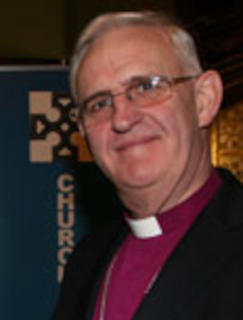
On August 29, 2002, the Church of Ireland announces that the Right Reverend John Neill, Bishop of Cashel and Ossory, is to succeed the Most Reverend Dr. Walton Empey as Archbishop of Dublin. The announcement is made at a meeting of the Church of Ireland Episcopal Electoral College in Christ Church Cathedral, Dublin.
Neill and his wife Betty have three sons, The Reverend Canon Stephen Neill, Rector of Celbridge, Andrew Neill, a member of Garda Síochána, and Peter Neill, a photographer.
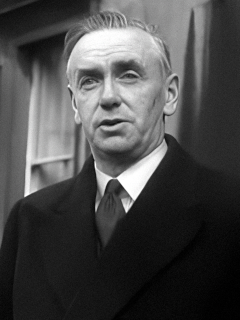
(Robert John) Douglas Gageby, one of the pre-eminent Irish newspaper editors of his generation, dies on June 24, 2004, following a lengthy illness. His life is well documented and a book of essays about him, Bright Brilliant Days: Douglas Gageby and the Irish Times, written by many of his colleagues, some of whom had attained fame for their literary achievements, is published in 2006.
Gageby is educated at Belfast Royal Academy and Trinity College Dublin, where he is elected a scholar in Modern Languages (French and German) in 1940. He is also actively involved with the student newspaper, Trinity News. He enlists in the Irish Army as a private soldier at the outbreak of World War II. He is commissioned later, and he serves as an intelligence officer. He reports from post-war Germany for The Irish Press and goes on to work under Conor Cruise O’Brien in the Irish News Agency. In 1954 he is the first editor of the Evening Press. In 1963 he becomes editor of The Irish Times, a post he holds until 1986, having been brought back from a short retirement in 1974. He is credited with moving The Irish Times from a Unionist organ into a successful Irish journal of record.
In 2003 it is revealed that a director, and later Chairman, of The Irish Times, Major Thomas Bleakley McDowell, had referred to Gageby as a “white nigger” for his views and role in the paper during the Northern Ireland civil rights movement‘s campaign in the 1960s. The comment appears in a letter from the British Ambassador to Dublin, Sir Andrew Gilchrist, to Kelvin White, head of the Irish Section of the British Foreign Office and is dated October 2, 1969. Gilchrist is referring to conversations which he had with McDowell where the latter professes himself to be fully behind the British government in the North and hostile to Gageby’s coverage of the civil rights movement. However, historian Mark O’Brien notes, “Despite his contacts with London, McDowell’s actions did not interfere with Gageby’s editorials on Northern Ireland”, due to the fact McDowell believes in editorial independence (even though McDowell strongly disagrees with Gageby’s nationalist views), and because Gageby is making the newspaper commercially successful. Under the 30 year rule, this letter is made available to newspapers on December 22 and 23, 1999, but no newspaper publishes it at that time.
The communiqué is later discovered by the historian Jack Lane and published in the Irish Political Review, a small magazine strongly antagonistic to The Irish Times, in January 2003. He brings it to the attention of The Irish Times editor, Geraldine Kennedy, on January 10, 2003, and she replies on January 15, 2003 saying she is “unable to confirm the veracity of it” and does not publish it. When, on January 26, 2003, the Sunday Independent (Ireland) publishes the story, The Irish Times finally follows the next day, January 27. Nonetheless, on April 24, 2004, Kennedy defends her position by saying, “The contents of the letter in question were published on January 27, 2003, as soon as its existence was drawn to my attention.”
Gageby dies on June 24, 2004, following a two year illness. His private funeral is conducted by Rev. Terence McCaughey, a family friend. The Irish Times endows an annual Douglas Gageby Fellowship for young journalists and a stand of trees is planted in his memory at Moynalty. His papers are presented to Dublin City University (DCU).
Costello is the younger son of John Costello senior, a civil servant, and Rose Callaghan. He is educated at St. Joseph’s, Fairview, and then moves to O’Connell School, for senior classes, and later attends University College Dublin (UCD), where he graduates with a degree in modern languages and law. He studies at King’s Inns to become a barrister, winning the Victoria Prize there in 1913 and 1914. He is called to the Irish Bar in 1914, and practises as a barrister until 1922.
In 1922, Costello joins the staff at the office of the Attorney General in the newly established Irish Free State. Three years later he is called to the inner bar, and the following year, 1926, he becomes Attorney General of Ireland, upon the formation of the Cumann na nGaedheal government, led by W. T. Cosgrave. While serving in this position he represents the Free State at Imperial Conferences and League of Nations meetings.
Costello is also elected a Bencher of the Honourable Society of King’s Inns. He loses his position as Attorney General of Ireland when Fianna Fáil comes to power in 1932. The following year, however, he is elected to Dáil Éireann as a Cumann na nGaedheal TD. Cumann na nGaedheal soon merges with other parties to form Fine Gael.
During the Dáil debate on the Emergency Powers Act 1939, Costello is highly critical of the Act’s arrogation of powers, stating that “We are asked not merely to give a blank cheque, but to give an uncrossed cheque to the Government.” He loses his seat at the 1943 Irish general election but regains it when Éamon de Valera calls a snap election in 1944. From 1944 to 1948, he is the Fine Gael front-bench Spokesman on External Affairs.
In 1948, Fianna Fáil has been in power for sixteen consecutive years and has been blamed for a downturn in the economy following World War II. The 1948 Irish general election results show Fianna Fáil short of a majority, but still by far the largest party, with twice as many seats as the nearest rival, Fine Gael. It appears that Fianna Fáil is headed for a seventh term in government. However, the other parties in the Dáil realise that between them, they have only one seat fewer than Fianna Fáil, and if they band together, they would be able to form a government with the support of seven Independent deputies. Fine Gael, the Labour Party, the National Labour Party, Clann na Poblachta and Clann na Talmhan join to form the first inter-partygovernment in the history of the Irish state.
While it looks as if cooperation between these parties will not be feasible, a shared opposition to Fianna Fáil and Éamon de Valera overcomes all other difficulties, and the coalition government is formed.
Since Fine Gael is the largest party in the government, it has the task of providing a suitable candidate for Taoiseach. Naturally, it is assumed that its leader, Richard Mulcahy, will be offered the post. However, he is an unacceptable choice to Clann na Poblachta and its deeply republican leader, Seán MacBride. This is due to Mulcahy’s record during the Irish Civil War. Instead, Fine Gael and Clann na Poblachta agree on Costello as a compromise candidate. Costello had never held a ministerial position nor was he involved in the Civil War. When told by Mulcahy of his nomination, Costello is appalled, content with his life as a barrister and as a part-time politician. He is persuaded to accept the nomination as Taoiseach by close non-political friends.
During the campaign, Clann na Poblachta had promised to repeal the Executive Authority (External Relations) Act 1936 but does not make an issue of this when the government is being formed. However, Costello and his Tánaiste, William Norton of the Labour Party, also dislike the act. During the summer of 1948, the cabinet discusses repealing the act, however, no firm decision is made.
In September 1948, Costello is on an official visit to Canada when a reporter asks him about the possibility of Ireland leaving the British Commonwealth. For the first time, he declares publicly that the Irish government is indeed going to repeal the External Relations Act and declare Ireland a republic. It has been suggested that this is a reaction to offence caused by the Governor General of Canada at the time, Harold Alexander, 1st Earl Alexander of Tunis, who is of Northern Irish descent and who allegedly arranges to have placed symbols of Northern Ireland in front of Costello at an official dinner. Costello makes no mention of these aspects on the second reading of the Republic of Ireland Bill on November 24 and, in his memoirs, claims that Alexander’s behaviour had in fact been perfectly civil and could have had no bearing on a decision which had already been made.
The news takes the Government of the United Kingdom and even some of Costello’s ministers by surprise. The former had not been consulted and following the declaration of the Republic in 1949, the UK passes the Ireland Act that year. This recognises the Republic of Ireland and guarantees the position of Northern Ireland within the United Kingdom for so long as a majority there want to remain in the United Kingdom. It also grants full rights to any citizens of the Republic living in the United Kingdom. Ireland leaves the Commonwealth on April 18, 1949, when The Republic of Ireland Act 1948 comes into force. Frederick Henry Boland, Secretary of the Department of External Affairs, says caustically that the affair demonstrates that “the Taoiseach has as much notion of diplomacy as I have of astrology.” The British envoy, John Maffey, 1st Baron Rugby, is equally critical of what he calls a “slipshod and amateur” move.
Many nationalists now see partition as the last obstacle on the road to total national independence. Costello tables a motion of protest against partition on May 10, 1949, without result.
In 1950, the independent-minded Minister for Health, Noël Browne, introduces the Mother and Child Scheme. The scheme would provide mothers with free maternity treatment and their children with free medical care up to the age of sixteen, which is the normal provision in other parts of Europe at that time. The bill is opposed by doctors, who fear a loss of income, and Roman Catholic bishops, who oppose the lack of means testing envisaged and fear the scheme could lead to birth control and abortion. The cabinet is divided over the issue, many feeling that the state cannot afford such a scheme priced at IR£2,000,000 annually. Costello and others in the cabinet make it clear that in the face of such opposition they will not support the Minister. Browne resigns from the government on April 11, 1951, and the scheme is dropped. He immediately publishes his correspondence with Costello and the bishops, something which had hitherto not been done. Derivatives of the Mother and Child Scheme are introduced in Public Health Acts of 1954, 1957 and 1970.
The Costello government has a number of noteworthy achievements. A new record is set in housebuilding, the Industrial Development Authority and Córas Tráchtála are established, and the Minister for Health, Noel Browne, with the then new Streptomycin, bring about an advance in the treatment of tuberculosis. Ireland also joins a number of organisations such as the Organization for European Economic Co-operation and the Council of Europe. However, the government refuses to join NATO, allegedly because the British remain in Northern Ireland. The scheme to supply electricity to even the remotest parts of Ireland is also accelerated.
While the “Mother and Child” incident does destabilise the government to some extent, it does not lead to its collapse as is generally thought. The government continues; however, prices are rising, a balance of payments crisis is looming, and two TDs withdraw their support for the government. These incidents add to the pressure on Costello and so he decides to call a general election for June 1951. The result is inconclusive but Fianna Fáil returns to power. Costello resigns as Taoiseach. It is at this election that his son Declan is elected to the Dáil.
Over the next three years while Fianna Fáil is in power a dual-leadership role of Fine Gael is taking place. While Richard Mulcahy is the leader of the party, Costello, who has proved his skill as Taoiseach, remains as parliamentary leader of the party. He resumes his practice at the Bar. In what is arguably his most celebrated case, the successful defence of The Leader against a libel action brought by the poet Patrick Kavanagh, dates from this period. Kavanagh generously praises Costello’s forensic skill, and the two men become friends.
At the 1954 Irish general election Fianna Fáil loses power. A campaign dominated by economic issues results in a Fine Gael-Labour Party-Clann na Talmhan government coming to power. Costello is elected Taoiseach for the second time.
The government can do little to change the ailing nature of Ireland’s economy, with emigration and unemployment remaining high, and external problems such as the Suez Crisis compounding the difficulty. Measures to expand the Irish economy such as export profits tax relief introduced in 1956 would take years have sizable impact. Costello’s government does have some success with Ireland becoming a member of the United Nations in 1955, and a highly successful visit to the United States in 1956, which begins the custom by which the Taoiseach visits the White House each St. Patrick’s Day to present the U.S. President with a bowl of shamrock. Although the government has a comfortable majority and seems set for a full term in office, a resumption of Irish Republican Army (IRA) activity in Northern Ireland and Great Britain causes internal strains. The government takes strong action against the republicans.
In spite of supporting the government from the backbenches, Seán MacBride, the leader of Clann na Poblachta, tables a motion of no confidence, based on the weakening state of the economy and in opposition to the government’s stance on the IRA. Fianna Fáil also tables its own motion of no confidence, and rather than face almost certain defeat, Costello again asks PresidentSeán T. O’Kelly to dissolve the Oireachtas. The general election which follows in 1957 gives Fianna Fáil an overall majority and starts another sixteen years of unbroken rule for the party. Some of his colleagues questioned the wisdom of his decision to call an election. The view is expressed that he was tired of politics and depressed by his wife’s sudden death the previous year.
Following the defeat of his government, Costello returns to the bar. In 1959, when Richard Mulcahy resigns the leadership of Fine Gael to James Dillon, he retires to the backbenches. He could have become party leader had he been willing to act in a full-time capacity. He remains as a TD until 1969, when he retires from politics, being succeeded as Fine Gael TD for Dublin South-East by Garret FitzGerald, who himself goes onto to become Taoiseach in a Fine Gael-led government.
During his career, Costello is presented with a number of awards from many universities in the United States. He is also a member of the Royal Irish Academy from 1948. In March 1975, he is made a freeman of the city of Dublin, along with his old political opponent Éamon de Valera. He practises at the bar until a short time before his death at the age of 84, in Ranelagh, Dublin, on January 5, 1976. He is buried at Dean’s Grange Cemetery in Dublin.
O’Reilly is born on May 14, 1929, in Granard, County Longford, one of six children of James P. O’Reilly, shopkeeper and musician, and Catherine O’Reilly (née Donegan). The family moves to Dublin when he is nine years old. He is educated at the Christian Brothers school in James’s Street, where he excels at Gaelic football and develops an interest in drama and music. Toward the end of his schooldays, he begins to participate in athletics, particularly the high jump, and is coached by Jack Sweeney, a leading athletics coach.
Always a man of many talents and interests, after leaving school O’Reilly combines working in the insurance business with an athletics career with Donore Harriers and evening drama classes. He wins several Irish titles, including the high jump, javelin, and decathlon, and sets a national record in the high jump. In 1954 he wins the British AAA Championships high jump title, beating the Commonwealth champion into second place, and setting a championship record of 6 ft. 5 in. (1.96 m). As a result, he secures a United States athletics scholarship to the University of Michigan, Ann Arbor, where he takes a degree in liberal arts, majoring in speech and drama. While at Michigan he improves his Irish record to 6 ft. 7 in. (2.007 m). His athletic career, however, is dogged with bad luck. He is selected to compete in the high jump at the European Athletics Championships in Bern, Switzerland, in 1954 but fractures an ankle in practice and fails to advance beyond the qualifying round. Although he competes at international level for ten years (1952–62), he is unlucky to never take part in the Olympic Games. A victim of sporting politics in 1952, as an NCAA athlete he is not entitled to compete. He is selected for the 1956 Summer Olympics in Melbourne but is unable to attend when, at the last minute, his club cannot provide the finance for him to attend. Earlier that year he wins the Big Ten Conference high jump title.
On leaving Michigan O’Reilly moves to New York City, where he embarks on an acting career with the Irish Players, but he returns to Dublin in 1959, where, after brief spells working as a teacher and for an advertising agency, he applies to Ireland’s new television station for a position. He is looking for an acting job but ends up being offered a position as a presenter, joining Teilifís Éireann in 1961 as an announcer/interviewer. His relaxed and unobtrusive style appeals to viewers and his light entertainment show, The Life of O’Reilly, is the most popular programme on Irish television in the day, eclipsing even a fledgling The Late Late Show. It is as a sports presenter and commentator, however, that O’Reilly is primarily remembered, as he becomes the face of sport on RTÉ Television for many years. He attends five Olympic Games as a broadcaster, from Mexico in 1968 to Los Angeles in 1984, commentating on athletics and gymnastics. The first presenter of RTÉ’s flagship Saturday afternoon sports programme Sports Stadium in 1984, he continues to present it over its fourteen-year life, co-presenting the final programme in December 1997. He also is the regular presenter of RTÉ’s Wimbledon Championships tennis coverage for many years, the sports results on news broadcasts on TV and radio, and Sunday Sport on RTÉ Radio, as well as commentating on individual sports such as ice-skating.
Although sports presenting is a natural progression for an athlete with his talents, O’Reilly’s real love is the arts. He continues to act, playing the part of Detective Inspector Michael Roarke in the classic children’s film Flight of the Doves (1971) with Ron Moody and Willie Rushton. He is also an accomplished singer and songwriter, and writes and performs his own one-man show, Across the Spectrum, comprising his own poems and songs in 1992. As well as a book of poems, The Great Explosion (1977), he releases a number of albums and tops the charts with his own song, “The Ballad of Michael Collins,” in 1981. He has a great admiration for Michael Collins, and this leads to his becoming the first non-political figure to give the oration at the annual Collins commemoration at Béal na Bláth, County Cork, in 1981. He also writes the song “Let the Nations Play” (1985), inspired by the boycotts of the Olympic games of 1980 and 1984, and the song is adopted as an anthem of the international Olympic movement.
Tall and slim in build, O’Relly is affable, modest, and self-deprecating in character. His relaxed style is no mere public affectation. He often exasperates colleagues by turning up just in time for broadcasts, and his ability to ad-lib is important in a live television environment. He once describes himself as “a champion high jumper who could enunciate properly and keep my hair neatly combed” (The Irish Times, April 7, 2001). Despite the disappointments in his sporting career, he maintains that his other interests more than compensated. In relation to the Olympics he is quoted as saying, “If you asked me whether I’d have preferred to win a medal or have written the song, I’d honestly say I would have preferred to have written the song” (Longford Leader, April 6, 2001).
O’Reilly lives in Ranelagh, Dublin, and is married twice. He meets his first wife Linda Herbst (née Kuhl) in New York in the late 1950s. His second marriage is to Johanna Lowry. He has four children. After a lenghty illness, he dies on April 1, 2001, in St. Vincent’s Hospital, Fairview, Dublin. He is buried at Mount Venus cemetery, Rathfarnham.
(From: “O’Reilly, Brendan” by Jim Shanahan, Dictionary of Irish Biography, http://www.dib.ie, October 2009)
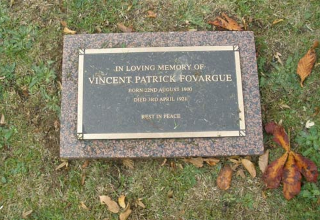
Fovargue is born on August 22, 1900, at 2 Rutland Place, Clontarf, Dublin, to Robert Fovargue, an engineer/fitter, and Elizabeth (Lillie) Larkin.
An intelligence officer with the 4th Battalion of the Dublin Brigade of the IRA in the Ranelagh area, he is captured by the British Army in Dublin. Under interrogation, he allegedly leaks information that results in the arrest of the other members of his unit a few days later. In return for this information, the Intelligence Corps allegedly allow him to escape during a staged ambush in Dublin’s South Circular Road.
This attempted ruse however does not go unnoticed by Michael Collins‘ informants in the Crown’s security forces. On the night of the escape, Detective ConstableDavid Neligan of the Dublin Metropolitan Police‘s “G” Division is on duty in Dublin Castle when he is passed a telephone message on a police form. The message, issued by the British Military Headquarters, states that a “Sinn Féin” suspect named Fovargue had escaped from three Intelligence Corps officers in a car while en route to prison. It gives a description of his appearance and asks that the British Army be notified in the event of his recapture by the Dublin Metropolitan Police.
Joe Kinsella is the I/O of the 4th Battalion. He is temporarily transferred to take care of munitions under Seán Russell for a few weeks and Fovargue is put in his place. In Kinsella’s statement to the BMH, he writes:
“From the outset I personally did not place a lot of trust in him, because on the morning that he took over from me he appeared to me, to be too inquisitive about the movements of Michael Collins and the GHQ staff generally. He wanted to know where they could be located at any time. He said that he had big things in view, and that it would be to the advantage of the movement generally if he was in a position to get in touch with the principal men with the least possible delay. From his attitude I there and then formed the opinion, rightly or wrongly, that he was inclined to overstep his position. I did not feel too happy about him and I discussed him with Sean Dowling. It transpired that my impressions of this man were correct. I told him of two meeting places of Intelligence staff, one of Company Intelligence held at Rathmines Road and one of Brigade Intelligence held at Saville Place. A short time after giving him this information both these places were raided…I was now confirmed in my suspicions that Fovargue was giving away information. He was later shot in England by the IRA.”
Neligan is not fooled by this either, as he explains:
“Now if they had said that this man (who was completely unknown to both of us) had escaped from one I.O. it might have sounded reasonable enough. But to tell us that an unarmed man had escaped out of a motor-car in the presence of three presumably armed men was imposing a strain on our credulity. Both of us thought this story too good to be true.”
The two men retype the message and pass it to Collins the following day. Meanwhile, Fovargue has been sent to England where he adopts the alias of Richard Staunton. Fovargue has in fact been sent to England by Intelligence Corps Colonel Ormonde Winter to infiltrate the IRA in Britain.
Sean Kavanagh, a Kilkenny IRA man, claims that Fovargue is put in a cell with him in Kilmainham in 1921 in order to try to extract information from him.
On April 2, 1921, a boy walking on the golf links of the Ashford Manor Golf Club in Ashford, Middlesex discovers the body of Fovargue, who had been shot through the chest. Discovered near the corpse is a small piece of paper on which had been scribbled in blue pencil the words “Let spies and traitors beware – IRA.”
Armstrong is the son of a house painter and attends Strandtown Primary School. Later he studies architecture at Queen’s University Belfast, but after two years he moves to study art at Belfast School of Art. The influence of Cubism and the School of Paris can be clearly seen in his work, which takes him to England, France and Spain. He also travels and paints in the west of Ireland and Connemara inspires some of his best work. In 1950 his work is exhibited in the Grafton Gallery in Dublin, and subsequent exhibitions take place in England, Spain and the United States, as well as in Belfast and Dublin. In 1957 he is awarded a travelling scholarship from the Council for the Encouragement of Music and the Arts (CEMA), a forerunner of the Arts Council of Great Britain, and goes to Spain. He eventually settles in Dublin in 1962 and begins showing work at the Royal Hibernian Academy.
In 1968 Armstrong is awarded the Douglas Hyde Gold Medal at the Oireachtas Exhibition. In 1969 he designs sets, with George Campbell and Gerard Dillon, for the Seán O’Casey play, Juno and the Paycock, at the Abbey Theatre in Dublin. He becomes a member of the Royal Hibernian Academy in 1972 and in 1973 he is awarded the Art in Context prize from the Arts Council of Northern Ireland. He becomes a member of Aosdána in 1981, the same year that a retrospective exhibition of his work from 1950 to 1980 is held by the Arts Council of Northern Ireland.
From 1971 Armstrong lives at 28 Chelmsford Avenue, Ranelagh, Dublin, in a house he shares with Gerard Dillon. A bachelor, Armstrong dies in a Dublin hospital on January 13, 1996. The contents of his studio are sold February 3, 1998.
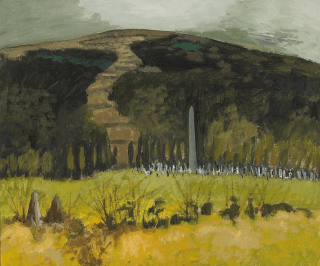
(Pictured: “Glendalough” by Arthur Armstrong, oil on board)
The following year, Doherty comes very close to breaking the Crucible curse, which refers to the fact that every first-time snooker world champion has failed to retain the title the following year. He reaches the final of the 1998 World Snooker Championship where he loses out to John Higgins of Scotland. He reaches his third final at the 2003 World Snooker Championship but is narrowly defeated by Mark Williams of Wales. In other Triple Crown events, he is a three-time UK Championship runner-up (1994, 2001, 2002) and a two-time Masters runner-up (1999, 2000).
An intelligent tactician and prolific break-builder, Doherty has compiled more than 300 century breaks in professional competition. Since 2009, he has combined his playing career with commentating and punditry work.
Doherty currently represents an Irish poker site, appearing on radio commercials, and regularly playing in tournaments, where the players on the site receive a bonus for knocking him out.
In partnership with Sean Francis O’Donoghue and Karl Leon Paul, Doherty set up an online cue sports equipment-marketing company.
Born on May 2, 1951, Dwyer is originally from Saint John’s Park in Tralee, County Kerry. His mother, Mary, outlives him. He has two sisters, Anne and Maria. As a young man in the early 1970s he takes part in the Tralee Film Society, for which he provides notes to The Kerryman. At this time, he is employed by the County Library in Tralee. He begins working for In Dublin followed by the Sunday Tribune and The Sunday Press.
Dwyer first travels to the Cannes Film Festival in 1982 and attends every one until 2009, months before his death. In 1985, he co-founds the Dublin Film Festival and directs it until the mid-1990s. In 2002, he co-founds the Dublin International Film Festival, of which he is the chairman. In later life he serves on the board of the Irish Museum of Modern Art.
In the 1990s, Dwyer presents the film show Freeze Frame for public service broadcaster RTÉ. The show results from a friendship he had formed with Alan Gilsenan and Martin Mahon of Yellow Asylum Films. He is also known for his appearances on the radio shows Morning Ireland and The Marian Finucane Show. The editor of The Irish Times, Geraldine Kennedy, speaking after Dwyer’s death, says he was an “enthusiastic advocate” of both national and international cinema and had once said he was “one of those lucky people in life who was able to pursue his interests and call them work.”
Dwyer becomes unwell following a trip to the Cannes Film Festival in May 2009. He takes a break from writing for The Irish Times, returning in December 2009 to contribute his first, and what is to be his last ever, piece in six months to weekly entertainment supplement The Ticket. The article is a review of cinema in 2009 and of the 2000s, and in his contribution, he references the ill health which had haunted him for much of the previous year and which had prevented him from viewing any cinema releases between June and September.
A ceremony takes place at the Church of the Holy Name in Ranelagh where Dwyer lived. The event is attended by notable politicians, journalists, artists, actors, writers and musicians. RTÉ newsreader Aengus Mac Grianna, a colleague of Jennings, reads a tribute to Dwyer. Daniel Day-Lewis gives a very special tribute at the church service to his dear friend of over 20 years, calling for the Jameson International Dublin Film Festival to be renamed in Dwyer’s honour.
Dwyer is cremated after the funeral on January 5, 2010.
Gifford is the second youngest of 12 children born to Frederick Gifford, a solicitor and a Roman Catholic, and Isabella Julia Burton Gifford, a Protestant. The boys are baptised as Catholics and the girls as Protestant, but effectively the children are all raised as Protestants with the girls attending Alexandra College in Earlsfort Terrace.
Gifford returns to Dublin in 1908 and, with great difficulty, tries to earn a living as a caricaturist, publishing her cartoons in The Shanachie, Irish Life, Meadowstreet and The Irish Review, which is edited from 1913 by Joseph Plunkett. She considers emigrating but gives up the idea. Nora Dryhurst, a journalist from London, brings her to the opening of the new bilingual school Scoil Éanna in Ranelagh, Dublin. It is here that she meets Plunkett for the first time. He is a friend of her brother-in-law, another of the future leaders of the 1916 Easter Rising, Thomas MacDonagh, who is married to her sister Muriel.
Gifford’s growing interest in the Roman Catholic religion leads to the deepening of Gifford and Plunkett’s relationship as she begins to discuss Catholic mystical ideas with him. Plunkett proposes to her in 1915, and she accepts and takes formal instruction in Catholic doctrine. She is received into the Catholic Church in April 1916. The couple plans to marry on Easter Sunday that year, in a double wedding with his sister and her fiancé.
After the Rising, Gifford’s brother-in-law Thomas MacDonagh is shot with Patrick Pearse and Thomas Clarke by firing squad on May 3. That day, she hears that Plunkett is to be shot at dawn. She purchases a ring in a jeweler’s shop in Dublin and, with the help of a priest, persuades the military authorities to allow them to marry. She and Joseph are married on the night of May 3 in the chapel of Kilmainham Gaol, a few hours before he is executed.
Grace Plunkett decides to devote herself through her art to the promotion of Sinn Féin policies and resumes her commercial work to earn a living. She is elected to the Sinn Féin executive in 1917.
During the Irish Civil War, Plunkett is arrested with many others in February 1923 and interned at Kilmainham Gaol for three months. She paints pictures on the walls of her cell, including one of the Blessed Virgin and the Christ Child. She is released in May 1923.
When the Civil War ends, Plunkett has no home of her own and little money. Like many Anti-Treaty Republicans, she is the target of social ostracism and has difficulty finding work. Her talent as an artist is her only real asset and her cartoons are published in various newspapers and magazines. She moves from one apartment to another and eats in the city-centre restaurants but has no wish to remarry. Her material circumstances improve in 1932 when she receives a Civil List pension from Éamon de Valera‘s Fianna Fáil government. She lives for many years in a flat in Nassau Street with a balcony overlooking the sports ground of Trinity College.
Plunkett’s in-laws refuse to honour her husband’s will, in which he leaves everything to his widow. Legally, the will is invalid because there is only one witness, rather than the required two, and the marriage takes place after the will is made, automatically revoking it. For years she receives nothing, so she begins legal proceedings against her in-laws in 1934. The Count and Countess Plunkett settle out of court, and she is paid £700, plus costs.
At around this time Plunkett joins the Old Dublin Society, where she meets the noted Irish harpsichord maker Cathal Gannon. When Cathal marries, she gives him and his wife Margaret a present of two single beds and a picture. From the late 1940s onwards, her health declines. In 1950 she is brought to St. Vincent’s Hospital. She convalesces in a nursing home, which she does not like, mainly because it restricts her freedom.
Grace Gifford Plunkett dies suddenly on December 13, 1955, in her apartment in South Richmond Street, Portobello. Her body is removed to St. Kevin’s Church, Harrington Street and among the attendees at her funeral is PresidentSeán T. O’Kelly. She is buried with full military honours close to the republican plot in Glasnevin Cemetery.
Maureen O’Hara, Irish actress and singer, dies peacefully in her sleep at her home in Boise, Idaho on October 24, 2015. The famously red-headed O’Hara is known for her beauty and playing fiercely passionate but sensible heroines, often in westerns and adventure films. She works on numerous occasions with director John Ford and longtime friend John Wayne and is one of the last surviving stars from the Golden Age of Hollywood.
O’Hara is born Maureen FitzSimons on August 17, 1920, in Ranelagh, County Dublin and grows up in an “eccentric” devout Catholic family and aspires to become an actress from a very young age. She trains with the Rathmines Theatre Company from the age of 10 and at the Abbey Theatre from the age of 14. She is given a screen test, which is deemed unsatisfactory, but Charles Laughton sees potential and arranges for her to co-star with him in Alfred Hitchcock‘s Jamaica Inn in 1939. She moves to Hollywood the same year to appear with him in the production of The Hunchback of Notre Dame and is given a contract by RKO Pictures. From there, she goes on to enjoy a long and highly successful career, and acquires the nickname “The Queen of Technicolor,” which she detests, believing that people see her only for her beauty rather than talent.
O’Hara appears in her first film with John Wayne, the actor with whom she is most closely associated, with Rio Grande (1950). This is followed by The Quiet Man (1952), her best-known film, and The Wings of Eagles (1957), by which time her relationship with Ford has deteriorated. Such is her strong chemistry with Wayne that many assume they are married or in a relationship. In the 1960s O’Hara increasingly turns to more motherly roles as she ages, appearing in films such as The Deadly Companions (1961), The Parent Trap (1961), and The Rare Breed (1966).
O’Hara retires from the industry in 1971 after starring with Wayne one final time in Big Jake but returns 20 years later to appear with John Candy in Only the Lonely (1991). In the late 1970s, O’Hara helps run her third husband’s flying business in St. Croix in the American Virgin Islands, and edits a magazine, but later sells them to spend more time in Glengariff in Ireland. She is married three times and has one daughter, Bronwyn, born in 1944 to her second husband.
Her autobiography, ‘Tis Herself, is published in 2004 and becomes a New York Times Bestseller. In November 2014, she is presented with an Honorary Academy Award with the inscription “To Maureen O’Hara, one of Hollywood’s brightest stars, whose inspiring performances glowed with passion, warmth and strength.”
Maureen O’Hara dies of natural causes in her sleep at the age of 95 on October 24, 2015, at her home in Boise, Idaho. O’Hara is buried at Arlington National Cemetery in Virginia next to her late husband Charles F. Blair, Jr.






 seamus dubhghaill