Craig is born at Sydenham, Belfast, on January 8, 1871, the seventh of nine children of James Craig (1828–1900), a wealthy whiskey distiller who had entered the firm of Dunville & Co. as a clerk and by age 40 is a millionaire and a partner in the firm. Craig Snr. owns a large house called Craigavon, overlooking Belfast Lough. His mother, Eleanor Gilmore Browne, is the daughter of Robert Browne, a prosperous man who owned property in Belfast and a farm outside Lisburn. Craig is educated at Merchiston Castle School in Edinburgh, Scotland. After school he begins work as a stockbroker, eventually opening his own firm in Belfast.
Craig enlists in the 3rd (Militia) battalion of the Royal Irish Rifles on January 17, 1900, to serve in the Second Boer War. He is seconded to the Imperial Yeomanry, a cavalry force created for service during the war, as a lieutenant in the 13th battalion on February 24, 1900, and leaves Liverpool for South Africa on the SS Cymric in March 1900. After arrival he is soon sent to the front and is taken prisoner in May 1900, but released by the Boers because of a perforated colon. On his recovery he becomes deputy assistant director of the Imperial Military Railways, showing the qualities of organisation that are to mark his involvement in both British and Ulster politics. In June 1901 he is sent home suffering from dysentery, and by the time he is fit for service again the war is over. He is promoted to captain in the 3rd Royal Irish Rifles on September 20, 1902, while still seconded to South Africa.
On June 7, 1921, Craig is appointed the first Prime Minister of Northern Ireland by the Lord Lieutenant of Ireland. The House of Commons of Northern Ireland assembles for the first time later that day.
Craig had made his career in British as well as Northern Irish politics, but his premiership shows little sign of his earlier close acquaintance with the British political world. He becomes intensely parochial and suffers from his loss of intimacy with British politicians in 1938, when the British government concludes agreements with Dublin to end the Anglo-Irish trade war between the two countries. He never tries to persuade Westminster to protect Northern Ireland‘s industries, especially the linen industry, which is central to its economy. He is anxious not to provoke Westminster, given the precarious state of Northern Ireland’s position. In April 1939, and again in May 1940 during World War II, he calls for conscription to be introduced in Northern Ireland (which the British government, fearing a backlash from nationalists, refuses). He also calls for Winston Churchill to invade Ireland using Scottish and Welsh troops in order to seize the valuable ports and install a Governor-General at Dublin.
While still prime minister, Craig dies peacefully at his home at Glencraig, County Down at the age of 69 on November 24, 1940. He is buried on the Stormont Estate on December 5, 1940, and is succeeded as the Prime Minister of Northern Ireland by the Minister of Finance, J. M. Andrews.
(Pictured: James Craig, 1st Viscount Craigavon, bromide print by Olive Edis, National Portrait Gallery, London)
In 1973, the Provisional Irish Republican Army (IRA) extends its campaign to mainland Britain, attacking military and symbolically important targets to both increase pressure on the British government, via popular British opinion, to withdraw from Northern Ireland and to maintain morale amongst their supporters. By 1974, mainland Britain sees an average of one attack — successful or otherwise — every three days.
In the early evening hours of November 21, at least three bombs connected to timing devices are planted inside two separate public houses and outside a bank located in and around central Birmingham. It is unknown precisely when these bombs were planted. If official IRA protocol of preceding attacks upon non-military installations with a 30-minute advance warning to security services is followed, and subsequent eyewitness accounts are accurate, the bombs would have been planted at these locations after 7:30 p.m. and before 7:47 p.m.
According to testimony delivered at the 1975 trial of the six men wrongly convicted of the bombings, the bomb planted inside the Mulberry Bush pub is concealed inside either a duffel bag or briefcase, whereas the bomb planted inside the Tavern in the Town is concealed inside a briefcase or duffel bag (possibly concealed within a large, sealed plastic bag) and Christmas cracker boxes. The remnants of two alarm clocks recovered from the site of each explosion leaves the possibility that two bombs had been planted at each public house. The explosion crater at each location indicates that if two bombs had been planted at each public house, they would each have been placed in the same location and likely the same container.
Reportedly, those who plant the bombs then walk to a preselected phone box to telephone the advance warning to security services. However, the phone box has been vandalised, forcing the caller to find an alternative phone box and thus shortening the amount of time police have to clear the locations.
At 8:11 p.m., an unknown man with a distinct Irish accent telephones the Birmingham Post newspaper. The call is answered by operator Ian Cropper. The caller says, “There is a bomb planted in the Rotunda and there is a bomb in New Street at the tax office. This is Double X,” before terminating the call. (“Double X” is an IRA code word given to authenticate any warning call.) A similar warning is also sent to the Birmingham Evening Mail newspaper, with the anonymous caller again giving the code word, but again failing to name the public houses in which the bombs had been planted.
The Rotunda is a 25-story office block, built in the 1960s, that houses the Mulberry Bush pub on its lower two floors. Within minutes of the warning, police arrive and begin checking the upper floors of the Rotunda, but they do not have sufficient time to clear the crowded pub at street level. At 8:17 p.m., six minutes after the first telephone warning had been delivered to the Birmingham Post, the bomb, which had been concealed inside either a duffel bag or briefcase located ner the rear entrance to the premises, explodes, devastating the pub. The explosion blows a 40-inch crater in the concrete floor, collapsing part of the roof and trapping many casualties beneath girders and concrete blocks. Many buildings near the Rotunda are also damaged, and pedestrians in the street are struck by flying glass from shattered windows. Several of the victims die at the scene, including two youths who had been walking past the premises at the moment of the explosion.
Ten people are killed in this explosion and dozens are injured, including many who lose limbs. Several casualties are impaled by sections of wooden furniture while others have their clothes burned from their bodies. A paramedic called to the scene of this explosion later describes the carnage as being reminiscent of a slaughterhouse. One fireman says that, upon seeing a writhing, “screaming torso,” he begs police to allow a television crew inside the premises to film the dead and dying at the scene, in the hope the IRA would see the consequences of their actions. However, the police refuse this request, fearing the reprisals would be extreme.
The Tavern in the Town is a basement pub on New Street located a short distance from the Rotunda and directly beneath the New Street Tax Office. Patrons there hear the explosion at the Mulberry Bush, but do not believe that the sound, described by one survivor as a “muffled thump,” is an explosion.
Police have begun attempting to clear the Tavern in the Town when, at 8:27 p.m., a second bomb explodes there. The blast is so powerful that several victims are blown through a brick wall. Their remains are wedged between the rubble and live underground electric cables that supply the city centre. One of the first police officers on the scene, Brian Yates, later testifies that the scene which greeted his eyes was “absolutely dreadful,” with several of the dead stacked upon one another, others strewn about the ruined pub, and several screaming survivors staggering aimlessly amongst the debris, rubble, and severed limbs. A survivor says the sound of the explosion is replaced by a “deafening silence” and the smell of burned flesh.
Rescue efforts at the Tavern in the Town are initially hampered as the bomb had been placed at the base of a set of stairs descending from the street, the sole entrance to the premises, had been destroyed in the explosion. The victims whose bodies are blown through a brick wall and wedged between the rubble and underground electric cables take up to three hours to recover, as recovery operations are delayed until the power can be isolated. A passing West Midlands bus is also destroyed in the blast.
This bomb kills nine people outright, and injures everyone in the pub, many severely. Two later die of their injuries. After the second explosion, police evacuate all pubs and businesses in Birmingham city centre and commandeer all available rooms in the nearby City Centre Hotel as an impromptu first-aid post. All bus services into the city centre are halted, and taxi drivers are encouraged to transport those lightly injured in the explosions to hospital. Prior to the arrival of ambulances, rescue workers remove critically injured casualties from each scene upon makeshift stretchers constructed from devices such as tabletops and wooden planks. These severely injured casualties are placed on the pavement and given first aid prior to the arrival of ambulance services.
At 9:15 p.m., a third bomb, concealed inside two plastic bags, is found in the doorway of a Barclays Bank on Hagley Road, approximately two miles from the site of the first two explosions. This device consists of 13.5 pounds of Frangex connected to a timer and is set to detonate at 11:00 p.m. The detonator to the device activates when a policeman prods the bags with his truncheon, but the bomb does not explode. The device is destroyed in a controlled explosion early the following morning.
The bombings stoke considerable anti-Irish sentiment in Birmingham, which then has an Irish community of 100,000. Irish people are ostracised from public places and subjected to physical assaults, verbal abuse and death threats. Both in Birmingham and across England, Irish homes, pubs, businesses and community centres are attacked, in some cases with firebombs. Staff at thirty factories across the Midlands go on strike in protest of the bombings, while workers at airports across England refuse to handle flights bound for Ireland. Bridget Reilly, the mother of the two Irish brothers killed in the Tavern in the Town explosion, is herself refused service in local shops.
The bombings are immediately blamed on the IRA, despite the organisation not having claimed responsibility. Due to anger against Irish people in Birmingham after the bombings, the IRA Army Council places the city “strictly off-limits” to IRA active service units. In Northern Ireland, loyalist paramilitaries launch a wave of revenge attacks on Irish Catholics and within two days of the bombings, five Catholic civilians have been shot dead by loyalists. The Provisional IRA never officially admits responsibility for the Birmingham pub bombings.
Six Irishmen are arrested within hours of the blasts and in 1975 are sentenced to life imprisonment for the bombings. The men, who become known as the Birmingham Six, maintain their innocence and insist police had coerced them into signing false confessions through severe physical and psychological abuse. After 16 years in prison, and a lengthy campaign, their convictions are declared unsafe and unsatisfactory, and quashed by the Court of Appeal in 1991. The episode is seen as one of the worst miscarriages of justice in British legal history.
In 2001, each of the Birmingham Six is subsequently paid between £840,000 and £1.2 million in compensation.
(Pictured: The Mulberry Bush pub after the November 21, 1974, bombing)
The Darkley killings or Darkley massacre is a gun attack carried out on November 20, 1983, near the village of Darkley, County Armagh, Northern Ireland. Three gunmen attack worshippers attending a church service at Mountain Lodge Pentecostal Church, killing three Protestant civilians and wounding seven. The attackers are rogue members of the Irish National Liberation Army (INLA). They claim responsibility using the cover name “Catholic Reaction Force,” saying it is retaliation for recent sectarian attacks on Catholics by the loyalist Protestant Action Force (PAF). The attack is condemned by INLA leadership.
In the months before the Darkley killings, several Catholic civilians are killed by loyalists. On October 29, 1983, a Catholic civilian member of the Workers’ Party, David Nocher (26), is shot dead in Belfast. On November 8, Catholic civilian Adrian Carroll (24) is shot dead in Armagh. Ulster Defence Regiment (UDR) personnel are later convicted but the convictions are cleared on appeal for three of them (see UDR Four case). Carroll is the brother of an INLA member who was killed a year earlier. These attacks are claimed by the Protestant Action Force, a cover name used mostly by members of the Ulster Volunteer Force (UVF). It is believed the Darkley killings are primarily a retaliation for the killing of Carroll.
On the evening of Sunday, November 20, about sixty people are attending a church service at Mountain Lodge Pentecostal Church. The small, isolated wooden church is outside the village of Darkley, near the border with the Republic of Ireland and several miles from Armagh. As the service begins, three masked gunmen arrive, at least one of whom is armed with a Ruger semi-automatic rifle, and open fire on those standing in the entrance. Three church elders are killed: Harold Browne (59), Victor Cunningham (39) and David Wilson (44). The fatally wounded Wilson staggers into the service, where he collapses and dies. The gunmen then stand outside the building and spray it with bullets, wounding an additional seven people before fleeing in a car. The service is being tape-recorded when the attack takes place. On the tape, the congregation can be heard singing the hymn “Are You Washed in the Blood of the Lamb,” followed by the sound of gunfire. All of the victims are Protestant civilians.
In a telephone call to a journalist, a caller claims responsibility for the attack on behalf of the “Catholic Reaction Force.” He says it is “retaliation for the murderous sectarian campaign carried out by the Protestant Action Force” and adds, “By this token retaliation we could easily have taken the lives of at least 20 more innocent Protestants. We serve notice on the PAF to call an immediate halt to their vicious indiscriminate campaign against innocent Catholics, or we will make the Darkley killings look like a picnic.” The caller names nine Catholics who had been attacked.
The name “Catholic Reaction Force” had never been used before and police say they believe the attack is carried out by members of the INLA. The INLA condemn the attack and deny direct involvement, but say it is investigating the involvement of INLA members or weapons. A week later, INLA leader Dominic McGlinchey admits that one of the gunmen had been an INLA member and admits supplying him with the gun but says there is no justification for the attack. The INLA member’s brother had been killed by loyalists. McGlinchey explains that the INLA member had asked him for a gun to shoot a known loyalist who had been involved in sectarian killings. However, “clearly deranged by the death of his brother,” he “used it instead to attack the Darkley Gospel Hall.” McGlinchey says, “he must have been unbalanced or something to have gone and organised this killing. We are conducting an inquiry.”
There are reprisal sectarian attacks on Catholics in North Belfast, Lisburn, and Portadown within 24 hours of the Darkley massacre. On December 5, fifteen days after the Darkley attack, the PAF shoot dead INLA member Joseph Craven (26) in Newtownabbey.
The name “Catholic Reaction Force” is used several other times. In August 1984, it is used to issue a threat to newspapers against the families of Royal Ulster Constabulary (RUC) officers, after Sean Downes, a Catholic man, dies after the RUC shot him with a plastic bullet during an anti-internment march on the Andersontown Road, Belfast. In May 1986, it is used to claim the killing of Protestant civilian David Wilson (39), who is shot while driving his firm’s van in Donaghmore. The Irish Republican Army (IRA) also claims responsibility, saying Wilson was a member of the UDR. The “Catholic Reaction Force” declares a ceasefire on October 28, 1994. In 2001, the name is used to claim two attacks on homes in which there are no injuries, and in 2002 is used to issue a threat to hospital workers suspected of links to the security forces.
(Pictured: The Mountain Lodge Pentecostal Church at Aughnagurgan outside Darkley, County Armagh, Northern Ireland)
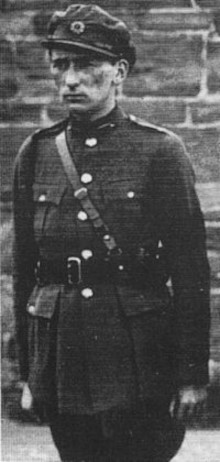
Tobin is the eldest son of Mary Agnes (nee Butler) and David Tobin, a hardware clerk. He has two younger siblings, Katherine and Nicholas Augustine Tobin, also born in Cork. His family moves to John Street in Kilkenny and then to Dublin. He goes to school in Kilkenny and is an apprentice in a hardware shop at the time of the 1916 Easter Rising. As a participant in the Rising, he fights in the Four Courts garrison under Edward Daly. He is arrested, court martialed, and sentenced to death but his sentence is commuted to life imprisonment. He is a prisoner in Kilmainham, Mountjoy, Lewes, Dartmoor, Broadmoor and Pentonville prisons. He is released in June 1917.
In October 1921, Tobin travels with the Irish Treaty Delegation as part of Collins’ personal staff.
Tim Pat Coogan and James Mackay have examined Tobin’s involvement in the assassination of British Field MarshalSir Henry Wilson. Wilson’s public tirades about Collins is evidence of mutual personal dislike between the two men. In May 1922 Collins tells Tobin “We’ll kill a member of that bunch” to the news of “bloody pogroms” in Belfast. Wilson is intimately involved with the Ulster loyalist cause, including the Curragh Mutiny and the establishment of the Ulster Special Constabulary. Just before the shooting, Coogan places Tobin in London. He meets courier Peig Ni Braonain at Euston Station collecting a document that has been sent from Dublin. Returning to Dublin before the incident, he is jubilant when he tells defence ministerRichard Mulcahy about Wilson’s death. Mulcahy is appalled and threatens to resign.
In October 1922, Tobin’s brother Nicholas, a Free State captain, is accidentally shot dead by his own troops during the raid and capture of a bomb making factory at number 8 Gardiner’s Place, Dublin.
Tobin believes in the steppingstone doctrine which sees the Treaty as a stage towards full independence. With the outbreak of the Irish Civil War he remains loyal to Collins and takes the Pro-Treaty side. He leads in the fight against the Anti-Treaty IRA in the south. Disillusioned with the continuing hostilities and in the aftermath of the death of Collins, he forms an association called the IRA Organisation (IRAO) or “Old Irish Republican Army” to distinguish themselves from the anti-treaty insurgents.
Richard Mulcahy, the new Irish defence minister, proposes to reduce the army from 55,000 to 18,000 men in the immediate post- Civil-War period. Tobin knows his own position is to be affected and shares the perception that the Irish Army treats former British officers better than former IRA officers. On March 7, 1924, Tobin, together with Colonel Charlie Dalton, sends an ultimatum to President of the Executive Council of the Irish Free StateW. T. Cosgrave demanding an end to the army demobilisation. The immediate response is an order for the arrest of the two men on a charge of mutiny. The cabinet, already wary of the Irish Army, orders an inquiry and appoints Garda CommissionerEoin O’Duffy to the army command.
On March 18, the mutineers assemble with hostile intent at a Dublin pub. An order is made to arrest the mutineers and the cabinet demands the resignation of the army council. The generals resign, affirming the subservience of the military to the civilian government of the new state.
In later years, Tobin rebuilds relations with his Civil War foes and joins Éamon de Valera‘s Anti-Treaty Fianna Fáil party. He joins up with Joseph McGrath to form the Irish Hospitals’ Sweepstake in the 1930s. Many other former army comrades find work in this lottery. He leaves the Sweep in 1938. After World War II, he becomes Superintendent of the Oireachtas for the Irish Dáil.
On October 14, 1929, Tobin marries Monica “Mona” Higgins at the Church of the Holy Family, Aughrim Street, Dublin. They have two daughters, Máire and Anne Tobin. Following the death of his father, David, in 1956, Tobin’s health declines, resulting in his death in Dublin on April 30, 1963.
Ó Brádaigh is born into a middle-class republican family. His father, Matt Brady, is an IRA volunteer who is severely wounded in an encounter with the Royal Irish Constabulary (RIC) in 1919. His mother, May Caffrey, is a Cumann na mBan volunteer and a 1922 graduate of University College Dublin (UCD). His father dies when he is ten and is given a paramilitary funeral led by his former IRA colleagues. His mother, prominent as the Secretary for the County Longford Board of Health, lives until 1974. He is educated at Melview National School at primary level and attends secondary school at St. Mel’s College, leaving in 1950, and graduates from University College Dublin in 1954. That year he takes a job teaching Irish language at Roscommon Vocational School in Roscommon. He is a deeply religious Catholic who refrains from smoking or drinking.
Ó Brádaigh joins Sinn Féin in 1950. While at university, in 1951, he joins the Irish Republican Army. In September 1951, he marches with the IRA at the unveiling of the Seán Russell monument in Fairview Park, Dublin. A teacher by profession, he is also a Training Officer for the IRA. In 1954, he is appointed to the Military Council of the IRA, a subcommittee set up by the IRA Army Council in 1950 to plan a military campaign against Royal Ulster Constabulary (RUC) barracks in Northern Ireland.
On August 13, 1955, Ó Brádaigh leads a ten-member IRA group in an arms raid on Hazebrouck Barracks, near Arborfield, Berkshire, England, a depot for the No. 5 Radar Training Battalion of the Royal Electrical and Mechanical Engineers. It is the biggest IRA arms raid in Britain. Most, if not all, of the weapons are recovered in a relatively short period of time. A van, traveling too fast, is stopped by the police and IRA personnel are arrested. Careful police work leads to weapons that had been transported in a second van and stored in London.
The IRA Border Campaign commences on December 12, 1956. As an IRA General Headquarters Staff (GHQ) officer, Ó Brádaigh is responsible for training the Teeling Column in the west of Ireland. During the Campaign, he serves as second-in-command of the Teeling Column. On December 30, 1956, he partakes in the Teeling Column attack on RUC barracks in Derrylin, County Fermanagh. RUC Constable John Scally is killed in the attack and is the first fatality of the new IRA campaign. Ó Brádaigh and others are arrested by the Garda Síochána across the border in County Cavan the day after the attack. They are tried and jailed for six months in Mountjoy Prison. A leading abstentionist, upon his arrest he refuses to recognize the authority of the Irish government and refuses to renounce violence in exchange for his release.
Upon completing his prison sentence, Ó Brádaigh is immediately interned at the Curragh Camp along with other republicans. On September 27, 1958, he escapes from the camp along with Dáithí Ó Conaill. While a football match is in progress, the pair cuts through a wire fence and escapes from the camp under a camouflage grass blanket. This is an official escape, authorised by the officer commanding (OC) of the IRA internees, Tomás Óg Mac Curtain. He is the first Sinn Féin TD on the run since the 1920s.
In October 1958, Ó Brádaigh becomes the IRA Chief of Staff, a position he holds until May 1959, when Seán Cronin is elected as his replacement. He is arrested in November 1959, refuses to answer questions, and is jailed in Mountjoy Prison under the Offences against the State Act. He is released in May 1960 and, after Cronin is arrested, again becomes Chief of Staff. Although he always emphasises that it is a collective declaration, he is the primary author of the statement ending the IRA Border Campaign in 1962. At the IRA 1962 Convention he indicates that he is not interested in continuing as Chief of Staff.
After Ó Brádaigh’s arrest in December 1956, he takes a leave from teaching at Roscommon Vocational School. He is re-instated and begins teaching again in late 1962, just after he is succeeded by Cathal Goulding in the position of Chief of Staff of the IRA. He remains an active member of Sinn Féin and is also a member of the IRA Army Council throughout the decade.
Ó Brádaigh opposes the decision of the IRA and Sinn Féin to drop abstentionism and to recognise the Westminster parliament in London, the Stormont parliament in Belfast and the Leinster House parliament in 1969/1970. On January 11, 1970, along with Seán Mac Stíofáin, he leads the walkout from the 1970 Sinn Féin Ard Fheis after the majority votes to end the policy of abstentionism, although the vote to change the Sinn Féin constitution fails to receive the required two-thirds majority. The delegates who walk out reconvene at the Kevin Barry Hall in Parnell Square, Dublin, and establish Provisional Sinn Féin.
Ó Brádaigh is voted chairman of the Caretaker Executive of Provisional Sinn Féin. That October, he formally becomes president of the party. He holds this position until 1983. In his presidential address to the 1971 Provisional Sinn Féin Ard Fheis, he says that the first step to achieving a United Ireland is to make Northern Ireland ungovernable. He apparently also serves on the Army Council or the executive of the Provisional Irish Republican Army until he is seriously injured in a car accident on January 1, 1984.
On May 31, 1972, Ó Brádaigh is arrested under the Offences Against the State Act and immediately commences a hunger strike. A fortnight later the charges against him are dropped and he is released. With Dáithí Ó Conaill he develops the Éire Nua policy, which is launched on June 28, 1972. The policy calls for a federal Ireland.
On December 3, 1972, Ó Brádaigh appears on the London Weekend TelevisionWeekend World programme. He is arrested by the Gardaí again on December 29, 1972, and charged in the newly established Special Criminal Court with Provisional IRA membership. In January 1973 he is the first person convicted under the Offences Against the State (Amendment) Act 1972 and is sentenced to six months in the Curragh Camp.
On December 10, 1974, Ó Brádaigh participates in the Feakle talks between the IRA Army Council and Sinn Féin leadership and the leaders of the Protestant churches in Ireland. Although the meeting is raided and broken up by the Gardaí, the Protestant churchmen pass on proposals from the IRA leadership to the British government. These proposals call on the British government to declare a commitment to withdraw, the election of an all-Ireland assembly to draft a new constitution and an amnesty for political prisoners.
The IRA subsequently calls a “total and complete” ceasefire intended to last from December 22, 1974, to January 2, 1975, to allow the British government to respond to proposals. British government officials also hold talks with Ó Brádaigh in his position as president of Sinn Féin from late December to January 17, 1975.
On February 10, 1975, the IRA Army Council, unanimously endorses an open-ended cessation of IRA “hostilities against Crown forces,” which becomes known as the 1975 truce. The IRA Chief of Staff at the time is Seamus Twomey of Belfast. It is reported in some quarters that the IRA leaders mistakenly believe they had persuaded the British Government to withdraw from Ireland and the protracted negotiations between themselves and British officials are the preamble to a public declaration of intent to withdraw. In fact, as British government papers now show, the British entertain talks with the IRA in the hope that this would fragment the movement further and score several intelligence coups during the talks. This bad faith embitters many in the republican movement, and another ceasefire does not happen until 1994.
In late December 1976, along with Joe Cahill, Ó Brádaigh meets two representatives of the Ulster Loyalist Central Co-ordinating Committee (ULCCC), John McKeague and John McClure, at the request of the latter body. Their purpose is to try to find a way to accommodate the ULCCC proposals for an independent Northern Ireland with the Sinn Féin’s Éire Nua programme. It is agreed that if this can be done, a joint Loyalist-Republican approach can then be made to request the British government to leave Ireland. Desmond BoalQC and Seán MacBrideSC are requested and accepted to represent the loyalist and republican positions. For months they have meetings in various places including Paris. The dialogue eventually collapses when Conor Cruise O’Brien, then Minister for Posts and Telegraphs and vociferous opponent of the Provisional IRA, becomes aware of it and condemns it on RTÉ Radio. As the loyalists had insisted on absolute secrecy, they feel unable to continue with the talks as a result.
In the aftermath of the 1975 truce, the Ó Brádaigh/Ó Conaill leadership comes under severe criticism from a younger generation of activists from Northern Ireland, headed by Gerry Adams, who becomes a vice-president of Sinn Féin in 1978. By the early 1980s, Ó Brádaigh’s position as president of Sinn Féin is openly under challenge and the Éire Nua policy is targeted in an effort to oust him. The policy is rejected at the 1981 Sinn Féin Ard Fheis and finally removed from the Sinn Féin constitution at the 1982 Ard Fheis. At the following year’s Ard Fheis, Ó Brádaigh and Ó Conaill resign from their leadership positions, voicing opposition to the dropping of the Éire Nua policy by the party.
On November 2, 1986, the majority of delegates to the Sinn Féin Ard Fheis vote to drop the policy of abstentionism if elected to Dáil Éireann, but not the British House of Commons or the Northern Ireland parliament at Stormont, thus ending the self-imposed ban on Sinn Féin elected representatives from taking seats at Leinster House. Ó Brádaigh and several supporters walk out and immediately assemble at Dublin’s West County Hotel and set up Republican Sinn Féin (RSF). As an ordinary member, he had earlier spoken out against the motion (resolution 162) in an impassioned speech. The Continuity IRA becomes publicly known in 1996. Republican Sinn Féin’s relationship with the Continuity IRA is similar to the relationship between Sinn Féin and the Provisional IRA when Ó Brádaigh was Sinn Féin’s president.
Ó Brádaigh believes RSF to be the sole legitimate continuation of the pre-1986 Sinn Féin, arguing that RSF has kept the original Sinn Féin constitution. RSF readopts and enhances his Éire Nua policy. His party has electoral success in only a few local elections.
Ó Brádaigh remains a vociferous opponent of the Good Friday Agreement, viewing it as a programme to copperfasten Irish partition and entrench sectarian divisions in the north. He condemns his erstwhile comrades in Provisional Sinn Féin and the Provisional IRA for decommissioning weapons while British troops remain in the country. In his opinion, “the Provo sell-out is the worst yet – unprecedented in Irish history.” He condemns the Provisional IRA’s decision to seal off a number of its arms dumps as “an overt act of treachery,” “treachery punishable by death” under IRA General Army Order Number 11.
In July 2005, Ó Brádaigh hands over a portion of his personal political papers detailing discussions between Irish Republican leaders and representatives of the British Government during 1974–1975 to the James Hardiman Library, National University of Ireland, Galway.
In September 2009, Ó Brádaigh announces his retirement as leader of Republican Sinn Féin. His successor is Des Dalton. He is also a long-standing member of the Celtic League, an organization which fosters cooperation between the Celtic people and promotes the culture, identity and eventual self-determination for the people, in the form of six sovereign states, for the Celtic nations – Wales, Cornwall, Brittany, Scotland, Isle of Man and Ireland.
After suffering a period of ill-health, Ó Brádaigh dies on June 5, 2013, at Roscommon County Hospital. His funeral is attended by 1,800 mourners including Fine Gael TD Frank Feighan and is policed by the Garda Emergency Response Unit and Gardaí in riot gear, for “operational reasons,” a show of force believed to have been to deter the republican tradition of firing a three-volley salute of shots over the final place of rest during the graveyard oration. As a result, there are some minor scuffles between gardai and mourners.
McCorley is one of three children born to Roger Edmund McCorley, a meat carver in a hotel, and Agnes Liggett. He has two elder brothers, Vincent and Felix. He joins the Fianna in his teens. His family has a very strong republican tradition, and he claims to be the great-grandson of the United Irishmen folk hero Roddy McCorley, who was executed for his part in the Irish Rebellion of 1798.
McCorley is noted for his militancy, as he is in favour of armed attacks on British forces in Belfast. The Brigade’s leaders, by contrast, in particular, Joe McKelvey, are wary of sanctioning attacks for fear of loyalist reprisals on republicans and the Catholic population in general. In addition, McCorley is in favour of conducting an armed defense of Catholic areas, whereas McKelvey does not want the IRA to get involved in what he considers to be sectarian violence. McCorley writes later that in the end, “the issue settled itself within a very short space of time, when the Orange mob was given uniforms, paid for by the British, and called the Ulster Special Constabulary (USC).” The role of the USC, a temporary police force raised for counter-insurgency purposes, in the conflict is still debated, but republicans maintain that the organization was responsible for the indiscriminate killings of Catholics and nationalists.
On January 26, 1921, McCorley, is involved in the fatal shooting of three Auxiliary Division officers in their beds in the Railway View hotel in central Belfast. Shortly afterwards, he and another IRA man, Seamus Woods, organize an active service unit (ASU) within the first battalion of the Belfast Brigade, with the intention of carrying out attacks, with or without the approval of the Brigade leadership. The unit consists of 32 men. McCorley later writes, “I issued a general order that, where reprisal gangs [State forces] were cornered, no prisoners were to be taken.” In March 1921, he personally leads the ASU in the killing of three Black and Tans in Victoria Street in central Belfast. He is responsible for the deaths of two more Auxiliaries in Donegall Place in April. In reprisal for these shootings, members of the RIC assassinate two republican activists, the Duffin brothers in Clonard Gardens in west Belfast. On June 10, 1921, both and Woods and McCorley units are involved in the killing a RIC man who is suspected in the revenge killings of the Duffin brothers. Two RIC men and a civilian are also wounded in that attack.
Thereafter, there is what historian Robert Lynch has described as a “savage underground war” between McCorley’s ASU and RIC personnel based in Springfield Road barracks and led by an Inspector Ferris. Ferris is accused of murdering the Lord Mayor of Cork Thomas MacCurtain and had been posted to Lisburn for his safety. Ferris himself is among the casualties, being shot in the chest and neck, but surviving. McCorley claims to have been one of the four IRA men who shot Ferris. In addition, his men bomb and burn a number of businesses including several cinemas and a Reform Club. In May 1921, however, thirteen of his best men are arrested when surrounded by British troops during an operation in County Cavan. They are held in Crumlin Road Gaol and sentenced to death.
On June 3, McCorley organizes an attack on Crumlin Road Gaol in an attempt to rescue the IRA men held there before they are executed. The operation is not a success; however, the condemned men are reprieved after a truce is agreed between the IRA and British forces in July 1921. On Bloody Sunday (July 10, 1921), he is a major leader in the defense of nationalist areas from attacks by both the police and loyalists. On that day twenty people are killed before he negotiates a truce beginning at noon on July 11. At least 100 people are wounded, about 200 houses are destroyed or badly damaged – most of them Catholic homes, leaving 1,000 people homeless.
In April 1922, McCorley becomes leader of the IRA Belfast Brigade after Joe McKelvey goes south to Dublin to join other IRA members who are against the Anglo-Irish Treaty. With McKelvey’s departure, Seamus Woods becomes Officer Commanding of the IRA’s 3rd Northern Division, which has up to 1,000 members, with McCorley designated as Vice Officer Commanding. McCorley for his part, supports the Treaty, despite the fact that it provides for the partition of Ireland and the continued British rule in Northern Ireland. The reason for this is that Michael Collins and Eoin O’Duffy have assured him that this is only a tactical move and indeed, Collins sends men, money and weapons to the IRA in the North throughout 1922.
However, McCorley’s command sees the collapse of the Belfast IRA. In May 1922, the IRA launches an offensive with attacks all across Northern Ireland. In Belfast, he carries out an assault on Musgrave Street RIC barracks. He also conducts an arson campaign on businesses in Belfast. His men also carry out a number of assassinations, including that of Ulster Unionist PartyMPWilliam J. Twaddell, which causes the internment of over 200 Belfast IRA men.
To escape from the subsequent repression, McCorley and over 900 Northern IRA men flee south, to the Irish Free State, where they are housed in the Curragh. McCorley is put in command of these men. In June 1922, the Irish Civil War breaks out between Pro and Anti-Treaty elements of the IRA. He takes the side of the Free State and Michael Collins. After Collins is killed in August 1922, his men are stood down. About 300 of them join the National Army and are sent to County Kerry to put down anti-Treaty guerrillas there. In the Spring of 1923, bitterly disillusioned by the brutal counterinsurgency against fellow republicans, he resigns his command.
McCorley later asserts that he “hated the Treaty” and only supported it because it allowed Ireland to have its own armed forces. Both he and Seamus Woods are severe critics of the Irish Free State inertia towards Northern Ireland after the death of Michael Collins. He comments that when Collins was killed “the Northern element gave up all hope.”
In 1936 McCorley is instrumental in the establishment of the All-Ireland Old IRA Men’s Organization, serving as Vice-President with President Liam Deasy (Cork No. 3 Brigade) and Secretary George Lennon (Waterford No. 2 Brigade).
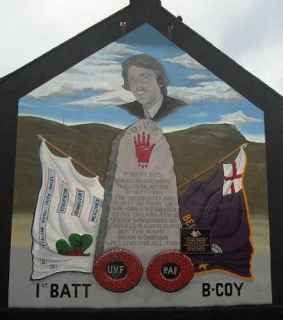
Brian Robinson, loyalist militant from Belfast, Northern Ireland, and member of the Ulster Volunteer Force (UVF), is shot dead by two members of an undercover British Army unit on September 2, 1989. His death is one of the few from the alleged shoot-to-kill policy in Northern Ireland to have involved a loyalist victim.
Robinson is born in Belfast in 1962 to Rab and Margaret Robinson, and brought up a Protestant on Disraeli Street in the staunchly loyalist Woodvale district of the Shankill Road. It is unknown when he becomes a member of the local Ulster Volunteer Force. He holds the rank of volunteer in its B Company, 1st Battalion Belfast Brigade. By the time of his death he has moved to Forthriver Crescent in the Glencairn estate, an area immediately northwest of Woodvale.
On September 2, 1989, Robinson and fellow UVF member Davy McCullough are travelling on a motorbike, with Robinson as the passenger armed with a gun, in Belfast’s Crumlin Road, close to the Irish nationalist area of Ardoyne. Upon seeing Paddy McKenna, a Catholic civilian, walking along the street, Robinson opens fire, hitting McKenna a total of eleven times and killing him. Unbeknownst to the two UVF members, an undercover British Army unit, linked to the Special Air Service, is in the area. Giving chase in a Vauxhall Astra car and a Fiat, the soldiers ram the motorbike, forcing both men off the road. Robinson is shot twice in his torso, then twice more in the back of the head by a female soldier standing over him. He is 27-years-old. Upon hearing the news of her son’s death, Robinson’s mother, Margaret, suffers a fatal heart attack. The two are buried on the same day.
The UVF leadership in west Belfast later claims that the intelligence leading to Robinson’s death had been provided by one of their own men, Colin “Crazy” Craig, who allegedly had been a police informer for several years. Craig is killed by the Irish National Liberation Army (INLA) on June 16, 1994, along with fellow UVF members Trevor King and David Hamilton. A UVF commander is quoted as mourning King and Hamilton, but adding that Craig was in line to be shot by the UVF anyway. Republican sources claim that the security forces infiltration of the UVF is even deeper, including Trevor King and “the most senior UVF figure in the North.”
Robinson’s funeral is well-attended as it leaves his home in Forthriver Crescent. Despite his membership in the UVF there are no paramilitary displays at the funeral, and the coffin is covered in the Union Jack instead of a UVF standard. Robinson is a member of the “Old Boyne Heroes” lodge of the Orange Order, and several members wearing their sashes flank the coffin. The cortege then meets up with Margaret Robinson’s funeral as it leaves her home in Crimea Street. A lorry carrying floral tributes leads the cortege. Both mother and son are buried in Roselawn Cemetery. A death notice from Robinson’s Orange lodge is published in the local press, which causes controversy.
Robinson’s death is commemorated annually in a band parade attended by loyalist bands in the Belfast area. One band, Star of the Shankill, has “In Memory of Brian Robinson” written on its crest and emblazoned upon its bass drum. The band also attracts controversy when it appears at a parade organised by the Apprentice Boys of Derry that passes near the area in which Robinson killed his victim. In 2010, Rab Robinson, the brother of Brian, issues an appeal to the parades organisers to postpone the parade that year, owing to the death of his younger brother earlier that year.
Robinson is commemorated in a mural on Disraeli Street, off Woodvale Road in Belfast.
In 2015, Robinson’s son Robert removes a Special Air Service flag that had been erected by the loyalists at the Twaddell Avenue protest camp. The Shankill UVF is later said to be reviewing its policy of flying the flag.
(Pictured: Mural commemorating Brian Robinson on Disraeli Street, off Woodvale Road in Belfast)
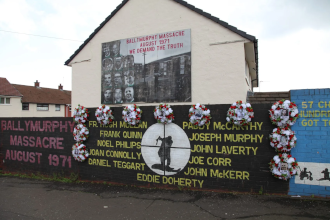
On the morning of Monday, August 9, 1971, the security forces launch Operation Demetrius, the main focus of which is to arrest and intern suspected members of the Provisional Irish Republican Army (IRA). The Parachute Regiment is selected to carry out the operation. The operation is chaotic and informed by poor intelligence, resulting in a number of innocent people being interned. By focusing solely on republicans, it excludes violence carried out by loyalistparamilitaries. Some nationalist neighbourhoods attempt to disrupt the army with barricades, petrol bombs and gunfire. In the Catholic district of Ballymurphy, ten civilians are shot and killed between the evening of August 9 and the morning of August 11, while another dies of heart failure.
Members of the Parachute Regiment state that they were shot at by republicans as they entered the Ballymurphy area and returned fire. The press officer for the British Army stationed in Belfast, Mike Jackson, later to become head of the British Army, includes a disputed account of the shootings in his autobiography, stating that those killed in the shootings were republican gunmen. This claim is strongly denied by the families of those killed in the shootings, including in interviews conducted during the documentary film The Ballymurphy Precedent. The claim is found to be without basis by a later coroner’s inquest, which establishes that those killed were “entirely innocent.”
The six civilians killed on August 9 are Francis Quinn (19), shot while going to the aid of a wounded man, Father Hugh Mullan (38), a Catholic priest, shot while going to the aid of a wounded man, reputedly while waving a white cloth to indicate his intentions, Joan Connolly (44), shot by three soldiers as she stands opposite the army base, Daniel Teggart (44), shot fourteen times mostly in the back as he lay injured on the ground, Noel Phillips (20) and Joseph Murphy (41), shot as they stand opposite the army base. Murphy is subsequently taken into army custody and after his release, as he is dying in hospital, he claims that he had been beaten and shot again while in custody. When his body is exhumed in October 2015, a second bullet is discovered in his body, which activists say corroborates his claim.
Edward Doherty (28), is shot and killed on August 10 while walking along Whiterock Road.
Another three civilians are shot on 11 August: John Laverty (20) and Joseph Corr (43) are shot at separate points at the top of the Whiterock Road. Laverty is shot twice, once in the back and once in the back of the leg. Corr is shot several times and dies of his injuries on August 27. John McKerr (49), is shot in the head by an unknown sniper while standing outside a Catholic church and dies of his injuries on August 20. While a number of eyewitnesses state that soldiers were seen shooting toward the area, the 2021 inquest cannot establish who had killed him. The coroner notes that a more specific finding is not possible, in large part, due to an “abject failing by the authorities to properly inquire into the death of [McKerr at the time].”
Paddy McCarthy (44), an eleventh civilian, dies on August 11 following an altercation with a group of soldiers. His family allege that an empty gun is put in his mouth and the trigger pulled, he suffers a heart attack and dies shortly after the alleged confrontation.
In February 2015, the conviction of Terry Laverty, younger brother of John Laverty, one of those killed, is quashed by the Criminal Cases Review Commission. He had been convicted of riotous behaviour and sentenced to six months on the eyewitness evidence of a private in the Parachute Regiment. The case is referred to court because the sole witness retracts his evidence.
In 2016, Sir Declan Morgan, the Lord Chief Justice of Northern Ireland, recommends an inquest into the killings as one of a series of “legacy inquests” covering 56 cases related to the Troubles. These inquests are delayed, as funding has not been approved by the Northern Ireland Executive. The Stormont first minister, Arlene Foster of the Democratic Unionist Party (DUP), defers a bid for extra funding for inquests into historic killings in Northern Ireland, a decision condemned by the human rights group Amnesty International. Foster confirms she has used her influence in the devolved power-sharing executive to hold back finance for a backlog of inquests connected to the conflict. The High Court says her decision to refuse to put a funding paper on the Executive basis is “unlawful and procedurally flawed.”
In January 2018, the coroner’s office announces that the inquest will begin in September 2018. On May 11, 2021, this coroner’s inquest finds that the ten civilians killed were innocent and that the use of lethal force by the British Army was “not justified.” The circumstances of the 11th death are not part of the inquest since Paddy McCarthy died from a heart attack, allegedly after being threatened by a soldier. Following the inquest verdict, Boris Johnson, the British prime minister, apologises for the deaths at Ballymurphy in a phone call to Foster and deputy First MinisterMichelle O’Neill. The lack of public apology is criticised by some relatives of the victims and Northern Irish politicians.
In May 2021, families of those shot dead by British soldiers in Ballymurphy urge the Irish government to oppose any attempt to prevent the prosecution of British soldiers alleged to have committed crimes during the Troubles.
The killings are the subject of the August 2018 documentaryThe Ballymurphy Precedent, directed by Callum Macrae and made in association with Channel 4.
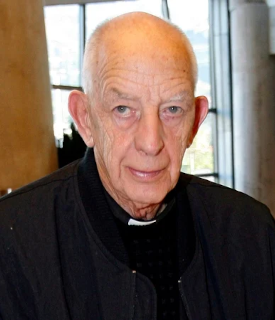
In the late 1980s, Reid facilitates a series of meetings between Gerry Adams and John Hume, in an effort to establish a “Pan-Nationalist front” to enable a move toward renouncing violence in favour of negotiation. Reid, himself a staunch nationalist who favours a united Ireland and the withdrawal of British forces from Northern Ireland, then acts as their contact person with the Irish Government in Dublin from a 1987 meeting with Charles Haughey up to the signing of the Good Friday Agreement in 1998. In this role, which is not public knowledge at the time, he holds meetings with various Taoisigh, and particularly with Martin Mansergh, advisor to various Fianna Fáil leaders. After the eventual success of the peace negotiations, Gerry Adams says, “there would not be a peace process at this time without [Father Reid’s] diligent doggedness and his refusal to give up.”
After he moves to Dublin, Reid is involved in peace efforts in the Basque Country. In January 2003, he is awarded the Sabino Arana 2002 “World Mirror” prize, by the Sabino Arana Foundation in Bilbao, in recognition of his efforts at promoting peace and reconciliation. He and a Methodist minister, the Rev. Harold Good, announce that the IRA has decommissioned their arms at a news conference in September 2005.
Reid is involved in controversy in November 2005 when he makes comments during a meeting in Fitzroy Presbyterian Church concerning the Unionist community in Northern Ireland. When the loyalist activist Willie Frazer makes remarks that Catholics had butchered Protestants during the Troubles, Reid angrily responds, “You don’t want to hear the truth. The reality is that the nationalist community in Northern Ireland were treated almost like animals by the unionist community. They were not treated like human beings. They were treated like the Nazis treated the Jews.” Reid later apologises, saying his remarks had been made in the heat of the moment. In an interview with CNN, he says that “The IRA were, if you like, a violent response to the suppression of human rights.”
Reid dies in a Dublin hospital on November 22, 2013. He is survived by two sisters and an aunt, and is buried in Milltown Cemetery, Belfast.
McIntyre is involved with the Boston College oral history project on the Troubles entitled the Belfast Project, conducting interviews with former Provisional IRA members who, like himself, had become disillusioned with the direction the republican movement had taken, such as Brendan Hughes and Dolours Price, and former Ulster loyalistparamilitaries such as David Ervine. The interviews are the basis for the book Voices from the Grave: Two Men’s War in Ireland by Ed Moloney.
In 2011, McIntyre becomes embroiled in controversy when transcripts of the interviews, held by Boston College, are subpoenaed by the Police Service of Northern Ireland (PSNI) in relation to an investigation of the 1972 abduction and killing of Jean McConville. In March 2014, the PSNI announces that it is seeking to question McIntyre over newly released Belfast Project recordings, specifically in reference to the alleged role of Gerry Adams in the kidnapping and murder of Jean McConville.
McIntyre is a prominent critic of modern-day Sinn Féin and its leadership. He has spoken at Republican Sinn Féin party events. He is a co-founder of The Blanket, a journal which casts a critical eye on the Northern Ireland peace process.




 seamus dubhghaill