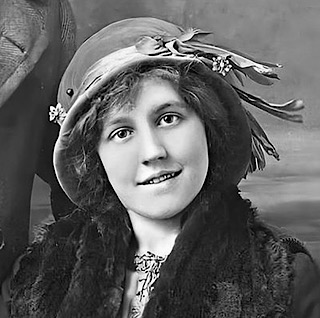
Mernin is born in Clanbrassil Street, Dublin, on November 16, 1886. Her parents are John Mernin and Marianne “Mary” (née McGuire). She has one sister, May. Her father is a baker and confectioner of Dorset Street, Dublin. After his death when Mernin is young, the children are raised by his family in Dungarvan, County Waterford.
In the 1910s, Mernin works as a typist in a number of Dublin companies, and by 1914 she is a shorthand typist in Dublin Castle at the garrison adjutant’s office. She is a member of the Keating branch of the Gaelic League, and through this her cousin, Piaras Béaslaí, introduces her to Michael Collins in 1918. From 1919 she begins working for Collins as an intelligence agent. She uses her position in Dublin Castle to obtain important documents and, in 1920, intelligence on British intelligence officers and the auxiliary police.
Under the alias of “Little Gentleman” or “Lt. G.,” Mernin is one of Collins‘a most important agents, so much so that many believe the Little Gentleman is a British intelligence officer. One of the most important contributions she makes is identifying the homes of British intelligence officers who are later killed on Bloody Sunday, November 21, 1920, by Collins‘s Irish Republican Army (IRA) unit The Squad. She aids Frank Saurin and Tom Cullen in identifying senior British agents in Dublin, typing secret reports for Collins in a room in 19 Clonliffe Road.
In February 1922, Mernin is discharged from the British service, taking up a position as a typist in the Irish Army from July 1922 until February 1952, when she retires. She works primarily at Clancy Barracks. She is awarded a military pension for her service from 1918-1922, and her statement is held in the Bureau of Military History in the Military Archives.
Mernin never marries, although she gives birth to a son in London in June 1922, with some evidence suggesting Béaslaí is the father. She lives at 167 Mangerton Road, Drimnagh. She dies at the age of 70 on February 18, 1957, in Dublin.
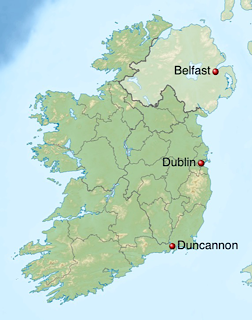
At the outbreak of the Irish Rebellion of 1641, most of south-eastern Ireland falls to the Catholic insurgents. Roughly 1,000 rebels blockade Duncannon, which is heavily fortified and contains an English garrison of about 300 men. Around 150 of the English troops are killed in forays against the Irish at nearby Redmond’s Hall, but without siege artillery, or expertise in siege warfare, the rebels are unable to take Duncannon.
Hostilities continue throughout 1642, as the Irish, now organised as the Irish Confederacy raid the town’s hinterland. As in much of Ireland, the conflict is bitter. In one incident, Laurence Esmonde, 1st Baron Esmonde, the Royalist commander, hangs 16 Irish prisoners who have been taken at nearby Ramsgrange. In response, the Irish execute 18 English prisoners whom they have been holding.
In 1643, because of his need for troops to fight in the English Civil War, Charles I signs a ceasefire with the Irish Confederates. As a result, hostilities between Duncannon and the Catholic-held surrounding area are suspended.
However, in 1644, the English garrison of Cork, under Murrough O’Brien, 1st Earl of Inchiquin, unhappy with the Royalist truce with the Irish Confederates, declares for the English Parliament, who are to remain hostile to Irish Catholic forces throughout the 1640s. Esmonde, under pressure from elements of his garrison, also changes to the side of Parliament and effectively re-declares war on the Catholic Confederates. His motives are unclear: though he is a Protestant convert, the Esmonde family are Anglo-IrishRoman Catholics, and he owes his entire advancement to the Crown.
Duncannon is a strategically important town for two reasons. Firstly, it has formidable defences. Secondly and more importantly, its guns overlook the sea route to Waterford and New Ross, two of the most important Catholic-held towns and also ports at which the Confederates receive military aid from Catholic Europe.
Needing to keep this channel open and also fearing the presence of an English garrison deep in their territory, the Confederates’ Supreme Council in Kilkenny despatches Thomas Preston, general of their Leinster Army, to take Duncannon in January 1645. Preston has at his disposal 1,300 men, four cannons and a mortar. The mortar, the first of its kind to be used in Ireland has been donated by Spain the previous year and is commanded by a French military engineer named Nicholas La Loue. La Loue had served with Preston in Flanders and is chief of engineering in the Leinster Army.
Duncannon possesses formidable defences. For one thing, it is located on a peninsula and can only be approached from the north, the other three sides jutting out into the sea. Just off the town are docked four Parliamentarian ships, which are supplying Duncannon with food and reinforcements. Secondly, it possesse two lines of fortifications, the outer line being a more modern low deep rampart protected by a dry ditch and the inner wall being a medieval curtain wall, complete with three towers. However, it has two grave weaknesses, first, it is overlooked by a hill to the north, from which an attacker can fire into the town and, secondly, the water supply is located outside the walls.
Preston arrives at Duncannon on January 20 and proceeds to construct a ring of trenches which cut off Duncannon on its landward side. From the hill that overlooks the town to the north, his guns are able to fire on a squadron of four Parliamentarian ships that are docked off Duncannon and providing the town with supplies. The flagship, the Great Louis, is badly damaged, its mast wrecked by cannon fire, and it takes several more hits from the mortar as it tries to get away. The ship sinks in deep water, drowning its crew and 200 soldiers who are on board.
Having cut off Duncannon’s supply from the sea, Preston proceeds to dig saps closer to the walls, the ultimate aim being to bring his cannon close enough to the walls in order to blast a breach and open the way for an assault. His engineers also dig a mine underneath one of the town’s bastions. All the while, the town’s defenders are kept under a bombardment by the mortar and, as the Confederate troops get closer to the walls, by sharpshooters. On March 12, one such sniper kills the fort’s second in command, one Captain Lurcan, who is hit in the head by a bullet.
On March 16, by which time the Irish trenches are “within pistol shot of the walls,” Preston orders the mine to be exploded, opening a breach in Duncannon’s outer walls. The Irish infantry then assault the town, but are beaten off with some losses. The following day, Saint Patricks Day, Preston tries again and this time his troops succeed in taking the town’s outer, more modern walls but are stopped at Duncannon’s inner, medieval ramparts. They succeed in occupying one of the town’s towers for an hour before being beaten back. Geoffrey Baron, a Confederate politician, who keeps a diary of the siege, reports that 24 Irish soldiers are killed in the two assaults.
At this point, Preston summons Esmonde to surrender, before he has to “proceed to extremities.” This is a delicate threat, implying that if the town falls to an assault, its defenders will be put to the sword – as is customary in contemporary siege warfare. Esmonde is also advised to surrender by the Parliamentarian vice admiral, William Smith, who is anchored offshore with seven ships, but cannot break through to relieve the town. In a letter that reaches Esmonde on March 11, Smith warns him that “if the rebels take the fort by storming it, they will undoubtedly put you all to death…you should agree with thy adversary while thou art in the way.” Esmond has Smith’s letter publicly read to his troops after the assaults of March 16-17 to discourage those who favour holding out.
Alongside the risk of massacre, the English garrison is also very low on gunpowder and water. The town’s only source of fresh water, a well, is behind the Confederate siege lines.
In light of these facts, Esmonde formally surrenders Duncannon to Preston on March 18. The Confederates take possession of the town but its garrison is allowed to march away to Youghal, which is in Protestant hands. However, they have to leave behind the town’s 18 artillery pieces. Esmonde himself dies a feways after the end of the siege. Preston goes on to briefly besiege Youghal, but bad weather, a lack of supplies and squabbling with James Tuchet, 3rd Earl of Castlehaven, the Confederate Munster general, puts an end to his campaign for the winter.
The siege is of importance in that it reopens the sea route into Waterford and eliminates a hostile English garrison in Confederate territory. Preston, who had for many years been the Spanish military governor of Leuven, is highly experienced in siege warfare and his conduct of the siege draws widespread praise. Not only does he take the town, but he does so at a relatively low cost. Sixty-seven Confederate soldiers die in the siege, of whom roughly 30 die of disease. Given that the campaign is conducted in mid-winter, in an age when disease routinely kills many more soldiers than combat, this represents a considerable logistical achievement on the part of the Irish general.
The Great Lewis, the Parliamentarian ship sunk during the siege, is rediscovered in 1999 and raised in 2004.
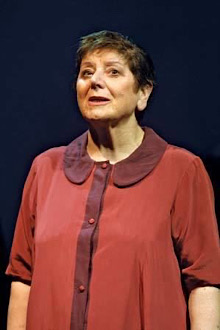
Manahan’s career begins when, as a young woman, she is recruited by the legendary Irish impresarios and theatrical directorsMicheál Mac Liammóir and Hilton Edwards. She later marries stage director Colm O’Kelly, who dies not long afterward of polio, which he contracts after swimming in the Nile during a theatre tour of Egypt. They have no children and she never remarries. She is known professionally by her maiden name. In 1946 she appears in a production by Irish playwrightTeresa Deevy, The Wild Goose, where she plays the part of Eileen Connolly. This is performed by Equity Productions in the Theatre Royal, Waterford.
In 1957, Manahan plays Serafina in the first Irish production of Tennessee Williams‘s The Rose Tattoo and achieves unexpected notoriety when she and several other members of the cast are arrested for the possession of a condom on stage.
Manahan plays a minor role in the Irish cultsoap operaThe Riordans (1960s), and as Mrs. Mary Kenefick in the TV comedy Me Mammy (1970s). She also plays the lead in the Irish comedy series, Leave It To Mrs O’Brien (1980s) and Mrs. Cadogan in The Irish R.M. (1980s). Most recently she plays Ursula in Fair City, for which her niece, Michele Manahan (daughter of Michael Manahan), is a writer.
Manahan has an extensive theatre portfolio having played at theatres throughout Ireland including the Abbey Theatre, the United Kingdom, continental Europe, the United States and Australia. She wins the Tony Award for Best Featured Actress in a Play for her role as Mag in Martin McDonagh’s The Beauty Queen of Leenane on Broadway. She previously receives a Tony nomination in 1969 for Brian Friel’s Lovers.
The Irish playwright John B. Keane writes the play Big Maggie specifically for Manahan. In 2001 she stars in Keane’s The Matchmaker with veteran Irish actor Des Keogh. In 2005 she stars in Sisters, a new play by Declan Hassett that is also written for her and for which she is nominated for a Drama Desk Award in the category of Outstanding Solo Performance. The production tours Ireland and is staged at the International Festival of World Theatre in Colorado and also plays at the 59E59 Theater in New York City in 2006.
In 2004 Manahan starts to play the role of Ursula in Fair City. All About Anna (2005), a documentary on her life and work is made by Charlie Mc Carthy/Icebox Films for RTÉ Television. In 2008, she becomes the first ever patron of the Active Retirement Ireland organization.
Manahan dies of multiple organ failure on March 8, 2009 in Waterford. She had suffered from a longterm illness.
Her funeral is held on March 11, officiated by her “longtime friend” the psychoanalyst, poet, and priest Bernard Kennedy. “As the final curtain falls, the lights dim, the auditorium becomes silent, we remember her” he says. Describing her as a woman of faith (who “sought to bring the word of God alive”), he says she had brought everyone together to be present at “her last great exit from this great stage of life,” saying her life’s work had drawn people from all over the world. “Anna believed in the empty tomb of the Resurrection and she believed the empty tomb could be filled by hearing the word take the place of the emptiness,” he says. “She knew the bedsits which preceded the Tony nomination.”
Born on March 13, 1831, in Lisburn, County Antrim, McCloy is the youngest of five children, born to Peter McCloy, a painter, and his wife Martha Phelan. He studies at the School of Design in Belfast from 1850 to 1851 while serving an apprenticeship in engraving, with J and T Smyth. He then spende a year at the Central School, Somerset House in London before being appointed Master at the Waterford School of Art around 1853, when he also becomes a visiting instructor to several other institutions. In the spring of 1865 he marries his student, the Waterford artist Ellen Lucy Harris, the fourth daughter of a banker named Richard Harris. The dismembered corpse of McCloy’s mother is recovered from the River Suir in September of the same year. She had been missing since the previous November.
McCloy shows just once at the Royal Academy of Arts with a work entitled The Haunt of Meditation in 1859. He exhibits infrequently at the Royal Hibernian Academy between 1862 and 1882, where he displays sixteen works in that time. He displays eleven works in the 1876 Industrial Exhibition at Belfast’s Ulster Hall. In 1880, he shows at Rodman and Company in London where the writer in the Belfast Telegraph indicates that McCloy is becoming a popular artist and is receiving extensive patronage.
After a year-long illness that prevents him from working, McCloy dies in Balham, South London, on October 4, 1904. He is survived by his wife, Ellen, and nine daughters. The Lisburn Museum in his hometown offers a belated retrospective of his work in 1981 to mark the one-hundred fiftieth anniversary of his birth. The exhibition is the first known solo display of McCloy’s work and consists of 58 works. The catalogue for this show is written by Eileen Black and funded by the Arts Council of Northern Ireland.
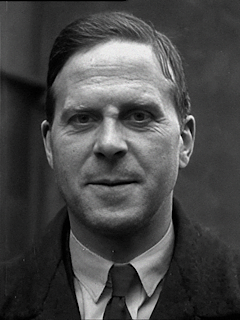
In March 1917, Ryan passes his final medical examinations. That June he sets up medical practice in Wexford. In 1921, he moves to Dublin where he opens a doctor’s practice at Harcourt Street, specialising in skin diseases at the Skin and Cancer Hospital on Holles Street. He leaves medicine in 1925, after he purchases Kindlestown, a large farm near Delgany, County Wicklow. He lives there and it remains a working farm until his death.
In July 1919, Ryan marries Máirín Cregan, originally from County Kerry and a close friend of Sinéad de Valera throughout her life. Cregan, like her husband, also fought in the Easter Rising and is subsequently an author of children’s stories in Irish. They have three children together.
While studying at university in 1913, Ryan joins the Gaelic League at Clonmel. The company commander recruits the young Catholicnationalist, who becomes a founder-member of the Irish Volunteers and is sworn into the Irish Republican Brotherhood (IRB) the following year. In 1916, he goes first to Cork to deliver a message from Seán Mac Diarmada to Tomás Mac Curtain that the Easter Rising is due to happen on Easter Sunday, then to Cork again in a 12-hour journey in a car to deliver Eoin MacNeill‘s cancellation order, which attempts to stop the rising. When he arrives back on Tuesday, he serves as the medical officer in the General Post Office (GPO) and treats many wounds, including James Connolly‘s shattered ankle, a wound which gradually turns gangrenous. He is, along with Connolly, one of the last people to leave the GPO when the evacuation takes place. Following the surrender of the garrison, he is deported to HM Prison Stafford in England and subsequently Frongoch internment camp. He is released in August 1916.
Ryan rejoins the Volunteers immediately after his release from prison, and in June 1917, he is elected Commandant of the Wexford Battalion. His political career begins the following year when he is elected as a Sinn Féin candidate for the constituency of South Wexford in the 1918 United Kingdom general election in Ireland. Like his fellow Sinn Féin MPs, he refuses to attend the Westminster Parliament. Instead he attends the proceedings of the First Dáil on January 21, 1919. As the Irish War of Independence goes on, he becomes Brigade Commandant of South Wexford and is also elected to Wexford County Council, serving as chairman on one occasion. In September 1919, he is arrested by the British and interned on Spike Island and later Bere Island. In February 1921, he is imprisoned at Kilworth Internment Camp, County Cork. He is later moved on Ballykinlar Barracks in County Down and released in August 1921.
In 1926, Ryan is among the Sinn Féin TDs who follow leader Éamon de Valera out of the party to found Fianna Fáil. They enter the Dáil in 1927 and spend five years on the opposition benches.
In 1947, after spending fifteen years as Minister for Agriculture, Ryan is appointed to the newly created positions of Minister for Health and Minister for Social Welfare. Following Fianna Fáil’s return to power at the 1951 Irish general election, he returns as Minister for Health and Social Welfare. Following the 1954 Irish general election, Fianna Fáil loses power and he moves to the backbenches once again.
Following the 1957 Irish general election, Fianna Fáil are back in office and de Valera’s cabinet has a new look to it. In a clear message that there will be a change to economic policy, Ryan, a close ally of Seán Lemass, is appointed Minister for Finance, replacing the conservative Seán MacEntee. The first sign of a new economic approach comes in 1958, when Ryan brings the First Programme for Economic Development to the cabinet table. This plan, the brainchild of T. K. Whitaker, recognises that Ireland will have to move away from self-sufficiency toward free trade. It also proposes that foreign firms should be given grants and tax breaks to set up in Ireland.
When Lemass succeeds de Valera as Taoiseach in 1959, Ryan is re-appointed as Minister for Finance. Lemass wants to reward him for his loyalty by also naming him Tánaiste. However, the new leader feels obliged to appoint MacEntee, one of the party elders to the position. Ryan continues to implement the First Programme throughout the early 1960s, achieving a record growth rate of 4 percent by 1963. That year an even more ambitious Second Programme is introduced. However, it overreaches and has to be abandoned. In spite of this, the annual growth rate averages five percent, the highest achieved since independence.
Ryan does not stand in the 1965 Irish general election, after which he is nominated by the Taoiseach to Seanad Éireann, where he joins his son, Eoin Ryan Snr. At the 1969 dissolution he retires to his farm at Kindlestown, County Wicklow, where he dies at age 77 on September 25, 1970. He is buried at Redford Cemetery, Greystones, County Wicklow. His grandson, Eoin Ryan Jnr, serves in the Oireachtas from 1989 to 2007 and later in the European Parliament from 2004 to 2009.
The GS&WR is an Irish gauge (1,600 mm (5 ft. 3 in.)) railway company that operates in Ireland from 1844 until 1924. The GS&WR grows by building lines and making a series of takeovers, until in the late 19th and early 20th centuries it is the largest of Ireland’s “Big Four” railway networks. At its peak the GS&WR has an 1,100-mile (1,800 km) network, of which 240 miles (390 km) are double track.
The core of the GS&WR is the Dublin Kingsbridge – Cork main line, Ireland’s “Premier Line,” and still one of her most important main line railways. The company’s headquarters are at Kingsbridge station. At its greatest extent, the GS&WR includes, in addition to the Dublin – Cork main line, the Dublin – Waterford and Mallow – Waterford lines and numerous branch lines.
There are earlier attempts to set up main line railways into the south of Ireland, but the 1840s efforts of Peter Purcell, a wealthy landowner and mail coach operator, and his associates ultimately prove successful with the implementation of a bill passed on August 6, 1844, for the GS&WR. Purcell is actively assisted by engineer John Benjamin Macneill, who has done surveys for the London and Birmingham Railway and has connections in London. The GS&WR’s vision to provide a single railway for most of the south of Ireland finds favour with United Kingdom Prime MinisterRobert Peel as having likely more profitably for wealthy investors and because a single company will be easier to control. These factors likely ease the passage of relevant legislation.
William Dargan, Ireland’s foremost railway contractor, builds much of the GS&WR’s main line and a number of its other routes.
The directors choose to begin by construction of the 32.5 mile (52.3 km) stretch of the Dublin – Cork main line as far as Cherryville Junction just west of Kildare and the 23.5 mile (37.8 km) branch to Carlow with contracts shared between McCormack and Dargan. Work begins in January 1845 with services commencing on August 4, 1846. Trains are scheduled to take about 2 hours, 35 minutes for the 56 mile (90 km) stretch to Carlow and coach connections are arranged to Kilkenny, Clonmel, Waterford and the evening mail coach for Cork.
In October 1849, the main line reaches the outskirts of Cork, where the GS&WR opens a temporary terminus at Blackpool. The final 1-mile (1.6 km) of line from Blackpool to the centre of Cork includes a 1,355-yard (1,239 m) tunnel and is not completed for another six years. Services through the tunnel begin in December 1855, running to and from a second temporary terminus beside the River Lee. Finally, the present Cork terminus in Glanmire Road opens in July 1856.
The battle consists of ten days of fighting in the countryside around Kilmallock in County Limerick, in which the National Army of the Irish Free State, advancing south from Limerick city, find their path blocked by anti-Treaty IRA troops, dug into a number of villages at Bruff, Bruree and Patrickswell. The fighting end with the retreat of the anti-Treaty fighters and the occupation of Kilmallock by Free State forces.
The prelude to the battle is the fall of Limerick city to Free State forces. The Republican forces in the city under Liam Deasy withdraw from their positions after a week of fighting and concentrate in Kilmallock and the nearby towns of Bruff and Bruree. The Free State forces, advancing south from the city, find their path blocked by the Republicans dug in at the three hilltop towns.
The National Army’s attempt to break through this position produces the only “line battle” of the war with the two sides facing each other along clear front-lines. The Kilmallock-Bruff-Bruree triangle sees some of the war’s most intense fighting.
Whereas in the fighting in Dublin, Limerick and Waterford, Free State troops equipped with artillery overcome Anti-Treaty resistance relatively easily, at Kilmallock they have a much harder time. The main reason for this is that the Free State troops, most of whom are new recruits, are facing some of the best of the IRA forces without an advantage in numbers or firepower. General Eoin O’Duffy complains of shortage of arms and ammunition. He estimates that while his forces have about 1,300 rifles, the Republicans could muster over 2,000. He is also critical of the quality of the troops at his disposal, whom he describes as, “a disgruntled, undisciplined and cowardly crowd.”
The Republicans know this and are confident of success. Nevertheless, the Republican commanders have their own issues with logistical support and lack of co-operation between forces from different counties. Deasy’s command includes Volunteers from counties Limerick itself, Cork and Kerry, all of whom have their own commanders. They have three improvised armoured cars, some mortars and heavy machine guns but no artillery.
O’Duffy draws up plans for the advance on Kilmallock with the assistance of his second-in-command Major GeneralW. R. E. Murphy who had been a lieutenant colonel in World War I. His experience in the trenches has a major effect on his approach – pre-disposing him to cautious advances and use of trenches for cover.
The Republican forces have the better of the first clashes. On Sunday, July 23, Free State forces take Bruff and begin their advance on Kilmallock, but are twice beaten back by determined Republican resistance. The following day, the Republicans manage to retake Bruff in a counter-attack, taking 76 prisoners. As a result of this setback, O’Duffy calls off the advance for the time being and waits for reinforcements.
National Army forces quickly retake Bruff after reinforcements arrive. However, things get worse for the National Army as the week goes on. They make slow progress in taking the Republican strongpoints, and their casualties also mount. On Tuesday, July 25, a unit of the Dublin Guard under Tom Flood is ambushed on a narrow road. They fight their way clear, but only after losing four men. Three more Free State soldiers are killed two days later. On July 30, Major General Murphy launches an attack to take Bruree. The Dublin Guards attack the town from the southeast, supported by armoured cars and an 18-pound field gun. The Republicans hold out for five hours until Free State artillery is brought into action. At least 13 Free State soldiers and nine Anti-Treaty fighters are killed in the action and more are wounded before the Free State troops secure Bruree.
The Republican commander, Deasy, knows how important Bruree is to the defence of Kilmallock and draws up plans to recapture the town using three armoured cars, trench mortars and machine guns. On August 2, Republicans capture Patrickswell south of Limerick. The armoured cars then attack Bruree, taking Free State forces by surprise. One car attacks Commandant Flood’s headquarters at the Railway Hotel. The Commandant and his men manage to escape out the back of the building under the cover of Lewis gun fire. The second armoured car rams the front door of another post in the school house, which persuades the twenty-five troops inside to surrender.
However, when Free State reinforcements, along with armoured cars arrive, the Republican counter-attack stalls. The Free State reinforcements are led by Commandant General Seamus Hogan, who personally leads his forces, riding in the armoured car nicknamed “The Customs House.” Having failed to secure the surrender of the town, Republican forces retreat.
Having held Bruree against a Republican counterattack, Free State forces prepare to capture Kilmallock itself, but anticipate there will be heavy fighting. Republican Adjutant General Con Moloney comments on August 2, “Up to yesterday we have had the best of the operations there [the Kilmallock area]. There will, I fear, be a big change there now as the enemy have been reinforced very considerably.” In the 3rd Western Division area they have all but disbanded, unwilling to fight Free Staters, destroy roads, and now discouraged by the Catholic church.
On Thursday, August 3, a force of 2,000 Free State troops, backed up by armoured cars and artillery, advance on Kilmallock from Bruree, Dromin and Bulgaden. Seven hundred troops arrive the next day with an armoured car and a field gun. By Saturday, the town is surrounded by Free State forces. The Dublin Guard are also on hand to prevent Republican forces from escaping. Three miles away, Free State artillery is deployed and shells Republican forces on Kilmallock Hill and Quarry Hill. The two hills are soon controlled by Free State forces.
The National Army has, therefore, assembled sufficient force to smother resistance at Kilmallock. They are still, however, expecting hard fighting before they take the town. To their surprise, when the Free State troops enter the town, they encounter only light resistance from a Republican rearguard (volunteers from Cork). Most of the Republican troops have already abandoned their positions and retreated to Charleville.
They departed not because the Free State troops are stronger, but because they have been outflanked by Free State seaborne landings on the coasts of County Kerry and County Cork on August 2 and 8 respectively. The landings in Cork and Kerry force Commandant General Deasy to release units from this area to return home to their own areas. Although the landings in Cork occur after the retreat from Kilmallock, the subsequent loss of brigades from Cork adds to Commandant General Deasy’s problems. The final phase of the fighting in County Limerick comes when the Free State advance south is held up at Newcastle West. Another day of heavy fighting ensues in which the National Army troops have to bring up armoured cars and artillery to dislodge the Republicans, who reportedly lose up to 12 men before they retreat in the direction of Cork.
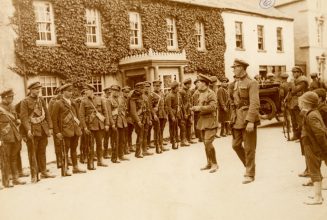
(Pictured: National Army troops lined up for a roll call during the Irish Civil War with local children casting an eye over the proceedings)
In 2004, Bacik’s book Kicking and Screaming: Dragging Ireland into the 21st Century, is published by The O’Brien Press.
In 2007, she contested the Seanad Éireann elections for the third time in the Dublin University constituency, and is elected to the third seat, behind sitting Independent senators Shane Ross and David Norris. She initially sits as an Independent senator.
In February 2009, Bacik is included in an ‘All Star Women’s Cabinet’ in the Irish Independent. In March 2009, she confirmed claims made on a TV programme that she had taken two voluntary pay cuts of 10% in addition to a pension levy. In June 2009, she is the Labour Party candidate for the Dublin Central by-election. She comes in third with 17% of the first preference votes. She joins the Labour Party group in the Seanad in September 2009, and becomes Labour Party Seanad spokesperson for both Justice and Arts, Sports and Tourism. In November 2009, a feature by Mary Kenny of the Irish Independent includes Bacik in a list of women who “well deserved their iconic status.”
In May 2010, Bacik seeks Labour’s nomination to contest the next election in the Dublin South-East constituency but is not selected. In December 2010, she is added to the ticket as the second candidate beside Labour Party leader, Eamon Gilmore, in the Dún Laoghaire constituency for the 2011 Irish general election. Gilmore tops the poll, with Bacik receiving 10.1% of first preference votes but she is not elected. She is re-elected to Seanad Éireann at the subsequent election, after which she becomes Deputy Leader of the Seanad. She holds her seat in the Seanad in 2016 and in 2020.
On April 27, 2021, after the resignation of Eoghan Murphy from his Dáil seat in Dublin Bay South, Bacik announces her intention to stand in the upcoming by-election. She campaigns with an emphasis on providing affordable housing, as well as improving healthcare and childcare, tackling climate change, and achieving “a true republic in which church and state are separated.” During the campaign, she describes herself as having “more bills passed into law than any other Senator, on issues such as workers’ conditions, women’s health rights, and LGBT equality”. She also campaigns on increasing the number of sports amenities for children in the area, calling for unused Defence Forces football fields at the Cathal Brugha Barracks to be freed up for local sports, with the suggestion rejected by Fine GaelMinister for DefenceSimon Coveney. Fine Gael complains to RTÉ after she features prominently on National Treasures, a prime-time TV show broadcast by RTÉ during the campaign. RTÉ has strict rules about fair coverage of candidates during campaigns. The national broadcaster blames an “inadvertent error” for the programme being shown three days before the election. A steering group within the broadcaster tells Fine Gael that “the broadcast should not have happened.” Consequentially, RTÉ has to show a special report on the by-election on Prime Time to “ensure fair coverage is given to all candidates.”
Bacik wins this election, receiving 8,131 (30.2%) first-preference votes. It is her fourth attempt as a Labour candidate, and she expresses her delight at the success at the count centre in the RDS. Following the election, she is described by The Irish Times as “a formidable activist and public intellectual” and that Fine Gael’s perceived antipathy towards their former TD, Kate O’Connell, may have contributed to the surge in support to Bacik from women voters. The newspaper claims that her election is “a long overdue morale boost” for Labour.
In March 2022, Bacik confirms she will run to succeed Alan Kelly as Labour Party leader. Kelly states that he believes that Bacik will succeed him. On March 24, 2022, she is confirmed as Labour Party leader unopposed at a party conference in Dublin. In a speech, she says she will focus on the rising cost of living and the serious and global problems facing the country. She pledges that Labour will fight the next election as a “standalone party” rather than joining any left-wing alliance.
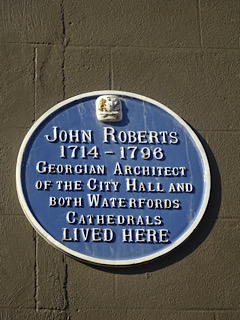
Roberts is born in Waterford in 1712 or 1714, the son of Thomas Roberts, an architect and builder. Little is known of his early life, although he possibly trains in London for a time. At 17, he elopes with Mary Susannah Sautelle, a Huguenot heiress who also lives in Waterford.
In 1785, Roberts builds a house in Waterford for William Morris, now the Harbour Commissioners’ headquarters and the Chamber of Commerce. In 1786, he designs Newtown House, later Newtown School, a Quaker school. In 1787, he designs The Leper Hospital and Church of St. Stephen. He also builds the Assembly Rooms on Waterford’s Mall in 1788, which is now the Theatre Royal and City Hall.
Roberts has between 21 and 24 children with his wife Susannah, of whom eight live to adulthood, including the painters Thomas Roberts and Thomas Sautelle Roberts. They live for many years in the old bishop’s palace, opposite the cathedral, with a country residence at Roberts Mount. He is nicknamed “Honest John” because he pays his workers so reliably, sometimes giving half their pay directly to their wives so that it would not be wasted on alcohol.
Roberts dies on May 23, 1796, after falling asleep on the floor of the Cathedral of the Most Holy Trinity, Waterford, and contracting pneumonia. The main square in Waterford is named John Roberts Square in his honour.
The mid-19th-century is a difficult time for the Irish. Under British subjugation, and amidst the vice-grip of the Great Famine, Ireland and its people are in desperate need for optimism, and something to bring the nation together.
News of the recent French Revolution has reached Irish ears and there is a growing belief that the path to independence is an achievable one.
During a trip to Paris with an Irish delegation sent to congratulate the French republicans on their successful revolution, Meagher is inspired to create a design for the Irish tricolour, similar to the French flag, with the help of a small group of French women sympathetic to the Irish cause.
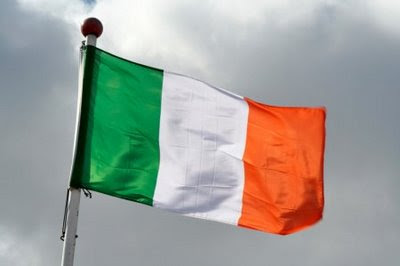
The new flag has green, white and orange stripes – the colours symbolising the unification of two traditions into one nation – Catholics (green) and Protestants (orange). Few realise however, that Meagher’s original flag has the orange stripe closest to the staff, a design now used by Ivory Coast.
As Meagher outlines later, “The white in the centre signifies a lasting truce between Orange and Green and I trust that beneath its folds the hands of Irish Protestants and Irish Catholics may be clasped in generous and heroic brotherhood.”
At a meeting in Waterford on March 7, 1848, Meagher first publicly unveils the flag from a second-floor window of the Wolfe Tone Club as he addresses a gathered crowd on the street below who are present to celebrate another revolution that has just taken place in France.
From March of that year the Irish tricolour appears side-by-side with the French tricolour at meetings held all over the country.
On April 14 and 15, the flag is paraded around the country. Political journalistJohn Mitchel says at the time, “I hope to see that flag one day waving, as our national banner.”
During this time, support for Meagher’s design grows, and following the events of the 1916 Easter Rising, it is resurrected by the Irish Volunteers and later by Sinn Féin and is unofficially adopted as the flag of Ireland. With the green stripe closest to the staff, Meagher’s tricolour becomes the official flag of the 26 counties of the Irish Republic.
In 1937, the design achieves constitutional status as the official Irish flag.
Until recently, display of the tricolour flag is illegal in the six occupied counties of Northern Ireland.
(From: “On this day in 1848: Ireland’s new flag is shown to public for first time” by Harry Brent, The Irish Post, http://www.irishpost.com, April 15, 2021)



 seamus dubhghaill