Flannery edits the Dominican bi-monthly journal entitled Doctrine and Life from 1958 to 1988, while at St. Saviour’s Priory, Dublin, where he also serves as prior from 1957 to 1960. He also edits the Religious Life Review. During and after the Second Vatican Council he makes available in English all the documents from the event.
From August 1969, Flannery is a member of the executive committee of the Northern Relief Coordination Committee, raising funds on behalf of the families of those interned without trial in Northern Ireland during the early 1970s.
Flannery embodies the post-Vatican II conception of the priest as a social catalyst engaged by the gospel, closer to his flock than to the clerical hierarchy. He has a great gift for friendship, is indefatigably interested in people, and courts religious affairs commentators and journalists at a time when the hierarchy ignores them, magnifying his influence.
Flannery dies of a heart attack on October 21, 2008, at Kiltipper Woods Care Centre, Dublin. Following a funeral mass at St. Saviour’s Priory, he is buried in the Dominican plot at Glasnevin Cemetery, Dublin, on October 24, 2008.
Carroll marries clothing designer Helena Reilly in Glasgow in 1923. They have four children, actress Helena Carroll, musician and producer Theresa Perez, journalist Kathleen Carroll and son Brian Carroll who resides in London. He is grandfather to Helena Perez Reilly and great grandfather to Paul Vincent Reilly. His brother, Niall Carroll, is a film critic.
Carroll founds two theater groups in Glasgow: the Curtain Theatre company, with Grace Ballantine and Molly Urquhart, in 1933 and the Glasgow Citizens Theatre in 1943. He remains the director and playwright in residence of the Citizens Theatre until his death.
The Wayward Saint is made into an opera in Germany in the 1960’s and his daughter Theresa commissions and produces an opera of his Beauty is Fled from the collection Plays for My Children which opens at Phoenix Symphony Hall in the 1970s as part of Theresa’s “Children’s Opera Series.”
Carroll dies at the age of 68 from undisclosed causes in Bromley, Kent, England on October 20, 1968.
Rackard is born in Killane on January 6, 1927. He makes his first regular appearance for the Wexford senior team during the 1947 All-Ireland Senior Hurling Championship and is a regular member of the starting fifteen until his retirement before the 1957 All-Ireland championship. During that time he wins two All-Ireland medals, four Leinster medals and one National Hurling League medal. He is an All-Ireland runner-up on two occasions. His brothers, Nicky and Billy, also experience All-Ireland success with Wexford.
Rackard plays his club hurling with Rathnure and enjoys much success and is a four-time county club championship medalist in his lengthy career.
In 1948, Rackard is a key member of the defence as Rathnure reaches only their second championship decider ever. A 3–5 to 0–2 trouncing of reigning champions Ferns St. Aidan’s gives him his first championship medal. After failing to retain their title the following year, Rathnure is back in the county decider once again in 1950. Another convincing 5–10 to 2–6 defeat of old rivals Ferns St. Aidan’s gives him his second championship medal.
It is 1955 before Rathnure qualifies for another championship decider and four-in-a-row hopefuls Ferns St. Aidan’s provides the opposition once again. A close game develops, however, a 2–9 to 2–5 victory gives Rackard a third championship medal.
After a number of years out of the limelight, Rathnure reaches the county final once again in 1961. A fourth defeat of Ferns St. Aidan’s gives Rackard, who scores two goals from his full-forward berth, a fourth and final championship medal.
Rackard first comes to prominence on the inter-county scene as a member of the Wexford minor hurling team in the early 1940s. He enjoys little success in this grade but is called up to the senior team in 1947.
After losing the provincial final in 1950, Rackard is at centre-back the following year as Wexford faces Laois in the eastern decider. A 3–12 to 4–3 victory gives him his first Leinster medal as Wexford claims the provincial crown for the first time since 1918. The subsequent All-Ireland decider sees three-in-a-row hopefuls Tipperary providing the opposition. Nicky Rackard’s goal-scoring ability is quelled by Tipperary goalkeeper Tony Reddin, while Séamus Bannon, Tim Ryan and Paddy Kenny score key goals which power Tipperary to a 7–7 to 3–9 victory.
After back-to-back Leinster defeats over the next two years, Wexford faces Dublin in the 1954 decider. A huge 8-5 to 1–4 victory gives Rackard his second Leinster medal. A record crowd of 84,856 attend the subsequent All-Ireland decider with Cork providing the opposition. Wexford has a four-point lead with seventeen minutes left to play, however, history is against Wexford when Johnny Clifford scores the winning goal for Cork with just four minutes left. A 1–9 to 1–6 victory secures a third successive All-Ireland for Cork.
In 1955, Wexford continues their provincial dominance with Rackard collecting a third Leinster medal following a 5–6 to 3–9 defeat of Kilkenny in a replay of the Leinster final. Galway, who gets a bye into the final without picking up a hurley, provides the opposition and takes a halftime lead. A Tim Flood goal nine minutes from the end clinches a 3–13 to 2–8 victory and a first All-Ireland medal for Rackard. It is Wexford’s first All-Ireland triumph in forty-five years.
Rackard adds a National Hurling League medal to his collection in 1956 as Tipperary is bested by 5–9 to 2–14. The subsequent championship campaign sees Wexford reach the provincial final once again. A narrow 4–8 to 3–10 defeat of Kilkenny gives Rackard his fourth and final Leinster medal. Galway falls heavily in the All-Ireland semi-final, allowing Wexford to advance to an All-Ireland final meeting with Cork. The game goes down in history as one of the all-time classics as Christy Ring is bidding for a record ninth All-Ireland medal. The game turns on one important incident as the Wexford goalkeeper, Art Foley, makes a miraculous save from a Ring shot and clears the sliotar up the field to set up another attack. Nicky Rackard scores a crucial goal with two minutes to go giving Wexford a 2–14 to 2–8 victory. In spite of Cork’s loss, Wexford’s Nick O’Donnell and Rackard, in an unparalleled display of sportsmanship in any game, raise Christy Ring onto their shoulders and carry him off the field. Wexford wins the game and Rackard collects his second All-Ireland medal but there is no doubt in their minds that the real hero is Ring.
A farm accident in 1957 brings an end to Rackard’s inter-county career.
Rackard also has the honour of being selected for Leinster in the inter-provincial series of games and enjoys some success. In 1956 he lines out in his only inter-provincial decider. A 5–11 to 1–7 trouncing of Munster gives Rackard a Railway Cup medal.
In retirement, Rackard, along with his brothers, come to be regarded as one of the greatest hurling families of all-time. In 1984, the centenary year of the foundation of the Gaelic Athletic Association, he is named to the Hurling Team of the Century. In 1992, both Billy and Bobby Rackard’s brilliance is recognised when they are presented with the All-Time All Star Award for hurling. Rackard is also posthumously named on the Hurling Team of the Millennium in 1999.
(Pictured: The Rackard brothers from left Bobby, Nicky and Billy)
Purser is born in Dublin on August 24, 1835, the son of John Tertius Purser (1809–1893), the general manager of the well-known A Guinness, Son & Co. brewery, and Anna Benigna Fridlezius (1803-1881). He is educated in a wealthy family, which includes artists, as his cousin Sarah Purser, or engineers, as his brother-in-law John Purser Griffith. He is the brother of mathematician Frederick Purser. He receives his early education at the private boarding school run by his uncle, Dr. Richard W. Biggs, at Devizes, Wiltshire. He completes his schooling at Devizes and begins his university studies at Trinity College, Dublin, graduating BA in mathematics in 1856. He is the best mathematician of his year at the University and in 1855 he gains the Lloyd Exhibition.
Purser becomes a tutor to the four sons of William Parsons, 3rd Earl of Rosse (1800-1867) in 1857. Lord Rosse’s 72-inch reflecting telescope, built in 1845 and colloquially known of as the “Leviathan of Parsonstown,” is the world’s largest telescope when it is built and continues to hold this distinction until the early 20th century. As well as acting as tutor to the children, Purser does become involved in Lord Rosse’s interest in astronomy but never does any observing.
In 1863, Purser is appointed professor of mathematics at Queen’s College, Belfast, a position he maintains until his retirement in 1901.
Purser never marries. When his father dies on April 5, 1893, Rathmines Castle passes to him. He dies at Rathmines Castle on October 18, 1903, a very wealthy man. In his will he leaves £100,000 to his brother Frederick Purser, £40,000 to his sister Anna Griffith and £5,000 to each of her children. In addition to the money, he owns property in Blessington Street, Essex Street and Eustace Street which he leaves to his brother-in-law John Purser Griffith. Other properties and interests that he owns he divides between his brother Frederick and his sister Anna. After his death, his sister Anna and her husband John Purser Griffith move into Rathmines Castle although, at this time, its ownership has gone to Frederick Purser. After Frederick dies in August 1910, the Castle and his considerable wealth passes to Anna.
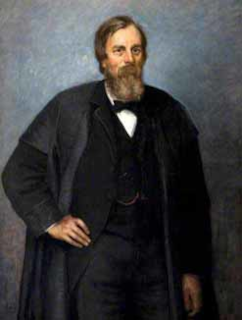
(Pictured: Portrait of John Purser painted by the artist Sarah Purser, daughter of Tertius Purser’s brother Benjamin Purser. The portrait hangs in Queen’s College, Belfast.)
The Plan of Campaign is a stratagem adopted in Ireland between 1886 and 1891, co-ordinated by Irish politicians for the benefit of tenant farmers, against mainly absentee and rack-rentlandlords and the tyrannical regime of enforced massive rents and evictions. It is launched to counter agricultural distress caused by the continual depression in prices of dairy products and cattle from the mid-1870s, which leaves many tenants in arrears with rent. Bad weather in 1885 and 1886 also cause crop failure, making it harder to pay rents. The Land War of the early 1880s is about to be renewed after evictions increase and outrages become widespread.
The Plan, conceived by Timothy Healy, is devised and organised by Timothy Harrington, secretary of the Irish National League, William O’Brien and John Dillon. It is outlined in an article headed Plan of Campaign by Harrington which is published on October 23, 1886, in the League’s newspaper, the United Ireland, of which O’Brien is editor.
Dillon is among those who organise a campaign whereby tenants pay their rents to the Land League instead of their landlords. If the tenants are evicted, they are to receive financial assistance from a general fund established for that purpose. As a result of his involvement in this campaign, Dillon spends a number of months in jail.
The measures are to be put into operation on 203 estates, mainly in the south and west of the country though including some scattered Ulster estates. Initially sixty landlords accept the reduced rents, twenty-four holding out but then agreeing to the tenant conditions. Tenants give in on fifteen estates. The chief trouble occurs on the remaining large estates.
The organisers of the Plan decide to test a number of their measures, expecting the remainder will then give in. Widespread attention is focused on it being implemented by Dillon and O’Brien on the estate of Hubert de Burgh-Canning, 2nd Marquess of Clanricarde, at Portumna, County Galway, on November 19, 1886, where the landlord is an absentee ascendancy landlord. The estate comprising 52,000 acres, or 21,000 hectare, yields 25,000 sterling annually in rents paid by 1,900 tenants. The hard-pressed tenants look for a reduction of twenty-five percent. The landlord refuses to give any abatement. The tenant’s reduced rents are then placed into an estate fund, and the landlord informed he will only receive the monies when he agrees to the reduction. Tenants on other estates then follow the example of the Clanricarde tenants, the Plan on each estate led by a member of the Irish Parliamentary Party (IPP) Campaign activists including Pat O’Brien, Alexander Blane or members of its constituency organisation, the National League. Some 20,000 tenants are involved.
In 1887, a rent strike takes place on the estate of Lady Kingston near Mitchelstown, County Cork. Another of the Land Leaguers, William O’Brien, is brought to court on charges of inciting non-payment of rent. Dillon organises an 8,000 strong crowd to demonstrate outside the courthouse. Three estate tenants are shot by police and others are injured. This incident becomes known as the “Mitchelstown Massacre.”
In December 1890, following the verdict in the O’Shea v O’Shea and Parnell divorce case, the IPP splits. This diverts attention from the Campaign which slowly peters out. The IPP also wants to disassociate itself from the more violent aspects on the approach to the Second Home Rule Bill that narrowly succeeds with a majority of 30 in the House of Commons but is then defeated by the House of Lords in 1893.
(Pictured: Eviction scene, Woodford Galway 1888, during the Plan of Campaign. The Woodford evictions become some of the most highly resisted with numerous pamphlets, during the period, referring to them)
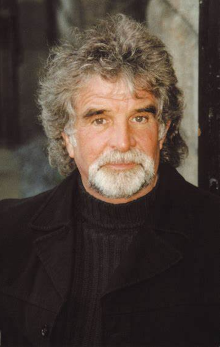
Watchorn first comes to prominence in 1969 as the lead singer of The Quare Fellas, a Dublin-based ballad group. They evolve into the Dublin City Ramblers in the early 1970s and with Watchorn as their lead singer they have hits with songs such as “The Rare Ould Times” and “The Ferryman,” both of which are written by Pete St. John.
Watchorn also writes and sings the Irish Football Team anthem, “We are the Boys in Green” (Home & Away album), with The Dublin City Ramblers for the teams European Championship campaign in Germany and again for the 1990 FIFA World Cup in Italy. The lyrics change slightly in both releases in 1988 and 1990.
In 1995, Watchorn leaves The Dublin City Ramblers and makes a number of solo albums. He joins The Dubliners in 2005, taking Paddy Reilly‘s place. He is well received throughout Ireland, the United Kingdom, Europe, Australia and the United States. He appears on their Tour Sampler EP in 2005, as well as the double album Live at Vicar Street (2006). He plays the banjo, bodhrán and spoons. He cites Luke Kelly, former lead singer with The Dubliners, as his favourite singer.
When The Dubliners announce their retirement in 2012 after finishing their 50 Years Anniversary Tour, Watchorn decides to keep on touring with former band members Seán Cannon and Eamonn Campbell and banjo player Gerry O’Connor under the name of “The Dublin Legends.”
On April 28, 2014, Watchorn posts a message on his website, stating that he has “decided to take a break from the music business for a while” and will not be touring the rest of 2014 with The Dublin Legends. He later admits this is due to ill health and that doctors had advised him that touring would do further damage to his health.
Watchorn’s distinctive and passionate vocals have made him a huge rock on the Irish folk scene. In his solo projects in the mid- and late-1990s, after his departure from The Dublin City Ramblers, he has session men who used to play alongside him and he uses the stage name “Patsy Watchorn, agus a Cháirde” (which means “and his Friends” in Irish).
Among the thousands paying their respects are 4,000 serving and retired gardaí, over 2,000 in uniform. Garda Golden is remembered as a happy man, proud to serve, a role model for the community – and by his brother Patrick as a “big gentle giant.”
In his homily, chief celebrant parish priest Father Pádraig Keenan tells the congregation that the killing of Garda Golden was “cold-blooded murder.” He reminds the mourners that Garda Golden is the 88th garda to die in the line of duty. He says, “It is 88 members too many. He like all the others is mourned by the entire nation.”
“His murder brings to mind once again all the families and communities that have been affected on our island.”
Fr. Keenan says, “Garda Tony’s death once again reflects how north Louth and the Cooley Peninsula have been affected by the tragic history of the Troubles on the island of Ireland, and especially the murder of Detective Garda Adrian Donohoe, three years ago at Lordship Credit Union in Bellurgan.”
He says that too many hearts have been broken, and too many lives shattered. There is no place for violence in our society, violence is wrong, always wrong. He refers to Garda Golden as one of life’s gentlemen.
Fr. Keenan begins the funeral mass by saying that Garda Golden quietly let “his light shine in so many ways through his life in a very humble way. Amidst our sadness may we be thankful for the charisma of his beautiful but too short life.”
The stillness of the water across from the churchyard in Dundalk Bay mirrors the silence and sadness that has unfolded on everyone since the weekend, he tells the congregation.
“Tony was so proud to serve the community of Omeath,” he says. “As one person from Omeath put it to me in recent days, he was ‘our garda’, and to a person amongst his family and colleagues, all are immensely proud of Garda Tony and his selfless nature. Proud of everything he lived for, worked for and stood for. Tony Golden was a much-loved role model in our community.”
Symbols including a family photograph are taken to the altar in memory of Garda Golden. A club jersey and hurley from the Stephenites GAA club in his native Ballina, County Mayo, represent his roots and love of sport. A television remote control, a soft drink, a bar of chocolate and packet of crisps were offered to recall his cherished “time out.”
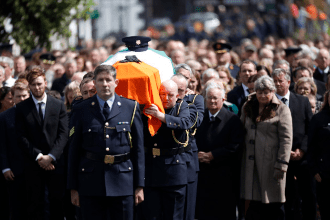
Garda Golden’s final journey begins at the home in the village of Blackrock he shared with his wife Nicola and their three young children, Lucy, Alex and Andrew. The funeral cortège is led by the Garda Commissioner, while thousands of gardaí escort their colleague into his parish church, St. Oliver Plunkett’s, for the funeral mass at noon.
Fr. Keenan is joined on the altar by the vicar general of the Armagh diocese Dean Colum Curry, who represents the Primate of All Ireland, Bishop Eamon Martin. As well as the chaplains to the Garda and the Defence Forces, Bishop John Fleming and Father Gerard O Hora travel to the funeral from Golden’s home county of Mayo.
Screens are erected in the grounds and the village to relay the service to those outside.
Businesses shut down along the route as a mark of respect during the funeral. Roads around the village are sealed off for several hours. Garda Golden is laid to rest at St. Paul’s Cemetery Heynestown.
Golden is killed as he is bringing Siobhan Phillips to her home to retrieve her personal possessions. Phillips is also shot in the incident and is in a critical condition in hospital with her family at her bedside at the time of Garda Golden’s funeral.
President of the Garda Representative Association, Dermot O’Brien, says members of the gardaí from all corners of Ireland traveled to County Louth to pay their respects to their colleague. He says they are grief-stricken and numb.
O’Brien says everyone will reflect in their own way and that the realisation has struck that Garda Golden was murdered doing “a bread-and-butter type call.”
“They are going to ask themselves, those that attended the same type of call on Sunday that it could have been them. These are very similar calls that a lot of members did on Sunday, and they will sit back and reflect on what happened to Tony as they responded to a similar call.”
O’Brien says he had spoken to Garda Golden’s unit in the days leading to the funeral and, while they are coping, they are not well. “They are angry, grieving and disillusioned because today they have to bury a second friend, a murdered friend, a second murdered colleague.”
Father Michael Cusack also speaks of the pain and anger expressed by members of the garda force he met following Garda Golden’s death. Speaking on RTÉ‘s Today with Sean O’Rourke, Fr. Cusack says it is a very difficult day and week for gardaí. He says a lot of care needs to be offered to the members of the force and that there needs to be appropriate follow-up care given.
(From: “Garda Tony Golden ‘mourned by entire nation’,” RTÉ News, http://www.rte.ie, October 15, 2015)
Hogan is the third child of John Hogan, a carpenter and builder of Cove Street, Cork, County Cork, and Frances Cos, the great-granddaughter of Sir Richard Cox, Lord Chancellor of Ireland from 1703 to 1707. As the family feels that she had married beneath her station, she is disinherited.
At the age of fourteen, Hogan is placed as clerk to an attorney, where he spends much of his time carving figures in wood. After two years, he chooses to be apprenticed to the architect Sir Thomas Deane, where his talents for drawing and carving are developed. He carves balusters, capitals, and ornamental figures for Deane’s buildings. At the completion of his apprenticeship in March 1820, Deane encourages him to consider taking up sculpture as a profession. For the next three years, he attends lectures on anatomy, copies casts of classic statuary in the Gallery of the Cork Society of Arts, and makes anatomical studies in wood of feet, hands, and legs. Among the first of his works to attract notice is a life-size figure of Minerva for an insurance building built by Deane.
In 1821, Hogan carves twenty-seven statues in wood for the North Chapel in Cork for the reredos behind the high altar. After subsequent cathedral renovations, these are now positioned in decorative plasterwork over the nave. He also does a bas-relief of the “Last Supper” for the altar. This work keeps him employed for about a year.
In 1823, the engraver William Paulet Carey visits Cork, and impressed with Hogan’s talent, begins to publicise his work in order to raise subscriptions for him to study in Italy. Hogan arrives in Rome, by way of Dublin and Liverpool, in 1824. He works in the galleries of the Vatican but cannot afford a studio. Additional subscriptions allow him to improve his situation, rent a studio, purchase marble, and hire models. Danish sculptor Bertel Thorvaldsen says to him, “My son, you are the best sculptor I leave after me in Rome.”
In 1829, Hogan visits Ireland, bringing several works with him. The Royal Arts Society provides a venue for an exhibition. The Royal Dublin Society awards him a gold medal.
Hogan’s best-known work and masterpiece are the three versions of the statue of The Dead Christ or The Redeemer in Death. Created in flawless Carrara marble, the first version (1829) is located in St. Therese’s Church, Dublin, the second (1833) in St. Finbarr’s (South) Church, Cork, and the third and final version (1854) is located in the Basilica of St. John the Baptist, Newfoundland. His other works include the Sleeping Shepherd and The Drunken Faun. He assures his international reputation in 1829 with The Dead Christ. Thereafter, his creations are snapped up by Irish bishops visiting his Rome studio.
In 1840, a monumental group in memory of Bishop James Warren Doyle, founder of the Cathedral of the Assumption in Carlow, is brought to Dublin and exhibited at the Royal Exchange. The statue of Bishop Doyle is in the Cathedral of the Assumption, as is a second Hogan work depicting the Holy Family.
Hogan marries Cornelia Bevignani in Rome in 1838. The figure of Hibernia, in Hogan’s work Hibernia with the Bust of Lord Cloncurry (1844), is reportedly modelled on his wife. A representation of this work is later used as the watermark on all Series A banknotes printed in Ireland from the 1920s to the 1970s. The couple has four sons and eight daughters.
With the revolutionary movement growing in Italy during the 1840s, and after spending twenty-four years in Rome, Hogan returns with his family to Ireland in 1848. At first, he finds little work in the aftermath of the Great Famine, but gradually commissions increase. He can be impatient with ignorance, intolerant of professional inferiority, and independent. He holds aloof from other artists and refuses to join the Royal Hibernian Academy.
Hogan has a stroke in 1855 and, though he recovers somewhat, his health begins to fail. By the year prior to his death, he can no longer work and his sons, John Valentine Hogan and James Cahill, assist at his studio and complete some of the work.
Hogan dies at his home at 14 Wentworth Place (later renamed Hogan Place), Dublin, on March 27, 1858. He is buried at Glasnevin Cemetery in Dublin.
(Pictured: Scan of a drawing depicting the Irish sculptor John Hogan with his sculpture The Drunken Faun in background, published in the Dublin University Magazine, January 1850)
Hartnett is born in Croom Hospital in Croom, County Limerick, on September 18, 1941. He is one of the most significant voices in late 20th-century Irish writing and has been called “Munster‘s de facto poet laureate.”
Although Hartnett’s parents’ name is Harnett, he is registered in error as Hartnett on his birth certificate. In later life he declines to change this as his legal name is closer to the Irish Ó hAirtnéide. He grows up in the Maiden Street area of Newcastle West, County Limerick, spending much of his time with his grandmother, Bridget Halpin, who resides in the townland of Camas, in the countryside nearby. He claims that his grandmother is one of the last native speakers to live in County Limerick, though she is originally from northern County Kerry. Although she speaks to him mainly in English, he listens to her conversing with her friends in Irish, and as such, he is quite unaware of the imbalances between English and Irish. When he begins school, he is made aware of the tensions between both languages and is surprised to discover that Irish is considered an endangered language, taught as a contrived, rule-laden code, with little of the literary attraction which it holds for him. He is educated in the local national and secondary schools in Newcastle West. He emigrates to England the day after he finishes his secondary education and goes to work as a tea boy on a building site in London.
Hartnett has started writing by this time and his work comes to be known of the poet John Jordan, who is professor of English at University College Dublin (UCD). Jordan invites him to attend the university for a year. While back in Dublin, he co-edits the literary magazine Arena with James Liddy. He also works as curator of James Joyce‘s tower at Sandycove for a time. He returns briefly to London, where he meets Rosemary Grantley on May 16, 1965, and they are married on April 4, 1966. His first book, Anatomy of a Cliché, is published by Poetry Ireland in 1968 to critical acclaim and he returns to live permanently in Dublin that same year.
Hartnett works as a night telephonist at the telephone exchange on Exchequer Street. He now enters a productive relationship with New Writers Press, run by Michael Smith and Trevor Joyce. They publish his next three books. The first of these is a translation from the Irish, The Old Hag of Beare (1969), followed by Selected Poems (1970) and Tao (1972). This last book is a version of the Chinese Tao Te Ching. His Gypsy Ballads (1973), a translation of the Romancero Gitano of Federico García Lorca, is published by the Goldsmith Press.
In 1974 Hartnett decides to leave Dublin and return to his rural roots, as well as deepen his relationship with the Irish language. He goes to live in Templeglantine, five miles from Newcastle West, and works for a time as a lecturer in creative writing at Thomond College of Education, Limerick.
In his 1975 book, A Farewell to English, Hartnett declares his intention to write only in Irish in the future, describing English as “the perfect language to sell pigs in.” A number of volumes in Irish follow including Adharca Broic (1978), An Phurgóid (1983) and Do Nuala: Foighne Chrainn (1984). A biography on this period of his life entitled A Rebel Act Michael Hartnett’s Farewell To English by Pat Walsh is published in 2012 by Mercier Press.
In 1984 Hartnett returns to Dublin to live in the suburb of Inchicore. The following year marks his return to English with the publication of Inchicore Haiku, a book that deals with the turbulent events in his personal life over the previous few years. This is followed by a number of books in English including A Necklace of Wrens (1987), Poems to Younger Women (1989) and The Killing of Dreams (1992).
Hartnett also continues working in Irish, and produces a sequence of important volumes of translation of classic works into English. These include Ó Bruadair, Selected Poems of Dáibhí Ó Bruadair (1985) and Ó Rathaille The Poems of Aodhaghán Ó Rathaille (1999). His Collected Poems appear in two volumes in 1984 and 1987 and New and Selected Poems in 1995.
Hartnett dies in St. Vincent’s Hospital, Dublin, from Alcoholic Liver Syndrome on October 13, 1999. A new Collected Poems appears in 2001.
Every April a literary and arts festival is held in Newcastle West in honour of Hartnett. Events are organised throughout the town and a memorial lecture is given by a distinguished guest. Former speakers include Nuala O’Faolain, Paul Durcan, David Whyte and Fintan O’Toole. The annual Michael Hartnett Poetry Award of € 4,000 also forms part of the festival. Funded by the Limerick City and County Council Arts Office and the Arts Council of Ireland, it is intended to support and encourage poets in the furtherance of their writing endeavours. Previous winners include Sinéad Morrissey and Peter Sirr.
During the 2011 Éigse, Paul Durcan unveils a bronze life-sized statue of Hartnett sculpted by Rory Breslin, in the Square, Newcastle West. Hartnett’s son Niall speaks at the unveiling ceremony.
Britain’s enemies in Continental Europe have long recognised Ireland as a weak point in Britain’s defences. Landing troops there is a popular strategic goal, not only because an invader can expect the support of a large proportion of the native population, but also because at least initially they will face fewer and less reliable troops than elsewhere in the British Isles. Additionally, embroiling the British Army in a protracted Irish campaign will reduce its availability for other theatres of war. Finally, French planners consider that a successful invasion of Ireland might act as the ideal platform for a subsequent invasion of Great Britain.
Unaware of Humbert’s surrender, the French despatch reinforcements under the command of CommodoreJean-Baptiste-François Bompart on September 16. Having missed one invasion force, the Royal Navy is more watchful. Roving frigate patrols cruise off the principal French ports and in the approaches to Ireland, while squadrons of battleships from the Channel Fleet sail nearby, ready to move against any new invasion force. In command of the squadron on the Irish station is Commodore Sir John Borlase Warren, a highly experienced officer (and politician) who has made a name for himself raiding the French coast early in the war.
The squadron carrying the reinforcements is soon spotted after leaving Brest. After a long chase, the French are brought to battle in a bay off the rugged County Donegal coast in the west of Ulster, very close to Tory Island. During the action the outnumbered French attempt to escape, but are run down and defeated piecemeal, with the British capturing four ships and scattering the survivors. Over the next fortnight, British frigate patrols scour the passage back to Brest, capturing three more ships. Of the ten ships in the original French squadron, only two frigates and a schooner reach safety. British losses in the campaign are minimal.
The battle marks the last attempt by the French Navy to launch an invasion of any part of the British Isles. It also ends the last hopes the United Irishmen have of obtaining outside support in their struggle against the British. After the action, Wolfe Tone is recognised aboard the captured French flagship and arrested. He is brought ashore by the British at Buncrana, on the Inishowen peninsula. He is later tried for treason, convicted, and commits suicide while in prison in Dublin, hours before he is to be hanged.
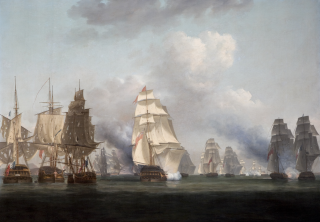
(Pictured: Attack of the French Squadron under Monsr. Bompart Chef d’Escadre, upon the Coast of Ireland, by a Detachment of His Majesty’s Ships under the Command of Sir J. B. Warren, October 12, 1798, by Nicholas Pocock, 1799)





 seamus dubhghaill