Clarke is the son of William Clarke, merchant seaman, and Margaret Clarke (née Austin). Educated locally, he leaves school at the age of eleven and begins work as a kitchen porter, later becoming a boot-shop assistant, a harness maker and a van driver. Influenced by a series of lectures at the Oliver Bond Club, Parnell Square, and by the writings of Arthur Griffith, he commits himself to the republican cause, joining the Irish Republican Brotherhood (IRB) in 1913 and subsequently the Irish Volunteers.
On his return to Ireland, Clarke acts as the courier for the First Dáil and serves as an usher at the first meeting of the First Dáil. He is interned from January 1921. Released in 1923, he acts as caretaker of the Sinn Féin headquarters on Harcourt Street and founds the Irish Book Bureau. Although the Anti-Treaty Sinn Féin rejects participation in the Dáil, they continue to contest local elections, and Clarke sits on Dublin City Council.
Although jailed many times between 1922 and 1940, Clarke remains an active republican campaigner, supporting the Irish Republican Army (IRA) initiatives of the 1940s and 1950s, taking a prominent role at republican meetings, and publicising the conditions of republican prisoners.
Although Clarke had served under Éamon de Valera during the Easter Rising, the two become implacable opponents. He is ejected from an official commemoration of the fiftieth anniversary of the First Dáil for interrupting de Valera’s speech in order to raise the complaints of the Dublin Housing Action Committee (DHAC). He vows to outlive de Valera and succeeds in this endeavour by outliving him a year.
Clarke is elected as a Vice-President of Sinn Féin in 1966. In the split of 1970, he supports the provisional wing, remaining Vice-President. In 1973 he is deported from Britain upon his arrival at Heathrow Airport.
Despite crippling arthritis, Clarke continues his work, refusing an IRA pension as he considers himself still on active service. He dies on April 22, 1976, at St. James’s Hospital, Dublin, and is buried in Glasnevin Cemetery close to the republican plot.
Clarke marries Anne, daughter of Thomas Hughes, sawyer, on July 25, 1909. They have two sons and one daughter. After her death, he marries Elizabeth Delaney on May 30, 1949.
The Dublin South West Inner City cumann of Sinn Féin is named for Clarke.
(Pictured: Joe Clarke selling Easter Lilies on Dublin’s O’Connell Street in 1966)
Thompson is the eldest son of William Thompson, a prosperous linen merchant, and Elizabeth Thompson (née Callwell). He has at least two older sisters and several younger brothers. His mother’s father is Robert Callwell, a printer, book-collector, partner in the Commercial Bank, Belfast, and one of the owners of the Northern Star newspaper.
After attending the Royal Belfast Academical Institution (RBAI) from 1818, Thompson is apprenticed in the linen business of William Sinclair in 1821. When his apprenticeship ends, he goes with his cousin George Langtry, later a wealthy shipowner, on a four-month tour (May–September 1826) of the Low Countries, the Rhine, Switzerland, and Italy. On his return to Belfast, he sets up his own business in linen bleaching. Despite early success, losses are incurred. As family and economic circumstances change, he increasingly concentrates on his natural history studies. By 1831 he has given up business. A self-taught naturalist, related by ties of kinship or friendship to most of the liberal and cultivated families of the “northern Athens,” he is shy and fastidious, but is persuaded in 1826 to join the Belfast Natural History Society by its founder, his friend James Lawson Drummond. He reads his first scientific paper, The Birds of the Copeland Islands, to the society on August 13, 1827. In that year he becomes a member of the Belfast Natural History Society’s council, and in 1833 he is chosen as one of the society’s vice-presidents. He is president from 1843 until his death.
Thompson becomes the most important naturalist in mid nineteenth-century Ireland. From 1827 to 1852 he contributes almost eighty papers on Irish natural history to the Magazine of Zoology and Botany and the Proceedings of the Zoological Society of London. From 1836 to 1851 he contributes to The Magazine of Natural History. Invited to travel to the Levant and the Aegean Sea in April–July 1841 with Edward Forbes, professor of natural history at the University of Edinburgh, on HMS Beacon, he observes twenty-three species of birds on migratory flights and publishes “Notice of migratory birds” in The Annals of Natural History. His authoritative observations add considerably to knowledge of the still-to-be-ascertained details of migratory patterns. Indeed, some people refuse to believe, even at that date, that birds do migrate. He publishes other papers in the same journal during 1841–43. At a meeting of the British Association for the Advancement of Science in Glasgow in 1840 his Report on the fauna of Ireland (Vertebrata) attracts favourable notice. He presents and publishes a second and final part enumerating the invertebrates at the Cork meeting of the British Association in August 1843. The two reports form the most complete catalogue of Irish fauna yet published. Thanks to an assiduous correspondence with a network of informants, as well as his own extensive observations, he adds perhaps more than 800 species to Irish fauna lists.
Thompson’s chief work, The Natural History of Ireland, becomes the standard text in Irish zoology in the nineteenth century. The first three volumes, published between 1849 and 1851, deal with birds, particularly their habits and habitats rather than physical descriptions. He is one of the first naturalists to note the effects of industrialisation and other human activities on birdlife. He leaves instructions for his manuscripts on the remaining vertebrates and all the invertebrates to be prepared for publication by Robert Patterson and James Ramsey Garrett. Robert Ball and George Dickie also assist. His notes, though detailed and comprehensive, all require checking, and are found on tiny scraps of paper, even scribbled on the flaps of old envelopes. James Thompson of Macedon, Belfast, painstakingly gums them all into blank notebooks to facilitate the work of his brother’s literary executors, who preface the posthumous publication in 1856 with a lengthy memoir of their friend.
From about 1820 to 1852 Thompson lives with his mother at 1 Donegall Square West, Belfast, commuting from Holywood House, Holywood, County Down, during the summer. His daily routine begins with research, correspondence, or writing for publications for four hours after breakfast. After a two- or three-hour exercise period and dinner, he returns to work for a further two to three hours. He is president of the Belfast Literary Society (1837–39) and also an enthusiastic patron of the visual arts in the city. He enjoys hunting, wildfowling, shooting in Scotland, and gardening, though his health deteriorates from the 1840s.
Early in 1852 Thompson travels to London to make arrangements for that year’s Belfast meeting of the British Association. On February 15 he becomes ill, having suffered a minor stroke. He dies, unmarried, at his Jermyn Street lodgings on the day he is due to return home, February 17, 1852. He is buried in Clifton Street Cemetery, Belfast. He bequeaths his collection to the Belfast Natural History Society, and in March 1852 the Society adds a memorial Thompson Room to its museum, paid for by subscription.
Thompson is a corresponding member of natural history societies in Boston and Philadelphia and has many friends. He is known to assist many other researchers in Ireland, Britain, and the Continent. One of those who thinks highly of his work is Charles Darwin, with whom he corresponds. He also helps many local people, including the poet Francis Davis, with money and practical assistance. He is much loved, and his friends are deeply saddened by his death. His niece, Sydney Mary Thompson, later known by her married surname, Christen, who is born in Belfast, is an amateur naturalist, geologist, and artist, one of the first women to achieve distinction in geology.
(From: “Thompson, William” by Andrew O’Brien and Linde Lunney, Dictionary of Irish Biography, http://www.dib.ie, October 2009)
When the war breaks out, one of the Boers’ early targets is the diamond-mining centre of Kimberley, which stands not far from the point where the borders of the Boer republics of the Transvaal and the Orange Free State, and the British-controlled Cape Colony meet. Although their forces surround the town, they do not press home any immediate assault. Nor do they attempt to cross the Orange River on this front to invade Cape Colony.
Meanwhile, British reinforcements are on their way to South Africa. Their commander, General Sir Redvers Buller, detaches the 1st Division under Lieutenant General Lord Methuen to relieve the Siege of Kimberley. This decision is made partly for reasons of prestige, as the capture of Kimberley, which contains the famous Imperialist and former Prime Minister of Cape Colony, Cecil Rhodes, would be a major propaganda victory for the British.
During November, Methuen’s force advances north along the Western Cape Railway. They fight and win two engagements against Boers from the Orange Free State under General Prinsloo at the Battle of Belmont and at the Battle of Graspan. At least one American, Lance Corporal Hollon Bush of the 7th Company, First Battalion Coldstream Guards is present and wounded at the Battle of Modder River. His journey to enlist from departure in New Orleans to England is not without many pitfalls before beginning service at the Tower of London, then on to Gibraltar and South Africa.
Methuen’s force consists of two infantry brigades, the Guards Brigade under Major-General Sir Henry Edward Colville and the 9th Brigade under Major-General Reginald Pole-Carew, two mounted regiments, three batteries of field artillery (18th, 62nd and 75th) and four guns of the Naval Brigade. Further reinforcements are arriving up the railway.
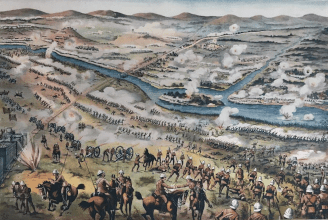
The British cavalry (the 9th Queen’s Royal Lancers and a unit recruited in Cape Town, Rimington’s Guides) make some attempts to scout the ground ahead of the army but fail entirely to detect General Koos de la Rey‘s trenches and other preparations. For example, the Boers had whitewashed stones on the veld or had placed biscuit tins as range markers. At 4:30 a.m. on November 28, Methuen’s force rouses itself, deploys into line and begins advancing toward the Modder River, with no plans other than to cross the river before having breakfast on the far side.
As the British troops come within 1,200 yards of the river, Methuen remarks to Colville, “They’re not here.” Colville replies, “They’re sitting uncommonly tight if they are.” At this point the Boers open fire. Most of the British troops are forced to throw themselves flat. Some try to advance in short rushes but can find no cover on the veld. Few British troops get closer than 1,000 yards to the Boers. The Guards try to outflank the Boer left but are unable to ford the Riet River. The British guns pound the buildings near Modder River Station and the line of poplar trees which mark the north bank of the Modder River, and entirely miss the enemy trenches on the south bank. Meanwhile, the Boer guns maintain a galling fire and are kept in action by repeatedly moving their positions.
The battle becomes a day-long stalemate. Most of the British infantry lay prone on the veld, tortured by heat and thirst, but safe from enemy fire unless they move. Many stoically smoke pipes or even sleep. Methuen gallops about the field trying to renew the advance and is himself wounded. At midday, some of Pole-Carew’s 9th Brigade find the open Boer right flank at Rosmead drift (ford) downstream. British infantry infiltrates across the ford and at about 1:00 p.m. drives the Boers out of Rosmead. The attack is disjointed and suffers casualties when a British field artillery battery which had just arrived on the field shells them by mistake. By nightfall, De la Rey has driven them back into a small insecure bridgehead.
Nevertheless, the Boers fear that they are now vulnerable to being outflanked and withdraw during the night.
Methuen reports that the battle had been “one of the hardest and most trying fights in the annals of the British army.” Although casualties are not cripplingly heavy (between 450 and 480), mainly because the Boers opened fire prematurely, it is clear that any simple frontal attack by infantry only against an enemy using bolt action rifles, is effectively impossible. The British are forced to pause for ten days, to evacuate their casualties, receive further reinforcements and repair their lines of communications. The delay allows the Boers to construct the entrenchments which they are to defend in the Battle of Magersfontein.
On the Boer side, there are about 80 casualties, including, Adriaan, the eldest son of Koos de la Rey, mortally wounded by a shell.
(Pictured: An illustration of the Battle of Modder River during the Second Boer War. This illustration is more dramatic than the actual battle, and is meant to amplify the British side of the war, Bacon’s South Africa War Prints, G. W. Bacon & Co. London)
Orpen is the fourth and youngest son of Arthur Herbert Orpen (1830–1926), a solicitor, and his wife, Anne Caulfield (1834–1912), the eldest daughter of the Right Rev. Charles Caulfield (1804–1862), the Bishop of Nassau. Both his parents are amateur painters, and his eldest brother, Richard Caulfield Orpen, becomes a notable architect. His nieces are Bea Orpen and Kathleen Delap. The historian Goddard Henry Orpen is his second cousin. The family lives at “Oriel,” a large house with extensive grounds containing stables and a tennis court. He appears to have a happy childhood there.
Orpen is a naturally talented painter, and six weeks before his thirteenth birthday is enrolled at the Dublin Metropolitan School of Art. During his six years at the college, he wins every major prize there, plus the British Isles gold medal for life drawing, before leaving to study at the Slade School of Fine Art in London between 1897 and 1899. At the Slade he masters oil painting and begins to experiment with different painting techniques and effects.
While at the Slade, Orpen becomes engaged to Emily Scobel, a model and the subject of his painting The Mirror (1900). She ends their relationship in 1901, and he marries Grace Knewstub, the sister-in-law of Sir William Rothenstein. He and Knewstub have three daughters together, but the marriage is not a happy one. By 1908, he has begun a long-running affair with Evelyn Saint-George, a well-connected American millionairess based in London, with whom he also has a child.
Orpen first exhibits at the New English Art Club (NEAC) in 1899, becoming a member in 1900. In 1901, he holds a solo exhibition at the Carfax Gallery in central London. His portraits, which establish his reputation, show the influence of the Realist artist Édouard Manet. He also becomes known as a painter of group portraits such as Homage to Manet (1909), in which he portrays members of the contemporary English art world sitting in conversation beneath a famous portrait by that artist.
At the start of World War I, a number of Irish people living in England return to Ireland to avoid conscription. Among them is Orpen’s studio assistant and former pupil, Seán Keating. Keating encourages him to do likewise, but he refuses and commits himself to supporting the British war effort. In December 1915, he is commissioned into the Royal Army Service Corps and reports for clerical duty at London’s Kensington Barracks in March 1916. Throughout 1916 he continues painting portraits, most notably one of a despondent Winston Churchill, but soon starts using both his own contacts and those of Evelyn Saint-George, to secure a war artist posting.
He is the official painter of the Paris Peace Conference after World War I. Throughout 1919 he paints individual portraits of the delegates to the Conference and these form the basis of his two large paintings, A Peace Conference at the Quai d’Orsay and The Signing of Peace in the Hall of Mirrors. In both pictures, the architecture overwhelms the gathered politicians and statesmen who’s political wranglings and vainglory diminish them in Orpen’s eyes.
Orpen becomes seriously ill in May 1931, and, after suffering periods of memory loss, dies at the age of 52 on September 29, 1931, in South Kensington, London, of liver and heart failure. He is buried at Putney Vale Cemetery in southwest London. A stone tablet in the Island of Ireland Peace Park Memorial at Mesen, Belgium, commemorates him. He is posthumously regarded as a facile and prolific, but somewhat superficial, artist who nevertheless achieves great popularity in his day.
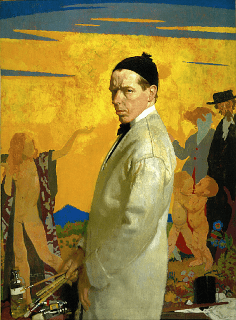
(Pictured: “Self-portrait” (1913), oil on canvas by William Orpen, Saint Louis Art Museum)
Needham then holds a staff appointment in Ireland, and during the Irish Rebellion of 1798 commands the crown forces at the Battle of Arklow on June 9, 1798. He places his approximately 1,600 troops in strong positions at the eastern and western ends of the town, where they can sweep the Arklow Rock Road and the Coolgreany Road with fire if the rebels approach along them. Ultimately, this is what the United Irish force, estimated at 5,000–9,000 strong, does, repeatedly attacking Needham’s right flank, which is in fact his strongest position. Estimates of the United Irish dead range from 200 to 1,000, and the failure of the attack ensures that the rebels lose the military initiative. He is also present at the Battle of Vinegar Hill on June 21, 1798, but his force arrives late, leaving a gap in the British line through which many rebels escape. This is later christened “Needham’s gap,” earning him the nickname of “the late General Needham” among his fellow officers.
Promoted to lieutenant-general in 1802, Needham is made colonel of the 5th Royal Veteran Battalion in 1804, entering House of Commons as MP for Newry in 1806. He is made full general in 1812, and, following the death of his two older brothers, succeeds as 12th Viscount Kilmorey in November 1818, resigning his parliamentary seat. On January 12, 1822, he is created 1st Earl of Kilmorey (Queen’s County) and Viscount Newry and Mourne. He dies on November 21, 1832, at the family seat, Shavington Hall, Shropshire, and is buried in St. Peter’s Church, Adderley.
Needham marries Anne Fisher, daughter of Thomas Fisher of Acton, Middlesex, on February 20, 1787. They have two sons, Francis Jack Needham, who succeeds as 2nd Earl, and the Hon. Francis Henry William Needham, lieutenant-colonel in the Grenadier Guards, and seven daughters. There are Needham letters in the Public Record Office (PRO), Kew, and in the Rebellion Papers in the National Archives of Ireland in Dublin.
Parsons also performs some preliminary work in association with the practices of the electrodeposition of copper sulfate upon silver films circa 1865 while in search of the design for a truly flat mirror to use in a telescope. However, he finds it impossible to properly electroplate copper upon these silver films, as the copper contracts and detaches from the underlying glass substrate. His note has been cited as one of the earliest confirmations in literature that thin films on glass substrates experience residual stresses. He revives discussion in his work Nature’s August 1908 edition after witnessing similar techniques used to present newly devised searchlights before the Royal Society.
Although overshadowed by his father (when astronomers speak of “Lord Rosse”, it is almost always the father that they refer to), Parsons nonetheless pursues some astronomical observations of his own, particularly of the Moon. Most notably, he discovers NGC 2, a spiral galaxy in the constellationPegasus.
After some years of ill-health, Parsons dies on August 30, 1908, at Birr Castle and is buried in the local churchyard. He leaves a bequest to the Royal Society to establish the “Rosse Fund,” and a further £1,000 to the science school fund at TCD.
Emmett is born in the Hammond’s Marsh area of Cork, County Cork, on April 24, 1764, the son of Dr. Robert Emmet from County Tipperary (later to become State Physician of Ireland) and Elizabeth Mason of County Kerry, both of whose portraits are today displayed at Cork’s Crawford Art Gallery. He is the elder brother of Robert Emmet, who is executed for leading the Irish Rebellion of 1803, becoming one of Ireland’s most famous republican martyrs. His sister, Mary Anne Holmes, holds similar political beliefs.
Emmet is a man of liberal political sympathies and becomes involved with a campaign to extend the democratic franchise for the Irish Parliament and to end discrimination against Catholics. He is called to the Irish bar in 1790 and quickly obtains a practice, principally as counsel for prisoners charged with political offenses. He also becomes the legal adviser of the Society of the United Irishmen.
When the Dublin Corporation issues a declaration of support of the Protestant Ascendancy in 1792, the response of the United Irishmen is their nonsectarian manifesto which is largely drawn up by Emmet. In 1795 he formally takes the oath of the United Irishmen, becoming secretary in the same year and a member of the executive in 1797. As by this time the United Irishmen had been declared illegal and driven underground, any efforts at peaceful reform of government and Catholic emancipation in Ireland are abandoned as futile, and their goal is now the creation of a non-sectarian Irish republic, independent from Britain and to be achieved by armed rebellion. Although Emmet supports this policy, he believes that the rebellion should not commence until French aid has arrived, differing from more radical members such as Lord Edward FitzGerald.
British intelligence infiltrates the United Irishmen and manages to arrest most of their leaders on the eve of the rebellion. Though not among those taken at the house of Oliver Bond on March 12, 1798, Emmet is arrested about the same time and is one of the leaders imprisoned initially at Kilmainham Gaol and later in Scotland at Fort George until 1802. Upon his release he goes to Brussels where he is visited by his brother Robert in October 1802 and is informed of the preparations for a fresh rising in Ireland in conjunction with French aid. However, at that stage France and Britain are briefly at peace, and the Emmets’ pleas for help are turned down by Napoleon.
Emmet receives news of the failure of his brother’s rising in July 1803 in Paris, where he is in communication with Napoleon. He then emigrates to the United States and joins the New York bar where he obtains a lucrative practice.
After the death of Matthias B. Hildreth, Emmet is appointed New York State Attorney General in August 1812 but is removed from office in February 1813 when the opposing Federalist Party obtains a majority in the Council of Appointment.
Ferguson is the son of a farmer. In 1902, he goes to work with his brother, Joe, in his bicycle and car repair business. While working there as a mechanic, he develops an interest in aviation, visiting air shows abroad. In 1904, he begins to race motorcycles.
The first person to accomplish powered flight in the UK is Alliot Verdon Roe in June 1908, who also flies an aeroplane of his own design, but this has not yet been achieved in Ireland. Ferguson begins to develop a keen interest in the mechanics of flying and travels to several air shows, including exhibitions in 1909 at Blackpool and Rheims where he takes notes of the design of early aircraft. He convinces his brother that they should attempt to build an aircraft at their Belfast workshop and, working from his notes, they work on the design of a plane, the Ferguson monoplane.
After making many changes and improvements, they transport their new aircraft by towing it behind a car through the streets of Belfast up to Hillsborough Park to make their first attempt at flight. They are at first thwarted by propeller trouble but continue to make technical alterations to the plane. After a delay of nearly a week caused by bad weather, the Ferguson monoplane finally takes off from Hillsborough on December 31, 1909. Ferguson becomes the first Irishman to fly and the first Irishman to build and fly his own aeroplane.
After falling out with his brother over the safety and future of aviation, Ferguson decides to go it alone, and in 1911 founds a company selling Maxwell, Star and Vauxhall cars and Overtime Tractors. He sees at first hand the weakness of having tractor and plough as separate articulated units, and in 1917 he devises a plough that can be rigidly attached to a Ford Model T car — the Eros, which becomes a limited success, competing with the Fordson Model F.
In 1917 Ferguson meets Charles E. Sorensen while Sorensen is in England scouting production sites for the Fordson tractor. They discuss methods of hitching the implement to the tractor to make them a unit. In 1920 and 1921 he demonstrates early versions of his three-point linkage on Fordson tractors at Cork and at Dearborn, Michigan. He and Henry Ford discuss putting the Ferguson system of hitch and implements onto Fordson tractors at the factory, but no deal is struck. At the time the hitch is mechanical. Ferguson and his team of longtime colleagues, including Willie Sands and Archie Greer, soon develop a hydraulic version, which is patented in 1926. After one or two false starts, he eventually founds the Ferguson-Sherman Inc., with Eber and George Sherman.
The new enterprise manufactures the Ferguson plough, incorporating the patented “Duplex” hitch system mainly intended for the Fordson “F” tractor. Following several more years of development, Ferguson’s new hydraulic version of the three-point linkage is first seen on his prototype “Ferguson Black” or ‘Irish tractor’ as he calls it, now in the Science Museum, South Kensington, London. A production version of the “Black” is introduced in May 1936, made at one of the David Brown Engineering Ltd. factories in Huddersfield, West Yorkshire, and designated Ferguson Model A tractor.
In October 1938, Ferguson demonstrates his latest tractor to Henry Ford at Dearborn, and they make the famous “handshake agreement.” He takes with him his latest patents covering future improvements to the Ferguson tractor and it is these that lead to the Ford-Ferguson 9N introduction to the world on June 29, 1939.
Henry Ford II, Ford’s grandson, ends the handshake agreement on June 30, 1947, following unsuccessful negotiations with Ferguson, but continues to produce a tractor, the 8N, incorporating Ferguson’s inventions, the patents on almost all of which have not yet expired, and Ferguson is left without a tractor to sell in North America. His reaction is a lawsuit demanding compensation for damage to his business and for Ford’s illegal use of his designs. The case is settled out of court in April 1952 for just over $9 million. The court case costs him about half of that and a great deal of stress and ill health.
By 1952, most of the important Ferguson patents have expired, and this allows Henry Ford II to claim that the case had not restricted Ford’s activities too much. It follows that all the world’s other tractor manufacturers can also use Ferguson’s inventions, which they do. A year later Ferguson merges with Massey-Harris Limited to become Massey-Harris-Ferguson Co., later Massey Ferguson.
Ferguson dies at his home at Stow-on-the-Wold, Gloucestershire, England, on October 25, 1960, as the result of a barbiturate overdose. The inquest is unable to conclude whether his death had been accidental or not.
A blue plaque commemorating Ferguson is mounted on the Ulster Bank building in Donegall Square, Belfast, the former site of his showroom. A granite memorial has been erected to Ferguson’s pioneering flight on the North Promenade, Newcastle, County Down, and a full-scale replica of the Ferguson monoplane and an early Ferguson tractor and plough can be seen at the Ulster Folk and Transport Museum at Cultra, County Down. Today his name lives on in the name of the Massey Ferguson company.
O’Brien is a ship builder and designer, and his notable boats include the Kelpie (used for gun running in 1914), the Saoirse (in which he circumnavigates the globe) and the Ilen (a Falkland Islands service ship).
O’Brien is credited with two buildings in his lifetime: the Co-operative Hall in County Donegal and the People’s Hall in County Limerick. He is also known as a naval architect, having designed two ships, the Saoirse and the llen. He later captains both of these ships himself.
In Saoirse, a 20-ton, 42-foot ketch designed and built in 1922 in Baltimore, County Cork, he and three crew members circumnavigate the globe between 1923 and 1925 – the first recorded by an amateur skipper from west to east, the first yacht circumnavigation by way of the three great capes: Cape Horn, Cape of Good Hope and Cape Leeuwin, and the first boat flying the Irish tri-colour to enter many of the world’s ports and harbours. His voyage begins and ends at the Port of Foynes, County Limerick, where he lives. His account of the voyage, Across Three Oceans, (1927) becomes one of the classics of maritime literature.
Up until O’Brien’s circumnavigation, this route is the preserve of square-rigged grain ships taking part in the grain race from Australia to England via Cape Horn (also known as the clipper route).
O’Brien’s seagoing experiences are put to use in his design of the Ilen, which is built for the Falkland Islands as a service boat and launched in the spring of 1926. In 1998, Ilen returns to the site where she was first built, on the River Ilen near Baltimore, County Cork, where she undergoes a full restoration and is re-launched in May 2018. This task provides work-based learning for the students of the Ilen School.
O’Brien has some involvement with gun running in 1914 on behalf of the Irish Volunteers, for political reasons and because he has experience in sailing. On July 26, 1914, nine hundred guns are brought to Howth harbour aboard Erskine Childers‘ yacht Asgard. As part of the same operation, O’Brien transports arms on his yacht, Kelpie. The guns on Kelpie are transshipped to another yacht, Chotah, owned by Sir Thomas Myles, before being landed at Kilcoole in County Wicklow on August 1, 1914. After the gun running incidents, he serves in the Royal Naval Volunteer Reserve.
In 1928, O’Brien marries a well-known artist, Kathleen Francis, the youngest daughter of Sir George Clausen, RA. The couple thereafter moves to Ibiza, where they live on the Saoirse until Kathleen’s death in 1936. They have no children. Relocating to Cornwall, where he lives with his sister, he writes books on sailing and works of fiction for children. Although too old for active service when war with Germany breaks out in 1939, he assists the British war effort by serving in the Small Ships Pool, which delivers support vessels across the Atlantic and brings food supplies from the United States in private yachts.
In 1940 O’Brien sells Saoirse to the Royal Cornwall Yacht Club. The boat remains in use until 1980, when it is lost off the Jamaican coast. After the war he retires to another sister’s home in Foynes, County Limerick, where he lives and continues to write books for children until his death on April 18, 1952.
Hogan is one of four sons and three daughters of Patrick Hogan, farmer, and Margaret Hogan (née Galvin). His family are staunch nationalists who have been heavily involved in the land struggle. He is the brother of Major General Daniel (Dan) Hogan, who is Chief of Staff of the Defence Forces in the 1920s. On November 19, 1920, Hogan is elected company commander of the Irish Republican Army (IRA) in the Grangemockler area, where he is working on the family farm.
A dedicated footballer, Hogan is the established full back on the Tipperary county football team. During the Irish War of Independence very few championships are completed, and challenge matches are the chief attraction. Following the success of a Kildare–Dublin challenge match, a challenge is organised between Tipperary and Dublin at Croke Park, Dublin, on November 21, 1920.
The day before the match, Hogan travels on the train with the other members of the team. A number of the players, including Hogan, become involved in a fight with soldiers from the Royal Lincolnshire Regiment before throwing them from the train. On arrival at (Kingsbridge) Heuston Station, they quickly go their separate ways anticipating arrest. Michael and Thomas “Tommy” Ryan, the two IRA members on the team, decide to stay at Philip Shanahan‘s pub in Monto that night, rather than Barry’s Hotel as planned. There they learn that “there is a ‘big job coming off” the following day but are unaware of the details.
On the morning of the match, fourteen members of the British intelligence service are assassinated by the IRA. This leads to concerns about the match and the safety of spectators, and the Dublin brigade of the IRA urges that the game be cancelled. Shanahan informs the team of the shooting of the British agents. Ryan claims that Dan Breen advised them it would be better not to attend the match, but instead to return to Tipperary. Leading Gaelic Athletic Association (GAA) officials Jim Nowlan, Dan MacCarthy and Luke O’Toole decide the match should proceed, arguing that a postponement would associate the IRA’s activities with the GAA.
Dublin and Tipperary are two of the best teams in the country at the time (and later contest the 1920 All-Ireland Senior Football Championship final when it is eventually played in 1922), so despite the events of the morning, a large crowd of some 10,000 people are in attendance.
At 3:00 p.m., not long after the match has started, a British military plane flies over and drops a flare, signaling British forces to converge on the ground. Black and Tans enter Croke Park and open fire on the crowd.
Hogan drops to the ground and is crawling to safety when a bullet hits him in the mouth. Tom Ryan, a young spectator from Wexford, enters the pitch to pray beside the dying Hogan and is also fatally shot. Another player, Jim Egan, is wounded, but survives. In all, fourteen people are killed and dozens are wounded and injured. The events of that day come to be known as “Bloody Sunday.”
Hogan’s body is returned to Grangemockler for burial on November 24, 1920. A huge crowd attends the funeral. He is buried in his football colours in a coffin draped with the tricolour. The GAA commemorates him by naming the main stand at Croke Park after him and erecting a monument to his memory at Grangemockler. His football jersey is in the South Tipperary County Museum in Clonmel.




 seamus dubhghaill