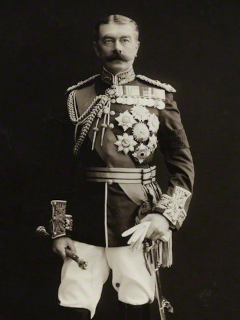
Kitchener is the second son of Lieutenant Colonel Henry Horatio Kitchener and his first wife, Frances Anne (née Chevallier), daughter of clergyman John Chevallier. Col. Kitchener resigns his commission in 1849 and purchases Ballygoghlan House estate near Tarbert, County Kerry, in early 1850 under the provisions of the Encumbered Estates Act of 1849. Ballygoghlan House is in a state of disrepair, however, and the family lives in Gunsborough Villa until the end of 1850. In 1857, Col. Kitchener purchases Crotta House, near Kilflynn, County Kerry, and the Kitcheners divide their time between the two residences. While innovative and successful in his agricultural methods, Col. Kitchener is harsh towards his tenants and, after carrying out many evictions, becomes extremely unpopular in the area. He is a rigid disciplinarian and occasionally punishes his son severely.
Although Kitchener attends Ballylongford village school, his education is largely neglected. When examined by his cousin Francis Elliot Kitchener, fellow of Trinity College Dublin (TCD), he is found to have only the most rudimentary knowledge of grammar and arithmetic. Education by private tutors follows. In 1864, his father sells his Irish estates and moves to Switzerland for the sake of his wife’s health. After further private tuition, he passes into the Royal Military Academy, Woolwich, in 1868, and is commissioned into the Royal Engineers in December 1870.
Kitchener begins his career on survey missions and carries out such work in Palestine (1874–78) and Cyprus (1878–82). He then enters the Egyptian Army and takes part in the Sudan campaign of 1883–85, organised to relieve Genral Charles George Gordon. Subsequent appointments include governor of Suakin (1886–88), adjutant-general of the Egyptian Army (1888–92), and Sirdar (Commander-in-Chief) of the Egyptian Army (1892–96). After the Dongola Expedition in 1896, he is promoted to major-general. He commands the Khartoum Expedition of 1898, defeating Mahdist forces at Atbara and Omdurman, and is raised to the peerage.
At the outbreak of the Second Boer War in 1899, he is appointed chief of staff to Frederick Roberts, 1st Earl Roberts, and assumes total command, with the rank of lieutenant-general, in 1900. While acting as commander-in-chief in South Africa he reorganises the British forces and, using new tactics, manages finally to defeat the Boers. He is severely criticised in the world press for the conditions in the concentration camps where Boer families are confined, but is made a viscount, promoted to general, and awarded £50,000 by parliament at the end of the war.
Kitchener serves as commander-in-chief in India beginning in 1902, is promoted to Field Marshal in 1909, and is a member of the Committee of Imperial Defence (1910) and consul-general in Egypt (1911–14). At the outbreak of World War I he is made Secretary of State for War and begins to reorganise the British Army, an immense achievement, raising 1,700,000 men in service battalions by May 1915, creating an army of volunteers to reinforce the depleted regular army in Belgium and France. An archconservative, he totally opposes Home Rule for Ireland, and initially blocks plans by John Redmond for the formation of a southern Irish division from members of the National Volunteers. Convinced that an all-Irish brigade or division would be a security risk, he rejects Redmond’s suggestions in a meeting of August 1915 and originally proposes dispersing Irish recruits through the numerous regiments in the army. Impressed by Redmond’s persistence, and impelled by the recruiting crisis of late 1915, he finally reverses his decision and sanctions the establishment of the 16th (Irish) Division.
On June 5, 1916, Kitchener is making his way to Russia on HMS Hampshire to attend negotiations with Tsar Nicholas II when in bad weather the ship strikes a German mine 1.5 miles (2.4 km) west of Orkney, Scotland, and sinks. He is among 737 who perish. He is the highest-ranking British officer to die in action in the entire war.
Although he only spends his early years in Kerry, Kitchener occasionally returns to Ireland. While on leave in June 1910 he goes on a tour of County Kerry, visiting places connected to his childhood. There are numerous portraits and memorials to him in England, including a marble effigy by W. Reid Dick in St. Paul’s Cathedral in London and a statue by John Tweed in Horse Guards Parade, London. There is a commemorative bible in the Church of Ireland church at Kilflynn, County Kerry, where he regularly attended Sunday service as a boy. There are some Kitchener letters in the John Redmond papers in the National Library of Ireland.
(From: “Kitchener, Horatio Herbert” by David Murphy, Dictionary of Irish Biography, http://www.dib.ie, October 2009)
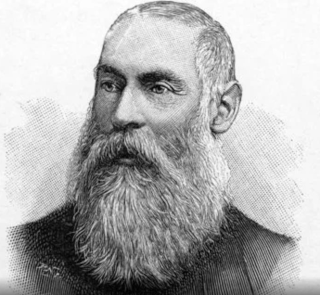
Boycott is born on March 12, 1832, at Burgh St. Peter, Norfolk, England, eldest surviving son of William Boycatt (1798–1877), rector of Wheatacrebury, Norfolk, and Elizabeth Georgiana Boycatt (née Beevor). The family name is changed to Boycott by his father in 1862. Educated at a boarding school in Blackheath, London, and the Royal Military Academy, Woolwich, he is commissioned ensign in the 39th (Dorsetshire) Regiment of Foot on February 15, 1850, and serves briefly in Ireland. He sells his commission on December 17, 1852, having attained the rank of captain, marries Annie Dunne of Queen’s County (County Laois) in 1852, and leases a farm in south County Tipperary.
In 1855, Boycott leaves for Achill Island, County Mayo, where he sub-leases 2,000 acres and acts as land agent for a friend, Murray McGregor Blacker, a local magistrate. He settles initially near Keem Strand but after some years builds a fine house near Dooagh overlooking Clew Bay. He clashes with local landowners and agents and is regularly involved in litigation. Twice summonsed unsuccessfully for assault (1856, 1859), he is involved (1859–60) in a bitter dispute with a land agent over salvage rights for shipwrecks, one of the few lucrative activities on the island. Achill’s remoteness and the difficulties of wresting a living from its harsh environment adds a roughness to the island’s social relations and probably aggravates Boycott’s tendency to high-handedness.
In 1873, Boycott inherits money and moves to mainland County Mayo, leasing Lough Mask House near Ballinrobe and its surrounding 300 acres. He also becomes agent for John Crichton, 3rd Earl Erne‘s neighbouring estate of 1,500 acres, home to thirty-eight tenant farmers paying rents of £500 a year, of which he receives 10 per cent as agent. He also serves as a magistrate and is unpopular because of his brusque and authoritarian manner, and for denying locals such traditional indulgences as collecting wood from the Lough Mask estate or taking short cuts across his farm. In April 1879, he purchases the 95-acre Kildarra estate between Claremorris and Ballinlough and an adjoining wood for £1,125, taking out a mortgage of £600 which stretches his finances.
Boycott is no brutal tyrant, but he is aloof, stubborn, and pugnacious, and believes that the Irish peasantry is prone to idleness and require firm handling. Such qualities and beliefs are unremarkable enough, but in the peculiar circumstances of the land war in County Mayo, they are enough to catapult this rather ordinary man to worldwide notoriety.
In autumn 1879, concerted land agitation begins in County Mayo, and on August 1, 1879, Boycott receives a notice threatening his life unless he reduces rents. He ignores it and evicts three tenants, which embitter relations on the estate. Lough Mask House is placed under Royal Irish Constabulary (RIC) surveillance beginning in November 1879. In August 1880, his farm labourers, encouraged by the Irish National Land League, strike successfully for a wage increase from 7s. –11s. to 9s. –15s. Since the harvest is poor, Lord Erne allows a 10 per cent rent abatement. But in September 1880, when Boycott demands the rent, most tenants seek a 25 per cent abatement. Lord Erne refuses, and on September 22, Boycott attempts to serve processes against eleven defaulters. Servers and police are attacked by an angry crowd of local women and forced to take refuge in Boycott’s house. Almost immediately he is subjected to the ostracism against land grabbers advocated by Charles Stewart Parnell in his September 19 speech at Ennis, County Clare. This weapon proves as devastating against an English land agent as an Irish land-grabber. His servants leave him, labourers refuse to work his land, his walls and fences are destroyed, and local traders refuse to do business with him. He is jeered on the roads, is hissed and hustled by hostile crowds in Ballinrobe, and requires police protection.
The campaign against Boycott is largely orchestrated by Fr. John O’Malley, a local parish priest and president of the Neale branch of the Irish National Land League. It is probably O’Malley who coins the term “boycott” as an alternative to the word “ostracise,” which he believes would mean little to the local peasantry. Propagated by O’Malley’s friend, the American journalist, James Redpath, it is adopted by advocates and opponents alike.
On October 22, 1880, before his story breaks on the world, Boycott gives evidence of his treatment to the Bessborough Commission in Galway. He publicises his plight in an October 18, 1880, letter to The Times, and in a long interview with The Daily News on October 24, which is reprinted in Irish unionist newspapers and arouses considerable sympathy for him. Although he rarely uses his former military rank, he becomes universally known as “Captain Boycott,” since it suits both sides to portray him as someone of social standing. Letters of support appear in unionist papers and the Belfast News Letter sets up a “Boycott Relief Fund” and proposes a relief expedition, portraying Boycott as a peaceable English gentleman unjustly subjected to intimidation.
The prospect of hundreds of armed loyalists descending on County Mayo alarms the government, who announced on November 8 that they will provide protection for a small group of labourers to harvest Boycott’s crops. On November 12, fifty-seven loyalists from counties Cavan and Monaghan, “the Boycott Relief Expedition,” arrive at Lough Mask with an escort of almost a thousand troops. After harvesting Boycott’s crops, they leave on November 26. The entire operation costs £10,000 – about thirty times the value of the crops. Although the expedition passes off largely without incident, it focuses international media attention on the affair and establishes the word “boycott” in English and several other languages as a standard term for communal ostracism.
On November 27, Boycott and his wife go to the Hammam hotel, Dublin, where he receives death threats. On December 1, he travels to London and then to the United States (March–May 1881) to see Murray McGregor Blacker, the friend from his time on Achill Island who has since settled in Virginia. In an interview with the New York Herald, he criticises the liberal government’s weakness toward the Land League and claims that the Irish land question is an intractable problem that can only be solved in the long term by emigration and industrialisation.
Boycott returns to Lough Mask on September 19, 1881, and at an auction in Westport is mobbed and burned in effigy. This, however, is the last outburst of hostility against him, and as the land agitation wanes so does his unpopularity. Although unsuccessful in efforts to win compensation from the government, he receives a public subscription of £2,000. He remains in County Mayo as Lord Erne’s agent until February 1886, when he obtains the post of land agent for Sir Hugh Adair in Flixton, Suffolk, but he keeps the small Kildarra estate, where he continues to holiday. On December 12, 1888, he gives evidence of his treatment to the parliamentary commission on “Parnellism and crime.”
After suffering from ill-health for some years, Boycott dies at Flixton on June 19, 1897, and is buried in the churchyard of Burgh St. Peter. A British-made film, Captain Boycott (1947), stars Cecil Parker in the title role.
The regiment’s 916 men are organized into 10 companies designated with the letters A–I and K. Most of the companies are organized in Orleans Parish, although Company D is from Tensas Parish, Company C from St. Landry Parish, and Company A from Union Parish and Sabine Parish. The unit’s first colonel is Isaac Seymour, its first lieutenant colonel is Louis Lay, and its first major is Samuel L. James. Over half of the unit’s men with known places of birth are born outside of the United States, primarily from Ireland. In its early days, the unit has a reputation for being disorderly and hard to control. Seymour has to publicly rebuke several officers in late 1861 for drunkenness.
On May 23, 1862, the regiment sees action in the Battle of Front Royal and captures two Union battle flags in a skirmish at Middletown the next day. May 25 sees the regiment engage in the First Battle of Winchester, where MacArthur is killed, and on June 9 it fights in the Battle of Port Republic, in which 66 of its men are killed or wounded. MacArthur’s role as major is then filled by Nathaniel G. Offutt. After Port Republic, Jackson’s men are transferred to the Virginia Peninsula to take part in the Seven Days Battles, and the 6th Louisiana skirmishes at Hundley’s Corner on June 26 before fighting in the Battle of Gaines’ Mill the next day. Seymour leads the brigade at Gaines’ Mill, since Richard Taylor is ill. The Louisianans, known as the Louisiana Tigers, become bogged down in Boatswain’s Swamp, are repulsed with loss, and withdraw from the battle. Seymour is killed during the charge and is replaced by Strong. Offutt takes over Strong’s position as lieutenant colonel, and William Monaghan becomes colonel.
Moving north with Jackson in August, the regiment fights in the Manassas Station Operations at Bristoe Station, Virginia on August 26 and Kettle Run, Virginia the following day. At Kettle Run, the regiment holds off a Union advance while the 8th Louisiana burns a bridge, and then the two regiments, joined by the 60th Georgia Infantry Regiment and the 5th Louisiana Infantry Regiment, fight against the Union Army‘s Excelsior Brigade and the brigade of Colonel Joseph Bradford Carr. It then fights in the Second Battle of Bull Run on August 29-30, 1862. At Second Bull Run, it is part of the brigade of Colonel Henry Forno. On the first day of the battle, Forno’s brigade helps repulse James Nagle‘s Union brigade. On the morning on 30 August 30, it is sent to the rear for supplies and does not rejoin the fighting that day.
After Second Bull Run, the 6th Louisiana fights in the Battle of Chantilly on September 1, 1862, where the Louisiana brigade is routed with the 5th, 6th, 8th, and 14th Louisiana regiments suffering the heaviest casualties in the Confederate army, and on September 17 sees action in the Battle of Antietam. At Antietam, the regiment is part of Harry T. Hays‘s brigade. During the fighting, Hays’s brigade charges toward the Miller’s Cornfield and is cut to pieces, with the brigade suffering 61 percent casualties. The 6th Louisiana loses 52 men killed or wounded, including Colonel Strong, who is killed and replaced with Offutt. All 12 officers of the 6th Louisiana that see action at Antietam are killed or wounded. Monaghan becomes lieutenant colonel and is replaced as major by Joseph Hanlon. Offutt in turn resigns on November 7 and is replaced by Monaghan. Hanlon becomes lieutenant colonel, and Manning is promoted to major. The regiment is held in reserve at the Battle of Fredericksburg on December 13, 1862, and is not directly engaged, although it does come under Union artillery fire.
An inspection in January 1863 rates the 6th Louisiana as having “poor” discipline and moderately good at performance in drills. Along with the 5th Louisiana Infantry, the regiment contests a Union crossing of the Rappahannock River on April 29, 1863. Union troops are able to force a crossing, and the 6th Louisiana has 7 men killed, 12 wounded, and 78 captured. It then fights in the Second Battle of Fredericksburg on May 3, 1863, where 27 of the unit’s men are captured. While part of the regiment is captured, most of the unit is able to withdraw from the field in better condition than the other Confederate units positioned near it. It then fights at the Battle of Salem Church the next day. Altogether, the 6th Louisiana Infantry sustains losses of 14 killed, 68 wounded, and 99 captured at the Battle of Chancellorsville. It next sees combat on June 14, 1863, in the Second Battle of Winchester, where it joins its brigade of other Louisiana units in capturing a Union fort.,
At the Battle of Gettysburg on July 1-3, 1863, the 6th Louisiana is still in Hays’ brigade. On July 1, the brigade is part of a Confederate charge that sweeps the Union XI Corps from the field, although it is less heavily engaged than some of the other participating Confederate brigades. Entering the town of Gettysburg, the brigade captures large numbers of disorganized Union troops. On the evening of the following day, the brigade is part of a failed attack against the Union position on Cemetery Hill. It then spends July 3, the final day of the battle, skirmishing. The Confederates, who are defeated at Gettysburg, withdraw from the field on July 4. The regiment takes 232 men into the fighting at Gettysburg and suffers 61 casualties.
Back in Virginia, the 6th Louisiana fights in the Bristoe campaign in October 1863 and is overrun in the Second Battle of Rappahannock Station on November 7, losing 89 men captured. In the spring of 1864, it fights in Ulysses S. Grant‘s Overland Campaign. On May 5, 1864, in the Battle of the Wilderness, the regiment helps repulse a Union attack, after Hays’ brigade had been repulsed and badly bloodied earlier in the battle. It then fights in the Battle of Spotsylvania Court House on May 9-19, 1864. On May 12, the regiment is part of its brigade’s fighting at the Mule Shoe. The brigade is badly wrecked at the Mule Shoe, and only 60 men are present at the 6th Louisiana’s roll call the next morning. From June through October, it is detached as part of Jubal Early‘s command to fight in the Valley campaigns of 1864. Monaghan is killed in battle in late August and is not replaced as colonel. At the Battle of Cedar Creek in October 1864, one company of the 6th Louisiana sees both men present shot. After the battle, the 5th, 6th, and 7th are consolidated into a single company when the brigade is reorganized due to severe losses. Taking part in the Siege of Petersburg, the 6th Louisiana’s survivors fight at the Battle of Hatcher’s Run on February 6, 1865, and at the Battle of Fort Stedman on March 25.
The 6th Louisiana’s remnants end their military service when Robert E. Lee‘s Confederate army surrenders on April 9, after the Battle of Appomattox Court House. At the time of the surrender, the 6th Louisiana has been reduced to 52 officers and men. Over the course of its existence, 1,146 men serve in the unit. Of that total, 219 are combat deaths, 104 die of disease, one man drowns, five die accidentally, one man is executed, and at least 232 desert. Desertions are particularly heavy in three companies that primary consist of men born outside of the United States.
(Pictured: National colors of the “Orleans Rifles” or Company H, Sixth Louisiana Infantry Regiment during the American Civil War)
O’Byrne is the son of James Burns, a farmer, and his wife Isabella (née Arnett). His biographer states that his parents came from County Wicklow, which would imply that their name had been anglicised from the form “O’Byrne,” which their son readopts. He never marries and spends most of his life living with his unmarried sister Teresa. He has other siblings, as he is survived by four nieces and two nephews.
O’Byrne’s childhood is spent in the Balmoral district of south Belfast in a comfortable but slightly precarious middle-class Catholic environment. Although sparse in direct autobiographical references, his writings contain references to excursions around the Malone and Stranmillis areas, with particular reference to the Botanic Gardens. He is educated at St. Malachy’s College. After leaving school, he manages a spirit grocery on the Beersbridge Road in east Belfast and is active in the Sexton Debating Society, named after Thomas Sexton, then home rule MP for Belfast West, and led by Joseph Devlin, who remains a lifelong friend despite their later political differences. He also studiess music with Carl Hardebeck, acquiring an extensive knowledge of Irish folk music and becoming an accomplished singer of Irish tunes in Hardebeck’s arrangements.
O’Byrne subsequently joins the Belfast Gaelic League, becoming a leading member, though he never masters the Irish language. He moves in the literary and antiquarian circles around Francis Joseph Bigger, whose friendship becomes central to his career and self-definition. He is a regular participant in Bigger’s soirées and establishes friendships with many prominent political and cultural figures, among them Roger Casement and Alice Milligan. Although he is usually seen as a specifically northern writer, he draws extensively on a wider Irish tradition of defensively self-glorifying Catholic-nationalist antiquarianism, including the works of W. H. Grattan Flood and Archbishop of Tuam, John Healy, a major source for his later pamphlet on Saint Patrick and for the descriptions of Ulster monasteries in As I Roved Out: A Book of the North (1946).
In 1900, O’Byrne publishes a collection of verses, A Jug of Punch, of which no copies are known to survive, and in 1905 collaborates with Cahir Healy on another collection, The Lane of the Thrushes, which applies Celtic revival imagery to rural Ulster. He publishes another collection, The Grey Feet of the Wind, in 1917. The manuscript of his unpublished Collected Poems (1951) is in the Public Record Office of Northern Ireland.
In 1902, O’Byrne gives up the spirit grocery to work full time as a journalist, singer, and storyteller. He appears at a wide variety of concerts, where he cuts a striking figure in Gaelic dress with saffron kilt. He provides musical interludes at productions by the Ulster Literary Theatre, and his recitation of Eleanor Alexander’s humorous piece on the battle of Scarva inspires Harry Morrow’s celebrated satirical play Thompson in Tir-na-nOg (1912). In 1913, he founds and manages the Celtic Players, a theatre company which stages some plays of his own composition, including The Dream of Bredyeen Dara, possibly a nativity story incorporating Saint Brigid of Kildare.
During World War I O’Byrne achieves immense cross-community success with a weekly dialect column in the Unionist paper Ireland’s Saturday Night, describing the domestic activities of “Mrs. Twigglety” and her working-class friends. At the same time, he has abandoned his earlier support for Devlin’s home rule politics to embrace physical-force republicanism under the influence of Denis McCullough. During Casement’s imprisonment and trial, he carries on an intense correspondence with him, comforting him, urging him to convert to Catholicism, and sending him religious icons. Some commentators have detected homoerotic undertones in their exchanges, though this is a matter of opinion.
After the Easter Rising of 1916, O’Byrne is active in the reconstituted Irish Republican Army (IRA), and in 1919–20 he smuggles arms from Belfast to Dublin. In August 1920, he emigrates to the United States, where he goes on a six-month lecture tour to raise funds for victims of the Belfast pogroms. He allegedly raises $100,000 and funds the construction of Amcomri Street in west Belfast. He spends the next eight years in the United States as a speaker and entertainer, contributing to American Catholic publications. He develops an abiding fondness for Chicago and considers applying for American citizenship. At one point he corresponds with the film star Rudolph Valentino, who admires his verses on Italian themes.
O’Byrne returns to Belfast in September 1928 with the intention of opening a bookshop in Dublin, but this has to be abandoned after the loss of his savings in the Wall Street crash of October 1929. He settles into respectable semi-poverty in Cavendish Street, off the Falls Road, and remains a presence on the fringes of Belfast literary life. In 1930, he founds the Cathal O’Byrne Comedy Company, which performs plays of his own composition, notably the slight comedies The Returned Swank and The Burden, drawing on The Drone, by Samuel Waddell. In 1932, he sings at a concert in the Dublin Mansion House held to mark the Eucharistic Congress. He writes extensively for Catholic publications in Ireland and elsewhere, in particular the Capuchin Annual, Irish Monthly, and Irish Rosary, and publishes several pamphlets with the Catholic Truth Society (CTS). The sensibility displayed in these writings has much in common with that of Brian O’Higgins, Aodh de Blácam, Daniel Corkery and Gearoid Ó Cuinneagáin.
O’Byrne also publishes The Gaelic Source of the Brontë Genius (1932), Pilgrim in Italy (1930), and the story collection From Far Green Hills (1935), which retells gospel episodes in the style of an Irish storyteller with elements of Wildean orientalist exoticism. Pilgrim in Italy is published by the Three Candles Press of Colm Ó Lochlainn, an old friend through the Bigger circle, as is his last story collection, Ashes on the Hearth (1948), a series of slight reveries in which the narrator, wandering the back streets of Dublin, relives such resonant moments as the last days of James Clarence Mangan.
O’Byrne is best remembered, however, for As I Roved Out (1946), a collection of 128 articles on Belfast history originally published from the late 1930s in the Belfast Irish News. It displays considerable knowledge of Belfast history, drawn from lifelong reading and from conversations with Bigger, and can be seen as at once the summation of and a lament for the northern branch of the Irish revival associated with such figures as Bigger and Alice Milligan. The pieces, moving out from central Belfast to surrounding rural districts are held together by the storyteller surveying the landscape. Surveys of Belfast by journalistic flâneurs are not unprecedented, O’Byrne dismisses the mercantile and unionist establishment of Belfast as hopelessly materialistic and oppressive, casting himself and, by implication, his Catholic/nationalist readers as internal exiles forced into the side streets of history, treasuring a martyred religious faith and gazing back wistfully to the bright and fleeting hope represented by the Society of United Irishmen and the cultural revival. The book is punctuated by expressions of anger against the whole heritage of the Ulster plantation. The economic success of the planters is attributed solely to their plunder of the natives. The textile industry is discussed solely in terms of exploitation and starvation wages. Shipbuilding is dismissed with a remark that ships were built in Ulster long before the planters arrived. Finally, the history of Belfast is summed up in the confrontation between the Belfast merchant, ancestor of the unionist “establishment,” and would-be slave-trader Waddell Cunningham and the United Irishman and self-declared “Irish slave” William Putnam McCabe.
There are numerous contemptuous references to the Sabbatarianism and respectable dullness of late Victorian Belfast, contrasted with the lively artistic activities of the volunteer period. The book is reprinted three times in O’Byrne’s lifetime and is seen by nationalists as an underground classic. Its image of Belfast layered with fragmentary and hidden memories has been drawn on by authors as diverse as Ciaran Carson and Gerry Adams, and in the early twenty-first century O’Byrne is commemorated as one of the city’s significant writers. A plaque is placed on his Cavendish Street house in 2004. It is ironic that his reputation should rest on his memorialisation of Belfast, for he denounced it as “interminable miles of mean streets . . . one of the ugliest cities in the world.”
O’Byrne is believed by some, though not all, of his acquaintances to be homosexual. This view is supported by references to the descriptions of male beauty (based on Gaelic saga models) which recur in his writings and by the expressions of longing which permeate his work (which might also reflect a wider sense of loneliness or cultural displacement). His last years, 1954–57, are spent in the Nazareth Nursing Home in Ormeau Road, Belfast, where he dies on August 1, 1957, a month after suffering a stroke. His funeral is crowded, and his gravestone describes him as “singer, poet and writer who brought joy into the lives of others.”
(From: “O’Byrne, Cathal” by Patrick Maume, Dictionary of Irish Biography, http://www.dib.ie, October 2009)
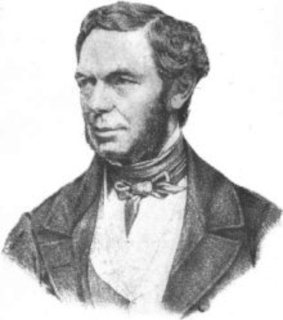
Brenan is born in Cork, County Cork, on November 17, 1828. He begins to write verse at an early age and is one of the genuine poets of the Young Ireland movement. His earlier poems are published under the initials “J. B., Cork,” or “J. B—n,” and some of his American verses under the pseudonym “Gondalez.” He is also an able prose writer.
Brenan is an active member of the Cork Historical Society, and is one of the editors of the Cork Magazine, which appears in November 1847, and continues to be published until the end of 1848, when the journal ceases publication. Some of its contributors, who include Frazer, Martin MacDermott, Fitz James O’Brien, Mulchinock and Mary Savage, later either end up in jail or in exile.
In January 1848, John Mitchel visits Cork and, according to Michael Cavanagh, who publishes a sketch of Brenan’s life in Young Ireland, Dublin, in June and July 1885, Brenan for the first time “beheld the man he most admired on earth, and with whose future destiny, whether for weal or woe, he felt his own was bound up. Never had the archenemy of England a more faithful or earnest follower.”
Brenan contributes to the Mitchel’s United Irishman and sells his rifle to obtain train fare so he can take up his residence in Dublin, the headquarters of the revolutionary movement. He later publishes articles in John Martin‘s The Irish Felon urging the Confederate Clubs members, many of whom have arms, to be in readiness for action. “The sooner you realise the fact,” he writes in a letter addressed to the Members of the Provincial Confederate Clubs, “that the Confederation was got up for the purpose of doing something, the better for us all. Just think what it undertook to do. It undertook to defeat the strongest Government and to liberate the most degraded country that ever existed. It undertook to give – to a province—to strike the chains off millions of slaves and, if necessary, to wash out the iron moulds in blood.”
In another letter to “the Young Men of Ireland” on July 22, 1848, he writes, “On you I principally rely. You realise that you are very ‘rash,’ rather inclined to be ‘violent,’ and have exceedingly little prudence to spare. Brothers, let your watchword be ‘Now or never—now and forever’ rashly.”
Brenan is associated with John Savage and John O’Mahony while Savage is operating on the slopes of the Comeragh Mountains. He is arrested and kept in prison for seven months alternately in Newgate Prison, Carrickfergus and Kilmainham Gaols. During his confinement he writes some fine poems, according to T. F. O’Sullivan, one, entitled Yearnings, evidently addressed to Mary Savage, sister of John.
After his release without trial in March 1849, Brenan becomes editor of the Irishman which had been started in Dublin by Bernard Fulham, and for six months attempts to rekindle the insurrectionary flame in the country. He is implicated in the attack on the Cappoquin police barracks on September 16, 1848, and in October escapes to the United States.
In America Brenan becomes associated with a number of journals, including Horace Greeley‘s New-York Tribune, Devin Reilly’s People, The Enquirer of Newark, New Jersey, and the New Orleans Delta in which he writes a series of papers under the pen-name Ben Fox. On August 27, 1851, he marries Mary Savage, in her parents’ house, on Thirteenth Street, New York.
Brenan writes some articles and poems for John Mitchel’s Irish Citizen in 1854. He is an enthusiastic supporter of the Southern cause and founds the New Orleans Times.
Brenan dies on May 27, 1857, at the early age of twenty-nine and is buried in the old French cemetery of New Orleans. During the last year of his life, he is almost totally blind. He is attended in his last illness by Dr. Dalton Williams. There are seven children of his and Mary’s marriage, only one of whom, Florence, survives their parents. She possesses her father’s literary ability but devotes her life to religion as a member of the Mercy Order.
Brenan’s best-known poem, “Come to Me, Dearest,” is addressed to Mary Savage before their marriage. The love story of Brenan and Mary is told in the sketch by Ellen Mary Patrick Downing, afterwards Sister Mary Alphonsus.
Doheny receives a rudimentary education from an itinerant scholar while labouring on his father’s holding, and in 1826 attends Maher’s classical academy near Emly for nine months. Educating himself in the late 1820s and early 1830s while teaching the children of local farmers, he determines on a career in law to help secure political redress for the disenfranchised poor. He is admitted to Gray’s Inn in November 1834, enters the King’s Inns, Dublin, in 1835 and is called to the Irish bar in 1838. Settling later that year in Cashel, County Tipperary, he first practises in the local courts and then on the southern circuit. Appointed legal assessor to the borough of Cashel under the Municipal Corporations (Ireland) Act 1840, he successfully prosecutes former borough officers for misappropriation of funds and fraudulent transfer of property, winning wider attention. He had supported the campaign for repeal in the early 1830s, and in 1841 joins Daniel O’Connell‘s Repeal Association, becoming active in forming temperance bands and setting up town meetings. By May 1841 he is on the association’s general committee. O’Connell finds him less tractable than most and is ruffled by his queries into the association’s financial management.
During 1842 Doheny begins to associate with the more militant members of the repeal movement such as Thomas Davis. There is a marked gap in age and class between Doheny and most of this group and some look down on his lack of refinement. Others, however, admire his zeal and sincerity, and an anonymous colleague describes him as “rough, generous, bold, a son of the soil, slovenly in dress, red-haired and red-featured, but a true personification of the hopes, passions, and traditions of the people.” Assisting in the launch of The Nation in October 1842, he is chagrined to find most of his articles rejected as unfit for publication, although fifteen are published between January 1843 and September 1844. He also publishes a competent History of the American Revolution (1846) for The Nation‘s “Library of Ireland” series. More impressive as a speaker than a writer, he contributes regularly to repeal meetings at Conciliation Hall, Burgh Quay, Dublin. He enthuses at the apparent martial potential of the immense, ordered crowds attending the “monster” repeal meetings of 1843, and is one of the main organisers of the Cashel meeting of May 31, 1843, at which he is loudly cheered. However, his later claim to have deliberately set up these meetings, with Davis and John Blake Dillon, on quasi-military lines in order to prepare the peasantry for a future war with Britain, is far-fetched. His opposition to O’Connell’s decision to submit to proclamation of the proposed meeting of October 8, 1843, at Clontarf again greatly irritates O’Connell.
An active member of the Repeal Association parliamentary committee from February 1844, in February and March 1845 Doheny chairs a sub-committee of five senior barristers investigating the legality of withdrawal from the House of Commons by the body of repeal MPs, coming “reluctantly” to the verdict that such an action is open to criminal prosecution. O’Connell’s gruff dismissal of his report testifies to their awkward relationship. He further vexes O’Connell by his advocacy of non-denominational university education during debates over the Maynooth College Act 1845. Irrevocable divisions between the Young Irelanders and O’Connell open up between April and July 1846 when Doheny leads calls for endorsement of the conduct of William Smith O’Brien – imprisoned for a month for refusal to serve on a parliamentary committee – and voices Young Ireland’s martial convictions in a speech at Liverpool. After the secession of the Young Irelanders from the Repeal Association in July 1846, he opposes attempts at reconciliation and is one of the founders of the Irish Confederation on January 13, 1847.
During the summer of 1847, Doheny begins setting up “Confederate Clubs” in east Tipperary and aids James Fintan Lalor in organising a failed tenant league meeting at Holycross, County Tipperary, on September 19. He is one of the few Young Irelanders attracted to Lalor’s revolutionary agrarian philosophy, but supports Smith O’Brien against John Mitchel in January 1848, deploring irresponsible demands for insurrection. However, after Mitchel’s conviction for treason felony in May, he supports armed action. Arrested for seditious speechmaking at Cashel on July 12, he is bailed on July 20. During the confused period of “rebellion” in late July, he attempts to organise the peasantry in Tipperary but is frustrated by O’Brien’s vacillation.
After the collapse of the armed adventure at Ballingarry on July 31, Doheny takes refuge near Slievenamon and, with James Stephens, eludes pursuit for nearly two months, until he finally escapes, disguised as a clergyman, on a cattle-ship from Cork to Bristol. Some days later he reaches Paris, where he stays for two months with Stephens and John O’Mahony before leaving for New York City. Practising law in New York, he dedicates himself to the development of an Irish Americanrepublican movement. Tensions between conservative and radical Young Ireland exiles, perhaps aggravated by social snobbery, surface by late 1849, when he is arrested for attempting to push Thomas D’Arcy McGee into an open cellar on a New York street, angered by accusations of boasting, drunkenness, and incompetence. Similar criticisms are made by John Blake Dillon and appear to have some foundation.
Doheny finds time to write The Felon’s Track (1849), a polemical account of the repeal agitation and the 1848 insurrection that is highly critical of O’Connell. Despite a rambling narrative, it becomes a popular work and is reprinted several times. He also gives several lectures on historical and literary subjects to Irish American societies and contributes a memoir on Geoffrey Keating to O’Mahony’s translation (1857) of Foras Feasa ar Éirinn.
Involved with the New York Irish militia from his arrival, he is elected lieutenant colonel of the 69th Infantry Regiment in November 1851, and in September 1852 becomes colonel of a new regiment, the Irish Republican Rifles. These formations are often wracked by dissension over strategy and leadership, and in February 1856 he and O’Mahony found the Emmet Monument Association, planning to mobilise an Irish American force to invade Ireland. Efforts to acquire Russian backing fails on the close of the Crimean War in March 1857.
In autumn 1857, Doheny and O’Mahony make overtures to James Stephens to reorganise the republican movement in Ireland, and in March 1858 they accept Stephens’s demands for undisputed authority there, though by the winter of 1858–59 Doheny shows increasing distrust of Stephens’s ambitions. Adopting the organisational structure set out by Stephens in establishing the IRB in 1858, he and O’Mahony found the American equivalent, the Fenian Brotherhood, in early 1859, although he plays a subordinate part. In July 1859, he founds and edits a short-lived newspaper in New York, The Phoenix, to promote Fenian ideals. Active in opposing the national petition for self-government of 1860–61, he argues that Britain will only yield to force. He assists in making preparations for the funeral of Terence Bellew MacManus in Ireland and acts as one of the pallbearers in New York. Travelling to Ireland in October 1861, he appears to argue for using the excitement engendered by the funeral to spark an insurrection in Dublin but is thwarted by Stephens.
Doheny dies suddenly on April 1, 1862, in New York and is buried in Calvary Cemetery in the city’s borough of Queens.
(From: “Doheny, Michael” by James Quinn and Desmond McCabe, Dictionary of Irish Biography, http://www.dib.ie, October 2009)
Dowden is the son of John Wheeler Dowden, a merchant and landowner, and is born three years after his brother John, who becomes Bishop of Edinburgh in 1886. His literary tastes emerge early, in a series of essays written at the age of twelve. His home education continues at Queen’s College, Cork and at Trinity College, Dublin. He contributes to the literary magazine Kottabos.
Dowden has a distinguished career, becoming president of the University Philosophical Society, and wins the vice-chancellor’s prize for English verse and prose, and the first senior moderatorship in ethics and logic. In 1867 he is elected professor of oratory and English literature in Dublin University.
Dowden’s first book, Shakespeare: A Critical Study of His Mind and Art (1875), results from a revision of a course of lectures, and makes him widely known as a critic: translations appear in German and Russian; his Poems (1876) goes into a second edition. His Shakespeare Primer (1877) is translated into Italian and German. In 1878 the Royal Irish Academy awards him the Cunningham gold medal “for his literary writings, especially in the field of Shakespearian criticism.”
Later works by Dowden in this field include an edition of The Sonnets of William Shakespeare (1881), Passionate Pilgrim (1883), Introduction to Shakespeare (1893), Hamlet (1899), Romeo and Juliet (1900), Cymbeline (1903), and an article entitled “Shakespeare as a Man of Science” (in the National Review, July 1902), which criticizes T. E. Webb’s Mystery of William Shakespeare. His critical essays “Studies in Literature” (1878), “Transcripts and Studies” (1888), “New Studies in Literature” (1895) show a profound knowledge of the currents and tendencies of thought in various ages and countries; but his The Life of Percy Bysshe Shelley (1886) makes him best known to the public at large. In 1900 he edits an edition of Shelley‘s works.
Other books by Dowden which indicate his interests in literature include: Southey (1879), his edition of Southey’s Correspondence with Caroline Bowles (1881), and Select Poems of Southey (1895), his Correspondence of Sir Henry Taylor (1888), his edition of William Wordsworth‘s Poetical Works (1892) and of his Lyrical Ballads (1890), his French Revolution and English Literature (1897), History of French Literature (1897), Puritan and Anglican (1900), Robert Browning (1904) and Michel de Montaigne (1905). His devotion to Johann Wolfgang von Goethe leads to his succeeding Max Müller in 1888 as president of the English Goethe Society.
In 1889 Dowden gives the first annual Taylorian Lecture at the University of Oxford, and from 1892 to 1896 serves as Clark lecturer at Trinity College, Cambridge. To his research are due, among other matters of literary interest, the first account of Thomas Carlyle‘s Lectures on periods of European culture; the identification of Shelley as the author of a review (in The Critical Review of December 1814) of a romance by Thomas Jefferson Hogg; a description of Shelley’s Philosophical View of Reform; a manuscript diary of Fabre d’Églantine; and a record by Dr Wilhelm Weissenborn of Goethe’s last days and death. He also discovers a Narrative of a Prisoner of War under Napoleon (published in Blackwood’s Magazine), an unknown pamphlet by Bishop George Berkeley, some unpublished writings of William Hayley relating to William Cowper, and a unique copy of the Tales of Terror.
Dowden’s wide interests and scholarly methods make his influence on criticism both sound and stimulating, and his own ideals are well described in his essay on The Interpretation of Literature in his Transcripts and Studies. As commissioner of education in Ireland (1896–1901), trustee of the National Library of Ireland, secretary of the Irish Liberal Union and vice-president of the Irish Unionist Alliance, he enforces his view that literature should not be divorced from practical life. His biographical/critical concepts, particularly in connection with Shakespeare, are played with by Stephen Dedalus in the library chapter of James Joyce‘s Ulysses. Leslie Fiedler is to play with them again in The Stranger in Shakespeare.
Dowden marries twice, first to Mary Clerke in 1866, and secondly in 1895 to Elizabeth Dickinson West, daughter of the dean of St Patrick’s. His daughter by his first wife, Hester Dowden, is a well-known spiritualist medium.
Dowden dies in Dublin on April 4, 1913. His Letters are published in 1914 by Elizabeth and Hilda Dowden.
A Dublin City Council plaque commemorating Dowden is unveiled on November 29, 2016.
In 1904, King Edward VII and Queen Alexandra travel to Ireland for a semi-official eight-day visit, arriving in Kingstown (now Dún Laoghaire) on April 26. They are accompanied by their daughter, Princess Victoria.
They travel by rail to Naas via the Great Southern and Western Railway Company. They are seated in a luxuriously upholstered carriage, the engine decorated with flags and streamers. The visit triggers a frenzy of preparation among the elite and merchants of Naas. Leading citizens from diverse backgrounds, including Protestants, Catholics, Loyalists, and Home Rulers, come together to welcome the royal visitors. The town is adorned with bunting, banners, and arches bearing royal and loyalist symbols, creating an extravagant showpiece of imperial loyalty.
During their visit to Naas, the King and Queen attend the Punchestown Races, adding a touch of glamour to the occasion.
They stay in the Dublin area for a few days, attending several events and ceremonies. After finishing in Dublin, the royals board their royal train for a three-day visit to Kilkenny.
For the arrival of the King and Queen in Kilkenny, significant efforts are undertaken to ensure the city is elegantly presented. In the weeks and months prior to the visit, local businessmen convene meetings in how best to organise the occasion.
The city is heavily festooned with bunting and streamers, and the route from the railway station to Kilkenny Castle is decorated with tiny fairy lights of every colour. During the visit, Princess Victoria plants three trees on the grounds of the Castle.
The visit is well-received in Kilkenny, although sometimes expressed in primitive fashion: an old man remarks, “Sure, the King’s a man after all,” his wife correcting him, “But he’s a great man, and the lovely lady’s an angel.” Although well-supported, black flags protesting the visit are hung from some buildings along the route. (It is more than 110 years before another royal visit is made to Kilkenny when Prince Charles and Princess Camilla visit the city on May 11, 2017.)
Shortly before her twelfth birthday, Hone suffers from polio (infant paralysis), suffering a fall while helping to decorate the Taney parish church for Easter. Her resulting ill health leads to her seeking treatment in Harley Street, Marylebone, Central London. She is educated by a governess, continuing her education in Switzerland, and goes on tours to Spain and Italy before moving to London in 1913. Her three sisters all marry British Army officers, and all are widowed in World War I.
Hone is extremely devout. She spends time in an Anglican Convent in 1925 at Truro in Cornwall and converts to Catholicism in 1937. This possibly influences her decision to begin working in stained glass. Initially, she works as a member of the An Túr Gloine stained glass co-operative before setting up a studio of her own in Rathfarnham.
Hone’s most important works are probably the East Window, depicting the Crucifixion, for the Chapel at Eton College, Windsor (1949–1952) and My Four Green Fields, now located in Government Buildings, Dublin. This latter work, commissioned for the Irish Government’s Pavilion, wins first prize for stained glass in the 1939 New York World’s Fair. It graces CIÉ‘s Head Office in O’Connell Street from 1960 to about 1983. The East Window of Eton College is commissioned following the destruction of the building after a bomb is dropped in 1940 on the school during World War II. She is commissioned to design the East Window in 1949, and the new window is inserted in 1952. This work is featured on an Irish postage stamp in 1969. From December 2005 to June 2006, an exhibition of her work is on display at the National Gallery of Ireland. Saint Mary’s church in Clonsilla also features her stained glass windows.
Despite ill health, Hone continues to produce a huge number of small stained glass panels as well as oils, watercolours, and gouache landscapes. In 1953, she is represented at the Contemporary Irish Art exhibition at Aberystwyth, Wales, and at the Tate gallery in London, receiving as well an honorary LLD from Trinity College Dublin (TCD). In 1954, she is elected an honorary member of the Royal Hibernian Academy (RHA).
Unmarried, Hone dies on March 13, 1955, while entering her parish church at Rathfarnham. She is survived by two of her sisters. Over 20,000 people visit a memorial exhibition of her work at University College Dublin (UCD), Earlsfort Terrace, Dublin, in 1958.
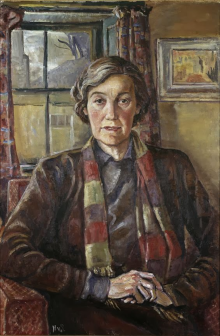
(Pictured: Portrait of Evie Hone by Hilda van Stockum)
O’Connell had rejected a suggestion from “friends of emancipation,” and from the English Roman Catholic bishop, John Milner, that the fear of Catholic advancement might be allayed if the Crown were accorded the same right exercised by continental monarchs: a veto on the confirmation of Catholic bishops. O’Connell insists that Irish Catholics would rather “remain forever without emancipation” than allow the government “to interfere” with the appointment of their senior clergy. Instead, he relies on their confidence in the independence of the priesthood from Ascendancy landowners and magistrates to build his Catholic Association into a mass political movement. On the basis of a “Catholic rent” of a penny a month (typically paid through the local priest), the Association mobilises not only the Catholic middle class, but also poorer tenant farmers and tradesmen. Their investment enables O’Connell to mount “monster” rallies that stay the hands of authorities and embolden larger enfranchised tenants to vote for pro-emancipation candidates in defiance of their landlords.
O’Connell’s campaign reaches its climax when he himself stands for parliament. In July 1828, he defeats a nominee for a position in the British cabinet, William Vesey-FitzGerald, in a County Clare by-election, 2057 votes to 982. This makes a direct issue of the parliamentary Oath of Supremacy by which, as a Catholic, he will be denied his seat in the Commons.
As Lord Lieutenant of Ireland, Wellington’s brother, Richard Wellesley, had attempted to placate Catholic opinion, notably by dismissal of the long-serving Attorney-General for Ireland, William Saurin, whose rigid Ascendancy views and policy made him bitterly unpopular, and by applying a policy of prohibitions and coercion against not only the Catholic Ribbonmen but also the Protestant Orangemen. But now both Wellington and his Home Secretary, Robert Peel, are convinced that unless concessions are made, a confrontation is inevitable. Peel concludes, “though emancipation was a great danger, civil strife was a greater danger.” Fearing insurrection in Ireland, he drafts the Relief Bill and guides it through the House of Commons. To overcome the vehement opposition of both the King and of the House of Lords, Wellington threatens to resign, potentially opening the way for a new Whig majority with designs not only for Catholic emancipation but also for parliamentary reform. The King initially accepts Wellington’s resignation and the King’s brother, Ernest Augustus, Duke of Cumberland, attempts to put together a government united against Catholic emancipation. Though such a government would have considerable support in the House of Lords, it would have little support in the Commons and Ernest abandons his attempt. The King recalls Wellington. The bill passes the Lords and becomes law.
The key, defining, provision of the Acts is its repeal of “certain oaths and certain declarations, commonly called the declarations against transubstantiation and the invocation of saints and the sacrifice of the mass, as practised in the Church of Rome,” which had been required “as qualifications for sitting and voting in parliament and for the enjoyment of certain offices, franchises, and civil rights.” For the Oath of Supremacy, the act substitutes a pledge to bear “true allegiance” to the King, to recognise the Hanoverian succession, to reject any claim to “temporal or civil jurisdiction” within the United Kingdom by “the Pope of Rome” or “any other foreign prince … or potentate,” and to “abjure any intention to subvert the present [Anglican] church establishment.”
This last abjuration in the new Oath of Allegiance is underscored by a provision forbidding the assumption by the Roman Church of episcopal titles, derived from “any city, town or place,” already used by the United Church of England and Ireland. (With other sectarian impositions of the Act, such as restrictions on admittance to Catholic religious orders and on Catholic-church processions, this is repealed with the Roman Catholic Relief Act 1926.)
The one major security required to pass the Act is the Parliamentary Elections (Ireland) Act 1829. Receiving its royal assent on the same day as the relief bill, the act disenfranchises Ireland’s forty-shilling freeholders, by raising the property threshold for the county vote to the British ten-pound standard. As a result, “emancipation” is accompanied by a more than five-fold decrease in the Irish electorate, from 216,000 voters to just 37,000. That the majority of the tenant farmers who had voted for O’Connell in the Clare by-election are disenfranchised as a result of his apparent victory at Westminster is not made immediately apparent, as O’Connell is permitted in July 1829 to stand unopposed for the Clare seat that his refusal to take the Oath of Supremacy had denied him the year before.
In 1985, J. C. D. Clark depicts England before 1828 as a nation in which the vast majority of the people still believed in the divine right of kings, and the legitimacy of a hereditary nobility, and in the rights and privileges of the Anglican Church. In Clark’s interpretation, the system remained virtually intact until it suddenly collapsed in 1828, because Catholic emancipation undermined its central symbolic prop, the Anglican supremacy. He argues that the consequences were enormous: “The shattering of a whole social order. … What was lost at that point … was not merely a constitutional arrangement, but the intellectual ascendancy of a worldview, the cultural hegemony of the old elite.”
Clark’s interpretation has been widely debated in the scholarly literature, and almost every historian who has examined the issue has highlighted the substantial amount of continuity before and after the period of 1828 through 1832.
Eric J. Evans in 1996 emphasises that the political importance of emancipation was that it split the anti-reformers beyond repair and diminished their ability to block future reform laws, especially the great Reform Act of 1832. Paradoxically, Wellington’s success in forcing through emancipation led many Ultra-Tories to demand reform of Parliament after seeing that the votes of the rotten boroughs had given the government its majority. Thus, it was an ultra-Tory, George Spencer-Churchill, Marquess of Blandford, who in February 1830 introduced the first major reform bill, calling for the transfer of rotten borough seats to the counties and large towns, the disfranchisement of non-resident voters, the preventing of Crown officeholders from sitting in Parliament, the payment of a salary to MPs, and the general franchise for men who owned property. The ultras believed that a widely based electorate could be relied upon to rally around anti-Catholicism.
In Ireland, emancipation is generally regarded as having come too late to influence the Catholic-majority view of the union. After a delay of thirty years, an opportunity to integrate Catholics through their re-emerging propertied and professional classes as a minority within the United Kingdom may have passed. In 1830, O’Connell invites Protestants to join in a campaign to repeal the Act of Union and restore the Kingdom of Ireland under the Constitution of 1782. At the same, the terms under which he is able to secure the final measure of relief may have weakened his repeal campaign.
George Ensor, a leading Protestant member of the Catholic Association in Ulster, protests that while “relief” bought at the price of “casting” forty-shilling freeholders, both Catholic and Protestant, “into the abyss,” might allow a few Catholic barristers to attain a higher grade in their profession, and a few Catholic gentlemen to be returned to Parliament, the “indifference” demonstrated to parliamentary reform will prove “disastrous” for the country.
Seeking, perhaps, to rationalise the sacrifice of his freeholders, O’Connell writes privately in March 1829 that the new ten-pound franchise might actually “give more power to Catholics by concentrating it in more reliable and less democratically dangerous hands.” The Young IrelanderJohn Mitchel believes that the intent is to detach propertied Catholics from the increasingly agitated rural masses.
In a pattern that had been intensifying from the 1820s as landlords clear land to meet the growing livestock demand from England, tenants have been banding together to oppose evictions and to attack tithe and process servers.






 seamus dubhghaill