seamus dubhghaill

Promoting Irish Culture and History from Little Rock, Arkansas, USA


Leave a comment

Birth of Liam Tobin, Irish Army Officer

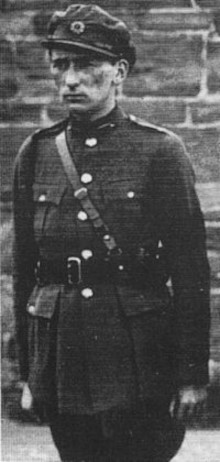
Liam Tobin, officer in the Irish Army and the instigator of the Irish Army Mutiny in March 1924, is born William Joseph Tobin at 13 Great Georges Street in Cork, County Cork, on November 15, 1895. During the Irish War of Independence, he serves as an Irish Republican Army (IRA) intelligence officer for Michael CollinsSquad.

Tobin is the eldest son of Mary Agnes (nee Butler) and David Tobin, a hardware clerk. He has two younger siblings, Katherine and Nicholas Augustine Tobin, also born in Cork. His family moves to John Street in Kilkenny and then to Dublin. He goes to school in Kilkenny and is an apprentice in a hardware shop at the time of the 1916 Easter Rising. As a participant in the Rising, he fights in the Four Courts garrison under Edward Daly. He is arrested, court martialed, and sentenced to death but his sentence is commuted to life imprisonment. He is a prisoner in Kilmainham, Mountjoy, Lewes, Dartmoor, Broadmoor and Pentonville prisons. He is released in June 1917.

In early 1919 Tobin becomes Collins’ chief executive in the Intelligence Directorate handling the many spies in Dublin Castle, including double agent David Neligan. Nancy O’Brien works for Under-Secretary for Ireland James Macmahon, decoding messages sent from London. Each day between 2:30 and 3:30 she passes any information acquired to either Tobin, Joseph McGrath, or Desmond FitzGerald. Tobin is involved in planning the assassinations of British soldiers, informants, members of the Royal Irish Constabulary, the Dublin Metropolitan Police, and operatives of MI5. He constructs detailed profiles of everyone remotely connected to the British government, often using Who’s Who, The Morning Post, and The Times, a newspaper that describes him as “one of the most formidable of [the] Twelve Apostles.”

In October 1921, Tobin travels with the Irish Treaty Delegation as part of Collins’ personal staff.

Tim Pat Coogan and James Mackay have examined Tobin’s involvement in the assassination of British Field Marshal Sir Henry Wilson. Wilson’s public tirades about Collins is evidence of mutual personal dislike between the two men. In May 1922 Collins tells Tobin “We’ll kill a member of that bunch” to the news of “bloody pogroms” in Belfast. Wilson is intimately involved with the Ulster loyalist cause, including the Curragh Mutiny and the establishment of the Ulster Special Constabulary. Just before the shooting, Coogan places Tobin in London. He meets courier Peig Ni Braonain at Euston Station collecting a document that has been sent from Dublin. Returning to Dublin before the incident, he is jubilant when he tells defence minister Richard Mulcahy about Wilson’s death. Mulcahy is appalled and threatens to resign.

Following the Anglo-Irish Treaty, Tobin is appointed deputy director of intelligence in the new state and assigned to the Criminal Investigation Department based at Oriel House. However Collins soon replaces him with Joseph McGrath. Tobin is placed on the Army Council and is Director of Intelligence from September 1922 until his appointment as Senior Aide-de-Camp to the new GovernorGeneral of the Irish Free State, Tim Healy, in November 1922. The position provides an apartment in Viceregal Lodge.

In October 1922, Tobin’s brother Nicholas, a Free State captain, is accidentally shot dead by his own troops during the raid and capture of a bomb making factory at number 8 Gardiner’s Place, Dublin.

Tobin believes in the steppingstone doctrine which sees the Treaty as a stage towards full independence. With the outbreak of the Irish Civil War he remains loyal to Collins and takes the Pro-Treaty side. He leads in the fight against the Anti-Treaty IRA in the south. Disillusioned with the continuing hostilities and in the aftermath of the death of Collins, he forms an association called the IRA Organisation (IRAO) or “Old Irish Republican Army” to distinguish themselves from the anti-treaty insurgents.

Richard Mulcahy, the new Irish defence minister, proposes to reduce the army from 55,000 to 18,000 men in the immediate post- Civil-War period. Tobin knows his own position is to be affected and shares the perception that the Irish Army treats former British officers better than former IRA officers. On March 7, 1924, Tobin, together with Colonel Charlie Dalton, sends an ultimatum to President of the Executive Council of the Irish Free State W. T. Cosgrave demanding an end to the army demobilisation. The immediate response is an order for the arrest of the two men on a charge of mutiny. The cabinet, already wary of the Irish Army, orders an inquiry and appoints Garda Commissioner Eoin O’Duffy to the army command.

On March 18, the mutineers assemble with hostile intent at a Dublin pub. An order is made to arrest the mutineers and the cabinet demands the resignation of the army council. The generals resign, affirming the subservience of the military to the civilian government of the new state.

In later years, Tobin rebuilds relations with his Civil War foes and joins Éamon de Valera‘s Anti-Treaty Fianna Fáil party. He joins up with Joseph McGrath to form the Irish Hospitals’ Sweepstake in the 1930s. Many other former army comrades find work in this lottery. He leaves the Sweep in 1938. After World War II, he becomes Superintendent of the Oireachtas for the Irish Dáil.

On October 14, 1929, Tobin marries Monica “Mona” Higgins at the Church of the Holy Family, Aughrim Street, Dublin. They have two daughters, Máire and Anne Tobin. Following the death of his father, David, in 1956, Tobin’s health declines, resulting in his death in Dublin on April 30, 1963.

Tobin is portrayed by actor Brendan Gleeson in Neil Jordan‘s biopic Michael Collins.


Leave a comment

Death of Major General William Hickie, Irish-Born British Army Officer

Major General Sir William Bernard Hickie, KCB, Irish-born senior British Army officer and Irish nationalist politician dies in Dublin on November 3, 1950. He sees active service in the Second Boer War from 1899 to 1902, is Assistant Quartermaster General in the Irish Command from 1912 to 1914 and serves in World War I from 1914 to 1918. He commands a brigade of the British Expeditionary Force in 1914 and is commander of the 16th (Irish) Division from 1915 on the Western Front.

Hickie is born on May 21, 1865, at Slevoir, Terryglass, near Borrisokane, County Tipperary, the eldest of the eight children of Colonel James Francis Hickie and his wife Lucila Larios y Tashara, originally of Castile. He is educated at St. Mary’s College, Oscott, Birmingham, England, a renowned seminary for training youths of prosperous Roman Catholic families.

Hickie attends the Royal Military College, Sandhurst, from 1882 to 1885. He is commissioned into his father’s regiment, the Royal Fusiliers at Gibraltar, in 1885 and serves with them for thirteen years in the Mediterranean, Egypt, and India, during which time he is promoted to captain on November 18, 1892. In 1899 he graduates as captain at the Staff College, Camberley, and is selected when the Second Boer War breaks out as a Special Service Officer in which capacity he acts in various positions of authority and command. He leaves Southampton for South Africa on board the SS Canada in early February 1900 and is promoted from captain of mounted infantry to battalion command as major on March 17, 1900. He is subsequently in command of a corps until eventually at the end of 1900 he is given command of an independent column of all arms. He holds this position for eighteen months. He serves with distinction at the Battle of Bothaville in November 1900 and receives the brevet promotion to lieutenant colonel on November 29, 1900. He serves in South Africa throughout the war, which ends with the Treaty of Vereeniging in June 1902. Four months later he leaves Cape Town on the SS Salamis with other officers and men of the 2nd battalion Royal Fusiliers, arriving at Southampton in late October, when the battalion is posted to Aldershot Garrison. In December 1902 he is elected a Fellow of the Royal Geographical Society (FRGS).

After the end of the war in South Africa there follows various staff appointments, the first from December 1902 as deputy-assistant adjutant general for district staff in the Cork district. In 1907 Hickie is back in regimental service in Dublin and Mullingar with the 1st Royal Fusiliers, where he is in command of the regiment for the last two years. From 1909 to 1912 is appointed to the Staff of the 8th Infantry Division in Cork where for four years he is well known in the hunting field and on the polo ground. In May 1912, he is promoted to colonel and becomes Quartermaster General of the Irish Command at Royal Hospital Kilmainham for which he is appointed a Companion of the Order of the Bath.

When war is declared, the Staff of the Irish Command becomes automatically the staff of the II Army Corps and accordingly with the outbreak of World War I in August 1914, Hickie is promoted to brigadier general and, as part of the British Expeditionary Force in France, takes charge of the Adjutant and Quartermaster-General’s Department during the retreat of the II Corps after the Battle of Mons, to Paris, and during the First Battle of the Marne. In mid-September 1914, he relieves one of the brigadiers in the fighting line as commander of the 13th Brigade (5th Infantry Division) and then commands the 53rd Brigade (18th Infantry Division) until December 1915, when he is ordered home to assume command of the 16th (Irish) Division at Blackburn.

Promoted to major general, Hickie takes over from Lieutenant General Sir Lawrence Parsons. It is politically a highly sensitive appointment which requires the professionalism and political awareness he, fortunately, possesses as the division is formed around a core of Irish National Volunteers in response to Edward Carson‘s Ulster Volunteers. He is much more diplomatic and tactful than his predecessors and speaks of the pride which his new command gives him but does not hesitate to make sweeping changes amongst the senior officers of the Irish Division. After putting the division through intensive training, it leaves under Irish command of which each man takes personal pride. It arrives in December 1915.

In the next two years and four months during which Hickie commands the 16th (Irish) Division, it earns a reputation for aggression and élan and wins many memorials and mentions for bravery in the engagements during the 1916 Battle of Guillemont and the capture of Ginchy, both of which form part of the Battle of the Somme, then during the Battle of Messines, the Third Battle of Ypres and in attacks near Bullecourt in the Battle of Cambrai offensive in November 1917.

During this period the Division makes considerable progress in developing its operational techniques but at a price in losses. The growing shortage of Irish replacement recruits, due to nationalist disenchantment with the war and the absence of conscription in Ireland, is successfully met by Hickie by integrating non-Irish soldiers into the division.

In February 1918, Hickie is invalided home on temporary sick leave, but when in the hospital the German spring offensive begins on March 21, with the result that after his division moves under the command of General Hubert Gough it is practically wiped out and ceases to exist as a division. Although promised a new command, this does not happen before the Armistice in November. He typifies the army’s better divisional commanders, is articulate, intelligent and is competent and resourceful during the BEF’s difficult period 1916–17, laying the foundations for its full tactical success in 1918. He is advanced to Knight Commander of the Order of the Bath in 1918.

Hickie retires from the army in 1922, when the six Irish line infantry regiments that have their traditional recruiting grounds in the counties of the new Irish Free State are all disbanded. He identifies himself strongly with the Home Rule Act and says that its scrapping is a disaster and is equally outspoken in condemning the activities of the Black and Tans. In 1925, he is elected as a member of Seanad Éireann, the Irish Free State Senate.

Hickie holds his seat until the Seanad is dissolved in 1936, to be replaced by Seanad Éireann in 1937. He is President of the Area Council (Southern Ireland) of the Royal British Legion from 1925 to 1948. He never marries.

Hickie dies on November 3, 1950, in Dublin and is buried in Terryglass, County Tipperary.


Leave a comment

69th Infantry Regiment Refuses to March in Parade for the Prince of Wales

On October 11, 1860, all the militia units of New York City are ordered to turned out to march in in a parade in honor of the visiting Prince of Wales, the 19-year-old Albert Edward, heir to the English throne, who is visiting New York City at the time. Colonel Michael Corcoran, a native of Carrowkeel, near Ballysadare, County Sligo, refuses to march his 69th Infantry Regiment in the parade to protest against British rule in Ireland. He is removed from command and a court martial is pending over the matter when the American Civil War begins.

Five days earlier, Corcoran refuses tickets to a ball in the prince’s honor, telling those who invited him that he is “not desirous of joining in the festivity.”

As for the order to march, Corcoran says he refuses to ask the sons of Erin to honor the son of “a sovereign under whose reign Ireland was made a desert and her sons forced to exile.” He is also heard to refer to the prince as “the bald-faced son of our oppressor.”

Corcoran’s actions cause a firestorm of outrage around the country and especially in New York. U.S. citizens, most completely ignorant of the conditions under which many of these men had lived in British-controlled Ireland, see the actions of the men of the 69th Infantry Regiment as an insult to American hospitality in welcoming these immigrants to their adopted country, though in truth, the welcome is much less than lukewarm.

Corcoran has written his name forever in the pantheon of Irish heroes in America. New York’s Irish present the regiment with a green flag commemorating the event.

Corcoran is arrested and stripped of his command by New York and a court martial is planned. But before he can be tried on the charge, Fort Sumter is fired upon, and the country is more worried about saving the Union than honoring visiting princes. With the outbreak of war, the court martial is dropped and Corcoran is restored to his command because he had been instrumental in bringing other Irish immigrants to the Union cause.

Corcoran leads the 69th Infantry Regiment to Washington, D.C. and serves for a time in the Washington defenses building Fort Corcoran. On July 21, 1861, he leads the regiment into action at the First Battle of Bull Run with what is now called the “Prince of Wales Flag” flying proudly above his men.

After promotion to brigadier general, Corcoran leaves the 69th Infantry Regiment and forms the Corcoran Legion, consisting of at least five other New York regiments.

The Mayor of New York City, Michael Bloomberg, unveils Ireland’s national monument to the Fighting 69th in Ballymote, County Sligo, on August 22, 2006. The monument is sculpted by Philip Flanagan. The inscription around the top of the monument reads “Michael Corcoran 1827–1863” Around the base is inscribed “New York Ballymote Creeslough Bull Run.” Underneath the monument is a piece of steel from the World Trade Center, donated by the family of Michael Lynch, who died in the tower on September 11, 2001. Lynch’s family are from County Sligo.

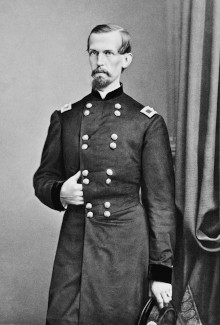
(Pictured: Michael Corcoran, Irish American general in the Union Army during the American Civil War and a close confidant of President Abraham Lincoln)


Leave a comment

Irish Brigade of France Takes Part in the Siege of Savannah

On October 9, 1779, members of Arthur Dillon‘s regiment of the Irish Brigade of France take part in the Franco-American siege of Savannah, or the Second Battle of Savannah, during the final stages of the siege during the American Revolutionary War. The year before, the city of Savannah, Georgia, had been captured by a British expeditionary corps under Lieutenant Colonel Archibald Campbell. The siege itself consists of a joint Franco-American attempt to retake Savannah, from September 16 to October 18, 1779.

Charles Henri Hector, Count of Estaing, begins landing troops below the city on September 12, and begins moving in by September 16. Confident of victory and believing that British Lieutenant Colonel John Maitland‘s reinforcements will be prevented from reaching Savannah by Major General Benjamin Lincoln, he offers Major General Augustine Prévost the opportunity to surrender. Prevost delays, asking for a 24-hour truce. Owing to miscommunication about who is responsible for preventing Maitland’s movements, the waterways separating South Carolina‘s Hilton Head Island from the mainland are left unguarded, and Maitland is able to reach Savannah hours before the truce ends. Prevost’s response to d’Estaing’s offer is a polite refusal, despite the arrival.

On September 19, as Charles-Marie de Trolong du Rumain moves his squadron up the river, he exchanges fire with Comet, Thunder, Savannah, and Venus. The next day the British scuttle Rose, which is leaking badly, just below the town to impede the French vessels from progressing further. They also burn Savannah and Venus. By scuttling Rose in a narrow part of the channel, the British effectively block it. Consequently, the French fleet is unable to assist the American assault.

Germaine takes up a position to protect the north side of Savannah’s defenses. Comet and Thunder have the mission of opposing any attempt by the South Carolinian galleys to bombard the town. Over the next few days, British shore batteries assist Comet and Thunder in engagements with the two South Carolinian galleys. During one of these, they severely damage Revenge.

The French commander, rejecting the idea of assaulting the British defenses, unloads cannons from his ships and begins a bombardment of the city. The city, rather than the entrenched defenses, bear the brunt of this bombardment, which lasts from October 3 to 8. “The appearance of the town afforded a melancholy prospect, for there was hardly a house that had not been shot through,” writes one British observer.

When the bombardment fails to have the desired effect, d’Estaing changes his mind and decides it is time to try an assault. He is motivated in part by the desire to finish the operation quickly, as scurvy and dysentery are becoming problems on his ships, and some of his supplies are running low. While a traditional siege operation would likely have succeeded eventually, it would take longer than d’Estaing is prepared to stay.

Against the advice of many of his officers, d’Estaing launches the assault against the British position on the morning of October 9. The success depends in part on the secrecy of some of its aspects, which are betrayed to Prévost well before the operations are supposed to begin around 4:00 a.m. Dillon’s regiment is sent to the right of the main assault, but their guides prove to be unreliable, and the column goes down the wrong path into a swamp. The British have already learned of the assault and the bagpipes of a Highland regiment begin playing at daybreak, unnerving the allies since it signals that surprise is lost. It is nearly daylight when the attack finally gets underway.

The redoubt on the right side of the British works had been chosen by the French admiral in part because he believed it to be defended only by militia. In fact, it is defended by a combination of militia and Scotsmen from John Maitland’s 71st Regiment of Foot, Fraser’s Highlanders, who had distinguished themselves at Stono Ferry. The militia includes riflemen, who easily pick off the white-clad French troops when the assault is underway. Admiral d’Estaing is twice wounded, and Polish cavalry officer Casimir Pulaski, fighting with the Americans, is mortally wounded. By the time the second wave arrives near the redoubt, the first wave is in complete disarray, and the trenches below the redoubt are filled with bodies. Attacks intended as feints against other redoubts of the British position are easily taken.

The second assault column is commanded by the Swedish Count Curt von Stedingk, who manages to reach the last trench. He later writes in his journal, “I had the pleasure of planting the American flag on the last trench, but the enemy renewed its attack, and our people were annihilated by crossfire.” He is forced back by overwhelming numbers of British troops, left with some 20 men, all being wounded, including von Stedingk. He later writes, “The moment of retreat with the cries of our dying comrades piercing my heart was the bitterest of my life,”

After an hour of carnage, d’Estaing orders a retreat. On October 17, Lincoln and d’Estaing abandon the siege.

The Irish Brigade of France suffers more than 40 killed and close to 150 wounded. Among the dead is Captain Bernard O’Neill, a 5th generation officer in Dillon’s regiment. Dillon’s regiment is the only one of the Brigade units to remain in command of one family for its entire service. Count Arthur Dillon, commander at Savannah, is the grandson of Colonel Arthur Dillon, who brought the regiment into French service in 1690. The Count later becomes a victim of the French Revolution. He is condemned for alleged participation in a prison conspiracy and executed by guillotine on April 13, 1794.


Leave a comment

Birth of William Cosgrove, Victoria Cross Recipient

William Cosgrove VC MSM, an Irish recipient of the Victoria Cross, the highest and most prestigious award for gallantry in the face of the enemy that can be awarded to British and Commonwealth forces, is born at Aghada, County Cork, on October 1, 1888.

Cosgrove is the son of Michael and Mary Cosgrove. He has four brothers, Dan, Ned, David and Joseph, and a sister Mary-Catherine. While they are still young their father emigrates to Australia, but later returns. In the meantime, his mother moves with his siblings to a cottage in nearby Peafield and they attend school at the National School, Ballinrostig. He begins work as an apprentice butcher at Whitegate. One of his daily chores is a morning delivery to Fort Carlisle (now Fort Davis) with a consignment of meat for the troops. It is from Fort Carlisle that he joins the army.

Cosgrove enlists in the Royal Munster Fusiliers on March 24, 1909, and is given the regimental number 8980. At the outbreak of war, the 1st Battalion of the Munster Fusiliers is stationed in Rangoon, Burma, as regular battalions are routinely stationed overseas. They leave Rangoon on November 21, 1914, and Cosgrove, now a corporal, lands in England on January 10, 1915. Upon landing they still wear their Indian issue uniforms and stand on the cold quay in their khaki drill shorts. The battalion is then assigned to the 86th Brigade of the 29th Division (United Kingdom), in preparation for the landings at the Dardanelles in Turkey.

During the Battle of Gallipoli, Turkey, the 1st Munsters, together with the 1st Battalion Royal Dublin Fusiliers and Royal Hampshire Regiment, are on the converted collier River Clyde when it runs ashore for the Cape Helles ‘V’ beach landing at 6:20 a.m. on April 25, 1915. On departing from the ship’s bay they are subject to fierce enfilading machine gun fire from hidden Turkish defences. One hundred or more of the Battalion’s men fall at this stage of the battle, with just three companies of Munsters making it to the shelter of the dunes. They are unable to advance due to the withering Turkish fire.

At daybreak on the following day it is decided to take the village behind the Sedd el Bahr fort overlooking the bay. Cosgrove leads a company section during the attack on the Turkish positions. Barbed wire holds them up and he sets himself the task of pulling the stanchion posts of the enemy’s high wire entanglement single-handed out of the ground, notwithstanding the terrific fire from both front and flanks with officers and men falling all around him. Thanks to his exceptional bravery, his heroic actions contribute greatly to the successful clearing of the heights. Turkish counter-attacks are held off. It is during this attack that his actions earn him the regiment’s first Victoria Cross of the war. He is also wounded during this action. Promoted to Sergeant, he sees no further action due to his wound, which is a contributing factor in his death years later.

Cosgrove transfers to the Royal Fusiliers in 1918, to the Prince of Wales’s Leinster Regiment in 1920, the Royal Northumberland Fusiliers in 1922, and later goes as an instructor to the Indian Territorial Force in 1928 to become 7042223 Staff Sgt Instructor. He comes home in 1935 pending discharge to pension. However, he is admitted to Millbank hospital and takes discharge before he is fit. After a short leave in Cork, he returns to London, where he is admitted to Middlesex Hospital. He is later transferred to Millbank hospital London, where he dies at the age of 47 on July 21, 1936.

In 1972, Cosgrove’s Victoria Cross medal is sold for a record price £2,300 to a private collector. When questioned about the high price which the medal fetches, the auctioneer replies “When one buys a gallantry medal, it is not just the medal one buys, but the act that won it.” His Victoria Cross, together with his other medals, are sold at an auction by Dix Noonan Webb held on September 22, 2006 for “the world’s most valuable auction of orders, decorations and medals.” A total of £1,965,010 is spent by 305 different buyers, a figure which represents “the highest amount ever realised by any numismatic auction in the UK.” The day’s highest price, £180,000, is paid by a collector for the Gallipoli landings Victoria Cross group of six, which includes the medal awarded to Sgt. William Cosgrove, Royal Munster Fusiliers.


Leave a comment

Death of Thomas McDowell, Former CEO of “The Irish Times”

Thomas Bleakley McDowell, often called T. B. McDowell or simply “the Major,” dies on September 9, 2009. He is a British Army officer and subsequently chief executive of The Irish Times for nearly 40 years.

Born in Belfast, Northern Ireland, on May 18, 1923, the only child of a Protestant and unionist couple, McDowell finishes school at the Royal Belfast Academical Institution in 1941 as World War II is under way. He is dissuaded from enlisting immediately in the British Army by his parents as his father, also named Thomas, had been gassed in World War I and suffers serious lung problems which lead to his early death in 1944. He goes instead to Queen’s University Belfast to study commerce but, a year later and still uncertain about his long-term plans, he joins the Royal Inniskilling Fusiliers, being commissioned in 1943. He goes on to join the Royal Ulster Rifles.

A knee injury during a night training exercise in Omagh makes McDowell ineligible for active military service and he becomes a weapons instructor. The accident also leads to him meeting his future wife, Margaret Telfer, the physiotherapist who treats him in hospital in Bangor, County Down.

McDowell rises to the rank of major and is part of the Allied forces in occupied Austria following the end of the war, taking part in joint patrols in Vienna with Russian, American and French officers. In the post-war period, he is given two years to finish his college course and spends a summer studying law with a tutor before passing the English bar and returning to the British Army.

After a further military posting to Edinburgh, McDowell’s legal qualification brings him to the army legal service in the War Office in London. With little prospect of further promotion and every chance of being posted abroad without his young family, he decides to leave the army. He is offered a job as legal adviser in London to James North Ltd, a company which makes protective clothing. With no experience of industry, he asks to be given a managerial role at first. The company suggests a managing position in its operations in Dublin. He slots easily into the city’s old business establishment, joining the Kildare Street Club, becoming a director of Pim’s department store, and setting his career firmly on a commercial rather than a legal path.

McDowell’s involvement with newspapers comes about through the recognition of his business acumen. He is asked by some acquaintances to take a look at the financial troubles of the Evening Mail, which is bought subsequently by The Irish Times, adding to the latter’s own financial difficulties.

McDowell is asked later by The Irish Times to see if Roy Thomson, the Canadian-born British press baron whom he had met while they both looked separately at the Evening Mail, might be interested in taking it over. Thomson passes and the company then asks McDowell himself to take charge as chief executive in 1962. Among his first actions are to close the Evening Mail and the Sunday Review, a short-lived tabloid that is ahead of its time. A year later, another problem is resolved when Douglas Gageby, who had been hired as managing director of The Irish Times shortly before McDowell’s arrival, takes over as editor.

Thus, what had begun as a slightly awkward relationship, turns into a highly successful partnership as Gageby sets about broadening the newspaper’s editorial appeal and McDowell sets it on a successful commercial course. McDowell always credits Gageby and his successors as editor with the success of the newspaper. Although he has a close relationship with editors, especially Gageby, he does not interfere in the editorial running of the newspaper.

By the early 1970s, the circulation of The Irish Times has almost doubled in a decade to 60,000 and it is making money. Some of the directors indicate an interest in selling the company. McDowell proposes instead that it be turned into a trust. It is a period when several newspapers in Ireland and Britain have changed hands or are seen as being vulnerable to takeovers. His aims are to protect the newspaper’s independence, make it as difficult as possible for anyone to take over, and formalise its aims in a guiding trust.

McDowell works on the trust document for many months, going through 28 drafts before he is satisfied with the result. The five directors of the company, including McDowell and Gageby, transfer their shares in the company to a solicitor in the autumn of 1973 in anticipation of announcing the trust at the end of that year. Further delays in finalising the trust terms result in its announcement in April 1974, on the eve of the introduction of capital gains tax. The timing gives rise to suggestions that the directors are taking their cash (£325,000 each) out of the company before the new tax takes effect. McDowell always denies that this is the case, maintaining that the timing is coincidental. He is also adamant that the motivation behind the formation of the trust itself is altruistic.

The formation of the trust leaves the newspaper with a large bank debt, used to buy out the directors/shareholders, at what turns out to be a difficult economic period after the first oil crisis hits the western world in the autumn of 1974. McDowell successfully guides The Irish Times‘ financial fortunes through the subsequent recession and into further periods of growth throughout the 1980s and 1990s.

McDowell stands down as chief executive of the company in 1997 and retires from the chairmanship of The Irish Times Trust in 2001. He is given the title President for Life in recognition of his huge contribution to the newspaper.

McDowell is a private person and never seeks or exploits the public status or limelight that goes with being a newspaper publisher. During his visit to the new The Irish Times offices on Tara Street in June 2008 for the unveiling of a portrait of him by Andrew Festing, he describes the newspaper and his family as the two loves of his life.

McDowell dies unexpectedly at the age of 87 on September 9, 2009. His funeral takes place in Whitechurch Parish Church, Rathfarnham, followed by burial in the adjoining churchyard.


Leave a comment

Death of Laval Graf Nugent von Westmeath

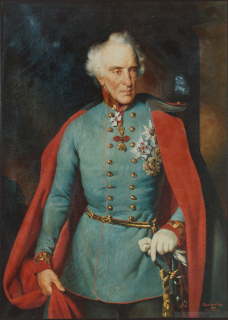
Laval Graf Nugent von Westmeath, Field Marshal in the Austrian army and a soldier of Irish birth who fights in the armies of Austria and the Two Sicilies, dies on August 21, 1862, in the Bosiljevo Castle near Karlovac, in what is now Croatia.

Nugent is born in Ballinacor, a townland in the civil parish of Killare, County Westmeath, on November 3, 1777. He is the son of Count Michael Anton Nugent von Westmeath, Governor of Prague.

In 1793, Nugent joins the Austrian Army, becoming Colonel in 1807, and Chief of Staff of the Army Corps of Archduke John of Austria in 1809. In 1813, he leads the campaign against Viceroy Eugène de Beauharnais, separating French units in Dalmatia and simultaneously joining the British fleet, thus conquering Croatia, Istria and the Po Valley. In 1815, during the Neapolitan War, he commands the right wing of the Austrian Army in Italy, liberates Rome, and defeats Joachim Murat at the Battle of Ceprano and the Battle of San Germano.

In 1816, Nugent is given the title of prince by Pope Pius VII. In 1817, he enters the service of King Ferdinand I of the Two Sicilies. He marries Countess Giovannina Riario-Sforza who owns property in the small town of Montepeloso (now called Irsina), in Basilicata. After the outbreak of the Carbonari rebellion in 1820, he returns to serve in the Austrian Army. In 1848, he leads an Army Corps under Joseph Radetzky von Radetz against the Piedmontese, in the course of the First Italian War of Independence, and also against the Hungarian Revolution of 1848. He receives the title of Field Marshal in 1849.

In recognition of his achievements, Nugent is created in addition to a Roman Prince, an Austrian Imperial Count and a Knight of the Golden Fleece. Later, in 1860, he is appointed titular Prior of Ireland of the Sovereign Military Order of St. John of Jerusalem of Rhodes of Malta.

Nugent dies on August 21, 1862, in the Bosiljevo Castle, near Karlovac, and his body is later transferred to a sarcophagus in the Doric temple “Peace for the Hero,” in Trsat above Rijeka, next to the sarcophagus of his wife.

An exhibition of Nugent’s life in terms of his art collecting as well as his military career is curated at the University of Galway in 2019.


Leave a comment

Birth of Sir William Bernard Hickie, British Army General

Sir William Bernard Hickie, British Army general, commander of the 16th (Irish) Division (1915–18) and an Irish nationalist politician, is born on May 21, 1865, at Slevoir, Terryglass, near Borrisokane, County Tipperary.

Hickie is the eldest son of Colonel James Francis Hickie, JP, of Slevoir, former commanding officer of the 7th Royal Fusiliers, and Lucila Calista (de Tejada) Hickie, daughter of Don Pablo Lariosy Herreros de Tejada of Laguna de Cameros, Castile. He is educated at St. Mary’s College, Oscott, before attending the Royal Military College, Sandhurst, and is commissioned into the Royal Fusiliers in 1885, serving in Egypt and India.

A major at the outbreak of the Second Boer War in 1899, Hickie serves on the staff of Lieutenant-Colonel P. W. J. Le Gallais, commanding officer of the mounted infantry. On November 6, 1900, he is involved in an attempt to capture General Christiaan De Wet at the Battle of Bothaville, when a force led by Le Gallais and Lieutenant-Colonel Wally Ross storm De Wet’s camp. De Wet escapes, while a rearguard of 100 men engages the British force. In a fierce fight Le Gallais is killed, and Wally Ross is badly wounded. Hickie decides to charge the Boer position and leads his small force forward just as reinforcements under Major-General C. E. Knox arrive. The Boers immediately surrender, and some are found with explosive bullets. He wants to execute them immediately, but Knox insists that they be tried. Exasperated with the whole affair, Hickie gives a highly critical interview after the action which is later published in The Times History of the War in South Africa (7 vols, 1900–09), edited by Leo Amery.

Hickie is promoted to brevet lieutenant colonel in 1901 and appointed deputy-assistant adjutant general of the 8th division (1903–06). In 1906, he is given command of the 1st battalion of the Royal Fusiliers. Promoted to colonel in 1912, he serves as assistant quartermaster general of the Irish command (1912–14) and is appointed a Companion of the Order of the Bath in 1914. On the outbreak of World War I, he is promoted to brigadier general and serves in Belgium and France in command of the adjutant’s and quartermaster-general’s department of II Corps. In this capacity, he is involved in the retreat following the Battle of Mons and during the First Battle of the Marne (September 1914). In December 1915, he is appointed to command the 16th (Irish) Division, with the rank of major general, replacing General Sir Lawrence W. Parsons. The division is based around a core of Redmondite National Volunteers, and Hickie, a Catholic and a home ruler, is an acceptable commander to John Redmond and other Irish nationalists.

Hickie is professional, politically adept, and popular with his men, and under his leadership the 16th is renowned for its aggressive fighting spirit. He commands the division during the Battle of the Somme in 1916 and, while proud of his men’s success in capturing Guillemont and Ginchy (September 1916), is appalled by their losses. When the division is ordered to capture Messines (now Mesen) in June 1917, he gives Major Willie Redmond permission to advance as far as the first objective and, following Redmond’s death, reproaches himself bitterly. After this attack the division is transferred to the fifth army and provides assault troops for future attacks. During the Third Battle of Ypres, and especially during the attack on Langemarck in August 1917, the division suffers horrendous casualties, losing 221 officers and 4,064 men. Among the casualties is Fr. Willie Doyle, who Hickie unsuccessfully recommends for a Victoria Cross. The division’s losses at Langemarck are highlighted by Irish MPs in the House of Commons, and Hickie’s handling of the attack is criticised. By this time, nationalist disillusionment with the war means that few Irish replacements are available, and Hickie is forced to accept increasing numbers of non-Irish conscripts into the division. Worn down by years of command, his health finally breaks, and, in February 1918, he is sent home on sick leave, being replaced by Major-General Sir Richard Amyatt Hull.

In 1918, Hickie is created a Knight Commander of the Order of the Bath (KCB) and is also awarded the French Croix de Guerre. During the Irish War of Independence (1919–21), he is critical of the methods used by Crown forces, denouncing in particular the indiscipline of the Black and Tans. In 1921 he retires from the army and becomes a prominent figure in the Royal British Legion in Ireland, tirelessly campaigning on behalf of ex-servicemen. In the 1920s he is involved with the Irish battlefield memorial committee, which erects memorial crosses at Wytschaete, Guillemont, and Salonika, commemorating the 10th and 16th divisions. He later serves as a senator of the Irish Free State (1925–36). Retiring from public life in 1936 to his residence at Terryglass, County Tipperary, he devotes his last years to gardening and reading.

Hickie dies on November 3, 1950, in Dublin, and is buried at Terryglass. He marries a daughter of the novelist Rev. J. O. Hannay, who predeceases him. There is a small collection of his papers in the National Library of Ireland (NLI).

(From: “Hickie, Sir William Bernard” by David Murphy, Dictionary of Irish Biography, http://www.dib.ie, October 2009)


Leave a comment

Death of Frederick William Hall, Victoria Cross Recipient

Frederick William Hall, VC, Irish Canadian recipient of the Victoria Cross, the highest and most prestigious award for gallantry in the face of the enemy that can be awarded to British and Commonwealth forces, dies on April 24, 1915, at Poelcappelle, Belgium.

Hall is born in Kilkenny, County Kilkenny, on February 21, 1885. His father is a British Army soldier from London. He emigrates to Canada around 1910, and lives on Pine Street in Winnipeg, Manitoba. He is 30 years old, and a company sergeant major (CSM) in the 8th (Winnipeg Rifles) Battalion, Canadian Expeditionary Force during World War I when he performs a deed for which he is awarded the Victoria Cross.

It is on the night of April 23, 1915, during the Second Battle of Ypres in Belgium that Hall discovers a number of men are missing. On the ridge above he can hear the moans of the wounded men. Under cover of darkness, he goes to the top of the ridge on two separate occasions and returns each time with a wounded man.

By nine o’clock on the morning of April 24 there are still men missing. In full daylight and under sustained and intense enemy fire, Hall, Cpl. Payne and Pvt. Rogerson crawl out toward the wounded. Payne and Rogerson are both wounded but return to the shelter of the front line. When a wounded man who is lying some 15 yards from the trench calls for help, Company Sergeant-Major Hall endeavors to reach him in the face of very heavy enfilade fire by the enemy. He then makes a second most gallant attempt and is in the act of lifting up the wounded man to bring him in when he falls, mortally wounded in the head. The soldier he is attempting to help is also shot and killed.

Hall’s name can be found on the Menin Gate Memorial to the Missing war memorial in Ypres, Belgium, honouring 56,000 troops from Britain, Australia, Canada and India whose final resting place in the Ypres salient is unknown.

In 1925, Pine Street in Winnipeg is renamed Valour Road because three of Canada’s Victoria Cross recipients resided on the same 700 block of that street: Frederick Hall, Leo Clarke and Robert Shankland. It is believed to be the only street in the British Commonwealth to have three Victoria Cross recipients to live on it, let alone the same block. A bronze plaque is mounted on a street lamp at the corner of Portage Avenue and Valour Road to tell the tale of these three men.


Leave a comment

Commissioning of the USS Juneau

USS Juneau (CL-52), a United States Navy Atlanta-class light cruiser, is commissioned on February 14, 1942, with Captain Lyman Knute Swenson in command. The ship becomes horribly famous as the vessel which carries the five Irish American Sullivan brothers to their death on November 13, 1942, after it is hit by a Japanese torpedo at the Battle of Guadalcanal.

The USS Juneau is laid down by Federal Shipbuilding and Drydock Company, Kearny, New Jersey, on May 27, 1940, and launched on October 25, 1941, sponsored by Mrs. Harry I. Lucas, wife of the mayor of the city of Juneau, Alaska.

After a hurried shakedown cruise along the Atlantic Coast in the spring of 1942, USS Juneau assumes blockade patrol in early May off Martinique and the Guadeloupe archipelago to prevent the escape of Vichy French naval units. She returns to New York to complete alterations and operates in the North Atlantic and Caribbean from June 1 to August 12 on patrol and escort duties. The cruiser departs for the Pacific Theater on August 22.

On 8 November, USS Juneau departs Nouméa, New Caledonia, as a unit of Task Force 67 under the command of Rear Admiral Richmond K. Turner to escort reinforcements to Guadalcanal. The force arrives there on the morning of November 12, and USS Juneau takes up her station in the protective screen around the transports and cargo vessels. Unloading proceeds unmolested until 14:05, when 30 Japanese planes attack the alerted United States group. The anti-aircraft fire is effective, and the USS Juneau alone accounts for six enemy torpedo bombers shot down. The few remaining Japanese planes are, in turn, attacked by American fighters with only one bomber escaping. Later in the day, an American attack group of cruisers and destroyers clears Guadalcanal on reports that a large enemy surface force is headed for the island. At 01:48 on November 13, Rear Admiral Daniel J. Callaghan‘s relatively small landing support group engages the enemy. The Japanese force consists of two battleships, one light cruiser, and nine destroyers.

Because of bad weather and confused communications, the battle occurs in near-pitch darkness and at almost point-blank range, as the ships of the two sides become intermingled. During the melee, the USS Juneau is struck on the port side by a torpedo launched by Japanese destroyer Amatsukaze, causing a severe list, and necessitating withdrawal. Before noon on November 13, USS Juneau, along with two other cruisers damaged in the battle, USS Helena (CL-50) and USS San Francisco (CA-38), head toward Espiritu Santo for repairs. USS Juneau is steaming on one screw, keeping station 800 yards off the starboard quarter of the likewise severely damaged USS San Francisco. She is down 12 feet by the bow, but able to maintain 13 knots.

A few minutes after 11:00, two torpedoes are launched from Japanese submarine I-26. These are intended for USS San Francisco, but both pass ahead of her. One strikes USS Juneau in the same place that had been hit during the battle. There is a great explosion, and USS Juneau breaks in two and disappears in just 20 seconds. Fearing more attacks from I-26, and wrongly assuming from the massive explosion that there are no survivors, USS Helena and USS San Francisco depart without attempting to rescue any survivors. In fact, more than 100 sailors survive the sinking of USS Juneau. They are left to fend for themselves in the open ocean for eight days before rescue aircraft belatedly arrive. While awaiting rescue, all but ten die from the elements and shark attacks. Among those lost are the five Sullivan brothers. Two of the brothers apparently survive the sinking, only to die in the water. Two presumably go down with the ship. Some reports indicate the fifth brother also survives the sinking but disappears during the first night when he leaves a raft and gets into the water. On November 20, 1942, USS Ballard (DD-267) recovers two of the ten survivors. Five more in a raft are rescued by a PBY Seaplane five miles away. Three others, including a badly wounded officer, make it to San Cristobal (now Makira) Island, about 55 miles away from the sinking. One of the survivors recovered by USS Ballard says he had been with one of the Sullivan brothers for several days after the sinking.

As a direct result of the Sullivans’ deaths (and the deaths of four of the Borgstrom brothers within a few months of each other two years later), the United States Department of War adopts the Sole Survivor Policy, a set of regulations, partially stipulated by law, that are designed to protect members of a family from the draft during peacetime, or from hazardous duty or other circumstances, if they have already lost family members to military service.

To honor the five Sullivan brothers, who all died in the sinking, and the USS Juneau, the United States Navy later commissions two ships named USS The Sullivans, and two ships named USS Juneau. On March 17, 2018, the wreck of USS Juneau is located by Paul Allen‘s research crew on board RV Petrel at a depth of about 13,800 feet off the coast of the Solomon Islands in several large pieces.