Higgins returns to Ireland and attends University College Dublin (UCD), studying English and French. For several years he is a teacher in several Dublin inner city schools. While at university he joins the Labour Party and becomes active in the Militant Tendency, an entryistTrotskyist group that operates within the Labour Party. Throughout his time in the Labour Party, he is a strong opponent of coalition politics, along with TDs Emmet Stagg and Michael D. Higgins. He is elected to the Administrative Council of the Labour Party by the membership in the 1980s. In 1989, he is expelled alongside 13 other members of Militant Tendency by party leader Dick Spring. The group eventually leaves the party and forms Militant Labour, which becomes the Socialist Party in 1996.
Higgins speaks out against the Iraq War while a TD, and addresses the Dublin leg of the March 20, 2003 International Day of Action. He is also prominent in the successful 2005 campaign to bring Nigerian school student Olukunle Eluhanla back to Ireland after he had been deported. He remains an opponent of the deportation policy.
Higgins uses his platform in the Dáil to raise the issue of exploitation of migrant and guest workers in Ireland. He and others claim that many companies are paying migrants below the minimum wage and, in some cases, not paying overtime rates. He expresses opposition in the Dáil to the jailing of the Rossport Five in July 2005. He raises the outsourcing of jobs by Irish Ferries in the Dáil in November 2005, requesting new legislation to regulate what he describes as “these modern slavers.”
Higgins is elected again as TD for Dublin West at the 2011 Irish general election. He wins the third seat (of four) with 8,084 first preference votes. In his first speech in the 31st Dáil, he opposed the nomination of Fine Gael‘s Enda Kenny as Taoiseach. On May 4, 2011, Kenny is forced to apologise to Higgins in the Dáil after falsely accusing him of being a supporter of Osama bin Laden after Higgins offers criticism of his assassination by the CIA. He had asked the Taoiseach, “Is assassination only justified if the target is a reactionary, anti-democratic, anti-human rights obscurantist like bin Laden?”
In the Dáil, Higgins accuses TánaisteEamon Gilmore of doing nothing for the 14 Irish citizens being held “incommunicado” by Israel in November 2011. In December 2011, he describes as a disgraceful campaign of intimidation the fines imposed by the government on people who are unable to pay a new household charge brought in as part of the latest austerity budget and says to Enda Kenny that he will be “the new Captain Boycott of austerity in this country.” He asks that Minister for FinanceMichael Noonan provide EBS staff with the 13th month end-of-year payment they are being denied.
In September 2012, Higgins publicly disagrees with former Socialist Party colleague Clare Daly, saying it is “unfortunate” that she has resigned from the party, but that it is impossible for Daly under the banner of the Socialist Party to continue to offer political support to Mick Wallace, who is at that time embroiled in scandal.
Higgins announces in April 2014 that he will not contest the next Dáil election. At the time he states his belief that the “baton of elected representation” should be carried by another generation of Socialist Party politicians — like Ruth Coppinger and Paul Murphy.
Following Fine Gael’s defeat at the 1977 Irish general election, the new leader, Garret FitzGerald, appoints Bruton to the front bench as Spokesperson on Agriculture. He is later promoted as Spokesperson for Finance. He plays a prominent role in Fine Gael’s campaign in the 1981 Irish general election, which results in another coalition with the Labour Party, with FitzGerald as Taoiseach. He receives a personal vote in Meath of nearly 23%, and at the age of only 34 is appointed Minister for Finance, the most senior position in the cabinet. In light of overwhelming economic realities, the government abandons its election promises to cut taxes. The government collapses unexpectedly on the night of January 27, 1982, when Bruton’s budget, that was to impose an unpopular value-added tax (VAT) on children’s shoes, is defeated in the Dáil.
The minority Fianna Fáil government which follows only lasts until November 1982, when Fine Gael once again returns to power in a coalition government with the Labour Party. However, when the new government is formed, Bruton is moved from Finance to become Minister for Industry and Energy. After a reconfiguration of government departments in 1983, he becomes Minister for Industry, Trade, Commerce and Tourism. In a cabinet reshuffle in February 1986, he is appointed again as Minister for Finance. Although he is Minister for Finance, he never presents his budget. The Labour Party withdraws from the government due to a disagreement over his budget proposals leading to the collapse of the government and another election.
Following the 1987 Irish general election, Fine Gael suffers a heavy defeat. Garret FitzGerald resigns as leader immediately, and a leadership contest ensues between Alan Dukes, Peter Barry and Bruton himself, with Dukes being the ultimate victor. Dukes’s term as leader is lackluster and unpopular. The party’s disastrous performance in the 1990 Irish presidential election, in which the party finishes in a humiliating and then unprecedented third in a national election, proves to be the final straw for the party and Dukes is forced to resign as leader shortly thereafter. Bruton, who is the deputy leader of Fine Gael at the time, is unopposed in the ensuing leadership election.
Bruton’s election is seen as offering Fine Gael a chance to rebuild under a far more politically experienced leader. However, his perceived right-wing persona and his rural background are used against him by critics and particularly by the media. However, to the surprise of critics and of conservatives, in his first policy initiative he calls for a referendum on a Constitutional amendment permitting the enactment of legislation allowing for divorce in Ireland.
By the 1992 Irish general election, the anti-Fianna Fáil mood in the country produces a major swing to the opposition, but that support goes to the Labour Party, not Bruton’s Fine Gael, which actually loses a further 10 seats. Even then, it initially appears that Fine Gael is in a position to form a government. However, negotiations stall in part from Labour’s refusal to be part of a coalition which would include the libertarian Progressive Democrats, as well as Bruton’s unwillingness to take Democratic Left into a prospective coalition. The Labour Party breaks off talks with Fine Gael and opts to enter a new coalition with Fianna Fáil.
In late 1994, the government of Fianna Fáil’s Albert Reynolds collapses. Bruton is able to persuade Labour to end its coalition with Fianna Fáil and enter a new coalition government with Fine Gael and Democratic Left. He faces charges of hypocrisy for agreeing to enter government with Democratic Left, as Fine Gael campaigned in the 1992 Irish general election on a promise not to enter government with the party. Nevertheless, on December 15, 1994, aged 47, he becomes the then youngest ever Taoiseach. This is the first time in the history of the state that a new government is installed without a general election being held.
Bruton’s politics are markedly different from most Irish leaders. Whereas most leaders had come from or identified with the independence movement Sinn Féin (in its 1917–22 phase), Bruton identifies more with the more moderate Irish Parliamentary Party (IPP) tradition that Sinn Féin had eclipsed at the 1918 Irish general election.
Continued developments in the Northern Ireland peace process and Bruton’s attitude to Anglo-Irish relations come to define his tenure as Taoiseach. In February 1995, he launches the Anglo-Irish “Framework Document” with the British prime ministerJohn Major. It foreshadows the 1998 Good Friday Agreement, which, among other things, establishes an elected, power-sharing executive authority to be run by these onetime adversaries, ending 30 years of bloodletting that had claimed more than 3,000 lives. However, he takes a strongly critical position on the British Government‘s reluctance to engage with Sinn Féin during the Irish Republican Army‘s 1994–1997 ceasefire. He also establishes a working relationship with Gerry Adams of Sinn Féin; however, both are mutually distrustful of each other.
The coalition remains in force to contest the 1997 Irish general elections, which are indecisive, and Bruton serves as acting taoiseach until the Dáil convenes in late June and elects a Fianna Fáil–Progressive Democrats government. He retires from Irish politics in 2004 and serves as the European Union Ambassador to the United States (2004–09).
Bruton dies at the age of 76 on February 6, 2024, at the Mater Private Hospital in Dublin, following a long bout with cancer. A state funeral is held on February 10 at St. Peter’s and St. Paul’s Church in Dunboyne.
Andrews comes from a family with strong political connections. His grandfather, Todd Andrews, fought in the Irish War of Independence and became a founder-member of Fianna Fáil, and his grandmother, Mary Coyle, was a member of Cumann na mBan. His father, David Andrews, served as a TD from 1965 to 2002 and is a former Minister for Foreign Affairs, while his uncle, Niall Andrews, is a former Fianna Fáil TD and MEP and his cousin, Chris Andrews (son of Niall Andrews), has been a Sinn Féin TD since 2020 (having previously served as a Fianna Fáil TD from 2007 to 2011). In April 2018, Andrews is described as “part of Fianna Fáil royalty.”
Andrews is educated at Blackrock College and attends university at University College Dublin (UCD). Before entering political life, he works as a secondary school teacher in Dublin from 1991 until 1997, working in Senior College Ballyfermot, Sutton Park School and Bruce College. While a secondary school teacher, he studies law at King’s Inns and qualifies as a barrister in 1997. He is called to the Bar in 1997 and practices as a barrister until 2003.
In June 2006, Andrews leads a group of Fianna Fáil backbenchers in an unsuccessful attempt to establish a backbench committee to influence government policy. At the 2007 Irish general election, he retains his seat in Dún Laoghaire with 8,587 votes.
Andrews is appointed Minister of State for Children in May 2008. As Minister, he frames the Government response to the Ryan Report on Institutional Abuse. This includes an Implementation Plan that delivers an additional 200 social workers for the HSE Child and Family Services. In April 2009, he introduces the Early Childhood Care and Education (ECCE) Scheme, which provides, for the first time, free universal access to pre-school education. The scheme benefits 65,000 children in 2013.
After the release of the Murphy Report into child abuse in the Dublin diocese in November 2009, Andrews, speaking at a conference in Dublin Castle, is asked about the position of the Bishop of Limerick, Donal Murray. He says, “I think it’s everybody’s view that if adverse findings are made against an individual in a commission of inquiry, then it would be amazing that there be no consequences for them.” Bishop Murray subsequently apologises to survivors and resigns from office.
In December 2009, Andrews oversees the introduction of government policy to lower the legal age of consent to sixteen, citing a Joint Oireachtas Committee on the Constitution report which recommends the legal age be reduced to sixteen from the current seventeen. He expresses the view the existing laws are “inappropriate” and out of touch with the modern reality of sexual relations between young people and promises to publish legislation to change the age of consent to sixteen. He notes that Ireland and Malta are “the only countries in Europe with an age of consent of seventeen.” However, the law is not passed by the Oireachtas before the 2011 Irish general election in which Fianna Fáil cedes power to a Fine Gael-Labour coalition.
On January 31, 2011, in the run up to the general election, Andrews is named Health spokesman by the party leader, Micheál Martin. He loses his seat at the general election.
In September 2012, Andrew is appointed Fianna Fáil Director of Elections for the Children’s referendum.
In February 2019, Andrews is selected as the Fianna Fáil candidate for the Dublin constituency at the 2019 European Parliament election. He is elected in May 2019 receiving 14.1% of the 1st preference votes, but as the fourth candidate elected, he does not take his seat until after the UK leaves the European Union on January 31, 2020.
Andrews is appointed EU Chief Observer for the 2023 Nigerian Federal and State elections by High Representative Vice President Josep Borrell. A report on the election is subsequently produced highlighting that the election was marred by a lack of transparency, public mistrust in the Independent National Electoral Commission (INEC), violence, and vote buying, stressing the need for comprehensive electoral reforms.
Outside of his political career, Andrews is appointed chief executive of the Irish aid charity GOAL in November 2012, replacing the retiring founder, John O’Shea. In October 2016, he resigns from GOAL after it is revealed that other senior executives of GOAL have been involved in “large-scale fraud,” though there is no suggestion that he himself is involved in the scandal. In October 2017, the new CEO of GOAL announces a deficit of €31.6 million due to the fraud but says that it will survive after “one of the most challenging years” in its 40-year history.
In March 2017, Andrews is appointed as Director-General of the Irish State-supported EU think tank and advocacy body, the Institute of International and European Affairs (IIEA), with the Chairperson of the IIEA, former Leader of the Labour Party, Ruairi Quinn, describing him as having the “political and administrative skills” of value to the IIEA.
Andrews is married and has two sons and a daughter. His brother, David McSavage, is a comedian, and he is a first cousin of former RTÉ television and radio presenter Ryan Tubridy.
Staples is born on July 31, 1775, the son of John Staples (1736-1820) and Henrietta Molesworth (1745-1813), a daughter of Richard Molesworth, 3rd Viscount Molesworth. His siblings are Rev. John Molesworth Staples (1776-1858), Grace “Marchioness of Ormonde” Louisa Staples Butler (1779-1860) and Hon. Frances Staples Ponsonby (1782-1858).
Staples lives at Lissan House, near the market town of Cookstown, County Tyrone. He marries Catherine Hawkins (1796-1872), daughter and heiress of Reverend John Hawkins and Anne Montgomery, on October 27, 1813. They have no children.
Staples dies in Dublin on May 14, 1865, and is buried in the Lissan Church of Ireland Churchyard in Cookstown. His title is inherited by his nephew.
Born into a political family in Wexford, Howlin is the son of John and Molly Howlin (née Dunbar), and named after Brendan Corish, the local Labour TD and later leader of the Labour Party. His father is a trade union official who serves as secretary of the Irish Transport and General Workers’ Union (ITGWU) in Wexford for 40 years. He also secures election as a Labour member of Wexford Corporation, where he serves for eighteen years, and is also election agent to Brendan Corish. His mother is also strongly involved in local Labour politics. His brother Ted is a former member of Wexford County Council and Lord Mayor of Wexford. He is raised on William Street in Wexford with his three siblings.
Howlin grows up in Wexford town and is educated locally in the Faythe and at Wexford CBS. He later attends St. Patrick’s College, Dublin, and qualifies as a primary school teacher. During his career as a teacher, he is active in the Irish National Teachers’ Organisation (INTO), before embarking on a career in full-time politics.
Howlin credits his introduction to politics to his involvement in the Irish anti-nuclear movement. The chair of Nuclear Opposition Wexford (NOW), he is involved in the organisation of a protest against the building of a nuclear power plant in Carnsore Point, which draws 40,000 protestors. In 1979, he is asked to run for Wexford Corporation and is selected in his absence but declines to run in order to continue as chair of NOW.
Howlin contests his first general election at the November 1982 Irish general election. He runs as a Labour candidate in the Wexford constituency, but despite the existence of a large left-wing vote in the area, he is not elected. In spite of this setback, a Fine Gael-Labour Party coalition government comes to power, and he is nominated by the Taoiseach, Garret FitzGerald, to serve in Seanad Éireann as a Senator. He secures election to Wexford County Council in 1985 and serves as Mayor of Wexford in 1986.
In 1987, the Labour Party withdraws from the coalition government and a general election is called. Howlin once again contests a seat in Wexford and is elected to Dáil Éireann. Labour are out of office as a Fianna Fáil government takes office. In spite of his recent entry to the Dáil, he is subsequently named Chief Whip of the Labour Party, a position he holds until 1993.
The 1992 Irish general election results in a hung Dáil once again. However, the Labour Party enjoys their best result to date at the time. After negotiations, a Fianna Fáil-Labour Party coalition government comes to office. Howlin joins the cabinet of Taoiseach Albert Reynolds as Minister for Health. During his tenure the development of a four-year health strategy, the identifying of HIV/AIDS prevention as a priority and the securing of a £35 million investment in childcare are advanced. He, however, is also targeted by anti-abortion groups after introducing an act which would allow information regarding abortion.
In 1994, the Labour Party withdraws from government after a disagreement over the appointment of Attorney GeneralHarry Whelehan as a Judge of the High Court and President of the High Court. However, no general election is called and, while it is hoped that the coalition could be revived under the new Fianna Fáil leader Bertie Ahern, the arithmetic of the Dáil now allows the Labour Party to open discussions with other opposition parties. After negotiations a Rainbow Coalition comes to power involving Fine Gael, Labour and Democratic Left. In John Bruton‘s cabinet, he becomes Minister for the Environment.
Following the 1997 Irish general election, a Fianna Fáil-Progressive Democrats coalition government comes to power and the Labour Party returns to the opposition benches. In the announcement of the party’s new front bench, Howlin retains responsibility for the Environment.
In late 1997, Dick Spring resigns as leader of the Labour Party and Howlin immediately throws his hat into the ring in the subsequent leadership election. In a choice between Howlin and Ruairi Quinn, the former gains some early support; however, the leadership eventually goes to Quinn by a significant majority. As a show of unity, Howlin is later named deputy leader of the party and retains his brief as Spokesperson for the Environment and Local Government.
In 2002, following Quinn’s resignation as party leader after Labour’s relatively unsuccessful 2002 Irish general election campaign, Howlin again stands for the party leadership. For the second time in five years, he is defeated for the leadership of the party, this time by Pat Rabbitte, who is formerly a leading figure in Democratic Left. He is succeeded as deputy leader by Liz McManus.
While having been publicly supportive of Rabbitte’s leadership, Howlin is perceived as being the leader of the wing of the party which is sceptical of Rabbitte’s policy with regard to future coalition with Fianna Fáil. Rabbitte explicitly rules out any future coalition with Fianna Fáil, instead forming a formal alliance with Fine Gael in the run-up to the 2007 Irish general election (the so-called Mullingar Accord).
On June 26, 2007, Howlin is appointed the Leas-Cheann Comhairle (deputy chairperson) of Dáil Éireann.
After the 2011 Irish general election, Fine Gael and the Labour Party form a government, and Howlin is appointed to the new office of Minister for Public Expenditure and Reform. In May 2011, he says that over the next 20 years the number of people in Ireland over 65 is set to increase by almost half a million, a situation that could see the annual health budget soar – rising by €12.5 billion in the next decade alone. While reform is a major part of government attempts “to regain full sovereignty over economic policy,” he tells a meeting of the Association of Chief Executives of State Agencies they will in any event face key “imperatives” in coming years. He says a new public spending review, on which he has briefed the cabinet in recent days, will not be a simple assessment of where to make cuts, but will also consider the way public sector services are delivered. He reiterates the government’s commitment not to cut public sector pay, “if the Croke Park Agreement works.” “These are just some of the challenges that our society is facing in the coming decade – crisis or no crisis. In the good times, tackling them was going to be difficult. Today, in these difficult times, tackling them is going to be imperative.” He says Ireland is facing a profound and complex economic crisis “where we are fighting a battle on three fronts – mass unemployment, a major failure in banking, and a fiscal crisis.”
Howlin retains his seat in the Dáil following the 2016 Irish general election, though only six of his Labour colleagues do likewise and the party returns to the opposition benches. Following the resignation of Joan Burton, he contests the 2016 Labour Party leadership election unopposed and is elected Leader of the Labour Party on May 20, 2016.
In March 2018, Howlin criticises Taoiseach Leo Varadkar for failing to personally invite him to accompany him as he meets ambulance crews in Howlin’s constituency of Wexford. Varadkar replies that he has been far too busy dealing with the recent weather crisis and Brexit “to organise invitations to Deputies personally in order that they felt included.” It is separately said of Howlin’s complaint, “It appears that the Taoiseach, the chief executive of the State, needs the imprimatur of local politicians when he enters their bailiwick, and needs to be accompanied and monitored by those same politicians while he is in their realm.”
Alan Kelly challenges Howlin for the party leadership in 2018, stating that he has failed to “turn the ship around.” He states that Kelly’s comments are a disappointing and unnecessary distraction. He also says that there is not a single parliamentary party member that supports the challenge, and that Kelly has the backing of a minority of councillors.
In September 2018, Howlin states that winning 14 seats in the 33rd Dáil is a realistic goal. During the campaign in 2020, he states his wish to end the United States‘s use of Shannon Airport for military related activities. In the 2020 Irish general election, party first preference vote drops to 4.4% of first preference votes and returns 6 seats – a record low. Howlin announces his intention to step down as leader on February 12, 2020. He also says that the Labour Party should not formally enter government, a view that is backed by the parliamentary party. He also states that he will not back any candidate in the following contest. On February 15, 2020, he rules himself out as a candidate for Ceann Comhairle of the 33rd Dáil, with the polling day to elect his successor set for April 3, 2020.
In 2020, Howlin’s legislation (Harassment, Harmful Communications and Related Offences Bill) is passed and signed into law by Michael D. Higgins. This bill makes the distribution of intimate images or “revenge porn” a criminal offense and makes other forms of cyberbullying and harassment punishable.
Howlin is a single man. He has spoken publicly of receiving hate mail relating to his private life and questioning his sexual orientation. In an interview with The Star during the 2002 Labour Party leadership contest, in response to repeated speculation, he announces he is “not gay.”
The Disfranchising Act, an act of parliament of the Parliament of Ireland, is debated in 1727 and receives royal assent on May 6, 1728. One of a series of Penal Laws, it prohibits all Roman Catholics from voting in parliamentary elections. Its full title is “An Act for the further regulating the Election of Members of Parliament, and preventing the irregular Proceedings of Sheriffs and other Officers in electing and returning such Members” and its citation is 1 Geo. 2. c. 9 (I).
In the eighteenth century, elections are held at irregular intervals and at the beginning of a new reign. The Act follows the death of George I on June 11, 1727, but does not take effect until after the election of 1727, coming into force in 1728.
The Act is repealed by the Roman Catholic Relief Act 1793, which receives royal assent on April 9, 1793, allowing the franchise in Ireland to all men holding a property with a rental value of at least two pounds annually.
O’Connell had rejected a suggestion from “friends of emancipation,” and from the English Roman Catholic bishop, John Milner, that the fear of Catholic advancement might be allayed if the Crown were accorded the same right exercised by continental monarchs: a veto on the confirmation of Catholic bishops. O’Connell insists that Irish Catholics would rather “remain forever without emancipation” than allow the government “to interfere” with the appointment of their senior clergy. Instead, he relies on their confidence in the independence of the priesthood from Ascendancy landowners and magistrates to build his Catholic Association into a mass political movement. On the basis of a “Catholic rent” of a penny a month (typically paid through the local priest), the Association mobilises not only the Catholic middle class, but also poorer tenant farmers and tradesmen. Their investment enables O’Connell to mount “monster” rallies that stay the hands of authorities and embolden larger enfranchised tenants to vote for pro-emancipation candidates in defiance of their landlords.
O’Connell’s campaign reaches its climax when he himself stands for parliament. In July 1828, he defeats a nominee for a position in the British cabinet, William Vesey-FitzGerald, in a County Clare by-election, 2057 votes to 982. This makes a direct issue of the parliamentary Oath of Supremacy by which, as a Catholic, he will be denied his seat in the Commons.
As Lord Lieutenant of Ireland, Wellington’s brother, Richard Wellesley, had attempted to placate Catholic opinion, notably by dismissal of the long-serving Attorney-General for Ireland, William Saurin, whose rigid Ascendancy views and policy made him bitterly unpopular, and by applying a policy of prohibitions and coercion against not only the Catholic Ribbonmen but also the Protestant Orangemen. But now both Wellington and his Home Secretary, Robert Peel, are convinced that unless concessions are made, a confrontation is inevitable. Peel concludes, “though emancipation was a great danger, civil strife was a greater danger.” Fearing insurrection in Ireland, he drafts the Relief Bill and guides it through the House of Commons. To overcome the vehement opposition of both the King and of the House of Lords, Wellington threatens to resign, potentially opening the way for a new Whig majority with designs not only for Catholic emancipation but also for parliamentary reform. The King initially accepts Wellington’s resignation and the King’s brother, Ernest Augustus, Duke of Cumberland, attempts to put together a government united against Catholic emancipation. Though such a government would have considerable support in the House of Lords, it would have little support in the Commons and Ernest abandons his attempt. The King recalls Wellington. The bill passes the Lords and becomes law.
The key, defining, provision of the Acts is its repeal of “certain oaths and certain declarations, commonly called the declarations against transubstantiation and the invocation of saints and the sacrifice of the mass, as practised in the Church of Rome,” which had been required “as qualifications for sitting and voting in parliament and for the enjoyment of certain offices, franchises, and civil rights.” For the Oath of Supremacy, the act substitutes a pledge to bear “true allegiance” to the King, to recognise the Hanoverian succession, to reject any claim to “temporal or civil jurisdiction” within the United Kingdom by “the Pope of Rome” or “any other foreign prince … or potentate,” and to “abjure any intention to subvert the present [Anglican] church establishment.”
This last abjuration in the new Oath of Allegiance is underscored by a provision forbidding the assumption by the Roman Church of episcopal titles, derived from “any city, town or place,” already used by the United Church of England and Ireland. (With other sectarian impositions of the Act, such as restrictions on admittance to Catholic religious orders and on Catholic-church processions, this is repealed with the Roman Catholic Relief Act 1926.)
The one major security required to pass the Act is the Parliamentary Elections (Ireland) Act 1829. Receiving its royal assent on the same day as the relief bill, the act disenfranchises Ireland’s forty-shilling freeholders, by raising the property threshold for the county vote to the British ten-pound standard. As a result, “emancipation” is accompanied by a more than five-fold decrease in the Irish electorate, from 216,000 voters to just 37,000. That the majority of the tenant farmers who had voted for O’Connell in the Clare by-election are disenfranchised as a result of his apparent victory at Westminster is not made immediately apparent, as O’Connell is permitted in July 1829 to stand unopposed for the Clare seat that his refusal to take the Oath of Supremacy had denied him the year before.
In 1985, J. C. D. Clark depicts England before 1828 as a nation in which the vast majority of the people still believed in the divine right of kings, and the legitimacy of a hereditary nobility, and in the rights and privileges of the Anglican Church. In Clark’s interpretation, the system remained virtually intact until it suddenly collapsed in 1828, because Catholic emancipation undermined its central symbolic prop, the Anglican supremacy. He argues that the consequences were enormous: “The shattering of a whole social order. … What was lost at that point … was not merely a constitutional arrangement, but the intellectual ascendancy of a worldview, the cultural hegemony of the old elite.”
Clark’s interpretation has been widely debated in the scholarly literature, and almost every historian who has examined the issue has highlighted the substantial amount of continuity before and after the period of 1828 through 1832.
Eric J. Evans in 1996 emphasises that the political importance of emancipation was that it split the anti-reformers beyond repair and diminished their ability to block future reform laws, especially the great Reform Act of 1832. Paradoxically, Wellington’s success in forcing through emancipation led many Ultra-Tories to demand reform of Parliament after seeing that the votes of the rotten boroughs had given the government its majority. Thus, it was an ultra-Tory, George Spencer-Churchill, Marquess of Blandford, who in February 1830 introduced the first major reform bill, calling for the transfer of rotten borough seats to the counties and large towns, the disfranchisement of non-resident voters, the preventing of Crown officeholders from sitting in Parliament, the payment of a salary to MPs, and the general franchise for men who owned property. The ultras believed that a widely based electorate could be relied upon to rally around anti-Catholicism.
In Ireland, emancipation is generally regarded as having come too late to influence the Catholic-majority view of the union. After a delay of thirty years, an opportunity to integrate Catholics through their re-emerging propertied and professional classes as a minority within the United Kingdom may have passed. In 1830, O’Connell invites Protestants to join in a campaign to repeal the Act of Union and restore the Kingdom of Ireland under the Constitution of 1782. At the same, the terms under which he is able to secure the final measure of relief may have weakened his repeal campaign.
George Ensor, a leading Protestant member of the Catholic Association in Ulster, protests that while “relief” bought at the price of “casting” forty-shilling freeholders, both Catholic and Protestant, “into the abyss,” might allow a few Catholic barristers to attain a higher grade in their profession, and a few Catholic gentlemen to be returned to Parliament, the “indifference” demonstrated to parliamentary reform will prove “disastrous” for the country.
Seeking, perhaps, to rationalise the sacrifice of his freeholders, O’Connell writes privately in March 1829 that the new ten-pound franchise might actually “give more power to Catholics by concentrating it in more reliable and less democratically dangerous hands.” The Young IrelanderJohn Mitchel believes that the intent is to detach propertied Catholics from the increasingly agitated rural masses.
In a pattern that had been intensifying from the 1820s as landlords clear land to meet the growing livestock demand from England, tenants have been banding together to oppose evictions and to attack tithe and process servers.
Brownlow’s father, grandfather, and great-grandfather had been MPs, and in 1753 he wins a hotly contested by-election in which his opponents accuse him of papist and Jacobite sympathies. The unsuccessful candidate is Francis Caulfeild, brother of James, 1st Earl of Charlemont, his petition to parliament causing a furor and is defeated by only one vote in one of the most celebrated electoral struggles of the day. Brownlow represents the county for over forty years, from 1753 until his death. In 1753, he supports the government on the controversial money bill.
Brownlow marries Judith, daughter of the Rev. Charles Meredyth, Dean of Ardfert, of County Meath, on May 25, 1754. They have two sons. After her death in Lyon, France, in October 1763, he marries Catherine, daughter of Roger Hall of Newry, County Down, on November 25, 1765. They have two sons and five daughters, three who marry into the nobility. In 1758, he is one of the Wide Streets commissioners in Dublin and owns an imposing house in Merrion Square. He is a trustee of the linen board in Ulster, and makes many improvements to his estate, castle, and demesne, the local church, and the town of Lurgan. However, it is alleged that private roads in his demesne were built with public money. He is one of a few landowners in County Armagh who are believed to have misappropriated the unusually high county cess levied by the grand jury, of which he is a member. In 1758, he suggests that salaries be paid to government officials, and one official, Henry Meredyth, his first wife’s uncle, subsequently receives an annual salary of £500.
In June 1763, large numbers of Presbyterian farmers and weavers, calling themselves the Hearts of Oak, in a notable show of dissatisfaction with the privileges of landlords, march on the homes of the gentry to demand redress. Brownlow is in England and avoids a confrontation. Despite the allegations of abuse of public money, he is generally recognised as one of the more independent and reform-minded MPs of the day. He captains a Volunteer troop of dragoons which march from Lurgan to assist Belfast after the French commander François Thurot lands at Carrickfergus in 1760. As one of the supporters of Henry Grattan, he is prominent in the Volunteer movement of the 1780s. He is captain of the Lurgan Volunteer company and lieutenant-colonel of the northern battalion and backs the movement in parliament until displeased by the Volunteer national convention (November 10 – December 2, 1783), which seeks franchise reform and seems to challenge the authority of the existing parliament.
Brownlow subscribes £9,000 to help found the Bank of Ireland in 1783, and in parliament on February 7, 1785, vigorously opposes William Pitt‘s proposals on Ireland’s commercial relations with England, seeing in them the danger that Ireland would become a “tributary nation.” He is appointed a privy councilor in 1765. He organises horse races in his locality and is a talented harpsichord player. After his death on October 28, 1794, the Belfast News Letter prints an unusually long and glowing tribute, expressing admiration for his “incorruptible integrity” and patriotism, as well as two poetic elegies. He is succeeded by his son William Brownlow.
(From: “Brownlow, William” by Linde Lunney, Dictionary of Irish Biography, http://www.dib.ie, October 2009 | Pictured: Portrait of the Right Honorable William Brownlow, oil on canvas by Gilbert Stuart, circa 1790)
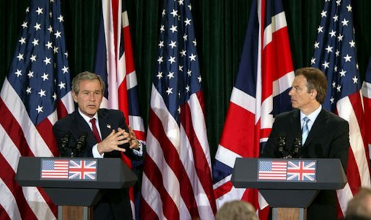
The two leaders meet at Hillsborough Castle and begin their sessions on April 7 with a half-hour walk through the gardens before dinner. The following day they hold a press conference and further talks, including a session on the Northern Ireland peace effort.
Bush and Blair, Bush’s closest ally in confronting Saddam Hussein, come together to discuss questions made increasingly urgent by the rapid military progress American and British forces have made and to plan for a postwar Iraq. They seek to bridge their differences over how much of a role to give the United Nations in rebuilding the country and putting together a new government.
Blair has been under pressure at home and from much of Europe to support giving the United Nations a strong role in stabilizing Iraq. The White House, however, has consistently signaled that it wants the United States and Britain to play the lead role in creating a new Iraqi government.
United States Secretary of StateColin L. Powell tells reporters traveling with the president that the United States is sending officials to the region to begin assembling a group of Iraqis who will constitute an interim governing authority and will be put in place alongside the American-led military and civilian authorities. In a sign of the speed with which the maneuvering for power in post-Hussein Iraq is unfolding, Ahmed Chalabi, the leader of the main Iraqi exile opposition group, the Iraqi National Congress (INC), is reported to be heading to Baghdad from southern Iraq.
“The hostilities phase is coming to a conclusion,” Powell says. “It’s time for all of us to think about the post-hostilities phase, how we create a representative government consisting of all elements of Iraqi society.”
Powell and British officials play down the magnitude of the differences between the United States and Britain over the United Nations role. The United Nations, Powell says, will have “an endorsing role to play to the interim authority to give it legitimacy,” a formulation that appears to reserve for the United States and Britain the right to select the leaders of the temporary postwar administration. A spokesman for Blair uses similar language, referring to the United Nations’ being involved “in a way that endorses that new Iraqi authority” as a step toward establishing a full-fledged Iraqi government.
Initially, primary responsibility for administering Iraq would rest with a team led by a retired United States Armylieutenant general, Jay Garner, and the interim Iraqi authority would be likely to begin assuming power after that, perhaps 90 days later, the British spokesman says.
Clearly wary of getting into another diplomatic squabble with other members of the United Nations Security Council, Powell and other administration officials have emphasized in recent days that the United States and Britain, having waged the war and paid for it with blood and money, will not be drawn into a negotiation with countries like France and Germany over the immediate postwar period.
Powell emphasizes, however, that part of his focus will now be on “healing” diplomatic wounds and granting the United Nations an important role once Iraq is stabilized.
At the United Nations, Secretary-GeneralKofi Annan says he will travel to Britain, France, Germany and Russia in the coming week to test whether the Security Council might be able to agree on a postwar plan. He announces that he has been working on post-conflict issues with a special adviser, Rafeeuddin Ahmed. He says he expects the United Nations to play an important role, whether as a political facilitator or dealing with issues like reconstruction or human rights. “Above all, the U.N. involvement does bring legitimacy, which is necessary, necessary for the country, for the region and for the peoples around the world,” Annan says.
Bush’s trip to see Blair here is the third British-American summit meeting in as many weeks. It coincides with news that American forces are attacking the presidential palaces and other symbols of the Iraqi government in the heart of Baghdad and that British soldiers have taken control of Iraq’s second-largest city, Basra.
The presence of the two leaders draws crowds of antiwar protesters and set off a local debate about whether this city, which has been trying to put behind it a history of sectarian violence, is an appropriate location for a war council.
The city authorities in Belfast have to divert traffic and clear public buildings in various locations following a series of bomb scares. The scenes are reminiscent of the conflicted time before the Northern Ireland peace agreement in 1998 put an end to organized sectarian violence that cost the lives of more than 3,600 people over three decades.
In the conversations about Iraq, Blair plays his customary role of trying to bridge trans-Atlantic differences. He hopes to placate criticism at home and ease relations with his European neighbors by pushing for a United Nations resolution authorizing an interim governing authority.
He had earlier envisaged a more prominent role for the United Nations, but he emerged from his last meeting with Bush, at Camp David on March 27, emphasizing the need for the United Nations to endorse the transition plans rather than play a central part in the plans, as he had advocated at the first summit meeting, in the Azores on March 16.
Europeans express alarm at what they see as the marginalization of the United Nations. At the same time, European critics of the war, like France, Germany and Russia, may object to Blair’s compromise proposal on grounds that it legitimizes a war they oppose. Even in Britain, the one European country where the war has majority support, there is great resistance to American domination of the postwar running of Iraq. An opinion poll in The Daily Telegraph shows that while Britons’ enthusiasm for the war has grown to a high of 60 percent and their approval of Blair’s conduct has also risen, there is only 2 percent approval of an American-controlled administration of Iraq.
Powell says the United States is only trying to lay out a plan under which military control of Iraq can give way to a mix of civilian and military control, including substantial involvement by Iraqis, and then to a full-fledged government. He says United Nations involvement might be necessary to convince banks and financial markets that they can safely and legally lend money to Iraq. Asked about peacekeeping duties, he says NATO is open to the possibility of helping to provide postwar security or assisting in the search for weapons of mass destruction.
Planning for the peace has exposed differences not only between the United States and Britain, but also within the Bush administration and between the administration and Congress.
Blair chose to hold his meeting with Bush in Northern Ireland in part so that the president can lend his support to the long-running efforts by Britain and Ireland to find a peaceful solution to the strife between Catholics and Protestants in the province. The White House, however, seems not to be paying much attention to Northern Ireland diplomacy. The schedules and credentials it distributes to reporters list the site as “Belfast, Ireland.”
(From: “Bush Meets With Blair to Discuss Postwar Iraq” by Richard W. Stevenson and Warren Hoge, The New York Times, http://www.nytimes.com, April 8, 2003)
In 1838, Hill purchases land in Gweedore (Irish: Gaoth Dobhair), a “district” in northwest County Donegal in the west of Ulster, and, over the next few years, he expands his holdings to 23,000 acres. He himself describes the condition of the local population as “more deplorable than can well be conceived.” According to the schoolmaster, Patrick McKye, they are in the “most needy, hungry and naked condition of any people.” Among other improvements, he builds a port, Bunbeg Harbour, to encourage fishing, improves the roads and other infrastructure, and constructs The Gweedore Hotel to attract wealthy tourists.
However, Hill’s attempts to reform local farming practices, in particular, his suppression of the rundale system of shared landholding, proves unpopular and controversial. While his reforms may have protected Gweedore from the worst effects of the Great Famine of the 1840s, as the local population did not decrease, as it did elsewhere in Ireland, his attitude to the famine is uncompromising and unsympathetic:
“The Irish people have profited much by the Famine, the lesson was severe; but so were they rooted in old prejudices and old ways, that no teacher could have induced them to make the changes which this Visitation of Divine Providence has brought about, both in their habits of life and in their mode of agriculture.”
Hill’s book Facts from Gweedore (1845) provides an account of conditions in Gweedore and seeks to explain and justify Hill’s agricultural reforms. It runs to five editions and plays a large part in the bitter public debates about the effects of Irish landlordism. In June 1858, he gives evidence to a House of Commonsselect committee on Irish poverty. The committee is critical of his actions.
Hill is twice married, to two sisters, daughters of Edward Austen Knight, brother of Jane Austen. On October 21, 1834, he marries Cassandra Jane Knight (1806–42). They have four children:
Norah Mary Elizabeth Hill (December 12, 1835 – April 24, 1920)
Captain Arthur Blundell George Sandys Hill (May 13, 1837 – June 16, 1923)
Augustus Charles Edward Hill (March 9, 1839 – December 9, 1908)
Cassandra Jane Louisa Hill (March 12, 1842 – August 16, 1901)
On May 11, 1847, Hill marries Louisa Knight (1804–89), niece and goddaughter of Jane Austen. She had moved to Ulster after Cassandra’s death to look after the children. The marriage prompts a parliamentary investigation into the legality of a marriage between a widower and his deceased wife’s sister. They have one son:
George Marcus Wandsbeck Hill (April 9, 1849 – March 22, 1911)
Hill dies at his residence, Ballyare House, in Ramelton, County Donegal, on April 6, 1879. He is buried at Conwal Parish Church in Letterkenny, alongside his first wife.





 seamus dubhghaill