The oath, pledging allegiance to the Constitution and fidelity to George V as King of Ireland, is required by the Anglo-Irish Treaty signed in 1921, and has been the symbolic focus of Irish republican opposition to the Treaty in the 1922–23 Irish Civil War. When Fianna Fáil is founded in 1926 by veterans of the losing anti-Treaty side in the Civil War, abolishing the oath is a core aim. It is a main item in the manifesto for its successful 1932 Irish general election campaign, after which it forms a minority government whose first action is to introduce the Constitution (Removal of Oath) Bill 1932. Seanad Éireann has more ex-unionists and others conciliatory towards the United Kingdom and vote to reject the bill unless the Treaty can be amended by agreement. After the 1933 Irish general election, the Fianna Fáil majority government is able to override the Seanad and enact the law.
As well as amending the Constitution, the 1933 act also amends the Constitution of the Irish Free State (Saorstát Eireann) Act 1922, which had both created the Constitution in Irish law and also prohibited any Constitutional amendment incompatible with the Treaty. Since the Free State cannot unilaterally amend the Treaty, Fianna Fáil amends the 1922 act to remove the Treaty’s precedence over the Constitution. Later constitutional amendments are also incompatible with the terms of the Treaty, in particular by weakening and ultimately abolishing the office of Governor-General of the Irish Free State. There is legal controversy over whether the Oireachtas has the power to amend the 1922 act, because it had been passed by the Third Dáil sitting as a constituent assembly before the Oireachtas had come into being. In 1935 the Judicial Committee of the Privy Council (JCPC) in London rules that, in British law, the Oireachtas does have the power, under the Statute of Westminster 1931. Irish jurisprudence takes issue with many of the assumptions underlying the 1935 decision.
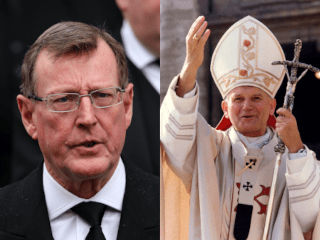
David Trimble becomes the first Ulster Unionist leader to meet a Pope when his historic meeting with John Paul II takes place in Rome on April 21, 1999. The meeting is widely welcomed as a sign that old prejudices are ending but Trimble is hotly criticised by both Protestants and Catholics in his Upper Bann constituency.
The First Minister is one of 54 Nobel Peace Prizelaureates who meets Pope John Paul II briefly at the Vatican, as part of a two-day trip organised by former Russian leader Mikhail Gorbachev. The Nobel Prize winners meet the Pope as a group and are then introduced and shake hands individually. There is a group photograph but no filming of the event. Careful stage-management ensures there are no public photographs of the two men close together.
A spokesman for Trimble says the UUP leader told the Pope he hopes this will be the year when peace will be secured in Northern Ireland. The Pope recalls his visit to Ireland and says murder cannot be condoned or called by another name.
Although the meeting is welcomed on both sides of the North divide, it does little to enhance Trimble’s standing in Upper Bann, particularly in troubled Portadown. In Portadown’s loyalist estates, there is open hostility toward Trimble. Many residents accusing their MP of “putting his personal status above the interests of his constituents.” The response is typified by one angry woman who says, “The loyalist people of this town and Drumcree, put David Trimble into office. Now he has turned his back on us. That’s a fatal mistake, this town and Drumcree will now destroy Trimble.”
“It’s unbelievable that this meeting is actually taking place,” says Orangeman Ivor Young. “It totally contradicts the oath that David Trimble took when he joined the Orange Order. We all knew Trimble was a traitor, this latest escapade puts the final nail in his political coffin here in Upper Bann. There is no way that he will ever be elected here again.”
Trimble also comes in for further criticism from Portadown Orange District, whose Drumcree protest has continued for the past 288 days. David Jones, the District’s press officer says that the people of Portadown once again see their local MP on “a world stage,” instead of being involved locally. “There are a lot of people around Portadown who aren’t very impressed that David Trimble has gone off to meet the Pope and hasn’t got more involved in trying to get the situation here solved,” says Jones.
On Portadown’s Garvaghy Road, Catholics are also critical of Trimble’s visit to Rome. “It’s amazing how he can travel to Rome to meet and talk to strangers,” says one nationalist resident, “yet he can’t be bothered to travel less than 30 miles to meet us, to talk about the serious issues that confront this community. After all we are as much his constituents as are the loyalists in this town.”
The meeting is the first time that the First Minister of Northern Ireland or the head of the Ulster Unionist Party has met the Pope in Rome. It also represents a rare appearance by an Orangeman at the heart of the Roman Catholic Church. Trimble and his entourage meet the Pope in the sumptuous surroundings of the Consistory Hall, the same room where the Cardinals of the Church gather to advise the Pope.
Earlier in the morning Trimble says in an interview with the Vatican radio that besides giving an update on developments in Northern Ireland, he wishes to “express to his Holiness the Pope that he and the Church will do what it can to persuade the paramilitaries to commit themselves irrevocably to peaceful means.”
Patrick John Hillery, Irish politician and the sixth President of Ireland, dies in Glasnevin, Dublin, at the age of 84 on April 12, 2008, following a short illness. He serves two terms in the presidency and, though widely seen as a somewhat lacklustre President, is credited with bringing stability and dignity to the office. He also wins widespread admiration when it emerges that he has withstood political pressure from his own Fianna Fáil party during a political crisis in 1982.
Following Ireland’s successful entry into the European Economic Community in 1973, Hillery is rewarded by becoming the first Irishman to serve on the European Commission, serving until 1976 when he becomes President. In 1976 the Fine Gael–Labour Party National Coalition under Liam Cosgrave informs him that he is not being re-appointed to the Commission. He considers returning to medicine; however, fate takes a turn when Minister for DefencePaddy Donegan launches a ferocious verbal attack on President Cearbhall Ó Dálaigh, calling him “a thundering disgrace” for referring anti-terrorist legislation to the courts to test its constitutionality. When a furious President Ó Dálaigh resigns, a deeply reluctant Hillery agrees to become the Fianna Fáil candidate for the presidency. Fine Gael and Labour decide it is unwise to put up a candidate in light of the row over Ó Dálaigh’s resignation. As a result, Hillery is elected unopposed, becoming President of Ireland on December 3, 1976.
When Hillery’s term of office ends in September 1983, he indicates that he does not intend to seek a second term, but he changes his mind when all three political parties plead with him to reconsider. He is returned for a further seven years without an electoral contest. After leaving office in 1990, he retires from politics.
Hillery’s two terms as president, from 1976 to 1990, end before the 1998 Good Friday Agreement, which sets terms for an end to violence in Northern Ireland. But he acts at crucial moments as an emollient influence on the republic’s policies toward the north and sets a tone that helps pave the way for eventual peace.
Patrick Hillery dies on April 12, 2008, in his Dublin home following a short illness. His family agrees to a full state funeral for the former president. He is buried at St. Fintan’s Cemetery, Sutton, near Dublin. In the graveside oration, TánaisteBrian Cowen says Hillery was “A humble man of simple tastes, he has been variously described as honourable, decent, intelligent, courteous, warm and engaging. He was all of those things and more.”
Pery is born into one of Limerick’s most politically influential families, elder son of the Rev. Stackpole Pery and Jane Twigge. His maternal grandfather is William Twigg, Archdeacon of Limerick.
A trained barrister, Pery becomes a member of the Irish House of Commons for the Wicklow Borough constituency in 1751. On the dissolution of the house following the death of George II, he is elected for the constituency of Limerick City and serves from 1761 until 1785, becoming Speaker of the House in 1771. In 1783, he stands also for Dungannon, however chooses to sit for Limerick City. He is considered one of the most powerful politicians in Ireland in his time, leading a faction which includes his nephew, the future Earl of Limerick, and his relatives by marriage, the Hartstonges. Following his resignation, he is created Viscount Pery, of Newtown Pery, near the City of Limerick, in the Peerage of Ireland, entitling him to a seat in the Irish House of Lords. As he has no male heirs, his title becomes extinct on his death on February 24, 1806.
Pery is also noted for his part in the history of the architecture of Limerick. In 1765, he commissions the engineer Davis Ducart to design a town plan for land that he owns on the southern edge of the existing city, which leads to the construction of the Georgian area of the city later known as Newtown Pery. He is also commemorated in the naming of Pery Square.
Pery marries Patricia (Patty) Martin of Dublin in 1756, who dies a year later, and secondly Elizabeth Vesey, daughter of John Vesey, 1st Baron Knapton, and Elizabeth Brownlow. He and Elizabeth have two daughters:
MacSwiney is one of eight children of John and Mary MacSwiney. His father had volunteered in 1868 to fight as a papal guard against Giuseppe Garibaldi, had been a schoolteacher in London and later opened a tobacco factory in Cork. Following the failure of this business, John MacSwiney emigrates to Australia in 1885, leaving the children in the care of their mother and his eldest daughter.
MacSwiney is educated by the Christian Brothers at the North Monastery school in Cork but leaves at fifteen to help support the family. He becomes an accountancy clerk but continues his studies and matriculates successfully. He continues in full-time employment while he studies at the Royal University (now University College Cork), graduating with a degree in Mental and Moral Science in 1907.
In 1901 MacSwiney helps to found the Celtic Literary Society, and in 1908 he founds the Cork Dramatic Society with Daniel Corkery and writes a number of plays for them. His first play, The Last Warriors of Coole, is produced in 1910. His fifth play, The Revolutionist (1915), takes the political stand made by a single man as its theme.
Described as a sensitive poet-intellectual, MacSwiney’s writings in the newspaper Irish Freedom bring him to the attention of the Irish Republican Brotherhood. He is one of the founders of the Cork Brigade of the Irish Volunteers in 1913 and is President of the Cork branch of Sinn Féin. He founds a newspaper, Fianna Fáil, in 1914, but it is suppressed after only eleven issues. In April 1916, he is intended to be second in command of the Easter Rising in counties Cork and Kerry but stands down his forces on the order of Eoin MacNeill.
In the 1918 Irish general election, MacSwiney is returned unopposed to the first Dáil Éireann as Sinn Féin representative for Mid Cork, succeeding the Nationalist MP D. D. Sheehan. After the murder of his friend Tomás Mac Curtain, the Lord Mayor of Cork, on March 20, 1920, he is elected as Lord Mayor. On August 12, 1920, he is arrested in Cork for possession of “seditous articles and documents,” and also possession of a cipher key. He is summarily tried by a court on August 16 and sentenced to two years’ imprisonment at Brixton Prison in England.
In prison MacSwiney immediately starts a hunger strike in protest of his internment and the fact that he was tried by a military court. Eleven other Irish Republican prisoners in Cork Jail go on hunger strike at the same time. On August 26, the British Government states that “the release of the Lord Mayor would have disastrous results in Ireland and would probably lead to a mutiny of both military and police in south of Ireland.”
MacSwiney’s hunger strike gains world attention. The British Government is threatened with a boycott of British goods by Americans, while four countries in South America appeal to Pope Benedict XV to intervene. Protests are held in Germany and France as well. An Australian member of Parliament, Hugh Mahon, is expelled from the Parliament of Australia for “seditious and disloyal utterances at a public meeting,” after protesting against the actions of the British Government. Two weeks later, the Spanish Catalan organization Autonomous Center of Employees of Commerce and Industry (CADCI) sends a petition to British Prime MinisterDavid Lloyd George calling for his release and the newspaper of the organization, Acció (Acción in Spanish), begins a campaign for MacSwiney.
Food is often placed near MacSwiney to persuade him to give up the hunger strike. Attempts at force-feeding are undertaken in the final days of his strike. On October 20, 1920, he slips into a coma and dies in London’s Brixton Prison on October 25, after 73 days on hunger strike. His body lay in St. George’s Cathedral, Southwark in London where 30,000 people file past it. Fearing large-scale demonstrations in Dublin, the authorities divert his coffin directly to Cork, and his funeral in the Cathedral of St. Mary and St. Anne on October 31 attracts huge crowds. He is buried in the Republican plot in St. Finbarr’s Cemetery in Cork. Arthur Griffith delivers the graveside oration. His death brings him and the Irish Republican campaign to international attention.
McGrath is born in Dublin on August 12, 1888. By 1916 he is working with his brother George at Craig Gardiner & Co., a firm of accountants in Dawson Street, Dublin. He works with Michael Collins, a part-time fellow clerk and the two strike up a friendship. In his spare time he works as secretary for the Volunteer Dependents’ Fund.
McGrath soon joins the Irish Republican Brotherhood. He fights in Marrowbone Lane in the 1916 Easter Rising. He is arrested after the rising, and jailed in Wormwood Scrubs and Brixton prisons in England. In the 1918 Irish general election, he is elected as Sinn Féin TD for the Dublin St. James’s constituency, later sitting in the First Dáil. He is also a member of the Irish Republican Army (IRA), and successfully organises many bank robberies during the Irish War of Independence (1919–1921), where a small percentage of the proceeds is retained as a reward by him and his fellow-soldiers. During this time he is interred briefly at Abercorn Barracks but escapes by dressing in army uniform and walking out of the gate with soldiers going on leave. He is eventually recaptured and spends time in jail in Belfast.
In October 1921 McGrath travels with the Irish Treaty delegation to London as one of Michael Collins’ personal staff. When the Provisional Government of Ireland is set up in January 1922, he is appointed Minister for Labour. In the Irish Civil War of 1922–1923, he takes the pro-Treaty side and is made Director of Intelligence, replacing Liam Tobin. In a strongly worded letter, written in red ink, he warns Collins not to take his last, ill-fated trip to County Cork.
McGrath is later put in charge of the police Intelligence service of the new Irish Free State, the Criminal Investigation Department (CID). It is modelled on the London Metropolitan Police department of the same name, but is accused of the torture and killing of a number of republican (anti-Treaty) prisoners during the civil war. It is disbanded at the war’s end with the official reason given that it is unnecessary for a police force in peacetime. He goes on to serve as Minister for Labour in the Second Dáil and the Provisional Government of Ireland. He also serves in the 1st and 2nd Executive Councils holding the Industry and Commerce portfolio.
In September 1922 McGrath uses strikebreakers to oppose a strike by Trade Unionists in the Post Office service, despite having threatened to resign in the previous March of the same year when the government threatened to use British strikebreakers.
McGrath resigns from office in April 1924 because of dissatisfaction with the government’s attitude to the Army Mutiny officers and as he says himself, “government by a clique and by the officialdom of the old regime.” By this he means that former IRA fighters are being overlooked and that the Republican goals on all Ireland has been sidelined. He and eight other TDs, who had resigned from Cumann na nGaedheal, resign their seats in the Dáil and form a new political party, the National Party. However, the new party does not contest the subsequent by-elections for their old seats. Instead, Cumann na nGaedheal wins seven of the seats and Sinn Féin wins the other two.
In 1927, McGrath takes a libel case against the publishers of The Real Ireland by poet Cyril Bretherton, a book that claims he is responsible for the abduction and murder of Noel Lemass, the brother of Seán Lemass, in June 1923 during the civil war, as well as a subsequent coverup. He wins the court case. During the 1930s, he and Seán Lemass reconcile and regularly play poker together.
Following his political career, McGrath goes on to become involved in the building trade. In 1925 he becomes labour adviser to Siemens-Schuckert, German contractors for the Shannon hydroelectric scheme near Limerick. He founds the Irish Hospitals’ Sweepstake in 1930, and the success of its sweepstakes makes him an extremely wealthy man. He has other extensive and successful business interests always investing in Ireland and becomes Ireland’s best-known racehorse owner and breeder, winning The Derby with Arctic Prince in 1951.
McGrath dies at his home, Cabinteely House, in Ballsbridge, Dublin on March 26, 1966. Cabinteely House is donated to the state in 1986 and the land is developed as a public park. His son, Patrick W. McGrath, inherits many of his father’s business interests, and also serves as Fine Gael Senator from 1973 to 1977.
(Pictured: Screenshot of a film of Irish politician Joseph McGrath shot in 1922)
Traynor is born into a strongly nationalist family in Dublin. He is educated by the Christian Brothers. In 1899, he is apprenticed to John Long, a famous woodcarver. As a young man he is a noted footballer and tours Europe as a goalkeeper with Belfast Celtic F.C. whom he plays with from 1910 to 1912. He rejects claims soccer is a foreign sport calling it “a Celtic game, pure and simple, having its roots in the Highlands of Scotland.”
When the Irish Civil War breaks out in June 1922, Traynor takes the Anti-Treaty IRA side. The Dublin Brigade is split, however, with many of its members following Michael Collins in taking the pro-Treaty side. During the Battle of Dublin, he is in charge of the Barry’s Hotel garrison, before making their escape. He organises guerilla activity in south Dublin and County Wicklow, before being captured by Free State troops in September. He is then imprisoned for the remainder of the war.
In 1936, Traynor is first appointed to the Cabinet as Minister for Posts and Telegraphs. In September 1939, he is appointed Minister for Defence and holds the portfolio to February 1948. In 1948, he becomes President of the Football Association of Ireland, a position he holds until his death. He serves as Minister for Defence in several Fianna Fáil governments and as Minister for Justice, where he is undermined by his junior minister, and later Taoiseach, Charles Haughey, before he retires in 1961.
Traynor dies in Dublin at the age of 77 on December 15, 1963. He has a road named in his memory, running from the Malahide Road through Coolock to Santry in Dublin’s northern suburbs.
(Pictured: Minister for Defence Oscar Traynor at his desk, June 1940)
Mitchel is born in Camnish, near Dungiven, County Derry on November 3, 1815, the son of a Presbyterian minister. At the age of four, he is sent to a classical school, run by an old minister named Moor, nicknamed “Gospel Moor” by the students. He reads books from a very early age. When a little over five years old, he is introduced to Latin grammar by his teacher and makes quick progress. In 1830, not yet 15 years old, he enters Trinity College, Dublin and obtains a law degree in 1834. In the spring of 1836 he meets Jane Verner, the only daughter of Captain James Verner. Though both families are opposed to the relationship, they become engaged in the autumn and are married on February 3, 1837, by the Rev. David Babington in Drumcree Church, the parish church of Drumcree.
Mitchel works in a law office in Banbridge, County Down, where he eventually comes into conflict with the local Orange Order. He meets Thomas Davis and Charles Gavan Duffy during visits to Dublin. He joins the Young Ireland movement and begins to write for The Nation. Deeply affected by the misery and death caused by the Great Famine, he becomes convinced that nothing will ever come of the constitutional efforts to gain Irish freedom. He then forms his own paper, United Irishmen, to advocate passive resistance by Ireland’s starving masses.
In May 1848, the British tire of Mitchel’s open defiance. Ever the legal innovators in Ireland, they invent a crime especially for the Young Irelanders – felony-treason. They arrest him for violating this new law and close down his paper. A rigged jury convicts him, and he is deported first to Bermuda and then to Australia. However, in June 1853, he escapes to the United States.
Mitchel works as a journalist in New York City and then moves to the South. When the American Civil War erupts, he is a strong supporter of the Southern cause, seeing parallels with the position of the Irish. His family fully backs his commitment to the Southern cause. He loses two sons in the war, one at the Battle of Gettysburg in 1863 and another at the Battle of Fort Sumter in 1864, and another son loses an arm. His outspoken support of the Confederacy causes him to be jailed for a time at Fort Monroe, where one of his fellow prisoners is Confederate PresidentJefferson Davis.
In 1874, the British allow Mitchel to return to Ireland and in 1875 he is elected in a by-election to be a member of the Parliament of the United Kingdom representing the Tipperary constituency. However, his election is invalidated on the grounds that he is a convicted felon. He contests the seat again in the resulting by-election and is again elected, this time with an increased vote.
Unfortunately, Mitchel, one of the staunchest enemies to English rule of Ireland in history, dies eight days later in Newry on March 20, 1875, and is buried there. Thirty-eight years later, his grandson, John Purroy Mitchel, is elected Mayor of New York City.
Briscoe is born in Dublin on September 25, 1894, the son of Abraham William Briscoe and Ida Yoedicke, both of whom are Lithuanian-Jewish immigrants. The original family name in Lithuania is believed to have been Cherrick or Chasen. His brother Wolfe Tone Briscoe is named after Theobald Wolfe Tone, one of the leaders of the Irish Rebellion of 1798. His father is the proprietor of Lawlor Briscoe, a furniture factory on Ormond Quay which makes, refurbishes, imports, exports and sells furniture, trading all over Ireland and abroad.
Briscoe is active in the Irish Republican Army (IRA) and Sinn Féin during the Irish War of Independence and accompanies Éamon de Valera to the United States. He speaks for the Sinn Féin cause at public meetings there and is adamant that being a “Hebrew” does not lessen his Irishness. He is sent by Michael Collins to Germany in 1919 to be the chief agent for procuring arms for the IRA. While in Germany in 1921 he purchases a small tugboat named Frieda to be used in transporting guns and ammunition to Ireland. On October 28, 1921, the Frieda slips out to sea with Charles McGuinness at the helm and a German crew with a cargo of 300 guns and 20,000 rounds of ammunition. Some sources cite this shipment as “the largest military shipment ever to reach the IRA” consisting of 1,500 rifles, 2,000 pistols and 1.7 million rounds of ammunition. On November 2, 1921, the Frieda successfully lands its cargo near Waterford Harbour.
In June 1922 during the Irish Civil War, Briscoe is involved in an incident with fellow anti-treaty IRA members who attack pro-treaty politician Darrell Figgis at his home. They enter the house and assault Figgis, cutting off his well-prized beard in the process. This traumatises Figgis’ wife Millie, who had been under the impression Briscoe and his fellow assistants had come to kill Figgis. In November 1924 Millie commits suicide, expressing in a suicide note that she was suffering from depression as a result of the 1922 attack. Figgis himself commits suicide in 1926.
In his biography, Briscoe recalls an incident of being recognised by a pro-Treaty opponent during the Civil War. He merely turns and walks away, confident that his enemy will not shoot him in the back.
Elected to the Dáil in the newly independent Ireland, Briscoe works with Patrick Little to bring through a law limiting the interest that can be charged by moneylenders and also, as he writes, “made it illegal for a married woman to borrow money without the knowledge and consent of her husband, for these foolish ones are always the easiest prey of the moneylenders.”
During World War II, Briscoe, at this time a member of Dáil Éireann, comes under close scrutiny from the Irish security services. His support for Zionism and his lobbying on behalf of refugees is considered potentially damaging to the interests of the state by officials from the Department of Justice. He is an admirer and friend of Ze’ev Jabotinsky and his campaign to liberate the Jews. Between 1939 and 1940, he along with John Henry Patterson, a former commander of both the Zion Mule Corps and later the 38th Battalion of the Royal Fusiliers, are involved in fund raising for the Irgun in the United States. Jabotinsky while head of Irgun visits Dublin to receive training in guerrilla warfare tactics against the British under the instruction of Briscoe. During the period Briscoe describes himself as the “Chair of Subversive Activity against England.” He wishes for Ireland to give asylum to Jews fleeing Nazi Germany but does so discreetly in order not to be accused of compromising the neutrality policy of the Fianna Fáil government.
After World War II Briscoe acts as a special advisor to Menachem Begin in the transformation of Irgun from a paramilitary group to a parliamentary political movement in the form of Herut in the new Israeli state. The party later becomes Likud. As he had already been a key figure in the formation in his own Fianna Fáil party out of the Anti-treaty IRA post Irish independence but not before a bitter Civil War, he prompts Begin to make the transition immediately after the Altalena Affair in order to avoid a similar civil conflict.
Briscoe serves in Dáil Éireann for 38 years and is elected 12 times in the Dublin South and from 1948, Dublin South-West constituencies. He retires at the 1965 Irish general election, being succeeded by his son, Ben, who serves for a further 37 years. In 1956, he becomes the first Jewish Lord Mayor of Dublin, although he is not the first Jewish Mayor in Ireland. That title belongs to William Annyas, who was elected Mayor of Youghal, County Cork in 1555. He serves a one-year term and is re-elected in 1961. His son Ben is also a Fianna Fáil TD, and he too serves as Lord Mayor of Dublin from 1988–1989.
Briscoe’s memoir, For the Life of Me, is published in 1958.
O’Sullivan is educated locally at Mount Carmel school. After completing a BA at University College Dublin (UCD), she then goes on to work as an English and History teacher and guidance counsellor in a secondary school in Baldoyle, a position she holds for thirty years.
O’Sullivan is a member of Tony Gregory‘s local political organisation in the 1970s, first canvassing for him and later serving as his election agent. She is co-opted onto Dublin City Council for the North Inner City local electoral area from September 2008 to June 2009, after the retirement of Mick Rafferty. After the death of Tony Gregory, she wins the resulting by-election which is held on the same day as the local elections where she also wins a seat on Dublin City Council, for the North Inner City local electoral area. Marie Metcalfe is co-opted to take the seat due to the dual mandate rule. Subsequently Anna Quigley replaces Metcalfe on Dublin City Council, who is in turn replaced by Mel MacGiobúin in March 2014. MacGiobúin fails to be elected at the local elections held in May.
O’Sullivan is re-elected to the Dáil at the 2011 Irish general election. She joins the Dáil technical group which gives independents and minor parties more speaking time in Dáil debates. She describes a proposal for political gender quota legislation as “tokenistic” and that women are able to get themselves nominated for election.
In December 2015, O’Sullivan and fellow independent TDs Clare Daly and Mick Wallace each put forward offers of a €5,000 surety for a 23-year-old man being prosecuted under terrorism legislation in the Special Criminal Court in Dublin charged with membership of an illegal dissident republican terrorist organisation.
After the 2016 Irish general election O’Sullivan unsuccessfully stands for election as Ceann Comhairle. She joins a technical group aligned with Independents 4 Change, while remaining outside the Independents 4 Change party. She is criticised by the brother of late TD Tony Gregory, over an allegedly false claim made in her election literature.
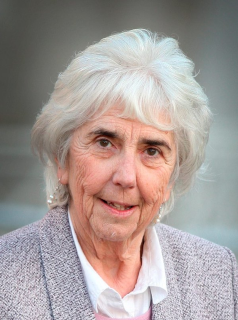
On January 16, 2020, O’Sullivan announces she will not be standing in the 2020 Irish general election in February.