Bardwell is born Leland Hone in India on February 25, 1922, to Irish parents William Hone and Mary Collise, and moves to Ireland at the age of two. Her father’s family are of the Anglo-IrishHone family. She grows up in Leixlip, County Kildare. She is educated at Alexandra School and later at the University of London.
Bardwell realises from childhood that a writing life is inevitable. In her memoirs she records: “Since the age of six writing had been not an ambition but a condition.” However, there are years of editorial rejections before she blossoms into a writer of the poetry, short stories for radio, plays and autobiographical novels that flowed, due in part to the encouragement of the coterie assembled there, from her basement flat in Dublin.
Bardwell’s five volumes of acclaimed poetry are The Mad Cyclist (1970), The Fly and the Bed Bug (1984), Dostoevsky’s Grace (1991), her “new and selected” The White Beach (1998) and The Noise of Masonry Settling (2005).
Bardwell is considered an important poet by her contemporaries. On the publication of her fourth collection of poetry, The White Beach, Eiléan Ní Chuilleanáin states, “it is good to see her work of the decades collected – it has inspired many Irish poets, male and female, and should be much more widely known,” adding that her work is “witty, full of sharp intimate honesty, full of truth and surprises.”
Wellesley marries Garrett Wesley, the Earl of Mornington, in 1759. The marriage is said to be a happy one. They have nine children together, with seven of them surviving to adulthood:
Lord Mornington dies on May 22, 1781, leaving Wellesley and their eldest son Richard, who is 21 years old at the time, to raise the rest of the family. She dislikes Arthur when he is young. She says that he is “food for powder and nothing more” and constantly worries about his future. In 1785, she goes to Brussels to live, as a way to economise. She takes Arthur with her and sends him to the Royal Academy of Equitation at Angers, in Anjou, after she returns to Britain in 1786. She is granted a pension of £600 in 1813 by Parliament after Arthur’s success in the Peninsular War.
Wellesley dies at the age of 89 on September 10, 1831.
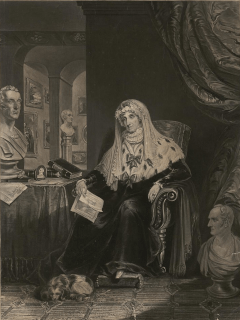
(Pictured: Portrait of Anne Wellesley, Countess of Mornington, the mother of Arthur Wellesley, 1st Duke of Wellington, 1839, from the Welsh Portrait Collection at the National Library of Wales)
William Parsons, 3rd Earl of Rosse, Anglo-Irishastronomer, naturalist, and engineer, is born in York, England on June 17, 1800. He is President of the Royal Society (UK), the most important association of naturalists in the world in the nineteenth century. He builds several giant telescopes. His 72-inch telescope, built in 1845 and colloquially known as the “Leviathan of Parsonstown,” is the world’s largest telescope, in terms of aperture size, until the early 20th century. From April 1807 until February 1841, he is styled as Baron Oxmantown.
Parsons marries Mary Field, daughter of John Wilmer Field, on April 14, 1836. They have thirteen children, of which four sons survive to adulthood: Lawrence, 4th Earl of Rosse, Rev. Randal Parsons, the Hon. Richard Clere Parsons, and the Hon. Sir Charles Algernon Parsons.
During the 1840s, Parsons has the Leviathan of Parsonstown built, a 72-inch telescope at Birr Castle, Parsonstown, County Offaly. He has to invent many of the techniques he uses for constructing the Leviathan, both because its size is without precedent and because earlier telescope builders had guarded their secrets or had not published their methods. Details of the metal, casting, grinding and polishing of the 3-ton ‘speculum’ are presented in 1844 at the Belfast Natural History Society. His telescope is considered a marvelous technical and architectural achievement, and images of it are circulated widely within the British commonwealth. Building of the Leviathan begins in 1842, and it is first used in 1845, with regular use waiting another two years due to the Great Famine. Using this telescope, he sees and catalogues a large number of nebulae, including a number that would later be recognised as galaxies.
Parsons performs astronomical studies and discovers the spiral nature of some nebulas, today known to be spiral galaxies. His telescope Leviathan is the first to reveal the spiral structure of M51, a galaxy nicknamed later as the “Whirlpool Galaxy,” and his drawings of it closely resemble modern photographs.
Parsons’s son publishes his father’s findings, including the discovery of 226 New General Catalogue of Nebulae and Clusters of Stars (NGC) objects in the publication Observations of Nebulae and Clusters of Stars Made With the Six-foot and Three-foot Reflectors at Birr Castle From the Year 1848 up to the Year 1878, Scientific Transactions of the Royal Dublin Society Vol. II, 1878.
Bowen is baptised in St. Stephen’s Church on Upper Mount Street. Her parents, Henry Charles Cole Bowen and Florence (née Colley) Bowen, later bring her to Bowen’s Court at Farahy, near Kildorrery, County Cork, where she spends her summers. When her father becomes mentally ill in 1907, she and her mother move to England, eventually settling in Hythe. After her mother dies in 1912, she is raised by her aunts. She is educated at Downe House School under the headship of Olive Willis. After some time at art school in London she decides that her talent lay in writing. She mixes with the Bloomsbury Group, becoming good friends with Rose Macaulay who helps her seek out a publisher for her first book, a collection of short stories entitled Encounters (1923).
In 1923 Bowen marries Alan Cameron, an educational administrator who subsequently works for the BBC. The marriage has been described as “a sexless but contented union.” She has various extra-marital relationships, including one with Charles Ritchie, a Canadiandiplomat seven years her junior, which lasts over thirty years. She also has an affair with the Irish writer Seán Ó Faoláin and a relationship with the American poet May Sarton. She and her husband first live near Oxford, where they socialize with Maurice Bowra, John Buchan and Susan Buchan, and where she writes her early novels, including The Last September (1929). Following the publication of To the North (1932) they move to 2 Clarence Terrace, Regent’s Park, London, where she writes The House in Paris (1935) and The Death of the Heart (1938). In 1937, she becomes a member of the Irish Academy of Letters.[3]
In 1930 Bowen becomes the first (and only) woman to inherit Bowen’s Court, but remains based in England, making frequent visits to Ireland. During World War II she works for the British Ministry of Information, reporting on Irish opinion, particularly on the issue of neutrality. Her political views tend towards Burkean conservatism. During and after the war she writes among the greatest expressions of life in wartime London, The Demon Lover and Other Stories (1945) and The Heat of the Day (1948). She is awarded the CBE the same year.
Bowen’s husband retires in 1952 and they settle in Bowen’s Court, where he dies a few months later. Many writers visit her at Bowen’s Court from 1930 onwards, including Virginia Woolf, Eudora Welty, Carson McCullers, Iris Murdoch, and the historian Veronica Wedgwood. For years Bowen struggles to keep the house going, lecturing in the United States to earn money. In 1957 her portrait is painted at Bowen’s Court by her friend, painter Patrick Hennessy. She travels to Italy in 1958 to research and prepare A Time in Rome (1960), but by the following year she is forced to sell her beloved Bowen’s Court, which is demolished in 1960. In the following months, she writes for CBS the narrative of the documentary titled Ireland the Tear and the Smile which is realized in collaboration with Robert Monks as cameraman and associate producer. After spending some years without a permanent home, she finally settles at “Carbery”, Church Hill, Hythe, in 1965.
In 1972 Bowen develops lung cancer. She dies at the age of 73 in University College Hospital in London on February 22, 1973. She is buried with her husband in St. Colman’s churchyard in Farahy, close to the gates of Bowen’s Court, where there is a memorial plaque to the author at the entrance to St. Colman’s Church, where a commemoration of her life is held annually.
Edgeworth is the son of Richard Edgeworth senior, and great-grandson of Sir Salathiel Lovell through his mother, Jane Lovell, granddaughter of Sir Salathiel. The Edgeworth family comes to Ireland in the 1580s. He is descended from Francis Edgeworth, appointed joint Clerk of the Crown and Hanaper in 1606, who inherits a fortune from his brother Edward Edgeworth, Bishop of Down and Connor.
A Trinity College, Dublin and Corpus Christi College, Oxford alumnus, Edgeworth is credited for creating, among other inventions, a machine to measure the size of a plot of land. He also makes strides in developing educational methods. He anticipates the caterpillar track with an invention that he plays around with for forty years but never successfully develops. He describes it as a “cart that carries its own road.”
Edgeworth is married four times, including both Honora Sneyd and Frances Beaufort, older sister of Francis Beaufort of the Royal Navy. He is the father of 22 children by his four wives. Beaufort and he install a semaphore line for Ireland. He is a member of the Lunar Society of Birmingham. The Lunar Society evolves through various degrees of organization over a period of years but is only ever an informal group. No constitution, minutes, publications or membership lists survive from any period, and evidence of its existence and activities is found only in the correspondence and notes of those associated with it. Dates given for the society range from sometime before 1760 to it still operating as late as 1813. Fourteen individuals have been identified as having verifiably attended Lunar Society meetings regularly over a long period during its most productive time: these are Matthew Boulton, Erasmus Darwin, Thomas Day, Richard Lovell Edgeworth, Samuel Galton, Jr., James Keir, Joseph Priestley, William Small, Jonathan Stokes, James Watt, Josiah Wedgwood, John Whitehurst and William Withering.
Trevor is born to a middle-class, Anglo-IrishProtestant family. They move several times to other provincial towns, including Skibbereen, Tipperary, Youghal and Enniscorthy, as a result of his father’s work as a bank official. He is educated at St. Columba’s College, Dublin, and at Trinity College, Dublin, from which he receives a degree in history. He works as a sculptor under the name Trevor Cox after his graduation from Trinity College, supplementing his income by teaching. He marries Jane Ryan in 1952 and emigrates to Great Britain two years later, working as a copywriter for an advertising agency. It is during this time that he and his wife have their first son.
Trevor’s first novel, A Standard of Behaviour, is published in 1958 by Hutchinson of London, but has little critical success. He later disowns this work and, according to his obituary in The Irish Times, “refused to have it republished.” It was, in fact, republished in 1982 and in 1989.
In 1964, at the age of 36, Trevor wins the Hawthornden Prize for Literature for The Old Boys. The win encourages him to become a full-time writer. He and his family then move to Devon in South West England, where he resides until his death. In 2002, he makes honorary KBE for services to literature. Despite having spent most of his life in England, he considers himself to be “Irish in every vein.”
Trevor writes several collections of short stories that are well received. His short stories often follow a Chekhovian pattern. The characters in his work are typically marginalised members of society. The works of James Joyce influence his short-story writing, and “the odour of ashpits and old weeds and offal” can be detected in his work, but the overall impression is not of gloominess since, particularly in his early work, his wry humour offers the reader a tragicomic version of the world. He adapts much of his work for stage, television and radio. In 1990, Fools of Fortune is made into a film directed by Pat O’Connor, along with a 1999 film adaptation of Felicia’s Journey, which is directed by Atom Egoyan.
Trevor’s stories are set in both England and Ireland. They range from black comedies to tales based on Irish history and politics. His early books are peopled by eccentrics who speak in a pedantically formal manner and engage in hilariously comic activities that are recounted by a detached narrative voice. Instead of one central figure, the novels feature several protagonists of equal importance, drawn together by an institutional setting, which acts as a convergence point for their individual stories. The later novels are thematically and technically more complex. The operation of grace in the world is explored, and several narrative voices are used to view the same events from different angles.
King is the eldest surviving son of Edward King, 1st Earl of Kingston, and Jane Caulfeild. From 1767 to 1768 he is educated at Eton College. He is styled Viscount Kingsborough between 1768 and 1797. He marries Caroline FitzGerald, daughter of Richard FitzGerald and Margaret King, on December 5, 1769, from whom he later separates. Together they have nine children.
On May 18, 1798, King is tried by his peers in the Irish House of Lords after allegedly murdering Colonel Henry FitzGerald. FitzGerald is a married man who elopes with King’s daughter. With public sympathy on King’s side and with considerable publicity he is tried by his peers. An executioner stands beside King with an immense axe, painted black except for two inches of polished steel, and holds at the level of the defendant’s neck. King is acquitted as after three summonses no witnesses come forward. After a short conferee the Lords Temporal returns to the House of Commons and delivers the verdict ‘not guilty.’ The Lord Chancellor of Ireland, John FitzGibbon, 1st Earl of Clare, pronounces the verdict, breaks his wand and dismisses the assembly.
The Directory of the United Irishmen had planned to use the occasion to kill the entire government and all the lords, but one vote cast against this scheme by the informer Francis Magan causes it to be abandoned.
Wellesley is born to Garret Wesley, 1st Earl of Mornington and Anne Wellesley, Countess of Mornington. Fatherless at an early age and neglected by his mother, he is a reserved, withdrawn child. He fails to shine at Eton College and instead attends private classes in Brussels, followed by a military school in Angers, France. Ironically, he has no desire for a military career. Instead, he wishes to pursue his love of music. Following his mother’s wishes, however, he joins a Highland regiment.
Wellesley fights at Flanders in Belgium in 1794, and directs the campaign in India in 1796, where his elder brother Richard is Governor-General. Knighted for his efforts, he returns to England in 1805.
After the Battle of Waterloo, Wellesley becomes Commander in Chief of the army in occupied France until November 1818. He then returns to England and Parliament, and joins Robert Jenkinson, 2nd Earl of Liverpool’s government in 1819 as Master-General of the Ordnance. He undertakes a number of diplomatic visits overseas, including a trip to Russia.
In 1828, after twice being overlooked in favour of George Canning and F. J. Robinson, 1st Viscount Goderich, Wellesley is finally invited by King George IV to form his own government and set about forming his Cabinet. As Prime Minister, he is very conservative; known for his measures to repress reform, his popularity sinks a little during his time in office. Yet one of his first achievements is overseeing Catholic emancipation in 1829, the granting of almost full civil rights to Catholics in the United Kingdom. Feelings run very high on the issue. George Finch-Hatton, 10th Earl of Winchilsea, an opponent of the bill, claims that by granting freedoms to Catholics Wellesley “treacherously plotted the destruction of the Protestant constitution.”
Wellesley has a much less enlightened position on parliamentary reform. He defends rule by the elite and refuses to expand the political franchise. His fear of mob rule is enhanced by the riots and sabotage that follow rising rural unemployment. His opposition to reform causes his popularity to plummet to such an extent that crowds gathered to throw missiles at his London home.
The government is defeated in the House of Commons and Wellesley resigns on November 16, 1830, to be replaced by Charles Grey, 2nd Earl Grey. Wellesley, however, continues to fight reform in opposition, though he finally consents to the Great Reform Act in 1832.
Two years later Wellesley refuses a second invitation to form a government because he believes membership in the House of Commons has become essential. The king reluctantly approves Robert Peel, who is in Italy at the time. Hence, Wellesley acts as interim leader for three weeks in November and December 1834, taking the responsibilities of Prime Minister and most of the other ministries. In Peel’s first cabinet (1834–1835), he becomes Foreign Secretary, while in the second (1841–1846) he is a Minister without portfolio and Leader of the House of Lords. Upon Peel’s resignation in 1846, he retires from politics.
In 1848 Wellesley organises a military force to protect London against possible Chartist violence at the large meeting at Kennington Common.
(From: “Arthur Wellesley, 1st Duke of Wellington,” GOV.UK (wwww.gov.uk) | Pictured: “Arthur Wellesley, 1st Duke of Wellington (1769-1852)” by Thomas Lawrence, oil on canvas)
Butcher leaves Trinity on his marriage, in 1876, to Rose Julia Trench (1840-1902), the daughter of ArchbishopRichard Chenevix Trench. The marriage produces no children.
Butcher dies in London on December 29, 1910, and his body is returned to Scotland and interred at the Dean Cemetery in Edinburgh with his wife. His grave has a pale granite Celtic cross and is located near the northern path of the north section in the original cemetery.
Butcher’s many publications include, in collaboration with Andrew Lang, a prose translation of Homer‘s Odyssey which appears in 1879 and the OCT edition of Demosthenes, Orationes, vol. I (Or. 1-19, Oxford, 1903), II.i (Or. 20–26, Oxford, 1907).
Her father, William Joseph Smithson, is an actor and theatrical manager from Gloucestershire, England, and her mother is an actress whose full name is unknown. She also has a brother, Joseph Smithson, and a sister, name also unknown. In October 1801, she is left in the care of Reverend James Barrett, a priest of the Church of Ireland, parish of Drumcliffe. Barrett becomes her guardian and raises her as though she were his own daughter. He instructs her “in the precepts of religion,” and keeps everything connected with the stage from her view. After his death on February 16, 1808, the Smithsons send Harriet to a boarding school in Waterford.
On May 27, 1814, Smithson makes her first stage appearance at the Theatre Royal, Dublin, as Albina Mandevill in Frederick Reynolds‘s The Will. Her performance is well received. In 1815, she takes her parents’ place in Montague Talbot’s company in Belfast after they return to Dublin. The season opens on January 1, 1816, where she extends her range in roles, performing in multiple comedies. She then travels to Newry, Limerick, Dublin, and Birmingham, where she joins Robert Elliston‘s company. She spends the next two months playing over forty roles in various genres.
Four years later, January 20, 1818, Smithson makes her first London appearance at Drury Lane as Letitia Hardy in The Belle’s Stratagem. Her first performance receives mixed reviews from critics, but she quickly gains some favour of critics and performers as she obtains more experience. She joins the permanent company at the Royal Coburg Theatre later that year. However, she rejoins Drury Lane Company in the autumn of 1820. On February 20, 1821, she takes the lead female role in Thérèse by John Howard Payne, when the cast actress falls ill. Overall, the London public remembers her as The Times put it, “a face and features well adapted to her profession; but [an actress] not likely to make a great impression on a London audience, or to figure among stars of the first magnitude.”
In 1827, Smithson makes her Paris début as Lydia Languish in The Rivals at the Théâtre de l’Impératrice. Though she receives negative reviews for this role, she is highly praised for her beauty and ability in the subsequent performance of She Stoops to Conquer. On September 11, 1827, she is given the small part of Ophelia next to Charles Kemble in Shakespeare’s Hamlet. She leaves a long-lasting impression on the French through her interpretation of Ophelia’s madness, utilizing pantomime and natural presentation.
The tremendous success of Hamlet leads to the announcement of Romeo and Juliet, for September 15. Smithson is cast as Juliet, where she revolutionizes the women’s role in theatre by becoming as important as her male counterpart. Until this point, women’s lines in theatre are heavily cut and censored to reduce the role for the company’s “restricted talent.” Again, the production is widely well received. On September 18, Shakespeare’s Othello becomes the third Shakespeare tragedy to be performed by The English theatre. Her performance as Desdemona is less effective, but the production is popular enough to be repeated the following week. She is cast as Jane Shore in the renowned tragedyThe Tragedy of Jane Shore, a role in which she moves her audience to tears. The production soon becomes the most performed play in the English season. At the end of her time in France, she had acted in several productions with famous actors such as William Charles Macready, Edmund Kean, and Charles Kemble.
As opportunities to continue her work in Paris dwindle, Smithson returns to London to perform Jane Shore again. The production opens at Covent Garden on May 11, 1829, under unfavorable circumstances. Some audience members, who had read her reviews before she went to Paris, feel reluctant to attend the show. However, just seven days after her next performance as Juliet, in Shakespeare’s Romeo and Juliet, the press gives her glowing reviews.
After Covent Garden closes for the summer in 1832, Smithson tours England to minor theatres performing almost exclusively in tragedies. In June 1832, she joins the Theatre Royal Haymarket, where she has limited success and receives criticism about her weight.
In 1830, Smithson goes back to Paris to set up an English theatre under her own management. She obtains permission to perform at the Theatre-Italien where she performs several unsuccessful plays. A year later, she breaks her leg and is forced to put her career on hold until her leg heals, leaving her in great debt. She gives her last performance, as Ophelia, on December 15, 1836, before her health deteriorates.
Toward the end of her life, Smithson suffers from paralysis, which leaves her barely able to move or speak. She dies on March 3, 1854, at her home on the rue Saint-Vincent, and is buried at the Cimetière Saint-Vincent. Berlioz has her body is later reinterred at the Montmartre Cemetery when Cimetière Saint-Vincent undergoes redevelopment.
(Pictured: Oil on canvas portrait of Harriet Smithson by Claude-Marie-Paul Dubufe, located at the Musee Magnin, Dijon, France)