O’Byrne is born on December 8, 1929, in Killiney, a suburb of Dublin, the son of John O’Byrne, KC, and Marjorie (née McGuire). He attends St. Mary’s College, Dublin, Castleknock College and University College Dublin (UCD), where he earns a degree in Legal and Political Science. In 1952, he is called to the King’s Inns. In 1954, he abandons a legal career in favour of the performing arts, joining the George Mitchell Singers in London but has a “day job” working for an insurance company. During the summer season in Llandudno, Wales, he meets and later marries a singer and dancer from Dublin named Vicky Fitzpatrick. They have three children, Jane, John, and Dominic.
O’Byrne emigrates to the Union of South Africa in 1958. In 1961, he wins a competition called The Voice of South Africa, thereby gaining a contract with the South African Broadcasting Corporation and a new career. As is commonly the case at the time, both among Irish actors abroad as well as many South Africans in the theatre and broadcast media, he uses Received Pronunciation for his professional speaking voice.
O’Byrne is also an actor, and narrates five films, while in South Africa. He is one of a series of actors who play the science-fiction character Mark Saxon in the original radio dramaNo Place to Hide, originally created by South African author Monty Doyle.
O’Byrne and his family move to Mullingar in 2001, but he continues to do broadcasts for Irish classical-music radio station RTÉ lyric fm, and his programmes for Fine Music Radio are recorded there and transmitted to South Africa for broadcast. He retires in 2004.
In 2010, at the MTN Radio Awards Gala, in Johannesburg, O’Byrne is honoured for his contribution to South African broadcasting, being named one of the inaugural inductees into the Radio Hall of Fame.
Darrell Edmund Figgis, Irish writer, Sinn Féin activist and independent parliamentarian in the Irish Free State, dies in London on October 27, 1925. The little that has been written about him has attempted to highlight how thoroughly his memory and works have been excised from Irish popular culture.
Figgis is born at Glen na Smoil, Palmerstown Park, Rathmines in Dublin, on September 17, 1882, the son of Arthur William Figges, tea merchant, and Mary Anne Deane. While still an infant, his family emigrates to Calcutta, India. There his father works as an agent in the tea business, founding A. W. Figgis & Co. They return when he is ten years of age, though his father continues to spend much of his time in India. As a young man he works in London at the tea brokerage owned by his uncle, and it is at this time that he begins to develop his interest in literature and literary criticism.
In 1910 Figgis, with the help of G. K. Chesterton, who wrote the introduction to his first book of verse, joins the Dent publishing company. He moves to Achill Island in 1913 to write, learn the Irish language and gain an appreciation of Irish culture, as perceived by many of his contemporaries to uniquely exist on the western seaboard. On his detention following the 1916 Easter Rising, he and the publishing house parted company. Subsequently, he establishes his own firm in which he republishes the works of William Carleton and others.
Figgis joins the Irish Volunteers in Dublin in 1913 and organises the original Battalion of Volunteers in Achill, where he had built a house. While in London, he is contacted by The O’Rahilly, who acquaints him with the arms dealers who had supplied the Ulster Volunteers. In this way he becomes part of the London group that discusses the financing and supply of German rifles for the Volunteers. He travels with Erskine Childers, initially to Belgium and from there to Germany, to make the purchase of the army surplusMauser rifles. He then charters the tug Gladiator, from which the arms are transferred at sea to the Childers’ yacht Asgard and Conor O’Brien‘s Kelpie.
At this time the Royal Navy is patrolling the Irish Sea in anticipation of imminent war with Germany, and Figgis is tasked with taking a motorboat to Lambay Island to signal to the Asgard the all-clear. By his own account, he is unable to persuade the skipper of the pilot vessel to put to sea as one of the worst storms in many years is raging. Due to luck and the skill of the crews, the three over-laden yachts arrive at their destinations. Figgis, accompanied by Seán McGarry, watch Asgard helplessly from Howth pier until Erskine decides to take a calculated risk and sails into the harbour. Against the odds, the conspiracy to buy rifles in Germany and land them safely in Ireland has succeeded. A large party of Volunteers, on their way to Dublin with rifles and ammunition is confronted by a detachment of the King’s Own Scottish Borderers and Dublin Metropolitan Police. With their route blocked, Figgis and Thomas MacDonagh engage the officers in an attempt to distract them.
Although Figgis does not participate in the 1916 Easter Rising, he is arrested and interned by the British authorities between 1916 and 1917 in Reading Gaol. After his release, he returns to Ireland. At the 1917 Sinn Féin Ardfheis he and Austin Stack are elected Honorary Secretaries of the party. The conference sees Éamon de Valera replace Arthur Griffith as President of the party. Shortly after, Figgis is one of four recently released internees who travels to the South Longford constituency to campaign for Joseph McGuinness in the by-election caused by the death of John Phillips. The overwhelming victory of the Sinn Féin candidate over the Irish Parliamentary Party (IPP) nominee marks the beginning of the eclipse of the latter party by the former party. In May 1918, Figgis is arrested for his alleged part in the spurious German Plot a second time and again deported to England. In 1918, he becomes editor of the newspaper The Republic.
From September 1919 to 1921 Figgis heads the Commission of Inquiry into the Resources and Industries of Ireland. At this time a serious rift between Figgis and Michael Collins, then Minister for Finance, becomes a matter of public record. This close attention of Collins will pursue Figgis in his later activities on the Constitution Committee. While he is participating in a Dáil Court at Carrick-on-Shannon, the proceedings are interrupted by a British Army raid. An officer named Captain Cyril Crawford summarily condemns Figgis and Peadar Kearney to be hanged. He orders rope for the purpose, but another officer intervenes and Keaney and Figgis are set free.
Figgis supports the Anglo-Irish Treaty. He is extremely critical of the Collins/De Valera Pact for the June 1922 Irish general election which is an attempt to avoid a split in the Sinn Féin party and, more importantly, in the Irish Republican Army (IRA). On May 25, 1922, he attends a meeting of the executive council of the Farmers’ Union and representatives, of business interests, and encourages them to put forward candidates in constituencies where anti-Treaty candidates might otherwise head the poll. As he is a member of the Sinn Féin Ard Chomhairle National Executive at the time, he is expelled from the party.
Soon after the signing of the Treaty, the necessity of quickly drafting a constitution for the proposed Free State becomes apparent. It is intended by Arthur Griffith that Figgis will chair the Constitution Committee, but this proposal is vetoed by Collins who nominates himself for the position specifically to minimise Figgis’ influence. The animosity between Collins and Figgis remained an undercurrent of the project. In the end, Collins decides the job should go to Captain David Robinson, but this did nothing to heal the rift between Figgis and James G. Douglas.
In December 1923, it is decided that a committee be established to investigate the means by which a public radio broadcasting service should be operated in the Free State. A central issue of contention is whether the service should be run and controlled directly by the State or operated commercially by an Irish Broadcasting Company. The latter option, it is suggested, would follow the model adopted in the UK by the establishment of the BBC. Figgis is co-opted onto the committee, and this decision leads to a series of allegations resulting in the new State’s first corruption scandal of which Figgis himself is the focus. The allegations result in his resignation from the Broadcasting committee and the launching of a second enquiry. He strenuously denies any impropriety.
On November 18, 1924, Figgis’s wife Millie commits suicide in the back of a taxi in Rathfarnham using a Webley revolver given to them by Collins following the 1922 assault. A year later, his new love, a 21-year-old Catholic woman named Rita North, dies due to complications when a doctor tries to surgically remove an already dead child. The court, after investigating her death, determines that she died due to peritonitis, an inflammation in the lining of the abdominal cavity. The public, however, jumps to the conclusion that she died in a failed illegal abortion.
Figgis himself commits suicide in a London boarding house in Granville Street on October 27, 1925, just a week after giving evidence at North’s inquest. He had been staying at the Royal Automobile Club until the day before his death, as is usual when he visits London. A small group of mourners comprising close family and friends attend his interment at the Hampstead Cemetery in West Hampstead, London.
Brendan O’Carroll, Irish actor, comedian, director, producer and writer, is born in Finglas, Dublin, on September 17, 1955. He is best known for portraying foul-mouthed matriarch Agnes Brown on stage and in the BBC and RTÉ television sitcom Mrs. Brown’s Boys. In 2015, he is awarded the Irish Film and Television Academy Lifetime Achievement Award for his contribution to Irish television.
O’Carroll is the youngest of eleven children. His mother, Maureen, is a Labour PartyTD and his father, Gerard O’Carroll, is a carpenter. His father dies in 1962 when O’Carroll is six years old, and his mother raises the eleven children with little money. He attends Saint Gabriel’s National School and leaves at the age of twelve. He has a string of occupations, including being a waiter and a milkman.
Having become well known as a comedy guest on The Late Late Show, O’Carroll releases four stand-up videos, titled How’s your Raspberry Ripple, How’s your Jolly Roger, How’s your Snowballs and How’s your Wibbly Wobbly Wonder.
O’Carroll writes the screenplay to Sparrow’s Trap, a boxing movie. The film, which has Stephen Rea cast in the lead role, runs into financing difficulties midway through the shoot when the distributor withdraws, and it is abandoned. Incurring debts of over €1 million, he becomes bankrupt, and the film has never been produced.
O’Carroll presents a quiz show called Hot Milk and Pepper on RTÉ One, with long-term collaborator Gerry Browne.
In 1992, O’Carroll performs a short radio play titled Mrs. Brown’s Boys and shortly afterwards he writes four books titled The Mammy, The Granny, The Chisellers and The Scrapper. In 1999, a movie named Agnes Browne, starring Anjelica Huston, is released, based on his book The Mammy. He also co-writes the screenplay. He then decides to put together his own family theatre company, Mrs. Browne’s Boys, and dresses up as a woman to play his part, as the actress he had originally hired did not show up.
From 1999 to 2009, O’Carroll writes and performs in five plays. Since 2011, the stage shows have been re-toured across the UK. In 2011, his plays are adapted into a television sitcom, with the name “Browne” shortened to “Brown.” From its beginning in 2011 through January 2022, 28 episodes have aired, across three series, several Christmas-special episodes and a one-off live episode that aired in 2016 on RTÉ One and BBC One. Mrs. Brown’s Boys D’Movie is released on June 27, 2014, and is a significant success in the UK, staying at number one in the box office for two consecutive weeks. However, the film has negative reviews with one saying it is not just unfunny but “close to anti-funny.” O’Carroll’s wife, his sister Eilish, his son Danny, and his daughter Fiona all appear or have appeared on episodes of Mrs. Brown’s Boys.
It is announced in January 2015 that the BBC wants O’Carroll to do “other stuff,” due to the fact that Mrs. Brown’s Boys has become so successful. He reveals plans to adapt his first ever written play, patser grey, into a television sitcom.
O’Carroll is married to Doreen O’Carroll from 1977 to 1999. He marries Jennifer Gibney in 2005. They live in Davenport, Florida. He has three surviving children: Fiona, Danny, and Eric. Their first son Brendan dies of spina bifida at just a few days old. He has six grandchildren, four children from Fiona and two children from Danny.
O’Carroll’s paternal grandfather, Peter O’Carroll, a father of seven and a prominent republican, is shot dead on October 16, 1920, at his home in Manor Street, Dublin. Two of his sons are Irish Republican Army volunteers. The incident is investigated in the television series Who Do You Think You Are?
In March 2016 O’Carroll appears in the BBC Two documentary Brendan O’Carroll – My Family at War, which explores the involvement of three of his uncles — Liam, James and Peadar O’Carroll — in the Easter Rising.
Scallon is born Rosemary Brown, the fifth of seven children of a King’s Cross railway station porter and trumpet player originally from Derry, Northern Ireland. When she is five, the family moves back to Derry where she grows up in the Creggan housing estate and Bogside. She attends St. Eugene’s Primary School and then enrolls at Thornhill College. A singing talent from childhood, she wins several local contests while also participating in local choirs and taking piano, violin and ballet lessons.
In the early 1960s Scallon forms a trio with two of her sisters, often performing at charity concerts organized by their father. When one sister leaves, the remaining duo lands a summer-long booking at the Palladium and a recording contract with Decca Records. Her other sister, however, leaves to join her new husband, a United States airman, in America. Stricken with stage fright, Scallon the solo singer manages to win a folk competition at the Embassy Ballroom with her eyes shut. The contest’s sponsor, teacher and music promoter Tony Johnston, helps her complete her equivalency degree and records a demo that convinces Decca Records to sign her on as a solo artist. She releases a single in 1967 that brings some attention from local TV and radio.
Performing under her school nickname “Dana,” Scallon becomes a fixture in Dublin‘s cabaret and folk clubs. She is crowned “Queen of Cabaret” and feted with a parade and a reception at Clontarf Castle on the Saturday before Easter 1968.
At the suggestion of Decca Record’s local agent, Phil Mitton, Scallon auditions for the Irish National Song Contest, a preliminary for the 1969 Eurovision competition. She reaches the finals in Dublin but comes in second.
RTÉ Television chief Tom McGrath invites Scallon back to compete the following year. She accepts even though she is preparing to retire from active performing to pursue teaching. The song, “All Kinds of Everything” by Derry Lindsay and Jackie Smith, is picked for her by McGrath and propels her to victory. She goes on to represent Ireland in the 1970 Eurovision contest, held in Amsterdam. She performs perched on a stool on stage and defeats England’s Mary Hopkin and Spain‘s Julio Iglesias to secure Ireland’s victory.
Scallon is given a hero’s welcome upon her return to Ireland, especially in Northern Ireland. “All Kinds of Everything” shoots to #1 on the Irish Singles Chart, as well as the UK Singles Chart. It is also successful in Australia, Austria, Germany, Israel, Malaysia, the Netherlands, New Zealand, Singapore, South Africa, Switzerland and Yugoslavia, on its way to passing 1 million sales. She quickly records an album, with orchestral accompaniment. Her follow-up single, “I Will Follow You,” fails to make much of a splash. Given the choice of giving up, she decides to fight for her recording career, and succeeds with Paul Ryan‘s “Who Put the Lights Out,” which spends eleven weeks on the UK charts.
In 1974 Scallon switches to GTO Records. Her first single on that label, “Please Tell Him That I Said Hello,” returns her to the top 10. Her 1975 holiday single “It’s Gonna be a Cold Cold Christmas” by Roger Greenaway and Geoff Stephens, reaches #4 and remains a classic. Now an established Irish singing star she appears in films and festivals and sells out a week of concerts at the London Palladium. She also maintains her “Queen of the Cabaret” reputation with regular appearances in top London clubs. The BBC gives her two shows of her own: a series called A Day with Dana in 1974 and four-part series of Wake Up Sunday in 1979. BBC Radio follows suit with a series of I Believe in Music in 1977.
Meanwhile, Scallon begins performing stage pantomime in a blockbuster production of Cinderella in Oxford. In September 1976, however, she is hospitalized with a non-malignant growth on her left vocal cord, requiring surgery. The single “Fairytale” is sustained in the charts with the publicity from her dire medical prognosis. The experience strengthens her religious faith. On October 5, 1978, she marries Damien Scallon, a hotel-owner from Newry, at St. Eugene’s Cathedral in Derry.
In 1979, recovered from her surgery, Scallon records a new album entitled The Girl is Back, which has modest success. Pope John Paul II‘s visit to Ireland that year inspires her to write a song based on his personal motto, “Totus Tuus,” which tops the Irish charts. Long associated with Christian causes and Sunday-morning programs, she and her husband look for opportunities to reach a broader market for Christian music and find one in the United States. They attend the National Religious Broadcasters conference in Washington, D.C. in 1980 and secure a contract with Word Records.
Scallon’s first album of Christian songs, Totally Yours, is released on Word Records in 1981. She continues to record pop music, including the 1982 album Magic and the official 1982 FIFA World Cup song for the Northern Ireland team, “Yer Man.” She also continues her stage career, starring in Snow White and the Seven Dwarfs at Hull and later in London’s West End and Wolverhampton. She tours the United States in 1984, including appearances at Billy Graham‘s Boston crusades. She pens an autobiography in 1985. She performs “Totus Tuus” before a packed Superdome crowd during John Paul II’s visit to New Orleans in 1987.
Also in 1987, after one of her husband’s hotels is damaged for the seventh time by a terrorist bomb, he takes a job managing retreats for EWTN and moves the family to Alabama. They rent a house in the Cherokee Bend area of Mountain Brook and enroll their children at Saint Rose Academy. Scallon is welcomed to the network as well, hosting the Say Yes and We Are One Body programs. She leaves Word Records and signs with Heart Beat Records for her later Catholic albums. In 1993 she again performs for the Pope at a World Youth Day event in Denver, Colorado.
Scallon is naturalized as a dual citizen of the United States and Northern Ireland in 1997 and moves back there a year later because she has been drafted as an independent candidate for President of Ireland. She garners 15% of the popular vote, finishing third in the race won by Mary McAleese, ahead of the Labour Party candidate. Most of her votes come from rural districts where conservative values are more strongly held.
In 1999 Scallon wins a seat on the European Parliament, representing Connacht-Ulster on a family values and anti-abortion platform. During her five-year term she opposes the development of a European constitution. She also speaks out against a 2001 proposal to amend the Irish constitution to legalize the “morning-after pill” and intrauterine contraceptive devices. With the support of the mainstream parties, the amendment is put to a popular referendum, which fails in 2002. That same year she is defeated in a campaign to represent Galway West in the Dáil Éireann, the lower house of the Irish parliament. In 2004 she fails to hold her seat in the European Parliament and also does not secure a nomination for President.
Leaving politics behind, Scallon joins a weight-loss challenge on RTÉ’s The Afternoon Show in 2005. In 2006 she competes with Ronan McCormack on Celebrity Jigs ‘n’ Reels, finishing second on the popular dance contest.
That same year, Scallon and her husband launch their own music label, DS Music Productions, and release a compilation of songs deidcated to John Paul II’s memory. That is followed by Good Morning Jesus: Prayers and Songs for Children of All Ages, which is featured in a special series on EWTN. Heart Beat Records files a lawsuit against DS Music Productions for alleged copyright violations.
In 2007 Scallon appears as a guest judge for Young Star Search, a Belfast CityBeat radio contest. In 2009 she is brought on as a judge for The All Ireland Talent Show. That same year she returns to EWTN as host of Dana and Friends.
On July 30, 1919, the first assassination authorised by Michael Collins is carried out by The Squad, also known as the Twelve Apostles, when Detective Sergeant “the Dog” Smith is shot near Drumcondra, Dublin.
On April 10, 1919, the First Dáil announces a policy of ostracism of Royal Irish Constabulary (RIC) men. At the time Sinn Féin official policy is against acts of violence. Boycotting, persuasion and mild intimidation succeed against many officers. However, others escalate their activities against republicans and in March 1920 Collins asks Dick McKee to select a small group to form an assassination unit.
When The Squad is formed, it comes directly under the control of the Director of Intelligence or his deputy and under no other authority. The Squad is commanded by Mick McDonnell.
The original “Twelve Apostles” are Mick McDonnell, Tom Keogh, Jimmy Slattery, Paddy Daly, Joe Leonard, Ben Barrett, Vincent Byrne, Sean Doyle, Paddy Griffin, Eddie Byrne, Mick Reilly and Jimmy Conroy. After some time, The Squad is strengthened with members Ben Byrne, Frank Bolster, Mick Keogh, Mick Kennedy, Bill Stapleton and Sam Robinson. Owen Cullen, a member of 2nd Battalion, is driver for a short time, and Paddy Kelly of County Clare for a short time. They are employed full-time and received a weekly wage.
Sometimes, as occasion demands, The Squad is strengthened by members of the IRA Intelligence Staff, the Active Service Unit, munition workers and members of the Dublin Brigade, TipperaryFlying Column men, Dan Breen, Séumas Robinson, Seán Treacy and Seán Hogan, and also Mick Brennan and Michael Prendergast of County Clare. The IRA Intelligence Staff consists of the Director of Intelligence Michael Collins, the Deputy Director of Intelligence Liam Tobin, the Second Deputy Director of Intelligence Tom Cullen, the Third Director of Intelligence Frank Thornton, and members Joe Dolan, Frank Saurin, Ned Kelleher, Joe Guilfoyle, Paddy Caldwell, Paddy Kennedy, Charlie Dalton, Dan McDonnell and Charlie Byrne. The munitions workers include Mat Furlong, Sean Sullivan, Gay McGrath, Martin O’ Kelly, Tom Younge and Chris Reilly.
Other members include Mick Love, Gearoid O’Sullivan, Patrick Caldwell, Charlie Dalton, Mick O’Reilly, Sean Healy, James Ronan, Paddy Lawson, John Dunne, Johnny Wilson and James Heery. Seán Lemass and Stephen Behan, the father of Irish writers Brendan and Dominic Behan, have also been listed as members of the Apostles. There is no hard evidence to support the inclusion of many of the names, but those who subsequently serve in the Irish Army have their active service recorded in their service records held in the Military Archives Department in Cathal Brugha Barracks, Rathmines. Andrew Cooney is also reported to have been associated with The Squad. Stephen Behan’s involvement is first made public in 1962, when the BBC broadcasts an episode of This Is Your Life dedicated to Behan. During the broadcast, remaining members of the squad joined Behan on the set of the show.
Following “The Dog” Smith’s assassination, The Squad continues to target plainclothes police, members of the G Division of the Dublin Metropolitan Police, and, occasionally, problematic civil servants. Organisationally it operates as a subsection of Collins’ Intelligence Headquarters. Two of the executions by The Squad are the killing on January 21, 1920, of RIC Inspector William Redmond of the DMP “G” Division and on March 2, 1920, a British double agent John Charles Byrnes.
One of the Apostles’ particular targets is the Cairo Gang, a deep-cover British intelligence group, so called since it has either been largely assembled from intelligence officers serving in Cairo or from the Dublin restaurant called The Cairo, which the gang frequents. Sir Henry Wilson brings in the Cairo Gang in the middle of 1920, explicitly to deal with Michael Collins and his organization. Given carte blanche in its operations by Wilson, the Cairo Gang adopts the strategy of assassinating members of Sinn Féin unconnected with the military struggle, assuming that this will cause the IRA to respond and bring its leaders into the open.
The most well-known operation executed by the Apostles occurs on what becomes known as Bloody Sunday, November 21, 1920, when British MI5 officers, linked to the Cairo Gang and significantly involved in spying, are shot at various locations in Dublin with fourteen killed and six wounded. In addition to the The Squad, a larger number of IRA personnel are involved in this operation. The only IRA man captured during the operation is Frank Teeling. In response to the killings, the Black and Tans retaliate by shooting up a Gaelic football match between Dublin and Tipperary at Croke Park, the proceeds from which are for the Irish Republican Prisoners Fund. Fourteen civilians are killed including one of the players, Michael Hogan, and 68 are wounded. The Hogan stand at Croke Park is named after Hogan.
The elimination of the Cairo Gang is seen in Dublin as an intelligence victory, but British Prime MinisterDavid Lloyd George comments dismissively that his men “… got what they deserved, beaten by counterjumpers…”. Winston Churchill adds that they were “.. careless fellows … who ought to have taken precautions.”
Some members of The Squad are hanged in 1921 for the killings on Bloody Sunday, including Thomas Whelan and Patrick Moran. Moran had killed a vet, Patrick MacCormack, who seems to have been an innocent victim.
In May 1921, after the IRA’s Dublin Brigade takes heavy casualties during the burning of the Custom House, The Squad and the Brigade’s Active Service Unit are amalgamated into the Dublin Guard, under Paddy Daly. Under the influence of Daly and Michael Collins, most of the Guard take the Free State side and join the National Army in the Irish Civil War of 1922–23. During this conflict some of them are attached to the Criminal Investigation Department and are accused of multiple assassinations of Anti-Treaty fighters. They are also involved in several atrocities against Republican prisoners, particularly after the death of Collins, due to many of them having personal ties with him.
Bill Stapleton goes on to become a director in Bord na Móna, Charles Dalton and Frank Saurin become directors in the Irish Sweepstakes. In October 1923, Commandant James Conroy is implicated in the murder of two Jewish men, Bernard Goldberg and Emmanuel ‘Ernest’ Kahn. He avoids arrest by fleeing to Mexico, returning later to join the Blueshirts. A later application for an army pension is rejected. The killings are the subject of a 2010 investigative documentary by RTÉ, CSÍ: Murder in Little Jerusalem.
Hutton becomes a Queen’s Counsel in 1970. From 1979 to 1989, as Sir Brian Hutton, he is a High Court judge. In 1989, he becomes Lord Chief Justice of Northern Ireland, becoming a member of the Privy Council of Northern Ireland, before moving to England to become a Lord of Appeal in Ordinary on January 6, 1997. He is consequently granted a life peerage as Baron Hutton, of Bresagh in the County of Down.
On March 30, 1994, as Lord Chief Justice of Northern Ireland, Hutton dismisses Private Lee Clegg‘s appeal against his controversial murder conviction. On March 21, 2002 he is one of four Law Lords to reject David Shayler‘s application to use a “public interest” defence as defined in section 1 of the Official Secrets Act 1989 at his trial.
Hutton represents the Ministry of Defence at the inquest into the killing of civil rights marchers on “Bloody Sunday.” Later, he publicly reprimands Major Hubert O’Neil, the coroner presiding over the inquest, when the coroner accuses the British Army of murder, as this contradicts the findings of the Widgery Tribunal.
Hutton also comes to public attention in 1999 during the extradition proceedings of former Chilean dictator General Augusto Pinochet. Pinochet had been arrested in London on torture allegations by request of a Spanish judge. Five Law Lords, the UK’s highest court, decide by a 3-2 majority that Pinochet is to be extradited to Spain. The verdict is then overturned by a panel of seven Law Lords, including Hutton, on the grounds that Lord Lennie Hoffmann, one of the five Law Lords, has links to human rights group Amnesty International which had campaigned for Pinochet’s extradition.
In 1978, Hutton defends the UK at the European Court of Human Rights in the case of Ireland v United Kingdom, when the court decides that the interrogation techniques used were “inhuman and degrading” and breached the European Convention on Human Rights, but do not amount to “torture.” The court also finds that the practice of internment in Northern Ireland had not breached the Convention. He sentences ten men to 1,001 years in prison on the word of “supergrass” informer Robert Quigley, who is granted immunity in 1984.
Hutton is appointed by Tony Blair‘s government to chair the inquiry on the circumstances surrounding the death of scientist David Kelly. The inquiry commences on August 11, 2003. Many observers are surprised when he delivers his report on January 28, 2004 and clears the British Government in large part. His criticism of the BBC is regarded by some as unduly harsh with one critic commenting that Hutton had given the “benefit of judgement to virtually everyone in the government and no-one in the BBC.” In response to the verdict, the front page of The Independent newspaper consists of one word, “Whitewash?”
Peter Oborne writes in The Spectator in January 2004: “Legal opinion in Northern Ireland, where Lord Hutton practised for most of his career, emphasises the caution of his judgments. He is said to have been habitually chary of making precedents. But few people seriously doubt Hutton’s fairness or independence. Though [he is] a dour Presbyterian, there were spectacular acquittals of some very grisly IRA terrorist suspects when he was a judge in the Diplock era.”
Hutton retires as a Law Lord on January 11, 2004. He remains a member of the House of Lords until retiring under the House of Lords Reform Act 2014 on April 23, 2018.
The 860-ruling Unionist Party council had been scheduled to meet on Saturday, May 13, but postponed the session for a week to allow Trimble to broaden his support among unionists still opposed to the deal. The council is expected to vote on resuming participation in a joint executive, which had been suspended on February 11 after the Irish Republican Army (IRA) failed to initiate disarmament.
The postponement of the unionist council meeting means a scheduled restart of devolution two days later will also be postponed. Great Britain and Ireland had offered to restore the Northern Ireland Assembly and a power-sharing executive composed of unionist, nationalist and republican members by May 22.
Great Britain and Ireland are co-sponsors of the 1998 Good Friday Agreement on reconciliation between the Catholic and Protestant communities. Trimble tells news media he is ready to support a return to sharing power with Sinn Féin, the IRA’s political wing, after receiving assurances on the arms issue.
Earlier in the month, the IRA broke the stalemate with an offer to put its arms arsenals beyond use under international supervision. The IRA offer fell short of a pledge to submit its weapons to destruction, as was understood from previous talks on the issue, but both Great Britain and Ireland back the compromise and press for its acceptance by unionists and nationalists as well.
Great Britain’s Northern Ireland SecretaryPeter Mandelson describes the postponement as the “correct decision.” He says, “David Trimble has been clarifying some issues and driving a hard bargain over others. Now he needs time to present the outcome to his party.” He says he is confident that Trimble will be successful and the way will then be paved for the return to power-sharing.
However, hard-line Ulster Unionist leader Jeffrey Donaldson says he does not believe that weapons will be put beyond use. “What we actually need to know and hear from the IRA is are they going to decommission their weapons?” Donaldson, a member of the British parliament, says in a BBC interview. “We haven’t had any clarification from the IRA.”
British Prime MinisterTony Blair says in parliament on Wednesday, May 17, the IRA offer to put its weapons “beyond use” is “an important confidence-building measure” but only the start of a process of silencing the guns. “We need to make progress until the time when these weapons are indeed completely, verifiably, beyond use,” Blair says.
(From: “Unionist leader says he will back Ulster deal,” UPI Archives, http://www.upi.com/archives, May 18, 2000)
Roddy Doyle, novelist, dramatist and screenwriter known for his unvarnished depiction of the working class in Ireland, is born in Dublin on May 8, 1958. His distinctively Irish settings, style, mood, and phrasing make him a favourite fiction writer in his own country as well as overseas.
Doyle grows up in a middle-class family in Kilbarrack. His mother, Ita Bolger Doyle, is a first cousin of the short story writer Maeve Brennan. After majoring in English and geography at University College Dublin, he teaches those subjects for fourteen years at Greendale Community School, a Dublin grade school. During the summer break of his third year of teaching, he begins writing seriously. In the early 1980s he writes a heavily political satire, Your Granny’s a Hunger Striker, but it is never published.
Doyle publishes the first editions of his comedy The Commitments (1987; film 1991) through his own company, King Farouk, until a London-based publisher takes over. The work is the first installment of his internationally acclaimed The Barrytown Trilogy novels, which also include The Snapper (1990; film 1993), and The Van (1991; film 1996). The series centres on the ups and downs of the never-say-die Rabbitte family, who temper the bleakness of life in an Irish slum with familial love and understanding.
Doyle’s fourth novel, Paddy Clarke Ha Ha Ha (1993), wins the 1993 Booker Prize. Set in the 1960s in a fictional working-class area of northern Dublin, the book examines the cruelty inflicted upon children by other children. The protagonist, 10-year-old Paddy Clarke, fears his classmates’ ostracism, especially after the breakup of his parents’ marriage. In 1994 he writes the BBC miniseries Family, which generates heated controversy throughout conservative Ireland. The program sheds harsh light on a family’s struggle with domestic violence and alcoholism and portrays the bleaker side of life in a housing project, the same venue he had used in the more comedic Barrytown novels. The Woman Who Walked into Doors (1996) and its sequel, Paula Spencer (2006), concern the ramifications of domestic abuse and alcoholism.
A Star Called Henry (1999) centres on an Irish Republican Army (IRA) soldier named Henry Smart and his adventures during the Easter Rising. Smart’s further adventures are detailed in Oh, Play That Thing (2004), which follows him as he journeys through the United States, and The Dead Republic (2010), which chronicles his return to Ireland. In Smile (2017) a lonely middle-aged man looks back on his life, especially his troubled childhood. His next novel, Love (2020), follows two old friends as they spend a night drinking and looking back at their lives. The Deportees and Other Stories (2007), Bullfighting (2011), and Life Without Children (2021) are short-story collections. He also writes a number of books for children, including Wilderness (2007) and A Greyhound of a Girl (2011).
In 1987 Doyle marries Belinda Moller, granddaughter of former Irish PresidentErskine Childers. They have three children – Rory, Jack and Kate.
In the television series Father Ted, the character Father Dougal Maguire‘s unusual sudden use of (mild) profanities, such as saying “I wouldn’t know, Ted, you big bollocks!,” is blamed on his having “been reading those Roddy Doyle books again.”
Mary Ellen Cregan is born to Morgan Cregan and Ellen O’Shea. Her father is a stonemason from Limerick. The family are strong believers in the Gaelic revival movement and Cregan herself learns the Irish language and performs songs at Gaelic League concerts. Although she goes to primary school locally, she goes away to secondary school to St. Louis Convent in Carrickmacross, County Monaghan. After finishing school, she becomes a teacher, working in Goresbridge, County Kilkenny from 1911 to 1914.
In September 1914 Cregan goes to Dublin to study music in the Leinster School of Music, under Madame Coslett Heller. It is while she is in Dublin that she becomes friends with the Ryan family, who are strong nationalists as well as interested in the Gaelic League and Sinn Féin. She begins to sing for concerts which are fundraisers for the Irish Volunteers. The last concert is just two weeks before the Easter Rising.
During Easter week Cregan is sent to Tralee with “automatics and ammunition” by Seán Mac Diarmada. While she is carrying a violin case of munitions, she is also carrying details for the wireless technology needed for communicating with the SS Aud, the boat which is carrying more weapons for the rebellion. The communications with the SS Aud go wrong when the car carrying the Volunteers goes off a pier and the occupants are drowned. She is still in the area to assist with the surviving Volunteer, who unfortunately knows nothing of the details for the SS Aud. She is not easily able to get back to Dublin, because owing to the Rising the city is cut off. By the time she gets back, her friends have been arrested.
When Cregan is going to school in Dublin she is also working in a school in Rathmines. Like many of the teachers, she loses her job after the rising because of her connection to the rebels. However, she is able to get new positions over the next few years in both Ballyshannon and Portstewart until she marries. In Ballyshannon she experiences the early expressions of support and sympathy, but Portstewart is a Unionist enclave with many houses flying union flags on polling day in 1918.
Cregan is a member of Cumann na mBan and with them is active during the Irish War of Independence. She is given a medal for her participation. On July 23, 1919, she marries Dr. James Ryan in Athenry, County Galway. His entire family had been deeply involved in the Easter Rising, as well as the Irish War of Independence and the Irish Civil War. They have three children, Eoin, who becomes a Senator, Nuala (Colgan) and Seamus.
The family is initially based in Wexford during the War. The house is often raided when the British soldiers are looking for her husband and Cregan herself is arrested in February 1921 for refusing to put up martial law posters. Later the family sells the house and remains mobile while she works for the Sinn Féin government, and her husband is in prison. It is during this time that she works as a courier to the continent and to London. After the war, they purchase Kindlestown House in Delgany, County Wicklow, where they remain for the rest of their lives.
Cregan’s first book for children is Old John and gains her considerable international success and attention. Sean Eoin is also published in Irish and is illustrated by Jack Butler Yeats. Her work is also aired on the BBC and RTÉ. Rathina wins the Downey Award in the United States in 1943. She also writes two plays: Hunger strike (1933), based on experience of her husband’s involvement in such a strike, which is broadcast on Radio Éireann on May 5, 1936, and Curlew’s call (1940).
Cregan dies on November 9, 1975, in St. Vincent’s Hospital, Dublin, and is buried in Redford cemetery near her home in County Wicklow.
(Pictured: Máirín Cregan and her husband, Dr. James Ryan)
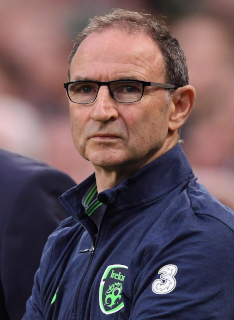
O’Neill becomes Republic of Ireland manager in 2013 and leads them to qualification for the 2016 UEFA European Football Championship for the third time in the nation’s history, beating the reigning world champions, Germany, in the process. He leaves the role with assistant Roy Keane by “mutual agreement” in November 2018. He is appointed as Nottingham Forest manager on January 15, 2019. He guides the club to a ninth-place finish in the Championship. However, he is sacked as manager on June 28, 2019, after reportedly falling out with some of the senior first team players.
In 2002, Norwich supporters voted O’Neill into the club’s Hall of Fame. He is awarded an OBE for services to sport in 2004. He is awarded the Nottingham Lifetime Achievement Award on November 3, 2013 for his services to football and achievements with Nottingham Forest.





 seamus dubhghaill