Ulster’s Solemn League and Covenant, commonly known as the Ulster Covenant, is signed by nearly 500,000 people on and before September 28, 1912, in protest against the Third Home Rule Bill introduced by the British Government in the same year.
The Covenant has two basic parts: the Covenant itself, which is signed by men, and the Declaration, which is signed by women. In total, the Covenant is signed by 237,368 men; the Declaration, by 234,046 women. Both the Covenant and Declaration are held by the Public Record Office of Northern Ireland (PRONI). An online searchable database is available on the PRONI website.
In January 1913, the Ulster Volunteers aim to recruit 100,000 men between the ages of 17 and 65 who had signed the Covenant as a unionist militia. A British Covenant, similar to the Ulster Covenant in opposition to the Home Rule Bill, receives two million signatures in 1914.
The majority of the signatories of the Covenant are from Ulster, although the signing is also attended by several thousand southern unionists. Acknowledging this, Carson pays tribute to “my own fellow citizens from Dublin, from Wicklow, from Clare [and], yes, from Cork, rebel Cork, who are now holding the hand of Ulster,” to cheers from the crowd.
The signature of Frederick Hugh Crawford is claimed by him to have been written in blood. However, this is disputed. Based on the results of a forensic test that he carries out in September 2012 at PRONI, Dr. Alastair Ruffell of Queen’s University Belfast asserts that he is 90% positive that the signature is not blood. Crawford’s signature is injected with a small amount of luminol. This substance reacts with iron in blood’s hemoglobin to produce a blue-white glow. The test is very sensitive and can detect tiny traces even in old samples. Crawford’s signature is still a rich red colour today which would be unlikely if it had been blood. Nevertheless, some unionists are not convinced by the evidence.
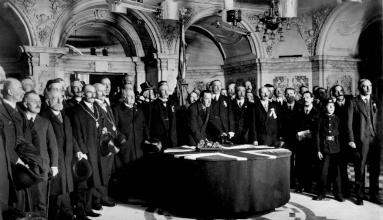
The Ulster Covenant is used as a template for the “Natal Covenant,” signed in 1955 by 33,000 British-descended Natalians against the nationalistSouth African government’s intention of declaring the Union a republic. It is signed in Durban‘s City Hall. Loosely based on Belfast’s Ulster Covenant, the Ulster scene is almost exactly reproduced.
September 28 is today known as “Ulster Day” to unionists.
(Pictured: Sir Edward Carson signing the Solemn League and Covenant)
After spending a year on the continent, Rynne returns to Ireland in 1957 to join the antiquities division of the National Museum of Ireland (NMI) in Kildare Street. One of his first assignments is to participate in the excavations at the Hill of Tara, previously headed by his old mentor at UCD, the recently deceased Professor Seán P. Ó Ríordáin. Already an expert on the Iron Age, he expands his expertise to cover Irish Celtic and early Christian art. He becomes an influential figure at the museum, remaining until 1967 and gaining much valuable experience in archaeological research, cataloguing and display, and is once described as the “true master of the Kildare Street crypt.” Intimately acquainted with the museum’s early Christian artefacts, he is particularly drawn to the eighth-century Ardagh chalice, on which he compiles extensive research notes relating to its dismantling and conservation. Although he is recognised as a leading authority on the chalice, his workload at the NMI and various academic commitments, not least his thirty-five years as editor of the North Munster Antiquarian Journal (NMAJ), prevent publication of his great work on the treasure.
During Rynne’s time at the NMI, he develops a close friendship with its director, Dr. Anthony T. Lucas, and on April 1, 1967 marries his daughter Aideen in the Church of the Miraculous Medal, Clonskeagh, Dublin. That year, he leaves the museum to take up a lectureship in archaeology at University College Galway (UCG), remaining there for thirty-one years until his retirement as professor of Celtic archaeology in 1998. During his professorship, he introduces many innovative changes at UCG, placing great emphasis on the value of well-planned field trips to historical monuments and archaeological sites around Connacht and north Clare, including Poulnabrone in his beloved Burren and Dún Aonghasa on Inishmore, which in 1991 he is first to suggest was built for ceremonial rather than defensive purposes. He often ventures further afield to sites such as the Jorvik Viking Centre, York, and the West Kennet Long Barrow in Wiltshire. Many local expeditions include small excavations, which he continues to conduct on behalf of the NMI.
Despite his heavy workload, Rynne writes close to one hundred academic papers in local and international journals, his expansive subject matter including not only archaeology but also folklore and Irish War of Independence history, the latter interest stemming from his father’s involvement in the formation of the Irish state (1917–23). His editorial tenure at the NMAJ includes the publication in 1975 and 1978 of dedicated issues on Edward MacLysaght and John Hunt respectively, and he is editor of Figures from the Past (1987), the Festschrift for Helen Maybury Roe. He also uses the national press to express his sometimes-eccentric views on various subjects, such as Irish neutrality, the American justice system and running the M3 motorway through Tara. A highly engaging and entertaining speaker, he thrives in front of an audience, be it a small group of students standing in a muddy field or an official address to the Royal Society of Antiquaries of Ireland, of which he serves as president from 1985 to 1989. His lectures are marked by his erudite and characteristically passionate delivery, complete with subtle intonation, and he is as comfortable speaking French as he is English or Irish.
Rynne’s legacy cannot be fairly assessed without reference to his largely unpopular stance in the Wood Quay controversy of the late 1970s. When Dublin’s original Viking settlement at Wood Quay is unearthed by archaeologists, he sides with the NMI, which, under the directorship of Joseph Raftery, decides to excavate only a small section of the site before handing it over to developers. This results in the destruction of much unexcavated archaeology. The NMI’s decision results in serious damage to its reputation, with Rynne one of the few archaeologists publicly supporting its unpopular stance. His loyalty to the NMI administration, which includes his father-in-law Lucas, alienates many fellow archaeologists, and is described by Patrick Wallace, then director of excavations at Wood Quay and among the many scholars who campaign to save the site, as “excessive, unnecessary and so unquestioning that it led to his being on the … wrong side during the Wood Quay court case.”
Rynne’s contribution to the history and heritage of his adopted province of Connacht and city of Galway is, however, widely acknowledged as immense. Once settled in UCG, he makes his home in the medieval town of Athenry, where he engages enthusiastically with the local community via lectures, walks and talks on the town’s famous walls and castle. Although Dublin-born, he becomes firmly entrenched in Galway’s colourful past and is instrumental in the founding of the city’s first municipal museum in Comerford House, adjacent to the Spanish Arch, in 1971. Drawing on his considerable NMI experience, he acts as honorary curator for the Galway museum for over a decade, before its move to the present purpose-built building in 2007. Ever willing to disseminate the story of Galway’s past beyond the twin towers of its university, to its citizens and the wider public, he compiles the Tourist Trail of Old Galway (1977). This signposted walking tour of Galway communicates the city’s importance in the medieval world, not only from an Irish, but also from a European and global perspective, and represents an enduring legacy to the self-styled promoter and protector of the city’s heritage.
In the summer of 2012 Rynne suffers a stroke and dies at the age of 79 on June 22, 2012, at University Hospital Galway. He is survived by Aideen, his wife of forty-five years, and their four sons and one daughter. A fifth son pre-deceases him. He is buried in the New Cemetery, Athenry.
(From: “Rynne, Etienne Andrew” by Frank Cullen, Dictionary of Irish Biography, http://www.dib.ie, June 2018)
The Electricity Supply Board (ESB; Irish: Bord Soláthair an Leictreachais), a state-owned electricity company operating in the Republic of Ireland, is established on August 11, 1927, by the fledgling Irish Free State government under the Electricity (Supply) Act 1927, to manage Ireland’s electricity supply after the successful Shannon hydroelectric scheme at Ardnacrusha and take over all existing projects for the electrification of Ireland. While historically a monopoly, the ESB now operates as a commercial semi-state concern in a “liberalised” and competitive market. It is a statutory corporation whose members are appointed by the government of Ireland.
The Shannon hydroelectric scheme at Ardnacrusha is Ireland’s first large-scale electricity plant and, at the time, it provides 80% of the total energy demands of Ireland. To give an idea of the growth in demand, the output of Ardnacrusha is now approximately two per cent of national peak demand for power.
By 1937, plans are being finalised for the construction of several more hydroelectric plants. The plans called for stations at Poulaphouca, Golden Falls, Leixlip (all in Leinster), Clady, Cliff and Cathaleen’s Fall (between Belleek and Ballyshannon in County Donegal), Carrigadrohid and Inniscarra (in County Cork). All these new plants are completed by 1949 and together harness approximately 75% of Ireland’s inland waterpower potential. Many of these plants are still in operation, however, as can be expected with continuing growth in demand, their combined capacity falls far short of Ireland’s modern needs.
With Ireland’s towns and cities benefiting from electricity, the new government pushes the idea of Rural Electrification. Between 1946 and 1979, the ESB connects in excess of 420,000 customers in rural Ireland. The Rural Electrification Scheme is described as “the Quiet Revolution” because of the major socio-economic change it brings about. The process is greatly helped in 1955 by the Electricity Supply Amendment Act, 1955.
In 1947, the ESB, needing ever more generation capacity, builds the North Wall station on a 7.5-acre site in Dublin‘s industrial port area on the north side of the River Liffey on the site of an old oil refinery. The original station consists of one 12.5 MW steam turbine that is originally purchased for a power station at Portarlington but instead used at North Wall. Other power stations built around this time include the peat fired stations at Portarlington, County Laois, and Allenwood, County Kildare.
Because of the risks of becoming dependent on imported fuel sources and the potential for harvesting and utilising indigenous peat, the ESB – in partnership with Bord na Móna – establishes those stations and ESB also builds Lanesboro power station in 1958. Located in County Longford, the plant burns peat, cut by Bord na Móna in the bogs of the Irish midlands. In 1965, the Shannonbridge station, located in County Offaly, is commissioned. The two stations have been replaced by new peat-fired stations near the same locations, and peat is also used to power the independent Edenderry Power Station in County Offaly.
As in most countries, energy consumption is low at night and high during the day. Aware of the substantial waste of night-time capacity, the ESB commissions the Turlough Hillpumped-storage hydroelectric station in 1968. This station, located in County Wicklow, pumps water uphill at night with the excess energy created by other stations, and releases it downhill during the day to turn turbines. The plant can generate up to 292 MW of power, but output is limited in terms of hours because of the storage capacity of the reservoir.
The 1970s bring about a continued increase in Ireland’s industrialisation and with it, a greater demand for energy. This new demand is to be met by the construction of the country’s two largest power stations – Poolbeg Generating Station in 1971 and Moneypoint Power Station in 1979. The latter, in County Clare, remains Ireland’s only coal-burning plant and can produce 915 MW, just shy of the 1015 MW capacity of Poolbeg. In 2002 and 2003, new independent stations, Huntstown Power (north Dublin) and Dublin Bay Power (Ringsend, Dublin), are constructed.
In 1991, the ESB establishes the ESB Archive to store historical documents relating to the company and its impact on Irish life.
On September 8, 2003, two of the last remaining places in Ireland unconnected to the national grid – Turbot Island and Inishturk Island (off the coast of County Galway)- are finally connected to the main supply. Some islands are still powered by small diesel-run power stations.
Sixty wind farms are currently connected to the power system and have the capacity to generate 590 MW of power, depending on wind conditions. These wind farms are mainly owned by independent companies and landowners.
On March 16, 2005, the ESB announces that it is to sell its ShopElectric (ESB Retail) chain of shops, with the exception of the Dublin Fleet Street and Cork Academy Street outlets, to Bank of Scotland (Ireland), converting them into main street banks. Existing staff are offered positions as bank tellers.
On March 27, 2008, the ESB announces a €22bn capital investment programme in renewable energy technology, with the aim to halve its carbon emissions within 12 years and achieve carbon net-zero by 2035.
Lever is born in Amiens Street, Dublin, on August 31, 1806. He is the second son of James Lever, an architect and builder, and is educated in private schools. His escapades at Trinity College, Dublin (1823–1828), where he earns a degree in medicine in 1831, are drawn on for the plots of some of his novels. The character Frank Webber in the novel Charles O’Malley is based on a college friend, Robert Boyle, who later becomes a clergyman. He and Boyle earn pocket-money singing ballads of their own composing in the streets of Dublin and play many other pranks which he embellishes in the novels Charles O’Malley, Con Cregan and Lord Kilgobbin.
Before seriously embarking upon his medical studies, Lever visits Canada as an unqualified surgeon on an emigrant ship. Arriving in Canada, he journeys into the backwoods, where he is affiliated to a tribe of Native Americans but has to flee because his life is in danger, as later his character Bagenal Daly does in his novel The Knight of Gwynne.
Back in Europe, Lever pretends he is a student from the University of Göttingen and travels to the University of Jena and then to Vienna. He loves German student life and several of his songs, such as “The Pope He Loved a Merry Life,” are based on student-song models. His medical degree earns him an appointment to the Board of Health in County Clare and then as a dispensary doctor in Portstewart, County Londonderry, but his conduct as a country doctor earns him the censure of the authorities.
In 1833 Lever marries his first love, Catherine Baker, and in February 1837, after varied experiences, he begins publishing The Confessions of Harry Lorrequer in the recently established Dublin University Magazine. Before Harry Lorrequer appears in volume form (1839), he has settled on the strength of a slight diplomatic connection as a fashionable physician in Brussels.
In 1842 Lever returns to Dublin to edit the Dublin University Magazine and gathers round him a typical coterie of Irish wits. In June 1842 he welcomes William Makepeace Thackeray, the author of The Snob Papers, to Templeogue, four miles southwest of Dublin, on his Irish tour. The O’Donoghue and Arthur O’Leary (1845) make his native land an impossible place for Lever to continue in. Thackeray suggests London, but Lever requires a new field of literary observation and anecdote. His creative inspiration exhausted, he decides to renew it on the continent. In 1845 he resigns his editorship and goes back to Brussels, whence he starts upon an unlimited tour of central Europe in a family coach. Now and again, he halts for a few months and entertains to the limit of his resources in some ducal castle or other which he hires for an off season.
Depressed in spirit as Lever is, his wit is unextinguished. He is still the delight of the salons with his stories, and in 1867, after a few years’ experience of a similar kind at La Spezia, he is cheered by a letter from Lord Derby offering him the more lucrative consulship of Trieste. The $600 annual salary does not atone to Lever for the lassitude of prolonged exile. Trieste, at first “all that I could desire,” became with characteristic abruptness “detestable and damnable.”
Lever’s depression, partly due to incipient heart disease, partly to the growing conviction that he is the victim of literary and critical conspiracy, is confirmed by the death of his wife on April 23, 1870, to whom he is tenderly attached. He visits Ireland in the following year and seems alternately in high and low spirits. Death had already given him one or two runaway knocks, and, after his return to Trieste, he fails gradually, dying suddenly, however, and almost painlessly, from heart failure on June 1, 1872, at his home, Villa Gasteiger. His daughters, one of whom, Sydney, is believed to have been the real author of A Rent in a Cloud (1869), are well provided for.
The couple are welcomed at NUI Galway by the Tánaiste (Deputy Prime Minister) Joan Burton, among the guests are Gerry Adams and Martin McGuinness.The highlight of Tuesday’s engagements is the historic handshake between the Prince and Gerry Adams. This is the first time a member of the British royal family and the Sinn Féin President have formerly engaged. They shake hands and speak briefly at a reception in NUI Galway, where the prince makes the first of two scheduled speeches.
Charles and Camilla then go on to visit the Burren in County Clare, fulfilling one of Charles’ life-long goals, by exploring the karst landscape for almost an hour.
They conclude their first day by dining with the President of Ireland, Michael D. Higgins, and his wife Sabina, at Lough Cutra Castle in south County Galway. They dine on blanched Highgrove asparagus to start, followed by pan-seared halibut, with panna cotta and poached Highgrove rhubarb for dessert.
Their packed itinerary for Wednesday begins with a trip to Lissadell House with a civic reception and a viewing of the Niland Collection at The Model contemporary arts centre in Sligo. Mayor of Sligo, Seán MacManus, formerly of Sinn Féin, attends the reception. MacManus’ son was killed in a gun battle with security forces in Northern Ireland in 1992.
The prince then visits the Institute of Technology, Sligo, and the couple has lunch at Lissadell. They then visit the grave of W. B. Yeats and attend a service at St. Columba’s Church, in Drumcliff. The royal couple takes part in a tree-planting and unveil a plaque. The theme of this service and the tree-planting is peace and reconciliation.
The prince then visits Mullaghmore Harbour on Wednesday afternoon. On August 27, 1979, his great-uncle, Lord Louis Mountbatten, is killed in a bomb attack executed by the Irish Republican Army (IRA). Mountbatten holidayed every summer at Classiebawn Castle near the harbor. He had, along with family and friends, embarked on a lobster-potting and angling expedition when a bomb on board was detonated just a few hundred yards from the harbor. He died of his injuries, along with his grandson Nicholas Knatchbull (14), Paul Maxwell (15), from County Fermanagh, and Lady Brabourne (83), his eldest daughter’s mother-in-law.
Charles and Camilla conclude their Wednesday itinerary with a trip to the Sligo races.
On Thursday and Friday, Charles and Camilla travel to Northern Ireland. Their engagements include a reception and a concert featuring a selection of local performers at Hillsborough Castle. They make a trip to Mount Stewart House and gardens to mark the completion of a three-year restoration programme. They also visit the Corrymeela Community, Northern Ireland’s oldest peace and reconciliation centre, which is celebrating its 50th anniversary in 2015.
(From: “History is made as Prince Charles fulfills life-long dream in Ireland” by Cathy Hayes, IrishCentral, http://www.irishcentral.com, May 20, 2015 | Pictured: The Prince of Wales and the Duchess of Cornwall at Mullaghmore pier on May 20, 2015)
With her distinctive, sensual mezzo soprano sound, she is an important blue-eyed soul singer and, at her peak, is one of the most successful British female performers, with six top 20 singles on the United StatesBillboard Hot 100 and sixteen on the United Kingdom Singles Chart from 1963 to 1989. She is a member of both the U.S. Rock and Roll Hall of Fame and UK Music Hall of Fame. International polls name Springfield among the best female rock artists of all time. Her image, supported by a peroxide blonde bouffant hairstyle, evening gowns, and heavy make-up, as well as her flamboyant performances on the black and white television of the 1960s, make her an icon of the Swinging Sixties.
As a fan of U.S. pop music, she brings many little-known soul singers to the attention of a wider UK record-buying audience by hosting the first national TV performance of many top-selling Motown artists beginning in 1965. Although she is never considered a Northern Soul artist in her own right, her efforts contribute a great deal to the formation of the genre.
Partly owing to these efforts, a year later she eventually becomes the best-selling female singer in the world and tops a number of popularity polls, including Melody Maker‘s Best International Vocalist. She is the first UK singer to top the New Musical Express readers’ poll for Female Singer.
To boost her credibility as a soul artist, Springfield goes to Memphis, Tennessee to record Dusty in Memphis, an album of pop and soul music with the Atlantic Records main production team. Released in 1969, it has been ranked among the greatest albums of all time by the U.S. magazine Rolling Stone and in polls by VH1 artists, New Musical Express readers, and Channel 4 viewers. The album is also awarded a spot in the Grammy Hall of Fame. Despite its current recognition, the album does not sell well and after its release Springfield experiences a career slump for several years. However, in collaboration with Pet Shop Boys, she returns to the Top 10 of the UK and U.S. charts in 1987 with “What Have I Done to Deserve This?” Two years later, she has two other UK hits on her own with “Nothing Has Been Proved” and “In Private.” Subsequently in the mid-1990s, owing to the inclusion of “Son of a Preacher Man” on the Pulp Fiction soundtrack, interest in her early output is revived.
In January 1994, while recording her penultimate album, A Very Fine Love, in Nashville, Springfield falls ill. When she returns to the UK a few months later, her physicians diagnose breast cancer. She receives months of chemotherapy and radiation treatment, and the cancer goes into remission. In 1995, in apparent good health, she sets about promoting the album, which is released that year. By mid-1996, the cancer returns, and, in spite of vigorous treatments, she dies in Henley-on-Thames on March 2, 1999. Her induction into the Rock and Roll Hall of Fame in Cleveland, Ohio, is scheduled just two weeks after her death. Her friend Elton John helps induct her into the Hall of Fame, declaring, “I’m biased but I just think she was the greatest white singer there ever has been … Every song she sang, she claimed as her own.”
Springfield is cremated and some of her ashes are buried at Henley-on-Thames, while the rest are scattered by her brother, Tom Springfield, at the Cliffs of Moher, County Clare, Ireland.
At the 1961 Irish general election, Mac Giolla unsuccessfully contests the Tipperary North constituency for Sinn Féin. In 1962, he becomes President of Sinn Féin and is one of the people who moves the party to the left during the 1960s. In 1969, Sinn Féin splits, and he remains leader of Official Sinn Féin. It is also in 1962 that he marries May McLoughlin who is also an active member of Sinn Féin as well as Cumann na mBan, the women’s section of the IRA. In 1977, the party changes its name to Sinn Féin the Workers Party and in 1982 it becomes simply the Workers’ Party.
In 1999, Mac Giolla writes to the chairman of the Flood Tribunal calling for an investigation into revelations that former Dublin Assistant City and County Manager George Redmond had been the official supervisor at the election count in Dublin West and was a close associate of Liam Lawlor. In 2003, Redmond is convicted of corruption by a Dublin court but subsequently has his conviction quashed due to conflicting evidence.
In his eighties Mac Giolla continues to be active and is a member of the group which campaigns to prevent the demolition of No. 16 Moore Street in Dublin city centre, where the surrender after the Easter Rising was completed. He also serves on the Dublin ’98 committee to commemorate the 200th anniversary of the Irish Rebellion of 1798.
Tomás Mac Giolla dies in Beaumont Hospital in Beaumont, Dublin on February 4, 2010, after a long illness.
(Pictured: Tomás Mac Giolla, former president of the Workers’ party and lord mayor of Dublin in 2007, by Niall Carson, PA Wire, Press Association Images)
Flannery edits the Dominican bi-monthly journal entitled Doctrine and Life from 1958 to 1988, while at St. Saviour’s Priory, Dublin, where he also serves as prior from 1957 to 1960. He also edits the Religious Life Review. He publishes many English language documents on the Second Vatican Council.
Thomas (Tom) Steele, engineer and political activist, is born on November 3, 1788, at Derrymore, County Clare, the son of William Steele, gentleman, and Catherine Steele (née Bridgeman).
In July 1805 Steele enters Trinity College Dublin, graduating BA in the spring of 1810. He then studies at Magdalene College, Cambridge, where he graduates MA in 1820, becoming an associate member of the Institution of Civil Engineers in the same year. In 1821 he inherits Cullane House, near Craggaunowen, County Clare, on the death of his uncle. Of an enthusiastic and adventurous nature, in 1823 he decides to support the cause of the liberals in Spain who had rebelled against the autocratic rule of Ferdinand VII in 1820. Mortgaging the house and lands at Cullane, he purchases a large quantity of arms and ships them to Spain on board the ship Iris. Commissioned in the Legion Estrenjera of the liberal army, he distinguishes himself in the Battle of Trocadero and the defence of Madrid. He later publishes an account of his experiences, Notes on the war in Spain (London, 1824).
Returning from Spain with his fortunes ruined, Steele begins experiments with underwater diving apparatus, patenting “Steele’s improved diving-bell” in 1825. In the same year he becomes a partner in the Vigo Bay Co., which attempts to recover gold and silver bullion from Spanish ships which sank in Vigo Bay in 1702. After extensive diving operations using Steele’s diving-bell, the company is wound up at an acrimonious meeting of shareholders in September 1826. Despite claims by some of the shareholders that bullion had been found, the scheme is a total failure.
Steele is involved in the Catholic Association and, a close friend of Daniel O’Connell, is active in the emancipation campaign although himself a protestant. In 1828 he seconds O’Connell’s nomination for Clare in the general election of that year. Appointed by O’Connell as ‘Head Pacificator,’ he tours the country collecting weapons and discouraging the rural population from engaging in faction fighting. There is a certain irony in this appointment, as Steele’s own volatile temper is well known. A noted duelist, he fights an inconclusive duel in 1829 with William Smith O’Brien, who had opposed O’Connell’s second candidature for County Clare. In 1828 he is a founder of the Limerick Independent Club.
An associate of the diving pioneers John and Charles Deane, Steele dives on the wreck of the Intrinsic, off the Clare coast in January 1836, using their new diving helmet. He then begins developing equipment to provide underwater illumination, and in 1840 dives with the Deane brothers off Plymouth on the wreck of Henry VIII‘s ship, the Mary Rose. Yet he is in serious financial difficulties, which are not helped by some of his more eccentric building projects. It is said of him that “he seemed utterly incapable of rationally estimating the value of money in his own case.” He begins renovating, at great expense, a ruined castle that stands on his land at Cullane. He also later has a large standing stone, known as the ‘Umbilicus Hiberniae’ (‘Navel of Ireland’), removed from Birr, King’s County (now County Offaly), and taken to his house. At Cullane it is set up as an altar and used for mass whenever O’Connell or members of the Catholic Association visit. It is not returned to Birr until 1974.
Known as “Honest Tom Steele,” Steele is deeply devoted to O’Connell, and is one of his key lieutenants during the repeal campaigns of the 1830s and 1840s. He takes his title and responsibilities as O’Connell’s “Head Pacificator” so seriously and generally expresses himself with such long-winded pomposity that he becomes something of a figure of fun for opponents of O’Connell and for many of the younger men in the Repeal Association. Tried on conspiracy charges after the prohibition of the Clontarf monster meeting, he is one of the six “traversers” imprisoned with O’Connell in Richmond jail from May to September 1844. Strongly supporting O’Connell’s repudiation of physical force, he chairs and takes a prominent part in the peace resolution debates of July 1846 in which the Young Ireland group walks out of the Repeal Association.
After the death of O’Connell on May 15, 1847, Steele falls into a deep depression and, financially ruined, jumps from Waterloo Bridge in London on April 19, 1848. Pulled from the river by a Thames boatman, he survives for a number of weeks. Former political opponents, including Lord Brougham, offer financial help but he refuses. He dies on June 15, 1848, and his remains are taken to Dublin, where he is waked at Conciliation Hall, the headquarters of the Repeal Association, on Burgh Quay. He is buried in Glasnevin Cemetery, beside O’Connell’s tomb. He appears as one of the figures on the O’Connell memorial in O’Connell Street, Dublin.
Steele never marries but harbours an unrequited passion for a Miss Eileen Crowe of Ennis, County Clare, and is often to be seen standing on a large rock, which comes to be known as “Steele’s Rock,” on the banks of the River Fergus in Ennis as he tries to catch a glimpse of Miss Crowe, who lives across the river.
(From: “Steele, Thomas (Tom)” by David Murphy, Dictionary of Irish Biography, http://www.dib.ie | Pictured: (L to R) Thomas Steele, Daniel O’Connell and O’Gorman Mahon by Joseph Patrick Haverty)
Anthony Gerard Foley, Irish rugby union player and head coach of Munster, is born on October 30, 1973, in Limerick, County Limerick. He is attached to the same squad during his professional playing career. He is a member of the Munster team that wins the 2002–03 Celtic League and is the winning captain during their 2005–06 Heineken Cup success. He plays for Ireland from 1995 until 2005 and captains the squad on three occasions. He is nicknamed “Axel,” after the fictional character Axel Foley of the Beverly Hills Cop film series. His father Brendan Foley and sister Rosie Foley also play rugby for Ireland.
In March 1989, Foley leads St. Munchin’s College to victory in the Munster Schools Junior Cup. He later represents Munster and Ireland Schools on several occasions over two seasons, notably during the 1992 Irish Schools tour of New Zealand. Winning six games out of eight, Ireland narrowly loses the final game to a New Zealand side featuring Jonah Lomu. A controversial Jeff Wilson penalty-goal wins the game in the final minutes.
Foley makes his professional debut for Munster against Swansea in November 1995, a game that is also Munster’s first ever Heineken Cup fixture. He is on the Munster team that loses 8–9 to Northampton Saints in the 2000 Heineken Cup Final, and is again the runner-up when Munster loses 15–9 to Leicester Tigers in the 2002 Heineken Cup Final. He is finally on the winning side when Munster wins the 2002–03 Celtic League.
When Mick Galwey resigns as Munster captain, Foley narrowly loses to Jim Williams in a vote to decide the next captain. When Williams leaves Munster in 2005, Foley becomes the new captain, and in his first season in the position, he leads Munster to victory over Biarritz Olympique in the 2006 Heineken Cup Final. He has played in all but one of Munster’s first 78 Heineken Cup games until a shoulder injury sustained during Munster’s 21–19 victory over Leicester Tigers at Welford Road Stadium in their first game of the 2006–07 Heineken Cup causes him to miss his side’s subsequent victory over CS Bourgoin-Jallieu, as well as back-to-back games against Cardiff in December 2006.
Foley stands down as captain at the beginning of the 2007–08 season, making way for Paul O’Connell. He is dropped for Munster’s final fixtures of the 2007–08 Heineken Cup, and announces his retirement for the end of the season.
Foley captains Ireland three times: in 2001 against Samoa, and in 2002 against Romania and Georgia. His last international is against Wales in the 2005 Six Nations Championship. In total he plays in 62 matches for Ireland and scores 5 tries against England in 1995, Romania in 2001, Fiji in 2002, France in 2004, and Wales in 2004.
In March 2011, it is announced that Foley will take over as Munster forwards coach at the end of the 2011 season. He temporarily replaces Gert Smal as Ireland’s forwards coach during the 2012 Six Nations Championship, after Smal is forced to miss the remainder of the tournament with an eye condition. He signs a contract extension with Munster in May 2013. The following year it is announced that he will succeed Rob Penney as Munster’s head coach, signing a two-year contract that begins on July 1, 2014.
Foley dies in his sleep on October 16, 2016, of an acute pulmonary edema brought on by heart disease while staying at a hotel in the Paris suburb of Suresnes with the Munster squad. The team is preparing to face Racing 92 in its opening game of the 2016–17 European Rugby Champions Cup. The match is postponed as a result of his death. PresidentMichael D. Higgins and then-TaoiseachEnda Kenny make tributes to Foley, and the Irish flag flies at half mast at government buildings in Munster.
Foley is brought home to Ireland on Wednesday, October 19, 2016. His funeral takes place on Friday, October 21, 2016 at St. Flannan’s Church in Killaloe, County Clare.
On October 22, 2016, in the first game after Foley’s death, Munster beats Glasgow 38–17 at a sold-out Thomond Park. Tributes are paid to Foley before, during and after the game and the number 8 jersey is retired for the game, with CJ Stander wearing the number 24 for the occasion. Before their historic first ever win against New Zealand at Soldier Field, Chicago, on November 5, 2016, the senior Irish men’s team pays tribute to Foley by forming a figure of 8, led by Munster’s CJ Stander, Simon Zebo, Conor Murray and Donnacha Ryan, to face the All Blacks Haka. Ahead of a game against Munster on November 11, 2016, the Māori All Blacks team pays tribute to Foley by placing a jersey with his initials on the halfway line before performing a Haka. Māori captain Ash Dixon then presents the jersey to Foley’s sons. Munster goes on to win the historic game 27–14. On January 7, 2017, further tributes are paid to Foley when the rescheduled Round 1 fixture between Racing 92 and Munster takes place.
To honour Foley’s memory and contribution to European rugby, the European Professional Club Rugby (EPCR) announces that the 2016–17 European Player of the Year would receive the Anthony Foley Memorial Trophy. The trophy is commissioned with the agreement of the Foley family and Munster Rugby and it is envisaged that it will be presented to all future European Player of the Year winners.