seamus dubhghaill

Promoting Irish Culture and History from Little Rock, Arkansas, USA


Leave a comment

Patrick Pearse Arrives in Ros Muc

patrick-pearse-cottage

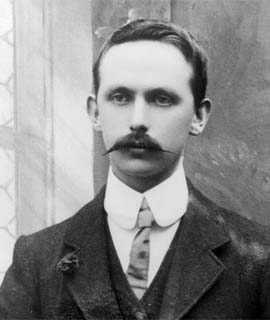
Patrick Pearse arrives in Ros Muc, County Galway on September 13, 1903, and takes up residence at his cottage in Inbhear.

Born in Dublin on November 10, 1879, Pearse joins the Irish Republican Brotherhood (IRB) in September 1913, becoming Director of Military Organisation of the Irish Volunteers in 1914 and is later co-opted into the IRB’s secretive Military Council, which infiltrates the Volunteers for the Easter Rising.

A writer and Irish language enthusiast long before he becomes a revolutionary, Pearse first comes to Ros Muc in 1903 as a 23-year-old handpicked by Conradh na Gaeilge to act as an Irish examiner.

Pearse develops a strong affinity with the area, buying land on Loch Eileabhrach in 1905, upon which he builds a cottage in 1909. Unusually for a professional at the time, he has it thatched in the style of poor country dwellings and on his regular visits between 1903 and 1915, spends time in the cabins of the poor, soaking up the folklore which finds its way into his writings.

Pearse has a rival for the affections of the locals in the shape of the Lord Lieutenant of Ireland, the Queen’s representative in Ireland. William Ward, 2nd Earl of Dudley also spends summers in the area, where he organises hunts with gentry and children’s fetes.

In response, Pearse organises an evening of Irish festivities for Ros Muc. Pearse gives scholarships to local gaeilgeoiri boys to his St. Enda’s School in Dublin.

Pearse’s last visit to the cottage is in 1915, when he composes the rousing oration for the funeral of Jeremiah O’Donovan Rossa. The following April, he goes one step further, declaring a Republic on the steps of the General Post Office (GPO) in Dublin.

After Pearse’s execution on May 3, 1916, his cottage passes to his mother Margaret. In 1921 it is burned down by the “Black and Tans” and Auxiliaries. Restored by Ó Conghaile and then again by Criostóir Mac Aonghusa, by 1943 Pearse’s sisters Senator Margaret Mary Pearse and Mary Brigid Pearse hand the cottage to the State.

Opened in 2016, a new visitor centre next to Pearse’s Cottage provides an introduction to the Irish language, Gaeltacht culture, and Pearse’s connection to Ros Muc.

(From: “Patrick Pearse’s cottage: a cultural visit to Ros Muc,” Darragh Murphy, The Irish Times, January 13, 2016)


Leave a comment

Birth of Máire Geoghegan-Quinn, Fianna Fáil Politician

maire-geoghegan-quinn

Máire Geoghegan-Quinn, former Fianna Fáil politician, is born in Carna, County Galway on September 5, 1950. She served as a European Commissioner for Research, Innovation and Science from 2010 to 2014 and as a Teachta Dála (TD) for the Galway West constituency from 1975 to 1997.

Geoghegan is educated at Coláiste Muire, Toormakeady, in County Mayo and at Carysfort College in Blackrock, from where she qualifies as a teacher. She is married to John Quinn, with whom she has two children. Her novel The Green Diamond, about four young women sharing a house in Dublin in the 1960s, is published in 1996.

Her father, Johnny Geoghegan, is a Fianna Fáil TD for Galway West from 1954 until his death in 1975. His daughter successfully contests the subsequent by-election. From 1977 to 1979 she works as Parliamentary Secretary at the Department of Industry, Commerce and Energy. She serves as a member of Galway City Council from 1985 to 1991.

Geoghegan-Quinn supports Charles Haughey in the 1979 Fianna Fáil leadership election and is subsequently appointed to the cabinet post of Minister for the Gaeltacht. Thus, she becomes the first woman to hold an Irish cabinet post since 1922 (after Constance Markievicz had been appointed Minister for Labour in 1919 during the First Dáil) and the first woman to hold such a post in the history of the Irish state.

In 1982, Geoghegan-Quinn is appointed Minister of State at the Department of Education and Skills. Her tenure is short because the 23rd Dáil lasts only 279 days, and a Fine GaelLabour Party coalition is elected at the November 1982 general election.

When Fianna Fáil returns to power after the 1987 general election, Geoghegan-Quinn becomes Minister of State at the Department of the Taoiseach. She expects a senior government position but is disappointed. She resigns in 1991, in opposition to Charles Haughey’s leadership of the party. The following year Albert Reynolds, whom she backs for the leadership, becomes Taoiseach and Fianna Fáil leader. For her loyalty to Reynolds, she is appointed Minister for Transport, Tourism and Sport. She becomes Minister for Justice and Equality in 1993, in which post she introduces substantial law reform legislation, including the decriminalisation of homosexuality. She is also briefly acting Minister for Equality and Law Reform in late 1994, following the resignation of Labour minister Mervyn Taylor from Reynolds’ coalition government.

When Reynolds resigns as leader of Fianna Fáil in November 1994, Geoghegan-Quinn is seen as his preferred successor. In the resulting leadership election, she stands against Bertie Ahern. A win would make her the first female Taoiseach. On the day of the vote, however, she withdraws from the contest “in the interests of party unity.” It is reported that she has the support of only 15 members of the 66-strong parliamentary party.

At the 1997 general election Geoghegan-Quinn retires from politics completely, citing privacy issues, after details about her 17-year-old son’s expulsion from school appeared in the newspapers. Other reports suggest that she sees her prospects for promotion under Ahern as poor, and a weak showing in constituency opinion polls indicate her seat could be in danger. She becomes a non-executive director of Aer Lingus, a member of the board of the Declan Ganley-owned Ganley Group and writes a column for The Irish Times.

Geoghegan-Quinn is appointed to the European Court of Auditors in 1999, replacing former Labour minister Barry Desmond. She is appointed for a second term at the Court of Auditors in March 2006, and resigns on February 9, 2010. She is nominated by Taoiseach Brian Cowen to become Ireland’s European Commissioner in November 2009, and is subsequently allocated the Research, Innovation and Science portfolio.

In April 2010, after numerous calls are made over several days for Geoghegan-Quinn to surrender her pensions as an Irish former politician, which are worth over €104,000, while she remains in a paid public office, she does so.

In July 2015, it is announced that Geoghegan-Quinn will chair an independent panel to examine issues of gender equality among Irish higher education staff.


Leave a comment

Birth of Peter O’Toole, Stage & Film Actor

peter-o-toole

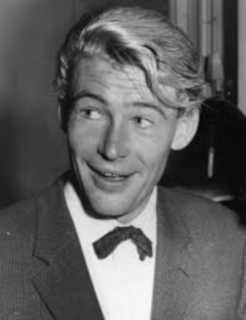
Peter Seamus O’Toole, British stage and film actor of Irish descent, is born on August 2, 1932, in Leeds, Yorkshire, England. Some sources give his birthplace as Connemara, County Galway. Records from the General Registry Office in Leeds confirm that O’Toole is born in the north England town in 1932.

O’Toole grows up in Leeds and is educated at the Royal Academy of Dramatic Art in London. He is a reporter for the Yorkshire Evening Post in his teens and makes his amateur stage debut at Leeds Civic Theatre. After serving two years in the Royal Navy, he acts with the Bristol Old Vic Company from 1955 to 1958 and makes his London debut as Peter Shirley in George Bernard Shaw’s Major Barbara (1956). He appears with the Shakespeare Memorial Company at Stratford-upon-Avon, Warwickshire, England, in 1960 in highly praised performances as Shylock in The Merchant of Venice and as Petruchio in The Taming of the Shrew, and he plays the lead in Hamlet for the inaugural production of the Royal National Theatre in London in 1963. A prominent film star by this point in his career, he continues to appear on stages throughout the world to great acclaim. He is named associate director of the Old Vic in 1980.

O’Toole makes his motion picture debut in Kidnapped in 1960 and two years later becomes an international star for his portrayal of T.E. Lawrence in David Lean’s epic Lawrence of Arabia (1962). In 1964 he plays Henry II of England in Becket, and he has the title role in Lord Jim (1965). He appears as Henry II again in The Lion in Winter (1968), a film notable for the witty verbal sparring matches between O’Toole and costar Katharine Hepburn. The Ruling Class (1972), a controversial black comedy that has become a cult classic, casts O’Toole as a schizophrenic English earl with a messiah complex.

Personal problems contribute to a decline in his popularity during the 1970s, but he makes a strong comeback in the early 1980s with three well-received efforts. He portrays a duplicitous and domineering movie director in The Stunt Man (1980), and his performance as the Roman commander Lucius Flavius Silva in the acclaimed television miniseries Masada (1981) is hailed as one of the finest of his career. His most popular vehicle during this period is My Favorite Year (1982), an affectionate satire on the early days of television, in which he plays Alan Swann, a faded Errol Flynn-type swashbuckling screen star with a penchant for tippling and troublemaking.

O’Toole subsequently maintains his status with fine performances in such films as the Oscar-winning The Last Emperor (1987), the cult favourite Wings of Fame (1989), and Fairy Tale: A True Story (1997), in which he portrays Sir Arthur Conan Doyle. Notable screen roles in the 21st century included King Priam in the historical epic Troy (2004), an aging romantic in Venus (2006), the voice of a haughty food critic in the animated Ratatouille (2007), and a priest in the historical drama For Greater Glory (2012). In addition, in 2008 he portrays Pope Paul III in the TV series The Tudors.

In 1992 O’Toole publishes a lively memoir, Loitering with Intent: The Child. A second volume, Loitering with Intent: The Apprentice, appears in 1996. He is nominated for an Academy Award eight times — for Lawrence of Arabia, Becket, The Lion in Winter, Goodbye, Mr. Chips (1969), The Ruling Class, The Stunt Man, My Favorite Year, and Venus — but never wins. In 2003 he is awarded an honorary Oscar. He receives an Emmy Award for his performance as Bishop Pierre Cauchon in the television miniseries Joan of Arc (1999).

O’Toole dies on December 14, 2013, at Wellington Hospital in St. John’s Wood, London, at the age of 81. His funeral is held at Golders Green Crematorium in London on December 21, 2013, where his body is cremated in a wicker coffin. His ashes are planned to be taken to Connemara, Ireland. They are being kept at the residence of the President of Ireland, Áras an Uachtaráin, by President Michael D. Higgins, an old friend of O’Toole. His family has stated their intention to fulfill his wishes and take his ashes to the west of Ireland.


Leave a comment

Birth of Sir Hudson Lowe, Governor of Saint Helena

CREATOR: gd-jpeg v1.0 (using IJG JPEG v80), quality = 90

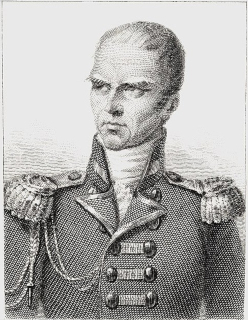
Sir Hudson Lowe, Anglo-Irish soldier and colonial administrator who is best known for his time as Governor of Saint Helena, where he is the “gaoler” of Napoleon Bonaparte, is born in Galway, County Galway on July 28, 1769.

Lowe is the son of John Lowe, an army surgeon. His childhood is spent in various garrison towns, particularly in the West Indies, but he is educated chiefly at Salisbury Grammar. He obtains a post as ensign in the East Devon Militia when he is eleven. In 1787 he enters his father’s regiment, the 50th Regiment of Foot, which is then serving in Gibraltar under Governor-General Charles O’Hara. In 1791, he is promoted to lieutenant. The same year he is granted eighteen months’ leave and chooses to spend the time traveling through Italy rather than return to Britain. He chooses to avoid traveling to France as the French Revolution had recently broken out.

Lowe holds several important commands in the war with France from 1793. He is knighted in 1814. He arrives on the island of Saint Helena, Napoleon’s last place of exile, in April 1816. Many persons, notably Arthur Wellesley, 1st Duke of Wellington, consider the choice ill advised, for Lowe is a conscientious but unimaginative man who takes his responsibility with excessive seriousness. Overwhelmed by the magnitude of the charge given him, he adheres rigorously to orders and treats Napoleon with extreme punctiliousness. After October 1816, the news that rescue operations are being planned by Bonapartists in the United States causes Lowe to impose even stricter regulations. The next month he deports Emmanuel, comte de Las Cases, Napoleon’s confidant and former imperial chamberlain, for writing letters about Lowe’s severity.

When, in late 1817, Napoleon first shows symptoms of his fatal illness, Lowe does nothing to mitigate the emperor’s living conditions. Yet he recommends that the British government increase its allowance to Napoleon’s household by one-half. After the emperor’s death on May 5, 1821, Lowe returns to England, where he receives the thanks of King George IV but is met with generally unfavourable opinion and is widely criticized for his unbending treatment of the former emperor. He later commands the British forces on Ceylon (1825–30) but is not appointed governor of that island when the office falls vacant in 1830.

Hudson Lowe dies at the age of 75 at Charlotte Cottage, near Sloane Street, Chelsea, London, of paralysis, on January 10, 1844.


Leave a comment

Birth of Author Violet Florence Martin

violet-florence-martin

Violet Florence Martin, Irish author, is born at Ross House in Connemara, County Galway on June 11, 1862. She is the co-author of a series of novels with her cousin Edith Somerville under the pen name of Martin Ross in the late nineteenth and early twentieth centuries.

Martin is the youngest of sixteen children of James Martin of Ross (1804–1872). The Martin family, a branch of the Martyn family – one of the Tribes of Galway – had settled at Ross by the early seventeenth century, having previously inhabited the town of Galway for some three hundred years. Her father is a Protestant, his grandfather having converted from the Catholic faith in order to retain the family estates under the Penal Laws. Nevertheless, each child of the family is secretly ‘baptised’ by the family servants.

Martin is a kinswoman of Richard Martin and her contemporary, Edward Martyn, two other notable members of the tribe. Her older brother, Robert Jasper Martin, is a noted songwriter and a well-regarded member of the Tory party in London. She shares a great-grandmother with the writer Maria Edgeworth, whose use of Irish vernacular speech she follows in her work.

Martin’s father manages to save both his estate and his tenants during the Great Famine boasting that not one of his people died during the disaster, but at the cost of bankruptcy. Following his death in 1872, the family moves to Dublin and only returns to Ross in 1888 following revelations of financial fraud of the estate by their agent.

Martin and Edith Somerville are second cousins. They originally meet on January 17, 1886, at Castletownshend, after which they become lifelong companions and literary partners. They come to share a home in Drishane, County Cork. In 1889, Violet adopts the pseudonym Martin Ross, which comprises her surname and the name of her ancestral home. Thus, the authors are called Somerville and Ross. Their works include The Real Charlotte (1889), Some Reminiscences of an Irish R.M. and In the Vine Country.

Martin is a convinced Irish Unionist, in opposition to Somerville’s open nationalism. Both she and her brother Robert are well-regarded members of the literary circle in Irish unionism. However, unlike her brother, Martin is a convinced suffragette, becoming vice-president of the Munster Women’s Franchise League. While on friendly terms with the leading members of the Gaelic literary revival such as W.B. Yeats and Lady Gregory, she objects to their romantic version of Irish peasantry. She is on good terms with Edward Martyn, partner of Gregory and Yeats – and her kinsman – and shares his love of the Irish language and culture.

Martin is seriously injured in a riding accident in November 1898, from which she never fully recovers. This is a contributing factor to her death in Drishane, County Cork, on December 21, 1915. Edith Somerville continues to write under their joint literary names, claiming that they are still in contact. The two women leave thousands of letters and 116 volumes of diaries, detailing their lives, much of them yet unpublished. Edith dies at Castletownshend in October 1949, aged 91, and is buried alongside Violet Florence Martin at Saint Barrahane’s Church, Castletownsend, County Cork.


Leave a comment

Death of Joe Heaney, Traditional Irish Singer

joe-heaney

Joe Heaney, traditional Irish singer also known as Joe Éinniú or Seosamh Ó hÉanaí, dies in Seattle, Washington on May 1, 1984. He spends most of his adult life abroad, living in England, Scotland and New York City, in the course of which he records hundreds of songs.

Heaney is born Carna, a remote village in the Irish-speaking district of Connemara, County Galway, along the west coast of Ireland on October 15, 1919. He starts singing at the age of five, but his shyness keeps him from singing in public until he is 20. He learns English at school in Carna. When he is 16 years old, he wins a scholarship to attend school in Dublin. While there he wins first and second prizes at a national singing competition. Most of his repertoire, estimated to exceed 500 songs, is learned while growing up in Carna.

In 1949, Heaney goes to London where he works on building sites and becomes involved in the folk-music scene. He records for the Topic Records and Gael Linn Records labels. He is married for six years until his wife dies of tuberculosis.

Heaney is recorded by Pádraic Ó Raghallaigh for Raidió Teilifís Éireann, and by Peter Kennedy for the BBC in 1959. The BBC recordings are assembled on a BBC LP, not commercially issued, as BBC LP 22570.

Heaney comes to the United States in 1965 at the invitation of the Newport Folk Festival. After singing at Newport, he decides to move to America and settles in New York City. From 1982 until 1984, Heaney is an artist-in-residence at the University of Washington in Seattle after previously having taught at Wesleyan University in Middletown, Connecticut.

Joe Heaney dies of emphysema in Seattle on May 1, 1984. The Joe Heaney Collection of the University of Washington Ethnomusicology Archives is established after his death. The Féile Chomórtha Joe Éinniú (Joe Heaney Commemorative Festival) is held every year in Carna. An Irish-language biography of him has been written by Liam Mac Con Iomaire, and a biography that discusses his work in the larger context of Ireland and the United States was published in 2011 by Sean Williams and Lillis Ó Laoire.


1 Comment

Death of Writer Walter Macken

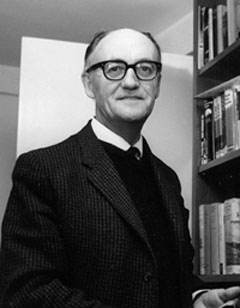
Walter Macken, writer of short stories, novels and plays, dies at his home in the Gaeltacht village of Menlo, County Galway on April 22, 1967.

Macken is born at 18 St. Joseph’s Terrance in Galway, County Galway on May 3, 1915. His father, Walter Macken, Sr., formerly a carpenter, joins the British Army in 1915 and is killed in March of the following year at Saint-Éloi. The family therefore has to rely on lodgers and a small service pension to sustain them.

Macken attends the Presentation Convent for Infants from (1918-1921), St. Mary’s, a Diocesan College where they train people who want to become priests (1923-1924), and Patrician Brothers both Primary and Secondary (1921-1922 and 1924-1934), where he takes his Leaving Certificate. He is writing short stories, novels, and plays in exercise books from the age of eight and carries on these works well into his teens.

Macken is originally an actor, principally with the Taibhdhearc na Gaillimhe in Galway, where he meets his wife Peggy, and The Abbey Theatre in Dublin. He also plays lead roles on Broadway in M. J. Molloy‘s The King of Friday’s Men and his own play Home Is the Hero. The success of his third book, Rain on the Wind, winner of the Literary Guild award in the United States, enables him to focus his energies on writing.

Macken also acts in films, notably in Arthur Dreifuss‘ adaptation of Brendan Behan‘s The Quare Fellow. He is perhaps best known for his trilogy of Irish historical novels Seek the Fair LandThe Silent People, and The Scorching Wind.

His son Ultan Macken is a well-known journalist in the print and broadcast media of Ireland, and wrote a biography of his father, Walter Macken: Dreams on Paper.

Walter Macken dies of heart failure at the age of 51 in Menlo, County Galway, on April 22, 1967.


Leave a comment

Birth of Patrick Ford, Irish American Journalist

patrick-ford

Patrick Ford, Irish American journalist, Georgist land reformer and fund-raiser for Irish causes, is born in Galway, County Galway on April 12, 1837.

Ford is born to Edward Ford (1805-1880) and Ann Ford (1815-1893), emigrating with his parents to Boston, Massachusetts in 1845, never returning to Ireland. He writes in the Irish World in 1886 that “I might as well have been born in Boston. I know nothing of England. I brought nothing with me from Ireland — nothing tangible to make me what I am. I had consciously at least, only what I found and grew up with in here.”

Ford leaves school at the age of thirteen and two years later is working as a printer’s devil for William Lloyd Garrison‘s The Liberator. He credits Garrison for his advocacy for social reform. He begins writing in 1855 and by 1861 is editor and publisher of the Boston Tribune, also known as the Boston Sunday Tribune or Boston Sunday Times. He is an abolitionist and pro-union.

During the American Civil War (1861–1865) Ford serves in the Union Army in the Ninth Massachusetts Regiment with his father and brother. He sees action in northern Virginia and fights in the Battle of Fredericksburg.

Ford spends four years after the war in Charleston, South Carolina, editing the Southern Carolina Leader, printed to support newly freed slaves. He settles in New York City in 1870 and founds the Irish World, which becomes the principal newspaper of Irish America. It promises “more reading material than any other paper in America” and outsells John Boyle O’Reilly‘s The Pilot.

In 1878, Ford re-titles his newspaper, the Irish World and American Industrial Liberator. During the early 1880s, he promotes the writings of land reformer, Henry George in his paper.

In 1880, Ford begins to solicit donations through the Irish World to support Irish National Land League activities in Ireland. Funds received are tabulated weekly under the heading “Land League Fund.” Between January and September 1881 alone, more than $100,000 is collected in donations. British Prime Minister William Ewart Gladstone later states that without the funds from the Irish World, there would have been no agitation in Ireland.”

Patrick Ford dies on September 23, 1913.


Leave a comment

Birth of Lady Gregory, Writer & Playwright

lady-gregory

Isabella Augusta, Lady Gregory (née Isabella Augusta), Irish playwright, folklorist and theatre manager, is born on March 15, 1852, at Roxborough, County Galway. Her translations of Irish legends, her peasant comedies and fantasies based on folklore, and her work for the Abbey Theatre, play a considerable part in the late 19th-century Irish Literary Revival.

Augusta is the youngest daughter of the Anglo-Irish gentry family Persse. Her mother, Frances Barry, is related to Standish O’Grady, 1st Viscount Guillamore, and her family home, Roxborough, is a 6,000-acre estate located between Gort and Loughrea, the main house of which is later burned down during the Irish Civil War. She is educated at home, and her future career is strongly influenced by the family nanny, Mary Sheridan, a Catholic and a native speaker of the Irish language, who introduces the young Augusta to the history and legends of the local area.

In 1880 Augusta marries Sir William Henry Gregory, a neighbouring landowner who had previously served as a Member of Parliament and as governor of Ceylon. He is a well-educated man with many literary and artistic interests, and his estate at Coole Park houses a large library and extensive art collection, both of which Lady Gregory is eager to explore. He also has a house in London, where the couple spends a considerable amount of time.

Lady Gregory’s literary career does not begin until after Sir Gregory’s death in 1892. In 1896 she meets William Butler Yeats and becomes his lifelong friend and patron. She takes part in the foundation of the Irish Literary Theatre in 1899 and becomes a director of the Abbey Theatre in 1904, which owes much of its success to her skill at smoothing the disputes among its highly individualistic Irish nationalist founders. As a playwright, she writes pleasant comedies based on Irish folkways and picturesque peasant speech, offsetting the more tragic tones of the dramas of Yeats and John Millington Synge.

Lady Gregory writes or translates nearly forty plays. Seven Short Plays (1909), her first dramatic works, are among her best, vivid in dialogue and characterization. The longer comedies, The Image and Damer’s Gold, are published in 1910 and 1913 and her strange realistic fantasies, The Golden Apple and The Dragon, in 1916 and 1920. She also arranges and makes continuous narratives out of the various versions of Irish sagas, translating them into an Anglo-Irish peasant dialect that she labels “Kiltartan.” These are published as Cuchulain of Muirthemne (1902) and Gods and Fighting Men (1904).

Lady Gregory returns to live in Galway after ill health forces her retirement from the Abbey Theatre board in 1928, although she continues to visit Dublin regularly. The house and demesne at Coole Park are sold to the Irish Forestry Commission in 1927, with Lady Gregory retaining life tenancy. Her Galway home had long been a focal point for the writers associated with the Irish Literary Revival, and this continues after her retirement. On a tree in what were the grounds of the house, one can still see the carved initials of Synge, Æ, Yeats and his artist brother Jack, George Moore, Seán O’Casey, George Bernard Shaw, Katharine Tynan and Violet Martin.

Lady Gregory, whom Shaw once described as “the greatest living Irishwoman,” dies at the age of 80 on May 22, 1932, at home from breast cancer. She is buried in the New Cemetery in Bohermore, County Galway. The entire contents of Coole Park are auctioned three months after her death, and the house is demolished in 1941.


Leave a comment

Death of Professional Golfer Christy O’Connor Jnr

christy-o-connor-jnr

Christy O’Connor Jnr, professional golfer, dies on January 6, 2016, in Tenerife, Canary Islands. He is known as “Junior” as he is a nephew of golfer Christy O’Connor Snr.

O’Connor is born in Knocknacarra, County Galway, near Salthill, on August 19, 1948, the son of Elizabeth (née Noone) and John O’Connor. The family farms cattle and pigs near a golf club.

O’Connor turns professional in 1967. The PGA European Tour officially begins in 1972, and O’Connor makes the top hundred on the Order of Merit in each of its first twenty-one seasons, with a best ranking of seventh in 1975. He wins four European Tour events. As a senior he competes on both the European Senior Tour and the United States-based Champions Tour and wins two Senior British Open titles (before it becomes one of the senior majors) and two Champions Tour events.

In 1992 O’Connor wins the Dunhill British Masters at the Woburn Golf Club, his fourth and final European Tour victory, with scores of 71, 67, 66, 66. A weather-interrupted tournament means that 36 holes have to be played on Sunday. At 44 years, O’Connor is the oldest player in the field.

O’Connor plays in the Ryder Cup twice. In 1975 he is a member of a losing Great Britain & Ireland team and in 1989 he is part of a European team which ties the match to retain the trophy. His personal record is one win, three losses and no ties. His win over Fred Couples is best remembered for a stunning 2 iron shot on the last hole at The Belfry which he leaves just 4 feet from the hole.

O’Connor is also active in golf course design, being involved in the design of at least 18 courses in Ireland, and many more abroad.

Christy O’Connor Jnr dies while on holiday with his wife Ann on January 6, 2016, in Tenerife, Canary Islands.