seamus dubhghaill

Promoting Irish Culture and History from Little Rock, Arkansas, USA


Leave a comment

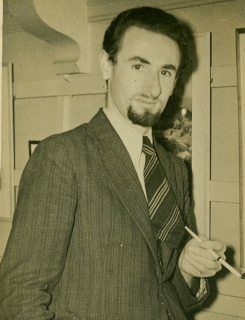
Death of Patrick Hennessy, Irish Realist Painter

Patrick Anthony Hennessy RHA, Irish realist painter known for his highly finished still lifes, landscapes and trompe-l’œil paintings, dies in London on December 30, 1980. The hallmark of his style is his carefully observed realism and his highly finished surfaces, the result of a virtuoso painting technique.

Hennessy is born in Cork, County Cork, on August 28, 1915. The son of John Hennessy an army sergeant major from County Kerry and Bridget Hennessy from Cork. His father is killed in World War I at the Battle of Passchendaele in 1917. In 1921, when he is five years old, his mother remarries in Cork. Her second husband is a Scot named John Duncan and shortly afterwards the whole family moves to Arbroath, Scotland, where Duncan has relatives.

Hennessy is educated in Arbroath at St. Thomas RC Primary School followed by secondary education at Arbroath High School, where he begins to show an aptitude for art, leaving in 1933 with the Dux for Art and an accompanying medal. In the autumn of 1933 he enrolls at the Dundee of Jordanstone College of Art & Design, for a four-year Diploma course in Drawing and Painting under James McIntosh Patrick and Edward Baird. Here he meets Harry Robertson Craig who becomes his lifelong companion. He plays a full part in the social activities of the college, winning a fancy dress award at the Christmas revels in 1935 and producing a ballet “Paradise Lost” the following year. He gains a First Class Pass in each year of the course along with winning first prize in 1934 and 1936 for work done during the summer vacation. He graduates with a First Class Distinction in 1937.

Having gained a scholarship, Hennessy continues his studies at the Dundee of Jordanstone College of Art & Design for a further year by doing a Post-Graduate Diploma course in Drawing and Painting. Within a month of gaining his Post-Graduate Diploma he holds his first joint exhibition at the Art Galleries in Arbroath. In June 1938 he is awarded the Annual Travelling Scholarship for further studies in Paris and Italy. In Paris he meets up with the artists Robert Colquhoun and Robert MacBryde, whom he had met the previous year, the three travelling south together to Marseilles towards the end of that year. On his return to Scotland he is selected for the residential summer school course at Hospitalfield House near Arbroath under James Cowie. Two of his paintings, a still life and a self-portrait, are accepted that year by the Royal Scottish Academy for their Annual Exhibition. However, by the autumn of 1939 with war looming and feeling somewhat disenchanted on his return to Scotland, he decides to return to Ireland.

On arrival in Dublin Hennessy is offered an exhibition in December 1939 at the Country Shop on St. Stephen’s Green which is opened by Mainie Jellett. This attracts favourable attention. During the early 1940s he lives at various addresses in and around Dublin with frequent trips to Cork. In 1940 he is invited to join the Society of Dublin Painters and holds regular annual exhibitions of his work there during the 1940s and early 1950s. These exhibitions are supplemented by an eclectic mix of commissions, mostly portraits which he undertakes during this period. In 1941 he has three of his paintings accepted by the Royal Hibernian Academy (RHA) for their annual exhibition. This is the beginning of a long relationship with the RHA. He exhibits there virtually every year from 1941 until 1979, the year before his death.

From the early 1940s onwards, Hennessey’s work sometimes incorporates a homosexual visual subtext. He re-unites with Harry Robertson Craig in 1946 and soon after they move to Crosshaven, County Cork, and later to Cobh. In 1947, Time magazine selects him as one of Ireland’s outstanding painters, in recognition of the important position he has then attained in the art world. In 1948 he has an exhibition at the Victor Waddington Gallery, Dublin, and that same year is elected an associate of the Royal Hibernian Academy and a full member the following year. In 1950 his painting De Profundis is selected for the Contemporary Irish Painting exhibition that tours North America. As a result of this tour, the American public and critics begin to take notice of his work. In 1951 he visits Italy, taking in Venice and Sicily and returning to Dublin with many of his canvases painted abroad. One of these paintings, Bronze Horses of St. Marks, is exhibited at the Royal Academy of Arts in London in 1954.

In 1956, a friend of Hennessy, David Hendriks, opens the Ritchie Hendriks Gallery on St. Stephen’s Green, Dublin and it is this gallery that is to be the main outlet for his work over the following 22 years. In October 1956 the Thomas Agnew Gallery in London holds an exhibition of his work comprising 38 of his paintings. However, during the winter of 1959 he becomes seriously ill with pneumonia. As a consequence of this, in the autumn of that year he and Craig decide to winter in Morocco. This is the beginning of a new era in both their lives. They would never again spend a full year in Ireland. His exhibitions at the Ritchie Hendriks Gallery had for many years enjoyed favourable reviews from the art critics but in the 1960s this changes with critics claiming his paintings to be dull, repetitive and suggest he needs to explore new areas. Despite the barrage of criticism, in 1965 the Guildhall Gallery in Chicago offers him a major exhibition. Shortly after this exhibition takes place in 1966 he becomes one of the artists on permanent display at the gallery with an annual exhibition. The North American market is extremely lucrative for him and by the end of the decade he is selling more of his work in the United States than in Ireland. In 1968 he finally moves to Tangier, Morocco on a permanent basis and in 1970 sells his studio on Raglan Lane, Dublin.

In Morocco, Hennessy paints prolifically for nine years to keep up with demand from the Hendriks Gallery and Guildhall Gallery along with the RHA. In 1975 the Guildhall Gallery mounts a highly successful Retrospective of his work. In 1978 he has his last exhibition in Dublin at the Hendriks Gallery. By this time he has moved to the Algarve, Portugal and is beginning to have health problems.

In November 1980, with his health deteriorating, Craig brings Hennessy to a hospital in London for treatment. However, on December 30, 1980 he dies from cancer. Following cremation his ashes are buried in nearby Golders Green Crematorium. He leaves his entire estate to Harry Robertson Craig with the proviso that on Craig’s death the Royal Hibernian Academy should be the beneficiary. This legacy has been used to set up the annual Hennessy Craig Scholarship for aspiring artists.

Hennessy falls into the category of painter who develops a distinctive personal style, labelled at various times in his life as a Traditional Realist, Romantic, Photo Realist, Illusionary and Surrealist. However, he always remains intrinsically himself. His subjects range from still life and interiors to landscapes and portraits.

Examples of Hennessy’s work can be found in the public collections of the Crawford Art Gallery, the Dublin City Gallery The Hugh Lane, the Irish Museum of Modern Art (IMMA), the Limerick City Gallery of Art (LCGA), the National Gallery of Ireland (NGI), the National Self-Portrait Collection of Ireland (NSPCI) at the University of Limerick (UL), and in the collections of University College Cork (UCC) and University College Dublin (UCD).


Leave a comment

Death of Moss Keane, Gaelic & Rugby Union Footballer

Maurice Ignatius “Moss” Keane, Gaelic footballer and a rugby union footballer who plays for Ireland and the British & Irish Lions, dies in Portarlington, County Laois, on October 5, 2010. The great Scottish rugby commentator Bill McClaren refers to Keane in his prime, “Maurice Ignatius Keane. Eighteen and a half stone of prime Irish beef on the hoof, I don’t know about the opposition but he frightens the living daylights out of me.”

Born at Currow, County Kerry on July 27, 1948, Keane starts out as a Gaelic footballer, playing at college level for University College Cork and in the process winning a number of medals including three Sigerson Cups, one Cork County Championship and a Munster Club Championship. He also plays in an All-Ireland Club Final. He represents Kerry Gaelic footballer’s at U-21 and Junior level as a full back, winning Munster Championships at both levels, playing in an All -Ireland at Junior level. In 2011 the Kerry County Board names the cup for the winners of the Intermediate Shield after him.

Keane then discovers rugby through a friend in college, playing for the UCC junior rugby team as ‘Moss Fenton,’ during the Gaelic Athletic Association‘s (GAA) ban on foreign games. When asked his first thoughts about rugby he answers, “It was like watching a pornographic movie – very frustrating for those watching and only enjoyable for those participating.” He makes his international debut for Ireland on January 19, 1974 against France in Paris, a game Ireland loses 9–6 in the 1974 Five Nations Championship.

Keane becomes the third Irish forward after Willie John McBride and Fergus Slattery to reach 50 international appearances. He scores his one and only test try in a 22–15 victory over Scotland in February 1980. He plays his 51st and final international against Scotland on March 3, 1984 in Dublin. Ireland loses the match 32–9. He is also a part of the famous Munster side that defeats the All Blacks in Thomond Park in 1978.

Keane tours New Zealand with Phil Bennett‘s British & Irish Lions in 1977, making one Test appearance, and is also a key man in Ireland’s 1982 Five Nations Championship win and their historic Triple Crown victory in 1982.

In 2005 Keane writes, with Billy Keane (no kin), his autobiography, called Rucks, Mauls and Gaelic Football.

Having gained a master’s degree in dairy science, Keane works for the Department of Agriculture during his rugby playing career and retires in July 2010. He keeps active playing golf on a weekly basis. In 1993 he is the victim of a vicious mugging.

In 2009 it is reported that Keane is being treated for colorectal cancer. He dies at the age of 62 on October 5, 2010. His funeral takes place on October 7 in St. Michael’s Church in Portarlington. Former Ireland international players, including Willie John McBride, Ollie Campbell, Tony Ward, Mick Galwey, Dick Spring, Donal Lenihan, Donal Spring and Ciaran Fitzgerald are in attendance. His coffin is adorned with the jerseys of Ireland, Munster, UCC, Kerry and Currow.

Many tributes are made including Taoiseach Brian Cowen saying, “one of the great gentleman of Irish sport would be sadly missed by his many fans and admirers worldwide. Moss Keane was one of the finest rugby players Ireland has ever produced. He was among rugby’s best known characters and a legend of the game at home and abroad.” Describing him as one of Irish rugby’s “most genuine characters and legends of the game,” the Irish Rugby Football Union (IRFU) pays tribute to Keane, “Moss had ability on the field that no one could doubt from his record at club, provincial and international level.” IRFU President Caleb Powell says, “UCC, Lansdowne, Munster, Ireland and the British & Irish Lions all benefited from his presence and ensured that his reputation will live long in the memories of not only Irish rugby, but world rugby.”

Keane is survived by his wife Anne and his two daughters Sarah and Anne Marie.


Leave a comment

“Public Safety Bill” Passed by Dáil Éireann

The Free State’s Provisional Government puts the “Public Safety Bill” before Dáil Éireann on September 27, 1922, which passes by 41 votes to 18. This is emergency legislation which allows for the execution of those captured bearing arms against the State. The legislation passes to the National Army powers of punishment for anyone “taking part in or aiding and abetting attacks on the National Forces,” having possession of arms or explosives “without the proper authority” or disobeying an Army General Order.

The legislation gives the Military Courts the right to impose the sentence of death, imprisonment or penal servitude on those found to be guilty of such offences, the sentence only requiring the signatures of two officers. By time the bill is a year old, 81 men are executed under its terms and over 12,000 men and women imprisoned.

The reason for such punitive legislation is the dragging on of the Irish Civil War caused by the Anglo-Irish Treaty. A pro-Treaty offensive against the anti-Treaty Irish Republican Army (IRA) in the summer of 1922 appears to have won the war for the government but the anti-Treatyites or republicans subsequently fall back on guerrilla tactics which the newly formed Free State or National Army have great difficulty in suppressing. Ernest Blythe, the Minister for Finance in the Provisional Government, later recalls, “there was for some time a feeling that the Civil War would speedily end as major resistance was broken, but actually it began to assume a chronic character.”

In the week preceding the Dáil’s motion, on September 21, six National Army soldiers are killed in a prolonged engagement with Republican fighters near Ballina, County Mayo. On the same day, the Free State barracks in Drumshambo, County Leitrim, is attacked and taken and one soldier is killed. On September 22, a National Army soldier is killed and several soldiers and three civilians injured in a gun and grenade attack by Republicans on Free State troops on Eden Quay in central Dublin. And on the day of the Bill itself coming before the Dáil, in County Kerry several hundred anti-Treaty IRA guerrillas attack the town of Killorglin and are only repulsed after 24 hours of fighting, when Free State troops arrive from Tralee.

At the time and since, the legislation passed in 1922 is known as the Public Safety Bill. However, no such Bill or Act can be found in the records of the Irish state. The Provisional Government have no legal right under the Treaty to enact new legislation without royal assent, the King being represented in the person of the Governor-General. And in theory the Provisional Government’s powers do not apply after the Treaty formally passes into law on December 6, 1922.

So technically speaking the Public Safety Bill is not a law but simply a resolution passed in the Dáil. However, since there was, as yet no Governor-General who could give his assent and as the government felt the situation was too grave for legal niceties, the legislation setting up military courts was passed anyway. It is not until August 1923, when the Free State passes an Act of Indemnity for all actions committed during the Irish Civil War and also pass new, formal special powers legislation – The Emergency Powers Act – that retrospectively legalises what it had enacted in the autumn of 1922.

After an amnesty of two weeks, in which anti-Treaty fighters could surrender without consequences, the legislation comes into force in mid-October. Republicans at first do not believe that the government is serious about enforcing what its foes term “the Murder Bill.” It is in practice nearly two months before it is used in earnest.

On November 17, 1922, four IRA men who had been captured in Dublin are shot by firing squad. By the end of the week, Erskine Childers, who had served as secretary to the delegation which signed the Treaty but later organized Republican propaganda against it, is also dead. He had been captured at his home in County Wicklow on November 11 in possession of a small pistol Michael Collins had given him before he departed for Treaty negotiations in London. He is sentenced and shot on November 24. On November 30 another three Republican prisoners are executed in Dublin.

Liam Lynch, IRA Chief of Staff, issues a general order that Teachtaí Dála (TDs) who had voted for the Bill be shot on sight. On December 6, in retaliation for the executions, IRA members assassinate the TD Sean Hales in Dublin. In reprisal for that four senior republicans, Rory O’Connor, Liam Mellows, Richard Barrett and Joe McKelvey, who had been captured long before the Public Safety legislation is passed are summarily shot.

The legislation passed on September 27, 1922, may well have helped, as its supporters claimed, to break anti-Treaty resistance and to bring the Irish Civil War to an end. However, it also helped to convert the conflict into a feud as bitter and as personal as a vendetta.

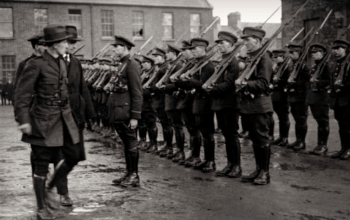
(From: “The passing of legislation allowing for executions during the Irish Civil War” by John Dorney, The Irish Story (www.theirishstory.com), September 27, 2013 | Photo: Richard Mulcahy, shown inspecting soldiers in Dublin, argued that permitting official executions would prevent National Army troops from carrying out unofficial killings)


Leave a comment

Birth of Poet Michael Hartnett

Michael Hartnett, Irish poet who writes in both English and Irish, is born in Croom Hospital in Croom, County Limerick, on September 18, 1941. He is one of the most significant voices in late 20th-century Irish writing and has been called “Munster‘s de facto poet laureate.”

Although Hartnett’s parents’ name is Harnett, he is registered in error as Hartnett on his birth certificate. In later life he declines to change this as his legal name is closer to the Irish Ó hAirtnéide. He grows up in the Maiden Street area of Newcastle West, County Limerick, spending much of his time with his grandmother, Bridget Halpin, who resides in the townland of Camas, in the countryside nearby. He claims that his grandmother is one of the last native speakers to live in County Limerick, though she is originally from northern County Kerry. Although she speaks to him mainly in English, he listens to her conversing with her friends in Irish, and as such, he is quite unaware of the imbalances between English and Irish. When he begins school, he is made aware of the tensions between both languages, and is surprised to discover that Irish is considered an endangered language, taught as a contrived, rule-laden code, with little of the literary attraction which it holds for him. He is educated in the local national and secondary schools in Newcastle West. He emigrates to England the day after he finishes his secondary education and goes to work as a tea boy on a building site in London.

Hartnett has started writing by this time and his work comes to be known of the poet John Jordan, who is professor of English at University College Dublin. Jordan invites him to attend the university for a year. While back in Dublin, he co-edits the literary magazine Arena with James Liddy. He also works as curator of James Joyce‘s tower at Sandycove for a time. He returns briefly to London, where he meets Rosemary Grantley on May 16, 1965, and they are married on April 4, 1966. His first book, Anatomy of a Cliché, is published by Poetry Ireland in 1968 to critical acclaim and he returns to live permanently in Dublin that same year.

Hartnett works as a night telephonist at the telephone exchange on Exchequer Street. He now enters a productive relationship with New Writers Press, run by Michael Smith and Trevor Joyce. They publish his next three books. The first of these is a translation from the Irish, The Old Hag of Beare (1969), followed by Selected Poems (1970) and Tao (1972). This last book is a version of the Chinese Tao Te Ching. His Gypsy Ballads (1973), a translation of the Romancero Gitano of Federico García Lorca, is published by the Goldsmith Press.

In 1974 Hartnett decides to leave Dublin and return to his rural roots, as well as deepen his relationship with the Irish language. He goes to live in Templeglantine, five miles from Newcastle West, and works for a time as a lecturer in creative writing at Thomond College of Education, Limerick.

In his 1975 book, A Farewell to English, Hartnett declares his intention to write only in Irish in the future, describing English as “the perfect language to sell pigs in.” A number of volumes in Irish follow including Adharca Broic (1978), An Phurgóid (1983) and Do Nuala: Foighne Chrainn (1984). A biography on this period of his life entitled A Rebel Act Michael Hartnett’s Farewell To English by Pat Walsh is published in 2012 by Mercier Press.

In 1984 Hartnett returns to Dublin to live in the suburb of Inchicore. The following year marks his return to English with the publication of Inchicore Haiku, a book that deals with the turbulent events in his personal life over the previous few years. This is followed by a number of books in English including A Necklace of Wrens (1987), Poems to Younger Women (1989) and The Killing of Dreams (1992).

Hartnett also continues working in Irish, and produces a sequence of important volumes of translation of classic works into English. These include Ó Bruadair, Selected Poems of Dáibhí Ó Bruadair (1985) and Ó Rathaille The Poems of Aodhaghán Ó Rathaille (1999). His Collected Poems appear in two volumes in 1984 and 1987 and New and Selected Poems in 1995.

Hartnett dies from Alcoholic Liver Syndrome on October 13, 1999. A new Collected Poems appears in 2001.

Every April a literary and arts festival is held in Newcastle West in honour of Hartnett. Events are organised throughout the town and a memorial lecture is given by a distinguished guest. Former speakers include Nuala O’Faolain, Paul Durcan, David Whyte and Fintan O’Toole. The annual Michael Hartnett Poetry Award of € 4,000 also forms part of the festival. Funded by the Limerick City and County Council Arts Office and the Arts Council of Ireland, it is intended to support and encourage poets in the furtherance of their writing endeavours. Previous winners include Sinéad Morrissey and Peter Sirr.

During the 2011 Éigse, Paul Durcan unveils a bronze life-sized statue of Hartnett sculpted by Rory Breslin, in the Square, Newcastle West. Hartnett’s son Niall speaks at the unveiling ceremony.


Leave a comment

Birth of John Boland, Politician & Olympic Medalist

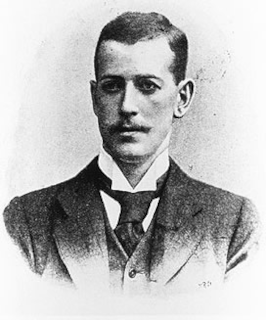
John Mary Pius Boland, Irish Nationalist politician, is born at 135 Capel Street, Dublin, on September 16, 1870. He serves as a Member of Parliament (MP) in the House of Commons of the United Kingdom of Great Britain and Ireland and as a member of the Irish Parliamentary Party for South Kerry (1900–1918). He is also noteworthy as a gold medalist tennis player at the first modern Olympics in Athens in 1896.

Boland is born to Patrick Boland (1840–1877), businessman, and Mary Donnelly. Following the death of his mother in 1882, he is placed with his six siblings under the guardianship of his uncle Nicholas Donnelly, auxiliary bishop of Dublin.

Boland is educated at two private Catholic schools, one Irish, the second English, and both of whose existence and evolution are influenced by John Henry Newman – the Catholic University School, Dublin, and The Oratory School, Birmingham. His secondary education at the two schools helps give him the foundation and understanding to play an influential role in the politics of Great Britain and Ireland at the beginning of the 20th century, when he is a member of the Irish Parliamentary Party which pursues constitutional Home Rule.

In 1892 Boland graduates with a BA from London University. He studies for a semester in Bonn, Germany, where he is a member of Bavaria Bonn, a student fraternity that is member of the Cartellverband. He studies law at Christ Church, Oxford, graduating with a BA in 1896 and MA in 1901. Although called to the Bar in 1897, he never practises.

Boland is the first Olympic champion in tennis for Great Britain and Ireland at the first modern Olympics, which takes place in Athens in 1896. He visits his friend Thrasyvoulos Manos in Athens during the Olympics, and Manos, a member of the organising committee, enters Boland in the tennis tournament. Boland promptly wins the singles tournament, defeating Friedrich Traun of Germany in the first round, Evangelos Rallis of Greece in the second, Konstantinos Paspatis of Greece in the semifinals, and Dionysios Kasdaglis of Greece in the final.

Boland then enters the doubles event with Traun, the German runner whom he had defeated in the first round of the singles. Together, they win the doubles event. They defeat Aristidis and Konstantinos Akratopoulos of Greece in the first round, have a bye in the semifinals, and defeat Demetrios Petrokokkinos of Greece and Dimitrios Kasdaglis in the final. When the Union Flag and the German flag are run up the flagpole to honour Boland and Traun’s victory, Boland points out to the man hoisting the flags that he is Irish, adding “It’s a gold harp on a green ground, we hope.” The officials agree to have an Irish flag prepared.

Following a visit to Kerry, Boland becomes concerned about the lack of literacy among the native population, as he also has a keen interest in the Irish language.

In 1908, Boland is appointed a member of the commission for the foundation of the National University of Ireland (NUI). From 1926 to 1947, he is General Secretary of the Catholic Truth Society. He receives a papal knighthood, becoming a Knight of St. Gregory in recognition for his work in education, and in 1950 he is awarded an honorary doctorate of Laws by the NUI.

Boland marries Eileen Moloney (1876–1937), daughter of an Australian Dr. Patrick Moloney, at SS Peter and Edward, Palace-street, Westminster, on October 22, 1902. They have one son and five daughters. His daughter Honor Crowley (née Boland) succeeds her husband, Frederick Crowley, upon his death sitting as Fianna Fáil TD for South Kerry from 1945 until her death in 1966. His daughter Bridget Boland is a playwright who writes The Prisoner.

Boland dies at the age of 87 at his home in London on Saint Patrick’s Day, March 17, 1958.


Leave a comment

Birth of Edel Quinn, Roman Catholic Lay Missionary

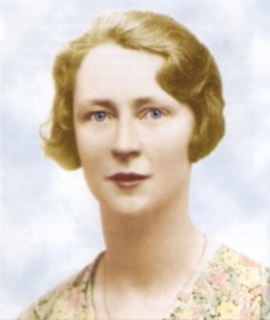
Edel Mary Quinn, Roman Catholic lay missionary and Envoy of the Legion of Mary to East Africa, is born in Castlemagner, County Cork, on September 14, 1907.

Quinn is the eldest child of bank official Charles Quinn and Louisa Burke Browne of County Clare. She is a great-granddaughter of William Quinn, a native of County Tyrone who settled in Tuam to build St. Mary’s Cathedral.

During Quinn’s childhood, her father’s career brought the family to various towns in Ireland, including Tralee, County Kerry, where a plaque is unveiled in May 2009 at Bank of Ireland House in Denny Street commemorating her residence there between 1921 and 1924. She attends the Presentation Convent in the town between 1921-1925.

Quinn feels a call to religious life at a young age. She wishes to join the Poor Clares but is prevented by advanced tuberculosis. After spending eighteen months in a sanatorium, her condition unchanged, she decides to become active in the Legion of Mary, which she joins in Dublin at the age of 20. She gives herself completely to its work in the form of helping the poor in the slums of Dublin.

In 1936, at the age of 29 and dying of tuberculosis, Quinn becomes a Legion of Mary Envoy, a very active missionary to East and Central Africa, departing in December 1936 for Mombasa. She settles in Nairobi having been told by Bishop Heffernan that this is the most convenient base for her work. By the outbreak of World War II, she is working as far off as Dar es Salaam and Mauritius. In 1941, she is admitted to a sanatorium near Johannesburg. Fighting her illness, in seven and a half years she establishes hundreds of Legion branches and councils in today’s Tanzania, Kenya, Uganda, Malawi, and Mauritius. John Joseph “J.J.” McCarthy, later Bishop of Zanzibar and Archbishop of Nairobi, writes of her:

“Miss Quinn is an extraordinary individual; courageous, zealous and optimistic. She wanders around in a dilapidated Ford, having for sole companion an African driver. When she returns home, she will be qualified to speak about the Missions and Missionaries, having really more experience than any single Missionary I know.”

All this time Quinn’s health is never good, and in 1943 she takes a turn for the worse, dying in Nairobi, Kenya of tuberculosis on May 12, 1944. She is buried there in the Missionaries’ Cemetery.

The cause for her beatification is introduced in 1956. She is declared venerable by Pope John Paul II on December 15, 1994, since when the campaign for her beatification has continued.


Leave a comment

The Conor Pass Ambush

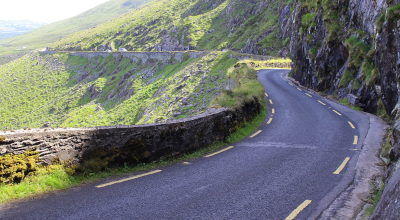
Two Royal Irish Constabulary (RIC) men are killed on Conor Pass in Dingle, County Kerry, on July 13, 1920 during the Irish War of Independence.

District Inspector Michael Fallon, accompanied by three other police in a motor car, are ambushed on the Conor Pass between Cloghane and Dingle, County Kerry. The D.I. is returning from an inspection of the barracks at Cloghane when the party is ambushed by members of the Irish Republican Army (IRA) West Kerry No.1 Brigade who are billetted at Fibough, in the Slieve Mish Mountains. The IRA volunteers include J. Dowling, Paddy Paul Fitzgerald, Dan Jeffers and Mick McMahon among their number.

Constables George Roach 62449 and Michael Linehan 63592 are killed outright. D.I. Fallon and Constable Joseph Campbell 67905, the driver, are both wounded. The IRA removes the bodies from the car and takes away the rifles and revolvers of the police. They then take Constable Campbell prisoner, dropping him off about three miles down the road.

Constable Linehan is 34 years old and single, and is originally from Cork. He has twelve years police service. His funeral takes place at St. Mary’s Catholic Church, Limerick, with burial in Mount St. Lawrence Cemetery. A hearse cannot be obtained so the constabulary, in relays, carry the coffin from the church to the cemetery.

Constable Roach has thirteen years service and is from County Clare. He is also a single man.

Compensation awards for gunshot injuries are later made to D.I. Fallon of £850 and to Constable Campbell of £600.

(From: “Constables George Roach and Michael Linehan, killed on the Connor Pass 1920” by Peter Mc, The Royal Irish Constabulary Forum (www.irishconstabulary.com), March 7, 2011)


Leave a comment

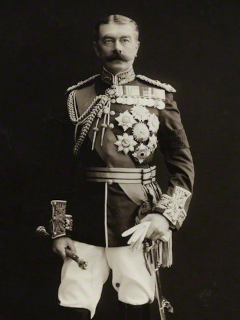
Death of Horatio Herbert Kitchener, 1st Earl Kitchener

Horatio Herbert Kitchener, 1st Earl Kitchener, Irish-born senior British Army officer and colonial administrator, drowns in the sinking of the HMS Hampshire west of Orkney, Scotland, on June 5, 1916. He wins notoriety for his imperial campaigns, especially his scorched earth policy against the Boers, his expansion of Lord Robertsinternment camps during the Second Boer War and his central role in the early part of World War I.

Kitchener is born in Ballylongford near Listowel, County Kerry, son of army officer Henry Horatio Kitchener and Frances Anne Chevallier, daughter of John Chevallier, a priest, of Aspall Hall, and his third wife, Elizabeth. The family moves to Switzerland when he is young, where he is educated at Montreux, then at the Royal Military Academy, Woolwich. He joins a French field ambulance unit in the Franco-Prussian War but is returned to England after he comes down with pneumonia.

Kitchener is credited in 1898 for winning the Battle of Omdurman and securing control of the Sudan for which he is made Baron Kitchener of Khartoum. As Chief of Staff (1900–1902) in the Second Boer War he plays a key role in Lord Roberts’ conquest of the Boer Republics, then succeeds Roberts as commander-in-chief, by which time Boer forces have taken to guerrilla warfare and British forces imprison Boer civilians in concentration camps. His term as Commander-in-Chief (1902–09) of the Army in India sees him quarrel with another eminent proconsul, the Viceroy Lord Curzon, who eventually resigns. He then returns to Egypt as British Agent and Consul General.

In 1914, at the start of World War I, Kitchener becomes Secretary of State for War, a Cabinet Minister. One of the few to foresee a long war, lasting for at least three years, and with the authority to act effectively on that perception, he organises the largest volunteer army that Britain had ever seen, and oversees a significant expansion of materials production to fight on the Western Front. Despite having warned of the difficulty of provisioning for a long war, he is blamed for the shortage of shells in the spring of 1915, one of the events leading to the formation of a coalition government and is stripped of his control over munitions and strategy.

On June 5, 1916, Kitchener is making his way to Russia on HMS Hampshire to attend negotiations with Tsar Nicholas II. At the last minute, Admiral Sir John Jellicoe changes the HMS Hampshire‘s route on the basis of a misreading of the weather forecast and ignoring (or not being aware of) recent intelligence and sightings of German U-boat activity in the vicinity of the amended route. Shortly before 7:30 PM the same day, steaming for the Russian port of Arkhangelsk during a Force 9 gale, HMS Hampshire strikes a mine laid by the newly launched German U-boat U-75 and sinks 1.5 miles west of the Orkney. Only twelve men survive. Amongst the dead are Kitchener and all ten members of his entourage. He is seen standing on the quarterdeck during the approximately twenty minutes that it takes the ship to sink. His body is never recovered.


Leave a comment

Birth of Architect George Coppinger Ashlin

George Coppinger Ashlin, Irish architect particularly noted for his work on churches and cathedrals, is born in County Cork on May 28, 1837. He becomes President of the Royal Institute of the Architects of Ireland.

Ashlin is the son of J. M. Ashlin, J.P. He receives his early education at the Collège de St. Servais in Liège, Belgium. He later enrolls at St. Mary’s College, Oscott (1851-55) where he is subsequently a pupil of Edward Welby Pugin. It is during this time that he develops an interest in architecture. By 1858, he enters the Royal Academy Schools, London.

When Pugin receives the commission for SS Peter and Paul’s, Carey’s Lane, Cork, in 1859, he makes Ashlin a partner with responsibility for their Irish work. This partnership lasts until late 1868. In 1861 they open their office at St. Stephen’s Green, Dublin. The practice is primarily ecclesiastical, designing some 25 religious buildings. Their churches and Cathedrals are mainly located in the counties of Wexford, Cork and Kerry, and are all of similar design. By far the most important commission undertaken by this partnership is the building of St. Colman’s Cathedral, Cobh for Bishop William Keane.

In 1867 Ashlin marries Mary Pugin (1844-1933), sister of Edward Welby Pugin and daughter of Augustus Welby Pugin, the Gothic revivalist. Their only daughter, Miriam, is born ten years later.

The partnership with Pugin is dissolved in 1870. Thereafter Ashlin practises in his own right, branching out to cover the entire island nation. His works of this period include Ballycotten (1901), Ballybunion (1892), Church of the Most Holy Rosary, Midleton (1893) and the Munster & Leinster Bank, both of Midleton, and finally Kildare (1898).

Ashlin is a member of the Royal Hibernian Academy and Fellow of the Royal Institute of British Architects.

George Coppinger Ashlin dies at the age of 84 on December 10, 1921. He is buried at Glasnevin Cemetery in Dublin.


Leave a comment

Birth of Helen Blackburn, Feminist & Women’s Rights Activist

Helen Blackburn, feminist and campaigner for women’s rights, especially in the field of employment, is born in Knightstown, County Kerry, on May 25, 1842. She is also an editor of The Englishwoman’s Review.

Blackburn is the daughter of Bewicke Blackburn, a civil engineer from County Kerry, and Isabella Lamb of County Durham in North East England. When her family moves to London in 1859, she soon comes into contact with the women of the Langham Place Group, especially Jessie Boucherett and Emily Faithfull.

Over the years Blackburn and Boucherett work together in a number of endeavours. Both are editors of The Englishwoman’s Review. Together they establish the Women’s Employment Defence League in 1891 to defend women’s working rights against restrictive employment legislation. Together they also edit The Condition of Working Women and the Factory Acts, 1896.

Blackburn joins the National Society for Women’s Suffrage in 1872 and is secretary of the executive committee of the Society from 1874 to 1880. She subsequently holds similar positions in a number of related organisations. She also takes opportunities to study, taking a class in Roman Law at University College London in 1875, and later (1886–88) classes at University College, Bristol. In the early 1890s, she assists Charlotte Carmichael Stopes in her writing of British Freewomen: Their Historical Privilege by supplying her own notes on the subject, then by purchasing the whole of the first edition in 1894. She retires in 1895 to care for her aged father, though later returns to take up her work.

Blackburn inspires and funds two collections. The first is an art collection in 1885 that includes pictures and work done by professional women to show the result of women’s industry. She is insistent that this does not include voluntary or amateurish work but rather show the products of female professionals. This loan exhibition includes portraits of leading women like Florence Nightingale and Mary Carpenter. This is donated to the University of Bristol, but recent enquiries indicate that this work is now lost. Her second collection is focused on a book collection by women. The books are from her collection, friends and from secondhand sources. Bookplates are commissioned and two bookcases which are decorated with paintings of Lydia Becker and Caroline Ashurst Biggs who had been the previous chairs of the Central Committee of the National Society for Women’s Suffrage. These bookcases are given to Girton College, Cambridge and are extant. In 1880 she is secretary of the West of England Suffrage Society in Bristol and is the main organizer of a large demonstration.

Blackburn’s long-term connection with the women’s movement allows her to write her history of the Victorian women’s suffrage campaign, Women’s suffrage: a record of the women’s suffrage movement in the British Isles, with biographical sketches of Miss Becker, finished in 1902, shortly before her death the following year, at Greycoat Gardens, Westminster, on January 11, 1903. She is buried at Brompton Cemetery. She leaves her archives and the decorated book collection to Girton College, Cambridge. Her will also makes provisions for establishing a loan fund for training young women.

A collaboration with Nora Vynne, published in 1903, titled Women under the Factory Act, criticises legislators for treating women as if they have not the intelligence of animals. Blackburn and Vynne argue that women should be allowed to take risks with their health in the workplace or they may find themselves always in need to protection as if they are incapable. The book is noted for its accuracy, but The Economic Journal recognises its authors as Freedom of Labour Defence members and suspects that it may have political motives arguing for the “equality of men and women.”

Blackburn’s name and picture, as well as those of 58 other women’s suffrage supporters, are on the pedestal of the statue of Millicent Fawcett in Parliament Square, London, unveiled in 2018.