In April 1916, Germany offers the Irish 20,000 Mosin–Nagant 1891 rifles, ten machine guns and accompanying ammunition, but no German officers. It is a fraction of the quantity of the arms Casement had hoped for, with no military expertise on offer. The weapons leave Germany bound for Ireland on a German cargo vessel named the SS Libau, disguised as a Norwegian vessel, Aud-Norge.
Casement confides his personal papers to Dr. Charles Curry, with whom he has stayed at Riederau on the Ammersee, before leaving Germany. He departs with Robert Monteith and Sergeant Daniel Beverley (Bailey) of the Irish Brigade in a submarine, initially the SM U-20, which develops engine trouble, and then the SM U-19, shortly after the Aud sails. According to Monteith, Casement believes the Germans are toying with him from the start and providing inadequate aid that will doom a rising to failure. He wants to reach Ireland before the shipment of arms and to convince Eoin MacNeill, who he believes is still in control, to cancel the rising.
Casement sends John McGoey, a recently arrived Irish American, through Denmark to Dublin, ostensibly to advise what military aid is coming from Germany and when, but with Casement’s orders “to get the Heads in Ireland to call off the rising and merely try to land the arms and distribute them.” McGoey does not reach Dublin, nor does his message. His fate is unknown until recently. Evidently abandoning the Irish Nationalist cause, he joins the Royal Navy in 1916, survives the war, and later returns to the United States, where he dies in an accident on a building site in 1925.
About 2:00 a.m. on the morning of April 21, 1916, three days before the rising begins, Robert Monteith, Daniel Bailey (calling himself Beverly), and Casement climb into a small boat for the trip to shore at Banna Strand in Tralee Bay, County Kerry. Their boat, now in the Imperial War Museum in London, capsizes before they reach shore.
Monteith helps an exhausted Casement to safety on shore. Casement is convinced that the Rising cannot be successful without a large number of German troops, and the best he has been able to obtain is one boatload of arms. Suffering from a recurrence of the malaria that had plagued him since his days in the Congo, and too weak to travel, Monteith and Bailey leave Casement at the ruins of McKenna’s Fort, an ancient ring fort in Rahoneen, Ardfert, now renamed Casement’s Fort, and head for Tralee.
About 1:30 p.m., Casement is discovered by two Royal Irish Constabulary (RIC) officers. He nearly talks his way out of being arrested, but a 12-year-old boy at the scene points out a piece of paper Casement had tossed away as the police approach. On that paper is a German code list. He is arrested on charges of high treason, sabotage and espionage against the Crown. He manages to send word to Dublin about the inadequate German assistance.
The Kerry Brigade of the Irish Volunteers might have tried to rescue Casement over the next three days, but its leadership in Dublin holds that not a shot is to be fired in Ireland before the Easter Rising is in train and therefore orders the Brigade to “do nothing.” A subsequent internal inquiry attaches “no blame whatsoever” to the local Volunteers for failing to attempt a rescue. Casement is taken to Brixton Prison and placed under special observation for fear of an attempt of suicide as there is no staff at the Tower of London to guard suicidal cases.
On the day of his execution by hanging at Pentonville Prison, August 3, 1916, Casement is received into the Catholic Church at his request. He is attended by two Catholic priests, Dean Timothy Ring and Father James Carey, from the East London parish of SS Mary and Michael. The latter, also known as James McCarroll, says of Casement that he was “a saint … we should be praying to him [Casement] instead of for him.” At the time of his death he is 51 years old.
Casement’s body is buried in quicklime in the prison cemetery at the rear of Pentonville Prison, though his last wish was to be buried at Murlough Bay on the north coast of County Antrim, in present-day Northern Ireland. Finally, in 1965, his remains are repatriated to Ireland. His remains lay in state at the Garrison Church, Arbour Hill (now Arbour Hill Prison) in Dublin for five days, close to the graves of other leaders of the 1916 Easter Rising, although he would not be buried beside them. After a state funeral, the remains are buried with full military honours in the republican plot in Glasnevin Cemetery in Dublin, alongside other Irish republicans and nationalists. The President of Ireland, Éamon de Valera, who is then in his mid-eighties and the last surviving leader of the Easter Rising, attends the ceremony, along with an estimated 30,000 others.
Josephine McNeill, Irish diplomat, is born on March 31, 1895, in Fermoy, County Cork. She is the first Irish female diplomat appointed to represent Ireland abroad in a ministerial capacity.
McNeill is born Josephine Ahearne, the daughter of shopkeeper and hotelier, James Ahearne, and his wife Ellen Ahearne (née O’Brien). She attends the Loretto Convent, Fermoy, and goes on to graduate from University College Dublin (UCD) with a BA, H.Dip.Ed. in French and German. With this she begins a teaching career, at St. Louis’ Convent, Kiltimagh, at the Ursuline Convent, Thurles, and at Scoil Íde. Scoil Íde, the female counterpart to St. Enda’s School, had been established by her friend, Louise Gavan Duffy. She is fluent in the Irish language and takes an active part in the cultural elements of the Irish independence movement, such as literature and music. She is a member of Cumann na mBan, serving as a member of the executive committee in 1921.
After the death of her husband in 1938, McNeill becomes the honorary secretary of the council of the Friends of the National Collections, as well as serving as chair of the executive committee of the Irish Countrywomen’s Association until 1950. As a member of the Department of External Affairs advisory committee on cultural relations, she writes on economic, social and cultural issues. She represents Ireland at the UNESCO general assembly in Paris in 1949.
McNeill is an active member of Clann na Poblachta from its foundation in 1946. She is appointed the minister to the Netherlands in 1950 by Seán MacBride, making her the first Irish female diplomat to represent the Republic of Ireland abroad in a ministerial capacity. This appointment is not well received by diplomats in the Department of External Affairs. Her reports from The Hague focus on the issues the Netherlands faces with decolonisation. In 1955, she becomes the minister to Sweden, going on to hold the joint appointment to Austria and Switzerland from 1956 to 1960, after which she retires. While serving in Switzerland she puts aside the resentment she feels towards Éamon de Valera based on how he had treated her husband, to sit with him during a convalescence while de Valera recovers from an eye operation.
McNeill is an amateur pianist and collects paintings and porcelains. In 1933, she publishes the Irish language book, Finnsgéalta ó India.
O’Hegarty comes from a family with strong nationalist roots. His parents are John, a plasterer and stucco worker, and Katherine (née Hallahan) Hegarty. His elder brother is Patrick Sarsfield O’Hegarty, the writer. His parents’ families emigrated to the United States after the Great Famine, and his parents married in Boston. His father is a member of the Irish Republican Brotherhood (IRB). In 1888, his father dies of tuberculosis at the age of 42, and his mother has to work to support the family.
O’Hegarty is educated at the Christian BrothersNorth Monastery school in Cork. By 1902, he has left school to work as a sorter in the local post office, rising to post office clerk. He is a supporter of the Gaelic revival, Irish traditional music, and Gaelic games. A committed sportsman, in his twenties he is captain of the Post Office HQ’s hurling team. He follows his brother Patrick into Conradh na Gaeilge and eventually the Irish Volunteers and the Irish Republican Brotherhood. He is a member of the Celtic Literary Society by 1905 and founds the Growney branch of Conradh na Gaeilge in 1907. A puritanical character by nature, he is a non-smoker and never drinks.
O’Hegarty is a founder of the local branch of the Irish Volunteers in Cork in December 1913. In June of the following year, he is appointed to the Cork section of the Volunteer Executive, and then to the Military Council. In October, the Dublin government discovers his illegal activities, and he is dismissed. Excluded from Cork under the Defence of the Realm Act (DORA) regulations, he moves to Ballingeary, where he works as a labourer. From there he moves to Enniscorthy, County Wexford, where he lives with Larry de Lacy. On February 24, 1915, he is arrested and tried under the Defence of the Realm Act for putting up seditious posters. But for this and a second charge of “possession of explosives” he is discharged. The explosives belonged to de Lacy.
The Volunteers appoint O’Hegarty as Commandant of Ballingeary and Bandon. During the Easter Rising, he is stationed in Ballingeary when visited by Michael McCarthy of Dunmanway to propose an attack on a Royal Irish Constabulary (RIC) post at Macroom. But their strength is fatally weakened and, having no reserves, they call off the attempt. In 1917, he becomes Vice-commandant of No.1 Cork Brigade. He works as a storekeeper at the workhouse but is intimidating, and clashes with the Poor Law Guardians.
During the Irish War of Independence, O’Hegarty is one of the most active in County Cork. Like others, he is exasperated with Tomás Mac Curtain’s inactivity and refusal to be more bellicose. One such is battalion commander Richard Langford, who joins with O’Hegarty’s unit to make an unauthorized raid on the RIC post at Macroom. Langford is court-martialed, but O’Hegarty continues to rise in the ranks. When a RIC Inspector is murdered, Mac Curtain condemns the shootings and calls for their end. On March 19, 1920, Mac Curtain is shot and killed in his home in Cork. The coroner blames the British establishment in Dublin, but the police never make any attempt to investigate the killings. Shortly after these events General Hugh Tudor begins the policy of official reprisals.
In January 1920, an inquiry is held into corruption alleged against “Hegarty’s Mob” or “Hegarty’s Crowd” running Cork City. O’Hegarty blames the former mayors for the charges of incompetence but remains on good terms with them.
In a raid on Cork City Hall on August 12, 1920, the British manage to net all the top brass of the IRA in Cork. In an incredible failure of intelligence, they do not identify the leadership as their prisoners. They are all released, including Liam Lynch, and O’Hegarty. Only Terence MacSwiney, the new Lord Mayor of Cork, is kept in custody and sent to England.
On February 25, 1921, the Coolavokig ambush is carried out by the 1st Cork Brigade under O’Hegarty at Ballyvourney village, on the road between Macroom and Ballyvourney. The IRA suffers no casualties; however, the number of British casualties has been disputed to this day.
The brigade commanders in the southern division retain a residual lingering resentment of Dublin GHQ’s lack of leadership and supplies. Seán Moylan, commandant of No. 2 Cork Brigade, thinks good communications with No.1 Brigade are to be vital, but little of this is seen via the organizer, Ernie O’Malley, at GHQ. At a meeting set up for April 26, 1921, when the manual of Infantry Training 1914 is produced, the document raises great anger. The meeting ends in uproar when O’Hegarty, who is “a master of invective, tore the communication and its authors to ribbons.”
O’Malley and Liam Lynch, the general, meet with O’Hegarty in the mountains of West Cork, near a deserted farmhouse, just off the main road. In the retreat that follows, the Irish take heavy casualties and leave their wounded to the good care of the British. These are the “Round-ups” in which the Irish sleep outside in order to avoid being at home when the Army calls. They are told by the Brigade to learn the national anthem of England to avoid arrest.
In East Cork brigade, O’Hegarty uncovers a spy ring. He is ruthless in the treatment of Georgina Lindsay and her chauffeur, who give away information to the Catholic clergy, but is remarkably lenient on brigade traitors within. He is allegedly not too bothered about evidence but is reminded that all executions of a traitor have to be approved by Dublin first.
O’Hegarty becomes more and more aggressive toward the establishment, using tough language to impose his will over the area. He attempts to force the civilian Teachtai Dála (TDs) for Cork to stand down, to give way to military candidates, telling the Dáil in December 1921, that any TD voting for the treaty will be guilty of treason. But Éamon de Valera is decided and overrules any interference with the Civil Government. Like the commanders, de Valera rejects the treaty but has already been defeated in the Dáil on a vote by W. T. Cosgrave‘s majority.
On February 1, 1922, O’Hegarty marries Maghdalen Ni Laoghaire, a prominent member of Cumann na mBan.
O’Hegarty is on the IRA’s Executive Council, but when there is a meeting on April 9, 1922, it is proposed that the Army should oppose the elections by force. As a result, Florence O’Donoghue and Tom Hales join him in resigning. In May, he and Dan Breen enter into negotiations with Free Stater Richard Mulcahy. A statement is published in the press asking for unity and acceptance of the Treaty. During this time, the republicans become very demoralized and ill-disciplined, but they have to gain strength before announcing independence from Dublin. The debate amongst the anti-Treaty IRA command is increasingly rancorous.
The bitter divisions split the anti-treatyites into two camps. Two motions are debated at the Army Convention on June 18, 1922. At first, the motion to oppose the treaty by force is passed. These men include Tom Barry, Liam Mellows, and Rory O’Connor, who are all in favour of continuing the fight until the British are driven out of Ireland altogether. However, one brigade’s votes have to be recounted, and then the motion is narrowly defeated. Joe McKelvey is appointed the new chief of staff, but the IRA is in chaos. While he strongly opposes the Anglo-Irish Treaty, O’Hegarty takes a neutral role in the Irish Civil War and tries to avert hostilities breaking out into full-scale civil war. He emerges as a leader of the “Neutral IRA” with O’Donoghue. This is a “loose” confederation of 20,000 men who have taken part in the pre-truce wars but have remained neutral during the Civil War from January 1923. Over 150 persons attend its convention in Dublin on February 4, 1923. By April 1923, O’Malley is imprisoned in Mountjoy Prison. In a letter to Seamus O’Donovan on April 7, he blames Hegarty for all this compromise and “peace talk.”
It has been alleged by the author Gerard Murphy that O’Hegarty had a role in the assassination of the Commander-in-Chief, Michael Collins, in August 1922, along with Florrie O’Donoghue and Joe O’Connor. It is alleged that as members of the 1st Southern Division Cork, they are actually feigning claims of neutrality but remain part of the IRB in order to set up talks towards peace and the cessation of hostilities at the start of the Irish Civil War.
Although probably an atheist during the Irish War of Independence, O’Hegarty returns to the Catholic church later in life. On forming the Neutral Group of the IRA in December 1922, he tries to unify differences in the volunteers between Republicans and the Free Staters. He communicates with the Papal Nuncio during the inter-war years in an attempt to have Bishop of CorkDaniel Cohalan‘s excommunication bill lifted. Instead, he turns to commemoration as a way to earn favour in Rome, with the dedication of a Catholic church at St. Finbarr’s Cemetery. After his wife’s passing, he becomes a close friend with Florence O’Donoghue until his own death.
The Organisation’s aims are to “encourage and assist any movement that will tend to bring about the National Independence of Ireland.” Among the first members of the Executive Committee are Victor Herbert (President), Thomas Hughes Kelly (Treasurer) and John D. Moore (Secretary). An office is set up in Sweden and relations are established with Imperial Germany. The Friends of Irish Freedom support the 1916 Easter Rising and, in the months following, raise $350,000 through the Irish Relief Fund to assist dependents of many who fought in the Rising.
In 1917, the Executive Committee of the Friends of Irish Freedom circulates a petition calling for the independence of Ireland throughout the United States and secures several hundred thousand signatures. PresidentWoodrow Wilson in turn directs Secret Service agents to examine the membership and funding of the organisation. In May 1918, the Friends of Irish Freedom organises the fourth Irish Race Convention during which Diarmuid Lynch becomes National Secretary holding the post until his return to Ireland in 1932.
By 1920, there is a Regular membership of 100,000 and 484 Associate Branches with an Associate membership of 175,000. During the Irish War of Independence, the Friends of Irish Freedom raise over $5,000,000 in Dáil loans for the newly declared Irish Republic through the promotion of Bond Certificates. Legal advisor to the organisation for the Bond Drive is Franklin Delano Roosevelt. In October 1920, a rift develops between the Irish American leaders and Éamon de Valera which results in a split between the Friends of Irish Freedom in the United States and the Irish Republican Brotherhood in Ireland. Prior to his departure from the United States, de Valera founds a rival organisation — the American Association for the Recognition of the Irish Republic — to take over the activities of the Friends.
The public dispute between the Friends of Irish Freedom and Sinn Féin representatives damages the effectiveness and credibility of the Irish American organisation. While the Executive largely remains loyal to Daniel F. Cohalan, many rank-and-file members do not renew their subscriptions. By mid-1921 membership has fallen to 20,000 and is further reduced after the outbreak of Irish Civil War in 1922. By 1928, the Friends of Irish Freedom has virtually ceased to exist as a viable Irish American organisation.
The Friends of Irish Freedom is wound up in 1932 following extensive litigation concerning the funds raised for the Irish Republic which were claimed by de Valera. Most of the funds are returned to the original donors.
(Pictured: Éamon de Valera and Friends of Irish Freedom members Daniel Cohalan, John Goff and James Devoy)
Donnelly is born in Killybrackey, near Dungannon, County Tyrone, on July 10, 1914, into a family of cattle breeders. His father, Joseph Donnelly, sells his farm in 1917 and the family moves to Dundalk and opens a greengrocer‘s shop. Joseph Donnelly becomes quite prosperous, running his shop, dealing cattle and buying and selling property in the Dundalk area. In addition to Charles, the Donnellys have five other sons and two daughters. His mother, Rose, dies in 1927, when he is 13 years old.
Donnelly receives his early education in the Christian Brothers school in Dundalk. When he is fourteen in 1928, the family moves again, this time to Dublin, where his father purchases a house on Mountjoy Square in the north inner city. He enrolls in O’Connell School on North Frederick Street but is expelled after only a few weeks. He spends the next few months wandering the streets of Dublin during school time before his father discovers what had happened. Also at this time, he meets and is befriended by radical political activists from the Irish Republican Army (IRA), the Communist Party of Ireland and the left-Republican group Saor Éire.
Donnelly’s father and aunts get him an apprenticeship with a carpenter, but he gives this up after a year to enroll in University College Dublin (UCD) in 1931, where he studies Logic, English, History and the Irish language. In university he begins writing poetry and prose for student publications but fails his first-year examinations. At this time, he also becomes deeply involved in radical left-wing and republican politics. He drops out of university in 1934, having failed his first-year exams three times and joins the radical group, the Republican Congress. There he befriends veteran republicans Frank Ryan and George Gilmore. He also becomes involved in a romantic relationship with another republican activist, Cora Hughes, Éamon de Valera‘s goddaughter and later partner of George Gilmore. In July 1934, he is arrested and imprisoned for two weeks for his role in picketing a Dublin bakery with other Congress members. After this, his father expells him from the family home and he spends a period sleeping in parks around Dublin.
The Republican Congress splits at its first annual meeting in September 1934, but the 20-year-old Donnelly is elected to the National Executive of the truncated organisation. Thereafter, he writes for the Congress newspaper on political and social questions. In January 1935, he is again arrested for assaulting a Garda at a Congress demonstration and is imprisoned for a month. In February 1935, he leaves Ireland for London. In the British capital he forms the first Republican Congress branch in London and becomes its first chairman. He finds employment variously as a dishwasher in pubs and cafes and as a reporter with an international news agency. While in London he remains a regular contributor to the Republican Congress newspaper and various left-wing publications. Together with two other poets, Leslie Daiken and Ewart Milne, he is one of the founders of a duplicated publication called Irish Front, the London journal of the Republican Congress. Daiken admits that many of the Irish Front editions are written almost entirely by Donnelly.
Eoin McNamee recalls Donnelly as “a frail looking Dublin man with a Tyrone background…he was something of an intellectual and clearly the theorist of the Irish Republican Congress in London at that time. He was well versed in Marxism, wrote for the Congress and Communist press, and frequently appeared on left-wing public platforms.”
In July 1936, on the outbreak of the Spanish Civil War, Donnelly urges the Republican Congress to send fighters to the International Brigades. He himself returns to Dublin with the intention of organising such a force. By the end of 1936, he has gone again to London and joins the Brigades. He reaches Spain on January 7, 1937, and at Albacete, meets up with an Irish contingent, led by Frank Ryan, known as the Connolly Column, who had come to Spain to fight on the Republican side. He and his comrades are attached to the American Lincoln Battalion. On February 15, after receiving only rudimentary military training, the Lincoln Battalion is thrown into the Battle of Jarama, near Madrid. Donnelly reaches the front on February 23, where he is promoted to the rank of field commander. On February 27, his unit is sent on a frontal assault on the Nationalist positions on a hill named Pingarrón. The object of the attack is to take the enemy trenches and ultimately to drive them across the Jarama River. He and his unit are pinned down by machine gun fire all day. In the evening, the Nationalists launch a counterattack.
A Canadian veteran recalls, “We ran for cover, Charlie Donnelly, the commander of an Irish company is crouched behind an olive tree. He has picked up a bunch of olives from the ground and is squeezing them. I hear him say something quietly between a lull in machine gun fire: Even the olives are bleeding.” The line later becomes famous.
A few minutes later, as his unit retreats, Donnelly is caught in a burst of gunfire. He is struck three times, in the right arm, the right side and the head. He collapses and dies instantly. His body lay on the battlefield until it is recovered by fellow Irish Brigadier Peter O’Connor on March 10. He is buried at Jarama in an unmarked grave with several of his comrades.
Written by Donnelly’s brother Joseph, a collection of his work, Charlie Donnelly: the Life and Poems, is published in 1987 by Dedalus Press. On the eve of the 71st anniversary of his death, February 26, 2008, he is commemorated with the unveiling of a plaque at his alma mater, UCD, attended by 150 people. The commemoration, organised jointly by a group of UCD students and the Donnelly family, is hosted by the School of English and also includes a lecture by Gerald Dawe on Donnelly’s life and poetry. In April 2008, the UCD branch of the Labour Party is renamed the Charlie Donnelly Branch in his honour.
Donnelly’s friend Blanaid Salkeld commemorates him in her poem “Casualties,” writing “That Charlie Donnelly small and frail/ And flushed with youth was rendered pale/ But not with fear, in what queer squalor/ Was smashed up his so-ordered valour.” A 1976 documentary about the Civil War by Cathal O’Shannon is entitled Even the Olives are Bleeding.
Donnelly is survived by a brother, Joseph, who manages to get many of his poems published in 1987; only five or six are published during his lifetime. Discussing his work, Colm Tóibín says it “mixed an Audenesque exactitude with a youthful romanticism… his poem “The Tolerance of Crows” belongs in any anthology of modern poetry.” In 1992, Donnelly has work included in Dedalus Irish Poets: An Anthology from Dedalus Press.
Fuller is born on January 1, 1900, in Kilflynn, County Kerry. He is the son of Daniel Fuller and Ellie Quinlan. His family is from Fahavane, in the parish of Kilflynn.
Fuller serves in the Kilflynn Irish Republican Army (IRA) flying column during the Irish War of Independence. He is First Lieutenant in the Kerry No.1 Brigade, 2nd Battalion. He opposes the Anglo-Irish Treaty and continues to fight with the anti-Treaty IRA during the Irish Civil War. Military records from the 1930s show, in his own hand, that he is in communication with Dublin regarding confirmation of membership in July 1922 and therefore eligible for war pensions. He becomes the most senior Kilflynn member upon the death of Captain George O’Shea.
In 1923, Fuller is captured by Free State troops and imprisoned in Ballymullen Barracks in Tralee by the Dublin Guard who had landed in County Kerry shortly before. On March 6, 1923, five Free State soldiers are blown up by a booby-trapped bomb at Baranarigh Wood, Knocknagoshel, north Kerry, including long-standing colleagues of Major General Paddy Daly, GOC Kerry Command. Prisoners receive beatings after the killings and Daly orders that republican prisoners be used to remove mines.
On March 7, nine prisoners from Ballymullen Barracks, six from the jail and three from the workhouse, are chosen with a broad geographical provenance and no well-known connections. They are taken lying down in a lorry to Ballyseedy Cross. There they are secured by the hands and legs and to each other in a circle around a land mine. Fuller is among them. His Kilflynn parish comrade Tim Tuomey is initially stopped from praying until all prisoners are tied up. As he and other prisoners then say their prayers and goodbyes, Fuller continues to watch the retreating Dublin Guard soldiers, an act which he later says saved him. The mine is detonated, and he lands in a ditch, suffering burns and scars. He crosses the River Lee and hides in Ballyseedy woods. He is missed amongst the carnage as disabled survivors are bombed and shot dead with automatic fire. Most collected body parts are distributed between nine coffins that had been prepared. The explosions and gunfire are witnessed by Rita O’Donnell who lives nearby and who sees human remains spread about the next day. Similar reprisal killings by the Dublin Guard follow soon after Ballyseedy.
Fuller crawls away to the friendly home of the Currans nearby. They take him to the home of Charlie Daly the following day. His injuries are treated by a local doctor, Edmond Shanahan, who finds him in a dugout. He moves often in the coming months, including to the Burke and Boyle families, and stays in a dugout that had been prepared at the Herlihys for seven months.
A cover-up begins almost immediately. Paddy Daly’s communication to Dublin about returning the bodies to relatives differs significantly from Cumann na mBan statements, which Daly complains about as simple propaganda, and later that of Bill Bailey, a local who had joined the Dublin Guard, who tells Ernie O’Malley that the bodies were handed over in condemned coffins as a band played jolly music. Fuller is named amongst the dead in newspaper reports before it is realised that he had escaped. Daly then sends a communication to GHQ that Fuller is reported as having become “insane.” The Dublin Guard scours the countryside for Fuller. The official investigation into the killings is presided over by Daly himself, with Major General Eamon Price of GHQ and Colonel J. McGuinness of Kerry Command. It blames Irregulars for planting the explosives and exonerates the Irish Army soldiers, and this is read out in the Dáil by the Minister for Defence, Richard Mulcahy.
Contrary statements to the Irish Army’s submissions are effectively ignored. Lieutenant Niall Harrington of the Dublin Guard, describes the evidence to the court and the findings as “totally untrue,” explaining that the actions were devised and executed by officers of the Dublin Guard. He contacts Kevin O’Higgins, Minister for Justice and Vice-President, a family friend, to deplore the findings. O’Higgins speaks to Richard Mulcahy, who does nothing. In a separate incident, Free State Lieutenant W.McCarthy, who had been in charge of about twenty prisoners, says that five of them had been removed in the night. They were reportedly shot in the legs then blown up by, in his words, “…a Free State mine, laid by themselves.” He resigns in protest. A Garda Síochána report into the events is also dismissed and is not made public for over 80 years.
Fuller leaves the IRA after the Civil War and follows a career as a farmer in Kerry. He joins Fianna Fáil, the political party founded by Republican leader Éamon de Valera in 1926 after a split from Sinn Féin. He is elected to the 9th Dáil on his first attempt, representing Fianna Fáil at the 1937 Irish general election, as the last of three Fianna Fáil TDs to be elected to the four seat Kerry North constituency. He is re-elected to the 10th Dáil at the 1938 Irish general election, when Fianna Fáil again wins three out of four seats, but loses his seat at the 1943 Irish general election to the independent candidate Patrick Finucane. He returns to farming thereafter.
Fuller never once mentions the Ballyseedy incident from a political platform and states later that he bore no ill-will towards his captors or those who were involved in his attempted extrajudicial killing. He does not want the ill feeling passed on to the next generation. He speaks publicly about the events in 1980, a few years before his death, on Robert Kee‘s groundbreaking BBC series Ireland: A Television History.
Fuller dies in Edenburn Nursing Home, Tralee, on February 23, 1984. He is buried near the Republican plot in Kilflynn where colleagues O’Shea, Tuomey and Timothy ‘Aero’ Lyons are buried.
Fuller’s son Paudie establishes the Stephen Fuller Memorial Cup for dogs of all ages, contested annually on the family farm.
Fuller’s fame largely rests on one night at Ballyseedy. To trace him through the rural society from which he and his fellow Volunteers originated and in which his life was spent, however, gives a fuller understanding of the devastating effects of the conflicts of 1916–23 on a tightly knit rural and small-town society, dominated by extended families of farmers and their service-industry relatives, and of how that society remembered and forgot those traumas.
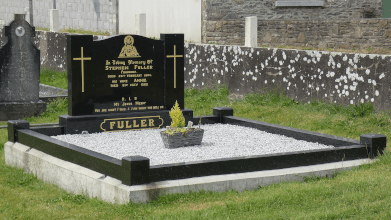
(Pictured: Stephen Fuller’s grave in Kilflynn, by St. Columba’s Heritage Centre)
The idea for a new party is discussed at a meeting in Dublin on February 21, 1940, attended by 104 former officers of the pro- and anti-Treaty wings of the Irish Republican Army (IRA). The inaugural meeting of the new party takes place on March 2, 1940. Simon Donnelly, who had fought in Boland’s Mill under Éamon de Valera in the 1916 Easter Rising, the former leader of the Dublin section of the IRA, and former chief of the Irish Republican Police (IRP), is elected as president of a central committee of fifteen members. Other leaders are Seán Fitzpatrick, another Irish War of Independence veteran; Con Lehane, who had recently left the IRA; Séamus Gibbons; Tom O’Rourke; Seán Dowling, one of Rory O’Connor‘s principal lieutenants in the Irish Civil War; Colonel Roger McCorley, one of the principal IRA leaders in Belfast during the Irish War of Independence who had taken the Irish Free State side in the Irish Civil War; Frank Thornton, one of Michael Collins‘ top intelligence officers; Roger McHugh, a lecturer in English at University College Dublin (UCD) and later professor; Captain Martin Bell and Peter O’Connor.
Also in attendance at the first meeting is Seamus O’Donovan, Director of Chemicals on IRA Headquarters Staff in 1921 and architect of the IRA Sabotage Campaign in England by the IRA in 1939–40. Indeed, O’Donovan proposes several of the basic resolutions. Additionally, the meeting is attended by Eoin O’Duffy and several former leaders of the Irish Christian Front.
Many members of the Irish far-right join Córas na Poblachta including Gearóid Ó Cuinneagáin, who becomes the leader of the party’s youth wing Aicéin and goes on to found Ailtirí na hAiséirghe, Alexander McCabe, Maurice O’Connor and Reginald Eager from the Irish Friends of Germany, George Griffin, Patrick Moylett, his brother John and Joseph Andrews of the People’s National Party, Dermot Brennan of Saoirse Gaedheal, and Hugh O’Neill and Alexander Carey of Córas Gaedhealach. As a result, the party assumes a pro-German and antisemitic attitude which is frequently expressed in party functions, and Gardaí suspects Córas na Poblachta members of daubing the walls of Trinity College Dublin in antisemitic slogans following the visit of British politician Leslie Hore-Belisha to Ireland in 1941.
Socialist republicans Nora Connolly O’Brien and Helena Molony take an interest in the group. Reflecting divisions within the IRA, a minority of the party’s leaders sympathise with communism rather than fascism.
The main aim of Córas na Poblachta is the formal declaration of a Republic. It also demands that the Irish language be given greater prominence in street names, shop signs, and government documents and bank notes. It proposes to introduce national service in order that male citizens understand their responsibilities. The party’s economic policy is the statutory right to employment and a living wage. It proposes breaking the link with the British pound, the nationalisation of banks and the making of bank officials into civil servants. In the area of education, the party espouses free education for all children over primary age as a right, and university education when feasible. It also calls for the introduction of children’s allowances. In addition, Córas na Poblachta advocates for “the destruction of the Masonic Order in Ireland” and during its founding meeting reporters are told that the party will be ready to take over the government of Ireland “on either a corporate or fascist basis.”
The party has close ties with the Irish nationalist and pro-fascist party Ailtirí na hAiséirghe, whose leader, Gearóid Ó Cuinneagáin, had led Córas na Poblachta’s youth wing Aicéin until its independence is terminated in 1942. There is talk of a merger, however, while the majority of the party’s executive committee, noted by G2 to be made up of “four ex-Army men, old IRA, ex-Blueshirts and a number of IRA who had been active up until comparatively recently”, desires a combination of Ireland’s extreme nationalist movements, the three most prominent leaders, Simon Donnelly, Sean Dowling and Roger McCorley, oppose one due to the fear that the party will be submerged in a joint organisation. Ó Cuinneagáin is dismissive of Córas na Poblachta’s prospects and discussions between him and the party’s leaders reinforce their fears that Ó Cuinneagáin seeks an outright takeover by Ailtirí na hAiséirghe. Proposals for a merging of the two parties are dropped though they continue to maintain cordial relations and co-operate in the 1943 Irish general election.
The party is not successful and fails to take a seat in a by-election held shortly after the party’s foundation. The party slowly falls apart, and Tim Pat Coogan notes that: “Dissolution occurred because people tended to discuss the party rather than join it.” Importantly, the party is not supported by the hardcore of republican legitimatists, such as Brian O’Higgins, who views the IRA Army Council as the legitimate government of an existing Irish Republic. Indeed, in March 1940, O’Higgins publishes a pamphlet entitled Declare the Republic lambasting the new party as making what he regards as false promises that will be compromised on following the party’s election to the Oireachtas.
Córas na Poblachta fields candidates in the 1943 Irish General Election but none are elected, receiving a total of 3,892 votes between them.
Although a failure, Tim Pat Coogan argues Córas na Poblachta was the “nucleus” of the Clann na Poblachta party which emerges to help take power from Fianna Fáil in 1948.
(Pictured: IRA veteran Simon Donnelly who serves as President of Córas na Poblachta)
Among those to welcome the new organisation is Sinn Féin President, Éamon de Valera, who promises all the support he can offer. CardinalMichael Logue, CatholicPrimate of Ireland, also offers his assistance: “Even if peace were restored, of which there seems little prospect at present, all the help which can be obtained shall be necessary, to restore the country from the wreck to which it has been reduced, and to help those who have been left destitute by the murder of those on whom they depended, or ruined by the destruction of their property.”
The Irish White Cross is managed by the Quaker businessman, and later Irish Free Statesenator, James G. Douglas. The organisation continues to operate until the Irish Civil War and its books are officially closed in 1928. From 1922, its activities are essentially wound down and remaining funds divested to subsidiary organisations. The longest running of these aid committees is the Children’s Relief Association which distributes aid to child victims of this troubled period, north and south of the border, until 1947. The head of the Children’s Relief Association is Áine Ceannt, the widow of Éamonn Ceannt who is perhaps one of the least known signatories of the 1916 Proclamation of the Irish Republic.
In June 1919, de Valera arrives in the United States for what is to be an 18-month visit. He has recently escaped from Lincoln Gaol in England in sensational fashion, after a duplicate key is smuggled into the jail in a cake and he escapes dressed as a woman. A few months later he is a stowaway aboard the SS Lapland from Liverpool bound for America.
De Valera’s plan is to secure recognition for the emerging Irish nation, tap into the huge Irish American community for funds, and to pressurize the U.S. government to take a stance on Irish independence. Playing on his mind is the upcoming Versailles conference where the nascent League of Nations is preparing to guarantee “existing international borders” – a provision that will imply Ireland remaining within the United Kingdom.
De Valera also has a challenge in winning over PresidentWoodrow Wilson, who is less than sympathetic to Ireland’s cause.
De Valera’s interest in America is of course personal. He is born in New York City on October 14, 1882, and his U.S. citizenship is one of the reasons he is spared execution after the 1916 Easter Rising.
At first de Valera keeps a low profile in America. Though he is greeted by Harry Boland and others when he docks in New York City, he first goes to Philadelphia and stays with Joseph McGarrity, the County Tyrone-born leader of Clan na Gael and a well-known figure in Irish America. He also quietly pays a visit to his mother in Rochester, New York.
De Valera’s first major engagement is on June 23, 1919, when he is unveiled to the American public at a press conference in the Waldorf-Astoria hotel in New York City. Crowds throng the streets around the hotel, and de Valera proclaims, “I am in America as the official head of the Republic established by the will of the Irish people in accordance with the principle of self-determination.”
De Valera then embarks upon a tour across America. Vast crowds turn out to see the self-proclaimed “president of the Irish republic.” In Boston an estimated crowd of 70,000 people hear him talk in Fenway Park. In San Francisco he unveils a statute of Irish revolutionary hero Robert Emmet in Golden Gate Park.
Later in the year, de Valera holds a huge rally in Philadelphia, where he is welcomed by the mayor at Independence Hall. He also visits smaller towns and cities across the United States, and his trip garners huge press coverage – an invaluable boon for his campaign to heighten awareness of the Irish issue in America.
But difficulties soon emerged during de Valera’s visit. He becomes embroiled in a bitter split among Irish Americans. He finds himself at odds with Judge Daniel Cohalan and John Devoy, central figures in the Friends of Irish Freedom (FOIF) association. Part of the dispute centers around money. De Valera had settled on an idea for a bond sale as a way of raising money for the cause – investors would be given bond certificates that would be exchangeable for bonds of the Irish Republic once it gets international recognition. But Cohalan and Devoy, who have already raised thousands through the Friends of Irish Freedom, are opposed, concerned about the scheme’s legality for one.
De Valera’s claim in an interview that Irish-British relations can be analogous to the relationship between Cuba and America also enrages the Cohalan-Devoy camp, who accuse him of surrendering the idea of full Irish sovereignty.
De Valera’s increasingly acrimonious relationship with Cohalan and Devoy spills over into the 1920 Republican and Democratic conventions. Against the advice of Cohalan and Devoy, he advances a resolution about Irish independence which is rejected 12-1 at the Republican convention in June of that year. A rival resolution by Cohalan squeezes through but ultimately is overturned. Similarly, he fails to secure the inclusion of the Irish issue in the Democratic Party’s policy platform during the Democrats’ convention in San Francisco.
De Valera leaves the United States in December 1920 with mixed results. Though he has raised millions of dollars through the bond sale, he has made little progress in co-opting official America to Ireland’s cause. Much as division is to characterise the next chapter of his political career in Ireland, de Valera’s sojourn in America leaves Irish America more divided than it has ever been.
(From: “Éamon de Valera’s US trip that left Irish America divided” by Suzanne Lynch, The Irish Times, http://www.irishtimes.com, June 1, 2019 | Pictured: Éamon de Valera (center) in New York with Friends of Irish Freedom’s Judge Daniel Cohalan and John Devoy in July 1919, Topical Press Agency/Getty)
Cohalan graduates from Manhattan College in 1885, takes a master’s degree in 1894, and is given an honorary LL.D. in 1911. He is admitted to the bar in 1888, and practices law in New York City. In September 1889, he removes to the Bronx, practices law there, and enters politics, joining Tammany Hall, becoming an adviser to party boss Charles F. Murphy and later to John F. Curry. He is Grand Sachem of the Tammany Society from 1908 to 1911.
Cohalan is active in Democratic Party politics by 1900, drafting state party platforms and serving as a delegate to the national conventions in 1904 and 1908.
On May 18, 1911, Cohalan is appointed by Gov. John Alden Dix to the New York Supreme Court, to fill the vacancy caused by the election of James Aloysius O’Gorman as U.S. Senator from New York. In November 1911, he is elected to succeed himself. On December 28, 1923, he tenders his resignation, to become effective on January 12, 1924, claiming that the annual salary of $17,500 is not enough to provide for his large family.
Cohalan is a close associate of Irish revolutionary leader John Devoy and is influential in many Irish American societies including Clan na Gael. He helps to form the Sinn Féin League in 1907 and is a key organiser of the Irish Race Convention and the Friends of Irish Freedom (FOIF) on March 4-5, 1916. He is involved with the financing and planning of the Easter Rising in Dublin and is instrumental in sending Roger Casement to Germany in 1914. He is Chairman of the Irish Race Convention held in Philadelphia on February 22-23, 1919, and active in the Friends of Irish Freedom (1916–34).
When the United States enters World War I, Cohalan’s earlier work to obtain German assistance for Ireland becomes a liability, but he urges Irish Americans to support the war effort and to insist that self-determination for Ireland be included among the war aims. He opposes the peace treaty and the League of Nations and leads an Irish American delegation to the United States Senate Committee on Foreign Relations hearings, contributing to the defeat of the treaty in the Senate.
State Senator John P. Cohalan (1873–1950) is one of Cohalan’s eleven siblings, and church historian Monsignor Florence Daniel Cohalan (1908–2001) is one of his nine children.