seamus dubhghaill

Promoting Irish Culture and History from Little Rock, Arkansas, USA


Leave a comment

Death of Hannah Lynch, Feminist, Novelist, Journalist & Translator

Hannah Lynch, Irish feminist, novelist, journalist and translator, dies in Paris, France on January 9, 1904, where she spends much of her working life.

Lynch is born in Dublin on March 25, 1859. Her father, who is a committed, non-violent Fenian, dies when she is young. Her mother, Anna Theresa Calderwood, is married twice. She grows up in a very female house with her mother and ten sisters and half-sisters. Her stepfather is James Cantwell, also a Fenian, who runs the Star and Garter Hotel. After finishing school, she works as a sub-editor for a provincial paper and as a governess in Europe.

A nationalist like her father and stepfather, Lynch is an executive member of the Ladies’ Land League and as a result closely associates with Fanny Parnell. She writes extensively, producing short stories and satirical sketches, as well as Land War fiction, travel writing, translations and literary criticism. Her satirical pieces include “A Dublin Literary Coterie Sketched by a Non-Pretentious Observer” (1888) and “My Friend Arcanieva” (1895). She publishes William O’Brien‘s paper United Ireland from France, after it is suppressed in Ireland. She disagrees with William Butler Yeats on the literary merit of Emily Lawless, calling her work “highly polished literary stories.”

Lynch also writes fiction on the subject of political and cultural affairs in Ireland, sometimes meeting controversy. Her first novel, Through Troubled Waters (1885), is a fictionalised version of a real-life incident in Galway in which the daughters of a prosperous landowning family are murdered to make way for the sons to inherit the land. The novel also depicts the rural clergy as complicit, by denouncing the victims from the pulpit. The newspaper United Ireland strongly criticises the novel, claiming it peddles in anti-Irish stereotypes for a British audience. She responds by stating that she had intended the book for an Irish publisher and audience, and that she should not be asked “to prove my patriotism at the expense of truth.”

Lynch publishes across Ireland, the United Kingdom and from Paris. By 1896, she has settled in Paris, having also lived in both Spain and Greece. She speaks Greek and French. She then returns to lecture in Ireland and is a part of the salons of Paris in the Belle Époque as well as the Irish Literary Revival in Dublin. She is friends with the historian, biographer and literary critic Arvède Barine (pseudonym of Louise-Cécile Vincens), the writers Mabel and Mary Robinson, and the medievalist Gaston Paris. Her work however does not bring significant income, and she is forced to apply to the Royal Literary Fund for help on multiple occasions. Eventually it takes a toll on her health. She spends time in hospital in Margate, England in 1903.

Lynch dies in Paris on January 9, 1904.


Leave a comment

Death of James McNeill, Second Governor-General of the Irish Free State

James McNeill, Irish politician and diplomat who serves as first High Commissioner to London and second Governor-General of the Irish Free State, dies on December 12, 1938.

One of five children born to Archibald McNeill, a Roman Catholic working class “baker, sailor and merchant,” and his wife, Rosetta (née McAuley) McNeill, McNeill is the brother of nationalist leader Eoin MacNeill. He serves as a high-ranking member of the Indian Civil Service in Calcutta.

Although unconnected with the Easter Rising in 1916, McNeill is arrested and jailed by the British Dublin Castle administration. On release, he is elected to Dublin County Council, becoming its chairman. He serves as a member of the committee under Michael Collins, the chairman of the Provisional Government, that drafts the Constitution of the Irish Free State. He is subsequently appointed as High Commissioner from Ireland to the United Kingdom.

When the first Governor-General of the Irish Free State, Tim Healy, retires in December 1927, McNeill is proposed as his replacement by the Irish government of W. T. Cosgrave and duly appointed by King George V as Governor-General of the Irish Free State.

In office, McNeill clashes with the King’s Private Secretary when he insists on following the constitutional advice of his Irish ministers, rather than that of the Palace, in procedures relating to the receipt of Letters of Credence accrediting ambassadors to the King in Ireland. He also refuses to attend ceremonies in Trinity College, Dublin, when some elements in the college try to ensure that the old British national anthem God Save the King is played, rather than the new Irish anthem, Amhrán na bhFiann.

When Éamon de Valera is nominated as President of the Executive Council of the Irish Free State in 1932, McNeill opts to travel to Leinster House, the parliament buildings, to appoint de Valera, rather than to require that he go to the Viceregal Lodge, the Governor-General’s residence and the former seat of British Lords Lieutenant, to avoid embarrassing de Valera, who is a republican.

However, McNeill’s tact is not reciprocated by de Valera’s government, and some of its ministers seek to humiliate him as the King’s representative by withdrawing the Irish Army‘s band from playing at functions he attends and demanding he withdraw invitations to visitors to meet him. In one notorious incident in April, two ministers, Seán T. O’Kelly (a future President of Ireland) and Frank Aiken, publicly walk out of a diplomatic function when McNeill, there as the guest of the French ambassador, arrives. In a fury, McNeill writes to de Valera demanding an apology for this treatment. When none is forthcoming, apart from an ambiguous message from de Valera that could be interpreted as partially blaming McNeill for attending functions at which ministers would be present, he publishes his correspondence with de Valera, even though de Valera had formally advised him not to do so. De Valera then demands that George V dismiss him.

The King engineers a compromise, whereby de Valera withdraws his dismissal request and McNeill, who is due to retire at the end of 1932, will push forward his retirement date by a month or so. McNeill, at the King’s request, resigns on November 1, 1932.

In June 1932 John Charles McQuaid, President of Blackrock College hosts an extravagant garden party to welcome Papal Legate Lorenzo Lauri, who had arrived in Ireland to represent Pope Pius XI at the 31st International Eucharistic Congress. While de Valera maintains a very high profile at the event, McQuaid, at de Valera’s request, goes to great lengths to avoid MacNeill to the extent possible.

McNeill dies on December 12, 1938, at the age of 69 in London. His widow Josephine is appointed Minister to the Hague by Seán MacBride, Minister for External Affairs in the coalition government of 1948.


Leave a comment

Canonisation of Laurence O’Toole by Pope Honorius III

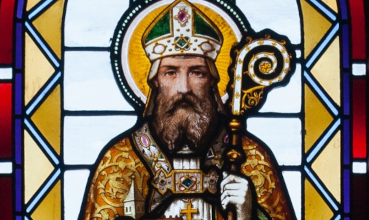
Lorcán Ua Tuathail, also known as Saint Laurence O’Toole, is canonised by Pope Honorius III on December 11, 1225. It will be 750 years before another Irish person is canonised.

O’Toole is born in Castledermot in what is now County Kildare in 1128. His father is Maurice O’Toole, King of Hy Murray. It is common practice in the day for princes of one clan to be given as hostages to another clan, as a guarantee of peace. When he is ten years old O’Toole is given as hostage to Diarmaid Mac Murchada, King of Leinster, who treats him very badly. He is sent in chains to a remote place, where he gets very little to eat and does not have enough clothes to keep him warm in the winter. For two years, even though he is a king’s son, he learns what it is like to be poor and to be oppressed.

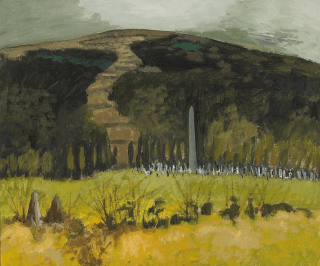
After two years, it is agreed that O’Toole is to be released. He is sent to a monastery at Glendalough, and the monks make him welcome. It is agreed that his father is to come and collect him there. But he soon comes to love Glendalough and likes joining the monks in prayer. After his two years as a hostage, he realises that wealth and power are not important. He feels very close to God in Glendalough. He asks his father’s permission to stay there and become a monk, to which his father agrees. At the age of only 26 years old, he is elected Abbot of Glendalough. As the leader of the community, he encourages the monks in their learning. There is always a welcome in the monastery for the poor. When there is a famine in the area, he sells some of the treasures of Glendalough to provide food for those who are hungry.

In 1162 O’Toole becomes the first Irish-born Archbishop of Dublin, then a city ruled by Danes and Norwegians. In those days, many of the people of Dublin do not take their Christian religion very seriously. He encourages them to become real Christians. He brings monks to Dublin from France, and they live at Christ Church Cathedral. They help many people to come back to Mass and the Sacraments. O’Toole himself never forgets his own days of poverty. He continues to care for the poor, especially homeless children. He makes room for them in his own house, and they share the food at his table.

The Normans land in Ireland in 1169. The following year they besiege Dublin under their leader, Richard de Clare, 2nd Earl of Pembroke, also known by the nickname of “Strongbow.” O’Toole meets Strongbow to arrange peace but the Normans attack while the talks are going on. They seize the city and begin killing the citizens and looting their houses. O’Toole saves the lives of many people.

As Archbishop of Dublin, O’Toole participates in the Third Council of the Lateran in Rome in 1179, with some of the other Irish bishops. Pope Alexander III knows that Ireland has been going through a bad time. He knows that many people, including priests, are no longer taking their religion seriously. He entrusts to O’Toole the task of reforming the Church in Ireland.

A new dispute breaks out between Henry II of England and the Irish Kings. In the spring of 1180, O’Toole leaves Ireland to see if he can help settle the dispute. King Henry II does not have much time for bishops. He has already arranged to have the Archbishop of Canterbury, Thomas Becket, murdered. He does not welcome O’Toole. He sees a chance to get rid of O’Toole as Archbishop of Dublin and does not let him return to Ireland. Henry has control of Normandy as well as England. O’Toole follows him there. As long as there is a chance of peace, he would not give up trying.

In 1180, O’Toole becomes seriously ill. The monks at Eu in Normandy look after him in their monastery but on November 14, 1180, at the age of 52, he dies. His tomb is in the crypt under the Collegial Church at Eu. Many people still go there to pray.

Laurence O’Toole is canonized by Pope Honorius III on December 11, 1225.

(From “St. Laurence O’Toole: a spiritual leader for difficult times,” CatholicIreland.net, November 30, 1999)


Leave a comment

Birth of Thomas Russell, Founding Member of the Society of United Irishmen

Thomas Paliser Russell, founding member and leading organiser of the Society of United Irishmen, is born in Dromahane, County Cork, on November 21, 1767.

Born into an Anglican family with a military tradition. Russell is intended for an ecclesiastical career in the Church of Ireland, but in 1783 sails with his brother’s regiment to India and fights at the battle of Cannanore. He is, however, disgusted by what he regards as “the unjust and rapacious conduct pursued by the authorities in the case of two native women,” and returns disaffected to Ireland in 1786. After briefly studying for the church ministry, he spends the next four years as a half-pay officer in Dublin pursuing studies of science, philosophy and politics.

In 1790, Russell meets Theobald Wolfe Tone in the visitors’ gallery of the Irish House of Commons and a lifelong friendship begins. At the end of the year, he is commissioned to Belfast as an ensign in the 64th infantry regiment of foot. Being convivial, good looking, charismatic and charming, he fits quickly into Belfast society. He is deeply religious and holds strong millennialist beliefs. On the other hand, he is also of a restless nature, drinks heavily, and is highly promiscuous.

Russell becomes a founder member of the first Society of United Irishmen in Belfast in 1791, writes for the Northern Star, and acts as secretary for the Dublin United Irishmen. He is the most socially radical of all United Irish leaders, an outspoken opponent of slavery and industrial exploitation.

Russell posts bail for a friend in order to secure his release from a debtor’s prison. When the friend defaults, Russell has to sell his ensigncy in July 1791. After several months, and to avoid further debt, he accepts the offer of Thomas Knox, 1st Viscount Northland, the father of an old army friend, to become seneschal (a kind of stipendiary magistrate) to the Northlands’ manor court at Dungannon. However, he resigns within a year, apparently disgusted by the sectarian animosities there. His financial situation worsens until he becomes librarian at the Belfast Society for Promoting Knowledge (the later Linen Hall Library) in 1794.

Russell is arrested on September 16, 1796, is charged with treason, and detained without trial in Newgate Prison, Dublin, until March 1799. He is then sent to Fort George in the north of Scotland. The longest serving United Irish prisoner, he is released in June 1802 on condition of exile to Hamburg. However, he soon makes his way to Paris where he meets Robert Emmet who, with William Putnam McCabe are advancing the plans for insurrection pending the French renewal of the war against England. Having little confidence in the French, however, he returns to Ireland in March 1803 to organise the North in conjunction with the veteran of the Battle of Antrim, James Hope. However, he meets with little success as much of the North is subdued following the suppression of the Irish Rebellion of 1798.

In 1803 Russell joins a general insurrection that is to take place throughout Ireland with blows being struck simultaneously at Dublin, Belfast, and Downpatrick. Unknown to him, Robert Emmet is unable to secure help and promised firearms. In Dublin after a brief street battle on the evening of July 23, 1803, Emmett calls off the rising.

Russell manages to hide for a number of weeks in Dublin but is caught in the authorities’ dragnet on September 9. He is sent under heavy escort to Downpatrick Gaol. There, convicted of high treason, he is hung and beheaded on October 12, 1803. His remains are buried in the graveyard of the parish church, Down Cathedral, in a grave paid for by his friend Mary Ann McCracken.


Leave a comment

Birth of Seamus O’Donovan, IRA Volunteer & Nazi Collaborator

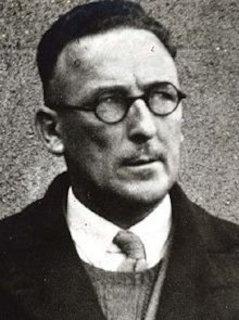
James O’Donovan, a leading volunteer in the Irish Republican Army (IRA) and Nazi collaborator also known as Séamus or Jim O’Donovan, is born on November 3, 1896, in County Roscommon. He is best known for his contacts with the Abwehr military intelligence of Nazi Germany.

O’Donovan is an explosives expert and reputedly invents the “Irish War Flour” (named after the flour sacks in which it was smuggled into Dublin aboard ships) and “Irish Cheddar” devices. He subsequently becomes IRA Director of Chemicals in 1921. During the Irish War of Independence, he is imprisoned in Mountjoy Prison and Kilmainham Gaol and later interned in Newbridge, County Kildare.

In addition to fighting in the Irish War of Independence, O’Donovan fights on the Anti-Treaty side during the Irish Civil War. In 1930 he becomes manager at Electricity Supply Board (ESB) headquarters in Dublin.

In August 1938, at the request of IRA Chief of Staff Seán Russell, O’Donovan writes the S-Plan, a bombing campaign targeting the United Kingdom. In his unpublished memoirs he writes that he “conducted the entire training of cadre units, was responsible for all but locally derived intelligence, carried out small pieces of research and, in general, controlled the whole explosives and munitions end” of S-Plan. During this time, he and Russell are the only GHQ members of the old IRA still in the organisation.

As “Agent V-Held”, O’Donovan visits Germany three times in 1939 on behalf of the IRA. On February 28 he negotiates an arms and radio equipment delivery at the Abwehrstelle in Hamburg. On April 26 he concludes a new arms deal with the Abwehrstelle and establishes, with the help of a Breton, a secret courier connection to Ireland via France. On August 23, he receives the last instructions for the event of war.

On February 9, 1940, Abwehr II agent Ernst Weber-Drohl lands at Killala Bay, County Sligo aboard U-37. He is equipped with an ‘Ufa’ transmitter, cash, and instructions for O’Donovan, who by this time is the chief IRA contact for Abwehr I/II. The transmitter is lost upon landing, but when Weber-Drohl reaches O’Donovan at Shankill, Killiney, County Dublin, he is able to deliver new transmission codes, $14,450 in cash, and a message from “Pfalzgraf Section” asking that the IRA concentrate its S-Plan attacks on military rather than civilian targets.

O’Donovan becomes increasingly enamoured of Nazi ideology during this time, and visits Germany three times. In 1942 he writes an article arguing that Ireland’s future lay in an alliance with a victorious Germany and attacks Britain and the United States for being “centres of Freemasonry, international financial control and Jewry.” Even long after the pact with the Germans falls apart, he continues to express his sympathy for the Nazi regime. His son, Gerard O’Donovan, recalls that every Saturday night a visitor would come to the family home and send messages to Germany.

In 1940, O’Donovan is involved in setting up Córas na Poblachta, a minor Irish republican political party which proves unsuccessful.

O’Donovan dies in Dublin on June 4, 1979.


3 Comments

Birth of Charles Edward Jennings, Soldier & Revolutionary

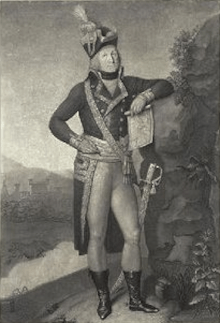
General Charles Edward Saul Jennings, Irish soldier and revolutionary who serves France in the eighteenth century and is sometimes romanticised as Brave Kilmaine, is born on October 19, 1751, in Sauls Court, Dublin.

Jennings is the second son of Theobald Jennings, a physician of Polaniran (Ironpool), Tuam, County Galway, and Eleonore Saul, daughter of Laurence Saul, a wealthy Dublin distiller. Educated privately in Dublin, he leaves Ireland in 1769, settling in Tonnay-Charente in the south of France, where his father had set up practice. His father had, several years previously, assumed the fictitious title of ‘baron of Kilmaine’ in the hope of improving his position in French society, and he subsequently assumes the same title.

In 1774 Jennings joins the Royal Dragoons as a trooper, transferring in 1778 into the Légion de Lauzun, a corps made up mostly of foreign volunteers. After the campaign in Senegal (1778–79) he returns to France and is commissioned as a sous-lieutenant. He then campaigns with Gilbert du Motier, Marquis de Lafayette, during the American Revolutionary War and teaches cavalry tactics at Metz on his return. Promoted to captain in 1788, at the outbreak of the French Revolution, he is stationed at Verdun and, despite a short period in prison, continues to serve with his regiment. In 1791, when several of the regiment’s officers flee from France, he remains and is one of the first officers to swear allegiance to the national assembly.

Promoted to Chef d’escadron in April 1792, Jennings serves under Charles François Dumouriez during the invasion of the Netherlands, distinguishing himself at the Battle of Valmy and the Battle of Jemappes, where he reinforces the French centre at a critical point, ensuring victory. A series of rapid promotions follow. He is made a colonel in January 1793, a general of brigade in March 1794, and a general of division in May1794.

After a series of reverses in the summer of 1793, in which the French lose the fortress-towns of Condé and Valenciennes, the committee of public safety appoints Jennings to command the Armée du Nord on May 15, 1793, with the rank of full general. In August, in order to preserve his force in the face of overwhelming opposition, he retreats from a position 120 miles north of Paris known as ‘Caesar’s camp.’ Although the allied army swings away to invest Dunkirk, he is arrested and imprisoned for endangering the city, and remains in prison until after the fall of Robespierre in July 1794. Within a few days, due to the turbulent political situation, he is rearrested and not released until December 1794. In May 1795 he cooperates with Napoléon Bonaparte in suppressing the Jacobin uprising in Faubourg Saint-Antoine in Paris and, having reestablished his credentials, commands the cavalry during the invasion of Italy (1796). Bonaparte regards him highly, and he distinguishes himself at the Battle of Lodi on May 10, 1796, seizing the city of Milan five days later. He defeats a large Austrian force in the Battle of Borghetto before investing and taking the fortress-town of Mantua in February 1797.

When peace terms are agreed with Austria, Jennings returns to France, taking command of the centre column of the Armée d’Angleterre, which had been raised to invade Britain and Ireland. However, his deteriorating health makes some observers question his suitability for such an appointment. An associate of Thomas Paine and James Napper Tandy, and a friend of Wolfe Tone, he is forced to watch the gradual reduction of his army as Napoleon diverts troops for his campaign in Egypt. Tone is at first suspicious of him, given that many Irish-born French officers had deserted the revolutionary cause but comes to admire him.

After the defeat of Admiral Bombard’s expedition to Ireland and Tone’s arrest on November 3, 1798, Jennings requests that the French government should take a senior British prisoner as hostage and subject him to the same treatment as Tone. After Tone’s death he assists Matilda Tone and her children. In early 1799 he is appointed military governor of Switzerland but is forced to resign due to his failing health.

In a fragile condition Jennings leaves Switzerland and returns to Passy in Paris, where his domestic griefs and chagrins add to the poignancy of his bodily sufferings, for his constitution is now completely broken up. He dies of dysentery on December 11, 1799, at the age of 48. He is buried with full military honours.

Jennings is historically honored at the Arc de Triomphe in Paris, where his name can be seen on the inside triumphal arch, on the Northern pillar, Column 05. Underneath the Arc is the Tomb of the Unknown Soldier (World War I). There is a personal portrait of Jennings in the ‘Hotel de Ville’ (City Hall) at Tonnay-Charente, where his father Dr. Theobald Jennings practiced as a physician.

A monument was erected in Jennings’s memory in Tonnay-Charente in the 19th century. Rue du Général Kilmaine, a street in Tonnay-Charente, is named in his honour in the 19th century.


Leave a comment

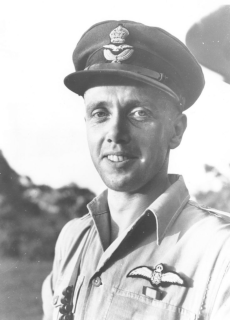
Death of David Lord, RAF Officer & Victoria Cross Recipient

David Samuel Anthony Lord, VC, DFC, recipient of the Victoria Cross, the highest award for gallantry in the face of the enemy that can be awarded to British and Commonwealth forces, is killed at Arnhem, Netherlands, on September 19, 1944, during World War II. A transport pilot in the Royal Air Force, he receives the award posthumously for his actions during the Battle of Arnhem while flying resupply missions in support of British paratroopers.

Lord is born on October 18, 1913, in Cork, County Cork, one of three sons of Samuel (a warrant officer in the Royal Welsh Fusiliers) and Mary Lord (née Miller). One of his brothers dies in infancy.

After World War I the family is posted to British India and Lord attends Lucknow Convent School. On his father’s retirement from the Army the family moves to Wrexham and then he is a pupil at St. Mary’s College, Aberystwyth, and then the University of Wales. Later, he attends the English College, Valladolid, Spain, to study for the priesthood. Deciding that it was not the career for him, he returns to Wrexham, before moving to London in the mid-1930s to work as a freelance writer.

Lord enlists in the Royal Air Force on August 6, 1936. After reaching the rank of corporal in August 1938, he applies to undertake pilot training, which he begins in October 1938. Successfully gaining his pilot’s wings, he becomes a sergeant pilot in April 1939, and is posted to No. 31 Squadron RAF, based in Lahore, India. He later flies the Vickers Type 264 Valentia biplane transport. In 1941, No. 31 Squadron is the first unit to receive the Douglas DC-2 which is followed by both the Douglas DC-3 and Dakota C-47 Skytrain transports. That year he is promoted to flight sergeant and then warrant officer. He flies in North Africa, supporting troops in Libya and Egypt for four months, before being posted back to India. Commissioned as a pilot officer in May 1942, he flies supply missions over Burma, for which he is mentioned in despatches.

Lord is awarded the Distinguished Flying Cross in July 1943, receiving the award at Buckingham Palace, and is promoted to flight lieutenant shortly afterwards. By January 1944, he has joined No. 271 Squadron RAF, based at RAF Down Ampney, Gloucestershire, and begins training as part of preparations for the invasion of Europe. On D-Day, he carries paratroopers into France and his aircraft was hit by flak, returning to base without flaps.

The Battle of Arnhem is part of Operation Market Garden, an attempt to secure a string of bridges through the Netherlands. At Arnhem, the British 1st Airborne Division and Polish 1st Independent Parachute Brigade are tasked with securing bridges across the Lower Rhine, the final objectives of the operation. However, the airborne forces that drop on September 17 are not aware that the 9th SS and 10th SS Panzer divisions are also near Arnhem for rest and refit. Their presence adds a substantial number of Panzergrenadiers, tanks and self-propelled guns to the German defences and the Allies suffer heavily in the ensuing battle. Only a small force manages to hold one end of the Arnhem road bridge before being overrun on September 21. The rest of the division becomes trapped in a small pocket west of the bridge and has to be evacuated on September 25. The Allies fail to cross the Rhine, which remains under German control until Allied offensives in March 1945.

Lord is 30 years old, and a flight lieutenant serving with No. 271 Squadron, Royal Air Force during World War II when he is awarded the Victoria Cross. On September 19, 1944, during the Battle of Arnhem in the Netherlands, the British 1st Airborne Division is in desperate need of supplies. His Dakota III “KG374” encounters intense enemy anti-aircraft fire and is hit twice, with one engine burning. He manages to drop his supplies, but at the end of the run finds that there are two containers remaining. Although he knows that one of his wings might collapse at any moment, he nevertheless makes a second run to drop the last supplies, then orders his crew to bail out. A few seconds later, the Dakota crashes in flames with its pilot and six crew members.

Only the navigator, Flying Officer Harold King, survives, becoming a prisoner of war. It is only on his release in mid-1945, as well as the release of several paratroops from the 10th Parachute Battalion, that the story of Lord’s action becomes known. He is awarded a posthumous Victoria Cross.

After Arnhem is liberated in April 1945, Grave Registration Units of the British 2nd Army move into the area and began to locate the Allied dead. Lord is buried alongside his crew in the Arnhem Oosterbeek War Cemetery. There are many plaques in memory of him, including one at Wrexham Cathedral in Wales.

Several aircraft have carried tributes to Lord. Between 1993 and 1998, the RAF Battle of Britain Memorial Flight‘s Dakota, serial “ZA947”, is painted in the colours of Lord’s aircraft during the Arnhem battle and bears the same code letters: YS-DM. Between 1973 and 2005, the Dakota displayed at RAF Museum Cosford is similarly painted and coded to represent Lord’s aircraft. From 1966 until its disbandment in 2005, No. 10 Squadron RAF is equipped with Vickers VC-10s, each of which is named after a Royal Air Force or Royal Flying Corps VC recipient. Aircraft serial number ‘XR810’ is named David Lord VC.

Lord’s Victoria Cross is presented to his parents at Buckingham Palace in December 1945. In 1997, his Victoria Cross, along with his other decorations and medals, are sold at auction by Spinks to Lord Ashcroft. As of 2014, the medal group is on display at the Imperial War Museum.


Leave a comment

Death of John Blake Dillon, Founding Member of Young Ireland

John Blake Dillon, Irish writer and politician who is one of the founding members of the Young Ireland movement, dies in Killiney, County Dublin on September 15, 1866.

Dillon is born on May 5, 1814, in the town of Ballaghaderreen, on the border of counties Mayo and Roscommon. He is a son of Anne Blake and her husband Luke Dillon (d. 1826), who had been a land agent for his cousin Patrick Dillon, 11th Earl of Roscommon. His niece is Anne Deane, who helps to raise his family after his death.

Dillon is educated at St. Patrick’s College, Maynooth, leaving after only two years there, having decided that he is not meant for the priesthood. He later studies law at Trinity College, Dublin, and in London, before being called to the Irish Bar. It is during his time at Trinity College that he first meets and befriends Thomas Davis.

While working for The Morning Register newspaper Dillon meets Charles Gavan Duffy, with whom he and Davis found The Nation in 1842, which is dedicated to promoting Irish nationalism and all three men become important members of Daniel O’Connell‘s Repeal Association, which advocates the repeal of the Act of Union 1800 between Great Britain and Ireland.

The young wing of the party, of which they are key members with William Smith O’Brien and Thomas Francis Meagher, come to be known as Young Ireland and advocate the threat of force to achieve repeal of the Act of Union. This is in contrast to the committed pacifism of O’Connell’s “Old Ireland” wing. This posturing eventually leads to the Young Ireland rebellion of 1848 where a countryside devastated by the Great Famine fails to rise up and support the rebels.

According to fellow Irish nationalist, Justin McCarthy, “…it has been said of him that while he strongly discouraged the idea of armed rebellion and had no faith in the possibility of Ireland’s succeeding by any movement of insurrection, yet when Smith O’Brien risked Ireland’s chances in the open field, he cast his lot with his leader and stood by his side in Tipperary.”

After the failure of Young Ireland’s uprising, Dillon flees Ireland, escaping first to France and, eventually, to the United States, where he serves the New York Bar.

Dillon returns to Ireland on amnesty in 1855 and in 1865 is elected as a Member of Parliament for Tipperary. By now he advocates a Federal union of Britain and Ireland and denounces the violent methods advocated by the Irish Republican Brotherhood or Fenian movement.

Dillon dies of cholera on September 15, 1866, in Killiney, County Dublin, at the age of 52, and is buried in Glasnevin Cemetery in Dublin.

Dillon is the father of John Dillon and grandfather of James Dillon.


Leave a comment

Death of Short Story Writer Michael Banim

Michael Banim, Irish short story writer and brother of John Banim, dies in Booterstown, a coastal suburb of Dublin, on August 30, 1874.

Banim is born in Kilkenny, County Kilkenny on August 5, 1796. He is educated at Dr. Magrath’s Catholic school. He goes on to study for the bar, but a decline in his father’s business causes him to retire from his studies. He returns home to take over the family business, which he returns to prosperity, restoring his parents to comfort, both material and mental. In 1826 he visits John in London, making the acquaintance of many distinguished men of letters. When the struggle for Catholic emancipation is at its height, he works energetically for the cause.

Around 1822, Banim’s brother John broaches his idea for a series of national tales. He assists John in the O’Hara Tales, where he uses the name “Abel O’Hara,” and there is difficulty in allocating their respective contributions. While John is the more experienced writer, Michael provides material based on his social observations. They revise each other’s work. He writes in such hours as he can snatch from business and is the principal author of about thirteen out of the twenty-four works attributed to the brothers, including Crohoore of the Bill-Hook, The Croppy, and Father Connell. He is amiable, unambitious, modest, and generous to a degree. He keeps himself in the background, letting his younger brother have all the honor of their joint production. In 1828 he has the honor of a visit from the Comte de Montalembert, who has read the O’Hara Tales and is then on a tour through Ireland.

When his brother John is struck down by illness, Banim writes and earnestly invites him to return to Kilkenny and share his home. “You speak a great deal too much,” he observes in one letter, “about what you think you owe me. As you are my brother, never allude to it again. My creed on this subject is, that one brother should not want while the other can supply him.” However, John remains in France, seeking medical care in Paris.

Following his brother’s death in 1842, Banim writes Clough Fionn (1852), and The Town of the Cascades (1864). In 1861 he writes prefaces and notes for a reprint of the “O’Hara” novels by the publishing firm William H. Sadlier, Inc. of New York City. Besides their desire to give a true picture of their country, still crippled and prostrate from the effects of the Penal Laws, the Banims are undoubtedly influenced by the Romantic movement, then at its height.

In 1840, Banim marries Catherine O’Dwyer with whom he has two daughters, Mathilde and Mary. Although a man of means, in less than a year he loses almost the whole of his fortune through the failure of a merchant. Poor health follows. He is appointed postmaster of Kilkenny in 1852, a position he holds until illness forces him to retire in 1873. He also serves a term as mayor. His health failing, he goes with his family to reside at Booterstown, near Dublin, where he dies on August 30, 1874. His widow is granted a civil list pension.


Leave a comment

Birth of Richard Lalor Shiel, Politician, Writer & Orator

Richard Lalor Sheil, Irish politician, writer and orator, is born at Drumdowney, Slieverue, County Kilkenny on August 17, 1791. The family is temporarily domiciled at Drumdowney while their new mansion at Bellevue, near Waterford, is under construction.

Shiel’s father is Edward Sheil, who acquires considerable wealth in Cadiz in southern Spain and owns an estate in County Tipperary. His mother is Catherine McCarthy of Springhouse, near Bansha, County Tipperary, a member of the old aristocratic family of Mac Cárthaigh Riabhach of Springhouse, who in their time were Princes of Carbery and Counts of Toulouse in France. He is taught French and Latin by the Abbé de Grimeau, a French refugee. He is then sent to a Catholic school in Kensington, London, presided over by a French nobleman, M. de Broglie. For a time, he attends the lay college in St. Patrick’s College, Maynooth. In October 1804, he is removed to Stonyhurst College, Lancashire, and in November 1807 enters Trinity College, Dublin, where he specially distinguishes himself in the debates of the Historical Society.

After taking his degree in 1811 Sheil is admitted a student of Lincoln’s Inn and is called to the Irish bar in 1814. He is one of the founders of the Catholic Association in 1823 and draws up the petition for inquiry into the mode of administering the laws in Ireland, which is presented in that year to both Houses of Parliament.

In 1825, Sheil accompanies Daniel O’Connell to London to protest against the suppression of the Catholic Association. The protest is unsuccessful, but, although nominally dissolved, the association continues its propaganda after the defeat of the Catholic Relief Bill in 1825. He is one of O’Connell’s leading supporters in the agitation persistently carried on until Catholic emancipation was granted in 1829.

In the same year Shiel is returned to Parliament for Milborne Port, and in 1831 for County Louth, holding that seat until 1832. He takes a prominent part in all the debates relating to Ireland, and although he is greater as a platform orator than as a debater, he gradually wins the somewhat reluctant admiration of the House. In August 1839, he becomes Vice-President of the Board of Trade in Lord Melbourne‘s ministry.

After the accession of Lord John Russell to power in 1846, Shiel is appointed Master of the Mint, and in 1850 he is appointed minister at the court of Tuscany. He dies in Florence on May 23, 1851. His remains are conveyed back to Ireland by a British ship-of-war, and interred at Long Orchard, near Templetuohy, County Tipperary.

George W. E. Russell says of Shiel, “Sheil was very small, and of mean presence, with a singularly fidgety manner, a shrill voice, and a delivery unintelligibly rapid. But in sheer beauty of elaborated diction not O’Connell nor anyone else could surpass him.”

Shiel’s play, Adelaide, or the Emigrants, is performed at the Crow Street Theatre in Dublin, on February 19, 1814, with success, and, on May 23, 1816, it is performed at Covent Garden in London. The Apostate, produced at the latter theatre on May 3, 1817, establishes his reputation as a dramatist. His other principal plays are Bellamira (written in 1818), Evadne (1819), Huguenot (produced in 1822) and Montini (1820).

In 1822, Sheil begins, with William Henry Curran, to contribute to The New Monthly Magazine a series of papers entitled “Sketches of the Irish Bar.” Curran, in fact, does most of the writing. These pieces are edited by Marmion Wilme Savage in 1855 in two volumes, under the title of Sketches Legal and Political. Sheil’s Speeches are edited in 1845 by Thomas MacNevin.

In 1816, Shiel marries a Miss O’Halloran, niece of Sir William MacMahon, Master of the Rolls in Ireland. They have one son, who predeceases Sheil. His wife dies in January 1822. In July 1830, he marries Anastasia Lalor Power, a widow. He then adds the middle name Lalor.