The first officers include members of the Society of United Irishmen who had fled to France in 1797. It also includes Irishmen who had been taken during the Irish Rebellion of 1798 who were freed during the short peace effected by the Treaty of Amiens on condition of exile, and who had sailed for France in June 1802. The treaty breaks down in May 1803 with the start of the War of the Third Coalition. As a part of Napoleon’s planned invasion of the United Kingdom in 1803–05, the Irish Legion is to provide the indigenous core for a much larger invasion force of 20,000 earmarked to take Ireland, known as the Corps d’Irlande.
The purpose of the Legion is to align the Irish hearts to the French cause in the imminent invasion of Ireland. General Charles-Pierre Augereau is ordained to lead the invasion and wants Irishmen to serve in his army. However, the Battle of Cape Finisterre and the Battle of Trafalgar in 1805 make a safe sea crossing uncertain at best, and Napoleon is forced to abandon his plans for Ireland. He shifts his focus towards Austria and Eastern Europe and launches the Austerlitz campaign in late 1805. The legion remains on the French coast on garrison duty and coastal defence.
The Legion is eventually expanded from a battalion to a regiment and there is greater demand for more soldiers. These make a varied group; some are former United Irishmen who were taken prisoner in 1798-99 and then freed during the peace that followed the Treaty of Amiens (1802–03), some had been impressed into the Royal Navy and deserted, and some were German or Polish. While the Legion is stationed at the Fortress of Mainz in 1806, they are joined by 1,500 Poles and many Irishmen who were sent in 1799 to serve the King of Prussia. Its headquarters is at ‘s-Hertogenbosch, known to the French as Bois-le-Duc, in what is then the Kingdom of Holland.
The Irish Legion has its own flag, and in December 1805 receives an eagle. The Legion is the only group of foreign soldiers in the French military to whom Napoleon ever gives an eagle. Wearing a green uniform, its maximum size is about 2,000 men.
The regiment is greatly assisted from 1807 by Napoleon’s war minister Marshal of FranceHenri Clarke, who was born in France to Irish parents and whose family had close links to the ancien regime Irish brigade that had served the kings of France. He and his father had served in Dillon’s Regiment, and his mother’s father and several uncles served in Clare’s Regiment. In August 1811, the Legion is renamed the 3e Regiment Etranger (Irlandais) (3rd Foreign Regiment (Irish)), but throughout the unit’s history it is always referred to as the Irish Regiment.
The regiment divides in loyalty during the “Hundred Days,” and is officially disbanded by King Louis XVIII on September 28, 1815. Its flags are burned and its eagle, like many, disappears.
(Pictured: Regimental Colours of the Irish Legion (Obverse))
Brooke is born on June 9, 1888, at Colebrooke Park, his family’s neo-Classicalancestral seat on what is then the several-thousand-acre Colebrooke Estate, just outside Brookeborough, a village near Lisnaskea in County Fermanagh. He is the eldest son of Sir Arthur Douglas Brooke, 4th Baronet, whom he succeeds as 5th Baronet when his father dies in 1907. His mother is Gertrude Isabella Batson. He is a nephew of Field MarshalAlan Brooke, 1st Viscount Alanbrooke, Chief of the Imperial General Staff (CIGS) during World War II, who is only five years his senior. His sister Sheelah marries Sir Henry Mulholland, Speaker of the Stormont House of Commons and son of Lord Dunleath. He is educated for five years at St. George’s School in Pau, France, and then at Winchester College (1901–05).
Brooke is a very active Ulster Unionist Party member and ally of Edward Carson. He founds his own paramilitary group, Brooke’s Fermanagh Vigilance, from men returning from the war front in 1918. Although the umbrella Ulster Volunteers had been quiescent during the war, it is not defunct. It re-emerges strongly in 1920, subsuming groups like Brooke’s.
In 1920, having reached the rank of captain, Brooke leaves the British Army to farm the Colebrooke Estate, the family estate in west Ulster, at which point he turns toward a career in politics.
Brooke has a very long political career. When he resigns the Premiership of Northern Ireland in March 1963, he is Northern Ireland’s longest-serving prime minister, having held office for two months short of 20 years. He also establishes a United Kingdom record by holding government office continuously for 33 years.
On May 2, 1943, Brooke succeeds John M. Andrews as Prime Minister of Northern Ireland. In 1952, while Prime Minister, was raised to the peerage as Viscount Brookeborough, the title taken from the village named after the Brookes. Although a peer, he retained his seat in the House of Commons at Stormont and remained Prime Minister for another decade.
As the Northern Ireland economy begins to de-industrialise in the mid-1950s, leading to high unemployment amongst the Protestant working classes, Brooke faces increasing disenchantment amongst UUP backbenchers for what is regarded as his indifferent and ineffectual approach to mounting economic problems. As this disenchantment grows, British civil servants and some members of the UUP combine to exert discreet and ultimately effective pressure on Brooke to resign to make way for Captain Terence O’Neill, who is Minister of Finance.
Brooke is noted for his casual style toward his ministerial duties. Terence O’Neill later writes of him, “he was good company and a good raconteur, and those who met him imagined that he was relaxing away from his desk. However, they did not realise that there was no desk.”
In his retirement Brooke develops commercial interests as chairman of Carreras (Northern Ireland), a director of Devenish Trade, and president of the Northern Ireland Institute of Directors. He is also made an honorary LL.D. of Queen’s University Belfast.
From 1970 to 1973, years in which the Stormont institution comes under its greatest strain and eventually crumbles, Brooke makes only occasional forays into political life. In 1972, he appears next to William Craig MP on the balcony of Parliament Buildings at Stormont, a diminutive figure beside the leader of the Vanguard Unionist Progressive Party (VUPP) who is rallying right-wing Unionists against the Government of Northern Ireland. He opposes the Westminsterwhite paper on the future of Northern Ireland and causes some embarrassment to his son, Captain John Brooke, the UUP Chief Whip and an ally of Brian Faulkner, by speaking against the Faulkner ministry‘s proposals.
Brooke dies at his home, Colebrooke Park, on the Colebrooke Estate, on August 18, 1973. His remains are cremated at Roselawn Cemetery, East Belfast, three days later, and, in accordance with his wishes, his ashes are scattered on the demesne surrounding his beloved Colebrooke Park.
William Corbet, an Anglo-Irish soldier in the service of France, is born in Ballythomas, County Cork, on August 17, 1779. In September 1798, he accompanies James Napper Tandy in an aborted French mission to Ireland in support of the United Irish insurrection. After two years of incarceration, he escapes from Ireland and serves in the campaigns of Napoleon reaching the rank of colonel. In 1831, under the July Monarchy, he is employed in the Morea expedition to Greece. He returns to France in 1837, retiring with the rank of Major-General.
Corbet is born into a branch of the Corbet family, an Anglo-Irish Protestant family. In 1798, as a member of the Society of United Irishmen, he is expelled from Trinity College Dublin with Robert Emmet and others for treasonable activities and goes instead to Paris. In September of the same year, he joins a French military force under James Napper Tandy with the rank of Captain and sails from Dunkirk with arms and ammunition for Ireland. The expedition has to turn back following the defeat of General Jean Joseph Amable Humbert and arriving in Hamburg they are handed over to the British authorities and taken to Ireland, where they are imprisoned in Kilmainham Gaol.
Corbet escapes in 1803 and returns to France. He is appointed professor of English at the military college of Saint-Cyr. Later that year he becomes a captain in the Irish Legion. Following the death of his brother Thomas (who was also in the Legion) in a duel with another officer, he is transferred to the 70th Regiment of the line, where he serves in André Masséna‘s expedition to Portugal, and distinguishes himself in the retreat from Torres Vedras and the Battle of Sabugal. After the Battle of Salamanca, he is appointed chef de bataillon of the 47th regiment and serves until 1813 when he is summoned to Germany to join the staff of MarshalAuguste de Marmont. He serves at the battles of Lützen, Bautzen, Dresden and others and is made a commander of the Legion of Honour. In December 1814, he is naturalised as a French citizen. In 1815, after the abdication of Napoleon, he is promoted to colonel and chief of staff to General Louis-Marie-Celeste d’Aumont at Caen.
In 1837, Corbet returns to France where, with the rank of Major-General, he is commander in the region of Calvados. He dies at Saint-Denis on August 12, 1842.
The Irish novelist Maria Edgeworth bases the main theme of her novel Ormond on Corbet’s 1803 escape from Kilmainham Gaol.
Talbot is born likely in 1630, probably in Dublin. He is one of sixteen children, the youngest of eight sons of William Talbot and his wife Alison Netterville. His father is a lawyer and the 1st Baronet Talbot of Carton, County Kildare. His mother is a daughter of John Netterville of Castletown, Kildare. The Talbots are descended from a Norman family that had settled in Leinster in the 12th century. They adhere to the Catholic faith, despite the founding of the Reformed Church of Ireland under Henry VIII. Little is recorded of Talbot’s upbringing. As an adult he grows to be unusually tall and strong by standards of the time.
Talbot marries Katherine Baynton in 1669, and they have two daughters, Katherine and Charlotte. Katherine dies in 1679. In 1681, he marries Frances Jennings, sister of Sarah Jennings, the future Sarah Churchill, Duchess of Marlborough.
Talbot’s early career is spent as a cavalryman in the Irish Confederate Wars. Following a period on the European continent, he joins the court of James, Duke of York, then in exile following the English Civil War, becoming a close and trusted associate. After the 1660 restoration of James’s older brother, Charles, to the thrones of England, Ireland and Scotland, he begins acting as agent or representative for Irish Catholics attempting to recover estates confiscated after the Cromwellian conquest, a role that defines the remainder of his career. James converts to Catholicism in the late 1660s, strengthening his association with Talbot.
When James takes the throne in 1685, Talbot’s influence increases. He oversees a major purge of Protestants from the Irish Army, which had previously barred most Catholics. James creates him Earl of Tyrconnell and later makes him Viceroy, or Lord Deputy of Ireland. He immediately begins building a Catholic establishment by admitting Catholics to many administrative, political and judicial posts.
Talbot’s efforts are interrupted by James’s 1688 deposition by his Protestant son-in-law William of Orange. He continues as a Jacobite supporter of James during the subsequent Williamite War in Ireland, but also considers a peace settlement with William that would preserve Catholic rights. Increasingly incapacitated by illness, he dies of a stroke on August 14, 1691, shortly before the Jacobite defeat. He is thought to have been buried in St. Mary’s Cathedral, Limerick. By depriving the Jacobites of their most experienced negotiator, his death possibly has a substantial impact on the terms of the Treaty of Limerick that ends the war.
Talbot’s widow, Frances, and his daughter, Charlotte, remain in France, where Charlotte marries her kinsman, Richard Talbot, son of William Talbot of Haggardstown. Their son is Richard Francis Talbot. Talbot’s other daughter, Katherine, becomes a nun. An illegitimate son, Mark Talbot, serves as an officer in France before his death in the Battle of Luzzara in 1702. Talbot’s estate in nearby Carton, renamed Talbotstown, is uncompleted at the time of his death. Tyrconnell Tower on the site is originally intended by him as a family mausoleum to replace the existing vault at Old Carton graveyard but is also left unfinished.
Talbot is controversial in his own lifetime. His own Chief Secretary, Thomas Sheridan, later describes him as a “cunning dissembling courtier […] turning with every wind to bring about his ambitious ends and purposes.” Many 19th and early 20th century historians repeat this view. Recent assessments have suggested a more complex individual whose career was defined by personal loyalty to his patron James and above all by an effort to improve the status of the Irish Catholic gentry, particularly the “Old English” community to which he belonged.
(Pictured: Watercolour portrait of Richard Talbot by John Bulfinch (d.1728) after painting by Sir Godfrey Kneller)
Henry is born Emily Grace Mitchell at Kirktown St. Fergus, near Peterhead, Aberdeenshire, Scotland, on February 10, 1868. She is the ninth of ten children of the Rev. John Mitchell and Jane Mitchell (née Gardner). Lord Byron is a cousin of her maternal grandmother. She is educated at home, spending time at the family’s home in Piccadilly, where she experiences London society. After the death of her father, and the reduced circumstances she finds herself in, she leaves home in 1895 to pursue a career as an artist. The first record of her work being exhibited is with the Aberdeen Artists Society in 1896 and 1898. These paintings have not been traced since. In 1899, she leaves Scotland for the continent, visiting Holland and Belgium, studying at the Blanc‐Guerrins Academy in Brussels. She goes on to attend the Delacluze Academy in Paris. While in Paris, she meets Paul Henry, an Irish artist. The couple marries in September 1903 in London.
The Henrys live at a few different residences outside London until 1910. A small number of her works are known from this time, such as The Girl in White, which is in the collections of the Hugh Lane Gallery. This piece shows the influence of fellow artist James Abbott McNeill Whistler, whom she meets in Paris through her husband. The couple travels to Achill Island for the first time in 1910, intending to stay two-weeks, but going on to live there until 1919. During this time, she paints numerous night scenes, including Achill Cottages (Hugh Lane Gallery). One of her well-known works is Top of the Hill, on display in the Limerick City Gallery of Art, which shows a group of island women. The period spent on the island places a strain on the Henrys marriage, as she is not as happy living there.
The couple returns to Dublin in 1919 and are founding members of the Society of Dublin Painters in 1920 alongside Letitia Marion Hamilton, Mary Swanzy, and Jack Butler Yeats. The Society offers an outlet for younger Irish artists to exhibit. Five of Henry’s works are featured at the Irish Exhibition in Paris in 1922, and at a similar exhibition in Brussels in 1930.
Around 1920, Henry has a romantic association with Stephen Gwynn who is an important political, cultural and literary figure from the lost world of late-nineteenth and early-twentieth century Ireland. During this period, she travels with Gwynn in France and Italy and later paints a number of portraits of him. Invariably, during this time, the Henrys’ marriage continues to have problems, with the couple breaking up in 1924. Her affair with Gwynn, who she depicts in two known oil paintings including The Orange Man (Limerick City Gallery of Art) and Portrait of a Man, which depicts a much more distinguished Gwynn in later life, contribute to the breakup. The couple legally separates in 1930.
Henry develops her own style through the 1920s and 1930s, spending time in France and Italy. From 1924 to 1925, she studies with André Lhote, a cubist painter who also works with Mainie Jellett, Evie Hone, and Mary Swanzy. She goes on to display little of his influence in her work. She paints in Venice and in the environs of the Italian lakes, painting with the fauvist style, with free brushwork and vibrant colours. She also experiments with expressionism, which can be seen in Spring in Winter. Upon the outbreak of World War II, she returns to Ireland. She does not have a permanent residence during this period, instead stayed with friends or living in hotels. She also experiences periods of melancholy during these later years, though she continues to exhibit. Her work is regularly displayed at the Royal Hibernian Academy (RHA), and she has solo shows at the Waddington and Dawson galleries. She is made an honorary member of the RHA in 1949.
Henry dies in Dublin on August 11, 1953, and is buried at Mount Jerome Cemetery. During her career, and for a number of years after her death, she is largely overshadowed by her husband, sometimes being referred to as “Mrs. Paul Henry.” She is even omitted from Paul Henry’s two-volume autobiography. Her body of work is re-examined in the 1970s, which leads to wider public recognition and her inclusion in a number of exhibitions such as The Paintings of Paul and Grace Henry at the Hugh Lane Gallery in 1991. She is deemed to be a much bolder painter than her husband, incorporating more elements of the modernist movement, as evident in The Long Grey Road of Disting (1915). Her popularity has been growing since her rediscovery.
(Pictured: “Road to Destiny,” oil on board by Grace Henry)
Dunphy grows up in Drumcondra, Dublin, in what he describes as “a one-room tenement flat [with] no electricity, no hot water.” He attends Saint Patrick’s National School, Drumcondra. In 1958, he gets a one-year government scholarship to Sandymount High School but has to work as a messenger at the tweed clothing shop Kevin and Howlin.
A promising footballer, Dunphy leaves Dublin while still a teenager to join Manchester United as an apprentice. He does not break into the first team at United, and subsequently leaves to play for York City, Millwall, Charlton Athletic, Reading and Shamrock Rovers. It is at Millwall that he makes the most impact. He is considered an intelligent and skillful player in the side’s midfield. He is a member of “The Class of ’71,” the Millwall side that fails by just one point to gain promotion to the Football League First Division.
Dunphy accompanies Johnny Giles back to Ireland to join Shamrock Rovers in 1977. Giles wants to make the club Ireland’s first full-time professional club and hopes to make Rovers into a force in European football by developing talented young players at home who would otherwise go to clubs in England. Dunphy is originally intended to be in charge of youth development. However, despite an FAI Cup winners medal in 1978, his only medal in senior football, and two appearances in the UEFA Cup Winners’ Cup, he becomes disillusioned with the Irish game and drops out of football altogether to concentrate on a career in journalism.
Since the 1980s, Dunphy has written a number of books. His first and most widely praised book is Only a Game? The Diary of a Professional Footballer, which is an autobiographical account of his days playing for Millwall. Written in diary form, it records events from the dressing room of his 1973–74 season, which begins well for him at Millwall but subsequently ends in disillusionment: after being substituted in an October 27, 1973, home loss to eventual league winners Middlesbrough, he does not play another game all season, the club finishing mid-table.
In 1985, rock band U2 and manager Paul McGuinness commission Dunphy to write the story of their origins, formation, early years and the time leading up to their highly successful album The Joshua Tree. His book Unforgettable Fire – Past, Present, and Future – The Definitive Biography of U2 is published in 1988. It receives some favourable reviews, but critics close to the band speak of many inaccuracies. A verbal war erupts in the press during which he calls lead singer Bono a “pompous git.”
Dunphy also writes a biography of long-serving Manchester United manager Matt Busby and in 2002 ghost writes the autobiography of Republic of Ireland and Manchester United player Roy Keane.
Since the mid-1980s, Dunphy has regularly appeared as an analyst during football coverage on Raidió Teilifís Éireann (RTÉ). Since RTÉ acquired the rights to show English football, he has been a regular contributor to Premier Soccer Saturday. He also contributes to analysis of UEFA Champions League games and, in international football, RTÉ’s coverage of FIFA World Cups, UEFA European Football Championships and qualifying matches involving the Republic of Ireland national football team.
In 2001, Dunphy becomes the first male host of the quiz show The Weakest Link, which airs on TV3, for just one series. In 2003, he is hired again by TV3 to host their new Friday night chat show, entitled The Dunphy Show. Pitted head-to-head with RTÉ’s long-running flagship programme, The Late Late Show, Dunphy’s show loses what is a highly publicised “ratings war,” and is cancelled before its original run concludes.
Dunphy is the first presenter of a made-for-mobile television show on the 3 mobile network in Ireland. His rants and “Spoofer of the Week” are watched by thousands of 3 Mobile customers. The shows are awarded “Best Entertainment Show” at Ireland’s Digital Media Awards. He admits he never uses a mobile himself but enjoys filming for a mobile audience from his living room in Ranelagh.
In July 2018, Dunphy announces that he is leaving RTÉ after 40 years with the broadcaster, and that he intends to focus on his podcastThe Stand with Eamon Dunphy.
Dunphy has also has a prominent radio career with several stations, including Today FM, Newstalk and RTÉ Radio 1. He is the original host in 1997 of the popular current affairs show The Last Word on Today FM. In September 2004, he takes over The Breakfast Show slot on the Dublin radio station Newstalk 106 from David McWilliams. The show tries to court controversy and listeners in equal measure. He fails to attract the large listenership predicted, with only a few additional thousand tuning in. He announces in June 2006 his intention to leave Newstalk 106, citing an inability to sustain the demands of an early morning schedule. After his departure from Newstalk 106, he confirms he is suffering from a viral illness from which he later recovers.
In July 2006, RTÉ announces that Dunphy will present a new weekly programme as part of the new RTÉ Radio 1 autumn schedule.
Dunphy rejoins Newstalk but leaves again in 2011 “due to interference from management and a push to put a more positive spin on the news.” On his last show he accuses his boss, Denis O’Brien, of “hating journalism.” He quits after Sam Smyth is sacked from Today FM (also owned by O’Brien) and says management at Newstalk is trying to remove “dissenting voices” like Constantin Gurdgiev from the airwaves.
Dunphy is a daily Mass-goer until he is preparing for marriage to his first wife, Sandra from Salford, when he is 21. He is Catholic and she is Protestant. The priest instructing them for marriage disapproves strongly of the mixed couple, saying that he should not marry her because she is “not a proper person.” Dunphy’s observance is already weakening but he quits his daily Mass-going at this point. He and Sandra have two children, a boy and a girl, and he is now a grandfather. His first marriage ends, and he moves to Castletownshend in County Cork for two years in the early 1990s. He lives with another partner, Inge, before meeting his second wife, RTÉ commissioning editor Jane Gogan, in the Horseshoe Bar in Dublin in 1992. They marry at the Unitarian Church on St. Stephen’s Green on September 24, 2009.
In an interview with An Phoblacht, Dunphy, who had previously written highly critical articles on the Provisional IRA and Sinn Féin, states that he is now a Sinn Féin supporter and declares he had voted for them in the 2011 Irish general election. He describes their representatives as “incredibly hard-working and incredibly intelligent.”
Dunphy publishes his autobiography entitled The Rocky Road in October 2013.
Today, Dunphy generally resides at his home near Ranelagh in Dublin. He also owns a holiday home in Deauville, France.
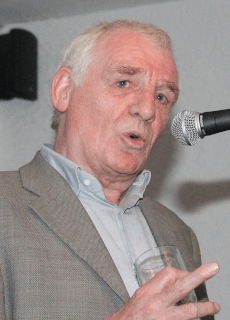
(Pictured: Éamon Dunphy at the Sinn Féin Summer School, 2013)
Hamilton is the daughter of Charles Robert Hamilton and Louisa Caroline Elizabeth Brooke. She attends Alexandra College. She and her sister Eva are great-granddaughters of the artist Marianne-Caroline Hamilton, and cousins of watercolouristRose Maynard Barton. The sisters’ father can only afford one dowry, so the sisters remain unmarried, with their artistic careers helping to support the household. Both she and her sister study at the Dublin Metropolitan School of Art under William Orpen. She studies enameling there also, winning a silver medal in 1912 by both the School and the Board of Education National Commission. Her work shows elements of Art Nouveau, foreshadowing her later modernist leanings. She also studies in Belgium with Frank Brangwyn and the Slade School of Fine Art.
Hamilton first exhibits in 1902 and goes go on to become a prolific painter of the Irish countryside, exhibiting more than 200 paintings at the Royal Hibernian Academy (RHA). Both sisters travel widely in Europe, with Letitia being influenced by modern European artistic trends of the early 20th-century. She is internationally exhibited, Royal Academy of Arts, Burlington Gallery and Kensington Art Gallery in London, in Scotland, and Paris. Her exposure to impressionism comes from studying with Anne St. John Partridge in France. Her style matures in the 1920s. That year, she is one of the founding members of the Society of Dublin Painters, along with Paul Henry, Grace Henry, Mary Swanzy, and Jack Butler Yeats. It is around this time that she changes her signature from MH (May Hamilton) to LMH, reflecting her full name. She works on small oil sketches, which later develop into finished works. Her style is rapid, with loose, fluid brush strokes. In the early 1920s, she travels to Venice, painting on a gondola studio loaned to her by artist and friend Ada Longfield. The works from this trip are considered among her best, with her exploring light effects, pastel shades, and strong outlines. She later employs these elements into her works on Irish landscapes.
Hamilton becomes a member of the Royal Hibernian Academy in 1943. In 1948, she becomes the last person to win a bronze medal at the art competitions at the London Olympic Games. She serves as president of the Society of Dublin Painters in the late 1950s. Despite her failing eyesight later in life, she continues to paint, mounting her final exhibition in 1963, a year before her death at the age of 86 in Dublin on August 11, 1964. She is also a committee member of the Water Colour Society of Ireland.
Mannock was born on May 24, 1887, to an English father, Edward Mannock, and an Irish mother, Julia Sullivan. His father serves in the British Army and in 1893, deeply in debt and exasperated with civilian life, he re-enlists, and the family moves to Meerut, India when he is five years old. In his early years, he is sickly and develops several ailments. Soon after arriving in Asia, he contracts malaria, narrowly avoiding death. Upon his return to England, he becomes a fervent supporter of Irish nationalism and the Irish Home Rule movement but becomes a member of the Independent Labour Party (ILP).
In 1914, Mannock is working as a telephone engineer in Turkey. After the Ottoman Empire‘s entry into the war on the side of the Central Powers he is interned. Poorly fed and cared for, his health rapidly declines in prison. Dysentery racks his intestines, and he is confined to a small cell. Turkish authorities repatriate him to Britain believing him to be unfit for war service. He recovers and joins the Royal Engineers (RE) and then the Royal Army Medical Corps (RAMC). He moves services again and in 1916 joins Royal Flying Corps (RFC). After completing his training, he is assigned to No. 40 Squadron RFC. He goes into combat on the Western Front, participating in three separate combat tours. After a slow start he begins to prove himself as an exceptional pilot, scoring his first victory on May 7, 1917.
By February 1918, Mannock has achieved sixteen victories and is appointed a Flight Commander in No. 74 Squadron. He amasses thirty-six more victories from April 12 — June 17, 1918. After returning from leave he is appointed commanding officer of No. 85 Squadron in July 1918, and scores nine more victories that month.
On July 26, Major Mannock offers to help a new arrival, Lt. Donald C. Inglis from New Zealand, obtain his first victory. After shooting down an enemy LVG two-seater behind the German front-line, Mannock is believed to have dived to the crash site to view the wreckage, seemingly breaking one of the unwritten rules of fellow pilots about the hazards of flying low into ground fire. In consequence, while crossing the trenches the fighters are met with a massive volley of ground fire. The engine of his aircraft is hit and immediately catches fire, and shortly thereafter the plane crashes behind German lines. His body is believed to have been found, though this is unproven, about 250 yards (250m) from the wreck of his plane, perhaps thrown, perhaps jumped. The body shows no gunshot wounds although he had vowed to shoot himself if shot down in flames.
The exact cause of Mannock’s death remains uncertain. A year later, after intensive lobbying by Ira Jones and many of his former comrades, he is awarded the Victoria Cross (VC).
Mannock’s name is listed on the Wellingborough War Memorial with the other fallen men from the town and the local Air Training Corps (ATC) unit bears his name – 378 (Mannock) Squadron. Additionally, Mannock Road, a residential street in Wellingborough, is named after him.
On June 24, 1988, a plaque is unveiled at 183 Mill Road, Wellingborough, by top scoring World War II British fighter pilot Air Vice-MarshalJohnnie Johnson. Mannock had lived at that address prior to the war after being befriended by the Eyles family.
Jack “Legs” Diamond, an Irish Americangangster in Philadelphia and New York City during the Prohibition era also known as John Nolan and Gentleman Jack, is born in Philadelphia on July 10, 1897, to Sara and John Moran, who emigrated from Ireland to Philadelphia in 1891. A bootlegger and close associate of gambler Arnold Rothstein, he survives a number of attempts on his life between 1916 and 1931, causing him to be known as the “clay pigeon of the underworld.” In 1930, his nemesis Dutch Schultz remarks to his own gang, “Ain’t there nobody that can shoot this guy so he don’t bounce back?”
In 1899, Diamond’s younger brother Eddie is born. He and Eddie both struggle through grade school, and their mother suffers from severe arthritis and other health problems. She passes away on December 24, 1913, following complications brought on by a bacterial infection and a high fever. John Moran then moves his family to Brooklyn, New York.
Diamond soon joins a Manhattan street gang called the Hudson Dusters. His first arrest for burglary occurs when he breaks into a jewelry store on February 4, 1914. He serves in the United States Army in World War I but is convicted and jailed for desertion in 1918 or 1919. He serves two years of a three- to five-year sentence at Leavenworth Military Prison. After being released in 1921, he becomes a hired thug and later personal bodyguard for crime boss Arnold Rothstein.
Diamond is known for leading a rather flamboyant lifestyle. He is an energetic individual, his nickname “Legs” derived either from his being a good dancer or from how fast he could escape his enemies. His wife Alice is never supportive of his life of crime but does not do much to dissuade him from it. He is a womanizer, with his best-known mistress being a showgirl and dancer, Marion “Kiki” Roberts.
In the late 1920s, Prohibition is in force, and the sale of beer and other alcoholic beverages is illegal in the United States. Diamond travels to Europe to acquire beer and narcotics but fails. However, he does obtain liquor, which is dumped overboard in partially full barrels that float to Long Island as ships enter New York Harbor. He pays children a nickel for every barrel they bring to his trucks.
Following the death of Jacob “Little Augie” Orgen, Diamond oversees illegal alcohol sales in downtown Manhattan via the Hotsy Totsy Club, an establishment partly owned by Diamond on Broadway. This work brings him into conflict with Dutch Schultz, who wants to move beyond his base in Harlem. He also runs into trouble with other gangs in the city. On July 14, 1929, he and fellow gang member Charles Entratta shoot three drunken brawlers in the Hotsy Totsy Club. Two of the brawlers, William Cassidy and Simon Walker, are killed, while the survivor, Peter Cassidy, is severely wounded. The club’s bartender, three waiters, and the hat check girl vanish, with one of them being found shot dead in New Jersey. He is not charged but is forced to close the club.
In 1930, Diamond and two henchmen kidnap truck driver Grover Parks in Cairo, New York, demanding to know where he had obtained his load of hard cider. When Parks denies carrying anything, Diamond and his men beat and tortured Parks, eventually letting him go. A few months later, he is charged with the kidnapping of James Duncan. He is sent to Catskill, New York, for his first trial, but is acquitted. However, he is convicted in a federal case on related charges and sentenced to four years in jail. He is tried in December 1931 in Troy, New York, also for kidnapping, and is once again acquitted.
On August 23, 1930, Diamond, under the false name John Nolan, boards the ocean liner SS Belgenland, bound for Europe. The New York City Police Department (NYPD) suspect that he might have left the U.S. aboard RMS Olympic or RMS Baltic, but he is not found on either ship when they reach Europe. The NYPD then sends a wireless telegraph message to the crew of SS Belgenland, who reply that a man similar to Diamond’s description is among the passengers. Diamond spends much of the voyage in the ship’s smoking-room playing poker, with one report claiming that he won thousands of dollars in this game. The SS Belgenland‘s officers, however, refute this, saying his winnings were small.
The NYPD telegraphs police in England, France and Belgium with the warning that Diamond is an undesirable character. When SS Belgenland reaches Plymouth on August 31, Scotland Yard officers tell Diamond he will not be allowed to land in England. He tells reporters that he wants to travel to the French spa town of Vichy for “the cure.” He disembarks in Antwerp on September 1, where Belgian police take him to their headquarters. Eventually, he agrees to voluntarily leave Belgium and is put on a train to Germany. When his train reaches Aachen, German police arrest him. On September 6, the German government decides to deport Diamond. He is driven to Hamburg and put on the cargo ship Hannover for passage to Philadelphia.
On September 23, Hannover arrives in Philadelphia, and Diamond is immediately arrested by the Philadelphia police. At a court hearing that day, the judge says he will release him if he leaves Philadelphia within the hour. Diamond agrees.
On October 24, 1924, Diamond is shot and wounded by shotgun pellets, reportedly after trying to hijack liquor trucks belonging to a rival crime syndicate.
On October 16, 1927, Diamond tries to stop the murder of “Little Augie” Orgen. His brother Eddie is Orgen’s bodyguard, but Diamond substitutes for Eddie that day. As Orgen and he are walking down a street on Manhattan’s Lower East Side, three young men approach them and start shooting. Orgen is fatally wounded, and Diamond is shot twice below the heart. He is taken to Bellevue Hospital, where he eventually recovers. Police interview him in the hospital, but he refuses to identify any suspects or help the investigation in any way. Police initially suspect that he is an accomplice and charge him with homicide, but the charge is dropped. The assailants are supposedly hired by Lepke Buchalter and Jacob “Gurrah” Shapiro, who are seeking to encroach on Orgen’s garment-district labor rackets.
On October 12, 1930, Diamond is shot and wounded at the Hotel Monticello on Manhattan’s West Side. Two men force their way into his room and shoot him five times. Still in his pajamas, he staggers into the hallway and collapses. When asked later by the police commissioner how he managed to walk out of the room, he says he drank two shots of whiskey first. He is rushed to the Polyclinic Hospital, where he eventually recovers. He is discharged from Polyclinic on December 30, 1930.
On April 21, 1931, Diamond is arrested in Catskill on assault charges for the Parks beating in 1930. Two days later, he is released from the county jail on $25,000 bond. Five days later, he is again shot and wounded at the Aratoga Inn, a roadhouse near Cairo. After eating in the dining room with three companions, he is shot three times and collapses by the front door. A local resident drives him to a hospital in Albany, where he eventually recovers. On May 1, while he is still in the hospital, the New York State Police seize over $5,000 worth of illegal beer and alcohol from his hiding places in Cairo and at the Aratoga Inn.
In August 1931, Diamond and Paul Quattrocchi go on trial for bootlegging. The same month, he is convicted and sentenced to four years in state prison. In September 1931, he appeals his conviction.
On December 18, 1931, Diamond’s enemies finally catch up with him. He is staying in a rooming house on Dove Street in Albany while on trial for kidnapping in Troy. On the night of his acquittal, December 17, he and his family and friends visit a restaurant in Albany. At 1:00 a.m., he and mistress, Marion “Kiki” Roberts, entertain themselves at the Rain-Bo Room of the Kenmore Hotel on North Pearl Street.
At 4:30 a.m., Diamond drunkenly goes back to the rooming house and passes out on his bed. Two gunmen enter his room about an hour later. One man holds Diamond down and the other shoots him three times in the back of the head.
There is much speculation as to who is responsible for the murder. Likely candidates include Schultz, the Oley Brothers, the Albany Police Department, and relatives of Red Cassidy, another Irish American gangster at the time. According to author William Kennedy in his book O Albany, Dan O’Connell, who runs the local Democraticpolitical machine, orders Diamond’s execution, which is carried out by the Albany police.
Given the power that the O’Connell machine holds in Albany and its determination to prevent organized crime, other than their own, from threatening their monopoly of vice in the city, some accept this account of the story. For those believing this theory, William Fitzpatrick’s promotion to chief of police is said to be a reward for executing Diamond. In 1945, Chief Fitzpatrick is shot and killed in his own office by John McElveney, an Albany police detective. McElveney is sentenced to 20 years to life in prison. He is released in 1957 when his sentence is commuted by GovernorW. Averell Harriman.
On December 23, 1931, Diamond is buried at Mount Olivet Cemetery in Maspeth, Queens. There is no church service or graveside ceremony. Family and spectators numbering 200 attend the interment. No criminal figures are spotted.
On July 1, 1933, Alice Kenny Diamond, Diamond’s 33-year-old widow, is found shot to death in her Brooklyn apartment. It is speculated that she is shot by Diamond’s enemies to keep her quiet.
Barry returns to Bandon in early 1919. He describes in his guerilla days in Ireland a Damascus-like conversion to Irish nationalism on hearing of the Easter Rising while with the Mesopotamian expeditionary force, but he is only accepted into the IRA with considerable caution. Initially tested in intelligence and training work, in mid-1920 he takes charge of the new brigade flying column, which is used both to train officers and to stage offensive actions.
Barry adapts his military experience successfully to the demands of guerrilla warfare, becoming the most famed of column leaders during the Irish War of Independence. In his memoirs, he pours scorn on the obsession of many with military titles and orthodox procedure, complaining of a “paper army.” He stresses the need for spontaneity, initiative, and knowledge of local conditions. “The reality,” he writes, “was a group of fellows, mostly in caps and not-too-expensive clothing, wondering how to tackle their job and where they would sleep that night or get their supper.” (The Reality of the Anglo–Irish War (1974)). He well realises that the war’s character does not permit any close control from the IRA’s GHQ in Dublin, hence increasing the importance of local leaders. His tactics put strong emphasis on speed of movement and on the need to attack the enemy at his weakest point. The column’s ambush successes are small in number but among the best-remembered of the war. He admits, however, that his own and his column’s lack of experience with mines frequently weakened their offensives.
The column’s first successful ambush is at Tooreen on October 22, 1920, followed on November 28 by the dramatic ambushing of a patrol of auxiliaries at Kilmichael while travelling from their Macroom base. A column of thirty-six men, divided into three sections, kill sixteen auxiliaries, with one captured and later shot, suffering two fatalities of their own. Controversy has raged since over whether a false surrender by the British force caused the brutality of some of the deaths. Together with the Bloody Sunday killings of a week earlier in Dublin, Kilmichael has a profound effect on the British military and political establishment, with the declaration in December of martial law for much of Munster and the implementation of wide-ranging internment, together with the authorisation of official reprisals.
After a short period in hospital with a heart condition, in early 1921 Barry leads unsuccessful attacks on Kilbrittain, Innishannon, Drimoleague, and Bandon barracks. The seizure of Burgatia House, outside Rosscarbery, in early February, and the successful resistance made there to British troops, wins much publicity but has little military significance. He is a leading figure in the brutal final stage of the war in the first six months of 1921, which sees widespread shooting of suspected spies and destruction of loyalist property. By March 1921, his flying column, with 104 men, is easily the largest in Ireland, and an explosives expert, Capt. McCarthy, has joined them.
The protracted engagement between Barry’s column and encircling British forces at Crossbarry on March 19, 1921, comes at a time when large-scale sweeps are making life increasingly difficult for the IRA. It consists of a daring and courageous breakout. Crossbarry is the largest action of the war, and Barry is to regard it as even more important than Kilmichael. Soon afterwards, Rosscarbery barracks is successfully attacked by a Barry-led party, representing one of the few successful such initiatives in 1921. Isolated triumphs, however, cannot hide the fact that pressure is increasing on the column, and he becomes increasingly critical of inactive regions. He is later to say that all County Kerry does during the war is to shoot one decent police inspector at Listowel Racecourse and a colleague of his. He is strongly critical also of the lack of assistance from GHQ and of the divisionalisation policy. He visits Dublin in May, travels around with Michael Collins, and is present when two American officers demonstrate the Thompson submachine gun. He is more aware than most of his 1st Southern Division colleagues of the scarcity of arms and ammunition at the war’s end.
During the truce, Barry becomes liaison officer for Munster, riling the British by insisting on his military rank, and criticising the IRA liaison men in Dublin for being overly deferential. He joins the overwhelming majority of the Cork IRA in opposing the Anglo–Irish Treaty but plays a characteristically maverick role throughout the treaty split. His independent attitude is heightened by his dislike of Liam Lynch, the republican IRA’s Chief of Staff, and his continuing respect for Michael Collins. He shows impatience at the long-drawn-out peace initiatives. In March 1922, therefore, he advocates armed confrontation with pro-treaty units over the occupation of barracks in Limerick, and on June 18 he submits a resolution, which only narrowly fails, at the army convention, giving British troops seventy-two hours to leave Dublin.
At the beginning of the Irish Civil War, Barry is arrested entering the Four Courts disguised as a woman. He escapes from an internment camp at Gormanston in early September 1922. For the rest of the war his actions mirror its confused nature. In late October 1922, he leads successful raids on the small towns of Ballineen and Enniskean, and later on Inchigeelagh and Ballyvourney. In December his column takes Carrick-on-Suir, demonstrating the weakness of the Free State army, but his talk of advancing on the Curragh and of large-scale actions does not materialise. There is no evidence that he is acting in accordance with any coordinated plan. By February 1923, he realises that the Republican IRA cause is hopeless and he is involved with Fr. Tom Duggan in efforts to get 1st Southern Division to declare a ceasefire. He journeys to Dublin to put pressure on the intransigent Lynch in this connection, telling Lynch, “I did more fighting in one week than you did in your whole life.”
Barry avoids capture in roundups after the war, remaining on the run until 1924. Unlike many republicans, he does not turn to constitutionalism, remaining strongly militaristic. He is always an unreconstructed republican, though by no means a naive one. In 1924 he becomes attached to Cleeves Milk Co., based in Limerick and Clonmel, and from 1927 to retirement in 1965 is general superintendent with the Cork harbour commissioners. He strongly advocates preserving the independence of the IRA army executive during the republican split of 1925–27. He is instrumental in continuing the drilling of IRA members and is a strong supporter of armed opposition to the Blueshirts.
During the 1930s Barry is arrested at various times for possession of arms and seditious utterances. He promotes an attack against a Freemasons’ meeting in Cork in 1936 and gives the orders for the killing on March 4 of that year of Vice-AdmiralHenry Boyle Somerville. He is opposed to the use by Frank Ryan of IRA volunteers to support the republican cause in the Spanish Civil War and to the proposals of Seán Russell for a bombing campaign in England. To maintain the link with traditional republicanism, he is elected IRA chief of staff in 1937. His plan, however, for the seizure of Armagh city, as part of a direct northern offensive, quickly collapses due to a leak of information, and he soon resigns his position. He forcefully attacks the bombing of English cities in 1938, regarding attacks on innocent civilians as immoral and counterproductive. He enlists in the National Army on July 12, 1940, only to be demobilised a month later. In 1946, he stands as an independent candidate in a by-election in the Cork Borough constituency, finishing at the bottom of the poll. He is more comfortable the following year touring the United States on an anti-partition platform.
In 1949 his Guerilla Days in Ireland is published. It proves a best-seller and has frequently been reprinted. It is well written in a forceful and direct style, one memoir needing no assistance from a ghost writer. Age does not mellow him: lawyers and bank managers are threatened by him over matters relating to his own column, and in 1974 he publishes a fierce pamphlet, angry at perceived slights in the Irish War of Independence memoir of Liam Deasy. He does strive to achieve a public reconciliation with Collins’s memory by unveiling the memorial to Collins at Sam’s Cross in 1966. On the outbreak of the Northern Ireland crisis in the late 1960s, he takes a militant line, castigating the argument that the Six Counties can be brought into the Republic by peaceful means, and asking when had peaceful means existed there. At the memorial meeting in Carrowkennedy, County Mayo, in 1971, he claims that there is a perfect right at the opportune time to take the Six Counties by force. He remains opposed to IRA bombing of civilian targets.
Barry dies in Cork on July 2, 1980. He is buried in St. Finbarr’s Cemetery, Cork. Early in the truce of 1921 he marries Leslie Price, one of the most active of Cumann na mBan members during and after the rising. They have no children.
While Barry always remains an influential figure in republican circles, he will be remembered best as the pioneer of guerrilla warfare, the hero of Kilmichael and Crossbarry. His military flair, individualism, and ruthlessness are well suited to the 1919–21 conflict. After that, his strained relations with colleagues and his lack of flexibility reduce his importance. While his life after the revolutionary era appears anti-climactic, he retains much of his charisma. In later years, he is ever willing to remind politicians and historians how far Ireland has retreated from republican ideals. He is often prickly and autocratic yet could be generous to old colleagues of either side of the treaty split. He is arguably the most intelligent but also the most intolerant of the revolutionary leaders.
(From: “Barry, Thomas Bernadine (‘Tom’)” by M. A. Hopkinson, Dictionary of Irish Biography, http://www.dib.ie, October 2009)






 seamus dubhghaill