seamus dubhghaill

Promoting Irish Culture and History from Little Rock, Arkansas, USA


Leave a comment

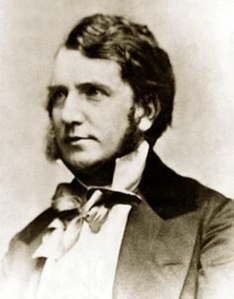
Death of Henry Joy McCracken, Founding Member of the United Irishmen

Henry Joy McCracken, Irish Republican, industrialist and a founding member of the Society of United Irishmen, is hanged from gallows erected in front of the Market House on Belfast‘s High Street on July 17, 1798, on land his grandfather had donated to the city.

McCracken is born in Belfast on August 31, 1767, into two of the city’s most prominent Presbyterian industrial families. He is the son of a shipowner, Captain John McCracken and Ann Joy, daughter of Francis Joy, of French Huguenot descent. The Joy family makes their money in linen manufacture and founds the News Letter. He is the older brother of political activist and social reformer Mary Ann McCracken, with whom he shares an interest in Irish traditional culture.

In 1792, McCracken helps organise the Belfast Harp Festival which gathers aged harpists from around Ireland and helps preserve the Irish airs by having them transcribed by Edward Bunting. Bunting, who lodges in the McCracken’s Rosemary Lane home, is a classically trained musician.

McCracken becomes interested in republican politics from an early age and along with other Protestants forms the Society of United Irishmen in 1795 which quickly makes him a target of the authorities. He regularly travels throughout the country using his business as a cover for organising other United Irish societies but is arrested in October 1796 and imprisoned in Kilmainham Gaol in Dublin. While imprisoned with other leaders of the United Irishmen, he falls seriously ill and is released on bail in December 1797.

Following the outbreak of the Irish Rebellion of 1798 in Leinster in May 1798, the County Antrim organisation meets on June 3 to decide on their response. The meeting ends inconclusively with a vote to wait for French aid being passed by a narrow margin. A new meeting of delegates is held in Templepatrick on June 5 where McCracken is elected general for Antrim, and he quickly begins planning military operations.

McCracken formulates a plan for all small towns in Antrim to be seized after which rebels will converge upon Antrim town on June 7 where the county’s magistrates are to hold a crisis meeting. Although the plan meets initial success and McCracken leads the rebels in the attack on Antrim, the Catholic Defenders group whom he expects assistance from are conspicuous by their absence. The mainly Ulster Scots rebels led by McCracken are defeated by the English forces and his army melts away.

Although McCracken initially escapes with James Hope, James Orr, and James Dickey and is supported in his month-long period of hiding by his sister Mary Ann, a chance encounter with men who recognize him from his cotton business leads to his arrest. He is offered clemency if he testifies against other United Irishmen leaders, but he refuses to turn on his compatriots.

McCracken is court martialed and hanged at Corn Market, Belfast, on land his grandfather had donated to the city, on July 17, 1798. According to historian Guy Beiner, his corpse is spared the indignity of decapitation in order not to provoke renewed agitation. He is buried in the Parish Church of St. George in Belfast, but a few years later the grave is demolished.

McCracken’s remains are believed to have been re-interred by Francis Joseph Bigger in 1909 at Clifton Street Cemetery, Belfast, alongside his sister Mary Ann. His illegitimate daughter Maria, whose mother is speculated to have been Mary Bodell, is raised by her aunt Mary Ann McCracken.


Leave a comment

King William III, William of Orange, Arrives in Belfast

William of Orange, King of Holland, and recently declared King William III of England, arrives with his fleet in Belfast on June 14, 1690. He remains for twelve days, departing on June 26. For his part he likes what he sees. “This country is worth fighting for,” he says.

William’s departure from London is held up by parliamentary business until the end of May, when he announces that he can wait no longer and adjourns Parliament. He sets out early in the morning of June 4, reaching Northampton before nightfall. On Sunday, June 8, he attends divine service in Chester Cathedral and goes on to inspect the ships at Hoylake on the tip of the Wirral Peninsula.

For two days the wind is contrary, but on June 11 he embarks on board the yacht “Mary” with a fleet escorted by Sir Cloudesley Shovell‘s squadron. On June 14 the hills of Ireland come in sight and in the afternoon the fleet casts anchor off Carrickfergus. He is rowed ashore in the Rear Admiral’s barge and at about 3:30 p.m. lands at the Old Quay under the shadow of the great Norman Castle.

The Garrison of the Castle has drawn up a Guard of Honour and the townspeople add their applause. The chosen spokesman is a Quaker, whose principles forbid him to doff his hat or use such titles as Sir and Majesty. He gets around the difficulty by taking off his hat and laying it on a stone and then stepping forward and saying “William, thou art welcome to thy Kingdom” which pleases the King so much that he replies, “You are the best-bred gentleman I have met since I came to England.” With these words he mounts his horse and sets off for Belfast.

Halfway along the shore is the little port of Whitehouse, where most of the army disembarks. The Commander-in-Chief, Frederick Schomberg, 1st Duke of Schomberg, and his senior commanders are waiting here to welcome the King. To cover the disembarkation, earthworks have been thrown up by the engineers at Fort William and garrisoned by troops ready for action.

In 1690 Belfast consists of about 300 houses in five streets. It has two churches, the Parish Church, where St. George’s Church still stands in the High Street, and the Presbyterian Meeting House in Rosemary Lane. The town had been surrounded by a rampart in 1642 and had been captured by Colonel Robert Venebles for Oliver Cromwell after a four-day siege and an assault on the North Gate in 1649.

It is at the North Gate that King William enters Belfast where North Street now crosses Royal Avenue. Here he is welcomed by the magistrates and burgesses in their robes and by the Rev. George Walker, now Bishop-elect of Derry. A Royal Salute is fired from the Castle and is echoed and re-echoed by the guns which Schomberg had placed at wide intervals for the purpose of conveying signals from post to post. Wherever it is heard it is known that King William has come. Before midnight all the heights of Antrim and Down are blazing with bonfires.

The next day being Sunday, William attends church at the Corporation Church, now St. George’s Church. On Monday, June 16, addresses of loyalty are presented on behalf of the Church of Ireland and Presbyterian Church clergy, the civic authorities of the city of Londonderry, the town of Belfast and by the Sheriffs, Justices of the Peace and Gentlemen of the Counties of Down and Antrim. The next two days are spent in military preparation.

In the previous season Schomberg had conducted a slow and cautious campaign but William says he has not come to Ireland to let the grass grow under his feet. He orders a general muster of the army in the Parish of Aghaderg which includes Scarvagh and on Thursday, June 19, begins his southward march from Belfast Castle.

The line of march continues along Upper Malone by the Old Coach Road and past the ruins of both Drumbeg and Lambeg Parish Churches which had been burned down in 1641. William reaches Schomberg’s headquarters in Lisburn Castle for lunch on the same day that he left Belfast Castle. The afternoon and evening are spent inspecting troops on Blaris Moor, and then on to Hillsborough Castle for the night.

The cavalcade moves on through the little round hills of County Down, crosses the Upper Bann between Huntly and Ballievey by ford over the hill of Banbridge and on to the rendezvous on the northwest of Loughbrickland.

After the disappointments of the previous season and the appalling loss of life through disease, Schomberg had dispersed his army into winter quarters all over Ulster. The Derry and Enniskillen men had gone home to pick up the threads of their lives. Now the farmers among them have the crop in and are recalled to the colours and ready to be reviewed. There are four regiments of Enniskillen men – Wynns, Tiffins, Lloyds and Cunninghams, one of foot and three of horse. There is only one regiment of Derry men, St. John’s, commanded by Mitchelburne with Rev. George Walker as chaplain.

On June 22, William sits in the saddle for hours reviewing his 36,000 men. Marching past are 10,000 Danes, some of whom came from Norway and Sweden, and even Finland, 7,000 Dutch and Brandenburgers, 2,000 French Huguenots, 11,000 English and Scots, 800 Derrymen, 4,500 Inniskilleners and two companies from Bandon, County Cork.

On June 24, an advance party reaches beyond Newry to the edge of Dundalk and brings intelligence that the deposed King James II has fallen back on Ardee. The following day the main army advances to Newry and camps on the side of a hill. On June 25, with the King at their head, wearing an Orange colour sash, they go through the Moyry Gap and pass out of Ulster en route to the Boyne.

(From: “History of Orangeism: King William in Ulster,” Museum of Orange Heritage, http://www.orangeheritage.co.uk)


Leave a comment

Birth of Mary Ann McCracken, Humanitarian & Social Reformer

Mary Ann McCracken, Irish businesswoman, radical humanitarian, supporter of the Society of United Irishmen and a noted social reformer, is born in Belfast on July 8, 1770.

McCracken’s father is Captain John McCracken, a Presbyterian of Scottish descent and a prominent shipowner. Her mother, Ann Joy, comes from a French Protestant Huguenot family, which made its money in the linen trade and founded the Belfast News Letter. Her liberal and far-sighted parents send her to David Manson‘s progressive co-educational school, where ‘young ladies’ received the same education as the boys. She excels at mathematics.

As an adult, McCracken manages a successful muslin business in Belfast, which pioneers the production of patterned and checked muslin. She runs the business together with her sister and has at least one agent in Dublin.

McCracken is the sister of Henry Joy McCracken, one of the founding members of the Society of United Irishmen. In the aftermath of her brother’s defeat at the Battle of Antrim on June 7, 1798, she helps Henry Joy and some colleagues hide in the hills of south Antrim, bringing them clothes and money. She is arranging for a ship to take him to the United States when he is recognised by three Carrickfergus soldiers and arrested there on July 7, 1798.

McCracken shares her brother’s interest in reviving the oral-music tradition of Ireland and is a founding member of the Belfast Harp Society (1808–1813). She supports Edward Bunting in his collecting of traditional music, introducing him to people who can help, acting as his unofficial secretary and contributes anonymously to the second volume of his work The Ancient Music of Ireland in 1809. Bunting lives with the McCrackens for thirty-five years, before moving to Dublin 1819 and thereafter corresponds regularly with McCracken.

McCracken, like her brother, holds radical beliefs and these extend not just to the politics of the time, but to many social issues, such as poverty and slavery. She is dedicated to the poor of Belfast and from her earliest childhood she works to raise funds and provide clothes for the children of the Belfast Poorhouse, now known as Clifton House, Belfast. Following a visit from Elizabeth Fry she forms the Ladies Committee of the Belfast Charitable Society and is chair from 1832–1855. Thanks to the efforts of the committee a school, and later a nursery, is set up to educate the orphans of Belfast. She takes particular pains to find a suitable teacher, displaying a high level of dedication and compassion for her cause. The committee also inspects the homes where children of the poorhouse are apprenticed out.

McCracken leads the Women’s Abolitionary Ccmmittee in Belfast during the height of the anti-slavery movement and continues to promote the cause long after the spirit of radicalism had died in Belfast. By the 1850s, the liberality of the 1790s had largely evaporated in the aftermath of the failure of the Irish Rebellion of 1798, and the subsequent executions or exile of the leading protagonists.

At the age of 88, McCracken is to be seen at the Belfast docks, handing out anti-slavery leaflets to those boarding ships bound for the United States, where slavery is still practised. Her continued campaign long after the deaths of her counterparts serves to demonstrate the strength of radicalism that exists in certain circles of Belfast society at the close of the eighteenth century.

After her brother’s execution in Belfast, McCracken takes over the care of his illegitimate daughter, Maria, which is not universally accepted in her wider family. She lives with Maria and her family until her death at the age of 96 on July 26, 1866. She is buried in grave number 35 at Clifton Street Cemetery.

A blue plaque has been placed by the Ulster History Circle on the house at 62 Donegall Pass, Belfast, where McCracken lived for much of her later life.


Leave a comment

Birth of Joseph Thomas Sheridan Le Fanu, Journalist & Novelist

joseph-sheridan-le-fanu

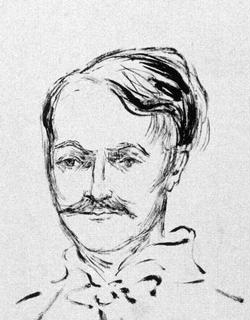
Joseph Thomas Sheridan Le Fanu, journalist, novelist, and short story writer, often called the father of the modern ghost story, is born in Dublin on August 28, 1814. He is the leading ghost story writer of the nineteenth century and is central to the development of the genre in the Victorian era. His best-known works include Uncle Silas (1864), a suspense story, and The House by the Churchyard (1863), a murder mystery. His vampire story Carmilla, which influences Bram Stoker’s Dracula, has been filmed several times.

Le Fanu is born at 45 Lower Dominick Street in Dublin to Thomas Philip Le Fanu and Emma Lucretia Dobbin, a literary family of Huguenot, Irish, and English descent. Within a year of his birth the family moves to the Royal Hibernian Military School in Phoenix Park where his father, a Church of Ireland clergyman, is appointed to the chaplaincy of the establishment.

In 1826, the family moves to Abington, County Limerick, where Le Fanu’s father takes up his second rectorship. Le Fanu uses his father’s library to educate himself and by the age of fifteen he was writing poetry.

The disorders of the Tithe War (1831–1836) affect the region in 1832 and the following year the family temporarily moves back to Dublin, where Le Fanu works on a government commission. Although Thomas Le Fanu tries to live as though he is well-off, the family is in constant financial difficulty. At his death, Thomas has almost nothing to leave to his sons and the family has to sell his library to pay off some of his debts.

Le Fanu studies law at Trinity College, Dublin, where he is elected Auditor of the College Historical Society. He is called to the bar in 1839 but never practices and soon abandons law for journalism. In 1838 he begins contributing stories to the Dublin University Magazine, including his first ghost story, The Ghost and the Bone-Setter (1838). He becomes owner of several newspapers from 1840, including the Dublin Evening Mail and the Warder.

In 1847, Le Fanu supports John Mitchel and Thomas Francis Meagher in their campaign against the indifference of the government to the Irish Famine. Others involved in the campaign include Samuel Ferguson and Isaac Butt. Butt writes a forty-page analysis of the national disaster for the Dublin University Magazine in 1847. Le Fanu’s support costs him the nomination as Tory Member of Parliament (MP) for County Carlow in 1852.

In 1856 the family moves from Warrington Place to the house of his wife Susanna’s parents at 18 Merrion Square. His personal life becomes difficult at this time, as his wife suffers from increasing neurotic symptoms. She suffers from anxiety after the deaths of several close relatives, including her father two years previous. In April 1858, Susanna suffers a “hysterical attack” and dies the following day. She is buried in the Bennett family vault in Mount Jerome Cemetery beside her father and brothers. He does not write any fiction from this point until the death of his mother in 1861.

He becomes the editor and proprietor of the Dublin University Magazine in 1861 and begins to take advantage of double publication, first serializing in the Dublin University Magazine, then revising for the English market. He publishes both The House by the Churchyard and Wylder’s Hand in this manner. After lukewarm reviews of The House by the Churchyard, which is set in the Phoenix Park area of Dublin, Le Fanu signs a contract with Richard Bentley, his London publisher, which specifies that future novels be stories “of an English subject and of modern times,” a step Bentley thinks necessary for Le Fanu to satisfy the English audience. Le Fanu succeeds in this aim in 1864, with the publication of Uncle Silas, which is set in Derbyshire. In his very last short stories, however, Le Fanu returns to Irish folklore as an inspiration and encourages his friend Patrick Kennedy to contribute folklore to the Dublin University Magazine.

Le Fanu dies in his native Dublin on February 7, 1873, at the age of 58. Today there is a road and a park in Ballyfermot, near his childhood home in south-west Dublin, named after him.


Leave a comment

Birth of American Folk Hero Davy Crockett

david-crockett

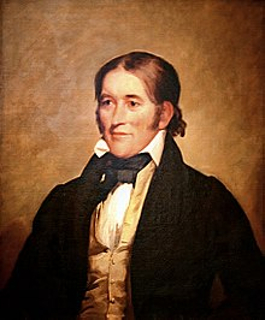
David “Davy” Crockett, 19th-century American folk hero, frontiersman, soldier, and politician, is born in Limestone, Greene County, North Carolina on August 17, 1786. He is commonly referred to in popular culture by the epithet “King of the Wild Frontier.” He represents Tennessee in the U.S. House of Representatives and serves in the Texas Revolution.

The Crockett family is of mostly FrenchHuguenot ancestry, although the family settles in Ireland before migrating to the Americas. Crockett is born in what is now Greene County, Tennessee (at the time part of North Carolina), close to the Nolichucky River and near the community of Limestone. He grows up in East Tennessee, where he gains a reputation for hunting and storytelling.

Crockett is made a colonel in the militia of Lawrence County, Tennessee and is elected to the Tennessee state legislature in 1821. In 1827, he is elected to the United States Congress where he vehemently opposes many of the policies of President Andrew Jackson, especially the Indian Removal Act. His opposition to Jackson’s policies leads to his defeat in the 1831 elections. He is re-elected in 1833, then narrowly loses in 1835, prompting his angry departure shortly thereafter to Texas, then the Mexican state of Tejas.

All that is certain about the fate of Crockett is that he dies fighting in the Battle of the Alamo in the Texas Revolution on the morning of March 6, 1836. According to many accounts, between five and seven Texans surrender during the battle, possibly to General Manuel Fernández Castrillón. General Antonio López de Santa Anna has ordered the Mexicans to take no prisoners, and he is incensed that those orders have been ignored. He demands the immediate execution of the survivors, but Castrillon and several other officers refuse to do so. Staff officers who had not participated in the fighting draw their swords and kill the unarmed Texians.

Crockett becomes famous during his lifetime for larger-than-life exploits popularized by stage plays and almanacs. After his death, he continues to be credited with acts of mythical proportion. In the 20th century these lead to television and movie portrayals, and he becomes one of the best-known American folk heroes.


Leave a comment

Birth of James Henry Cousins, Playwright & Actor

james-h-cousins

James Henry Cousins, Irish writer, playwright, actor, critic, editor, teacher and poet, is born in Belfast on July 22, 1873, a descendant of Huguenot refugees. He uses several pseudonyms including Mac Oisín and the Hindu name Jayaram.

Largely self-educated at night schools, Cousins works some time as a clerk and becomes private secretary and speechwriter to Sir Daniel Dixon, 1st Baronet, the Lord Mayor of Belfast. In 1897 he moves to Dublin where he becomes part of a literary circle which includes William Butler Yeats, George William Russell and James Joyce. It is believed that he serves as a model for the Little Chandler character in Joyce’s short story collection Dubliners.

Cousins is significantly influenced by Russell’s ability to reconcile mysticism with a pragmatic approach to social reforms and by the teachings of Helena Blavatsky. He has a lifelong interest in the paranormal and acts as reporter in several experiments carried out by William Fletcher Barrett, Professor of physics at the University of Dublin and one of the founders of the Society for Psychical Research.

Cousins produces several books of poetry while in Ireland as well as acting in the first production of Cathleen ní Houlihan, under the stage name of H. Sproule, with the famous Irish revolutionary and beauty Maud Gonne in the title role. His plays are produced in the first years of the twentieth century in the Abbey Theatre, the most famous being “the Racing Lug”. After a dispute with W.B. Yeats, who objects to “too much Cousins,” the Irish National Theatre movement splits with two-thirds of the actors and writers siding with Cousins against Yeats.

Cousins also writes widely on the subject of Theosophy and in 1915 travels to India with the voyage fees paid for by Annie Besant, the President of the Theosophical Society. He spends most of the rest of his life in the sub-continent, apart from a year as Professor of English Literature at Keio University in Tokyo and another lecturing in New York. Toward the end of his life, he converts to Hinduism. At the core of Cousins’s engagement with Indian culture is a firm belief in the “shared sensibilities between Celtic and Oriental peoples.”

While in India he becomes friendly with many key Indian personalities including poet Rabindranath Tagore, Indian classical dancer Rukmini Devi Arundale, painter Abdur Rahman Chughtai and Mahatma Gandhi. He is the person who brings change into the life of poetry of the great renowned Kannada poet and writer Kuvempu. He writes a joint autobiography with his wife Margaret Elizabeth Cousins, a suffragette and one of the co-founders of the Irish Women’s Franchise League and All India Women’s Conference (AIWC).

In his The Future Poetry Sri Aurobindo acclaims Cousins’ New Ways in English Literature as “literary criticism, which is of the first order, at once discerning and suggestive, criticism which forces us both to see and think.” He also acknowledges that he learned to intuit deeper being alerted by Cousins’ criticisms of his poems. In 1920 Cousins comes to Pondicherry to meet the Mother and Sri Aurobindo.

James Cousins dies on February 20, 1956, in Madanapalle, Andhra Pradesh, India at the age of 82.


Leave a comment

Birth of John Brougham, Actor & Dramatist

john-brougham

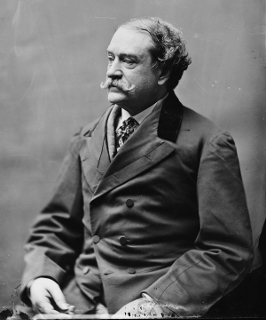
John Brougham, Irish American actor and dramatist, is born in Dublin on May 9, 1814.

Brougham’s father is an amateur painter and dies young. His mother is the daughter of a Huguenot, whom political adversity has forced into exile. He is the eldest of three children. Both of his siblings die in youth, and the father being dead, and the widowed mother left penniless, he is reared in the family and home of an uncle.

Brougham is prepared for college at an academy at Trim, County Meath, twenty miles from Dublin, and subsequently is sent to the University of Dublin. There he acquires classical learning and forms interesting and useful associations and acquaintances. He also becomes interested in private theatricals. He falls in with a crowd that puts on their own shows, cast by drawing parts out of a hat. Though he most always trades off larger roles so he can pay attention to his studies, he takes quite an interest in acting. He is a frequent attendant, moreover, at the Theatre Royal in Hawkins Street.

Brougham is educated with the intention of his becoming a surgeon and walks the Peth Street Hospital for eight months. However, misfortune comes upon his uncle, so he is obliged to provide for himself. Before leaving the university he, by chance, becomes acquainted with the actress Lucia Elizabeth Vestris.

Brougham goes to London in 1830 and, after a brief experience of poverty, suddenly determines to become an actor. He is destitute of everything except fine apparel, and he has actually taken the extreme step of offering himself as a cadet in the service of the East India Company. But, being dissuaded by the enrolling officer, who lends him a guinea and advises him to seek other employment, and happening to meet with a festive acquaintance, he seeks recreation at the Tottenham Theatre where Madame Vestris is acting.

Brougham’s acquaintance with Madame Vestris leads to him being engaged at the theatre, and he thus makes his first appearance on the London stage in July in Tom and Jerry, in which he plays six characters. In 1831 he is a member of Madame Vestris’s company and writes his first play, a burlesque. He remains with Madame Vestris as long as she and Charles Mathews retain Covent Garden Theatre, and he collaborates with Dion Boucicault in writing London Assurance, the role of Dazzle being one of those with which he becomes associated. His success at small or “low” comic roles such as Dazzle earn him the nickname “Little Johnny Brougham,” a moniker which he embraces, and which boosts his popularity with working-class audiences.

In 1840 Brougham manages the Lyceum Theatre, for which he writes several light burlesques, but in 1842 he moves to the United States, where he becomes a member of William Evans Burton‘s company, for which he writes several comedies, including Met-a-mora; or, the Last of the Pollywogs, a parody of John A. Stone and Edwin Forrest’s Metamora; or The Last of the Wamponoags, and Irish Yankee; or, The Birthday of Freedom.

Later Brougham is the manager of Niblo’s Garden, and in 1850 opens Brougham’s Lyceum, which, like his next speculation, the lease of the Bowery Theatre, is not a financial success, despite the popularity of such works as Po-ca-hon-tas; or, The Gentle Savage. He is later connected with James William Wallack‘s and Augustin Daly‘s theatres and writes plays for both.

In 1860 Brougham returns to London, where he adapts or writes several plays, including The Duke’s Motto for Charles Fechter. In November 1864 he appears at the Theatre Royal in his native Dublin in the first performance of Dion Boucicault’s Arrah-na-Pogue with Boucicault, Samuel Johnson and Samuel Anderson Emery in the cast.

After the American Civil War Brougham returns to New York City. Brougham’s Theatre is opened in 1869 with his comedies Better Late than Never and Much Ado About a Merchant of Venice, but this managerial experience is also a failure due to disagreements with his business partner, James Fisk. He then takes to playing the stock market. His last appearance onstage is in 1879 as “O’Reilly, the detective” in Boucicault’s Rescued.

John Brougham dies in Manhattan on June 7, 1880.


3 Comments

Birth of Melesina Trench, Writer, Poet & Diarist

melesina-trench

Melesina Trench (née Chenevix), Irish writer, poet and diarist, is born in Dublin on March 22, 1768. During her lifetime she is known more for her beauty than her writing. It is not until her son, Richard Chenevix Trench, publishes her diaries posthumously in 1861 that her work receives notice.

Melesina Chenevix is born to Philip Chenevix and Mary Elizabeth Gervais. She is orphaned before her fourth birthday and is brought up by her paternal grandfather, Richard Chenevix (1698–1779), the Anglican Bishop of Waterford and Lismore. The family is of Huguenot extraction.

After the death of Richard Chenevix she goes to live with her other grandfather, the Archdeacon Gervais. On October 31, 1786, she marries Colonel Richard St. George, who dies only four years later in Portugal, leaving one son, Charles Manners St. George, who becomes a diplomat.

Between 1799 and 1800, Melesina travels around Europe, especially Germany. It is during these travels that she meets Lord Horatio Nelson, Lady Hamilton and the cream of European society, including Antoine de Rivarol, Lucien Bonaparte, and John Quincy Adams while living in Germany. She later recounts anecdotes of these meetings in her memoirs.

On March 3, 1803, in Paris she marries her second husband, Richard Trench, who is the sixth son of Frederick Trench and brother of Frederick Trench, 1st Baron Ashtown.

After the breakdown of the Peace of Amiens, Richard Trench is detained in France by Napoleon‘s armies, and in August 1805 Melesina takes it upon herself to petition Napoleon in person and pleads for her husband’s release. Her husband is released in 1807, and the couple settles at Elm Lodge in Bursledon, Hampshire, England.

Their son, Francis Chenevix Trench, is born in 1805. In 1807, when they are on holiday in Dublin, their son Richard Chenevix Trench is born. He goes on to be the Archbishop of Dublin, renowned poet and contemporary of Alfred, Lord Tennyson. Her only daughter dies a few years later at the age of four.

Trench corresponds with, amongst others, Mary Leadbeater, with whom she works to improve the lot of the peasantry at her estate at Ballybarney. She dies at the age of 59 in Malvern, Worcestershire on May 27, 1827.

Melesina Trench’s diaries and letters are compiled posthumously by Richard Chenevix Trench as The remains of the late Mrs. Richard Trench in 1861 with an engraving of her taken from a painting by George Romney. Another oil painting, The Evening Star by Sir Thomas Lawrence, has her as a subject, and she is reproduced in portrait miniatures – one in Paris by Jean-Baptiste Isabey and another by Hamilton that is copied by the engraver Francis Engleheart.

Copies of a number of her works are held at Chawton House Library.

(Pictured: “Melesina Chenevix, Mrs. George, later Mrs. Trench,” attributed to George Romney (British, 1734–1802), oil on canvas)


Leave a comment

Birth of Oliver Goldsmith, Novelist, Playwright & Poet

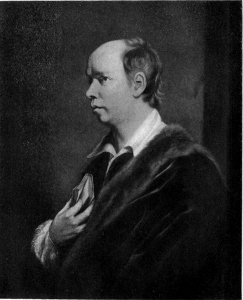
Oliver Goldsmith, novelist, playwright and poet, is born on November 10, 1728. He is best known for his novel The Vicar of Wakefield (1766), his pastoral poem The Deserted Village (1770), and his plays The Good-Natur’d Man (1768) and She Stoops to Conquer (1771, first performed in 1773). He is thought to have written the classic children’s tale The History of Little Goody Two-Shoes (1765).

The location of Goldsmith’s birth is uncertain. He is born either in the townland of Pallas, near Ballymahon, County Longford, where his father is the Anglican curate of the parish of Forgney, or at the residence of his maternal grandparents, at the Smith Hill house near Elphin, County Roscommon. When Goldsmith is two years old, his father is appointed the rector of the parish of Kilkenny West in County Westmeath. The family moves to the parsonage at Lissoy, between Athlone and Ballymahon, and continues to live there until his father’s death in 1747.

In 1744 Goldsmith enters Trinity College, Dublin. Neglecting his studies in theology and law, he falls to the bottom of his class. In 1747, along with four other undergraduates, he is expelled for a riot in which they attempt to storm the Marshalsea Prison. He graduates in 1749 as a Bachelor of Arts, but without the discipline or distinction necessary to gain entry into a profession in the church or the law. He lives for a short time with his mother, tries various professions without success, studies medicine desultorily at the University of Edinburgh from 1752 to 1755, and sets out on a walking tour of Flanders, France, Switzerland and Northern Italy, living by his wits.

Goldsmith settles in London in 1756, where he briefly holds various jobs, including an apothecary‘s assistant and an usher of a school. Perennially in debt and addicted to gambling, Goldsmith produces a massive output as a hack writer on Grub Street for the publishers of London, but his few painstaking works earn him the company of Samuel Johnson, with whom he is a founding member of “The Club.” There, through fellow Club member Edmund Burke, he makes the acquaintance of Sir George Savile, who later arranges a job for him at Thornhill Grammar School. During this period, he uses the pseudonym “James Willington” to publish his 1758 translation of the autobiography of the Huguenot Jean Marteilhe.

In character Goldsmith has a lively sense of fun, is totally guileless, and never happier than when in the light-hearted company of children. The money that he sporadically earns is often frittered away or happily given away to the next good cause that presents itself so that any financial security tends to be fleeting and short-lived. His talents are unreservedly recognised by Samuel Johnson whose patronage aids his eventual recognition in the literary world and the world of drama.

Goldsmith is described by contemporaries as prone to envy, a congenial but impetuous and disorganised personality who once planned to emigrate to America but failed because he missed his ship. At some point around this time he works at Thornhill Grammar School, later basing the character Squire Thornhill in The Vicar of Wakefield on his benefactor Sir George Savile and certainly spending time with eminent scientist Rev. John Mitchell, whom he probably knows from London. Mitchell sorely misses good company, which Goldsmith naturally provides in spades.

Oliver Goldsmith’s premature death in 1774 may have been partly due to his own misdiagnosis of his kidney infection. He is buried in Temple Church in London. There is a monument to him in the centre of Ballymahon, also in Westminster Abbey with an epitaph written by Samuel Johnson.


Leave a comment

Death of Oliver Goldsmith, Novelist, Playwright & Poet

Oliver Goldsmith, Irish novelist, playwright, and poet best known for his novel The Vicar of Wakefield (1766), his pastoral poem The Deserted Village (1770), and his plays The Good-Natur’d Man (1768) and She Stoops to Conquer (1771, first performed in 1773), dies in London on April 4, 1774. He is thought to have written the classic children’s tale The History of Little Goody Two-Shoes (1765).

Goldsmith’s birth date and location are not known with certainty, although he reportedly tells a biographer that he was born on November 10, 1728. The location of his birthplace is either in the townland of Pallas, near BallymahonCounty Longford, where his father is the Anglican curate of the parish of Forgney, or at the residence of his maternal grandparents, at the Smith Hill House near Elphin, County Roscommon, where his grandfather Oliver Jones is a clergyman and master of the Elphin diocesan school, which is where Goldsmith studies. When Goldsmith is two years old, his father is appointed the rector of the parish of “Kilkenny West” in County Westmeath. The family moves to the parsonage at Lissoy, between Athlone and Ballymahon, and continues to live there until his father’s death in 1747.

In 1744 Goldsmith enters Trinity College, Dublin. His tutor is Theaker Wilder. Neglecting his studies in theology and law, he falls to the bottom of his class. In 1747, along with four other undergraduates, he is expelled for a riot in which they attempt to storm the Marshalsea Prison. He is graduated in 1749 as a Bachelor of Arts, but without the discipline or distinction that might have gained him entry to a profession in the church or the law. His education seems to have given him mainly a taste for fine clothes, playing cards, singing Irish airs, and playing the flute. He lives for a short time with his mother, tries various professions without success, studies medicine desultorily at the University of Edinburgh from 1752 to 1755, and sets out on a walking tour of FlandersFranceSwitzerland, and Northern Italy.

Goldsmith settles in London in 1756, where he briefly holds various jobs, including an apothecary‘s assistant and an usher of a school. Perennially in debt and addicted to gambling, Goldsmith produces a massive output as a hack writer for the publishers of London, but his few painstaking works earn him the company of Samuel Johnson, with whom he is a founding member of “The Club.” There, through fellow Club member Edmund Burke, he makes the acquaintance of Sir George Savile, who later arranges a job for him at Thornhill Grammar School. The combination of his literary work and his dissolute lifestyle leads Horace Walpole to give him the epithet “inspired idiot.” During this period, he uses the pseudonym “James Willington,” the name of a fellow student at Trinity, to publish his 1758 translation of the autobiography of the Huguenot Jean Marteilhe.

Goldsmith is described by contemporaries as prone to envy, a congenial but impetuous and disorganised personality who once planned to emigrate to America but failed because he missed his ship. At some point around this time he works at Thornhill Grammar School, later basing Squire Thornhill on his benefactor Sir George Savile and certainly spending time with eminent scientist Rev. John Mitchell, whom he probably knows from London. Mitchell sorely misses good company, which Goldsmith naturally provides in spades. Thomas De Quincey writes of him “All the motion of Goldsmith’s nature moved in the direction of the true, the natural, the sweet, the gentle.”

His premature death in 1774 is believed to have been partly due to his own misdiagnosis of a kidney infection. Goldsmith is buried in Temple Church in London. There is a monument to him in the centre of Ballymahon and also in Westminster Abbey with an epitaph written by Samuel Johnson.